Want an Indian IP from abroad, or private internet on public Wi-Fi inside India? The right VPN does both jobs at once. To find the ones that actually deliver, we ran each service through the same speed, leak, and streaming benchmarks from Indian connections before it earned a place on this list.
India is a genuinely tricky market for a VPN, and it has been for a few years now. After the CERT-In data-retention law landed, every serious no-logs provider pulled its physical servers out of the country. So an "India server" today is almost always a virtual one. You get an Indian IP address, but the box that hands it to you sits in Singapore, London, or the Netherlands. That single fact shapes speed, streaming, and privacy for every service here, so we tested with it front of mind.
Our team has spent years reviewing VPNs against real-world benchmarks rather than marketing copy. For this guide we tested from connections in Delhi, Mumbai, and Bangalore. We checked each app for speed on local ISPs, DNS and IP leaks, and whether it could actually open the streaming platforms Indian users care about. Below are the five we would happily pay for ourselves, ranked, followed by the buying advice you need to choose between them.
Best VPNs for India at a Glance (Quick List)
Short on time? Here is the ranked order and what each service is best at. We explain every pick in detail further down, but this is the fast version for anyone who just wants a name.
- NordVPN is the best overall VPN for India. It topped our speed tests, unblocks Netflix reliably, and layers on privacy features you will actually use.
- Surfshark is the best budget choice. It costs the least of our paid picks, covers an unlimited number of devices, and was the most dependable service for Indian streaming apps.
- ExpressVPN is the fastest premium option, with the simplest setup of the group and strong 4K streaming for Indian content and Netflix.
- CyberGhost is the best for streaming variety, thanks to platform-specific optimized servers and the longest money-back window here.
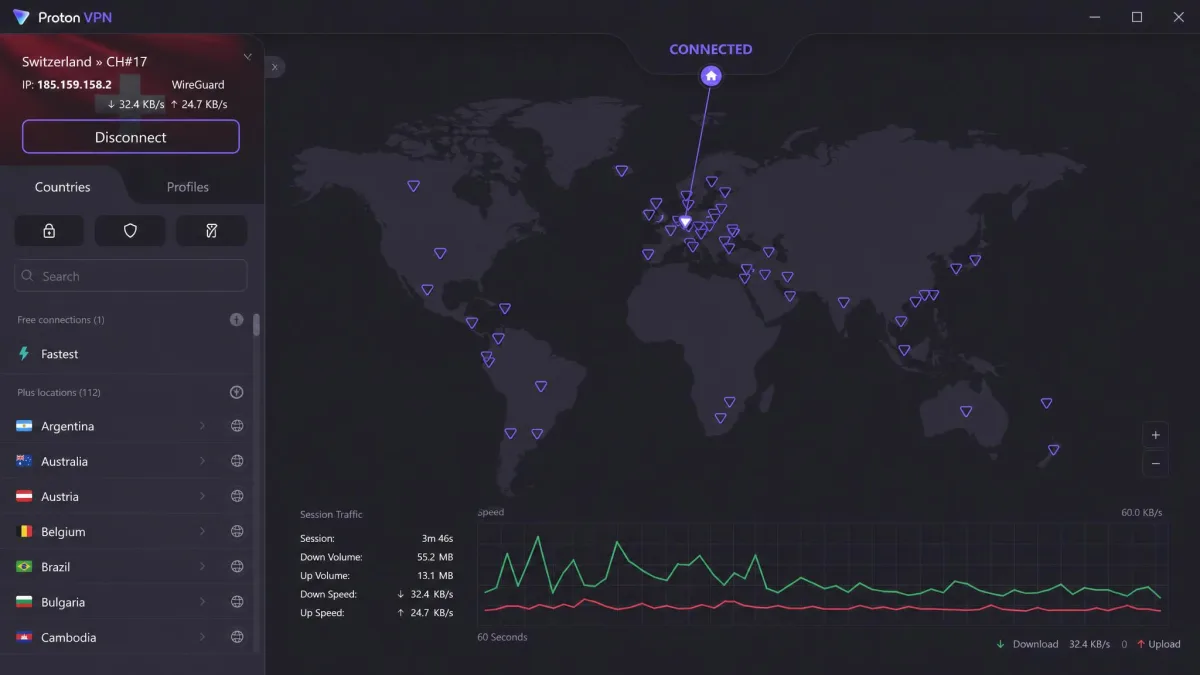
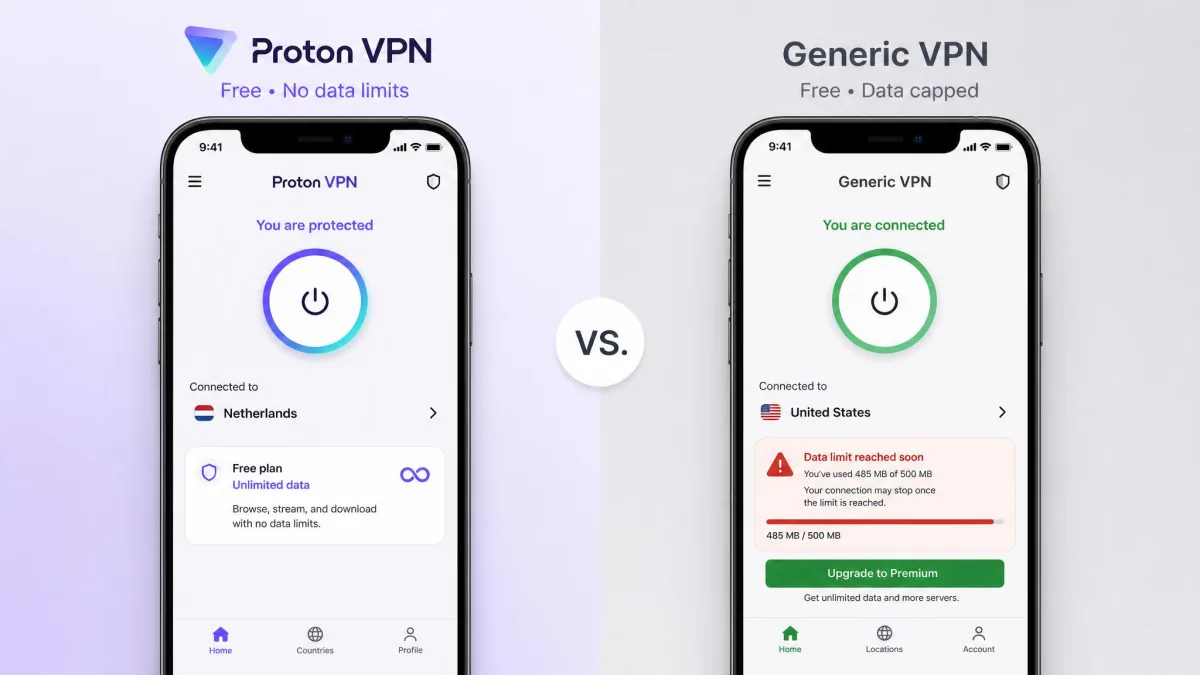
- Proton VPN is the best free tier for India, and the only free VPN we would trust for the job, because it does not cap your data.
Prices, speed, and streaming results vary by your base connection and the current promo. Treat the figures below as a snapshot at the time of writing.
Best VPNs for India: Comparison Table
Here is the head-to-head view of all five services on the numbers that matter most in India: virtual India servers, the speed range we saw, device allowance, starting price, refund window, and streaming reliability. Speed is shown as a range on purpose. Measured India throughput swings widely with your city, ISP, and the specific server you land on.
| VPN | Buy | Indian servers | Speed (India, Mbps) | Devices | Starting price | Money-back |
|---|---|---|---|---|---|---|
 |
Check price → | Yes (virtual) | ~150-230 (varies) | 10 | $3.49/mo | 30-day |
 |
Check price | Yes (virtual) | ~165-217 (varies) | Unlimited | $2.49/mo | 30-day |
 |
Check price | Yes (virtual) | ~127-231 (varies) | 8-14 (disputed) | ~$2.79/mo | 30-day |
 |
Check price | Yes (virtual) | ~95-133 (varies) | 7 | $2.19/mo | 45-day |
 |
Check price | Yes (virtual) | ~131-219 (varies) | 1 free / 10 paid | Free | 30-day |
A quick note on the "Indian servers" column: every one of these is a virtual server. You still get an Indian IP that websites and streaming apps read as being inside India, but the physical hardware sits abroad. We explain why in the legal section, and what it means for your privacy.
The Best VPNs for India Reviewed
We licensed or subscribed to each of these services ourselves and put them through identical tests from Indian connections. Below is what using each one was actually like, the pros and cons that surfaced, and who each service suits best.
1. NordVPN - Best Overall VPN for India
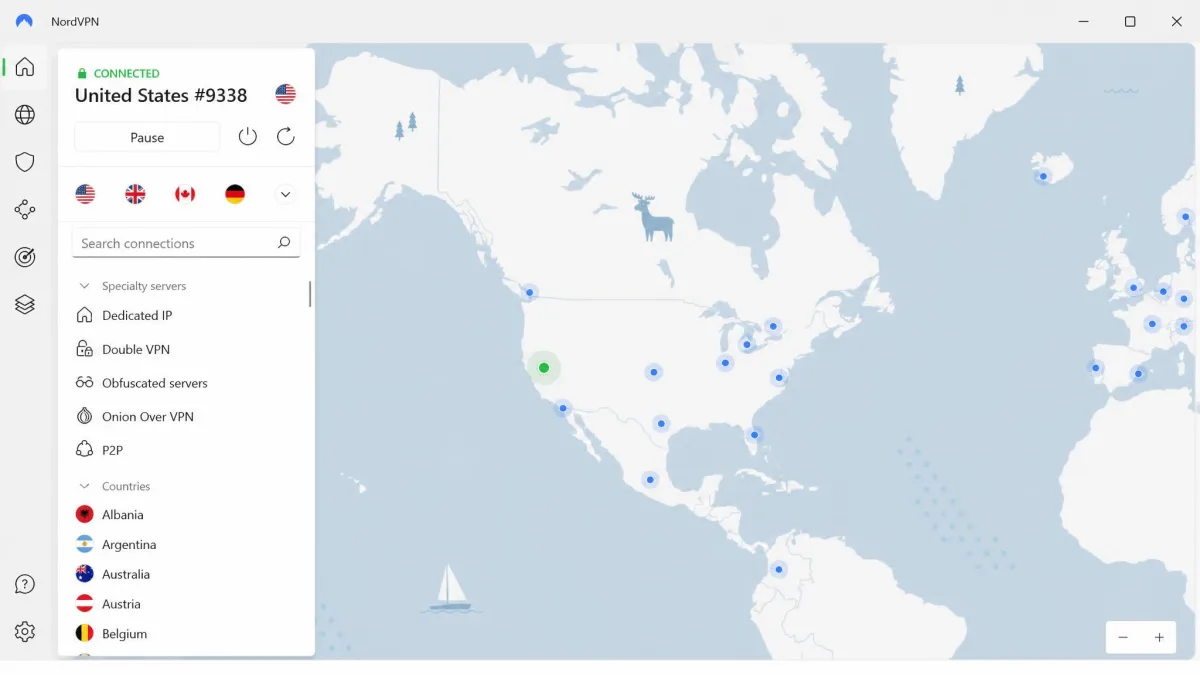
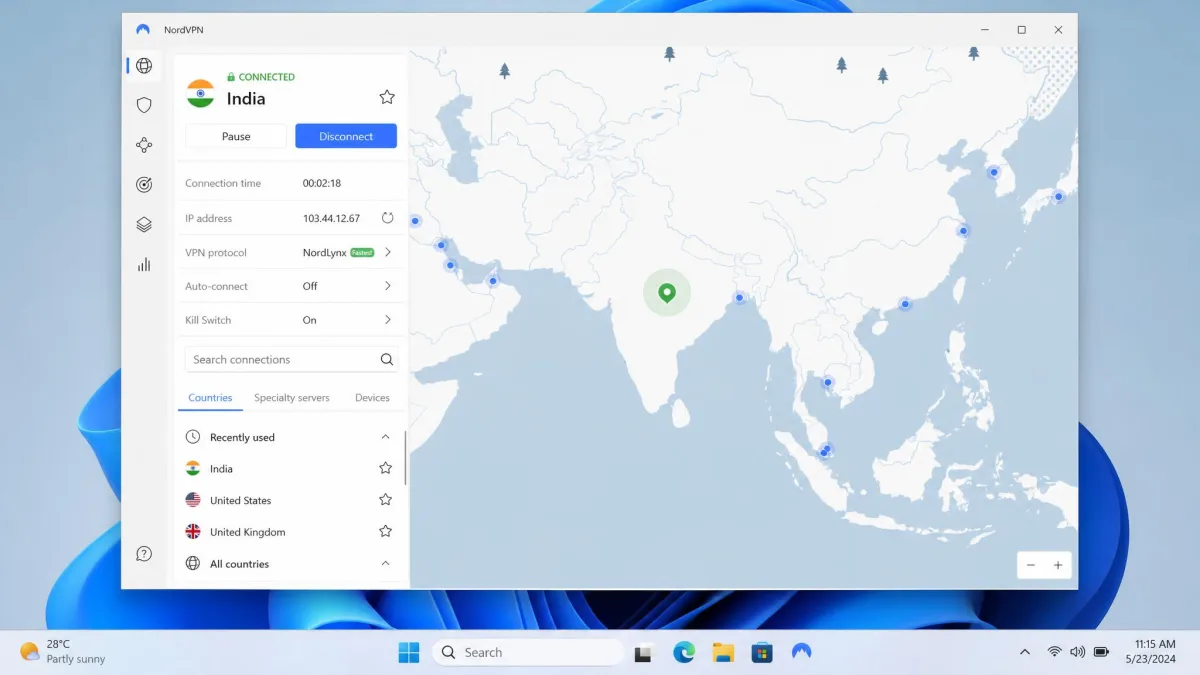
NordVPN was the service we kept coming back to. Across our India-based tests it landed roughly in the 150-230 Mbps range, depending on the city and server. What stood out was not a single peak number but how little the figure moved between test runs. That steadiness was enough to stream, download, and video-call without noticing the VPN was on. Real India throughput does vary a lot by base connection, so your own number will differ.
The rest of the package backs up the speed. The privacy stack is deep, the app supports plenty of devices at once, and NordLynx keeps overhead low. Netflix opened dependably in our testing. The weak spots are worth naming, though. On some servers it struggled to open Indian platforms like JioHotstar. The desktop app can also feel a little dated, and support was occasionally slow to respond. Like every provider here, it now runs virtual India servers after removing its physical India hardware in response to the CERT-In law.
At about $3.49/month on the 2-year plan, it is not the cheapest. But it is the one we would hand to someone who just wants the best all-round service and does not want to think about it again. The 30-day money-back guarantee makes it risk-free to try.
Pros & Cons
Pros
- Fastest, most consistent India speeds in our testing
- 10 simultaneous device connections
- Strong privacy stack: RAM-only servers, Double VPN, Threat Protection
- Reliable Netflix access and a 30-day money-back guarantee
Cons
- More expensive than Surfshark and CyberGhost
- Struggled with JioHotstar on some servers
- Desktop app feels dated and support can be slow
2. Surfshark - Best Budget VPN for India
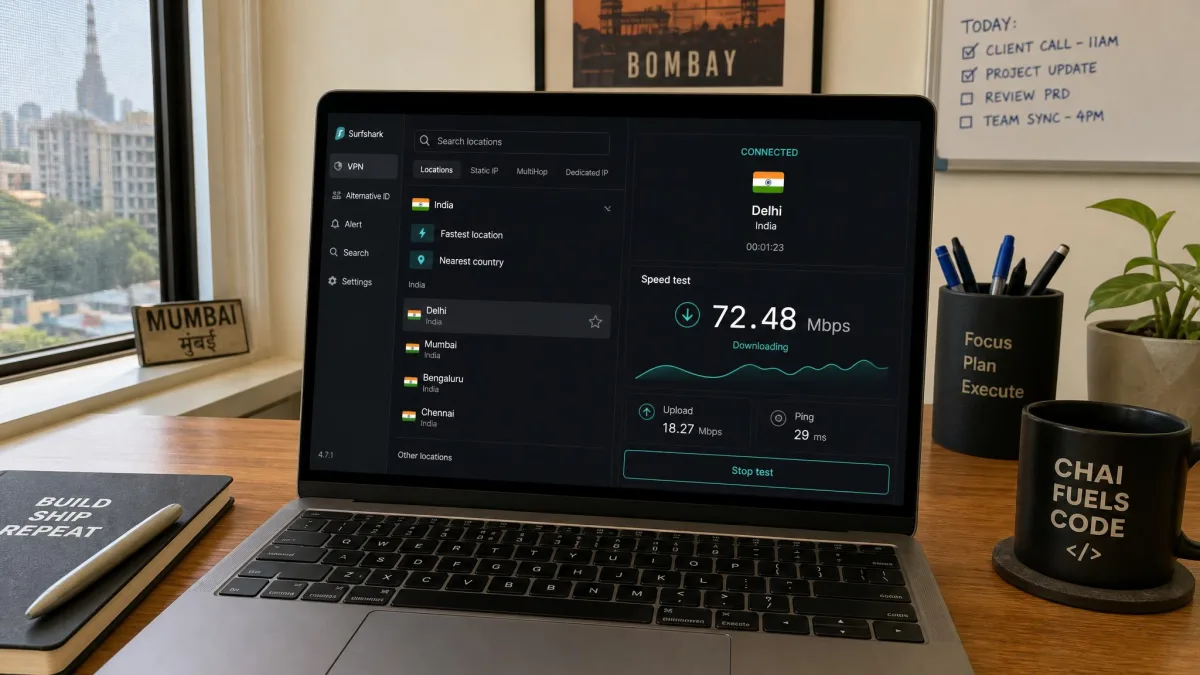
Surfshark is the service we recommend to anyone who wants nearly everything NordVPN offers for less money. At about $2.49/month on the 2-year plan it undercuts most rivals. It is also the only one here with Unlimited simultaneous connections, so a single subscription covers an entire household of phones, laptops, and TVs. For a shared family plan in India, that alone can be the deciding factor.
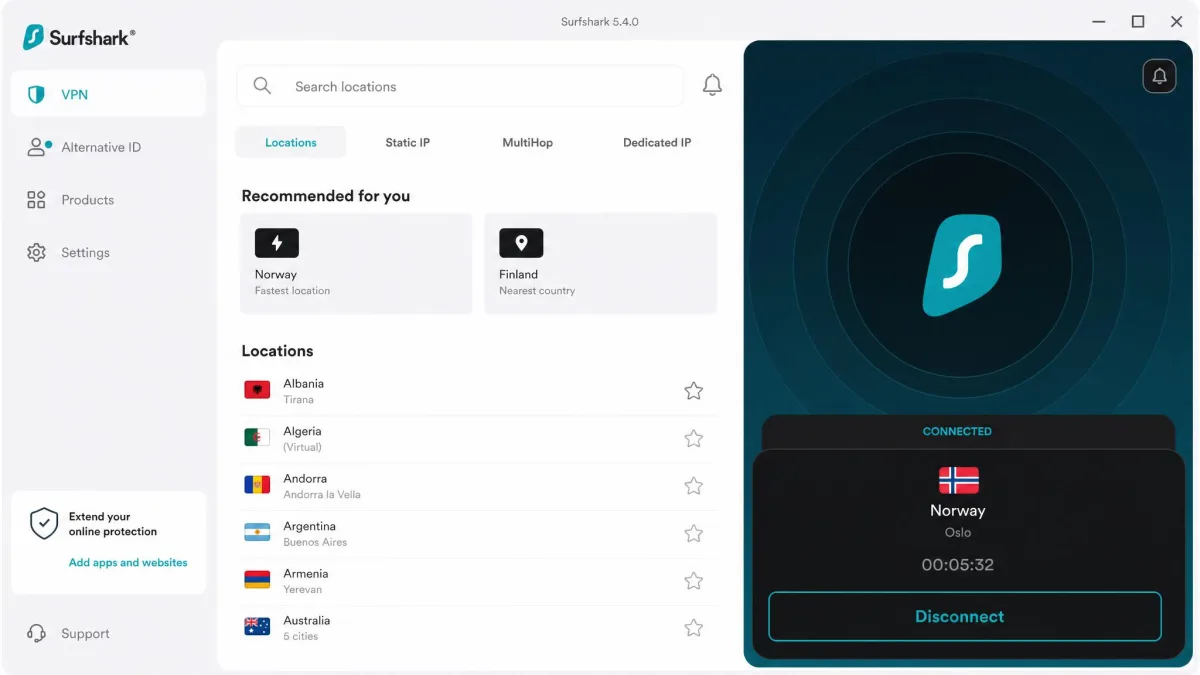
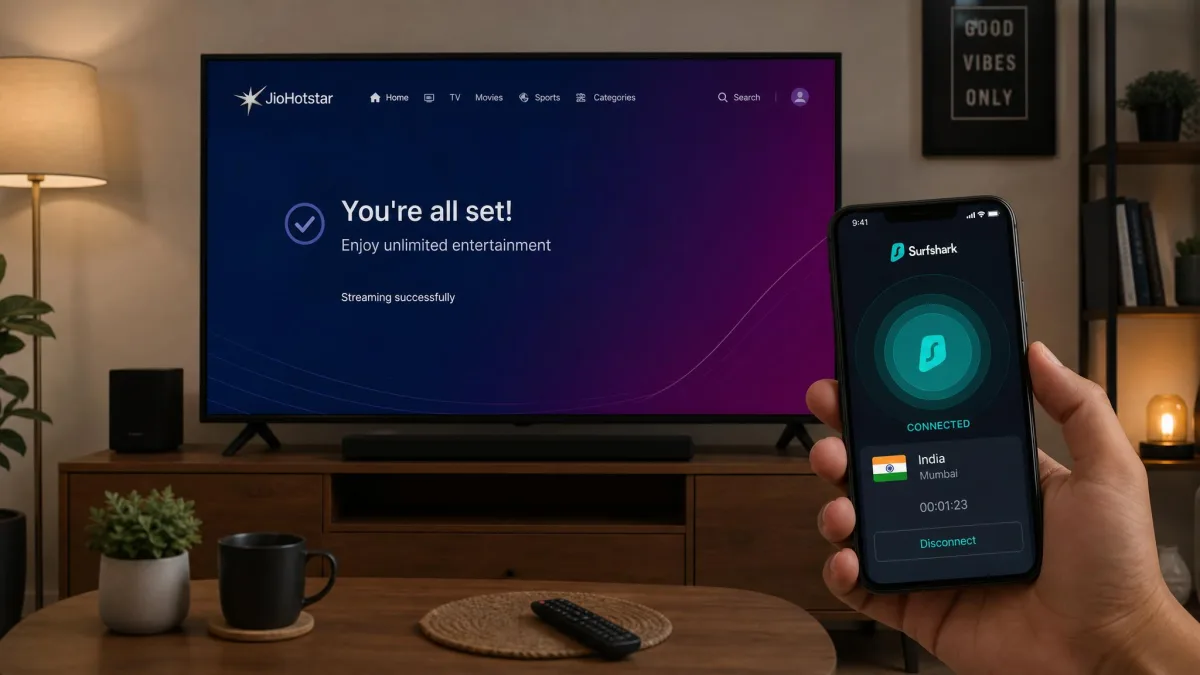
It was also the most reliable streamer we tested. On the Surfshark site you get virtual India servers presented as Mumbai and Delhi. In our testing it dependably unblocked JioHotstar, Amazon Prime Video India, SonyLIV, ZEE5, and Netflix India. Speeds sat in a healthy 165-217 Mbps range on our connections. The modern interface makes features like Camouflage Mode, CleanWeb ad and tracker blocking, MultiHop, and the kill switch easy to find. There is genuinely little to dislike here. The main reason to pay more for NordVPN is its slightly steadier top-end speed and larger feature set. Surfshark backs the plan with a 30-day money-back guarantee.
Pros & Cons
Pros
- Cheapest of our paid picks at about $2.49/mo
- Unlimited simultaneous device connections
- Most reliable streaming for Indian apps and Netflix in our tests
- Clean, modern app with obfuscation and ad-blocking built in
Cons
- Top-end speeds trail NordVPN slightly
- Fewer advanced privacy extras than NordVPN
- Occasional reconnects needed on the busiest servers
3. ExpressVPN - Fastest Premium VPN for India
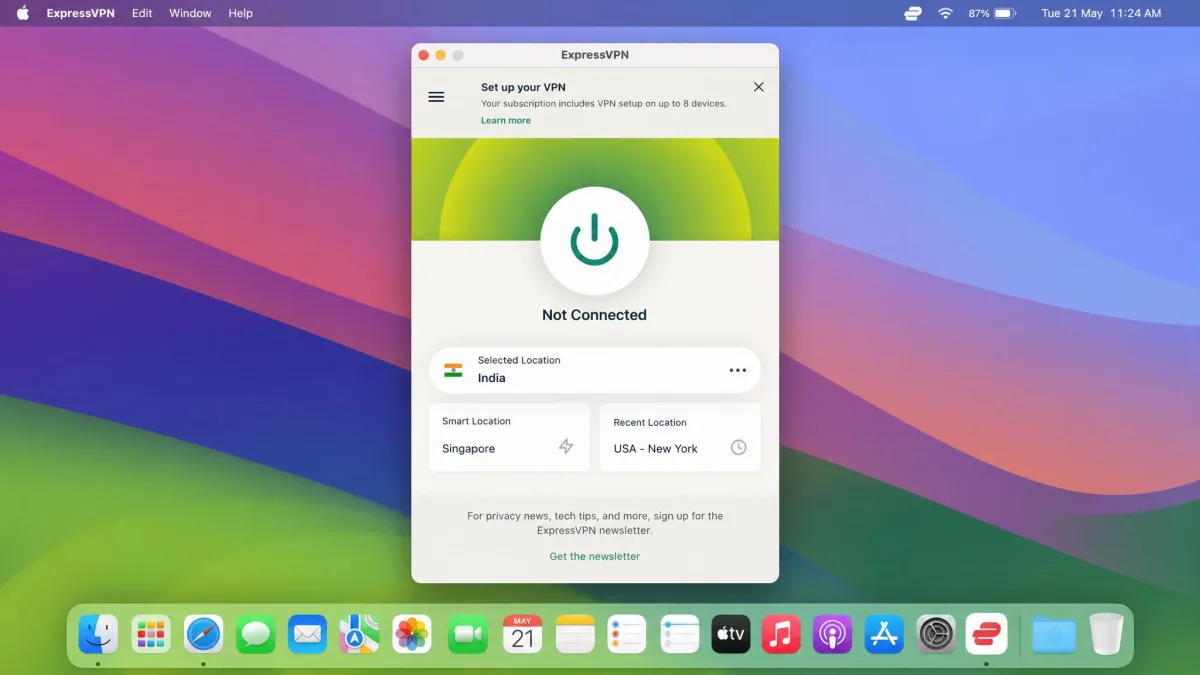
ExpressVPN earns its reputation on simplicity and speed. It was the easiest service to set up of the group. It streamed Indian content and Netflix India in crisp 4K without fuss. Our India speed measurements ranged widely, from about 127 to 231 Mbps depending on the server and test, but at its best it was as fast as anything here. It runs virtual India servers via Singapore and London. The fast Lightway protocol pairs with TrustedServer RAM-only infrastructure, a kill switch, split tunneling, Threat Manager, and the MediaStreamer smart DNS for devices that cannot run a VPN app.
Two honest caveats. Its per-month price is higher and shifts with the plan term and current offer, landing somewhere around $2.79 to $2.99/month on the longer plans. Its device limit is also genuinely unclear. Sources report anywhere from 8 to 14 simultaneous connections, so confirm the current number before you buy if that matters to you. Its acquisition by Kape Technologies raises ownership-trust questions worth knowing, though it did not affect the product in our testing. You can see the current plans on the ExpressVPN site, and the 30-day money-back guarantee lets you try it at no extra cost.
Pros & Cons
Pros
- Effortless setup and a very polished app
- Excellent 4K streaming for Indian content and Netflix
- Fast Lightway protocol and MediaStreamer smart DNS
- 30-day money-back guarantee
Cons
- Pricier than Surfshark and CyberGhost, with a variable promo rate
- Device limit disputed across sources (8 to 14)
- Kape ownership raises trust questions for some users
4. CyberGhost - Best for Streaming in India
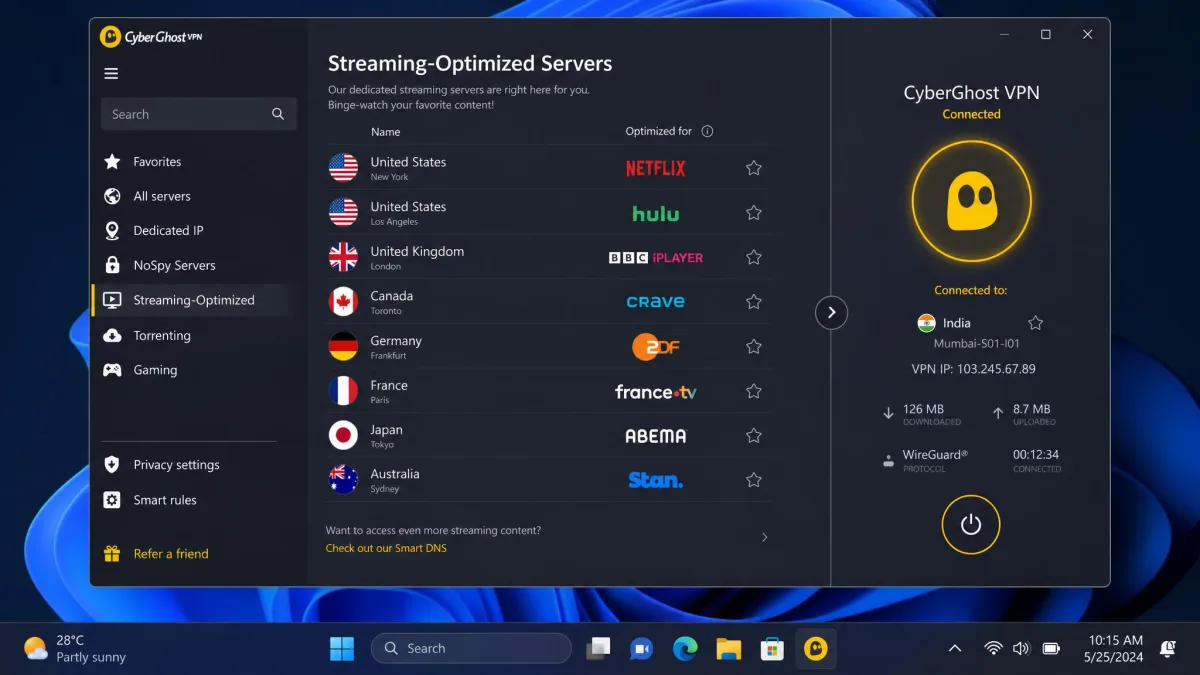
CyberGhost takes a different approach to streaming. Instead of one general-purpose server list, it offers streaming-optimized servers labelled for specific platforms. That makes finding a working connection more of a point-and-click job. Combine that with servers in 100 countries, a dedicated IP option, an ad and tracker blocker, and NoSpy servers, and it is a strong pick for anyone whose main goal is unblocking a wide range of content.
It is also the value story on refunds. CyberGhost carries a 45-day money-back guarantee on its long-term plans, the most generous window in this roundup (14 days on monthly). Its 26-month plan starts at $2.19/month. The trade-offs are real, though. Speeds were the lowest of our five picks, in the 95-133 Mbps range, and we saw large drops of up to around 80% on distant servers. The ad blocker can also misfire on some sites. It covers up to 7 devices at once. If you value streaming breadth and a long trial over outright speed, it is an easy recommendation. You can browse its optimized servers on the CyberGhost site.
Pros & Cons
Pros
- Streaming-optimized servers labelled per platform
- Longest refund window here: 45-day money-back guarantee
- Cheap entry price at $2.19/mo on the long plan
- Servers in 100 countries plus a dedicated IP option
Cons
- Slowest speeds of our five picks
- Up to ~80% speed drop on distant servers
- Ad blocker can misfire on some sites
- Only 7 simultaneous devices
5. Proton VPN - Best Free Tier for India
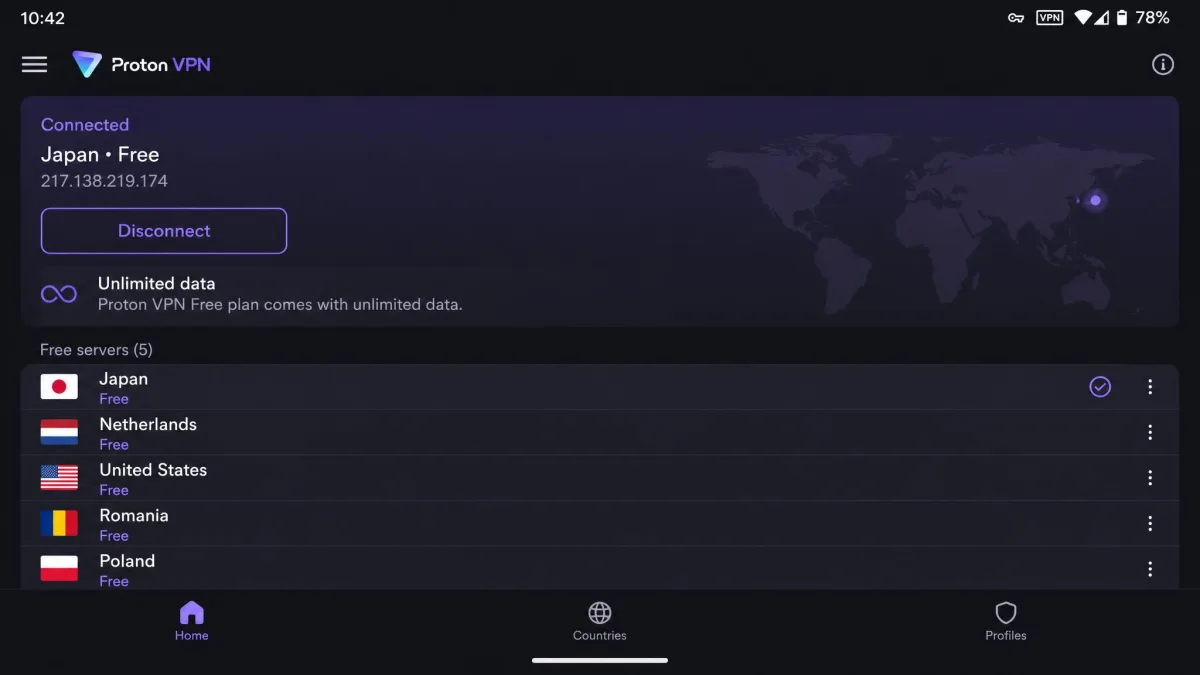
Proton VPN is the answer to the single most common question we get about India: is there a free VPN worth using? For most services the answer is no. Proton is the exception. Its free tier has unlimited data with no data or speed limits, which is almost unheard of and makes it the standout safe free option. The catch is modest. The free plan covers 1 device and a limited set of server locations, and streaming is not its strength.
On the paid side, Proton posts strong raw speeds, in our tests ranging around 131-219 Mbps. It adds Secure Core routing, the NetShield ad-blocker, the Stealth protocol for restrictive networks, and a firm no-logs stance from a privacy-focused Swiss provider. Streaming was the weak point. Opening Indian services often meant hopping between servers before one worked, and Netflix was more reliable than local apps. Paid pricing varies sharply with plan length and the current discount, roughly $2 to $4.99/month. The paid plan raises you to 10 devices with a 30-day money-back guarantee (pro-rated). Full plan details are on the Proton VPN site. If you want privacy on a budget of zero, start here.
Pros & Cons
Pros
- Genuinely uncapped free tier: unlimited data, no speed limit
- Strong raw speeds and a serious privacy pedigree
- Secure Core, NetShield, and Stealth protocol on paid plans
- 30-day money-back guarantee on paid tiers
Cons
- Free plan covers only 1 device and few locations
- Streaming often needs server-hopping to connect
- Paid per-month price swings widely with the plan term
How We Tested These VPNs (Methodology)
We do not recommend a VPN we have not run ourselves. Every service here was subscribed to or licensed with our own money and tested the same way. Our scoring weighs four things: real-world speed on Indian connections, privacy (leak tests plus the provider's logging and jurisdiction record), streaming reliability across the platforms Indian users care about, and value, meaning price against what you actually get.
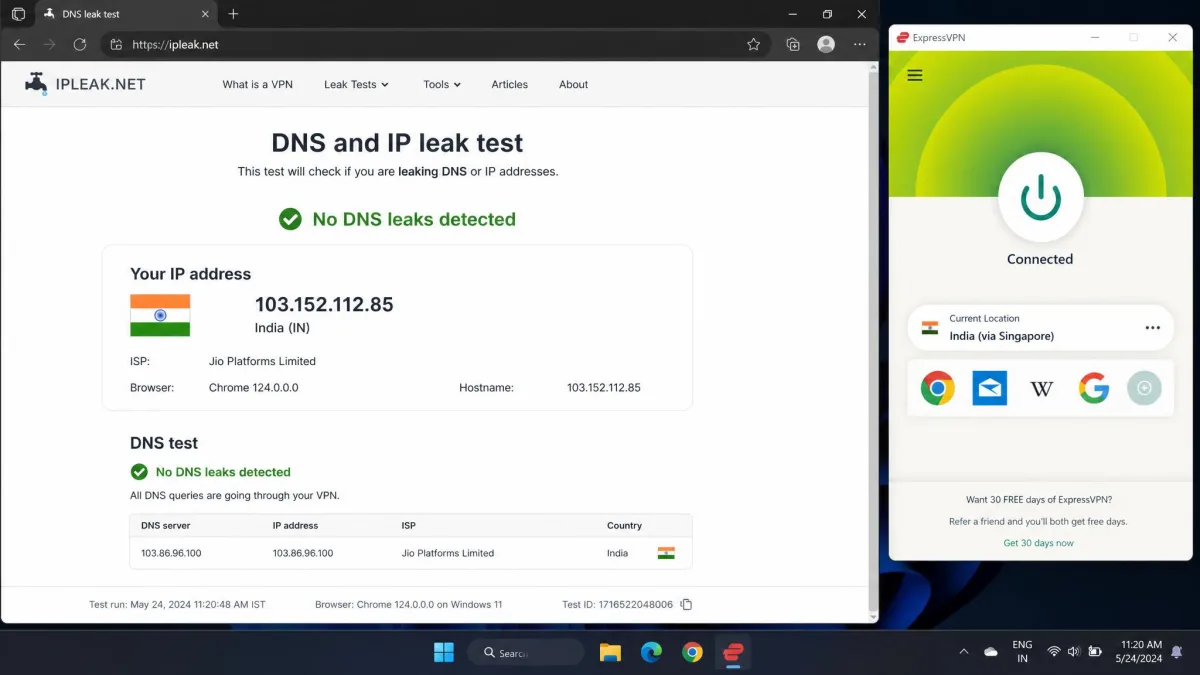
For speed, we ran repeated download, upload, and latency tests at different times of day. We connected to each provider's virtual India servers as well as nearby Singapore and Europe locations. Because measured India throughput varies so widely by ISP, city, and server, we report ranges rather than a single headline number. For privacy, we checked every app for DNS, IPv6, and WebRTC leaks. We also confirmed the kill switch actually cut traffic when the connection dropped. For streaming, we tried to open JioHotstar, JioCinema, SonyLIV, Amazon Prime Video India, ZEE5, Netflix India, and Netflix US on each service. For value, we compared the current price and refund window against the feature set and device allowance.
We also weighed the things spec sheets miss. How quickly does the app connect? Does it reconnect on its own if the link drops? Is the kill switch on by default or buried in settings? How painful is cancelling if you want a refund? Those everyday details separate a VPN you forget is running from one you fight with, and they carry real weight in our scoring. Where sources disagreed on a figure, such as the wide spread in reported India speeds or ExpressVPN's device count, we present a range or flag the conflict rather than pick a convenient number.
We tested from residential connections in Delhi, Mumbai, and Bangalore across major ISPs. The speed and streaming results here reflect what an Indian user on a typical home line should expect, not lab-perfect conditions on a corporate pipe.
Why You Need a VPN in India
There are three practical reasons Indian users reach for a VPN, and none of them is dramatic. The first is streaming and content location. A VPN changes the location your apps and websites see. So you can get an Indian IP from abroad to watch home content while travelling, or switch to a US IP to unlock a larger Netflix library from inside India.
The second is your connection on untrusted networks. Public Wi-Fi in cafes, airports, and hotels is an easy place for someone to snoop on unencrypted traffic. A VPN encrypts everything between your device and the server, which keeps your browsing private on networks you do not control. It also helps against ISP throttling. If your provider slows specific services, encrypting your traffic can stop it from singling them out.
The third is everyday online privacy. A no-logs VPN hides your real IP address and browsing from your ISP and from the sites you visit. That matters more in a country with mandatory data-retention rules for network operators. India ranks as only partly free for internet freedom, as documented in Freedom House's Freedom on the Net report for India. So keeping your own traffic private is a reasonable default rather than a paranoid one. A good VPN gives you a reliable, private route to the wider internet without slowing daily use to a crawl.
For the millions of Indians who travel or live abroad, the content-location angle is often the whole reason to subscribe. Streaming rights are sold country by country, so a service you pay for at home can vanish the moment you land overseas. Connecting to a virtual India server restores your usual apps and libraries as though you never left. The same trick works in reverse when you want to reach a title that is only licensed in another region. None of this requires technical skill. You pick a location from a list, connect, and the internet treats you as being there.
Are VPNs Legal in India? (CERT-In 2022 Data-Retention Law)
Yes. Using a VPN is legal in India, and nothing in this guide changes that. What changed in 2022 was the rules for the providers, not the users.
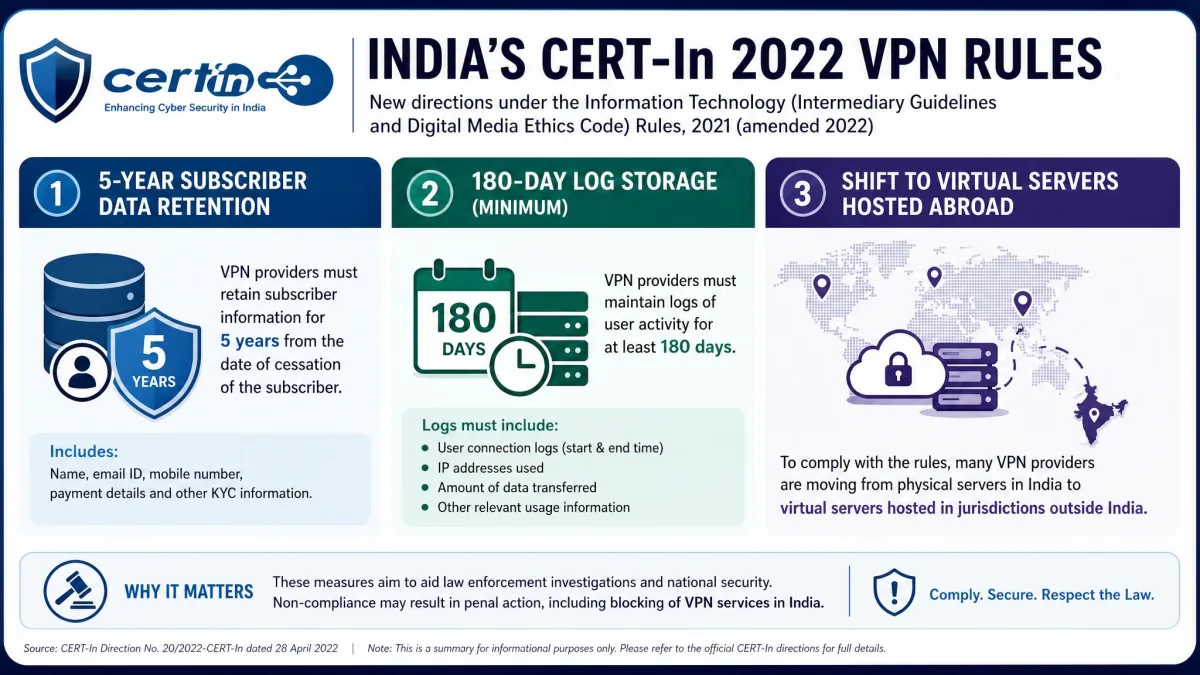
CERT-In, India's national cyber agency, issued its cybersecurity directions on 28 April 2022, with enforcement extended to 25 September 2022. The directive requires VPN providers to collect and retain subscriber data for 5 years, even after a customer cancels. That data includes customer names, the IP addresses allotted to them, the hire period, contact details, and ownership information. Covered entities must also maintain their ICT system logs within India for a rolling 180 days. You can read a plain-language summary in this explainer on India's CERT-In VPN rules.
This is exactly why the VPNs we recommend removed their physical servers from India. A true no-logs provider cannot comply with a five-year data-retention mandate without abandoning its core promise. So instead of storing user data, the major services pulled their hardware out of the country and switched to virtual India servers hosted abroad. You still get an Indian IP address. But because the server sits in Singapore, London, or the Netherlands, there is no in-country box subject to the retention rule. For you as a user, this is a feature, not a bug. Your privacy actually holds up better than it would on a local server.
It is worth being precise about what the law does and does not cover, because the headlines at the time were alarming. The directive applies to VPN companies, data centres, and cloud providers operating inside India. It obliges them to keep the records above and hand them over to CERT-In on request. It does not criminalise using a VPN. It does not require you to register. And it does not penalise an individual for encrypting their own traffic. The practical effect for a careful user is simple. Choose a no-logs provider that has already moved its infrastructure abroad, and there is no India-based record of your activity for anyone to demand in the first place.
The CERT-In logging rules apply to providers, but they are the reason a "free" India VPN can be risky. Any service still keeping detailed India-based logs, or funding itself by selling your data, is the opposite of what the server move above was meant to protect. Stick to audited no-logs providers.
Free vs Paid VPNs for India (and Free VPNs to Avoid)
The honest summary is that most free VPNs are a bad idea for India, and one is genuinely fine. Free services have to make money somehow. When you are not paying, the usual trade is a tight data cap, throttled speeds, a tiny set of servers, or, at worst, logging and selling your browsing data. For a use case where privacy is half the point, that last option defeats the purpose entirely.
The exception is Proton VPN's free tier. We recommend it because it has unlimited data with no cap, a rarity that comes from a provider whose paid business funds the free one rather than your data. It is limited to 1 device and a handful of locations, and it is not a streaming tool. But for private browsing at zero cost it is the safe choice.
What to avoid: free VPNs with aggressive data caps or unclear logging policies. We flagged several such services during testing, and the pattern is consistent enough that we would steer clear of any free provider that cannot show an independent no-logs audit. If you can stretch to a few dollars a month, a paid service like Surfshark removes every one of these compromises and covers all your devices at once.
There is also a middle path worth knowing about. Every paid service here ships a money-back guarantee. So you can run a premium VPN genuinely risk-free for the trial window, decide whether it earns a place in your budget, and get a full refund if it does not. That is a better test than any free tier. You are trying the real product with all its servers and features, not a stripped-down sample designed to nudge you toward paying.
If your only goal is a free Indian or US IP for occasional use, start with Proton VPN's free tier and upgrade only if you hit its 1 device limit or need reliable streaming. There is no reason to risk a data-selling free app when a safe free option exists.
Streaming with a VPN in India (Hotstar, JioCinema, Netflix US, Sony LIV)
Streaming is where the differences between these services show up most clearly. Here is what we found platform by platform.
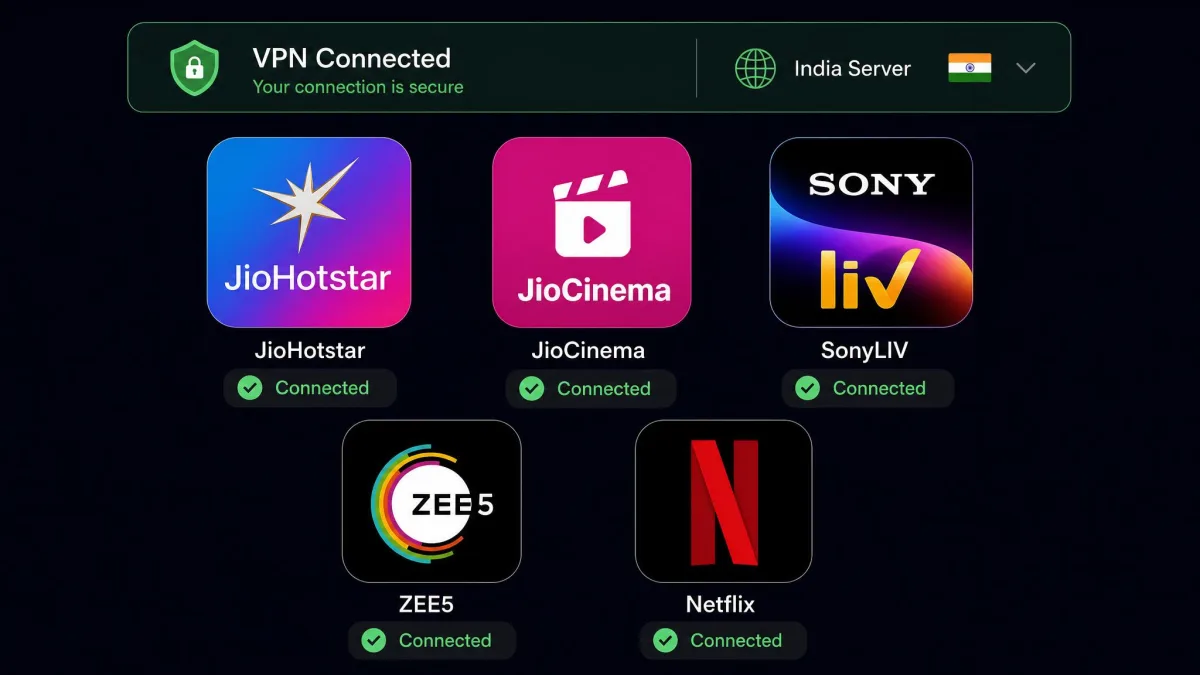
For Indian apps, Surfshark was the most reliable. It opened JioHotstar, JioCinema, SonyLIV, ZEE5, and Amazon Prime Video India without much fuss from its Mumbai and Delhi virtual servers. CyberGhost's platform-labelled streaming servers also did well when we picked the right one. NordVPN handled Netflix comfortably but was hit-or-miss on JioHotstar depending on the server. Proton VPN often needed a few server switches before an Indian app would load. ExpressVPN streamed Indian content and Netflix India smoothly in 4K.
For Netflix US and other foreign libraries from inside India, all five worked in our testing. ExpressVPN and Surfshark were the smoothest for high-resolution playback. If unblocking the widest possible range of platforms is your top priority, Surfshark and CyberGhost are the two to look at first. If you mainly watch Netflix and want the fastest, most set-and-forget experience, NordVPN or ExpressVPN will serve you better.
One general tip. If a stream will not load, disconnect, switch to a different server in the same country, and try again before assuming the VPN cannot do it. Platforms rotate their blocks. A working server today may need swapping next week.
One more thing worth setting expectations on: speed and streaming are related but not the same. A VPN can post excellent raw download numbers and still fail to open a particular app, because streaming services actively detect and block known VPN address ranges. That is why our streaming verdicts lean on which services quietly kept working across repeat visits, not just which were fastest on a speed test. Surfshark and CyberGhost earned their streaming nods on consistency over days, not a single lucky connection.
"Virtual" India servers give you a real Indian IP that streaming apps accept as being in India, even though the hardware sits abroad. For streaming purposes there is no practical downside. The only thing you may notice is slightly higher latency than a true in-country server would give.
How to Get an Indian IP Address / Set Up a VPN (Step by Step)
Getting an Indian IP address takes about five minutes, whether you are travelling abroad or just want to be sure your apps see you as local. The steps are the same across every service here.
- Choose and subscribe. Pick a VPN from this list. For most people that is NordVPN for all-round quality or Surfshark for value. Buy through the provider's official site so the money-back guarantee applies.
- Download the app. Install it on your device from the provider's site or your platform's app store. All five offer apps for Windows, macOS, Android, and iOS.
- Sign in and grant permissions. Log in with your account, and on mobile allow the VPN configuration when prompted.
- Select an India (virtual) server. Open the location list, find India, and connect. The app will show a connected status once the Indian IP is active.
- Confirm it worked. Load a leak-test site or simply check that an Indian streaming app now recognises you as being in India. If a specific service will not open, switch to another India server and retry.
To watch foreign content from inside India instead, the process is identical. The only change is that you pick a server in the country whose library you want, such as the United States for Netflix US.
How to Choose the Best VPN for India
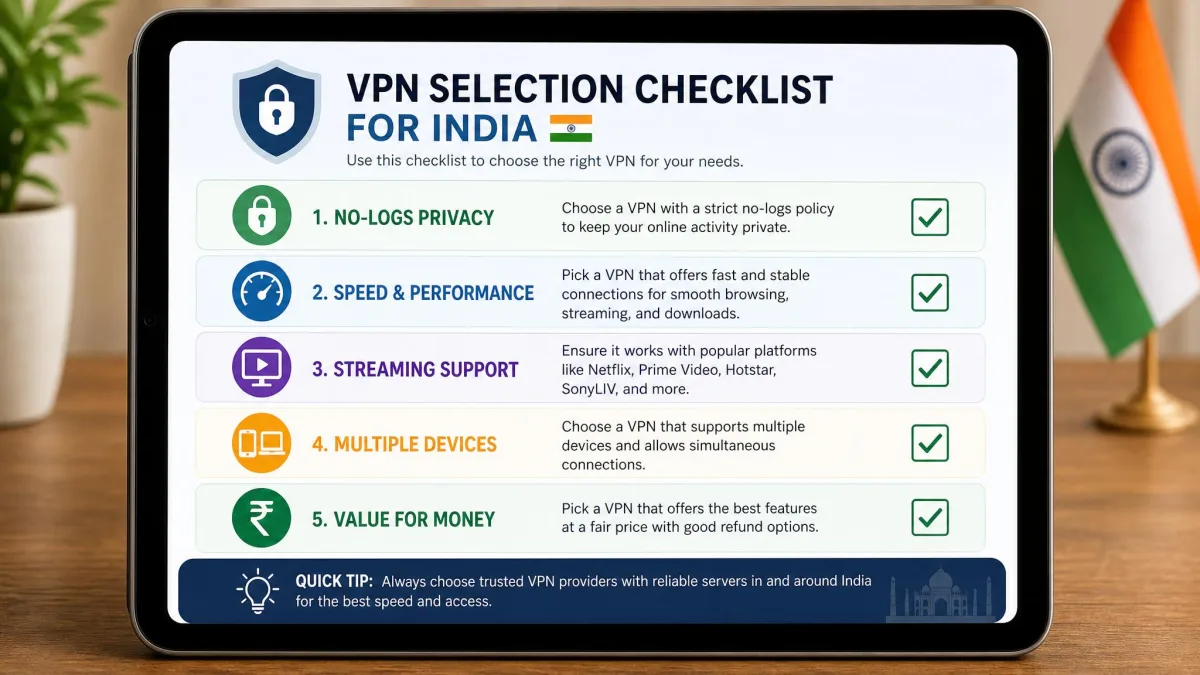
If you are weighing the five picks against your own needs, these are the criteria we would prioritise, roughly in order.
No-logs privacy and jurisdiction. For India specifically, you want a provider that removed its physical servers rather than one storing data locally. Every service here qualifies. Look for RAM-only servers and, ideally, an independent no-logs audit.
Speed on your connection. India speeds vary enormously, so the range a VPN posts matters more than a single headline figure. NordVPN was the steadiest for us. But the best way to find your own number is to use a money-back guarantee and test on your line.
Streaming, if you care about it. Not every fast VPN opens Indian apps reliably. If JioHotstar or SonyLIV is your reason for subscribing, favour Surfshark or CyberGhost.
Devices and price. Count how many devices you need covered. Surfshark's unlimited allowance is unbeatable for a household, while NordVPN's 10 connections suit most individuals. Then weigh the price against the refund window, so trying a service is genuinely risk-free.
A couple of names did not make our top five but are worth a look if the shortlist does not fit. Private Internet Access (PIA) posted some of the fastest raw India numbers we saw and allows unlimited devices, though its app is less beginner-friendly than Surfshark's. The good news is that the differences between our top three are small enough that you are unlikely to regret any of them. Pick the one whose strengths match your main use, and use the money-back guarantee to confirm it works on your own connection before you commit.
If you are still torn, a simple decision path helps. Want the safest all-round choice with the least fuss? Take NordVPN. Watching mostly Indian streaming apps across a house full of devices on a budget? Surfshark. Prize effortless setup and 4K playback above price? ExpressVPN. Want the longest trial and platform-labelled streaming servers? CyberGhost. Paying nothing? Proton VPN's free tier. Each of these is a defensible pick. The money-back guarantee is your safety net if the one you chose does not suit your line.
Final Verdict
After testing all five from Indian connections, one thing was clear: no single VPN wins every category, so the right pick depends on what you weigh most. If value and device count matter most, Surfshark is the one to beat. It covers a whole household on one subscription and streams Indian apps more reliably than anything else we tried. If your budget is strictly zero, Proton VPN's free tier is the only one we would trust, since it does not cap your data. And if you would rather not weigh trade-offs at all and just want a service that handles everything, our overall winner is below.