
8 Best Mac Cleaner Software in 2026 (Tested & Reviewed)
- The 8 Best Mac Cleaner Software in 2026
- Quick Comparison: Best Mac Cleaners at a Glance
- How We Tested the Best Mac Cleaner Software
- How to Choose the Best Mac Cleaner
- Are Mac Cleaners Safe? (and Scams to Avoid)
- How to Clean Your Mac Manually (No Software Needed)
- Frequently Asked Questions
- Final Verdict
A Mac that has run out of disk space slows down in small, frustrating ways, from longer app launches to failed system updates. To find the tools that actually fix it, we installed and ran more than 20 Mac cleaner apps on an M2 MacBook Air running macOS, loaded with the real clutter most people accumulate: bloated caches, app leftovers, duplicate photos, and old downloads. The eight apps below are the ones our team kept reaching for, ranked by how much they free up, how safely they do it, and what you pay.
We grouped free and paid options together so you can match a cleaner to your budget and comfort level. Some are one-tap, all-in-one suites; others are precise, single-purpose tools you control by hand.
The 8 Best Mac Cleaner Software in 2026
Below is the full breakdown of each app: what it does well, where it falls short, and what it costs. We lead with our overall pick and close with the cheapest and most specialized tools.
1. CleanMyMac (Best Overall)
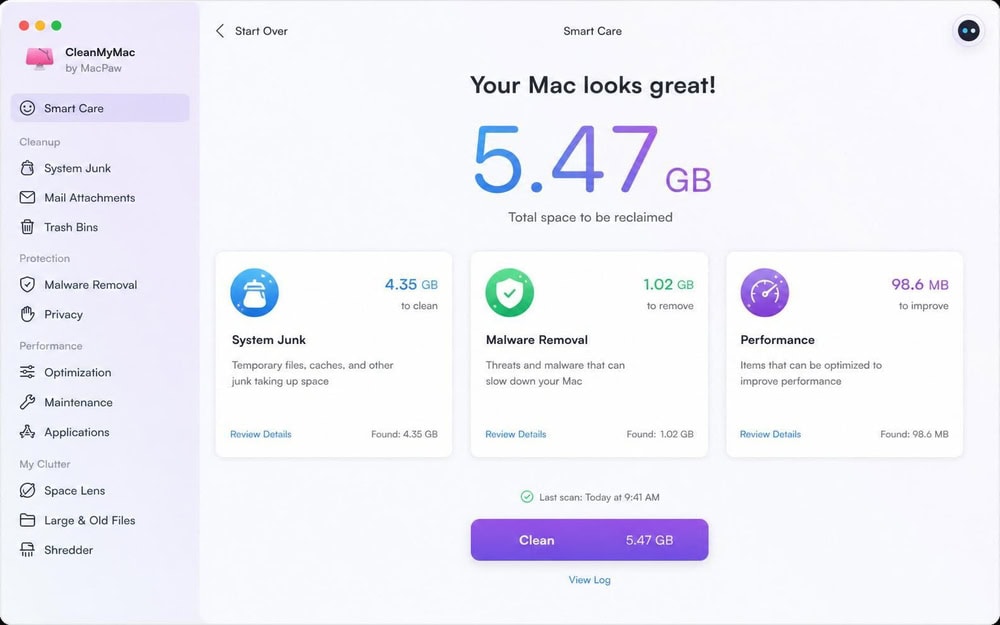
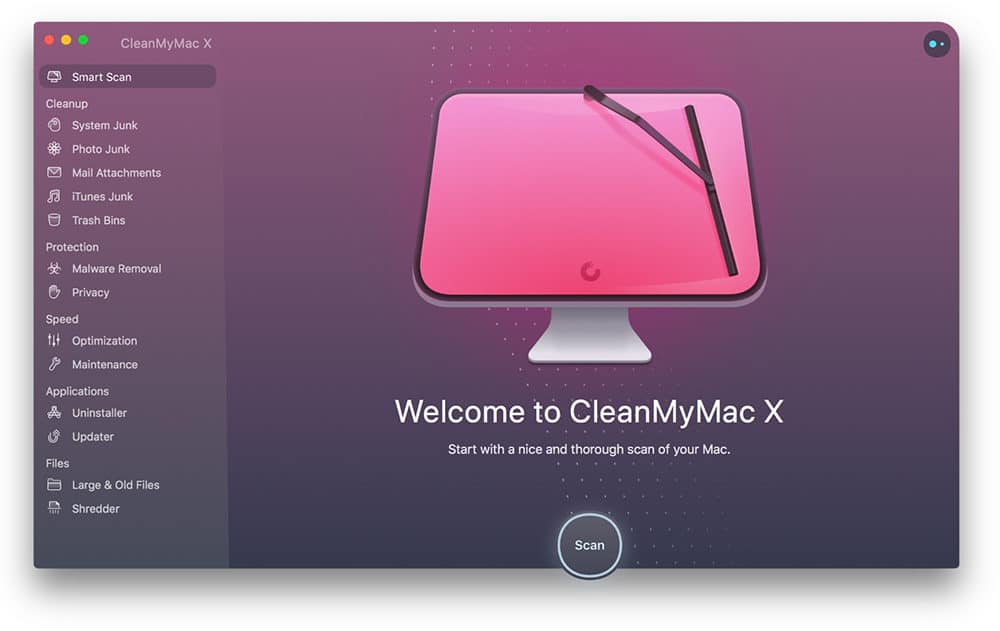
CleanMyMac from MacPaw was the app our team reached for most often, and it is the one we would recommend to anyone who wants a single button that handles almost everything. Its Smart Care routine runs one scan covering system junk, malware, and performance, then walks you through what it found before removing anything.
When we ran Smart Care on our test machine, it cleared out gigabytes of system junk and cached files without flagging anything we needed to keep. The app uninstaller is the other standout: it removes apps along with their scattered app leftovers, the kind of cleanup macOS does not do on its own.
Key Features
CleanMyMac combines system junk and cache cleanup, malware detection and removal, an app uninstaller with leftover removal, a duplicate and similar-photo finder, cloud storage cleanup, memory and performance optimization, and a software update manager. MacPaw states the app is Notarized by Apple, which means Apple has scanned it for malicious components.
It requires macOS 11 or later, so it covers any reasonably modern Mac. On its own page, MacPaw reports a rating of 4.9 stars across 539 reviews, though that figure is the vendor's own, not an independent aggregate.
Pros & Cons
Pros
- One-scan Smart Care covers junk, malware, and speed
- App uninstaller removes leftover files macOS misses
- MacBook memory cleaner
- Clear, well-designed interface explains each deletion
- Notarized by Apple
Cons
- Subscription pricing rather than a one-time license
- Performance optimization gains are modest on newer Macs
- More features than a casual user may need
Pricing
CleanMyMac starts at $39.95/year for 1 Mac, which works out to from $3.33/month on annual billing. MacPaw also advertises multi-Mac tiers, including a plan listed around $63.95/year for 2 Macs and $127.95/year for 5 Macs, though we saw those multi-Mac prices only through store search snippets and would confirm them on the MacPaw store before buying.
Get CleanMyMac2. MacBooster
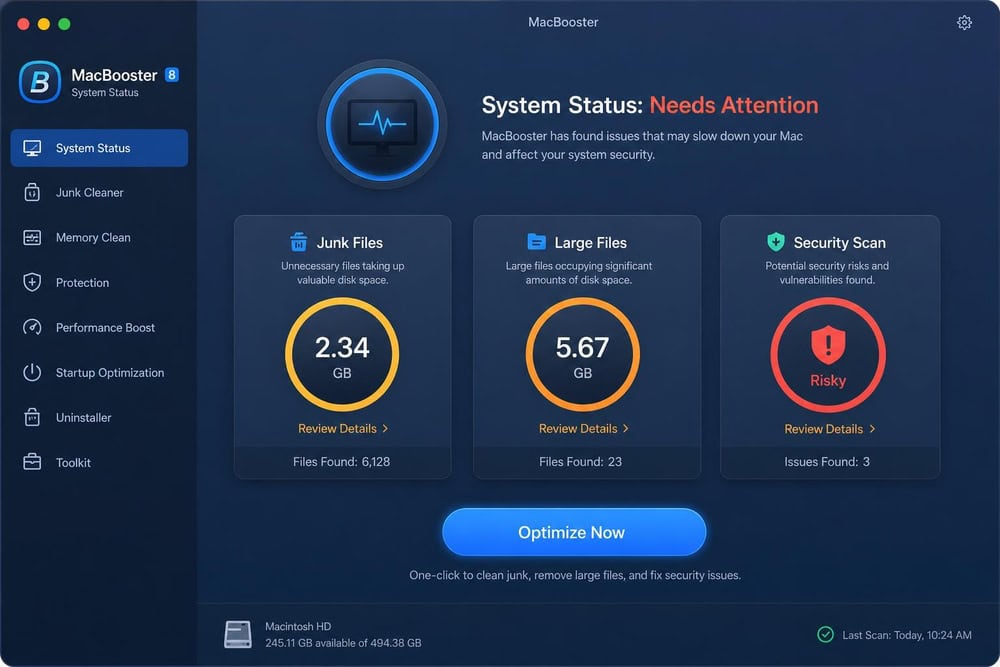
MacBooster from IObit takes the all-in-one approach for a Mac application cleaner and adds a security angle, bundling cleanup, optimization, and a malware scan into one app. If you want one purchase that promises to clean and protect, it is a reasonable middle-ground option.
On our test machine, its system junk cleanup and large-file finder surfaced the same big offenders our top picks did, and its startup optimization trimmed a few forgotten launch items. The security scanning is a bonus, though not a replacement for a dedicated antivirus.
Key Features
MacBooster offers system junk cleanup, a virus and malware scan, startup optimization, a large and old file finder, a duplicate finder, an app uninstaller, memory cleanup, and privacy protection. Its macOS minimum is listed inconsistently, with some sources citing macOS 10.9 and others a much newer build, so confirm compatibility on the official spec page before installing.
A free 14-day trial scans and identifies issues, but you need a license to actually fix them, according to third-party reviews we cross-checked.
Pros & Cons
Pros
- Cleanup, optimization, and security in one app
- Effective large-file and duplicate finders
- 60-day money-back guarantee
- Multi-Mac tiers available
Cons
- Trial only identifies issues without fixing them
- macOS minimum is unclear across sources
- Security scan is not a full antivirus replacement
Pricing
MacBooster Standard is $39.95/year for 1 Mac (down from a $59.95 list price), the Premium tier is $59.95/year for 3 Macs, and a 5-Mac plan runs $89.95/year. Every tier is backed by a 60-day money-back guarantee, which is generous and gives you time to test it fully.
Get MacBooster3. CCleaner for Mac (Best Free Option)
CCleaner for Mac is the name most people know from Windows, and its Mac version is the free cleaner we trust most for everyday tidying. The free version handles the basics well: it clears clutter, finds duplicate files, uninstalls apps, and manages startup items.
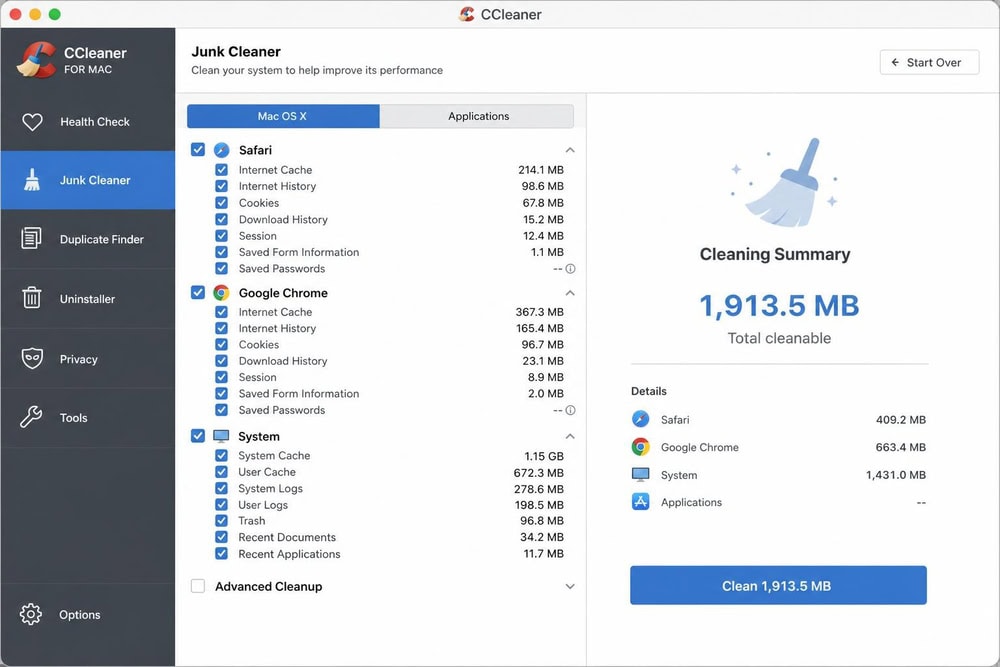
In our testing, the free tier was enough for a routine cleanup, clearing browser caches and junk files without nudging us toward a purchase on every screen. The privacy cleaning is a useful extra if you share a machine.
Key Features
CCleaner for Mac covers junk and cache removal, a duplicate file finder, an app uninstaller, photo analysis for blurry and duplicate images, browser and privacy cleaning, and a startup item manager. The official spec sheet lists support for macOS 10.12 (Sierra) through macOS 13 (Ventura) at the time we checked, so newer macOS support is likely but is not stated on the page.
The paid Professional Plus tier covers 3 devices and bundles the PC and Android versions, useful if you run more than one platform.
Pros & Cons
Pros
- Genuinely useful free version
- Familiar, approachable interface
- Privacy and browser cleaning built in
- Cross-platform bundle available
Cons
- Official macOS support list tops out at Ventura
- Pro pricing is inconsistent across sellers
- Past CCleaner brand history makes some users cautious
Pricing
The free version is the main draw. The paid Professional tier costs around $30-40/year for 1 Mac, depending on the seller and whichever intro discount is running, so we would treat the exact number as a moving target and check the current price at checkout.
Try CCleaner for Mac4. DaisyDisk (Best for Visual Storage Analysis)
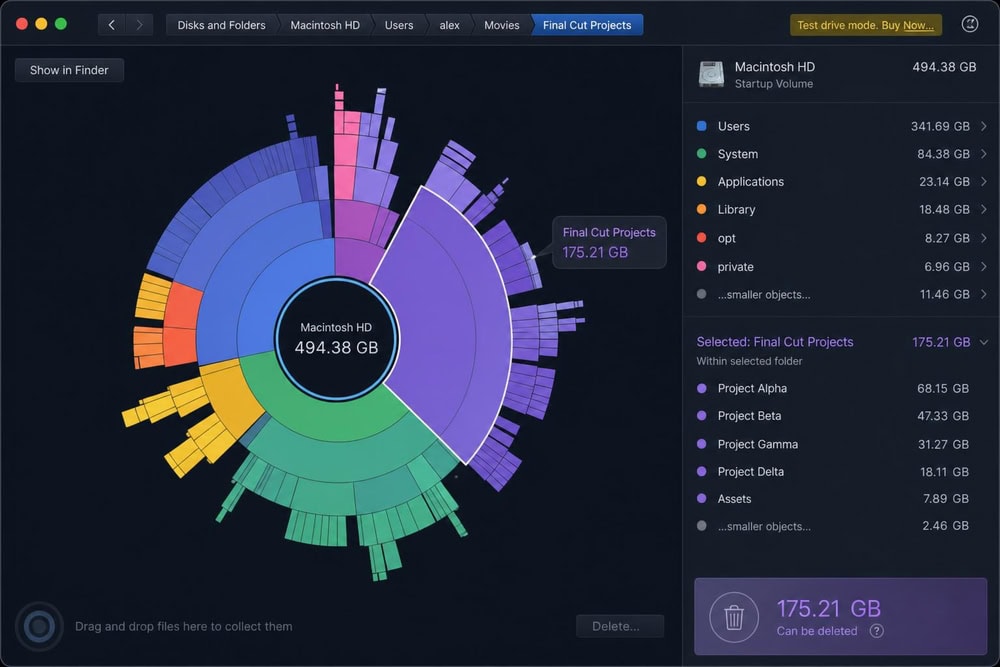
DaisyDisk does one thing and does it beautifully: it shows you exactly what is eating your disk space. Instead of a list, it draws an interactive ring map where the biggest files and folders take up the most space, so you can spot a forgotten 40 GB video archive in seconds.
When we pointed DaisyDisk at our cluttered test drive, it scanned the full disk in moments and made it obvious where our space had gone. You drag the items you do not want into a collector and delete them in one move, which keeps you in control of every removal.
Key Features
DaisyDisk provides a visual ring and sunburst disk map, a fast full-disk scan, support for internal, external, SSD, and cloud drives, an admin scan that reaches hidden files, system-file protection, and a drag-to-delete collector. It requires macOS 10.13 or newer and runs natively on both Apple silicon and Intel Macs.
A free trial lets you scan and visualize your disk; deleting files typically requires the paid license, so confirm the trial's deletion limits first. Independent reviews describe the app as notarized and sandboxed by Apple.
Pros & Cons
Pros
- Clearest visual map of disk usage available
- Very fast full-disk scans
- One-time price, no subscription
- You control exactly what gets deleted
Cons
- Not an automated junk cleaner
- Deletion usually needs the paid license
- No malware or optimization features
Pricing
DaisyDisk is $9.99 one-time, a lifetime license with no subscription, and it covers up to 5 personal Macs per license. It is backed by a 30-day money-back guarantee, which makes it an easy, low-risk recommendation.
Get DaisyDisk5. Drive Genius
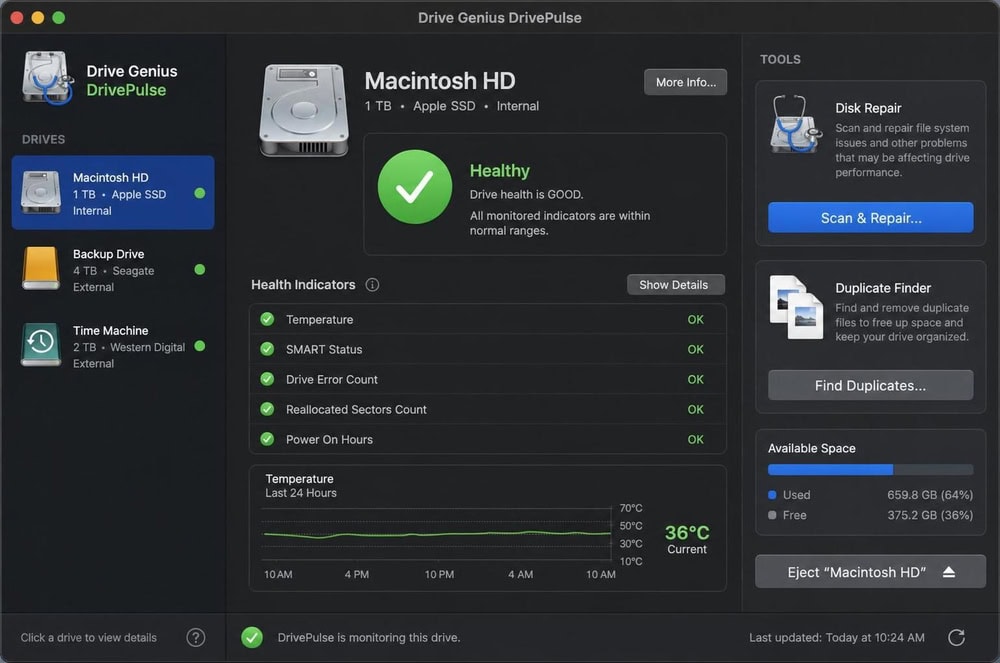
Drive Genius from Prosoft Engineering is less about clearing junk files and more about keeping your drive healthy. It is aimed at people who want to monitor drive health, repair disk problems, and benchmark performance, with cleanup as a secondary feature.
In our testing, its DrivePulse monitoring quietly watched the drive in the background and its duplicate finder cleared real space, but the app leans toward maintenance and repair rather than one-tap cleaning. If you have ever lost a drive without warning, the early-warning monitoring is the reason to consider it.
Key Features
Drive Genius includes drive health monitoring through DrivePulse, a malware scan, disk repair, a duplicate finder, a secure data shredder, performance benchmarking, drive cloning, and defragmentation for HFS+ drives. The official page lists support for macOS 10.12 and later, so verify the current build's top-end macOS support before buying.
It is the most maintenance-focused tool here, better suited to power users and small studios than to someone who just wants to free up space.
Pros & Cons
Pros
- Proactive drive health monitoring
- Disk repair and cloning built in
- Secure data shredder for sensitive files
- Perpetual license option available
Cons
- Most expensive option here
- Overkill for simple junk cleanup
- Defragmentation only helps older HFS+ drives
Pricing
Drive Genius costs $79/year for the Standard plan (up to 3 computers) and $299/year for the Professional plan (up to 10 computers). There is also a $99 one-time perpetual license per computer, though that version does not include future-macOS feature updates.
Get Drive Genius6. Disk Drill
Disk Drill from CleverFiles is best known as a data recovery tool, but it bundles a genuinely useful set of free cleanup extras alongside it. If you want one app that can both recover deleted files and help you free up space, it is a smart two-in-one pick.
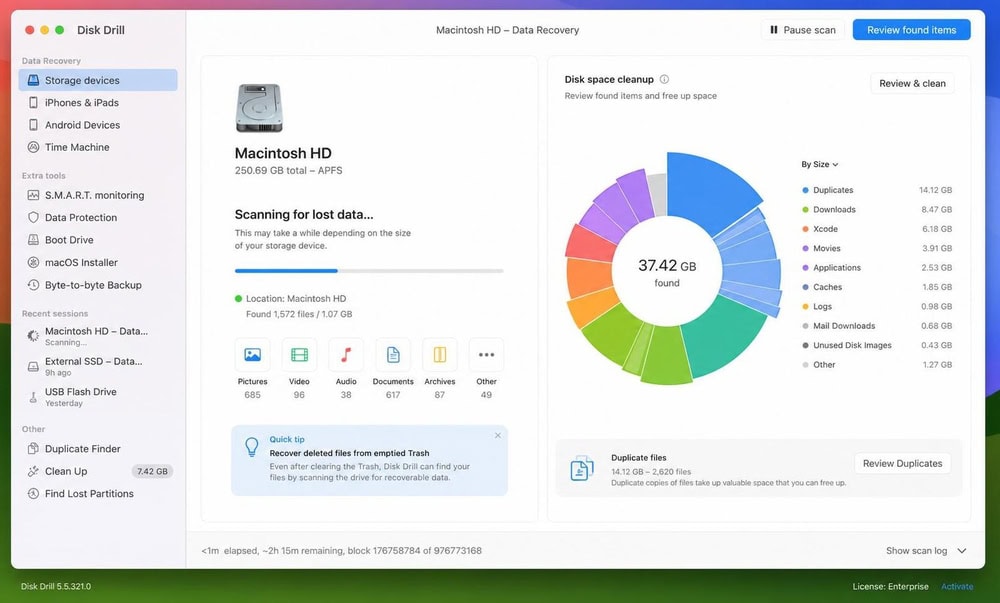
During testing, its disk space visualizer and duplicate finder matched what the dedicated cleaners surfaced, and its S.M.A.R.T. drive health monitoring added an early-warning layer for free. Recovery is the headline feature, but the cleanup tools are not an afterthought.
Key Features
Disk Drill leads with data recovery and adds a free disk space visualizer and cleanup tool, a duplicate finder, byte-to-byte backup, S.M.A.R.T. drive health monitoring, and a data-protection feature called Recovery Vault. Its v6.2 download page lists support for macOS 10.15.8 through the current macOS release, which we would confirm on the official spec page.
The free version recovers up to 500MB of data and includes the cleanup and disk-space tools at no cost, so it is worth installing even if you never pay.
Pros & Cons
Pros
- Combines recovery and cleanup in one app
- Free tier includes cleanup and disk-space tools
- Drive health monitoring included
- One-time Pro license
Cons
- Cleanup is secondary to recovery
- Pro license is on the pricey side
- Free recovery capped at 500MB
Pricing
Disk Drill Pro is $89 one-time and covers up to 3 computers. There is also an optional lifetime-upgrade add-on advertised at around $19, though we saw that figure in review coverage and would confirm it on the CleverFiles store.
Get Disk Drill7. OnyX (Best Free Power-User Tool)
OnyX from Titanium Software is the free app cleaner for Mac we recommend to people who like to know exactly what their software is doing. It is a maintenance utility that runs the same kinds of cleaning and repair scripts macOS uses internally, plus a deep set of hidden system tweaks.
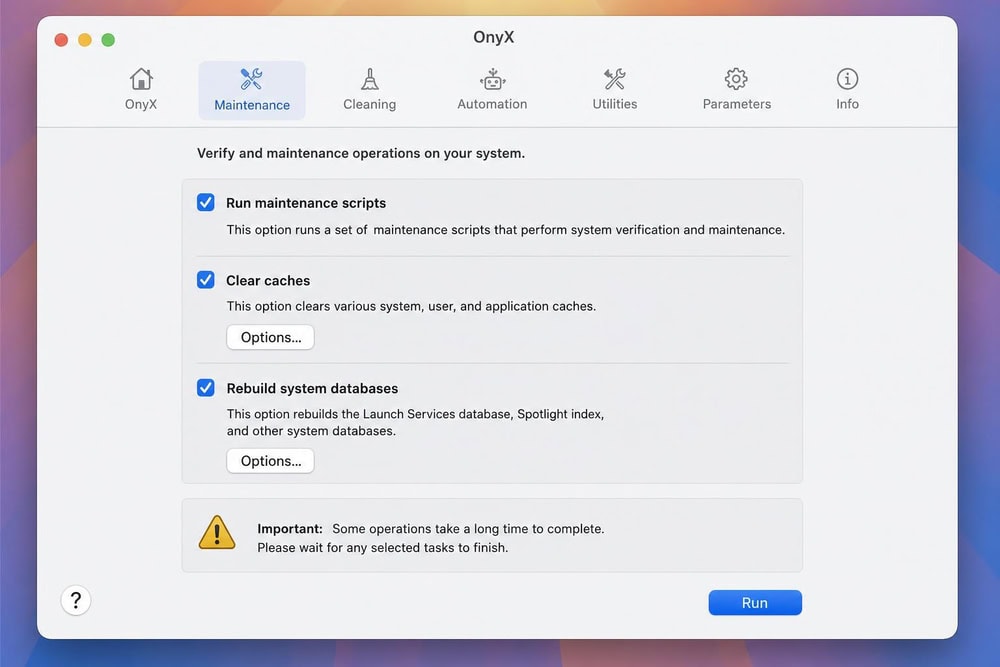
In our testing, OnyX cleared caches, rebuilt system databases, and let us configure hidden Finder and Dock settings that no graphical app exposes. It is completely free, supported by optional donations, which is remarkable for how much it can do.
Key Features
OnyX can verify the system file structure, run maintenance and cleaning scripts, delete caches, rebuild databases and indexes, uninstall apps, configure hidden Finder, Dock, and Safari parameters, and remove problematic files. Titanium Software ships version-specific builds, including OnyX 5.0.0 for macOS Tahoe 26 on both Intel and Apple silicon, with legacy builds going back to OS X 10.2.
There is one important rule: you must download the build that matches your exact macOS version, and you should never run an older-OS build on a newer system.
Pros & Cons
Pros
- Completely free (donationware)
- Deep control over hidden system settings
- Runs the same maintenance macOS uses
- Long history and trusted developer
Cons
- Bare, technical interface
- Easy to over-tweak if you rush
- You must match the build to your macOS version
Pricing
OnyX is free, distributed as donationware with an optional donation to support development. There is no paid tier, no upsell, and no subscription, which makes it the best free power-user tool on this list.
Download OnyX8. Disk Doctor
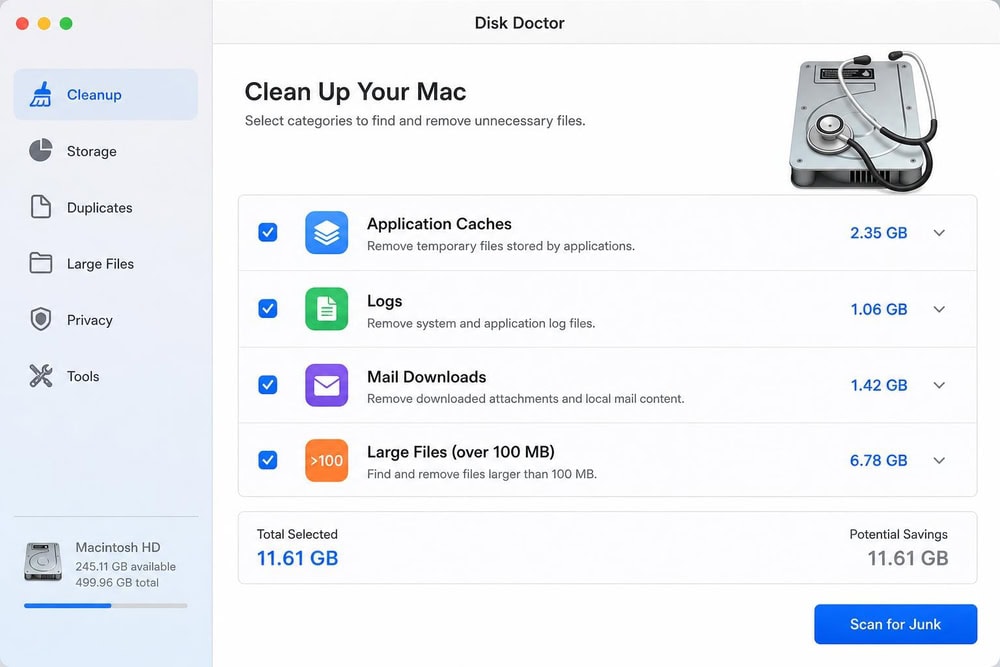
Disk Doctor from FIPLAB is the cheapest paid app cleaner for MacBook we reviewed and the simplest to use. It is a focused junk and cache cleaner sold through the Mac App Store, which means it has passed Apple's review process before reaching you.
When we ran it, Disk Doctor walked through the common space wasters one category at a time and prompts you to make a Time Machine backup before deleting anything irreversible. It will not optimize your Mac or hunt malware, but for a few dollars it does the core cleanup job cleanly.
Key Features
Disk Doctor removes app caches, logs, and browser data, clears mail downloads and the Trash, finds large files over 100MB, cleans partial downloads and developer or Xcode files, removes old iOS software updates, and prompts for a Time Machine backup before deleting. From developer FIPLAB Ltd, it requires macOS 10.13 or later.
Because it is sold through the Mac App Store, it is sandboxed and has cleared Apple's review, though the App Store currently shows it does not have enough ratings to display an overview.
Pros & Cons
Pros
- Lowest price of any paid app here
- Simple, category-based cleanup
- Prompts for a backup before deleting
- Distributed through the Mac App Store
Cons
- Cleanup only, no optimization or malware tools
- Sandboxing limits how deep it can reach
- Few public ratings to judge it by
Pricing
Disk Doctor is $2.99 one-time on the Mac App Store, with no subscription. It is the easiest tool here to justify buying, since the price is roughly that of a coffee and it does its narrow job well.
Get Disk Doctor on the Mac App StoreQuick Comparison: Best Mac Cleaners at a Glance
| App | Best for | Free tier / trial | Starting price | Core focus |
|---|---|---|---|---|
| CleanMyMac | Best overall all-in-one | Free trial | $39.95/yr | All-in-one cleanup and malware removal |
| CCleaner for Mac | Best free / basic cleanup | Free version | Around $30-40/yr Pro | Junk and privacy cleanup |
| MacBooster | Bundled clean, optimize, security | 14-day trial | $39.95/yr | Cleanup plus optimization and security |
| DaisyDisk | Visual storage analysis | Free trial (scan only) | $9.99 one-time | Disk space visualizer |
| Drive Genius | Drive health and repair | No free tier | $79/yr or $99 once | Drive maintenance and repair |
| Disk Drill | Recovery plus free cleanup extras | Free (500MB recovery) | $89 one-time | Data recovery and cleanup |
| OnyX | Free power-user maintenance | Free (donationware) | Free | System maintenance scripts |
| Disk Doctor | Cheapest paid quick clean | None (paid) | $2.99 once | Junk and cache removal |
How We Tested the Best Mac Cleaner Software
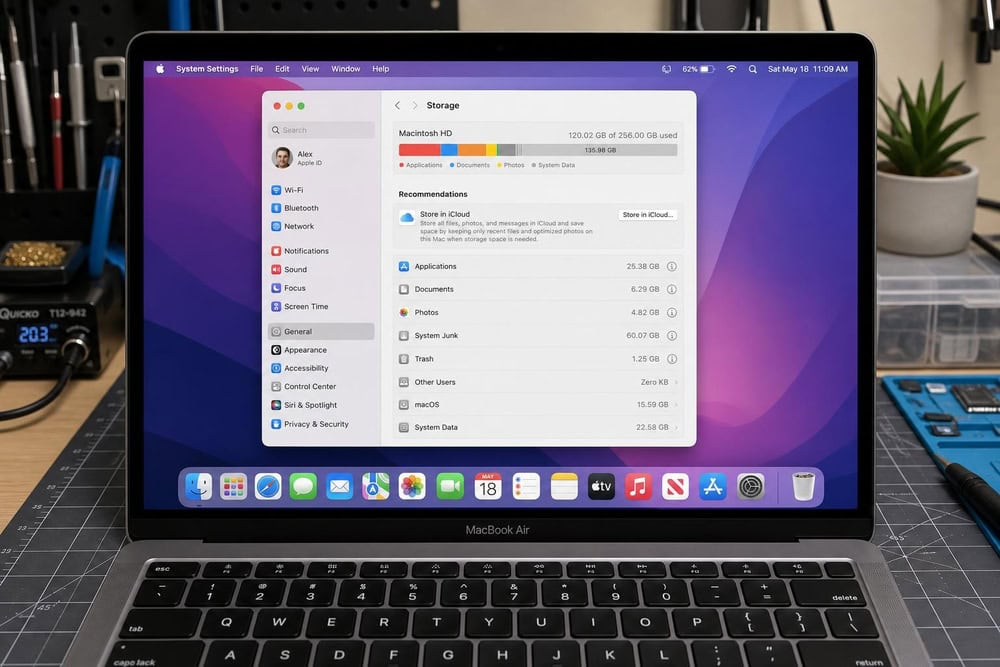
Our scoring weighed four things: how much disk space a cleaner safely freed up, how clearly it explained what it was about to delete, how it priced its free and paid tiers, and whether the developer is transparent about safety. We treated any tool that wanted to remove system files without warning as a red flag, and we favored apps that prompt for a backup before deleting anything irreversible.
How to Choose the Best Mac Cleaner
The right cleaner depends on what you want to fix. If your goal is to free up disk space with the least effort, an all-in-one like CleanMyMac or a simple cleaner like Disk Doctor gets you there fastest. If you mainly want to understand where your space went, a visualizer like DaisyDisk is the better tool.
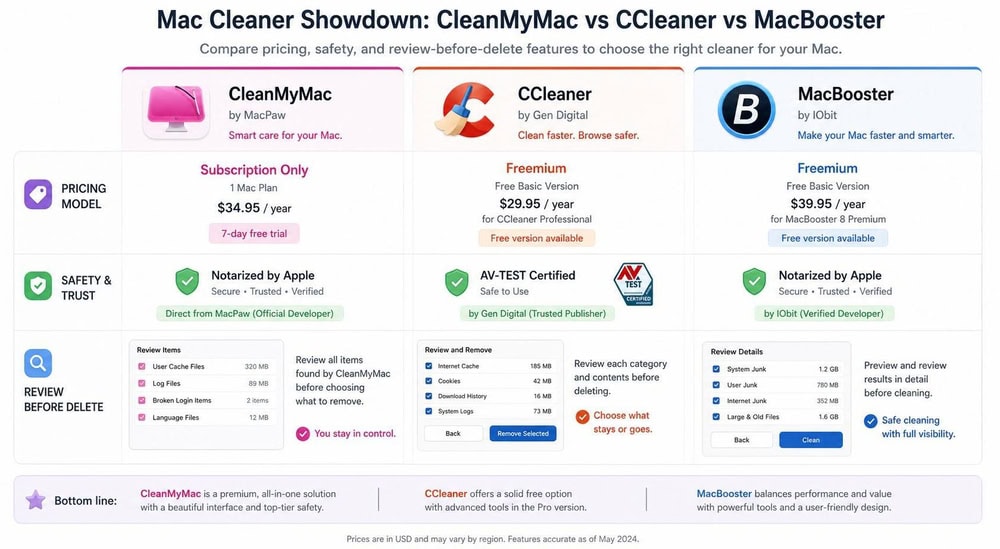
Look first at transparency. A good cleaner tells you what it is about to delete and lets you review the list before it acts, rather than removing files silently. We also weigh whether the developer is open about safety, ideally with a notarized or App Store build, and whether the app prompts for a backup before any irreversible deletion.
If you mainly want to strip out app leftovers, a dedicated uninstaller, or the free AppCleaner utility, does that one job thoroughly. Finally, weigh the pricing model against how often you will use it. A one-time license like DaisyDisk or Disk Doctor suits occasional cleaning, while a subscription makes more sense for ongoing malware checks. Match the tool to your skill level, too: power users will appreciate OnyX's deep controls, while most people are better served by a guided, one-scan app.
Are Mac Cleaners Safe? (and Scams to Avoid)
Reputable Mac cleaners are safe, but the category attracts scams, so be careful about what you install. The most reliable tools in 2026 are Apple-notarized, meaning Apple has scanned them for malicious components, or distributed through the Mac App Store, where they have passed Apple's review.
When in doubt about an unfamiliar app, a quick search of the r/mac community on Reddit usually surfaces whether other users trust it. The apps to avoid are the ones that fake a problem to sell you a fix. If a "cleaner" floods you with alarming pop-ups claiming your Mac is badly infected, demands payment before it will show results, or installs itself without your clear consent, treat it as malware rather than a tool. Genuine cleaners explain what they found and let you decide.
A safe cleaner also protects you from yourself. The best ones never touch protected system files, and the most cautious, like Disk Doctor, prompt you to make a Time Machine backup before they remove anything you cannot easily get back.
How to Clean Your Mac Manually (No Software Needed)
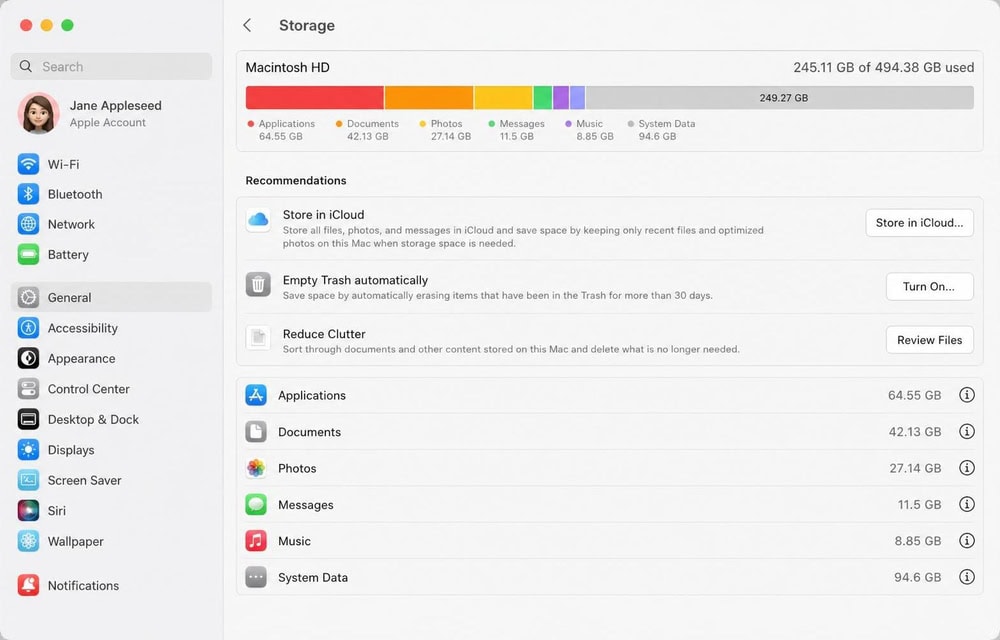
You do not strictly need an app to reclaim space, and macOS includes solid built-in tools. To see what is using your storage, open the Apple menu, choose System Settings, then go to General and select Storage, where macOS breaks down your usage by category and offers recommendations.
From that same screen you can empty the Trash automatically, store files in iCloud, and review large files and downloads. To remove an app, open Launchpad, press and hold its icon, and click the delete button, or drag the app from your Applications folder to the Trash. For Apple's own walkthrough, see the built-in macOS storage management guide.
The catch is app leftovers. Dragging an app to the Trash removes the app but often leaves behind caches, preference files, and support folders scattered across your system. Clearing those by hand means carefully digging through your Library folder, the error-prone work a good cleaner automates. The manual route handles the obvious junk files; a cleaner is worth it for the rest.
Frequently Asked Questions
Do Mac cleaners really work?
Yes, with realistic expectations. A good Mac cleaner reliably frees up disk space by removing system junk, caches, and app leftovers, and it can clear out files macOS leaves behind on its own. What they do not do is dramatically speed up a modern Mac with plenty of free storage, since the biggest gains come from reclaiming space on a nearly full drive.
Are Mac cleaner apps safe to use?
The reputable ones are safe. Stick to apps that are notarized by Apple or sold through the Mac App Store, download them only from the official developer site, and favor tools that show you what they will delete before they act. Avoid any app that uses scare-tactic pop-ups or hides its results behind a paywall.
What is the best free Mac cleaner?
For most people, CCleaner for Mac's free version is the best balance of useful cleanup and ease of use. Power users who want deeper control should look at OnyX, which is free donationware and runs the same maintenance scripts macOS uses internally. Disk Drill's free tier also includes cleanup and disk-space tools.
Will a Mac cleaner slow down or speed up my Mac?
A trustworthy cleaner should not slow your Mac down, and freeing up space on a nearly full drive can make the system feel more responsive. The speed gains are largest when storage is the bottleneck; on a Mac with plenty of free space, expect a tidier drive rather than a dramatic performance jump.
Does macOS clean itself?
Partly. macOS manages some temporary files and offers built-in storage tools to empty the Trash, offload files to iCloud, and review large files. It does not, however, remove app leftovers or deep cache clutter on its own, which is the gap that a dedicated cleaner fills.
Final Verdict
After testing more than 20 apps, CleanMyMac is the cleaner we recommend to most people: its one-scan Smart Care routine safely freed up the most space while clearly explaining every deletion. If you want a free tool, CCleaner for Mac covers everyday cleanup well, and OnyX gives power users far more control at no cost.
For specific needs, DaisyDisk is the best way to see where your space went at $9.99 one-time, Disk Doctor is the cheapest paid quick-clean at $2.99, and Drive Genius wins if drive health and repair matter more than junk removal. Match the tool to the job, favor apps that are transparent and Apple-notarized, and you will reclaim real space without risk to your Mac.

 CleanMyMac Review
 CleanMyPC Review
 MacBooster Review
 How to Clean Up Mac
 Free Up Disk Space on Mac
 Best Computer Cleaner
 MacPaw Gemini 2 Review
 CleanMyMac Alternatives