
Bitdefender vs Kaspersky 2026: Which Antivirus Is Better?
- Bitdefender vs Kaspersky at a Glance (Quick Verdict)
- How We Compared Bitdefender and Kaspersky
- Bitdefender Overview
- Kaspersky Overview
- Malware Protection and Detection
- System Performance and Resource Impact
- Features Compared
- Ease of Use and Interface
- Device Compatibility (Windows, macOS, Android, iOS)
- Pricing and Plans
- Customer Support
- Privacy, Trust, and Safety
- Final Verdict: Should You Choose Bitdefender or Kaspersky?
- Frequently Asked Questions
We compared Bitdefender and Kaspersky on malware protection, system performance, features, device coverage, price, and privacy. Our analysis leans on the two independent labs the industry treats as the gold standard, AV-TEST and AV-Comparatives, paired with our own hands-on time in both apps. The two suites are closer on protection than most comparisons admit, so the deciding factors are performance, value, and one issue unrelated to detection rates: Kaspersky's standing with the US government.
Bitdefender vs Kaspersky at a Glance (Quick Verdict)
On detection these two are effectively tied. They separate everywhere else: Bitdefender ships in every market without restriction and offers the stronger free tier, while Kaspersky runs lighter on resources but carries a US sales ban that rules it out for American readers.
| Criteria | Bitdefender | Kaspersky |
|---|---|---|
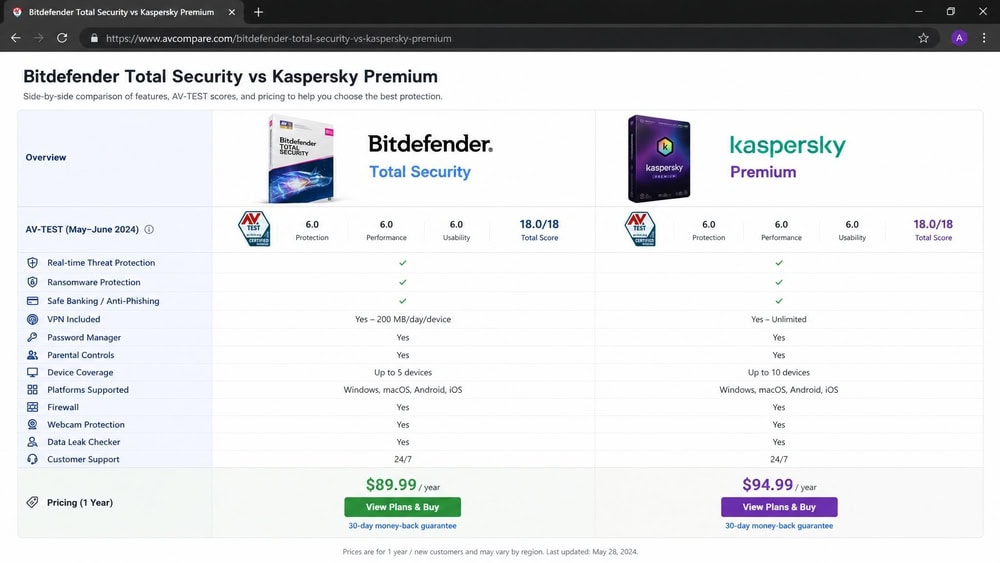
| AV-TEST (Protection / Performance / Usability) | 6.0 / 6.0 / 6.0 - Top Product | 6.0 / 6.0 / 6.0 - Top Product |
| AV-Comparatives Real-World Protection | 99.5% (ADVANCED+) | 99.8% (ADVANCED+) |
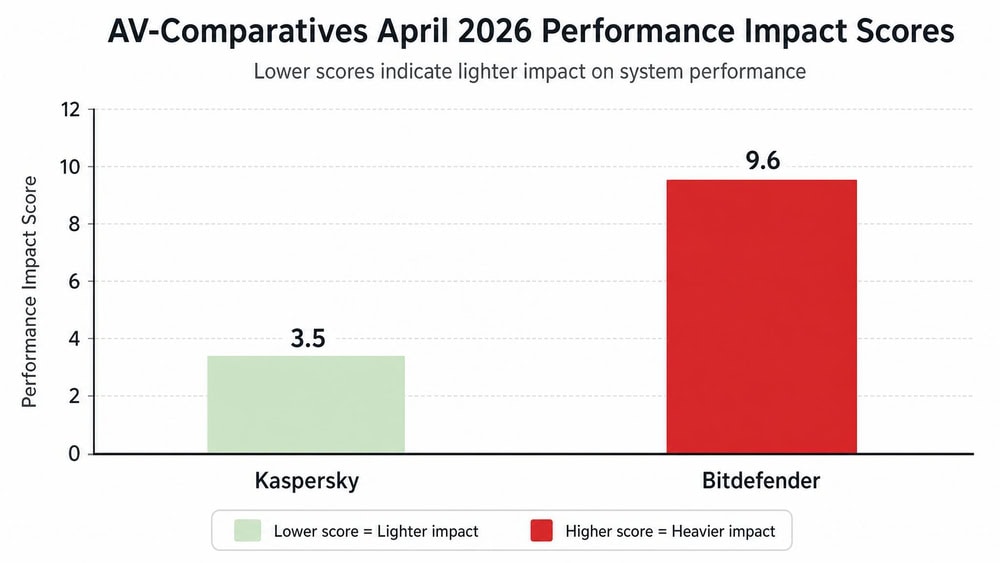
| AV-Comparatives performance impact (lower is better) | 9.6 (ranked 9th) | 3.5 (ranked 2nd) |
| First-year price (approx.) | ~$59.99 | ~$38.99 (cached/third-party) |
| Bundled VPN data cap | 200 MB/day (unlimited on Premium/Ultimate) | Limited on Plus; unlimited on Premium |
| Device platforms | Windows, macOS, Android, iOS | Windows, macOS, Android, iOS |
| Free version | Yes (Windows, no expiry) | Exists globally; unsupported for US users |
| Refund window | 30-day money-back | 30-day money-back |
| US privacy / trust standing | EU-based; no ban or listing | FCC Covered List; US sales banned |
| Founded / HQ | 2001 / Romania (EU) | 1997 / Moscow, Russia |
How We Compared Bitdefender and Kaspersky
Testing and Evaluation Criteria
We pulled the most recent certified results from AV-TEST and AV-Comparatives, the two labs that test on a fixed cadence with disclosed methodology. From AV-TEST home-Windows cycle, scoring Protection, Performance, and Usability out of 6.0 each. From AV-Comparatives we used the Real-World Protection Test and the Performance Test, where a lower impact score means a lighter touch.
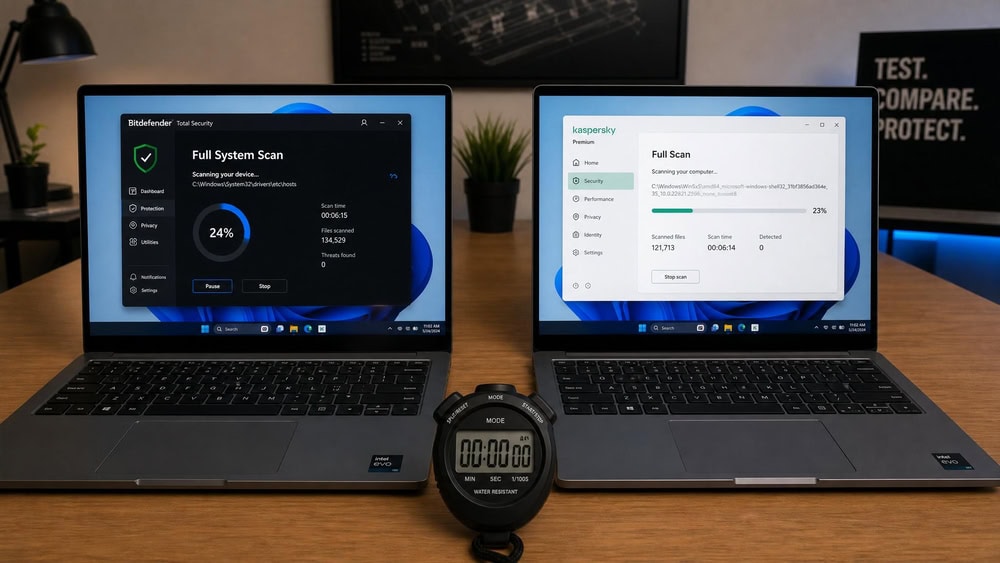
We also installed Bitdefender Total Security and Kaspersky Premium on two matched Windows 11 machines for a week. We ran full scans, opened the dashboards daily, fired the web-protection module at known-bad test pages, and timed boot and copy operations. Where a number could date quickly, such as promotional pricing, we flag it rather than present it as fixed.
Bitdefender Overview
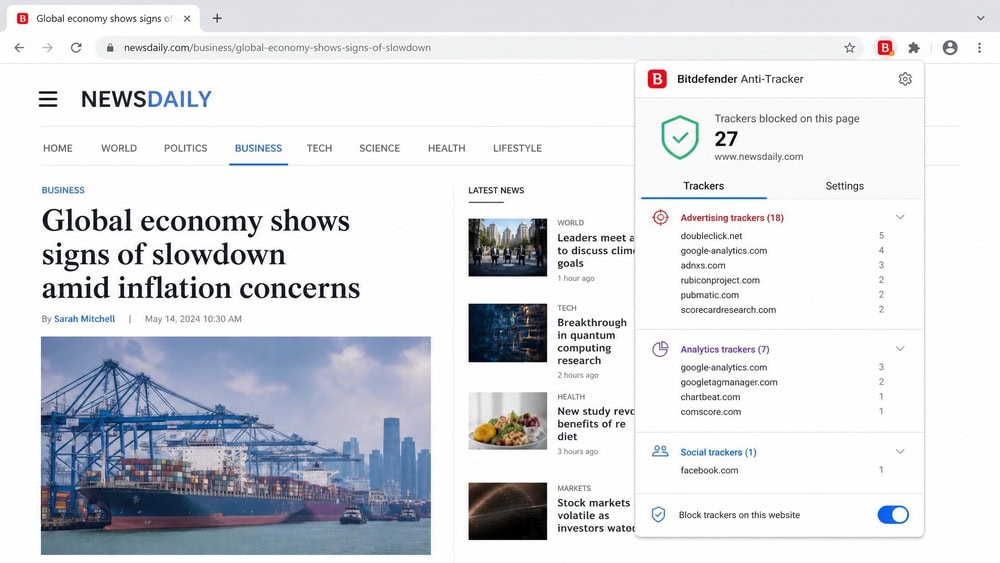
Bitdefender was founded in 2001 and is headquartered in Bucharest, Romania, an EU member state, which becomes relevant once we reach privacy. Its consumer line runs from Antivirus Plus through Internet Security, Total Security, Premium Security, and Ultimate Security, with Total Security the multi-platform suite most buyers choose. The package layers real-time protection, Advanced Threat Defense, anti-phishing filtering, web-attack prevention, a firewall, ransomware remediation, a password manager, a bundled VPN, Anti-Tracker, a file shredder, and webcam and microphone protection.
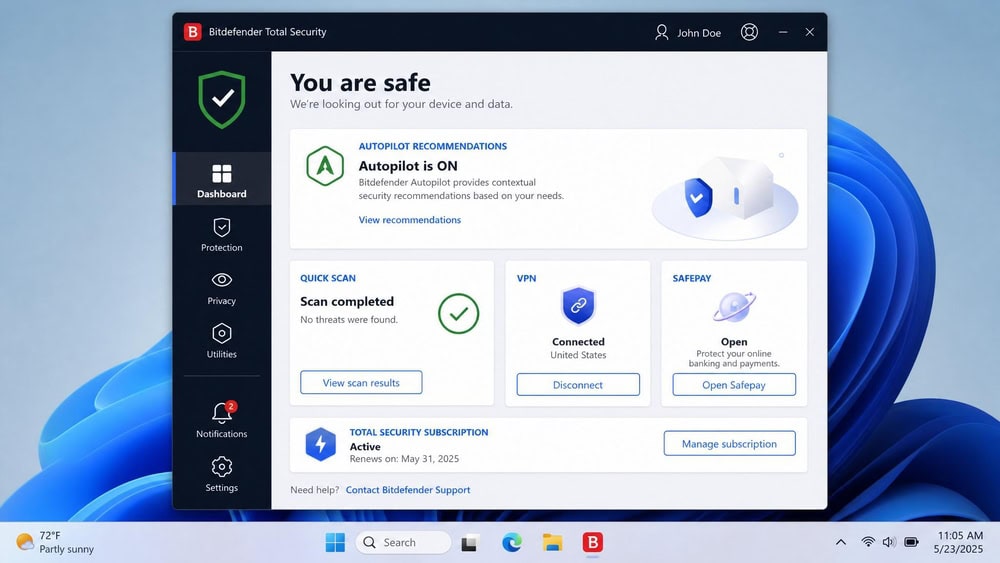
During our week with Total Security, the standout moment came when we pointed the browser at a batch of known phishing test URLs. Bitdefender's web-protection layer intercepted the page before it finished loading on all but one obscure sample, throwing a full-screen block rather than a quiet toolbar warning. The interface otherwise stayed out of the way, surfacing an Autopilot recommendation only when a setting needed attention.
Bitdefender Pros and Cons
Pros
- Near-perfect lab protection (AV-TEST 6.0; AV-Comparatives 99.5%, ADVANCED+)
- Sold without restriction in the US and EU
- Strong, no-expiry free version for Windows
- Rich extras: password manager, Anti-Tracker, file shredder, webcam protection
- 30-day money-back guarantee
Cons
- Heavier measured system impact than Kaspersky (9.6 vs 3.5)
- Bundled VPN capped at 200 MB/day unless you buy a higher tier
- Renewal pricing rises noticeably after the first-year promo
Kaspersky Overview
Where Bitdefender is an EU company with no government baggage, Kaspersky is the opposite case: a technically excellent product carrying a regulatory cloud. Founded in 1997 by Eugene Kaspersky and headquartered in Moscow, Russia, the suite spans three tiers, Standard, Plus, and Premium. Its feature set covers real-time antivirus, anti-phishing, a two-way firewall, performance optimization, a password manager, a VPN (limited on Plus, unlimited on Premium), Safe Kids parental controls, identity protection, and a data-leak checker.
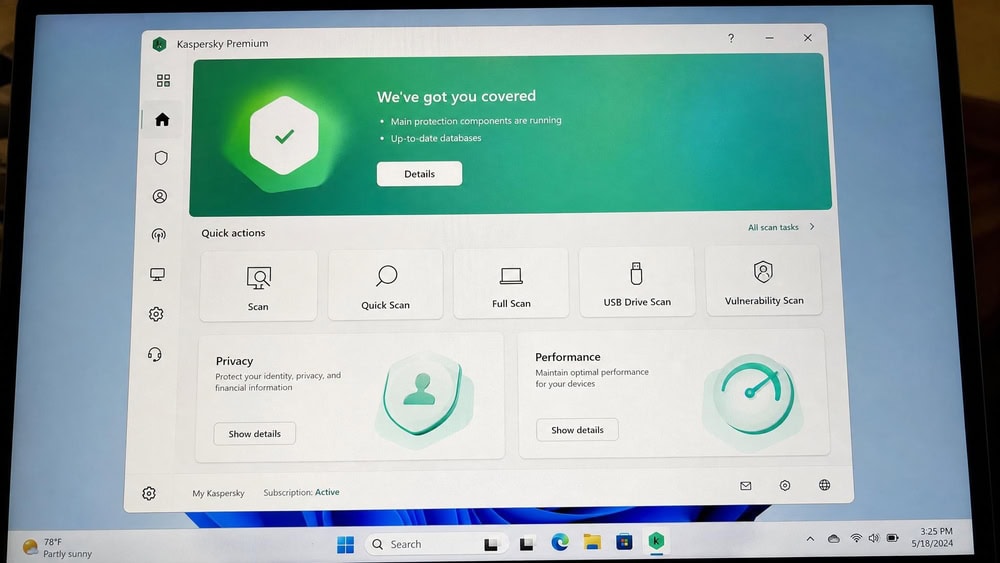
The Kaspersky engine impressed us the way it impresses the labs. When we ran our phishing-page battery against it, the interception rate matched Bitdefender's almost sample for sample, and it did so while sitting noticeably lighter on the machine; boot and file-copy times barely moved. The catch surfaced when we checked update status: for a US install, Kaspersky can no longer deliver the signature updates that keep that engine current.
Kaspersky Pros and Cons
Pros
- Near-perfect lab protection (AV-TEST 6.0; AV-Comparatives 99.8%, ADVANCED+)
- Lightest system impact of the two (AV-Comparatives 3.5, ranked 2nd)
- Clean, fast interface with strong optimization tools
- Unlimited VPN on the Premium tier
- 30-day money-back guarantee
Cons
- Banned from new US sale; updates cut off for US users
- Listed on the FCC Covered List as a national-security concern
- Russia-based ownership drives ongoing trust questions
Malware Protection and Detection
Lead with the labs, not the marketing: on certified testing, Bitdefender and Kaspersky sit at the very top of the field and are statistically tied. Both earn perfect protection marks from AV-TEST and an ADVANCED+ award from AV-Comparatives.
AV-Test Results
In the home-Windows cycle, AV-TEST's latest results award both suites a flawless 6.0/6.0 for Protection and name each a Top Product. There is no daylight between them, so detection is not the reason to pick one over the other.
AV-Comparatives Results
The picture stays close in the Real-World Protection Test. AV-Comparatives recorded Bitdefender at 99.5% across the run, blocking 398 of 400 live threats for an ADVANCED+ rating. The AV-Comparatives Kaspersky results for the same period show 99.8%, blocking 399 of 400, making it a single sample apart.
One widely cited figure deserves a direct note. Some comparisons quote a "99% vs 81%" gap favoring Bitdefender; that number comes from PCMag's own hands-on malware test, a different methodology than the certification labs. Read it as PCMag's result, not an independent-lab score. On the lab data the industry standardizes around, the two are even.
Verdict: Malware Protection
A draw, separated by 0.3 of a percentage point no user would feel. We give the narrow edge to whichever you can keep updated, which for US readers means Bitdefender.
System Performance and Resource Impact
If protection is a tie, performance is where the labs disagree instructively. AV-TEST's Performance score is a perfect 6.0 for both. AV-Comparatives, which reports a finer-grained figure, puts Kaspersky at an impact score of 3.5 (2nd overall, lighter is better) and Bitdefender at 9.6 (9th). The labs measure slowdown differently, so rather than crown a single winner, we read Kaspersky as the lighter-footprint suite by the more granular measure.
Our week tracked that reading: Kaspersky's background activity was harder to notice during boot and large file copies, while Bitdefender's full scans were more demanding. Neither made a modern machine feel slow, but on older hardware the gap would matter.
Verdict: Performance
Kaspersky takes performance on its 3.5 impact score and our matching impression, with the caveat that AV-TEST scores both perfectly. On an aging laptop, this is its clearest win.
Features Compared
Both suites are full security packages rather than bare antivirus, so the feature contest comes down to where each is generous and where it nickel-and-dimes.
VPN
Both bundle a VPN and gate the good version behind their top tier. Bitdefender caps its VPN at 200 MB per day per device on most plans, lifting the limit only on Premium Security and Ultimate. Kaspersky limits VPN traffic on Plus and unlocks unlimited use on Premium.
Anti-Phishing Protection
Anti-phishing is a strength for both. In our runs against known-bad URLs, both blocked the overwhelming majority before the page rendered, Bitdefender with a more assertive block screen and Kaspersky with a quieter but equally effective one.
Password Manager
Both include a password manager, Bitdefender across Total Security and up, Kaspersky on Plus and Premium. Neither replaces a dedicated standalone manager, but both cover generation, storage, and autofill.
Firewall
Each suite ships a firewall: Bitdefender's is on by default in Total Security, Kaspersky's two-way firewall on Plus and Premium. Both ran without nagging us for rule approvals.
Parental Controls
Bitdefender's parental controls arrive on its Family and higher tiers, while Kaspersky leans on its well-regarded Safe Kids platform. Safe Kids is the more mature dedicated offering, though US availability is constrained by the same ban that affects the rest of the lineup.
Extra Tools (Anti-Tracker, File Shredder, Optimization)
Here the suites diverge by philosophy. Bitdefender stacks privacy extras: Anti-Tracker, a file shredder, webcam and microphone protection, and a one-click optimizer. Kaspersky counters with system optimization, a data-leak checker, and identity protection. Bitdefender's privacy bundle is the broader of the two.
Verdict: Features
Features land close to even, with Bitdefender's wider privacy toolkit edging Kaspersky's optimization and identity tools, a slight lead decided by breadth.
Ease of Use and Interface
Both apps have matured into clean, modern dashboards that will not intimidate a first-time user.
Bitdefender Interface
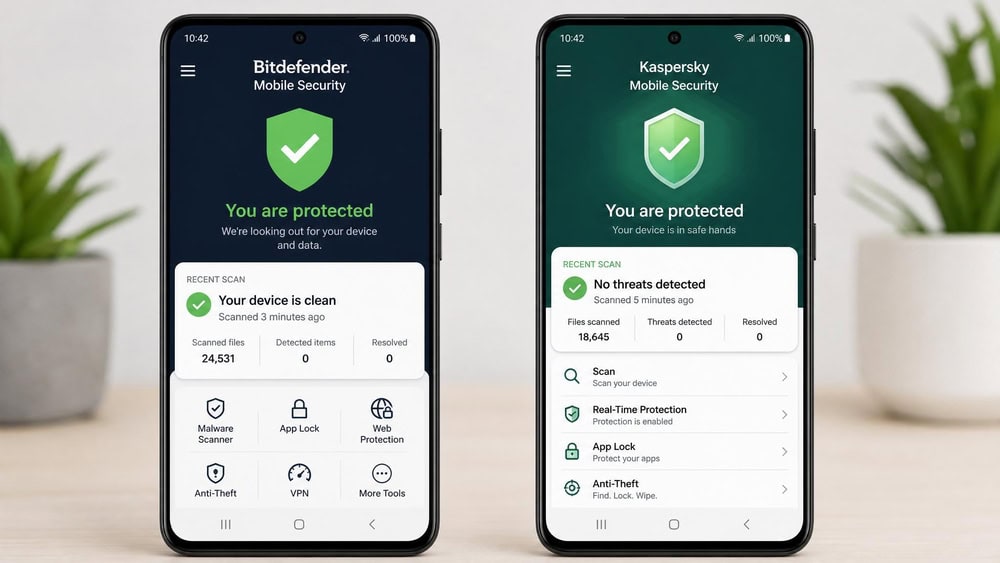
Bitdefender centers everything on a single status indicator and an Autopilot system that surfaces recommendations only when something needs attention. Tools live in a left rail, and the default install is genuinely go-and-forget for non-technical users.
Kaspersky Interface
Kaspersky's window is tile-based and equally approachable, with scan, privacy, and performance laid out plainly. It felt the snappier of the two to navigate, consistent with its lighter footprint.
Verdict: Usability
Usability is a wash: both are clean, fast, and beginner-friendly. Kaspersky feels marginally lighter; Bitdefender's Autopilot is the more hands-off.
Device Compatibility (Windows, macOS, Android, iOS)
Both vendors cover the same four platforms. Bitdefender Total Security and Kaspersky's Standard, Plus, and Premium tiers all run on Windows, macOS, Android, and iOS, so a mixed-device household is served either way. One wrinkle: Bitdefender's entry-level Antivirus Plus is Windows-only, so full cross-platform coverage needs Total Security or higher. On the Kaspersky side, the practical limiter is not the platform list but US availability.
Pricing and Plans
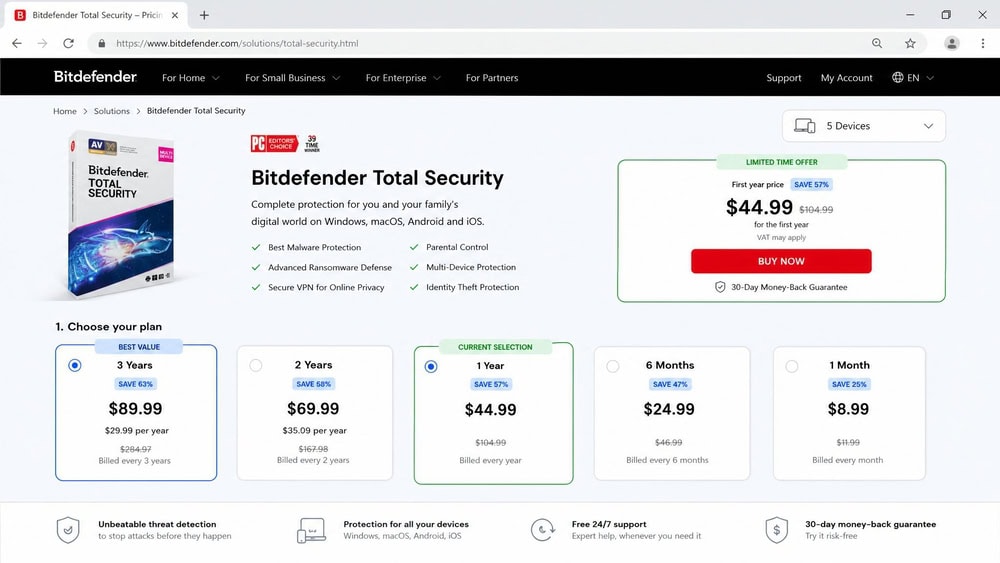
Price is where US readers face an unusual asymmetry: Bitdefender's figures are live and actionable, while Kaspersky's US prices are historical because the product can no longer be sold to new American customers.
Bitdefender Pricing
Bitdefender Total Security runs around $59.99 for the first year covering five devices, though the live rate moves; we have seen the same plan from roughly $19.99 to $79.99 across official and third-party promos, so verify the current offer at checkout. Renewal is the catch because Bitdefender's own page only says it "may be higher than the initial purchase price," and third-party trackers commonly cite around $90/year for a 3-device plan, though the figure varies by term and device count, so budget for a step up in year two.
Kaspersky Pricing
There is no current legitimate US consumer price for Kaspersky. New US sales and licensing have been prohibited since July 20, 2024, with updates and resale barred since September 29, 2024, so an American reader cannot legally buy or download it at any price. The historical Standard listing of around $38.99 per year is now context only, not an offer. Outside the US, Kaspersky remains available and priced normally.
Free Versions Compared
Bitdefender offers a useful free antivirus for Windows with no expiry, minus the VPN, password manager, firewall, parental controls, and full anti-phishing. Kaspersky's free tier exists globally, but for US readers it is effectively unavailable: since updates were cut off on September 29, 2024, a US install cannot stay current. Bitdefender is the only practical free choice for an American reader.
Verdict: Value for Money
Bitdefender wins value, less on sticker price than on the fact that a US buyer can actually purchase, run, and update it. Kaspersky's intro pricing may look competitive on paper, but a product you cannot legally buy or update has no value to weigh.
Customer Support
Bitdefender offers the more complete support for US readers: 24/7 chat, email, phone, and an extensive in-app knowledge base. Kaspersky's support is comparable globally, and Premium bundles remote IT assistance, but US users hit the same wall as everywhere else: official channels are constrained by the sales ban.
Privacy, Trust, and Safety
This is the section that decides the comparison, and it has nothing to do with detection rates. Bitdefender is an EU company based in Romania with no national-security listing or sales restriction anywhere we could find. Kaspersky's technology is excellent, but its Russian ownership has drawn formal US government action that is now the defining fact of any US purchase decision.
The timeline is specific. The FCC Covered List added AO Kaspersky Lab as a national-security threat on March 25, 2022, the first Russian company on that list. Even earlier, the US warned firms against Kaspersky after Russia's 2022 invasion of Ukraine. Two years later, the US Commerce Department Kaspersky sales ban issued a Final Determination on June 20, 2024 under its supply-chain authority. New US sales and licensing were prohibited effective July 20, 2024, and the more consequential cutoff followed on September 29, 2024, when antivirus signature and codebase updates to US users were barred. That last date is why a US Kaspersky install is a liability rather than an asset: an antivirus that cannot update stops protecting you against new threats.
For balance, Bitdefender's record is not spotless either; the company disclosed a 2015 data breach in which some customer records were exposed. But there is no Bitdefender equivalent to a federal sales ban and an update cutoff, and that asymmetry is decisive for a US reader.
Final Verdict: Should You Choose Bitdefender or Kaspersky?
Technology and practicality point the same way for most readers. On protection the two are tied; on system impact Kaspersky is lighter; on features, value, availability, and trust Bitdefender holds the advantage where it counts. For a US buyer the ban settles the question; readers elsewhere have a genuine choice.
Choose Bitdefender if…
- You are in the US and want a suite you can legally buy and keep updated
- You want the broadest privacy toolkit (Anti-Tracker, file shredder, webcam protection)
- You want a strong, no-expiry free version for Windows
- You value steady availability and full customer support
Choose Kaspersky if…
- You are outside the US, where it remains fully supported
- You are running older or low-spec hardware and want the lightest system impact
- You specifically want the Safe Kids parental platform or unlimited Premium VPN
Frequently Asked Questions
Is Kaspersky better than Bitdefender?
On lab protection they are essentially tied, with both earning a perfect 6.0 from AV-TEST and an ADVANCED+ rating from AV-Comparatives. Kaspersky is lighter on resources, but Bitdefender wins overall for US readers because Kaspersky can no longer be legally sold or updated there.
Who owns Kaspersky, and is it safe or banned in the US?
Kaspersky was founded in 1997 by Eugene Kaspersky and is headquartered in Moscow, Russia. The US Commerce Department prohibited new US sales from July 20, 2024 and cut off updates to US users on September 29, 2024. The product remains fully supported outside the US.
Can I run Bitdefender and Kaspersky at the same time?
No. Two real-time antivirus engines running together will conflict, flag each other, and degrade both performance and protection. Install one only; if you switch, fully uninstall the first.
Which is cheaper, Bitdefender or Kaspersky?
Kaspersky's historical Standard price (around $38.99/year) looked lower than Bitdefender Total Security (around $59.99 first year), but because Kaspersky cannot be sold to new US customers, Bitdefender is the only one a US reader can actually buy.
Which uses fewer system resources?
Kaspersky. AV-Comparatives' Performance Test gives it an impact score of 3.5 (2nd overall) versus Bitdefender's 9.6 (9th), where a lower score means lighter. AV-TEST rates both a perfect 6.0, so the gap matters most on older hardware.
Which is better for gaming?
Both include game or silent modes that suppress notifications and defer scans during full-screen play. Kaspersky's lighter measured impact gives it a slight edge on lower-spec rigs, but on a modern machine the difference is negligible.
Does Bitdefender or Kaspersky have a better free version?
Bitdefender, for US readers. Its free Windows antivirus has no expiry and provides solid real-time protection. Kaspersky's free tier exists globally but cannot receive updates on a US install since the September 29, 2024 cutoff.

 IObit Malware Fighter Review
 Kaspersky Safe Kids Review
 Aura Review
 Apps That Detect Spyware
 Best iPhone Spyware Detection Apps
 How to Detect Spyware on Android
 Signs Someone Is Spying on iPhone
 Why Internet Safety Matters