Total VPN is mostly sold inside TotalAV's antivirus bundles, and on its own it renews at a $99 annual list price once the first-year deal ends. Its privacy policy has no VPN no-logs statement, and no independent audit has been published. That leaves a lot of subscribers asking whether a dedicated VPN would give them more for the same money.
We compared seven alternatives against Total VPN on speed, leak protection, streaming, audited no-logs policies, device limits and what you actually pay in year two. Each score below comes from that VPN's full HTS review. Our top pick is NordVPN, which scores 9.0 against Total VPN's 6.4.
Quick list: the best Total VPN alternatives
If you only have a minute, these are the seven VPNs we would move to from Total VPN, ranked by their HTS review scores:
- NordVPN (9.0/10) - best overall Total VPN alternative
- Proton VPN (9.0/10) - best free Total VPN alternative
- ExpressVPN (8.8/10) - best for streaming and ease of use
- Surfshark (8.6/10) - best for unlimited devices
- Mullvad VPN (8.5/10) - best for privacy without an account
- Windscribe (8.5/10) - best free tier with generous data
- Private Internet Access (8.4/10) - best for customization and torrenting
The best Total VPN alternatives in 2026
Every VPN below was measured against Total VPN as the baseline. We looked at how much speed each one gives up on nearby servers, and on distant ones where we ran them. We also checked whether its kill switch and leak protection hold, which streaming services it reaches, and what it costs after the first term. A handful of these also add things Total VPN simply does not offer, such as a Linux app, port forwarding or a free plan.
1. NordVPN - best overall Total VPN alternative
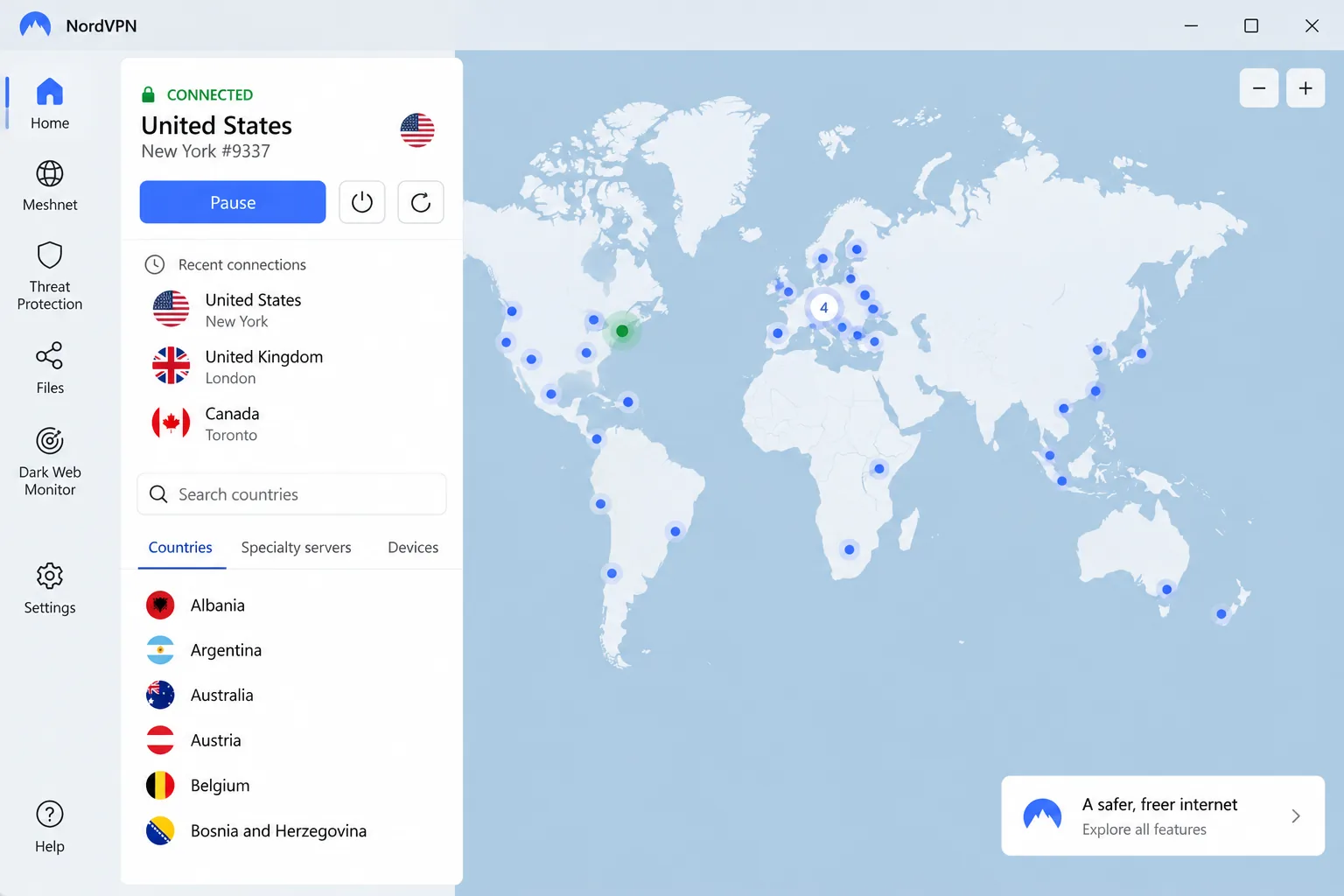
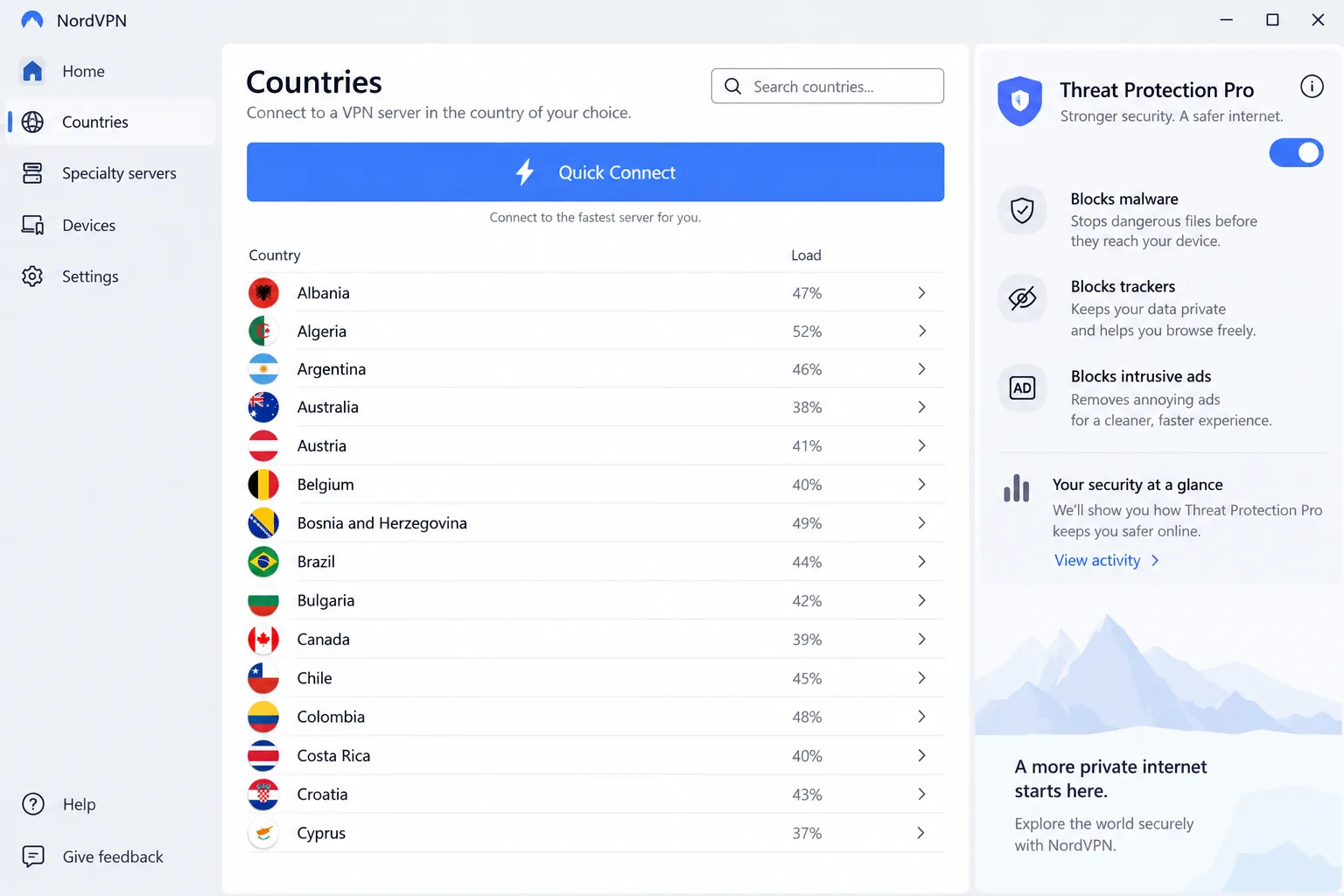
NordVPN is the most complete upgrade from Total VPN, and it earns 9.0 in our NordVPN review. Speed was the first thing we checked. On nearby servers NordVPN cost us only about 4% of our download speed and 7% of upload, and 4K streams played without buffering. Netflix, Hulu, BBC iPlayer and Prime Video all unblocked reliably.
Double VPN is the exception to that strong performance. It cut our speed by around 80% and only runs on preset server pairs, so we keep it for occasional high-privacy sessions. There are small rough edges too. The map view needs zooming before you can pick a server, so we switched to the list view, and live chat opens with a chatbot before a person takes over.
NordVPN is based in Panama, and Deloitte Lithuania completed NordVPN's sixth no-logs assurance engagement in December 2025. NordVPN runs rolling promotions, so the two-year Basic plan moves between roughly $3.09 and $3.49 a month. The renewal price is much higher than the intro rate, at roughly $8 to $12 a month depending on the term you renew onto.
Pros
- Threat Protection Pro blocks ads and malware
- RAM-only servers and post-quantum encryption
- Full Linux app and router support, which Total VPN lacks
Cons
- Renewal costs well above the intro rate
- No free plan
2. Proton VPN - best free Total VPN alternative
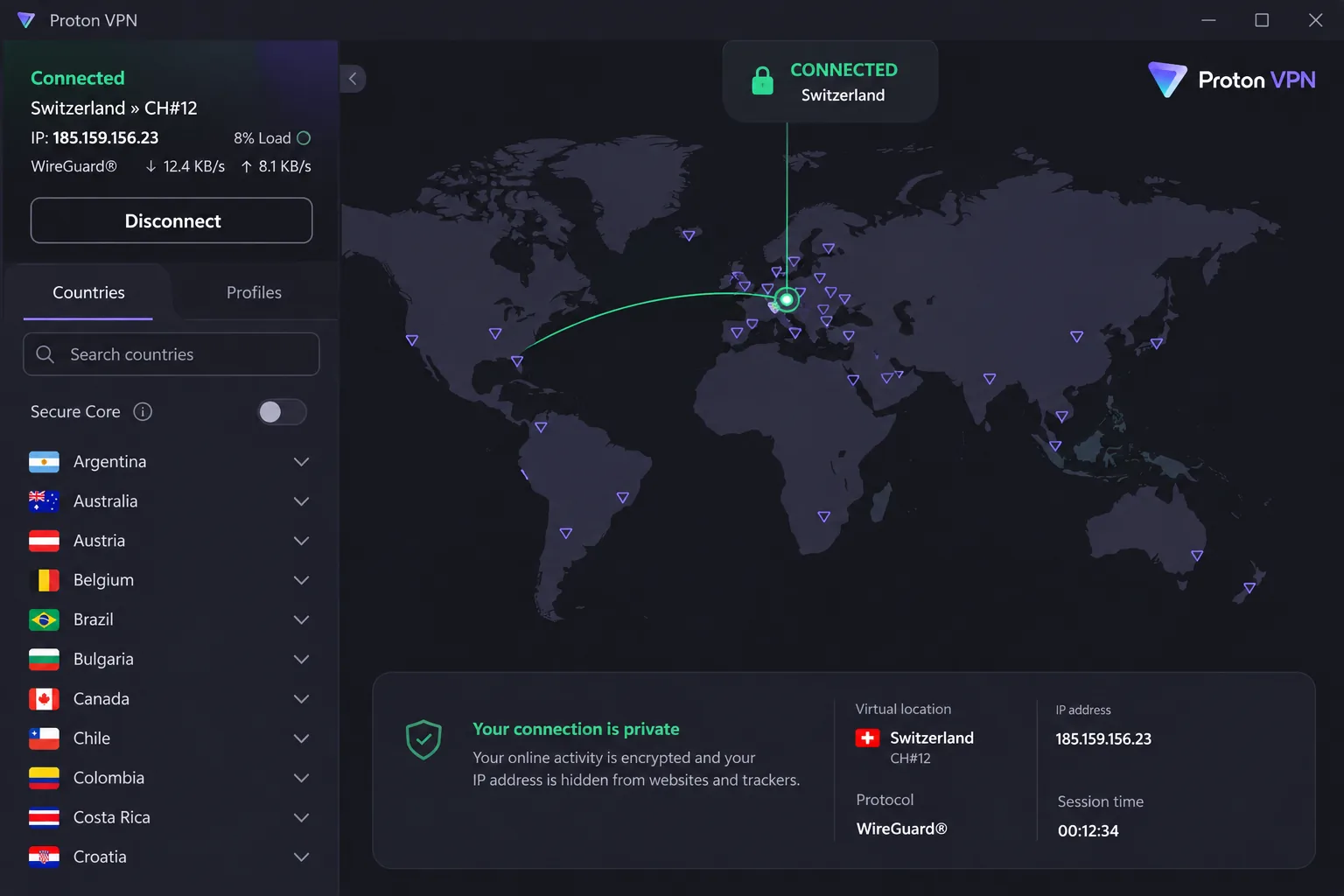
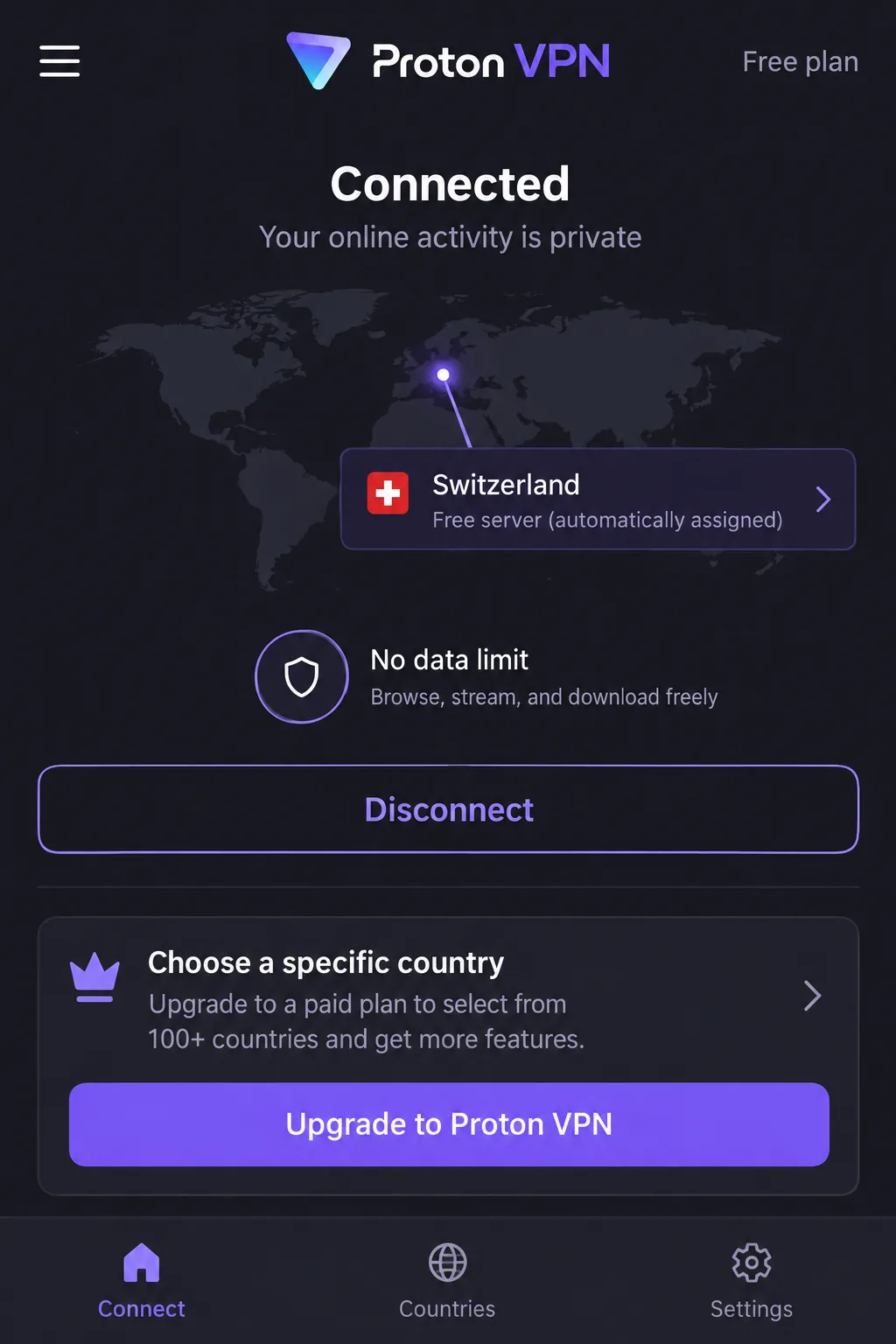
Where NordVPN wins on extras, Proton VPN wins on what you can do without paying. Total VPN has no free plan and no free trial, while Proton's free tier has no data cap and no ads. It covers 1 device and servers in 10 countries and runs at medium speed. It also assigns a server for you instead of letting you pick a country. The paid VPN Plus plan scores 9.0 in our Proton VPN review.
On VPN Plus, nearby servers gave up only about 10% of our baseline speed, and distant servers averaged around three-quarters of baseline. That is a far smaller long-haul penalty than the 76% drop we measured on Total VPN's UK-to-Australia route. DNS, IPv6 and WebRTC leak tests stayed clean across dozens of countries, and the US Netflix library loaded without any server hopping. Support is the weak spot: live chat runs roughly 9am to midnight CET, and email replies can take two days or more.
Proton AG is based in Switzerland, and Securitum has now completed its fifth consecutive annual independent no-logs audit of the service. VPN Plus costs $2.99 a month on the two-year plan, $3.99 on one year or $9.99 monthly. Proton VPN's renewal rate depends on the plan length you renew onto.
Pros
- Secure Core multi-hop and the NetShield ad, tracker and malware blocker on paid plans
- P2P with port forwarding on paid plans
- Open-source apps, including Linux and Apple TV
Cons
- Free users cannot choose a country
- Live chat is not available around the clock
3. ExpressVPN - best for streaming and ease of use
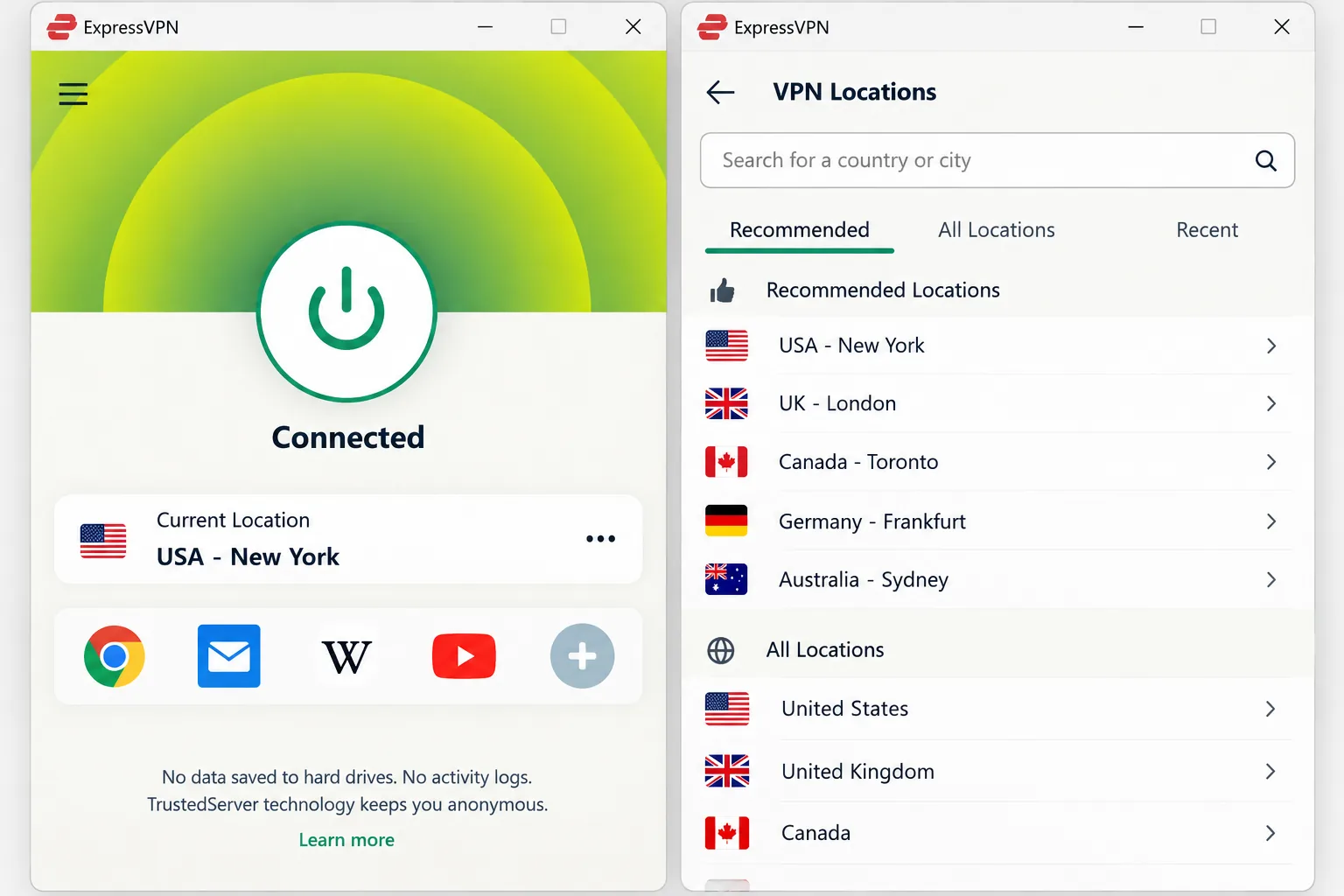
Proton's free tier is a privacy tool first, while ExpressVPN is the pick for people whose main frustration with Total VPN is streaming. It scores 8.8 in our ExpressVPN review, and its apps are the most polished of the seven. Netflix libraries in several countries, ESPN+ and Hulu streamed without issues in our checks, with no hunting for a server that works.
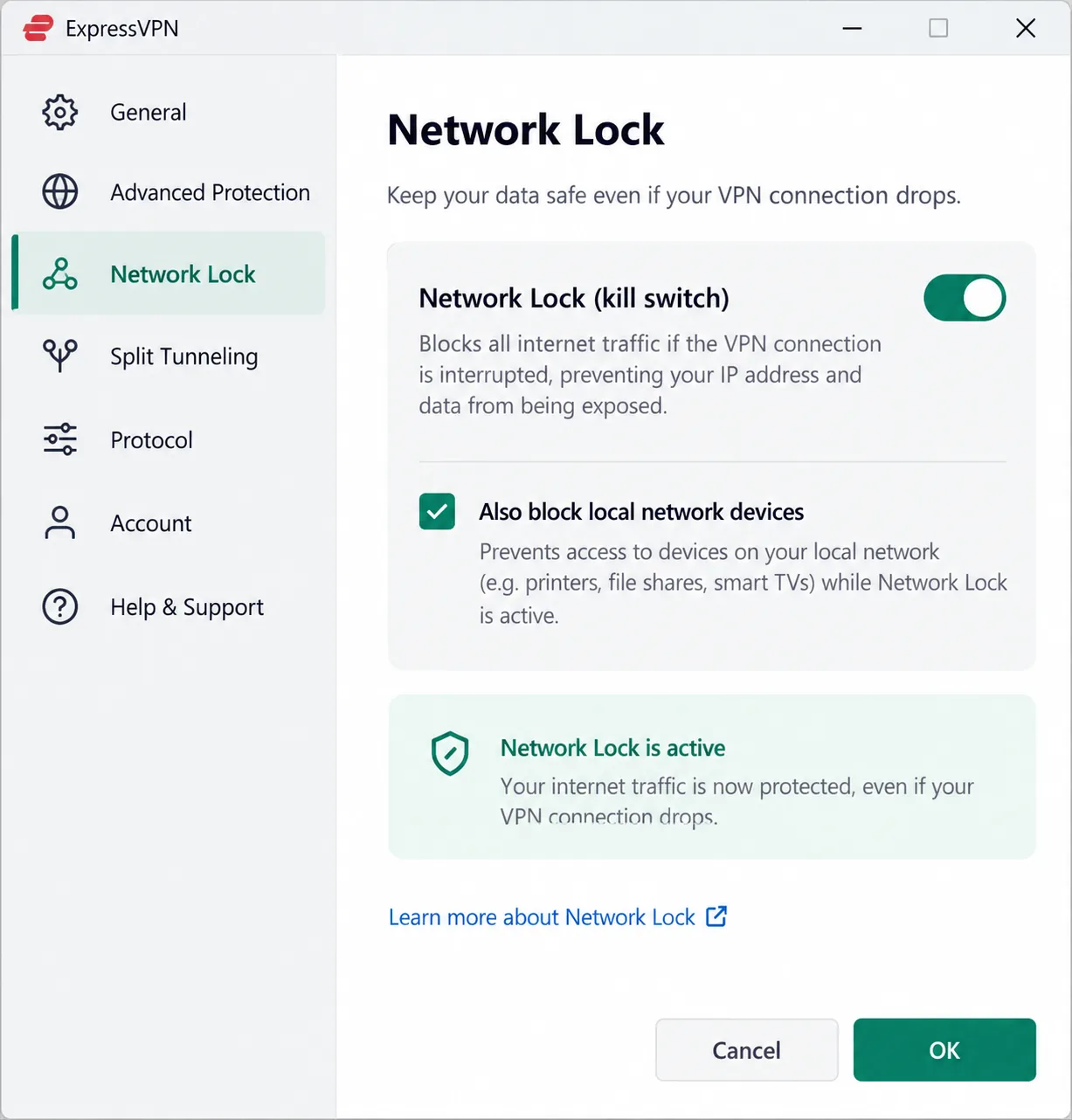
Network Lock, ExpressVPN's kill switch, fired correctly when a server timed out and again when we changed networks. The trade-off is raw speed: downloads fell roughly 37% to 39% on nearby servers, more than NordVPN or Proton VPN lost. Email support can take close to two days, so live chat is the faster route.
Price is the other catch, since ExpressVPN costs more than NordVPN and Surfshark on comparable terms. Its two-year Basic rate moves between about $2.44 and $2.99 a month with promotions and bonus months, and Basic renews at $99.95 a year. That renewal is almost exactly Total VPN's $99 list price, so you pay the same in year two for a much stronger service.
ExpressVPN is registered in the British Virgin Islands and owned by Kape Technologies, which also owns PIA. KPMG has audited its privacy commitments three times, most recently in June 2025, and the reports are listed on ExpressVPN's security audits page.
Pros
- Lightway protocol with post-quantum protection
- RAM-only TrustedServer setup and automatic obfuscation
- Apps for routers, Apple TV, Fire TV and browsers
Cons
- Bigger speed loss on nearby servers than NordVPN or Proton
- Only 10 devices on the cheapest tier

4. Surfshark - best for unlimited devices
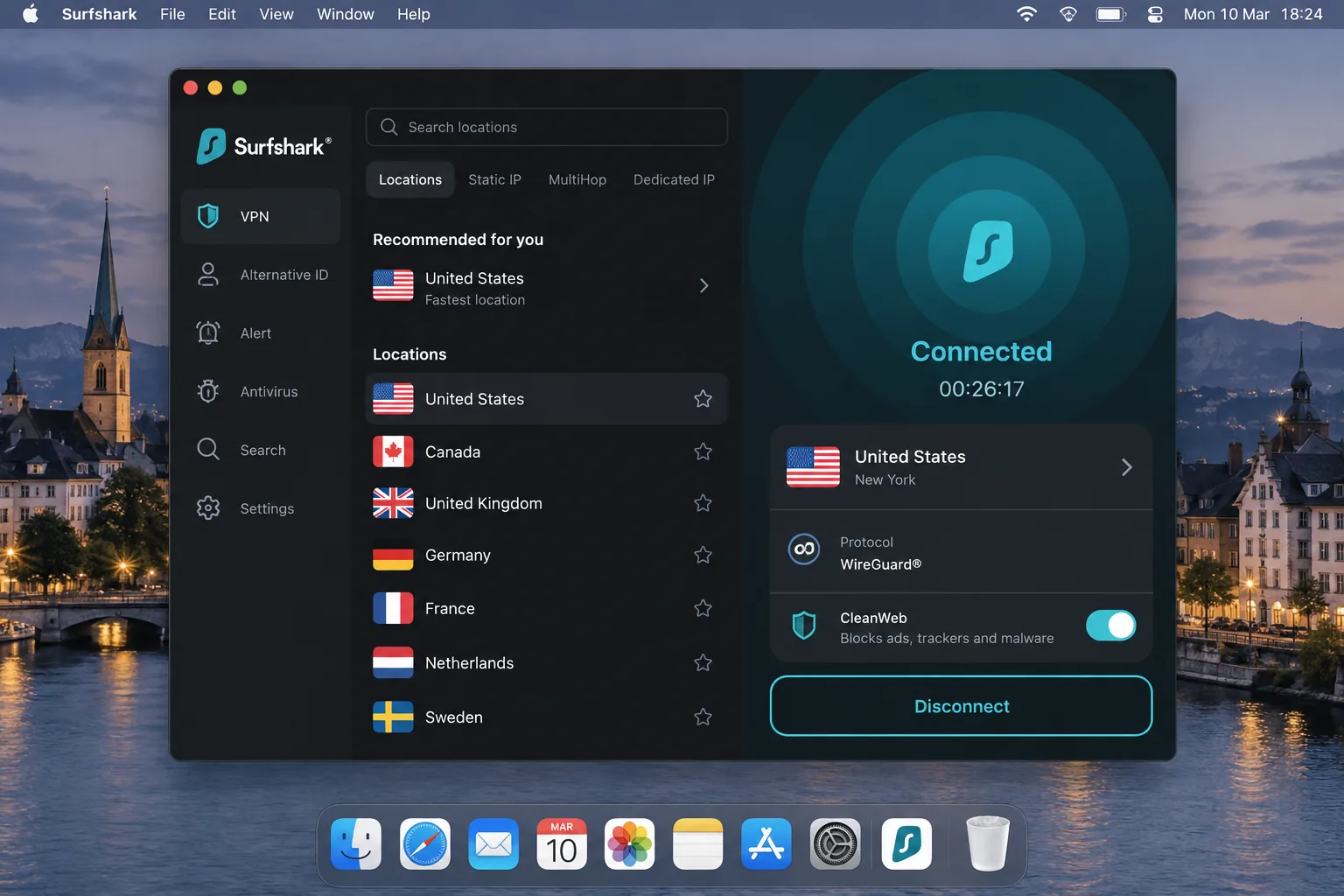
If ExpressVPN is the premium choice, Surfshark is the household one. Total VPN's device limit depends on whether you buy the standalone app or a TotalAV bundle, and the vendor does not publish a single figure. Surfshark removes the question with unlimited simultaneous connections on every plan, and it scores 8.6 in our Surfshark review.
On macOS, our downloads slowed by only about 10% on a transatlantic server. The Windows app showed bigger slowdowns and occasional ping spikes, so Mac users get the better experience. Netflix unblocked in more than 15 regional libraries, plus Max, Disney+, Hulu and BBC iPlayer. The kill switch held, and no IPv4, IPv6, DNS or WebRTC leaks appeared. MultiHop slowed connections significantly, so we left it off for everyday use.
Surfshark B.V. is based in the Netherlands, and Deloitte verified its no-logs policy in 2023 and again in 2025. The Starter plan costs $2.49 a month on the two-year term, billed $67.23 for 27 months. Surfshark's monthly price differs by region and tax but sits at roughly $15 to $16, which makes it one of the priciest month-to-month plans in the category. The value is on the two-year plan.
Pros
- CleanWeb blocker and Camouflage obfuscation included
- Native Android TV, Apple TV and Fire TV apps
- RAM-only servers and Dynamic MultiHop
Cons
- Windows app is slower, with occasional ping spikes
- Expensive on monthly billing
5. Mullvad VPN - best for privacy without an account
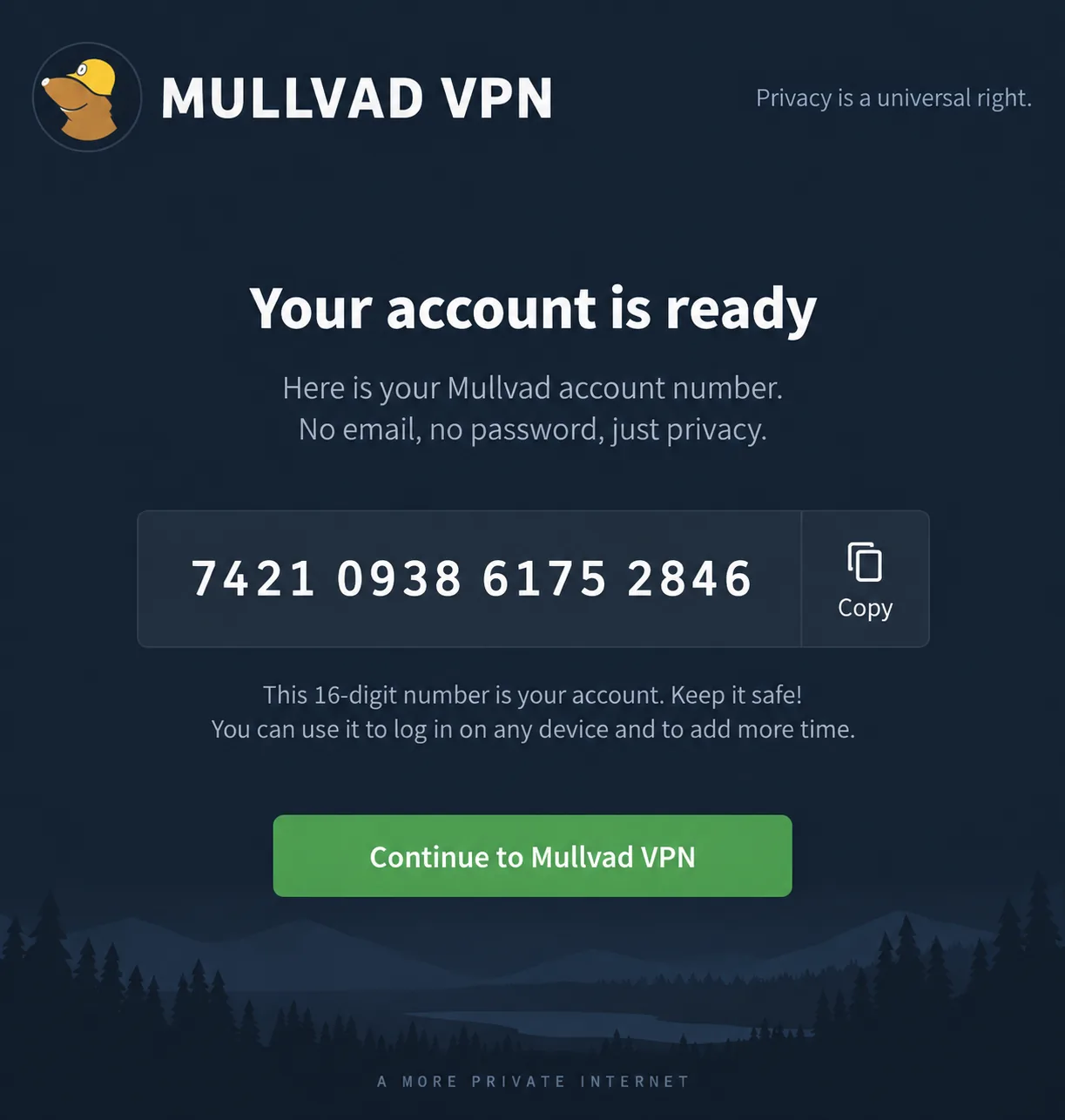
Surfshark is about covering every device; Mullvad VPN is about handing over as little as possible. Sign-up generates a random 16-digit account number, and that number is the only login. There is no email, username or password, and creating an account took us seconds. Mullvad scores 8.5 in our Mullvad VPN review.
Mullvad also fixes Total VPN's renewal problem in the simplest way. It charges a flat EUR 5 a month (about $5.60) on any term, with no discounts and so no renewal jump. Local speed loss was only around 6% in our runs, while distant servers slowed downloads noticeably. Streaming was hit or miss, with some servers getting into Netflix and others being detected. Support is email-only, and replies came in hours rather than minutes.
The privacy record is what sets Mullvad apart. Swedish police searched its office on April 18, 2023, and left with no customer data because none was stored. Cure53 audited its infrastructure in 2024, and X41 D-Sec reviewed its account and payment systems in January 2026. Having removed OpenVPN in January 2026, Mullvad now runs WireGuard only. Its 14-day refund excludes cash, crypto and App Store payments.
Pros
- DAITA traffic-analysis protection and multihop
- Pays by cash or crypto as well as card and PayPal
- Open-source apps, including Linux
Cons
- Only 5 devices
- Email-only support and no port forwarding

6. Windscribe - best free tier with generous data
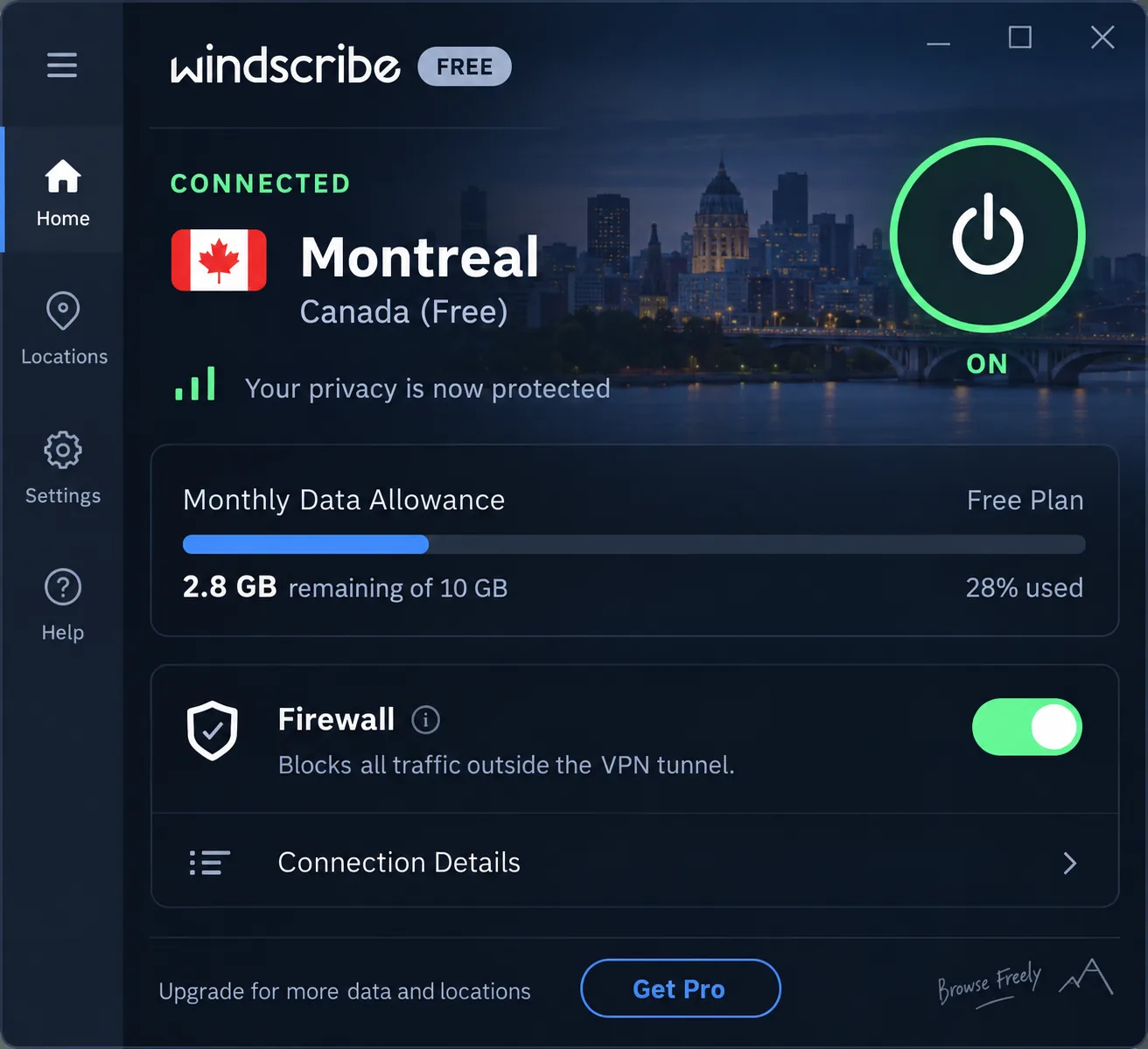
Like Proton, Windscribe gives you a real free plan, but it trades Proton's unlimited data for unlimited devices. The free tier offers 10GB a month once you confirm an email address, across servers in 10 countries. Windscribe scores 8.5 in our Windscribe review.
On the paid Pro plan, a nearby US server over WireGuard barely dented our speed, going from 94.6 to 91.8 Mbps, and Singapore still held about 68 Mbps. The free tier is less steady: speeds periodically dropped by up to 90%, roughly twice every three hours. Free servers did not unblock US Netflix, though the UK, French and German libraries worked. The desktop Firewall blocks all traffic outside the tunnel by default, so when we killed the VPN process our traffic stopped instead of exposing our real IP.
Some settings live on Windscribe's website rather than in the app, including R.O.B.E.R.T. custom blocking rules and port forwarding. The AI chatbot answers quickly, but a billing question waited about 18 hours for a human reply.
Pro costs $9.00 monthly or $69 a year ($5.75 a month), and the yearly plan renews at the same rate. Windscribe Limited is based in Canada, which is a Five Eyes member just as Total VPN's UK is, but its no-logs claim was tested in practice. An Athens court dismissed the case against its CEO on April 11, 2025, because no user logs existed to hand over. Its audits are security audits rather than no-logs audits, and the most recent was Packetlabs' review of its server stack in June 2024.
Pros
- Free plan works on unlimited devices
- Firewall kill switch on by default on desktop
- Double Hop, static IPs and an anti-censorship mode
Cons
- No human live chat
- Refunds only within 7 business days, under 10 GB used, and for unfixable technical issues

7. Private Internet Access - best for customization and torrenting
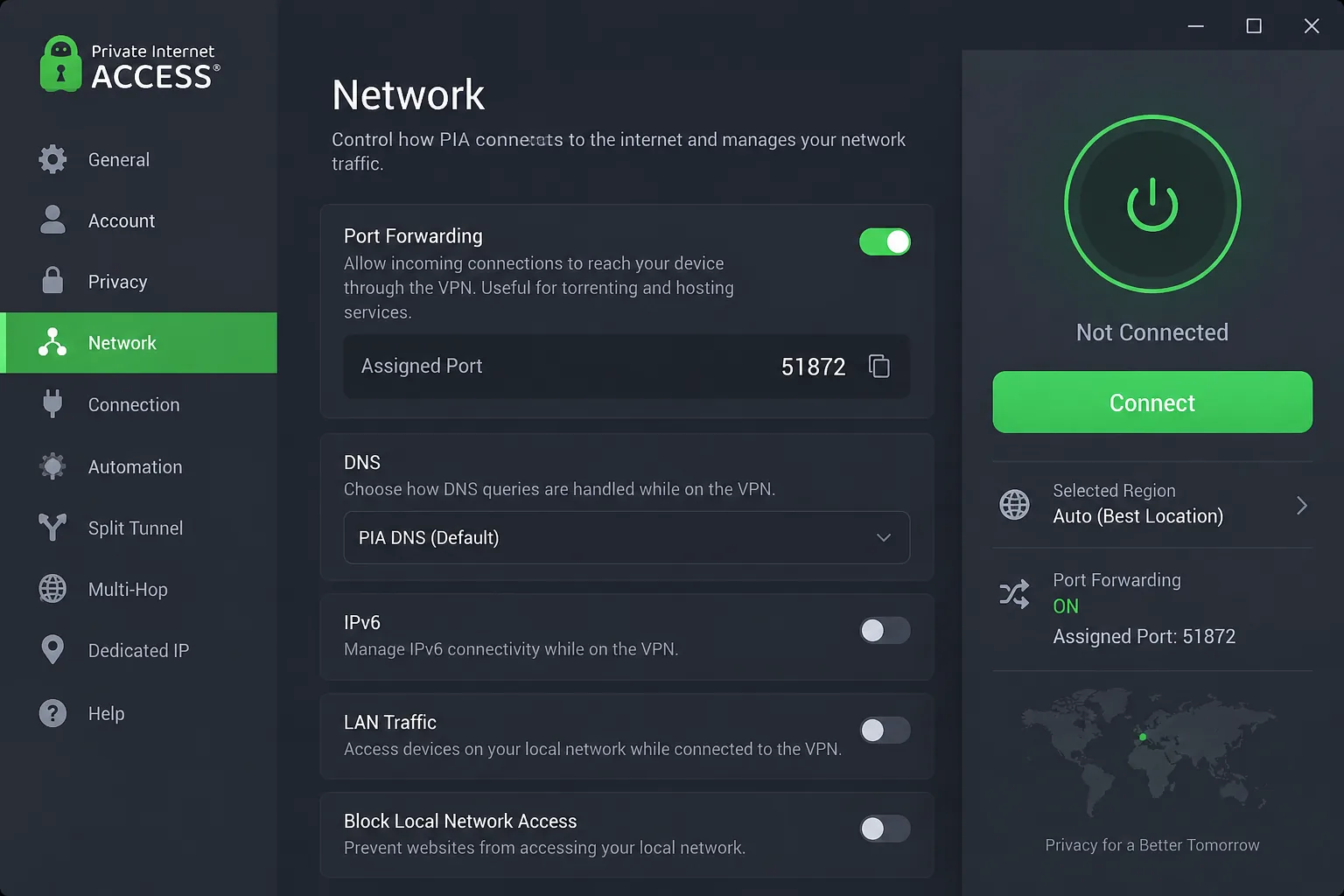
Private Internet Access sits at the opposite end from Mullvad's simplicity. It gives you more advanced settings than any other VPN here, including customizable encryption, Multi-Hop via proxy and split tunneling, and it scores 8.4 in our PIA review. The long settings list overwhelmed us a little at first, but it became easy to manage once we had tuned it.
Torrenting is where PIA beats Total VPN most clearly, because Total VPN has no port forwarding at all and PIA offers it on all servers except US locations. Torrenting with port forwarding cost very little speed, but the forwarded port changed every time we reconnected, so expect to update your client. General speed loss was small: about 4% on local servers and 18% on international ones.
PIA is based in the United States and has been owned by Kape Technologies since 2019. Deloitte completed PIA's third no-logs assurance audit on December 19, 2025. PIA rotates its long-term deal, so the three-year-plus-three-months rate sits around $1.89 a month depending on date and region. The monthly plan is $11.95. Auto-renewal is on by default, and refunds within the 30-day window need a manual support request.
Pros
- Servers in all 50 US states
- Open-source apps, including a full Linux app
- MACE blocker and RAM-only servers
Cons
- US and UK Netflix stayed blocked, and Disney+ and Hulu detected the VPN in our tests
- Auto-renewal is on by default
Total VPN alternatives compared
The table puts the seven picks side by side, with Total VPN in the last row as the baseline. Prices marked "about" move with promotions.
| Product | Buy | Starting price | Monthly / renewal | Devices | Server countries | Free plan | Independent no-logs audit | Streaming | Torrenting | Platforms | Standout feature |
|---|---|---|---|---|---|---|---|---|---|---|---|
|
Check price → | About $3.09-$3.49/mo (2 yr) | $14.99 monthly; renewal about $8-$12/mo | 10 | About 118-160+ (counts vary) | No | Yes: Deloitte, 6th, Dec 2025 | Strong | P2P servers | Windows, Mac, Linux, Android, iOS, TV, router | Threat Protection Pro, Meshnet |
|
Check price | $2.99/mo (2 yr) | $9.99 monthly | 10 (free: 1) | 140+ | Yes, no data cap (10 countries) | Yes: Securitum, 5th annual | Good on paid plans | P2P with port forwarding (paid) | Windows, Mac, Linux, Android, iOS, TV | Free plan with no data cap; Secure Core |
|
Check price | About $2.44-$2.99/mo (2 yr) | $12.99 monthly; renews $99.95/yr | 10 / 12 / 14 by tier | 113 | No | Yes: KPMG, June 2025 | Strong | Allowed | Windows, Mac, Linux, Android, iOS, router | Lightway, polished apps |
|
Check price | $2.49/mo (2 yr + 3 mo) | About $15-$16 monthly | Unlimited | 100 (4,500+ servers) | No | Yes: Deloitte, 2023 and 2025 | Strong | Allowed | Windows, Mac, Linux, Android, iOS, TV | Unlimited devices |
|
Check price | $5.60/mo flat (EUR 5) | Same flat price, no renewal jump | 5 | About 50 (changes daily) | No | Infrastructure and app audits (Cure53 2024, X41 2026) | Hit or miss | Allowed, no port forwarding | Windows, Mac, Linux, Android, iOS | Anonymous numbered account |
|
Check price | $5.75/mo ($69/yr); free tier | $9.00 monthly; yearly renews at $69 | Unlimited | 69+ | Yes, 10GB/month (10 countries) | Security audits only; no-logs upheld in court, 2025 | Pro good; free misses US Netflix | Allowed, port forwarding | Windows, Mac, Linux, Android, iOS, router, extensions | Generous free tier, Build A Plan |
|
Check price | About $1.89/mo (3 yr + 3 mo) | $11.95 monthly | Unlimited | 104 (total keeps changing) | No | Yes: Deloitte, Dec 2025 | Weak | Port forwarding (non-US) | Windows, Mac, Linux, Android, iOS, router | Port forwarding, deep settings |
 |
Rotating first-year promo (about $19-$39) | Renews at $99/yr list price | Depends on standalone app or bundle | Vendor pages disagree | No free plan or trial | None published | US Netflix reliable; others hit or miss | Allowed, no P2P servers or port forwarding | Windows, Mac, Android, iOS (no Linux, no router) | Bundles with TotalAV antivirus |
How we tested the Total VPN alternatives
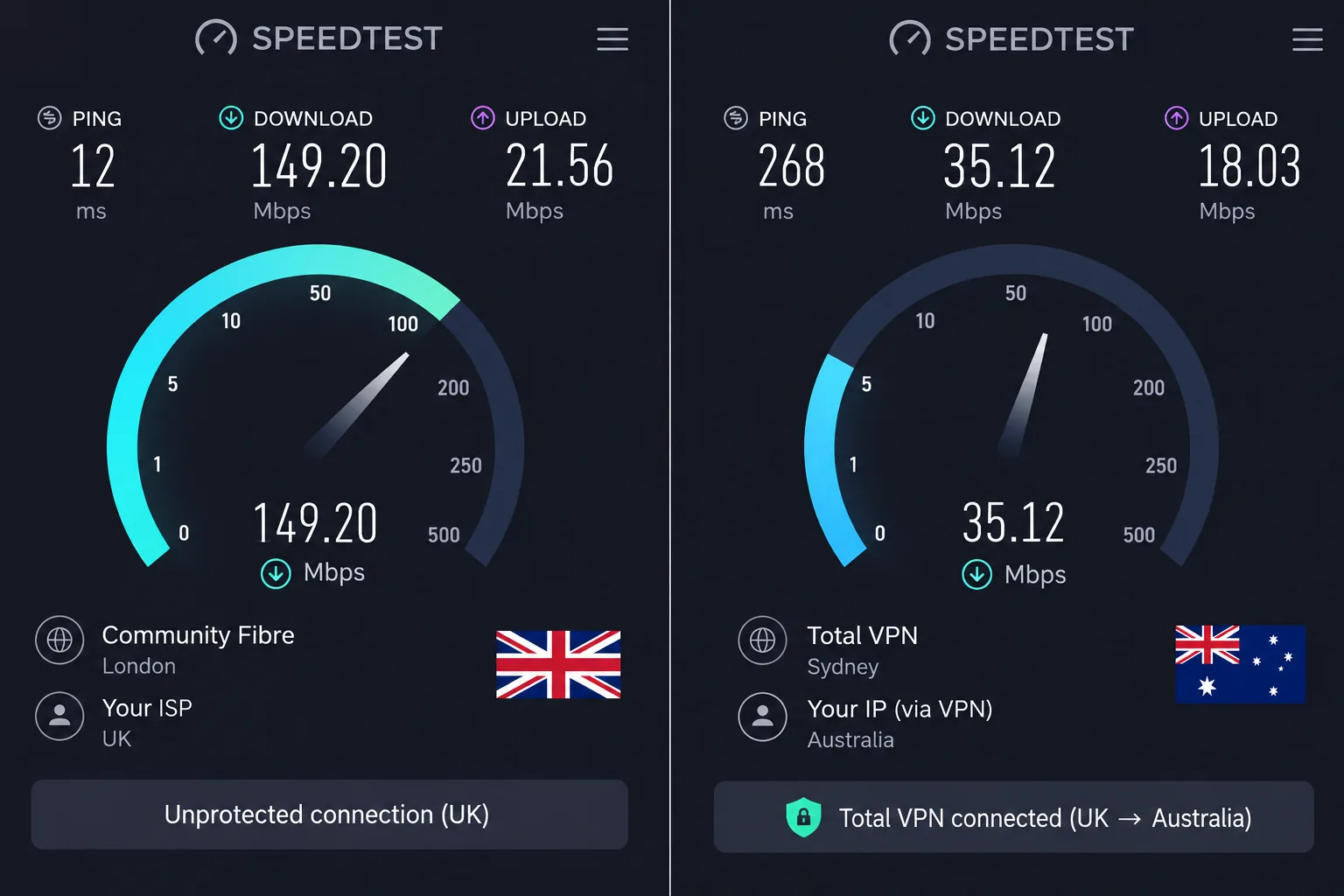
We started with Total VPN itself, so every alternative had a real baseline to beat. On a nearby server over WireGuard, Total VPN's speed loss stayed in the single digits, and browsing, downloads and HD streaming felt no different from an unprotected connection. Distance changed that picture. Speed on a UK-to-Australia route fell about 76%, from 149 to 35 Mbps, while UK, US and Canada servers held around 117 to 120 Mbps. Latency on distant servers also climbed high enough to make video calls and online gaming laggy.
We then ran the same checks on each alternative. We measured speed loss on nearby servers and, for most picks, on long-distance routes too. We also ran DNS, IPv6 and WebRTC leak tests and forced disconnects to see whether each kill switch held. Total VPN's kill switch did its job here: it cut traffic even after we forced the app to crash, with no IP leak.
Streaming checks covered Netflix in several regions plus Disney+, BBC iPlayer, Hulu, Max and Prime Video. For privacy, we read each provider's binding privacy policy rather than its marketing copy, and we gave real weight to published independent audits. On price, we looked past the first-term deal to the monthly and renewal rates, and we checked how each service handles cancellation and refunds. Finally, we contacted support to see how quickly a person actually replies.
Why look for a Total VPN alternative?
Total VPN does the basics, so the case for switching is not that it is broken. The real case rests on the bundle you probably bought it in, what you pay after year one, how much proof sits behind its privacy promises and a handful of missing features.
Total VPN and the TotalAV bundle
Total VPN is run by Total Security Limited, a UK company that also makes TotalAV antivirus, and by a US arm in Boston. In December 2024 Total Security merged with Pango Group, and the combined company was renamed Point Wild. Point Wild's brands include TotalAV, Hotspot Shield, Betternet, UltraAV and Comparitech. We cover the standalone app in our Total VPN review, where it scores 6.4.
You can buy Total VPN on its own, but most people get it inside TotalAV. The entry TotalAV Plus and Premium plans do not include a VPN. Internet Security ($129 a year at list price, 6 devices) includes Total VPN, and Total Security ($149 a year, 8 devices) adds a password manager. The VPN inside TotalAV scores 6.5 in our TotalAV VPN review.
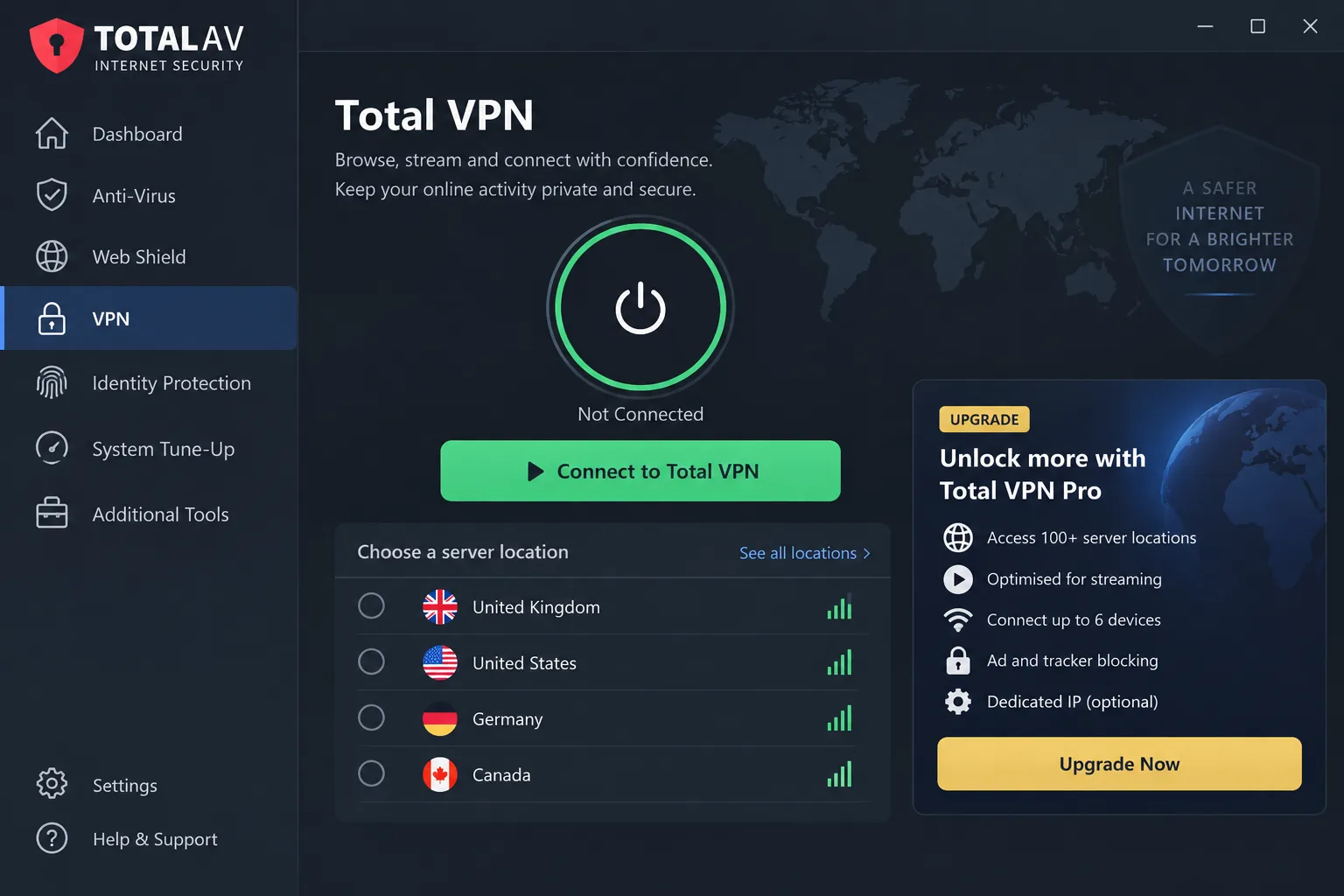
Those two versions behave like different products. In our testing the standalone app and the VPN inside TotalAV had different server lists, protocols and kill-switch coverage. Setup through the TotalAV app also pushed repeated upsell prompts and add-ons, and locked features stayed on screen until we paid for them.
TotalAV is far from the only antivirus that bundles a VPN. Norton, McAfee, Avast, AVG and Bitdefender all do the same. A bundled VPN is convenient, but it is usually a secondary product inside a security suite, so compare it with a dedicated VPN before renewing.
Introductory pricing vs. renewal pricing
Total VPN's own pricing page lists the Premium VPN plan at $99 a year and says the subscription renews automatically at the then-regular rate. The first-year price is a rotating promotion that runs from about $19 to $39 depending on the offer and bundle. The official pricing page shows no intro figure. Either way, the $99 renewal is several times what most people paid in year one.
After a discounted term, the subscription renews at the standard, non-discounted price. Unexpected charges also often trace back to add-ons, such as a password vault or TotalAV, that were ticked during sign-up. Ad blocking is sold separately as Total Adblock.
Several of our picks are easier to budget for. Mullvad charges the same flat price on every term, Windscribe's yearly plan renews at the same $69, and ExpressVPN publishes its $99.95 renewal up front.
Privacy policy, audits and logging
Total VPN is based in the United Kingdom, a Five Eyes intelligence-sharing member. That alone does not rule a VPN out, but it raises the bar for privacy proof, and Total VPN's paperwork does not clear it.
Its privacy policy, effective 28 November 2025, contains no VPN no-logs statement. A general clause says the company may automatically collect "browser type, IP address, pages visited and other activities on the Services, device type, time and date of visit". It keeps data "for as long as we need to use it in connection with our business". The no-logs claim in Total VPN's help centre is not reflected in that binding privacy policy. No independent no-logs audit has been published to confirm what activity is or is not recorded.
Every pick on our list has outside proof behind its privacy claims. Five have passed independent no-logs audits, Mullvad has infrastructure and app audits plus its 2023 police search, and Windscribe has security audits plus its 2025 court result.
Where Total VPN falls short on features
Total VPN offers AES-256 encryption and DNS and IP leak protection, but it is single-hop only, with no double VPN, no RAM-only servers, no port forwarding, no labelled P2P servers and no dedicated streaming servers or SmartDNS. There is no Linux app and no router support. Protocol choice differs between the standalone Total VPN app and the version inside TotalAV. Whether a device gets the kill switch also depends on the app version and platform.
Reliability was the bigger issue in daily use. The connection tended to drop during idle periods and did not reconnect on its own, so a laptop could wake up unprotected until we reconnected by hand. Single-device setup was quick, but the multi-device instructions were unclear, and a bundled install needed a full restart before it worked. When we needed help, live chat was hard to find from the support site, and each session started with a chatbot before a human took over.
How to choose a Total VPN alternative
Once you know why you are leaving Total VPN, start with privacy proof, because it is the hardest thing to check yourself. Look for a recent, published independent no-logs audit, and read the binding privacy policy rather than the help-centre summary. EFF's guide to choosing a VPN is a good checklist for the questions to ask about ownership, logging and jurisdiction.
Next, work out the year-two price. Ignore the headline monthly rate, look up the renewal price, and decide whether a flat-priced service suits you better than a deep first-term discount. Count your devices too, because a household with more than five or six is better served by a VPN with no device limit.
Then match the VPN to what you actually do online. Streaming fans should lean toward NordVPN, ExpressVPN or Surfshark, while torrenting is easier with port forwarding on Proton VPN, Windscribe or PIA. Linux users get a proper app from all seven picks, something Total VPN cannot offer.
Use money-back guarantees to test a replacement before your Total VPN plan renews. NordVPN, Proton VPN, ExpressVPN, Surfshark and PIA all give you 30 days. Mullvad's window is 14 days, and Windscribe's refund terms are much stricter, so try its free plan first instead.
Free Total VPN alternatives
If you would rather not pay anything while you decide, note that Total VPN has no free plan, so the only way to try it is inside the money-back window. Several alternatives let you use a VPN at no cost, with sensible limits.
Proton VPN is our first choice, because its free plan has no data cap and no ads, though it covers only 1 device. Windscribe is the better fit if you want several devices covered, since its free tier works on unlimited devices with 10GB of data a month.
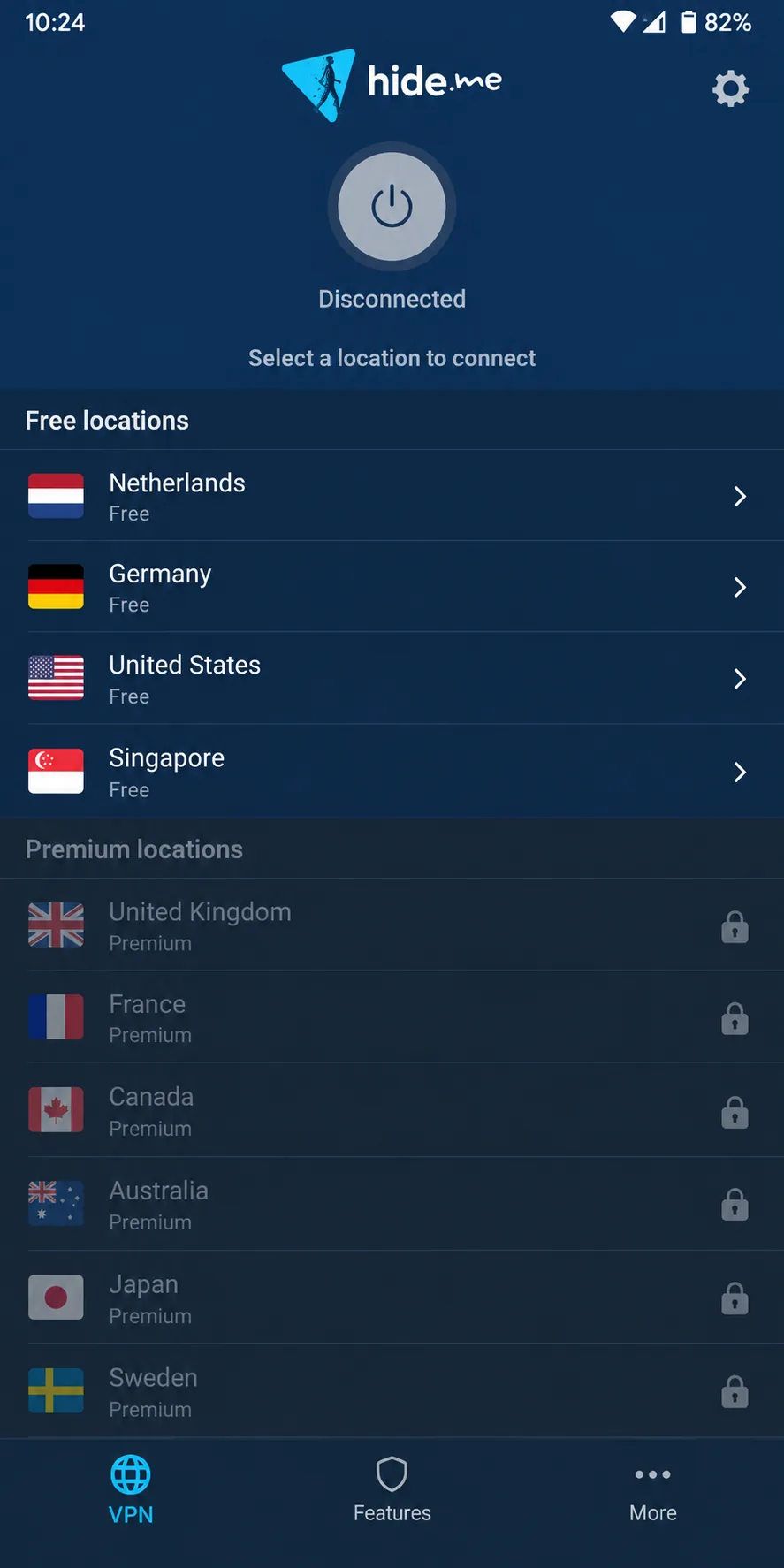
Two other free tiers are worth knowing. Hide.me, which scores 8.2 in our Hide.me review, offers unlimited data on 1 device with 8 free locations, and it needs no account or email. Its no-logs policy has been audited by Securitum. TunnelBear's free plan caps you at 2GB a month, and since early 2026 free users can no longer choose a server. Together, those limits make it hard to recommend beyond light use.
For the full ranking, with every limit compared side by side, see our ranking of the best free VPN alternatives.
VPNs to avoid as a Total VPN replacement
The most common mistake is switching brands without switching owners. Hotspot Shield is a Point Wild brand, just like Total VPN and TotalAV, so moving to it keeps you with the same owner. It scores 6.5 in our Hotspot Shield review, barely above Total VPN. Its free Basic tier covers 1 device, uses US servers only and is ad-supported. In 2017 the Center for Democracy and Technology filed an FTC complaint over Hotspot Shield's data handling. Betternet belongs to the same group.
Be careful with rankings, too. Comparitech ranks Total VPN third of 62 VPNs, but Comparitech is itself a Point Wild brand. That does not make its testing wrong, but it is a conflict of interest worth knowing about.
Finally, swapping one antivirus bundle for another rarely fixes the underlying problem. A VPN tucked inside Norton, McAfee, Avast, AVG or Bitdefender carries the same bundle trade-offs, so check its audit history and renewal price before you commit.
How to cancel Total VPN and switch
Cancelling and getting a refund are two separate steps with Total VPN, and mixing them up is how people end up charged again.
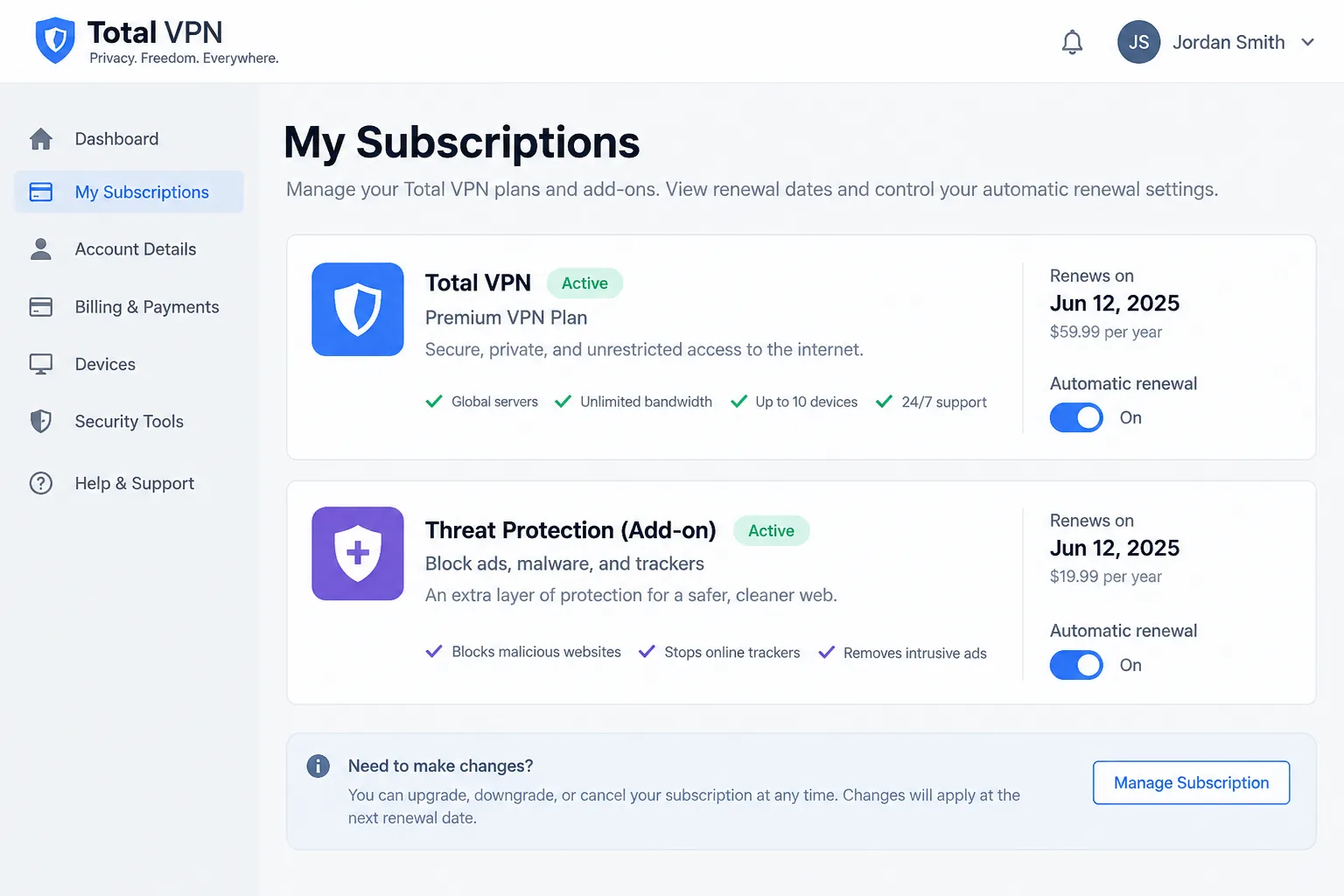
To stop future charges, log in to your Total VPN account and open My Subscriptions in the control panel (the terms also call this area My Services), then turn off automatic renewal. Do this at least 1 day before your billing cycle ends. Turning off auto-renewal does not end your access or trigger a refund. If you want your money back, fully terminate the subscription first, then request the refund from the billing department. Repeat both steps separately for each service on your account, including any TotalAV or add-on plans. If you bought through Apple's App Store or Google Play, cancel and request the refund through that store instead.
Monthly Total VPN plans get no renewal reminder, and annual plans get only an email notice up to 30 days before renewal. Check your account for add-ons ticked at sign-up, because each one renews and must be cancelled on its own.
Once the cancellation is confirmed, install your new VPN before your Total VPN access runs out, so you are never on public Wi-Fi without protection. Uninstall the Total VPN app, or switch off the VPN inside TotalAV if you are keeping the antivirus, so the two VPNs do not fight over your internet connection.
Frequently asked questions
Is Total VPN a good VPN?
Is Total VPN sold separately or only with TotalAV?
What is the best free alternative to Total VPN?
Can I use another VPN alongside TotalAV antivirus?
How do I cancel Total VPN and get a refund?
Is Total VPN good for streaming and torrenting?
Which Total VPN alternative is cheapest?
Verdict: which Total VPN alternative should you choose?
For most people leaving Total VPN, NordVPN is the right move: it gave up only about 4% of our download speed on nearby servers, reaches more streaming platforms and backs its privacy policy with repeated outside audits. Proton VPN is a solid pick if you want to start free or care most about Swiss privacy. ExpressVPN suits streamers who want apps that need no tinkering, and Surfshark is the value choice for households with many devices.
Choose Mullvad if you want to sign up without giving any personal details, Windscribe for the most flexible free and flat-priced plans, and PIA if torrenting with port forwarding matters more than streaming.