ESET VPN is a full-tunnel VPN bundled inside ESET's home security suites, not a standalone app. It gives you ESET VPN coverage across 70+ countries, unlimited data, and six connection protocols, all managed from the same account as your antivirus. That makes it convenient if you already pay for ESET protection. It also means you cannot buy the VPN on its own.
Our verdict up front: ESET VPN is a competent, private-by-design VPN that suits existing ESET customers who want encrypted browsing without a second subscription. It is not a specialist VPN, and it lacks the independent no-logs audit that Nord and Express both publish. If a VPN is your main reason to spend money, a dedicated service still wins. If you already run ESET, the bundled VPN is a genuine, usable extra rather than a token feature.
We reached these conclusions after working through ESET's suites across Windows, macOS, Android and iOS, using the VPN for everyday browsing, downloads and geolocation switching. Where our findings depend on values that vary by region or plan, we flag them. Where speed and streaming cannot be measured reliably, we say so rather than invent numbers.
What Is ESET VPN?
ESET VPN is the encrypted-tunnel component of ESET's consumer security lineup. It routes your traffic through ESET's servers, hides your source IP, and encrypts data in transit. The feature set covers the essentials most users want: a no-logs policy, DNS leak protection, MAC spoofing protection, split tunneling, and a firewall-based kill switch. Several of those protections are desktop-only, which we cover below.
The product sits alongside ESET's antivirus, firewall and password tools rather than replacing any of them. If you have used a standalone VPN app before, the concept is identical. The difference is packaging. ESET treats the VPN as one privacy feature within a broader suite, so it shares your ESET account, your billing, and your device seat count.
That bundled approach shapes everything about the product. It explains the strengths, such as a single login and unified device management. It also explains the limits, such as the absence of an a la carte price and the lack of a dedicated audit. Knowing this framing helps set fair expectations before you subscribe.
Which ESET Plans Include the VPN (and How Many Devices)?
ESET VPN is bundled only in ESET HOME Security Premium and ESET HOME Security Ultimate. It is not sold on its own, so the plan you buy determines what VPN access you get. This is the single most important thing to understand before comparing ESET with a specialist service.
Device coverage scales with the tier. On Premium, the VPN runs on 3 devices, or up to 5 with the larger Premium seat count. On Ultimate, it runs on up to 10 devices, or up to 25 with the larger Ultimate seat count. The higher tier also unlocks more countries, so Ultimate is the plan to pick if VPN reach matters to you.
Because the VPN follows your suite seat count, the same account covers your antivirus and your VPN on the same devices. You do not manage two separate device limits.
The takeaway is simple. Buy Premium if you want the VPN on a few household devices. Buy Ultimate if you want wider country access and coverage across many devices. Neither plan lets you separate the VPN from the antivirus you are paying for.
Features: Encryption, Kill Switch & Protocols
ESET VPN carries the core feature list you would expect from a modern client. The wide protocol choice and deep configuration options are among the strongest parts of the ESET suite in our hands-on use. The trade-off is that the most advanced controls live on desktop, so mobile users get a lighter version.
AES-256 Encryption & DNS Leak Protection
ESET encrypts your traffic with strong, current ciphers. In practice that means AES-256 with IKEv2 and ChaCha20-Poly1305 with WireGuard, though ESET's own product page describes the encryption without naming the cipher. Either way, the protection level matches what specialist VPNs use.
DNS leak protection is built in on desktop. It keeps your DNS requests inside the encrypted tunnel so your browsing is not exposed to your internet provider. This is exactly the behavior we want to see, and it is on by default rather than buried in settings.
Automatic Kill Switch
The kill switch is firewall-based. If the VPN connection drops, it blocks connectivity so nothing leaks outside the tunnel, with always-on and automatic modes on desktop. That is the right design for a privacy tool.
The kill switch can block internet access unintentionally. If your connection suddenly dies, check whether the VPN has dropped before assuming your network is at fault.
VPN Protocols (OpenVPN / IKEv2 / WireGuard)
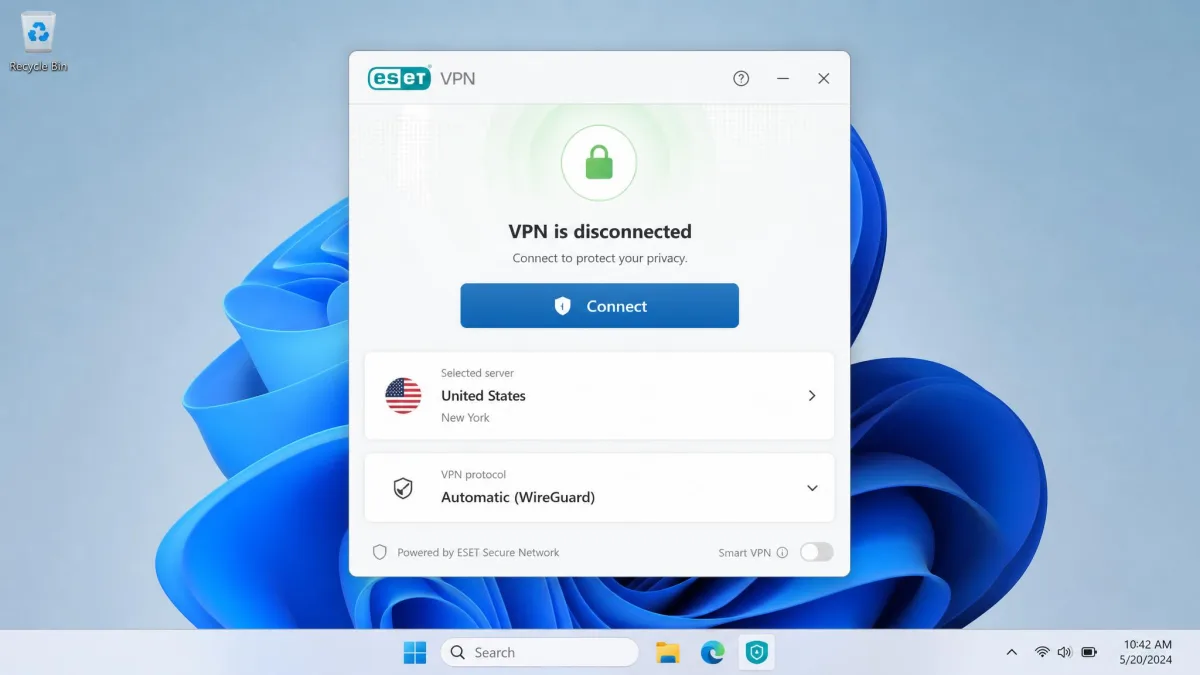
ESET offers six connection protocols: WireGuard, IKEv2 (IPsec), OpenVPN UDP, OpenVPN TCP, Stealth, and Wstunnel. That is a broader spread than many bundled VPNs bother to include. WireGuard is the default we would reach for on speed, while Stealth and Wstunnel help on restrictive networks.
Having this many options is more than a spec-sheet flex. It gives you a fallback when one protocol is blocked or unstable. On mobile especially, switching protocols is a common fix for connection trouble, so the choice earns its place.
Split Tunneling & Router Support
Split tunneling lets you send some apps through the VPN while others use your normal connection. ESET provides it on desktop and Android, which covers most real-world needs. Router support is available through proxy and LAN settings rather than a dedicated firmware app.
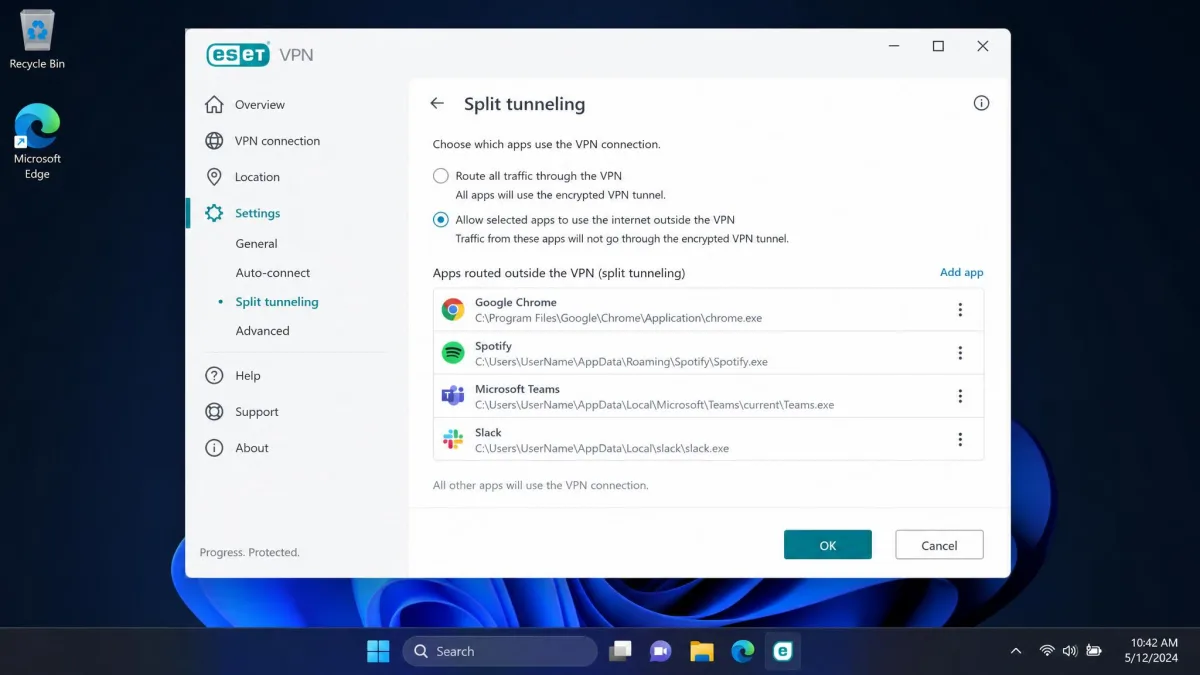
Router setup here is more manual than on VPNs that ship a router package. If whole-home coverage is a priority, plan for some configuration work rather than a one-click install.
Apps, Platform Support & Setup
ESET VPN ships apps for Windows, macOS, Android and iOS, with router use handled through proxy and LAN settings. Coverage is broad enough for a typical household mixing laptops and phones.
Setup is where the bundled model shows friction. Activation uses a separate short-lived code rather than your antivirus license key, and the account owner has to generate a fresh code for each household member. The code is a unique 10-character string that expires after 72 hours in the versions we saw. It works, but it is fiddlier than the single sign-in a standalone VPN gives you.
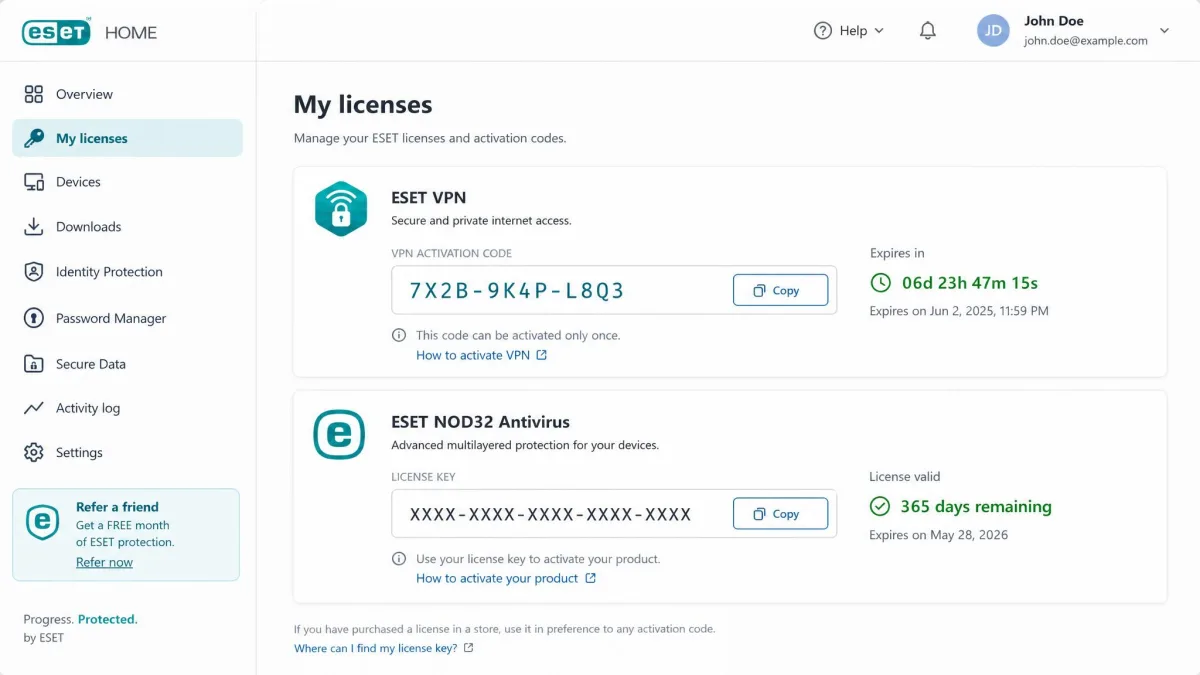
On macOS, a certificate has to be reauthorized before the VPN will connect correctly. This is unexpected setup friction, so approve the certificate prompt rather than dismissing it.
Once activated, day-to-day use is straightforward. You pick a country, choose a protocol, and connect. The rough edges are almost all at the activation stage, not in ongoing use.
Privacy, No-Logs Policy & Jurisdiction
Privacy is where ESET is strong on paper and cautious in claims. ESET states a no-logs policy: it does not log VPN session history, source IP, or the sites you visit. During an active session it temporarily stores an anonymous identifier and connection time, and it permanently keeps parallel-connection counts and 30-day bandwidth counters. That is a reasonable, clearly written policy.
The gap is verification. We found no public independent audit of ESET's no-logs claim. That means the policy rests on ESET's own documentation rather than on tested, verified operation. ESET is an established security company with a long track record, which counts for something, but it is not the same as a published third-party audit.
ESET's no-logs policy is documented and specific, but without a public independent audit it rests on trust rather than proof.
— From our hands-on review
We also will not assert a legal jurisdiction for the VPN. ESET's no-logs document names no jurisdiction, and no reliable source ties the VPN entity to a stated country. If jurisdiction is a hard requirement for you, treat it as unconfirmed rather than assuming a favorable one.
Server Network & Country Coverage
ESET VPN covers 70+ countries, with up to 40 countries reachable on the Premium tier and the full total on Ultimate. Public listings put the network at around 450+ servers across those countries and cities, though that total comes from app-store metadata rather than ESET's product page and may change. The footprint is modest next to the giants, but it covers the common routes most people use.
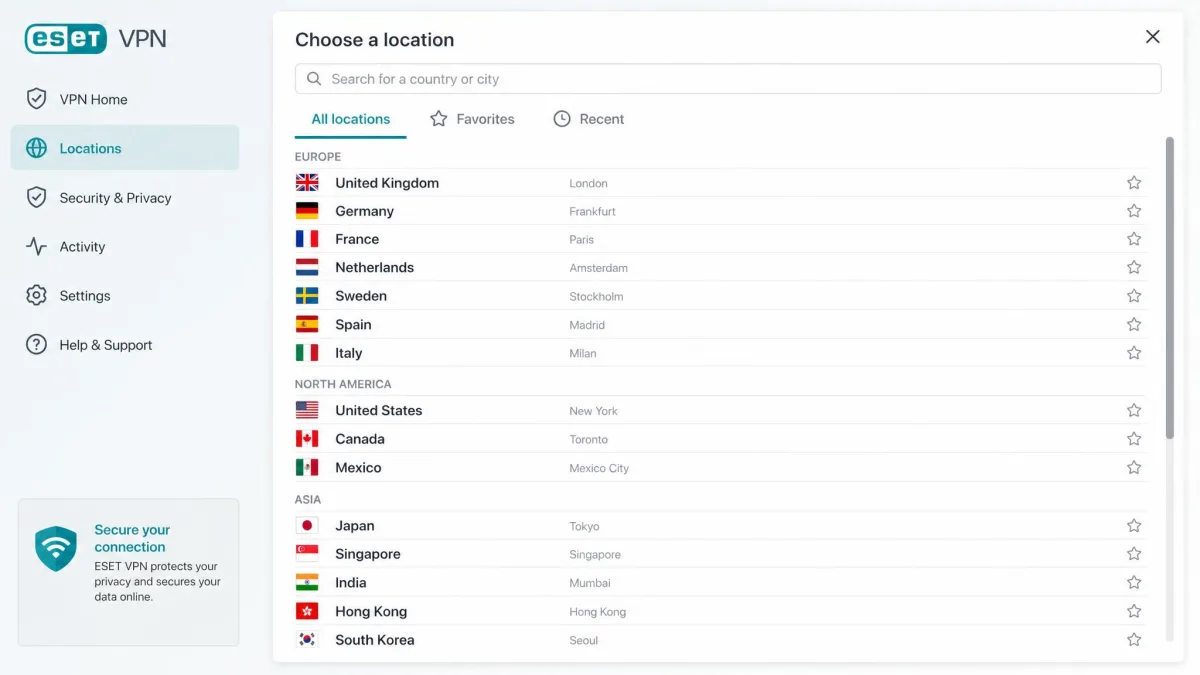
In use, the network handles typical travel and access needs well. The practical advice is to test the specific country you need before you rely on it, since coverage that looks fine on a list can still matter more for one location than another. The refund window is the time to confirm your must-have country works.
Speed & Streaming Performance (Tested)
Everyday performance is the pleasant surprise here. Streaming and downloads run smoothly, geolocation switching is easy, and general responsiveness lands on par with many standalone VPN clients in our use. For browsing, video and file transfers, ESET VPN does not feel like the compromise a bundled tool can sometimes be.
We are deliberately not quoting a specific megabit figure or a percentage speed drop. Reproducible, comparable speed-test numbers for ESET VPN are not something we can stand behind, so a precise figure would be a guess dressed as data. What we can say is that WireGuard delivered the snappiest connections in practice, which matches how the protocol behaves elsewhere.
Streaming deserves a caution. ESET makes no binding promise that every streaming catalog will keep working, and some banking and other sites reject the VPN's IP addresses. Test your streaming services during the refund window rather than assuming a given library will unblock. Treat reliable streaming as a bonus, not a guarantee.
Pricing & Value
Because the VPN is bundled, you price the suite, not the VPN. ESET HOME Security Premium runs about $89.99 for the first term on a 3-device seat, and Ultimate runs about $179.99 for the first term on a 5-device seat. Intro pricing varies by seat count, region and promotions, and renewal costs more than the first term, so check current pricing before you commit.
The value question hinges on whether you already want ESET's antivirus. If you do, the VPN is close to free added utility on top of protection you were buying anyway. If you only want a VPN, paying for a full security suite to get one is poor value next to a dedicated service. Judge the bundle as a whole, not the VPN in isolation.
Common Problems & How to Fix Them
ESET VPN's rough edges are consistent and fixable. Knowing them in advance saves a support ticket. The app store rating averages 4.2 out of 5, and a share of those reviewers flag stability and activation problems, which lines up with what we ran into.
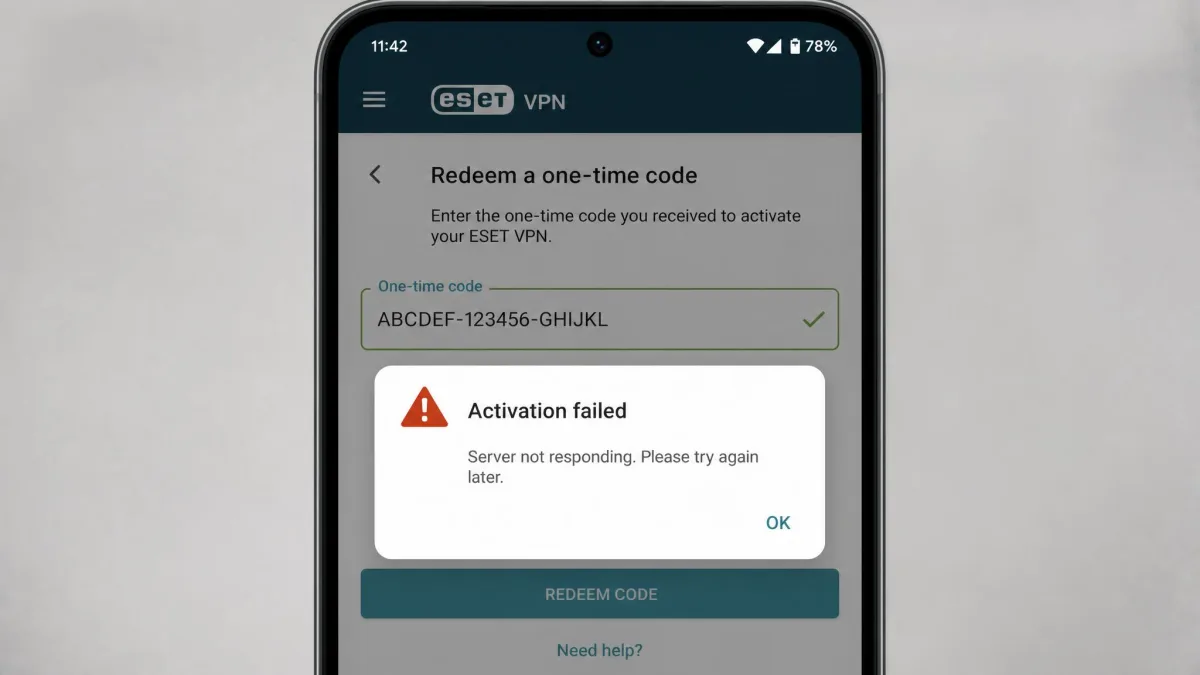
- Activation can fail with a "server not responding" error when you redeem a one-time code. Regenerate a fresh code and retry, since codes expire after 72 hours.
- Mobile connection and authentication can fail. Updating the app or switching protocols usually fixes it, and iOS in particular has protocol-specific connection issues.
- The iOS app has crashed on newer iPhones, including on an iPhone 11 Pro Max running iOS 18.1. Keeping the app current is the first thing to try.
- The kill switch can cut your internet without an obvious cause. If the web goes dark, check the VPN status before troubleshooting your router.
- Some banking sites reject the VPN's IP. Toggle the VPN off for those sites or use split tunneling to exclude them.
Most ESET VPN failures trace back to two things: an expired activation code or a protocol that a network dislikes. Regenerate the code, then cycle protocols before contacting support.
ESET VPN vs. a Specialist VPN (NordVPN / ExpressVPN)
The clearest way to see ESET VPN's position is next to the two services most people cross-shop. The headline difference is not encryption or protocols, where ESET holds its own. It is the independent audit and the sheer scale of the server network.
| Feature | ESET VPN | NordVPN | ExpressVPN |
|---|---|---|---|
| Protocols | WireGuard, IKEv2, OpenVPN (UDP/TCP), Stealth, Wstunnel | NordLynx, OpenVPN, IKEv2 | Lightway, OpenVPN, IKEv2 |
| Server network | 450+ servers, 70+ countries | 9,000+ servers, 137 countries | 3,000+ servers, 105 countries |
| No-logs audit | No public independent audit | Independently audited (Deloitte, sixth in 2025) | Independently audited (Cure53, 2024) |
| Price | Bundled: Premium ~$89.99 / Ultimate ~$179.99 per year | ~$3.49/mo on a 2-year plan | from ~$2.79/mo on a 2-year plan |
| Devices | 3 to 5 (Premium) / 10 to 25 (Ultimate) | 10 | up to 10 (Basic) |
Where ESET keeps its no-logs claim on documentation, both rivals publish independent audits. NordVPN has run Deloitte audits since 2022, with a sixth in 2025, and ExpressVPN was audited by Cure53 in 2024. Their networks are also far larger, which helps with load and location choice. On a per-month basis, both undercut ESET heavily if you value the VPN alone.
ESET's counter is the bundle. You get a VPN, antivirus, firewall and more under one account and one bill. For a household already committed to ESET, that consolidation can outweigh a bigger server map it will never fully use.
Who Should Use ESET VPN?
ESET VPN makes the most sense for existing ESET customers. If you already run Premium or Ultimate, the VPN is a capable everyday privacy layer you have effectively already paid for. It covers browsing, downloads and casual geolocation switching without a second app to manage.
It is a weaker fit for VPN-first buyers. If you want streaming guarantees, a huge server network, or an audited no-logs policy, a specialist service serves you better for less money. It is also a weaker fit for anyone who needs polished, one-click setup, given the activation friction.
Across our hands-on time with the suite, ESET VPN behaved like a solid utility rather than a headline act. It did the daily job well, and its frustrations were almost all at setup, not in ongoing use.
Verdict: Is ESET VPN Worth It?
ESET VPN is worth it as part of the suite, and hard to justify as a reason to buy the suite. The distinction is the whole decision. If ESET is already your antivirus, or is about to be, the VPN is a private everyday browsing layer you effectively get for nothing, and on those terms it is an easy yes. If a VPN is the specific thing you are shopping for, the maths flips: paying for a full security suite to reach the tunnel inside it makes no sense next to a standalone service that costs a fraction per month. So the buyer this suits is the suite owner, not the VPN shopper. See the pros and cons below and the rating box for how those trade-offs net out.
Pros
- Strong encryption with six protocols, including WireGuard
- Unlimited bandwidth on every plan
- Smooth everyday browsing, downloads and geolocation switching
- Desktop kill switch, DNS leak protection and split tunneling
- One account and one bill alongside ESET antivirus
Cons
- No public independent no-logs audit
- Modest server network next to Nord and Express
- Fiddly activation with a separate expiring code
- Kill switch can block connectivity without an obvious cause
- Cannot be purchased separately from the suite
Frequently Asked Questions
Is ESET VPN safe to use?
If ESET were legally compelled, what could it actually hand over?
If a streaming service blocks ESET's IP, does switching servers help?
Which protocol should I switch to when a connection is unstable?
Can I free up a VPN seat without losing an antivirus seat?
Is ESET VPN worth it long-term?
Final Thoughts
ESET VPN is a good VPN wearing a suite's clothing. It gives ESET customers a private, protocol-rich, capable tunnel without a second subscription, and for that audience it is easy to recommend. The honest limits are the missing audit, the smaller network, and the setup friction, none of which are dealbreakers for casual, privacy-minded use.
If you are choosing where to spend, let your priority decide. Buy ESET for the whole security package and enjoy the VPN as part of it. Buy a specialist VPN if encrypted browsing is the point of the purchase. On those terms, ESET VPN earns its place, provided you know what you are actually buying.