F-Secure VPN is a deliberately simple VPN from a trusted Finnish security brand, and it used to be called Freedome. It comes from F-Secure, a cybersecurity company founded in 1988, so the pedigree is real and the app looks the part. That reputation is exactly why we wanted to check whether the product lives up to the name.
Our honest angle is this: a trusted brand does not automatically mean a strong VPN. F-Secure gets the basics right and keeps everything friendly for beginners. It also cuts corners that more serious users will notice within a day of testing.
We put F-Secure VPN through our standard review process across Windows, macOS, and Android, running speed, leak, and streaming benchmarks on nearby and distant servers. This review walks through security, privacy, speed, servers, streaming, pricing, and value, then lands on a clear verdict. We bought access ourselves and tested the current apps rather than trusting the marketing.
What Is F-Secure VPN? (formerly Freedome)
F-Secure VPN is the standalone VPN service that F-Secure sells on its own and inside the larger F-Secure Total bundle. Longtime users will know it as Freedome, the older brand name that F-Secure retired. The core promise has not changed: one tap, and your connection is protected.
The service focuses on everyday online privacy rather than advanced configuration. You get encrypted traffic, tracker blocking, and automatic Wi-Fi protection in a single, tidy interface. There is very little to tweak, which is the whole point.
F-Secure is a Finnish company, and that matters for privacy. Finland sits inside the EU and outside the 5, 9, and 14 Eyes intelligence alliances. For a security brand with this much history, the VPN feels like a natural extension of the antivirus business rather than a bolt-on.
F-Secure VPN Pros and Cons
Every VPN involves trade-offs, and F-Secure's are unusually easy to summarize. The strengths cluster around trust, privacy, and simplicity. The weaknesses cluster around a small network and thin feature set.
Pros
- Strong Finnish and EU privacy jurisdiction, outside the major surveillance alliances
- Trusted, established security brand with a long track record
- Built-in tracker blocking and automatic Wi-Fi protection
- Simple, beginner-friendly app with a one-tap design
Cons
- Limited protocol choice and no true per-app split tunneling
- Small server network of roughly 20 to 30 servers
- Weak, inconsistent streaming support
- Per-device pricing that adds up quickly
- Logging policy that is more nuanced than the marketing suggests
Security and Protocols
Security is where F-Secure has the most credibility, and the fundamentals hold up. The apps use AES-256 encryption, the same standard the wider industry relies on. On the desktop builds this means AES-256-GCM with TLS and 2048-bit RSA keys.
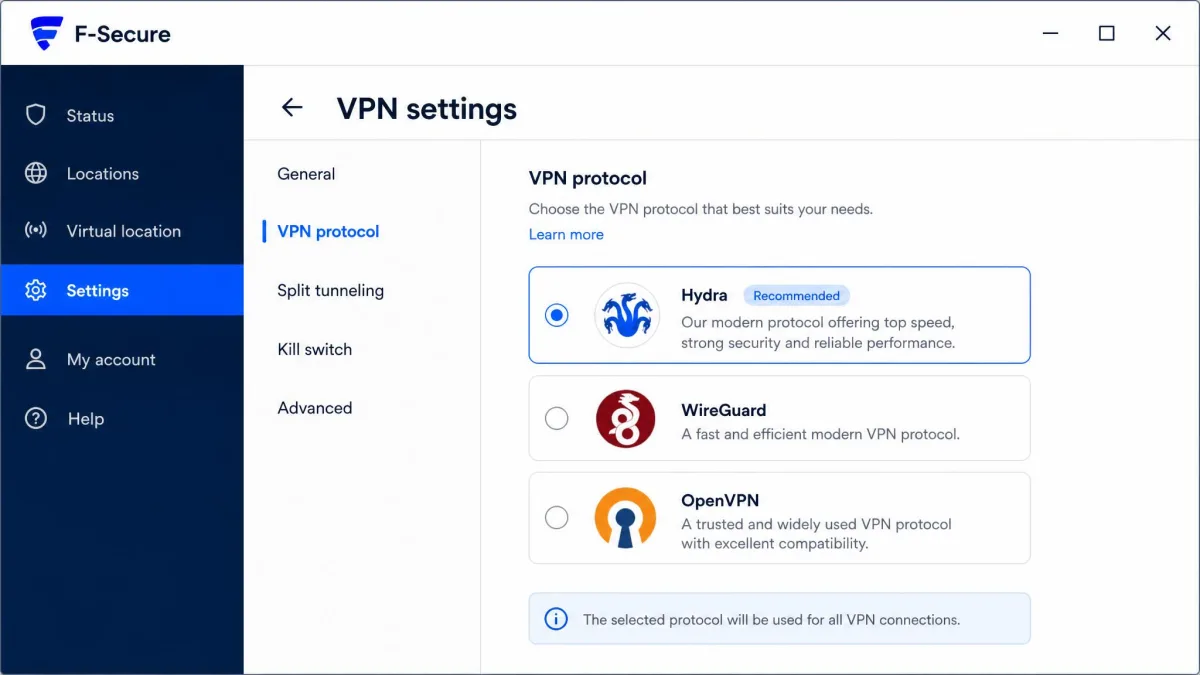
Protocol support has modernized recently. F-Secure now runs Hydra, its proprietary protocol, alongside WireGuard and OpenVPN, and it dropped the older IKEv2 option. WireGuard is the addition most users will care about, and our own explainer on what WireGuard is and why it matters covers why that protocol tends to be fast and lean.
One caveat surfaced in testing. The Hydra protocol was not always stable for us: a session would connect and work for a while, then the internet connection dropped entirely and needed a manual reconnect. It did not happen constantly, but it happened often enough to note.
Encryption, Kill Switch, and Leak Tests (DNS/IP/WebRTC)
The kill switch is the headline security feature, and it works on Windows, Mac, and Android. It is not available on iOS, which is a real gap if the iPhone is your main device. A VPN without a kill switch can leak your real IP the moment the tunnel drops.
Leak protection was solid in the areas that matter most. F-Secure passed our DNS and IP leak tests cleanly, so your real address and lookups stayed hidden. WebRTC handling has been flagged as a weaker point in older testing, so browser users should confirm their setup.
A kill switch only protects you if it is enabled. On the platforms that support it, turn it on during setup rather than assuming it is active by default.
Split Tunneling, Trusted Networks, and Tracker/Wi-Fi Protection
Split tunneling is where the marketing and the reality diverge. F-Secure does not offer true per-app split tunneling. What it offers instead is a Trusted Wi-Fi networks bypass, available on Android and Windows, that stops the VPN from engaging on networks you mark as safe.
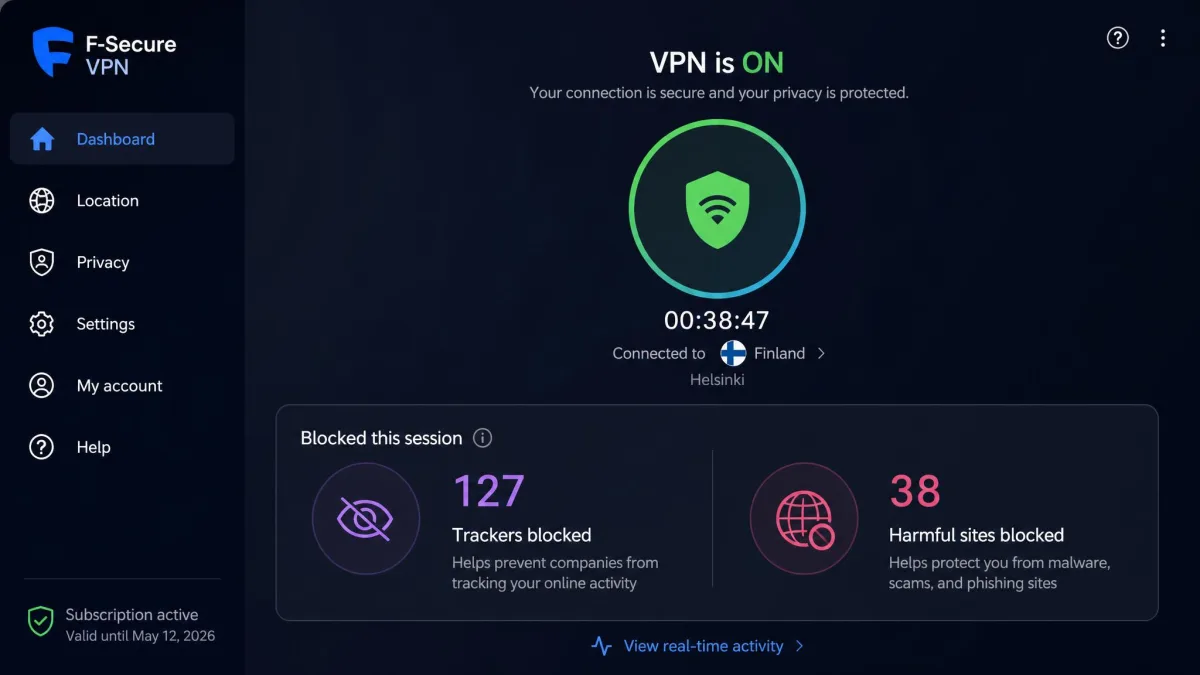
The tracker blocking and Wi-Fi protection are more convincing. The app blocks known trackers, warns against malicious sites through browsing protection, and switches the VPN on automatically when you join an unsecured network. For a set-and-forget security tool, that automation is the feature that earns its keep.
Privacy, Logging Policy, and Finnish Jurisdiction
Privacy is F-Secure's strongest selling point on paper, thanks to that Finnish base outside the Eyes alliances. The jurisdiction is genuinely favorable, and F-Secure's brand reputation gives the no-logs promise more weight than a no-name provider would carry.
The logging policy itself is more nuanced than the homepage implies. F-Secure states that it does not create traffic logs and does not sell or share your traffic. It does, however, retain some connection metadata, including session duration, data transferred, a device ID, and your public IP, and that connection metadata is kept for 90 days.
For most everyday users this is an acceptable trade, but it is not the absolute zero-logs stance some rivals advertise. We would like to see F-Secure spell out its retention windows more plainly. The confusion is avoidable, and clarity would suit a brand that sells trust.
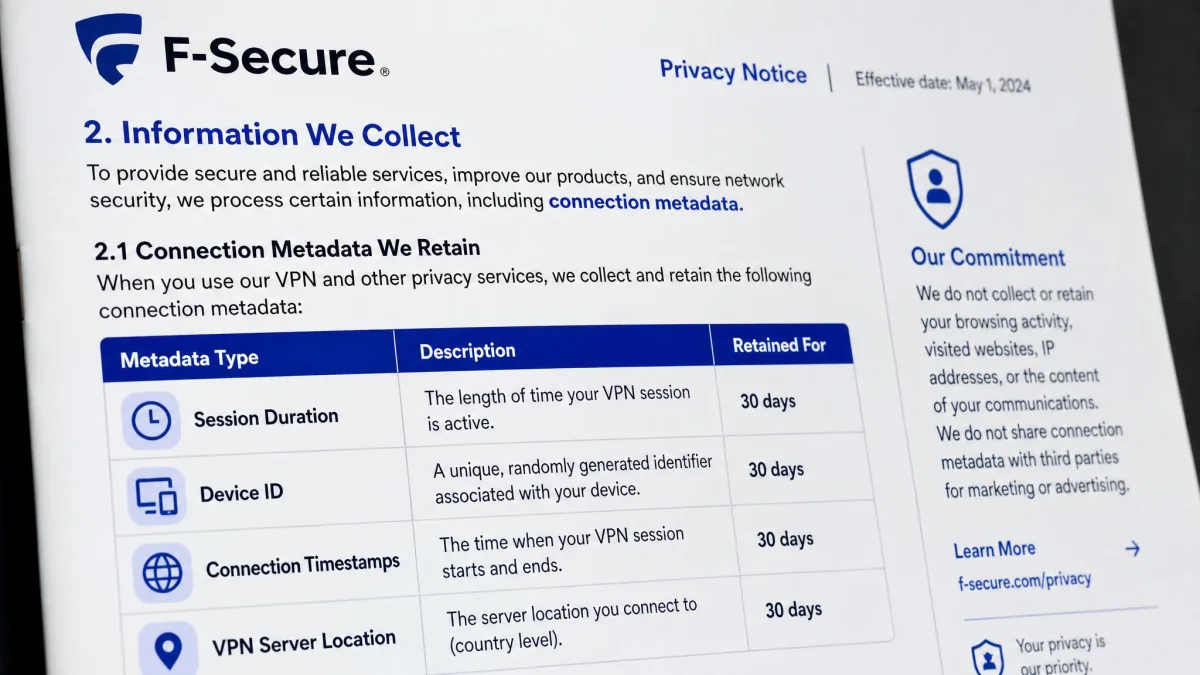
If a strict, independently audited no-logs policy is your top priority, read the fine print here carefully and compare it against providers that publish third-party audits.
Speed and Performance
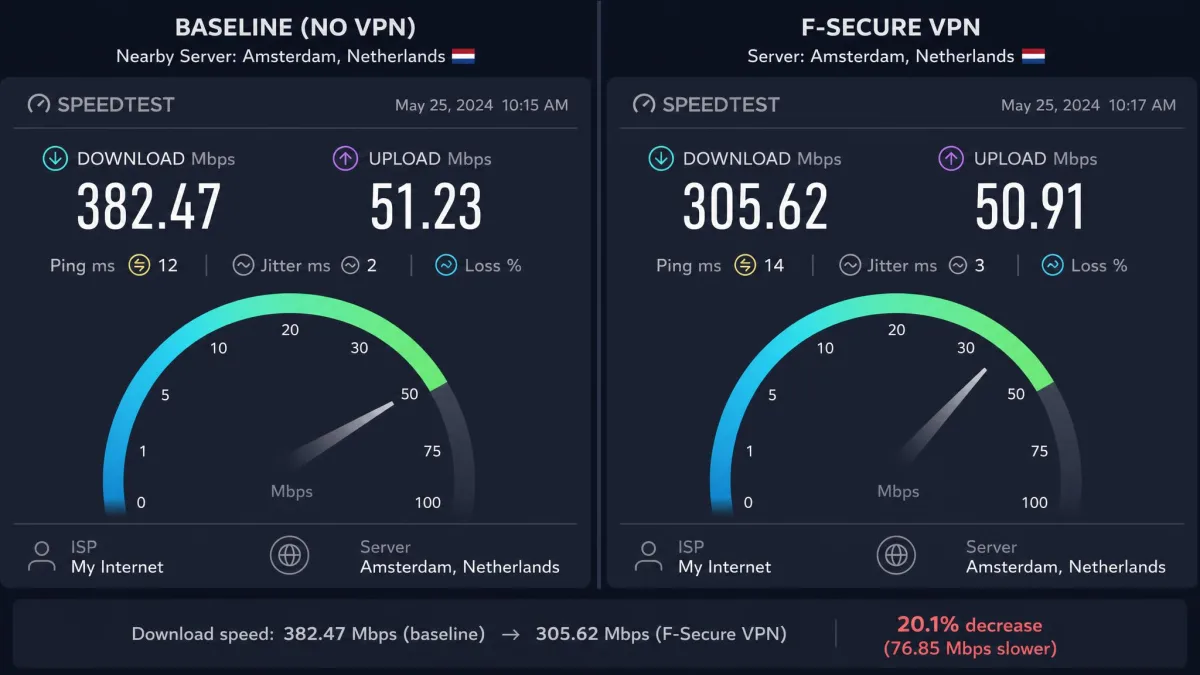
Speed is where a small network shows its limits, and F-Secure's results split neatly by distance. On nearby European servers the performance held up reasonably well, with download drops in the range of 15 to 30 percent. That is fine for browsing, video calls, and general use.
Distant servers were a different story. Connecting to somewhere like Australia, our losses climbed past 50 percent, which you feel immediately on large downloads. Nearby servers streamed comfortably from full HD up to 4K, while distant ones dropped 20 to 30 percent and struggled with 4K.
The takeaway is simple. If your usage stays close to Europe, F-Secure is quick enough for daily life. If you routinely connect across the world, the small, Europe-heavy network becomes a bottleneck.
Servers and Server Network
The server network is F-Secure's clearest weakness, and there is no way to dress it up. F-Secure runs a small fleet, roughly 28 to 30 servers, concentrated mostly in Europe. The company does not publish an exact live count, and the fleet lands somewhere between about 28 and 30 servers depending on when you check.
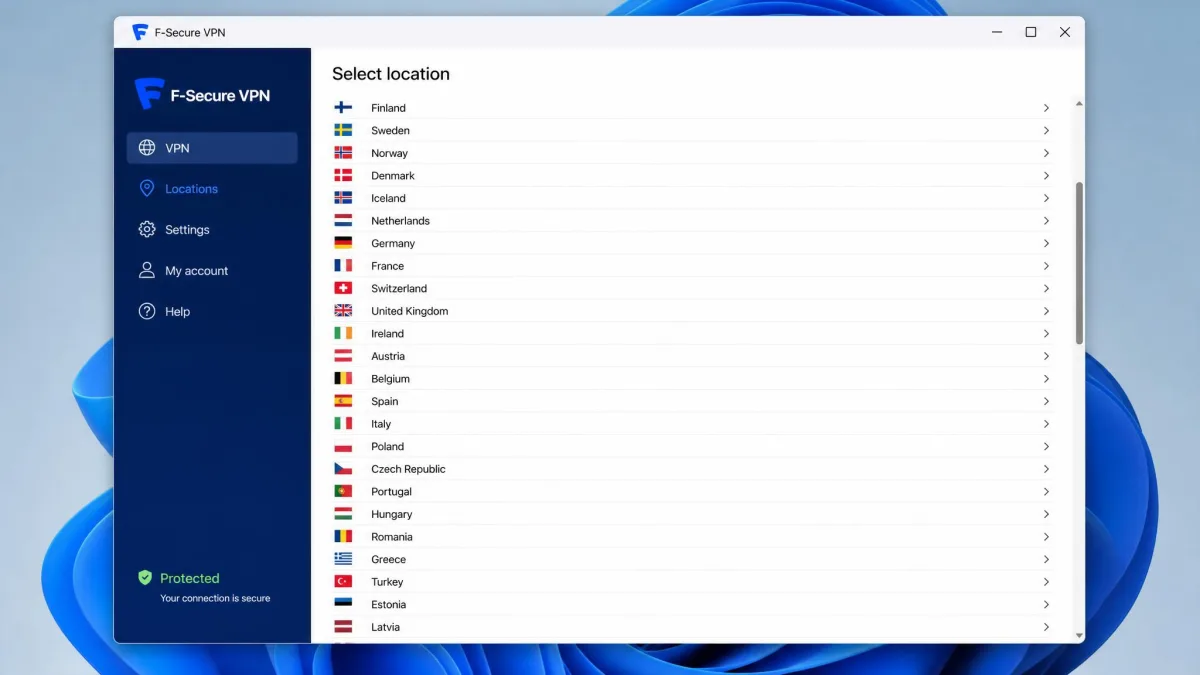
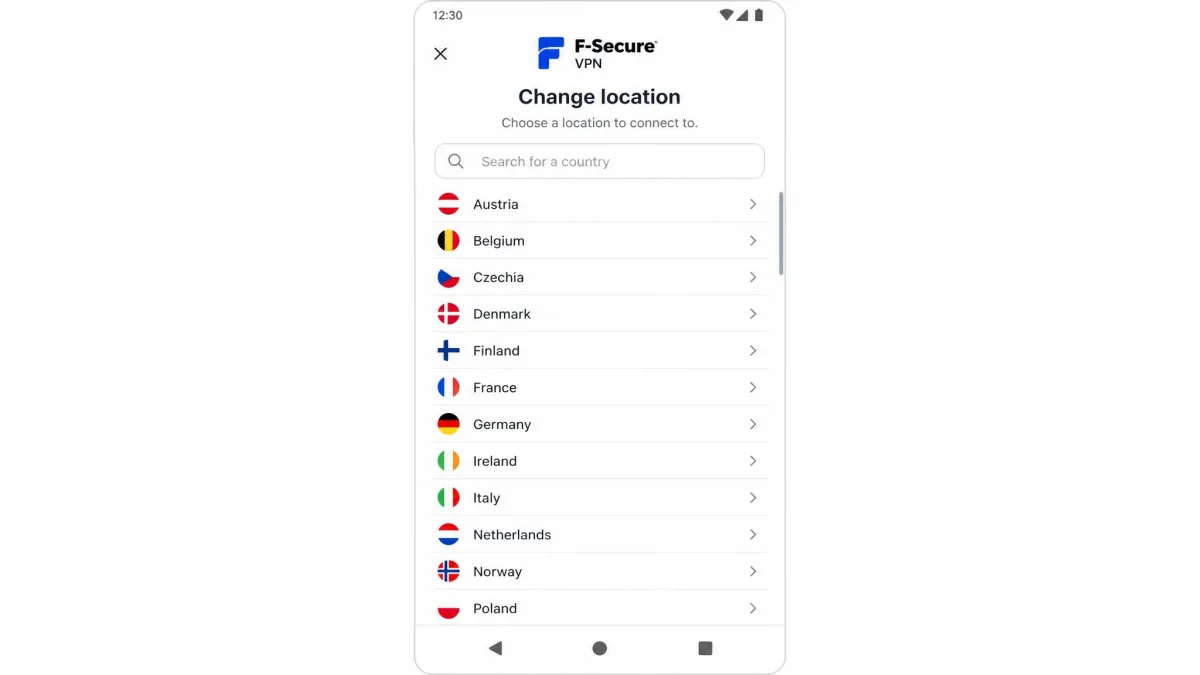
By country coverage, F-Secure advertises servers in over 20 countries on its VPN product page. That is enough to cover the most common destinations, but it is a fraction of what the big names offer. Some locations are virtual, meaning the server is physically elsewhere than the country label suggests.
A network this size has real consequences. Fewer servers means fewer options when one location is slow or blocked, and less room to spread load at peak times. For a privacy tool this is livable; for streaming or global access it is limiting.
Streaming and Unblocking (Netflix and beyond)
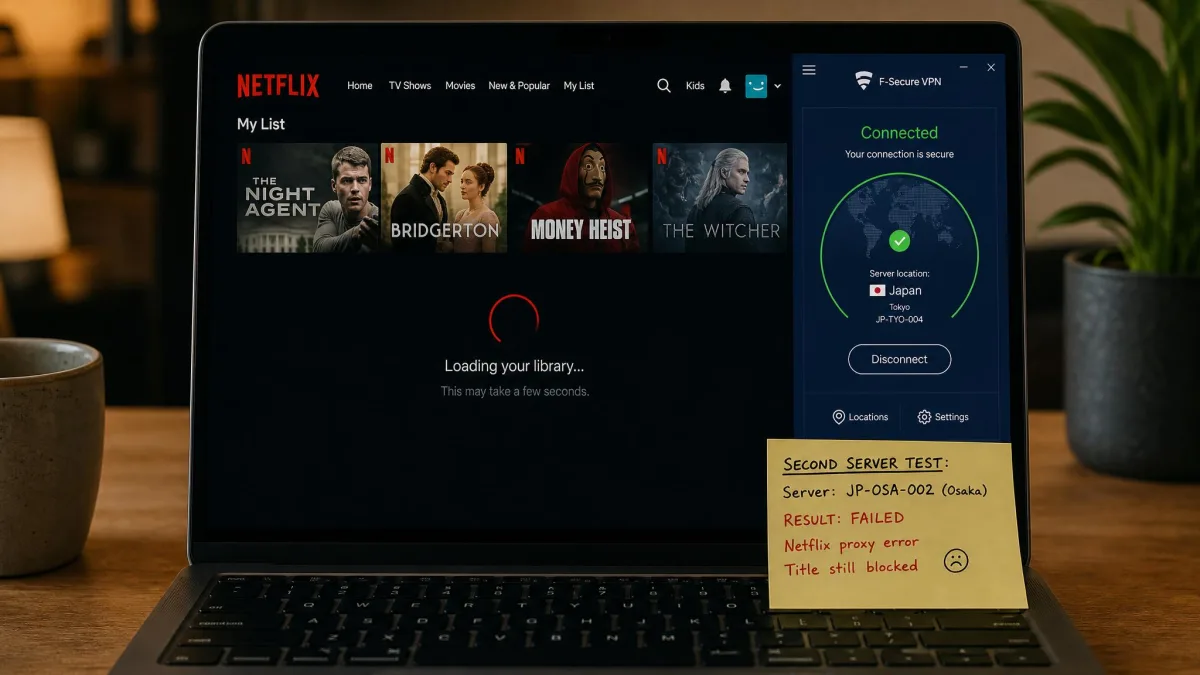
Streaming is the weakest area we tested, and it comes down to design. F-Secure has no dedicated streaming servers, so unblocking is hit or miss rather than reliable. When you need a specific library on a specific night, that inconsistency is frustrating.
Our results were genuinely mixed. Some tests unblocked multiple Netflix libraries, along with Amazon Prime Video, BBC iPlayer, and Disney+ in HD. Others failed outright, including Hulu, HBO Max, DAZN, and Disney+ US. There is no pattern you can plan around.
If streaming is a core reason you want a VPN, F-Secure is hard to recommend on that basis alone. It can work, but it will not work every time, and it offers no server built for the job.
Torrenting and Gaming
F-Secure draws a hard line on P2P, and buyers need to know it upfront. The service does not support torrenting on its servers, so downloaders should look elsewhere. This is a policy limit, not a performance quirk.
Gaming is similarly out of scope. F-Secure does not support gaming consoles, and the added latency on distant servers works against fast-paced online play. The service also skips smart TVs and Linux, and it offers no browser extensions. This is a VPN built for phones and computers doing ordinary tasks, and it does not pretend otherwise.
Apps, User Interface, and Ease of Use
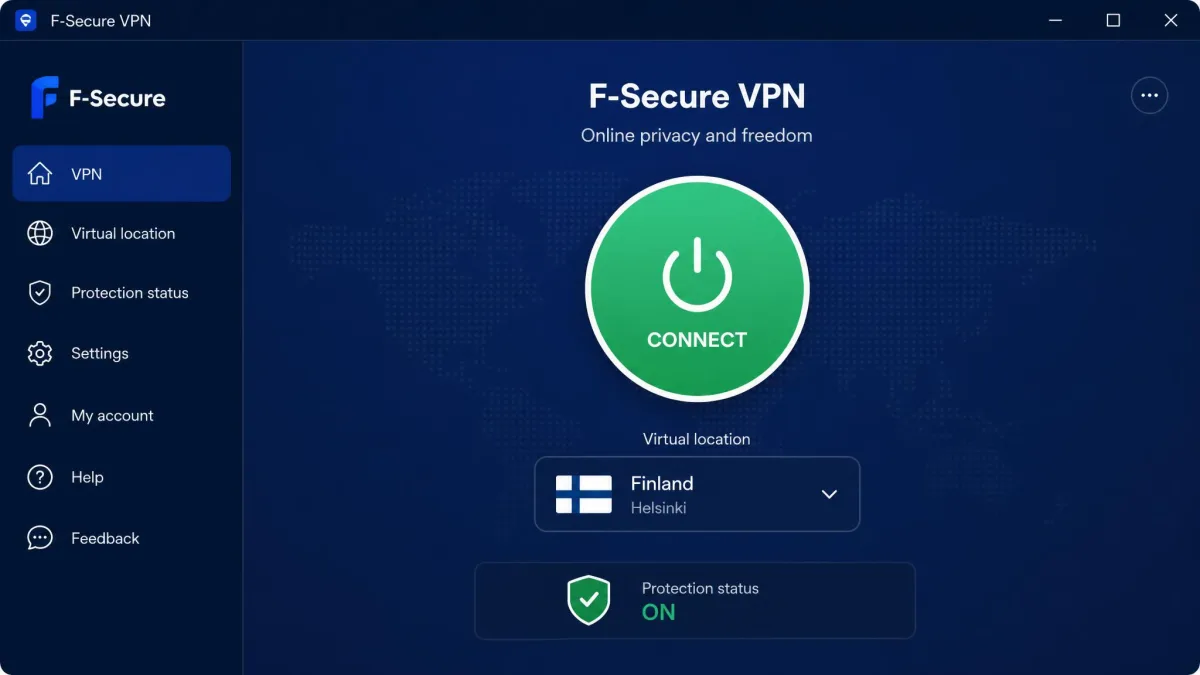
The app is the part of F-Secure that most clearly justifies the brand's reputation. It is simple and beginner-friendly, built around a one-tap connect design with very little to configure. If you have never used a VPN before, you will not feel lost.
That simplicity is a double-edged feature. Power users who want granular control over protocols, ports, or per-app routing will find the options thin. F-Secure has chosen clarity over configurability, and for its target audience that is the right call.
In daily use, the polish shows. It runs quietly in the background, protects public Wi-Fi without constant tweaking, and stays out of your way. As a set-and-forget security layer, it behaves exactly as a trusted brand should.
Device Compatibility and Simultaneous Connections
Device support covers the essentials and nothing exotic. F-Secure VPN runs on Windows, macOS, Android, and iOS, which handles most households. There is no native support for Linux, smart TVs, routers, or gaming consoles.
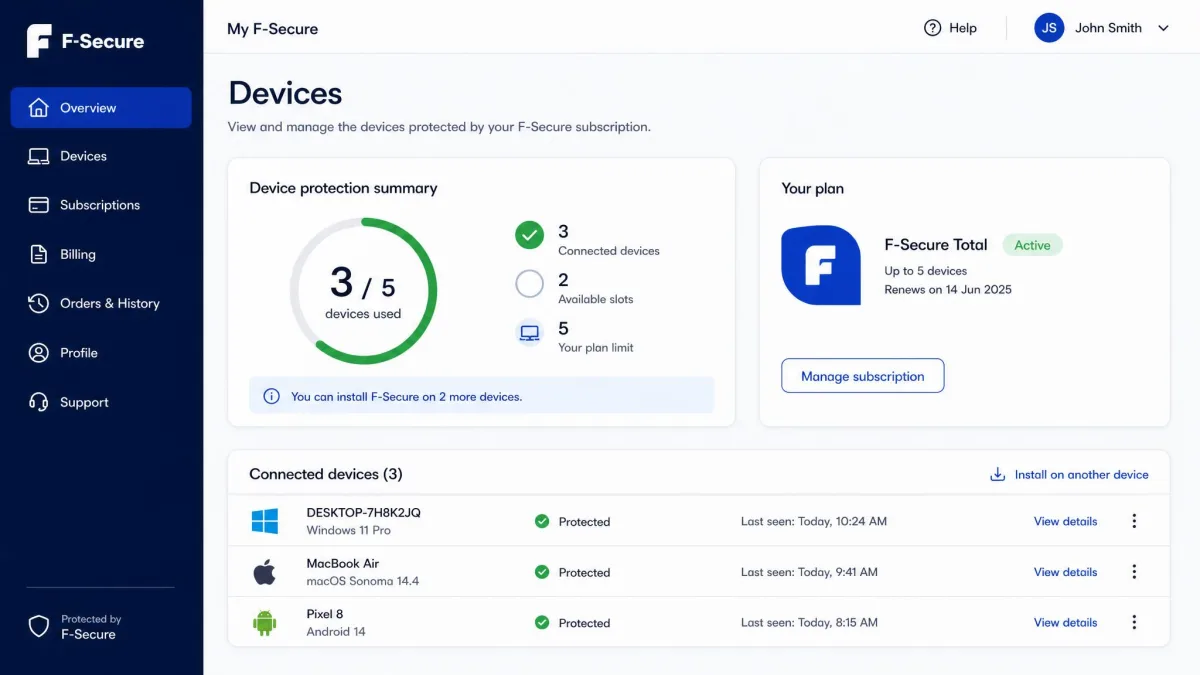
Simultaneous connections are capped and, unusually, tied to your plan. F-Secure lets you protect up to 5 devices at once, but the number depends on the tier you buy, sold in 1, 3, or 5 device options. Compared with rivals that allow far more connections on every plan, this tiered structure feels restrictive.
Customer Support and Knowledge Base
Support is a mixed bag, and it is worth setting expectations before you buy. The knowledge base is thin, so troubleshooting can be frustrating when something goes wrong and you want a quick self-serve answer. For a product aimed at beginners, a fuller help library would help.
Direct support did not impress us either. Response times can be slow, and F-Secure's communication during service outages has drawn criticism. If you value fast, hands-on help, factor that into the decision.
Pricing and Plans (device tiers, money-back guarantee)
Pricing is where F-Secure's value case gets hard to make. The plans are billed per device, which pushes the cost up the more you protect. A single device runs €49.99 per year, three devices cost €69.99 per year, and five devices cost €79.99 per year.
Longer terms soften the blow a little. A two-year, five-device plan runs €144.99, which works out to a lower monthly rate. Every plan is backed by a 30-day money-back guarantee, so you can test it risk-free within that window.
There is also a free trial, though its length is inconsistent. F-Secure's own page currently shows a 30-day trial, while the trial has also appeared as short as 5 days elsewhere, and in some regions it is not offered at all. It appears to vary by region and campaign, so check what you are actually offered before you count on it.

Is F-Secure Total Worth It vs the Standalone VPN?
F-Secure also sells the VPN inside F-Secure Total, its bundle with antivirus and identity protection. If you need security software anyway, Total can be the better buy, because you fold the VPN into one subscription instead of paying for it alone.
If you only want a VPN, the standalone product is the cleaner choice, and our roundup of the best antivirus suites that include a VPN is worth a look if a bundle appeals. Decide what you actually need first, then pick the SKU that matches, rather than paying for tools you will not use.
How F-Secure VPN Compares (comparison table)
Placed next to the market leaders, F-Secure's position becomes obvious. It competes on trust and simplicity, not on scale or streaming. The table below lines it up against NordVPN and ExpressVPN on the metrics that decide most purchases.
| Product | Servers / countries | Protocols | Streaming | Simultaneous devices | Price (entry) |
|---|---|---|---|---|---|
|
~28-30 servers, 20+ countries | Hydra, WireGuard, OpenVPN | Inconsistent | 5 (tiered 1/3/5) | €49.99/yr |
 |
7,000+ servers, 110+ countries | NordLynx, OpenVPN, IKEv2 | Strong | 10 | ~$60/yr |
 |
105 countries | Lightway, WireGuard, OpenVPN | Strong | 8 | ~$100/yr |
The gap in raw network size speaks for itself. Rival prices here are approximate and move with promotions, so treat those entry figures as ballpark. If you want deeper single-product context, our ExpressVPN review and CyberGhost VPN review go server-by-server.
Who Should Use F-Secure VPN?
F-Secure VPN fits a specific buyer, and it fits them well. If you want a simple, trustworthy VPN to protect public Wi-Fi and block trackers, and you value a known security brand over a long feature list, this is a comfortable pick. Privacy-minded beginners are the sweet spot.
It is a poor fit for demanding users. If you stream heavily, torrent, game, run Linux, or need servers across dozens of countries, the small network and missing features will hold you back. Bitdefender's bundled option is another brand-led alternative, and our Bitdefender VPN review covers how it compares.
Final Verdict
F-Secure VPN is a polished, trustworthy VPN that plays it safe, and honesty requires naming both sides of that. The brand, the Finnish jurisdiction, and the effortless app are real advantages for everyday privacy. The tiny network, weak streaming, per-device pricing, and thin extras are equally real limits.
It feels overpriced for what it offers, with better-value options available at nearly every price point. We would not steer a power user here. For a beginner who wants set-and-forget protection from a name they trust, it earns a place on the shortlist, especially with a 30-day guarantee to test it.