Brave VPN is the paid privacy layer built into the Brave browser, sold as Brave Firewall + VPN and powered behind the scenes by Guardian. Instead of shipping a separate app, Brave lets you flip on a device-wide VPN straight from the browser you may already be using. The pitch is simple: one subscription, whole-device protection, no extra software to hunt down.
We wanted to know whether that convenience holds up once you push it. So we tested Brave VPN across Windows and Android, checked how it handled everyday connections, and ran it against streaming services. This review covers what we found on speed, servers, privacy, and price, and where Brave lands next to bigger names like NordVPN, Proton VPN, and Surfshark.
The short version is that Brave VPN is genuinely easy to live with, but it asks a premium price for a thin feature set and a small network. Whether it is worth it depends entirely on what you want from a VPN, so let's dive into the details.

What Is Brave VPN? (Brave Firewall + VPN, powered by Guardian)
Brave VPN is marketed as Brave Firewall + VPN, a paid feature bundled into the Brave browser rather than a standalone service. The VPN side encrypts your traffic and routes it through a remote server; the firewall side blocks trackers and unwanted connections at the device level. Both run together under one subscription.
The service is not built entirely in-house. Brave licenses the underlying VPN from Guardian, a US-based company that DNSFilter acquired in August 2022. That ownership matters for privacy, and we come back to it below. For now, the important point is that when you subscribe to Brave VPN, you are using Guardian's servers and Guardian's no-logs infrastructure wearing a Brave badge.
What sets it apart from a browser proxy or a simple extension is scope. Because it protects the whole device rather than just the browser, all of your traffic is encrypted, not only your Brave tabs. Email clients, other browsers, and background apps ride the same tunnel. That is a real advantage over browser-only privacy tools, and it is the strongest reason to consider Brave VPN at all.
Brave VPN is powered by Guardian, which DNSFilter acquired in 2022. You are subscribing to Guardian's network and privacy practices, presented inside the Brave browser.
Security & Privacy
Privacy is where Brave has to make its case, since the brand's whole identity is built on protecting users. The encryption and protocol foundations are solid, the no-logs policy is credible and audited, but the US jurisdiction is a genuine caveat you should weigh before subscribing.
Encryption & Protocols (WireGuard, IKEv2, AES-256)
Brave VPN leans on modern cryptography. On most platforms it uses the WireGuard protocol, which pairs strong ChaCha20-style encryption with lean, fast code. On iOS it falls back to IKEv2 with AES-256, the same cipher banks and governments rely on. Reporting on exactly which protocol runs where is not fully consistent, and on some platforms the behavior looks IKEv2-only, so treat the protocol as platform-dependent rather than a single fixed choice.
For most users this is a non-issue in practice. WireGuard and IKEv2 are both trusted, audited protocols, and you get sound encryption whichever one your device negotiates. The catch is that Brave gives you no protocol-selection toggle. You cannot force WireGuard or switch to IKEv2 yourself, which more configurable services let you do.
No-Logs Policy, Audits & US Jurisdiction
The no-logs claim is specific and, unusually, backed by outside verification. Per Guardian's no-logs policy, the service does not log your DNS traffic, network activity, bandwidth, originating IP address, account activity, or connection metadata. That is the list you want to see; the categories that would deanonymize you are all named as off-limits.
Those claims are not just marketing. Guardian commissioned two independent audits by Assured in 2024, covering the software in February and the infrastructure in April, and the auditors reported only medium and low-risk issues. Independent audits are still the exception rather than the rule in this market, and Brave earns real credit here.
The asterisk is jurisdiction. Guardian is a US company, which places Brave VPN inside the Five Eyes intelligence-sharing alliance. A no-logs provider cannot hand over data it never keeps, so audited no-logging blunts the risk. Still, if your threat model includes government data requests, a provider outside Five Eyes may suit you better.
Brave VPN operates under US jurisdiction, within the Five Eyes alliance. The audited no-logs policy limits what could ever be handed over, but privacy-maximalists should factor the jurisdiction in.
Firewall, Shields & Leak Protection
The firewall is the other half of the package. It blocks trackers and ads across the whole device through Brave's Shields technology, so the filtering you get inside the browser extends to other apps. There is a kill switch to cut your connection if the tunnel drops, plus DNS leak protection to keep queries inside the encrypted path.
The kill switch and DNS leak protection are the baseline any paid VPN should clear, and Brave includes both. The tracker and ad blocking is a genuine bonus that many rivals charge extra for or bolt on as a separate feature.
Device Support & Browser Integration
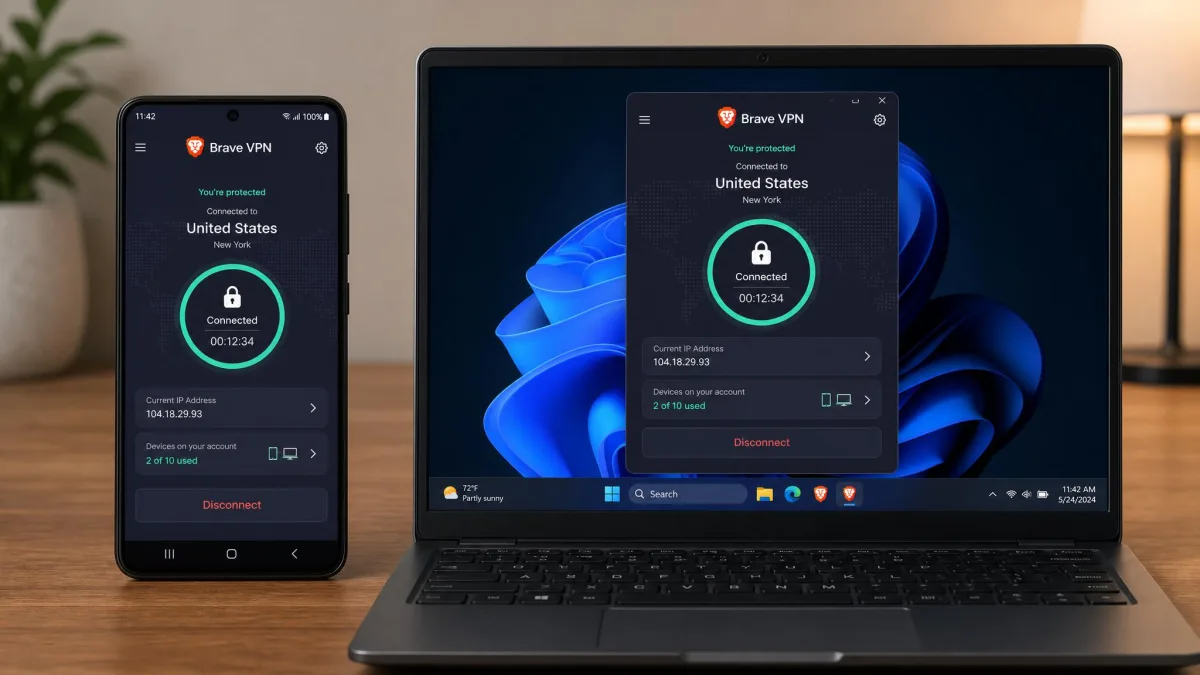
Brave VPN runs on Android, Windows, iOS, and macOS, with a Linux client listed as coming soon. There are no dedicated router or smart TV apps, so you cannot protect devices that lack a native client by installing on your home router. One subscription covers up to 10 devices simultaneously, which is generous and matches what NordVPN offers.
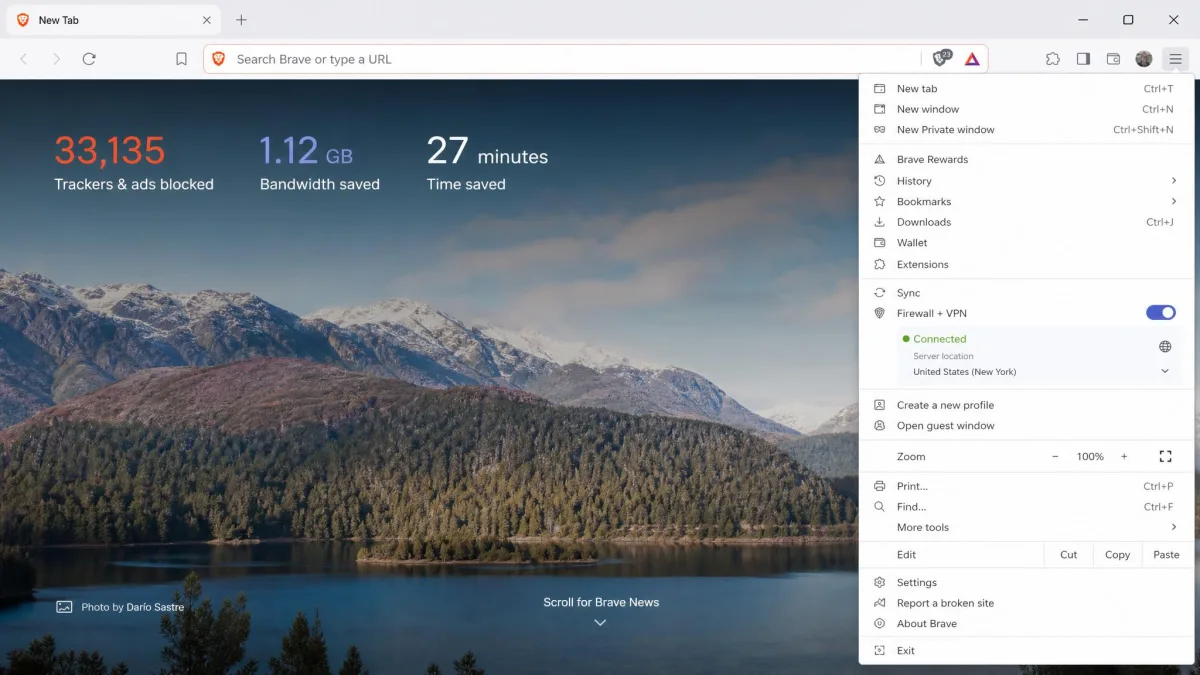
The browser integration is the standout, and it genuinely changes the experience. Turning the VPN on is nearly frictionless: there is no separate app or extension to install, and you enable it straight from the Brave browser menu. On our test machines the toggle connected quickly, and the device-wide protection meant traffic from outside Brave was covered too.
That said, the integration is also a limitation. Your entry point is the Brave browser, so the experience is smoothest if Brave is already part of your daily setup. If you live in Chrome or Firefox, a conventional standalone VPN will feel more natural than routing your subscription through a browser you otherwise ignore.
Server Network & Locations
Here is where Brave shows its youth. The network spans 300+ servers across 40+ regions, per Brave's own figures. That is enough to cover the popular destinations, but it is tiny next to the field. NordVPN runs more than 9,300 servers, and even mid-tier rivals count servers in the thousands.
Size is not just a bragging number. The server network is small and skews heavily toward North America and Western Europe, which leaves thin coverage elsewhere. North American and Western European exits are the ones that stay well-served, so if you connect to the US, the UK, Germany, or France, you will find a nearby server without much trouble. The thin spots are the ones off that axis. If you need an exit in Southeast Asia, Africa, or South America, your options narrow quickly, the nearest server may sit a long way from you, and a crowded server is more likely to be slow. For users who mostly connect to US or European locations, the coverage is adequate; for anyone who needs global reach, it is a real constraint.
Speed & Performance
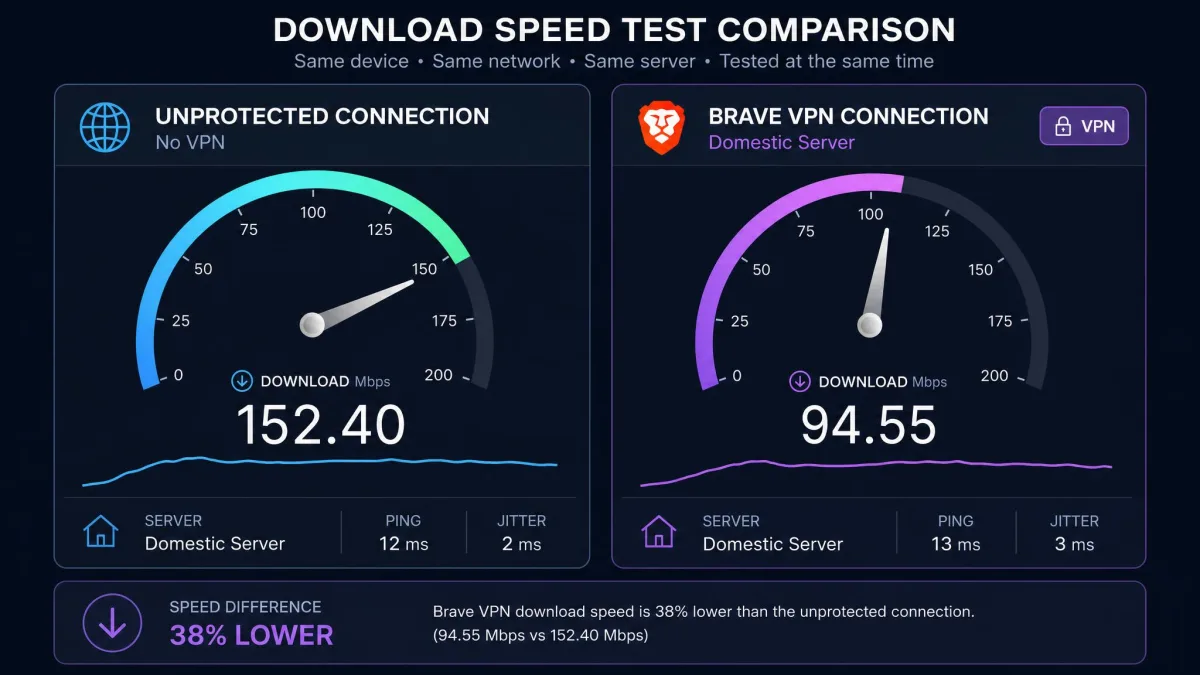
Speed is the metric we scrutinize hardest, because a VPN you turn off to stream or download defeats its own purpose. Brave's results were mixed. On domestic servers we saw download speeds drop sharply, in the region of 35 to 40 percent in our testing, which is a steep toll given WireGuard's reputation for being fast.
Real-world speed varies a lot by server and route, and a nearby, lightly loaded server will always beat a distant, busy one. WireGuard connections can be quick when conditions are right, so your mileage will differ. But a 35 to 40 percent domestic loss is well behind what the leaders post. NordVPN measured around a 6 percent reduction in comparable testing, and Proton VPN around 8 percent. Against those numbers, Brave feels slow.
A 35 to 40 percent domestic speed drop is a steep toll for a WireGuard VPN, and it puts Brave well behind rivals that shave off single digits.
— From our hands-on testing
For light browsing the slowdown is easy to miss. For large downloads, video calls, or anything bandwidth-hungry, it is the kind of drop you notice.
Streaming, Torrenting & Geo-Unblocking
If your reason for buying a VPN is unblocking content, Brave VPN is a hard sell. In our testing, streaming was unreliable, with connections blocked on Netflix US, Disney+, and BBC iPlayer. Some services detected and blocked the VPN's IP addresses, and connection drops happened often enough to break a viewing session.
The small network is the root cause. Streaming platforms blacklist known VPN server IPs aggressively, and a large provider counters by cycling through thousands of addresses. With only 300-odd servers, Brave has far fewer IPs to rotate, so the ones it has get flagged and stay flagged. If reliable Netflix or iPlayer access is your goal, this is not the tool.
Torrenting is a similar compromise. P2P traffic is permitted on any server, so nothing blocks you from using it for downloads. But there is no P2P-optimized infrastructure, and the small network with variable speeds makes it a workable fallback rather than a strength. It functions; it does not shine.
Brave VPN Pricing, Plans & Free Trial
Pricing is Brave VPN's biggest problem. The service costs $9.99 per month, or $99.99 per year if you pay annually, which works out cheaper monthly but still lands at the premium end. There is a 7-day free trial so you can test it before committing, and you can cancel free of charge during that window.
The value math is unflattering. The price feels high relative to what you get, especially next to cheaper rivals with far larger networks. NordVPN starts as low as $3.49 a month on long-term plans, Proton VPN from around $2.99, and Surfshark from around $2.49. Each of those gives you more servers, faster speeds, and working streaming for less than half of Brave's rate. You are paying a premium for the browser integration and the audited privacy, not for raw capability.
Payment Methods & Refund Policy
The refund situation deserves a clear warning. Brave VPN has no 30-day money-back guarantee. Your only no-cost exit is to cancel during the 7-day trial; after that, you are committed for the billing period you paid for. Getting a refund once the trial ends is a common sticking point, so treat the trial as your real evaluation window and set a reminder before it closes.
That policy is out of step with the industry norm. NordVPN, Proton VPN, and Surfshark all offer a 30-day money-back guarantee, giving you a month of real-world use with a safety net. Brave gives you one week, and then the door closes.
There is no 30-day money-back guarantee. Once the 7-day free trial ends, you cannot get a no-questions refund, so decide within that first week.
Customer Support
Support is a weaker spot. Customer support draws complaints, and the refund friction above tends to be where users run into trouble. Because the VPN is delivered through the browser and powered by a third party in Guardian, help can feel a step removed compared with a dedicated provider whose whole business is the VPN. When a problem crosses that line between Brave and Guardian, it is not always obvious which one owns the fix, and that hand-off is exactly where users tell us they get stuck.
If hands-on, responsive support matters to you, this is worth weighing. The larger rivals maintain live chat and extensive knowledge bases, so an answer is usually a few clicks away, and that gap shows plainly when something goes wrong and you need help fast.
Brave VPN Pros and Cons
Brave VPN is a study in trade-offs. The convenience and privacy credentials are real; the network, features, and price are where it falls short. Here is how the balance shakes out after our testing.
Pros
- Browser-integrated: turns on from the Brave menu with nothing extra to install
- Easy to use, with a genuinely frictionless connect experience
- Device-wide firewall and tracker blocking, not just browser protection
- Audited no-logs policy backed by two independent 2024 reviews
Cons
- US jurisdiction, inside the Five Eyes alliance
- Thin feature set: no split tunneling, multi-hop, custom DNS, or protocol toggle
- Expensive at $9.99 a month next to faster, larger rivals
- No 30-day money-back guarantee, only a 7-day trial
How Brave VPN Compares to Other VPNs (NordVPN, Proton, Surfshark)
Set against the mainstream leaders, Brave VPN trails on almost every measurable axis except device-wide simplicity. The table below lines up the numbers that matter most, and the pattern is consistent: Brave costs more and delivers less on servers, speed, and streaming.
| Product | Price/month | Servers | Speed loss | Netflix | Devices | Money-back |
|---|---|---|---|---|---|---|
 |
$9.99 | 300+ / 40+ regions | ~35-40% | Unreliable | 10 | 7-day trial only |
 |
from $3.49 | 9,300+ / 137 countries | ~6% | Yes | 10 | 30-day |
 |
from $2.99 | 100+ countries | ~8% | Yes | 10 | 30-day |
 |
from $2.49 | 100 countries | Fast (varies) | Yes | Unlimited | 30-day |
The comparison is stark. Where Brave optimizes for browser-native convenience, the others optimize for capability, and they cost less doing it. NordVPN and Surfshark unblock streaming reliably, Proton adds a strong free tier and privacy pedigree, and every one of them backs the sale with a full month to change your mind. Brave's advantage is narrow but real: nothing else turns on this cleanly from inside a browser you already use.
Who Should Use Brave VPN? (Verdict & Rating)
Brave VPN makes sense for a specific person: a committed Brave browser user who wants basic, device-wide privacy without installing or managing a separate app, and who values an audited no-logs policy over speed, streaming, or price. For that user, the convenience is worth something, and the privacy foundations are sound.
For most other people, the math does not work. You pay a premium for a small network, mediocre speeds, unreliable streaming, a thin feature set, and only a 7-day safety net. If you want value, speed, or reliable unblocking, NordVPN, Proton VPN, and Surfshark all do more for less. Brave VPN is competent and honestly built, but it is a convenience purchase, not a capability one.