Getting online in Afghanistan means working around blocked social and news platforms, slow connections, and the real chance that the internet will be cut altogether. Since the Taliban returned to power, local providers have restricted major apps, provinces have lost fibre access, and the whole country has gone dark at least once. That changes what a VPN has to do. It needs obfuscation to hide the fact that you are using a VPN at all, a strict no-logs policy so there is nothing to hand over, and a kill switch that stops your traffic from leaking when the connection drops.
We ranked the five services below on exactly those points, then on how they cope with slow, long-haul connections out of the region. Every pick here can disguise VPN traffic, and every one has an independently audited no-logs policy.
Quick Answer: The Best VPNs for Afghanistan
NordVPN is our top pick. Proton VPN is the strongest privacy choice and the only one with a free plan we trust. ExpressVPN is the easiest to run, because its stealth mode is always on.
Best VPNs for Afghanistan Compared
"Nearby locations" covers the UAE, India, Pakistan and Turkey, the closest hubs for most traffic leaving the country.
| Product | Buy | Obfuscation / stealth | Audited no-logs | Kill switch | Simultaneous connections | Nearby locations | Price from |
|---|---|---|---|---|---|---|---|
 |
Check price → | Obfuscated Servers (NordWhisper) | Deloitte, 6th assessment (2025) | Internet + App kill switch | 10 | UAE, India (virtual), Pakistan (virtual), Turkey | About $3.49/mo2-yr (promo varies) |
 |
Check price | Stealth protocol, all plans incl. Free | Securitum, yearly 2022-2026 | Yes | 10 (1 on Free) | UAE, Turkey, India (Smart Routing), Pakistan (Smart Routing) | About $3/mo2-yr; Free plan |
 |
Check price | Automatic on all servers | KPMG (2025) | Network Lock | 10 / 12 / 14 by tier | India, Pakistan, Turkey (all virtual) | $2.99/mo2-yr |
 |
Check price | Camouflage mode (auto on OpenVPN), NoBorders | Deloitte, 2023 and 2025 | Yes | Unlimited | UAE, India, Pakistan, Turkey | $2.49/mo2-yr |
 |
Check price | Shadowsocks (not on iOS) | Deloitte, three audits (latest 2026) | Standard + advanced | Unlimited | UAE, India (virtual), Pakistan (virtual), Turkey (virtual) | $2.03/mo3-yr |
1. NordVPN - Best Overall VPN for Afghanistan
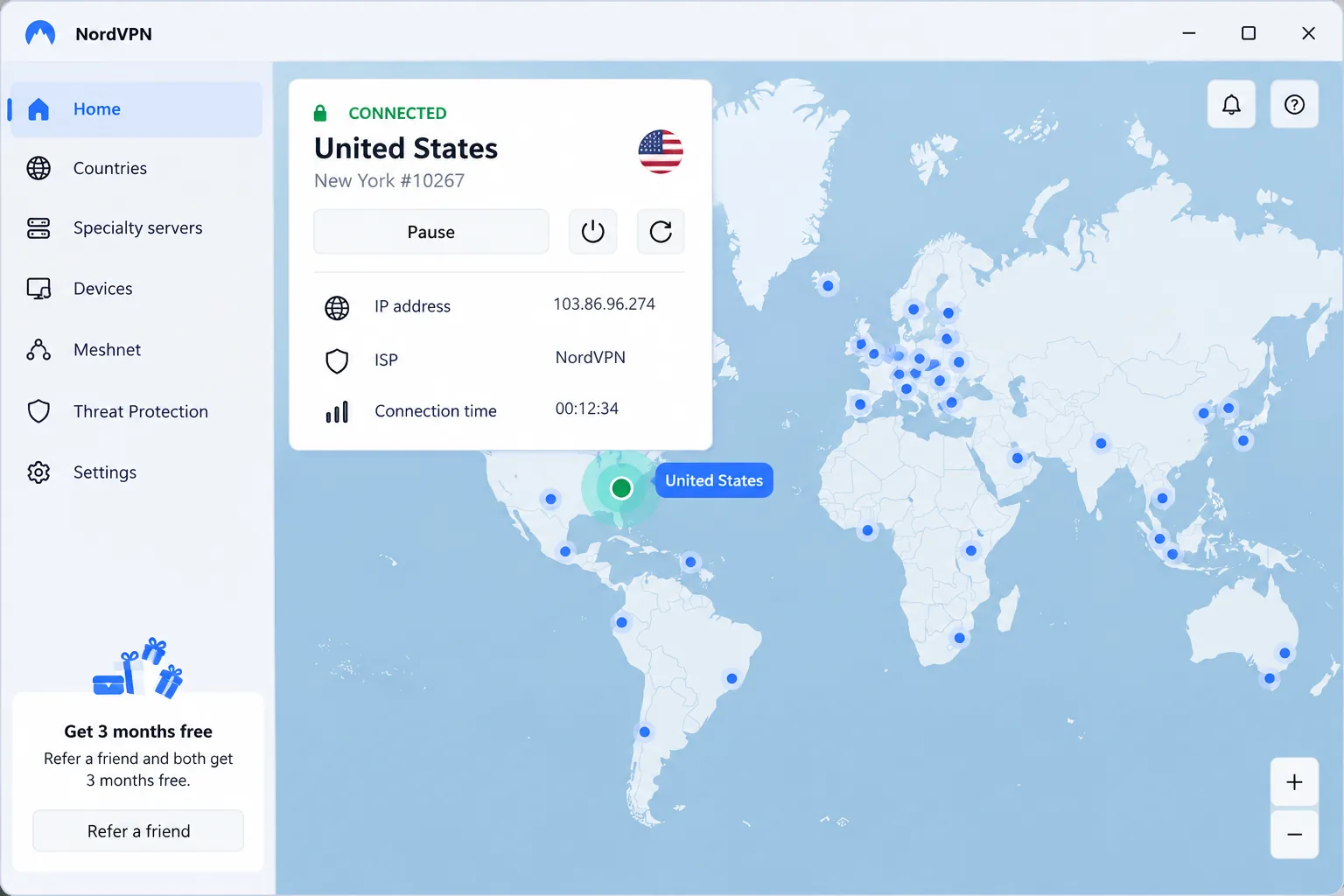
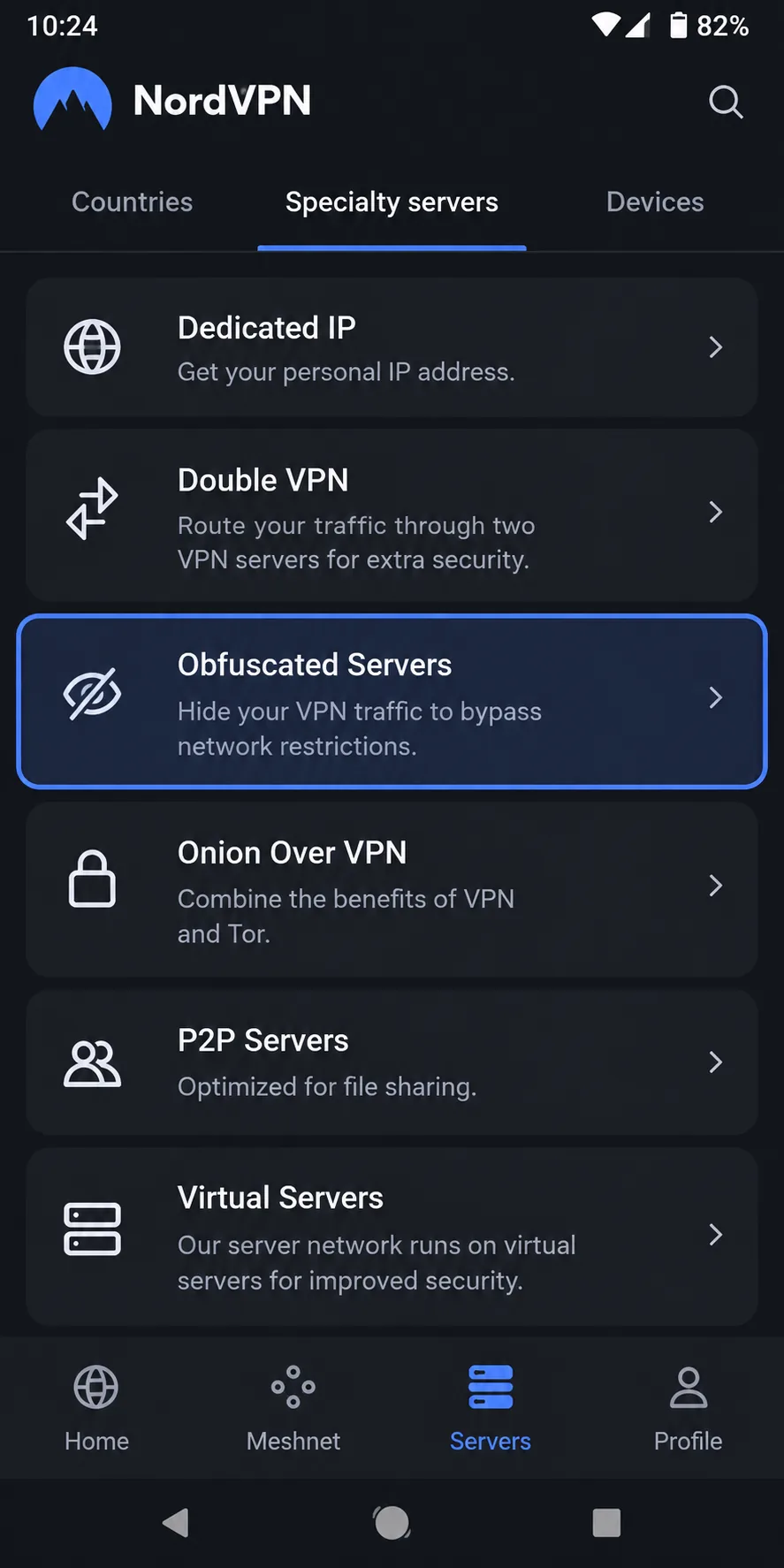
NordVPN takes our top spot with a 9.0 score in our full NordVPN review, and its stealth option is the main reason. The Obfuscated Servers category now runs on NordVPN's own NordWhisper protocol instead of OpenVPN, so you pick the category, connect, and there is nothing else to configure. NordVPN will not turn obfuscation on for you, though. On a restrictive network you have to choose the obfuscated category by hand.
We measured what that switch costs on our Afghanistan-focused test set. On NordLynx, NordVPN's WireGuard-based protocol, the connection held about 11.5 Mbps. Moving to the obfuscated servers dropped it to about 7.5 Mbps, which is still enough for messaging, news sites and standard-definition video on a slow line. Read those figures as the relative cost of stealth rather than the speed you will see at home. Obfuscation took roughly a third off the connection, and on a typical Afghan fixed line of 4.5 to 5 Mbps, the same proportional loss starts from a much lower base. On nearby servers in normal use, the speed loss stayed small.
NordVPN was founded in 2012 and is incorporated in Panama. Its no-logs policy has been through six independent assessments, from PwC in 2018 to Deloitte in 2025, and the sixth covered the obfuscated servers too. One account covers 10 devices, with servers in well over 100 countries.
NordVPN also lists an Afghanistan virtual location whose physical server sits in Singapore. It was added recently and may not appear in every app version. Either way, it does not put a server inside Afghanistan. For streaming, Netflix, BBC iPlayer, Amazon Prime Video, Disney+ and HBO Max all unblocked on the servers we checked.
Pricing starts from about $3.49 a month on the 2-year Basic plan, though the promo shifts by tens of cents from week to week. A 30-day money-back guarantee covers new accounts.
Pros
- Obfuscated Servers need no setup beyond choosing the category
- Six independent no-logs assessments
- Separate Internet and App kill switches
- Afghanistan virtual location for an Afghan IP address
Cons
- You must switch to obfuscated servers manually on restricted networks
- Obfuscation cuts download speed by roughly a third
- Picking a city on mobile hides behind an easy-to-miss three-dot menu
- Renewal costs more, and the charge lands about two weeks before the term ends
2. Proton VPN - Best for Privacy and Stealth in Afghanistan
Proton VPN ties NordVPN at 9.0 in our Proton VPN review, and it wins on privacy. Proton AG runs it from Switzerland, it launched in 2017, and its apps are open source. Securitum has audited its no-logs policy for the fifth consecutive year, with the latest report added in June 2026.
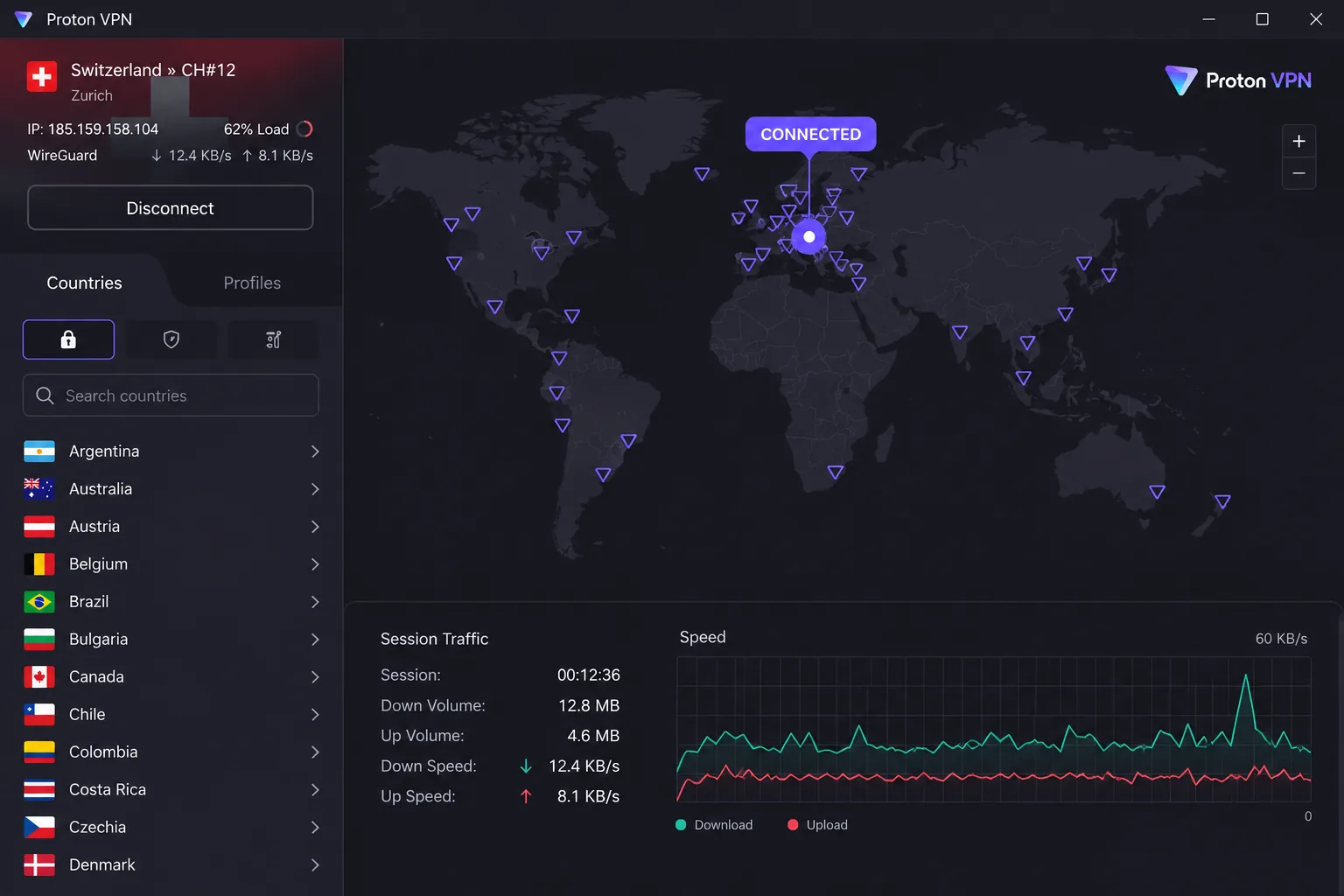
Its Stealth protocol wraps VPN traffic in obfuscated TLS over TCP, so to a censor it looks much like ordinary secure web browsing. It is available on every plan, including Free.
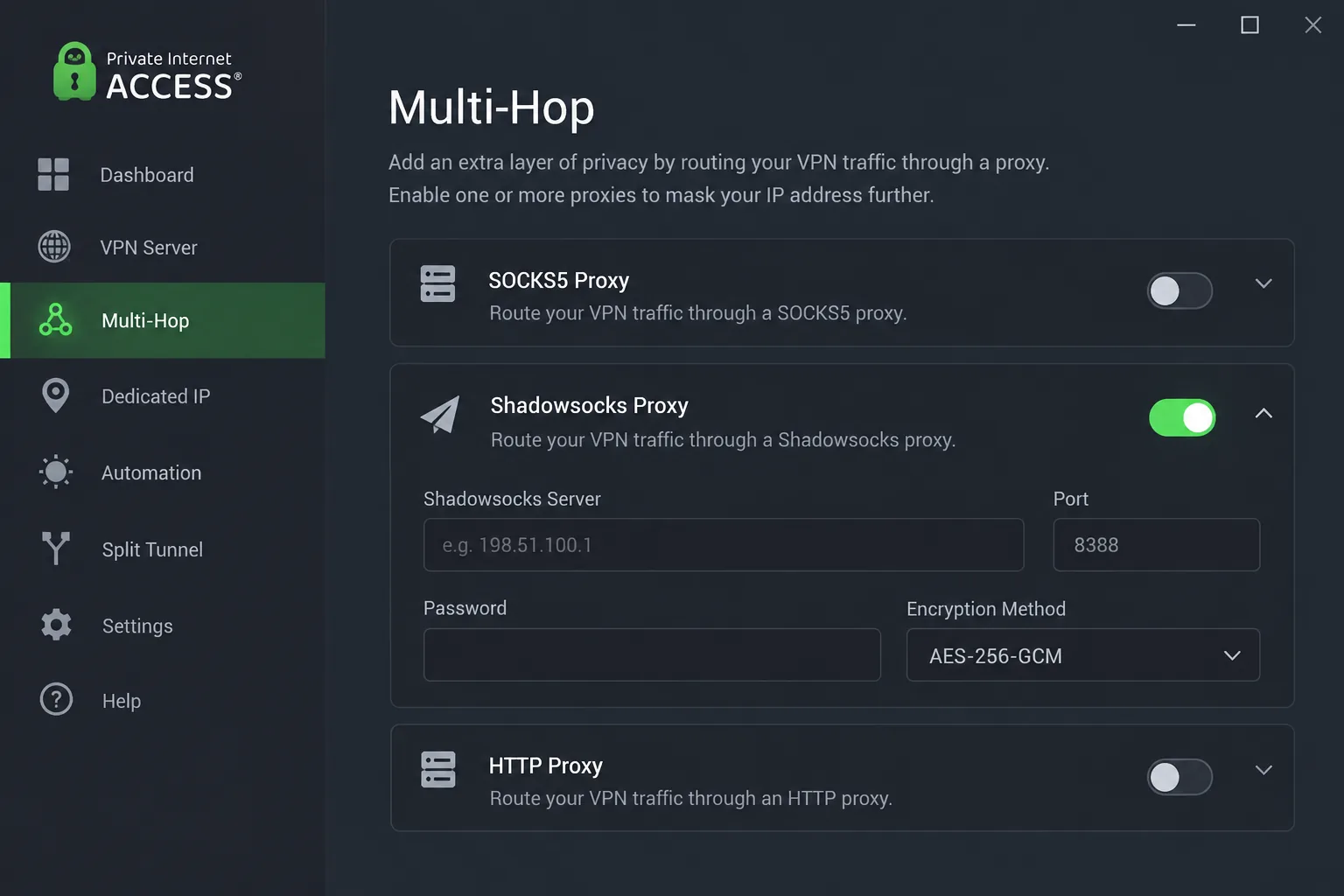
We switched Proton to Stealth by opening Settings → Protocol and choosing Stealth. With Stealth set, download speed held up well on nearby servers, but upload fell off sharply once we connected to distant ones. That matters if you send photos or video out of the country, so stay close to the region when you upload. When we contacted support, live chat took several minutes to answer and email replies arrived after about two days. Proton has kept connecting through most internet-restriction events, but success is far from guaranteed under the tightest conditions.
Paid plans add Afghanistan servers. These are Smart Routing servers, which give you an Afghan IP address while the hardware sits in London. Nearby, the UAE and Turkey have physical servers, while Pakistan and India use Smart Routing through Singapore. Proton also covers Uzbekistan, Tajikistan and Turkmenistan, which few rivals list. Paid plans cover 140+ countries and up to 10 devices.
VPN Plus costs $9.99 month to month, or from about $3 a month on the 2-year plan, a rate that moves between sales. Refunds under the 30-day money-back guarantee are prorated to the unused part of your subscription.
Pros
- Stealth protocol on every plan, including Free
- Swiss jurisdiction, open-source apps and five straight years of audits
- Afghanistan Smart Routing servers on paid plans
- Broadest Central Asian coverage of our picks
Cons
- Upload speeds drop sharply on distant servers
- Live chat can take several minutes and email about two days
- Refunds are prorated rather than a full 30-day refund
3. ExpressVPN - Most Reliable VPN for Afghanistan
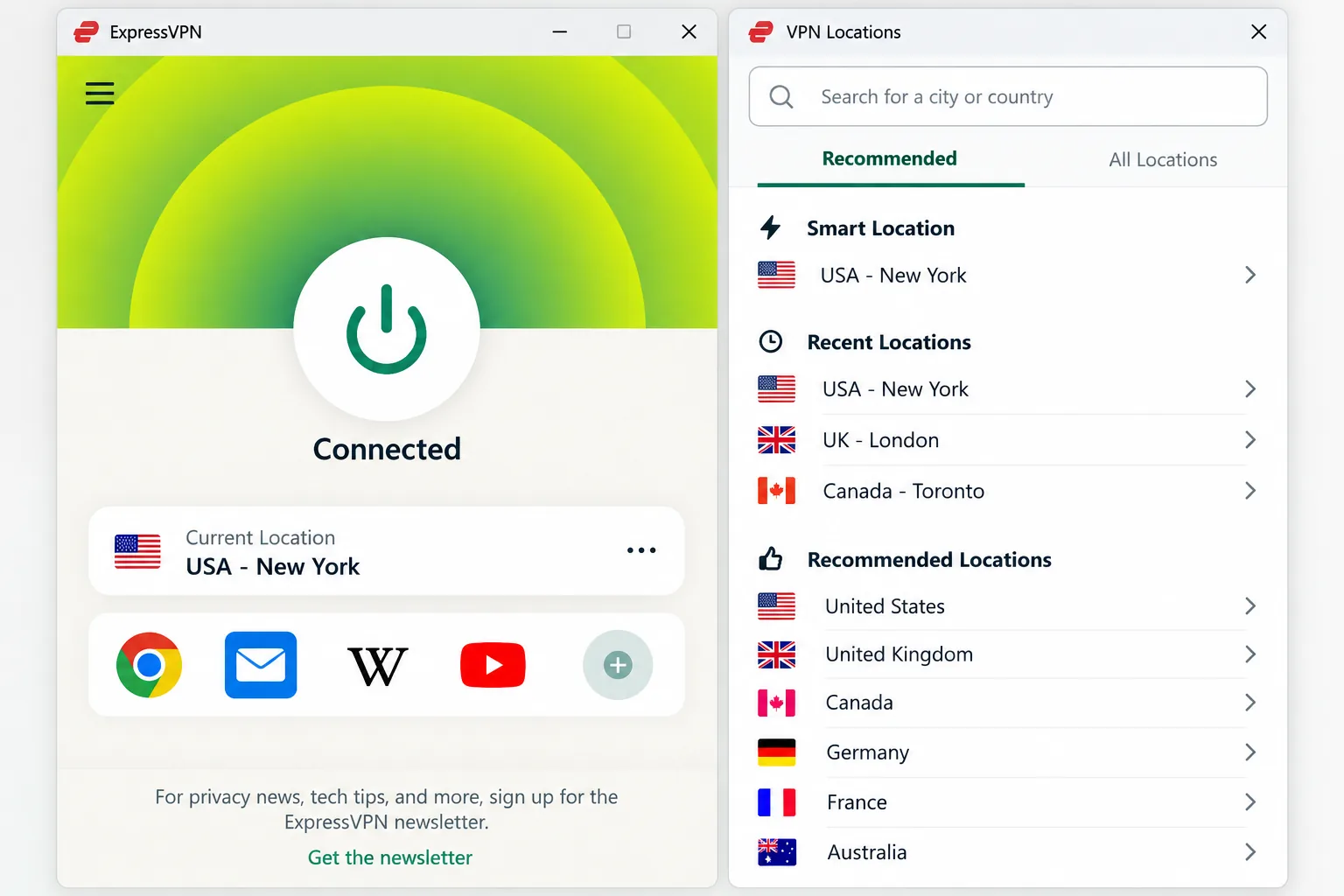
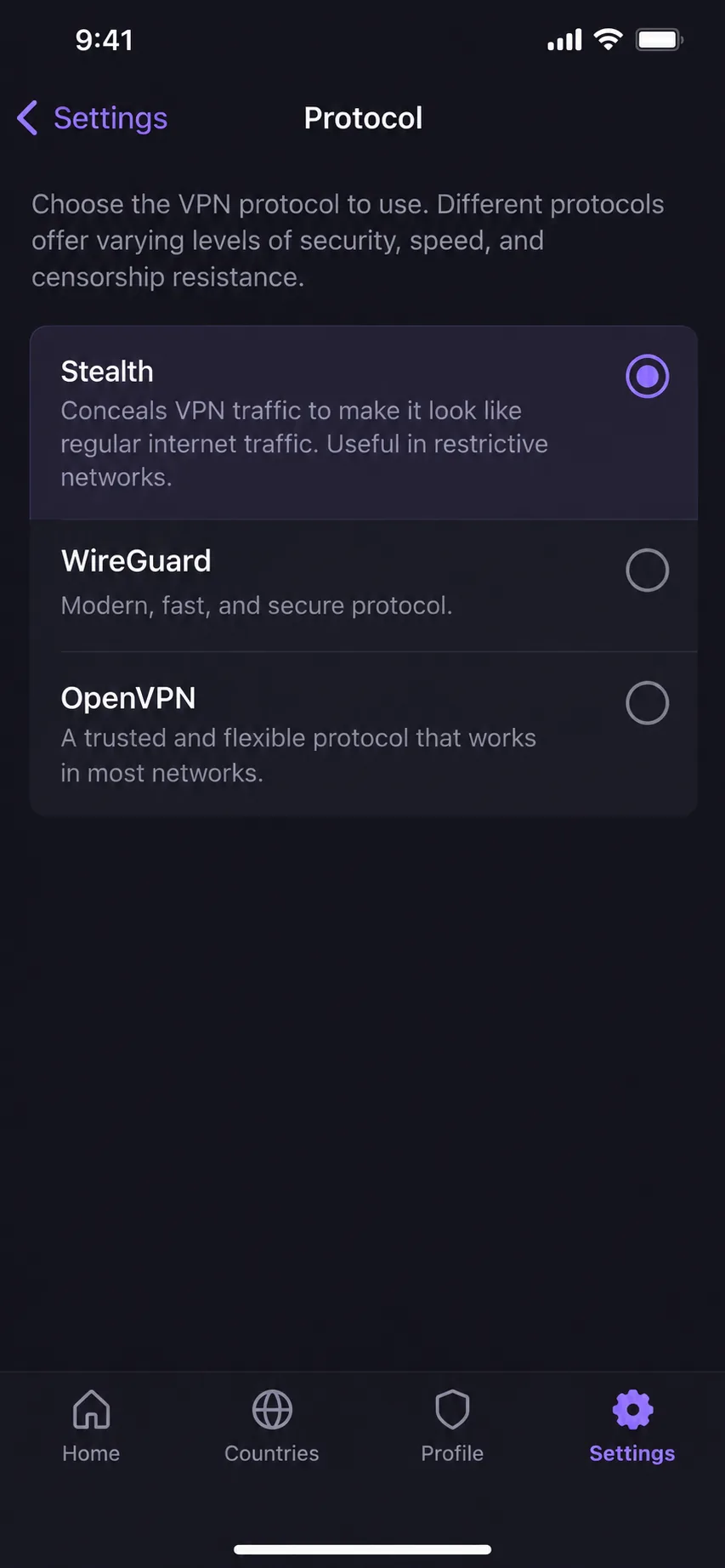
Where NordVPN and Proton ask you to switch stealth on, ExpressVPN never turns it off. Obfuscation runs automatically on all its servers and protocols, so there is nothing to configure before you connect from a censored network. That makes it the VPN we would hand to a relative who does not want to touch settings. It scores 8.8 in our ExpressVPN review.
The always-on obfuscation costs very little. In the same test set where NordLynx held about 11.5 Mbps, ExpressVPN's Lightway protocol held about 10.4 Mbps with obfuscation on. That is a smaller drop than NordVPN's obfuscated servers showed. Connections completed quickly, and the Network Lock kill switch never threw a false alarm while we worked. The only extra step at install is copying an activation code from checkout into the app.
Lightway supports post-quantum ML-KEM encryption, and TrustedServer runs every server from RAM, so nothing is written to disk. KPMG's 2025 assessment of TrustedServer brought ExpressVPN to 23 third-party audits. When Turkish investigators seized one of its servers in December 2017, they found no logs. The company was founded in 2009, is based in the British Virgin Islands, and has been owned by Kape Technologies since 2021.
Servers cover 113 countries. There is no Afghanistan location, but Pakistan, India, Turkey, Uzbekistan and Kazakhstan are available as virtual locations. On the 2-year term, the three tiers cost $2.99 a month for Basic, $4.49 for Advanced and $7.49 for Pro, covering 10, 12 or 14 devices. Basic renews at $99.95 a year. A 30-day money-back guarantee applies, and the mobile app stores offer a 7-day free trial.
Pros
- Obfuscation is always on, with nothing to configure
- Lightway keeps most of its speed with stealth active
- RAM-only servers and 23 third-party audits
- One-click apps that mirror desktop on mobile
Cons
- Renewal at $99.95 a year costs more than rivals for a similar feature set
- No Afghanistan location
- Split tunneling is missing on iOS
4. Surfshark - Best Budget VPN for Afghanistan
Surfshark has the lowest 2-year price of our picks and scores 8.6 in our Surfshark review. The 2-year plan costs $2.49 a month ($67.23 for the first 27 months), and one account covers unlimited devices, so every phone and laptop in a household or small office can share it.
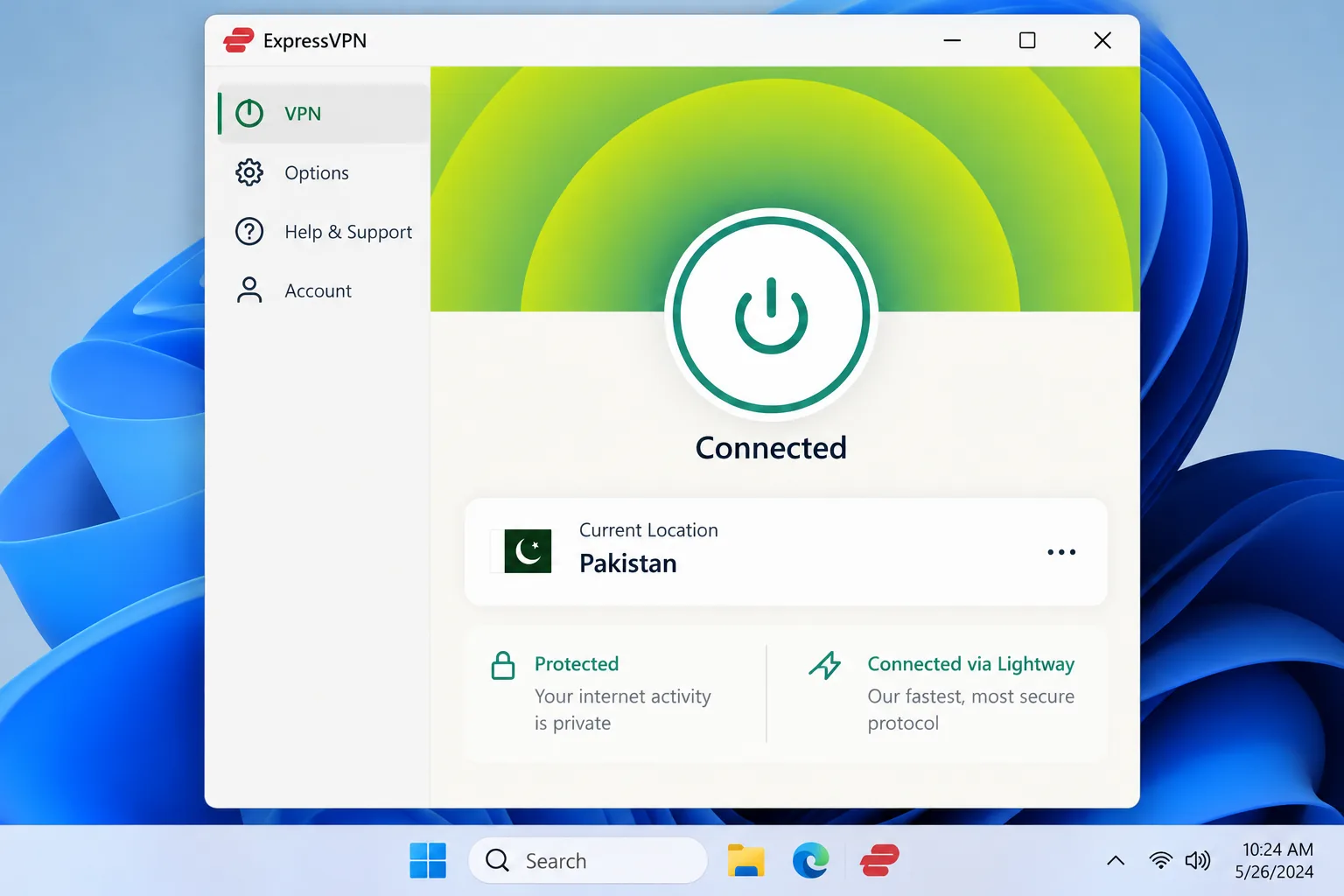
Its stealth feature, Camouflage mode, switches on by itself whenever you connect over OpenVPN. The trade-off is that it only works over OpenVPN, which is slower than WireGuard. We saw that clearly on our Afghanistan-focused test set. WireGuard held about 10.9 Mbps down, but Camouflage mode fell to about 6.5 Mbps, and upload dropped to roughly 0.5 Mbps in one run. Use WireGuard as long as it connects, and save Camouflage for networks that block you.
Setup took us under five minutes, from download to a connected server. Latency jumped even on nearby servers, which you notice on calls and in games but not while browsing. Netflix, BBC iPlayer, Hulu and Amazon Prime Video all unblocked, though streams sometimes took a moment to start.
Surfshark lists Pakistan, India (Delhi and Mumbai), the UAE, Turkey, Uzbekistan and Kazakhstan, but its server page does not say which are virtual. It runs 4,500+ servers in 100 countries on RAM-only hardware, and Deloitte verified the no-logs policy in 2023 and again in 2025. Surfshark was founded in 2018, has been based in the Netherlands since 2021, and merged with Nord Security in 2022 while keeping separate infrastructure. Renewal pricing varies by term and currency, and a 30-day money-back guarantee applies.
Pros
- Lowest 2-year price of our picks
- Unlimited simultaneous connections
- Camouflage mode turns on automatically over OpenVPN
- Live chat answered our questions in under a minute
Cons
- Camouflage only works over the slower OpenVPN protocol
- Upload speed can collapse with Camouflage active
- Latency rises even on nearby servers
5. Private Internet Access - Best for Advanced Users in Afghanistan
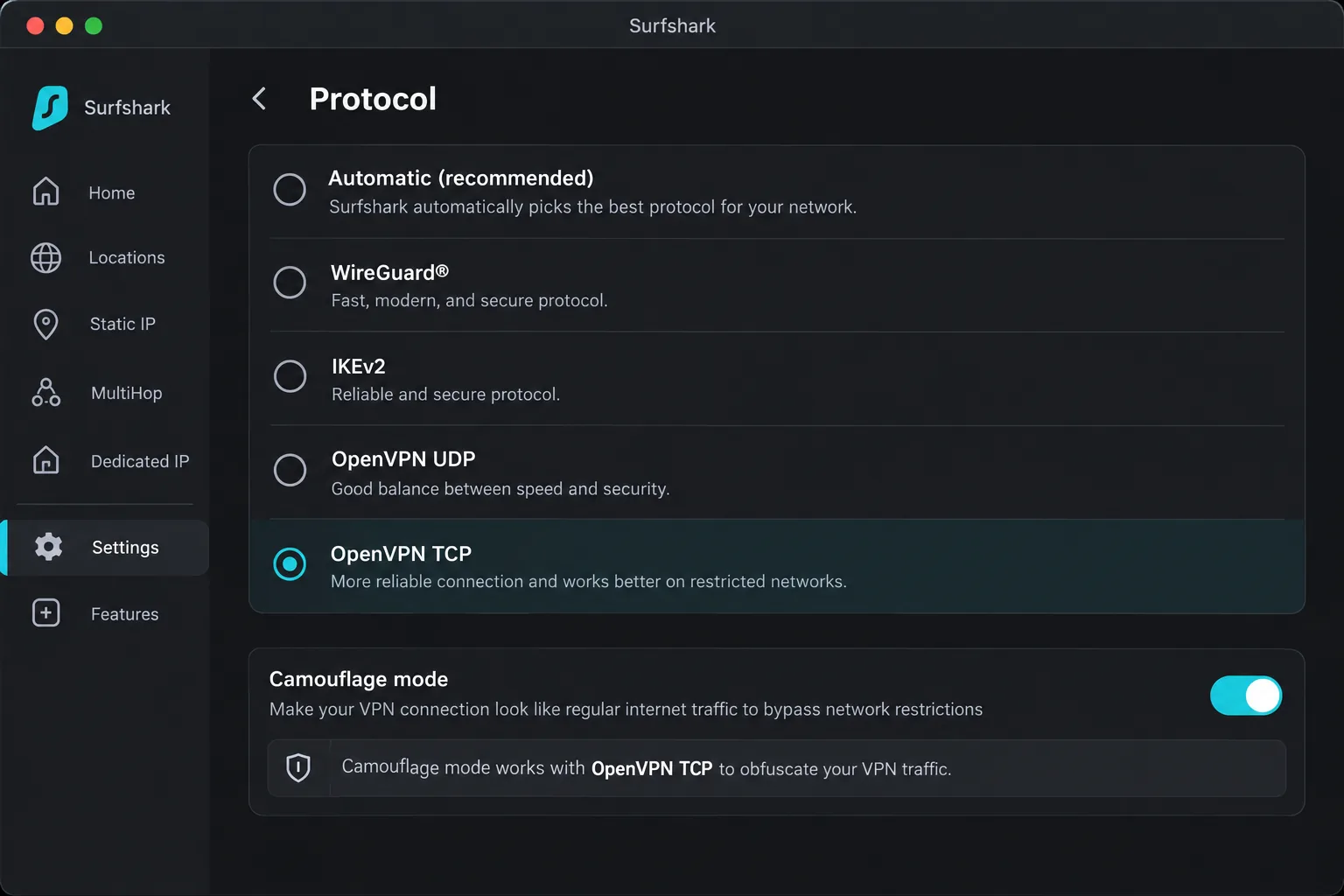
Surfshark keeps things simple, while Private Internet Access hands you the controls. PIA scores 8.4 in our Private Internet Access review, and its stealth option works differently from the other four. Instead of a dedicated protocol, PIA can route your connection through a Shadowsocks proxy, a tool built to disguise VPN traffic from deep packet inspection. That option is not available on iOS, so it suits Windows, macOS and Android users best.
Turning Shadowsocks on means leaving WireGuard behind, because on desktop the Multi-Hop option only shows up once you switch to OpenVPN over TCP. The proxy exits are also far from Kabul. You choose Auto or one of six locations in the US, Canada, the UK, the Netherlands, Switzerland and Japan. The extra hop costs enough speed and latency that PIA itself rules Multi-Hop out for gaming and video calls. Reliability is mixed too. Shadowsocks has got through China's Great Firewall, but PIA does not connect reliably there even with obfuscation on. Support will not promise access in China or Iran either. If a proxy crawls, switch to a different Shadowsocks location first.
The rest of PIA's toolkit is aimed at people who like to tune things. You get a standard kill switch and an advanced one that blocks all traffic outside the VPN. WireGuard and OpenVPN, the MACE ad and tracker blocker, and port forwarding round out the set. Servers run from RAM, and Deloitte has completed three no-logs audits, the latest published in February 2026. There is no device cap, and PIA lists servers in 112 countries, though that count keeps climbing as it adds locations through 2026.
Nearby, PIA's United Arab Emirates server is physical, while India, Pakistan and Turkey are virtual locations, with the India hardware sitting in Singapore. PIA's server list shows no Afghanistan location at the moment. Pricing starts at $2.03 a month on the 3-year plan, billed as $79 for 3 years plus 3 extra months. The 1-year plan costs $3.99 a month. A 30-day money-back guarantee covers new subscribers on every plan.
Distance matters more than the flag. In our testing, the closest servers kept most of the line speed, while long routes such as Singapore pushed ping past 250 ms. That is worth remembering, because India's Mumbai location runs on Singapore hardware. Speeds also swung between runs, so try two or three nearby locations, and stay on WireGuard unless you need Shadowsocks. The kill switch held up: when we killed the app mid-session, our real IP never leaked, and IP, DNS and WebRTC leak tests came back clean. Traffic can slip past the VPN after a reboot, before the tunnel comes up, so choose the Always setting if a leak would put you at risk.
PIA is the right choice if you are comfortable adjusting protocols and want Shadowsocks as a fallback. Beginners will find ExpressVPN easier.
Pros
- Shadowsocks proxy option to disguise VPN traffic
- Standard and advanced kill switches
- Unlimited devices and port forwarding
- Three Deloitte no-logs audits
Cons
- Shadowsocks is not available on iOS
- More settings to learn than the other picks
- No Afghanistan location in its server list
How We Chose the Best VPNs for Afghanistan
We started from our own review scores and then filtered for the problems Afghan users actually face. A VPN only made this list if it can disguise VPN traffic, has an independently audited no-logs policy, and includes a kill switch. After that, we weighed speed on slow, long-haul connections, server locations in nearby countries, simultaneous connections, ease of use and price.
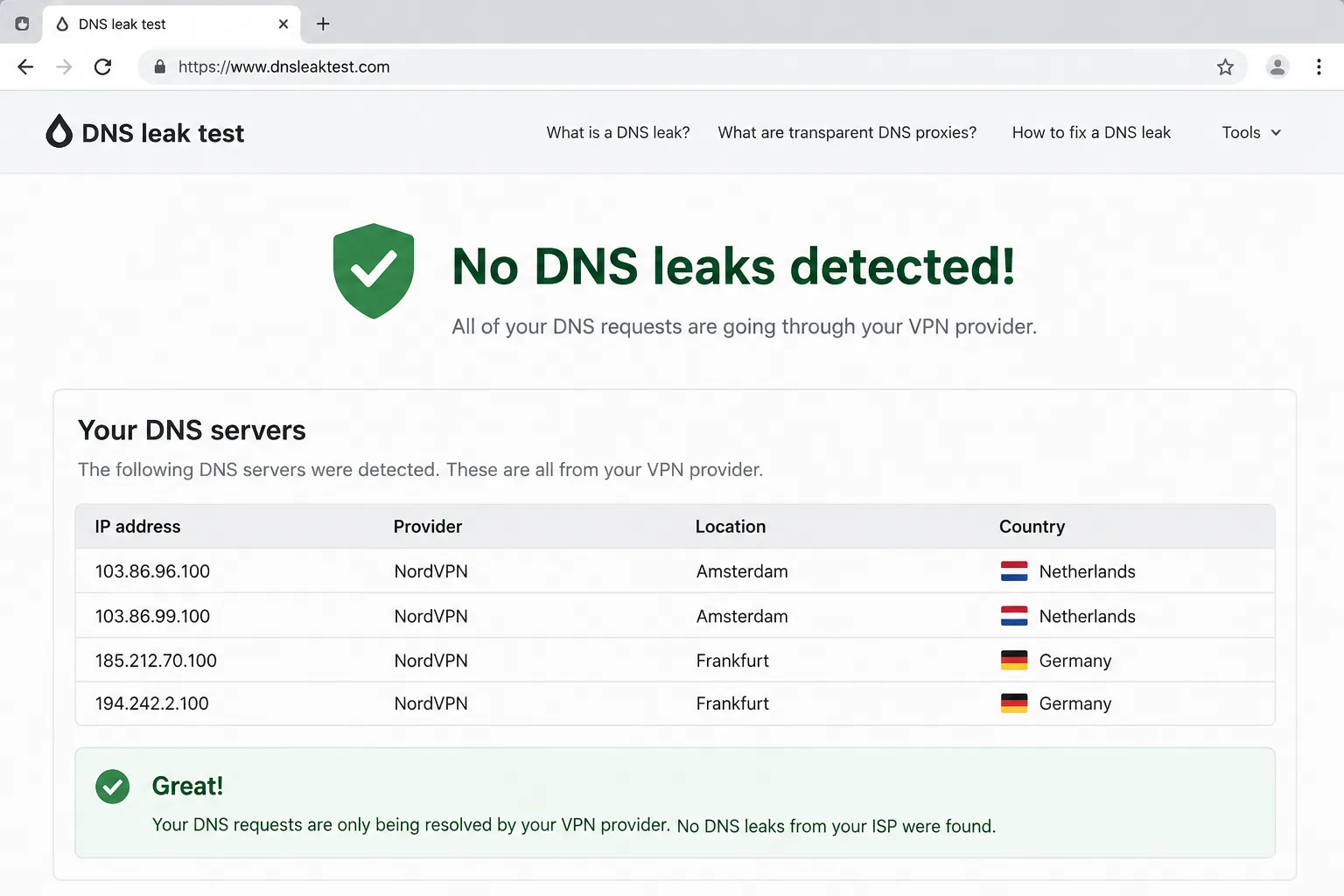
The kill switch was the hard requirement, because on unstable lines a single request that slips out during a drop could reveal your real address. Leak testing then backed it up. IP and DNS tests came back clean on NordVPN, Surfshark and ExpressVPN across servers and protocols, and PIA passed its IP, DNS and WebRTC checks.
The fifth slot needed a tiebreak. CyberGhost and Private Internet Access both score 8.4 with us, and CyberGhost is easier for beginners. However, CyberGhost has no obfuscation or stealth mode, which makes it a poor fit for networks that block VPN traffic. PIA, with its Shadowsocks option, took the slot instead. PureVPN offers a virtual Kabul server, but at 7.2 it scores too low to recommend over these five.
What to Look for in a VPN for Afghanistan
A VPN for Afghanistan has a harder job than one you use on café Wi-Fi at home. It has to get past blocks, protect you if something goes wrong, and stay usable on a slow line.
Obfuscation and Stealth Protocols
Many censors use deep packet inspection, or DPI, which examines the shape of your traffic rather than its contents. Ordinary VPN protocols have a recognisable shape, so a network can block them even though it cannot read them. Obfuscation disguises VPN traffic to look like normal encrypted web traffic. Our guide on how to make a VPN undetectable explains the techniques in more depth.
In Afghanistan, a VPN that cannot hide what it is will often fail before it gets the chance to protect you.
Strict No-Logs Policy
A no-logs policy means the provider does not record your online activities or which sites you visit. Promises are cheap, so we only picked services that have let an outside auditor check their policy. Look for a recent audit, ideally repeated every year, and RAM-only servers that wipe themselves on reboot. Jurisdiction matters too, and all five of our picks are based well outside any Afghan authority's reach.
Kill Switch and Leak Protection
A kill switch blocks all internet traffic the moment your VPN connection drops, so nothing slips out unprotected while it reconnects. Drops happen often on unstable Afghan connections, so keep the kill switch on at all times. Our explainer on what a VPN kill switch does covers the different types. You also want DNS leak protection, because a DNS leak can show your internet provider every site you look up even while the VPN is connected.
Keep your VPN's stealth mode and kill switch on whenever you are online in Afghanistan, and do not rely on an unknown free VPN app. If your phone might be checked, remember that a VPN protects your traffic, not what is stored on the device.
Performance on Mobile Networks
Afghan connections are slow before a VPN adds anything. Fixed-line median download speeds sit between roughly 4.5 and 5 Mbps, depending on the month and the tracker, and mobile speeds stay under 20 Mbps. On a line that slow, every bit of VPN overhead shows. Nearby servers in Pakistan, the UAE, India or Turkey keep latency far lower than servers in Europe or North America. WireGuard-based protocols such as NordLynx and Lightway also hold onto more speed than OpenVPN.
Can You Use a Free VPN in Afghanistan?
You can, but most free VPNs are a bad idea anywhere privacy matters. A 2016 CSIRO study of Android VPN apps looked at 283 apps drawn from 1.4 million on Google Play. It found that 18% tunnelled traffic without encryption and over 38% showed some sign of malware. About 84% did not tunnel IPv6 traffic and 66% did not tunnel DNS traffic, so they leaked exactly what a censor would want to see. On top of that, 75% used third-party tracking libraries.
The exception is Proton VPN's free plan. It gives you unlimited data, no ads, the Stealth protocol and a kill switch on one device. The limits are real, though. You get servers in 10 countries, but the app chooses one at random and you cannot pick a country yourself. Free servers also get crowded at peak hours. Our roundup of the best free VPNs covers other options, but stick to the paid picks if your safety depends on it.
Internet Censorship in Afghanistan: What Is Blocked and Who Is Watching
Freedom House's 2026 Freedom in the World report rates Afghanistan Not Free, with a score of 8/100, up only slightly from 6/100 in 2025. About 11.3 million people, or 25.5% of the population, use the internet, so online restrictions shape how a large share of Afghans get their news. Our guides to the best VPN for Iran and the best VPN for China show how similar blocks work elsewhere.
What Websites and Platforms Are Blocked in Afghanistan?
Reported blocks cover social media, news sites, VoIP and private messengers, politics, religion, dating, gambling, LGBT content, and sites critical of the Taliban. BBC, VOA and Deutsche Welle have been named among the blocked news services. The Taliban cabinet ordered TikTok and PUBG banned in April 2022, and carriers enforced the ban that September.
The biggest recent wave came in October 2025. From October 7 to 8, NetBlocks found Instagram, Facebook and Snapchat intentionally restricted on several Afghan providers, and Proton added X to that list. Afghans could not reach those platforms without a VPN, and Proton VPN signups in Afghanistan rose 35,000% over baseline on October 7. We could not confirm whether those restrictions are still in force today. If Facebook is your main need, see our guide to the best VPN to unblock Facebook.
Pressure on media continues in 2026. In May, the vice and virtue ministry warned YouTubers and social media activists in Kandahar against publishing video content, and in October the Taliban suspended BBC FM radio broadcasts across the country.
Can the Taliban See What You Do Online?
Afghanistan's Telecommunications Regulatory Authority licenses internet providers such as AfghaNet, Etisalat and Giganet, and it can require them to monitor traffic and hand over user data. We could not find a primary source on how much ISP-level monitoring happens in practice. A VPN's encryption hides your traffic and the sites you visit from your provider, which is the main reason to use one. The physical risk is clearer. Human Rights Watch's 2026 World Report records checkpoints set up to inspect mobile phones.
Internet Shutdowns and Throttling
Restrictions escalated through September 2025. On September 16, Balkh province's spokesperson said fibre-optic internet was completely banned there "to prevent vice". Similar restrictions followed in six more provinces, including Kandahar and Helmand, as Al Jazeera reported on the fibre bans and the Taliban's denial. The Taliban blamed old fibre-optic cables that needed replacing.
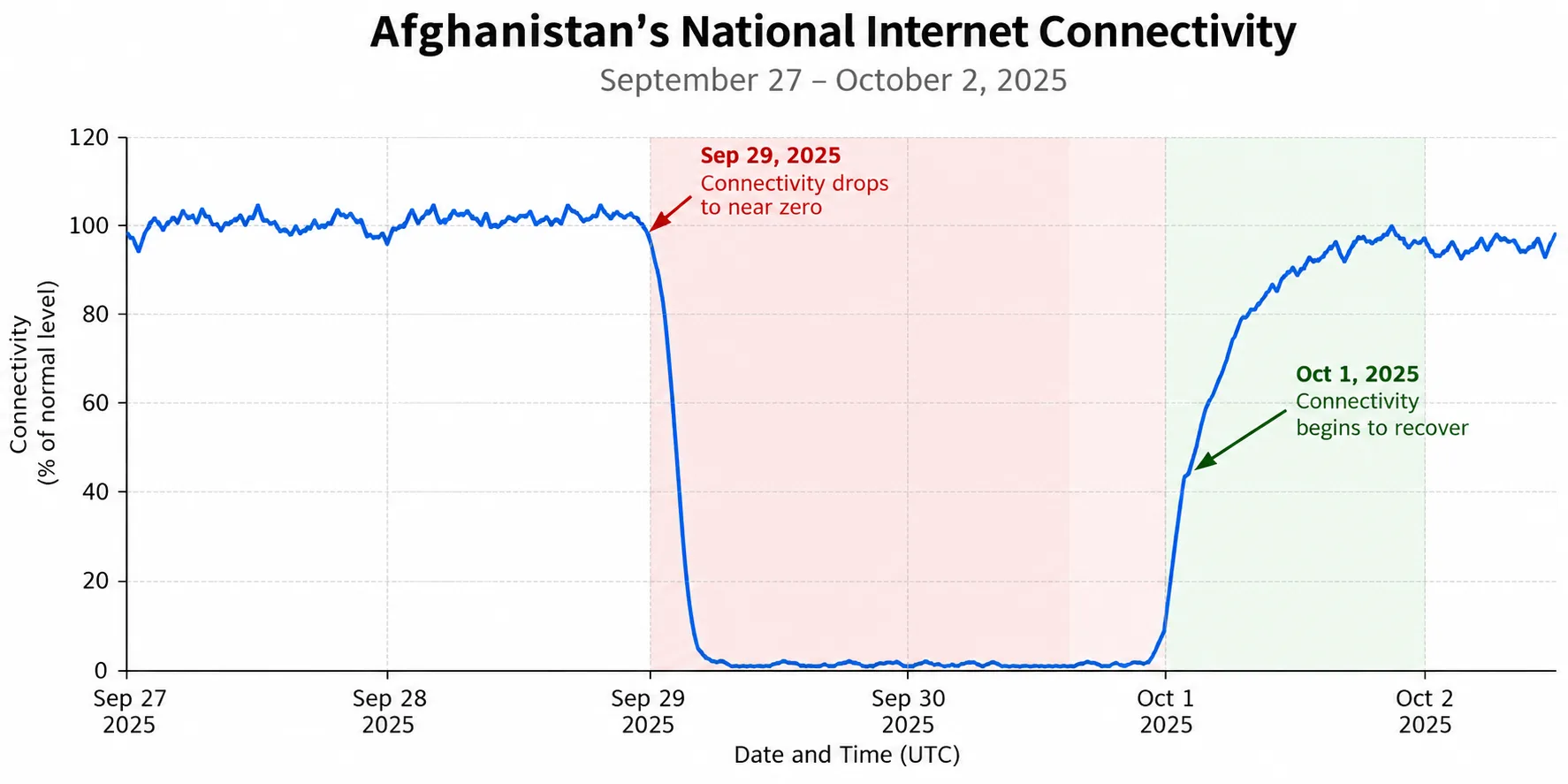
Then, from the evening of September 29, 2025, the whole country lost internet and phone service for about 48 hours. RFE/RL's report on the nationwide blackout notes that NetBlocks measured connectivity at under 1% of normal levels, consistent with intentional disconnection. It was the first nationwide communications shutdown since the Taliban returned in 2021, and it cut a country of about 43 million people off from banking, flights, schools and hospital systems.
No VPN could connect during that blackout, because there was no internet connection to tunnel through. A VPN only helps while some connectivity remains, as it did during the October social media blocks.
Is Using a VPN Legal in Afghanistan?
We found no specific law or decree that bans VPN use in Afghanistan. The 2017 Electronic Crimes Law makes it a crime to share "anti-Islamic" or "anti-government" content, which targets what you post rather than the tool you use. Afghanistan has no published VPN statute, but the Taliban enforce online-content rules unpredictably. "Not explicitly banned" is not the same as "safe from consequences". Use a VPN discreetly, and avoid sharing material that could draw attention.
How to Download and Set Up a VPN in Afghanistan
The easiest time to set up a VPN is before you arrive or before restrictions tighten. Proton notes that the Afghan authorities have blocked many VPN websites, so downloading from a vendor's site may not work.
If the VPN Website Is Blocked
Try your device's app store first, because it is a separate route from the vendor's own website. If that fails, get the official installer file from a trusted contact who downloaded it outside the country, or use an unrestricted network such as an office connection. As a last resort, email the provider's support team and ask for an official mirror site. Our guide on how to bypass a VPN blocker walks through more workarounds.
Setting Up the App Safely
- Sign in, then turn on the kill switch before your first connection.
- Switch on stealth. In NordVPN, choose the Obfuscated Servers category. In Proton VPN, open Settings → Protocol and choose Stealth. In Surfshark, choose OpenVPN as your protocol so Camouflage mode activates. ExpressVPN needs no change.
- Pick a nearby server in Pakistan, the UAE, India or Turkey.
- Run a DNS leak test in your browser and confirm it shows only your VPN provider's servers.
What to Do If Your VPN Stops Working in Afghanistan
When a VPN that worked yesterday will not connect today, work through these steps in order.
- Switch to stealth mode. Move to your provider's obfuscated option, even though it is slower.
- Change the protocol. Try TCP instead of UDP, or a different protocol entirely. Some networks block one and let another through.
- Try a different nearby server. A blocked IP address can stop one server while others in the same country still work.
- Switch networks. If fixed-line internet fails, try mobile data, or the reverse.
- Update the app. Providers push updates when they find new ways around blocks.
- Fall back to your second VPN. Keep a second provider installed in advance, so you are not trying to download one while blocked.
FAQ
Is it safe to use a VPN in Afghanistan?
Which VPN is best for iPhone or Android in Afghanistan?
Can I use a VPN on mobile data in Afghanistan?
Do WhatsApp calls work with a VPN in Afghanistan?
What should I do during a total internet blackout?
Will a VPN slow down my connection?
Can I stream home-country services from Afghanistan?
How do I get an Afghanistan IP address from abroad?
Final Verdict: The Best VPN for Afghanistan
Our recommendation for most people is to install two of these services, not one. Connections in Afghanistan can change from one week to the next, and a backup you have already set up is far more useful than one you have to download while blocked. If budget is the deciding factor, Surfshark's $2.49 a month is the lowest 2-year price and covers every device in the house. PIA only goes lower if you commit to three years.