Amnezia VPN is a free, open-source app that sets up a stealth VPN on a server you rent, using protocols such as AmneziaWG or Xray with REALITY. It also sells a managed Premium service. "Stealth" means the traffic is disguised so censors and firewalls can't easily spot it as a VPN.
The catch with self-hosting is that one server means one IP address, which a censor only has to flag once. You also have to maintain that server yourself. Amnezia's own infrastructure came under attack in 2026, starting with IP blocking on May 20 and a DDoS attack on June 1.
Below are the managed stealth VPNs and self-hosted tools we'd reach for instead, with notes on where each beats Amnezia.
Quick picks: the best Amnezia VPN alternatives at a glance
- Proton VPN: best overall, with Stealth on every plan (managed)
- NordVPN: best for obfuscated servers and speed (managed)
- Mullvad VPN: best for anonymous, no-account privacy (managed)
- ExpressVPN: best for beginners who don't want to run a server (managed)
- Surfshark: best budget stealth option (managed)
- Outline: easiest self-hosted replacement, built on Shadowsocks (self-hosted)
- Xray with VLESS + REALITY: best self-hosted stealth build (self-hosted)
- WireGuard: best plain open-source protocol for speed, not stealth (self-hosted)
How we chose these Amnezia VPN alternatives
We judged each alternative the way we judge any VPN before recommending it: does it connect where it has to, and what does it cost in speed? Obfuscation and DPI resistance came first, so we noted how each behaved on restrictive networks, from blocking hotel Wi-Fi to China, and where a manual protocol switch was needed.
Speed came next because obfuscation usually costs throughput, as the Proton and NordVPN sections below show. After that we weighed protocol support, apps for all five major platforms, open-source code and audits, price, and how easy each self-hosted option was to build and keep running.
1. Proton VPN - best overall Amnezia alternative (Stealth protocol)
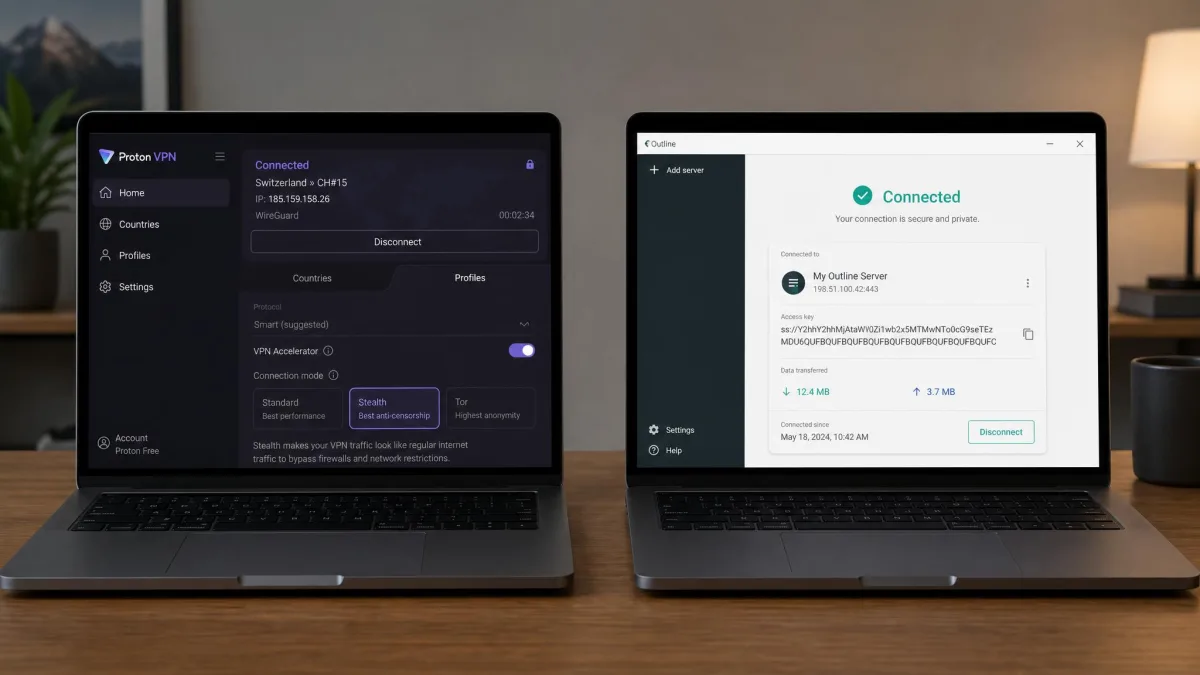
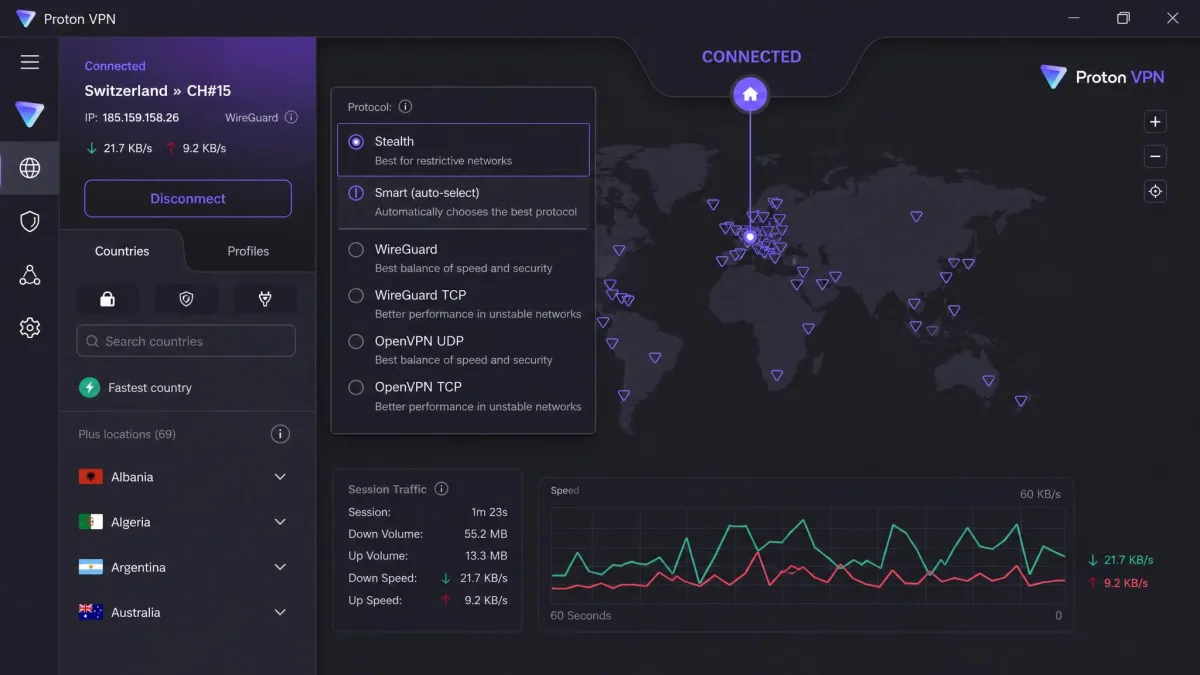
Proton VPN is a managed service, so there is no server to rent or patch, and its Stealth protocol is the closest match to Amnezia's obfuscation. Stealth, launched in 2022, wraps the tunnel in obfuscated TLS over TCP so it looks like ordinary encrypted web traffic.
- Stealth available on Windows, macOS, Linux, Android and iOS, on every plan including Free
- 20,000+ servers in 140+ countries; VPN Plus covers 10 devices
- WireGuard, OpenVPN and Stealth in open-source apps
On hotel Wi-Fi that blocked regular WireGuard, Stealth connected for us quickly. The disguise costs speed: it ran around 10 percent slower than OpenVPN and up to 35 percent slower than WireGuard, so we keep it for restrictive networks. In mainland China it works on some networks and fails on others, and Proton itself puts the odds in restrictive countries at about 50 percent. We go deeper on how Proton VPN's Stealth protocol handles China.
VPN Plus costs about $2.99 a month on the 2-year plan, though that rate is promotional and renews higher, or $9.99 on monthly billing, and a 30-day money-back guarantee applies. When a self-hosted Amnezia server gets blocked, you have no other IP to fall back on; Proton hands you a whole network to try, and you maintain none of it. We score it 9.0/10 in our Proton VPN review.
2. NordVPN - best for obfuscated servers and speed
Where Proton built a stealth protocol you switch on, NordVPN folds obfuscation into a server category. It is a managed service with no free plan. Its obfuscated servers now run on NordWhisper, an in-house protocol launched in 2025 that disguises VPN traffic as regular web traffic.
- NordLynx (WireGuard-based), OpenVPN and NordWhisper
- Windows, macOS, Linux, Android and iOS, with up to 10 simultaneous connections
When we pick Obfuscated Servers, the app now starts a NordWhisper connection itself instead of first asking us to choose OpenVPN TCP or UDP. NordVPN is rolling this change out platform by platform, and on Linux the obfuscated servers still use OpenVPN.
A plain nearby NordLynx server was the fastest option we had, while obfuscated servers traded a little speed for their disguise. Plain NordLynx is blocked instantly in China, though, and obfuscated results there swing from steady connections to weeks of being unusable.
The Basic plan costs $3.49 a month on the 2-year plan, billed upfront, or $14.99 on monthly billing, with a 30-day money-back guarantee. Its edge over Amnezia is a fast default for everyday use, with obfuscation one tap away. More in our NordVPN review.

3. Mullvad VPN - best for anonymous, no-account privacy
If NordVPN is the feature-heavy option, Mullvad is the minimalist one. It is a managed, WireGuard-only service, and signing up generates a random 16-digit account number with no email or password.
- Four obfuscation methods: LWO (Lightweight WireGuard Obfuscation), QUIC, Shadowsocks and UDP-over-TCP
- Windows, macOS, Linux, Android and iOS (UDP-over-TCP is not on iOS)
- Flat EUR 5 a month on any term, up to 5 devices, cash and Monero accepted
QUIC obfuscation reached desktop in app 2025.9, and Mullvad dropped OpenVPN in January 2026. We explain each method in our guide to Mullvad's stealth protocol.
Mullvad held up well on distant servers for us, at about 92 Mbps nearby and 85 Mbps to Japan, where a 1080p video call stayed stable. China is harder: we needed US servers and had to cycle through obfuscation methods, and roughly half our attempts connected, at slow speeds. Support is email-only, and split tunnelling needs manual entries.
There is no free plan or trial, only a 14-day money-back window (cash payments excluded). A self-hosted Amnezia server ties your traffic to a VPS on your hosting account, and a blocked protocol means rebuilding it. Mullvad asks for no personal details, and when one method is filtered you switch to another in the same app. See our Mullvad VPN review.

4. ExpressVPN - best for beginners who don't want to run a server
Mullvad asks you to choose an obfuscation method, while ExpressVPN chooses for you. It is a managed service with automatic obfuscation on every server on supported platforms. Its Lightway protocol does not obfuscate by itself, so the disguise is a layer added on top.
- Lightway, OpenVPN and WireGuard across servers in 113 countries
- Apps for Windows, macOS, Linux, iOS, Android, routers and smart TVs
- Basic, Advanced and Pro tiers covering 10, 12 and 14 devices
It is not plug-and-play in China. Automatic mode dropped constantly for us in Beijing, and setting Lightway manually worked best, with OpenVPN TCP as the fallback. Once tuned, it connected on roughly 85 percent of attempts with about 180 ms of latency and fast speeds.
Basic costs about $2.79 a month on the 2-year plan, a rate that moves with promotions, or $12.99 on monthly billing. There is no free plan, and a 30-day money-back guarantee applies. Its edge over Amnezia is zero configuration on most networks. More in our ExpressVPN review.

5. Surfshark - best budget stealth option
Surfshark is the cheapest managed pick here, but its stealth takes more setup than ExpressVPN's. Its Camouflage mode obfuscates traffic only when you select an OpenVPN option; WireGuard and IKEv2, the defaults, are not obfuscated.
- OpenVPN, WireGuard and IKEv2, with Camouflage and NoBorders modes
- 4,500+ RAM-only servers in 100 countries, unlimited devices
- Apps for Windows, macOS, Linux, iOS, Android and Fire TV
In China, the default WireGuard and IKEv2 connections were blocked instantly, so we had to switch to OpenVPN TCP before Camouflage did anything. NoBorders mode is meant to switch on when the app detects restrictions, but it did not trigger reliably there, and connections succeeded about 60 percent of the time.
The Starter plan costs about $2.49 a month on the 2-year plan, plus bonus months, and renews at $79 a year, though renewal pricing can change. Web purchases get a 30-day money-back guarantee. Its answer to Amnezia's one-server ceiling is a large pool of servers at the lowest price here, as long as you remember the OpenVPN step. See our Surfshark review.

6. Outline - easiest self-hosted Amnezia replacement (Shadowsocks)
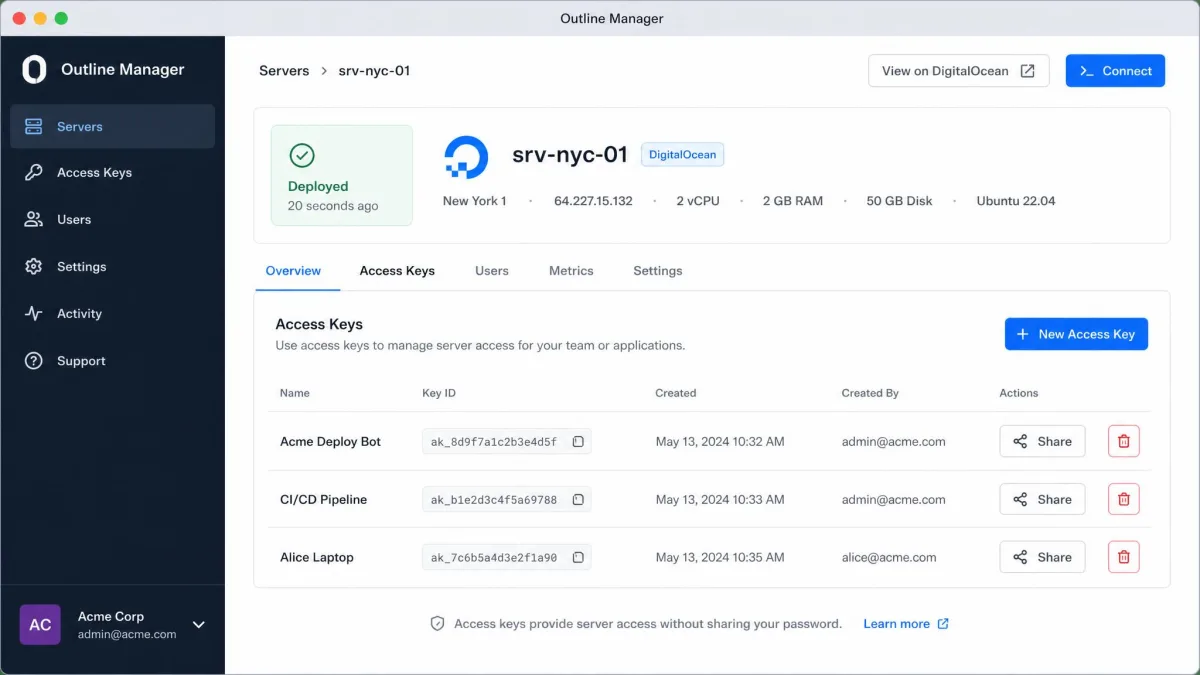
The managed picks end here, and Outline is the gentlest step if you still want your own server. Outline is a free, open-source (Apache-2.0) tool that lets you create your own VPN on a rented server and share access to it. It runs a Shadowsocks proxy, an encrypted protocol built not to look like a VPN.
- Outline Manager builds the server; the client runs on Windows, macOS, Linux, Android and iOS
- Automated deployment on DigitalOcean, Amazon Lightsail and Google Cloud, or any Linux server via one script
- Launched in 2018 by Jigsaw; run by the non-profit Outline Foundation since January 2026
Setting it up took us four steps: install Outline Manager, get a VPS, let the Manager deploy the server and generate an access key, then paste that key into the client. Revoking one person's key cuts them off without touching anyone else.
Its stealth is more modest than Xray's. China's Great Firewall has detected fully encrypted traffic like Shadowsocks since 2021, and in Russia from May 2024 Outline worked only partially on networks where VLESS kept working. The software is free, and DigitalOcean's cheapest Basic Droplet costs $4 a month.
7. Xray with VLESS + REALITY (3x-UI) - best self-hosted stealth setup
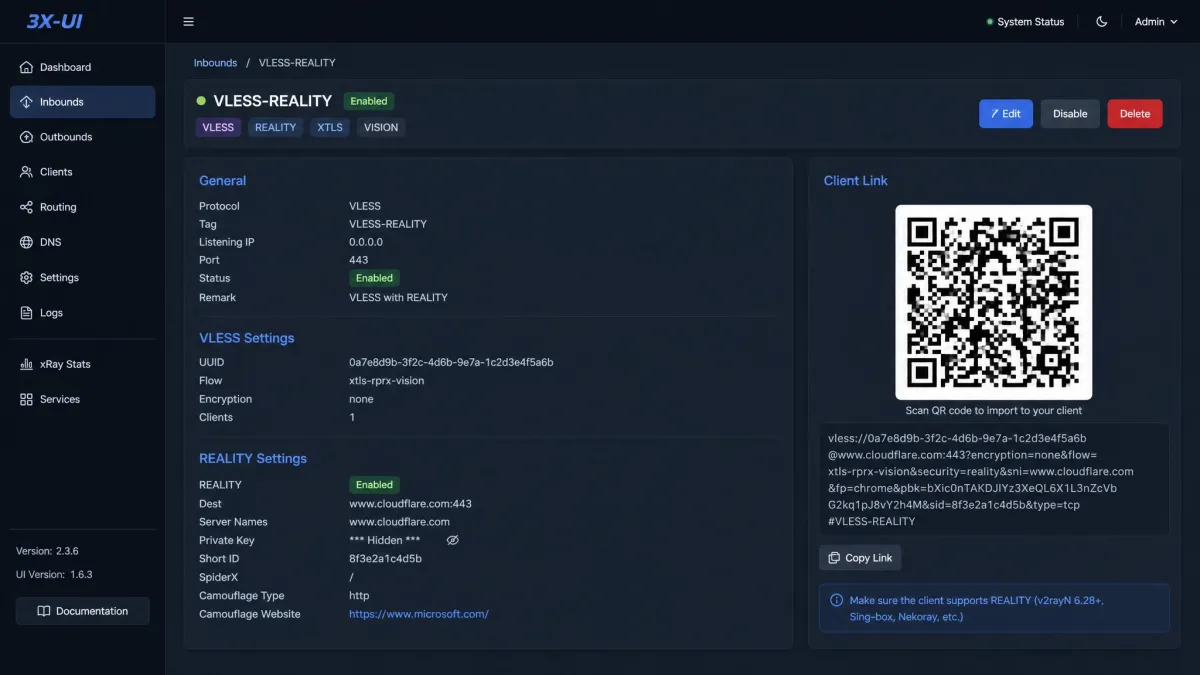
Where Outline trades stealth for ease, this build trades ease for stealth. It is a self-hosted stack: the open-source Xray-core project carries the VLESS protocol. Its REALITY transport hides your server's TLS handshake behind a real, popular website, so you need no domain or certificate of your own.
- 3x-ui, an open-source web panel, installs with a one-line script on Ubuntu, Debian, Fedora and more
- The panel also supports Trojan, Shadowsocks, WireGuard and AmneziaWG
- Clients include v2rayN (Windows), v2rayNG (Android), Streisand and FoXray
A full VLESS + REALITY build on a cloud VM took us about 30 minutes, though the documentation is thin, and the Docker install path is the roughest part. Older Docker installs came up with admin/admin credentials on HTTP port 2053, so change them if you followed an old guide.
Regenerating an inbound silently breaks old exported links, so re-export after every change. Newer Xray builds' post-quantum TLS can also break handshakes with current clients, so pin a known-good panel version. On Apple devices, Streisand and FoXray worked cleanly for us, while Hiddify gave mixed results.
8. WireGuard - best plain open-source protocol (with an obfuscation caveat)
WireGuard sits underneath several picks on this list, but it is a speed pick, not a stealth pick. WireGuard is a simple, fast, open-source VPN protocol with a small, auditable codebase. You run it on your own server, with free cross-platform clients for Windows, macOS, Linux, BSD, Android and iOS.
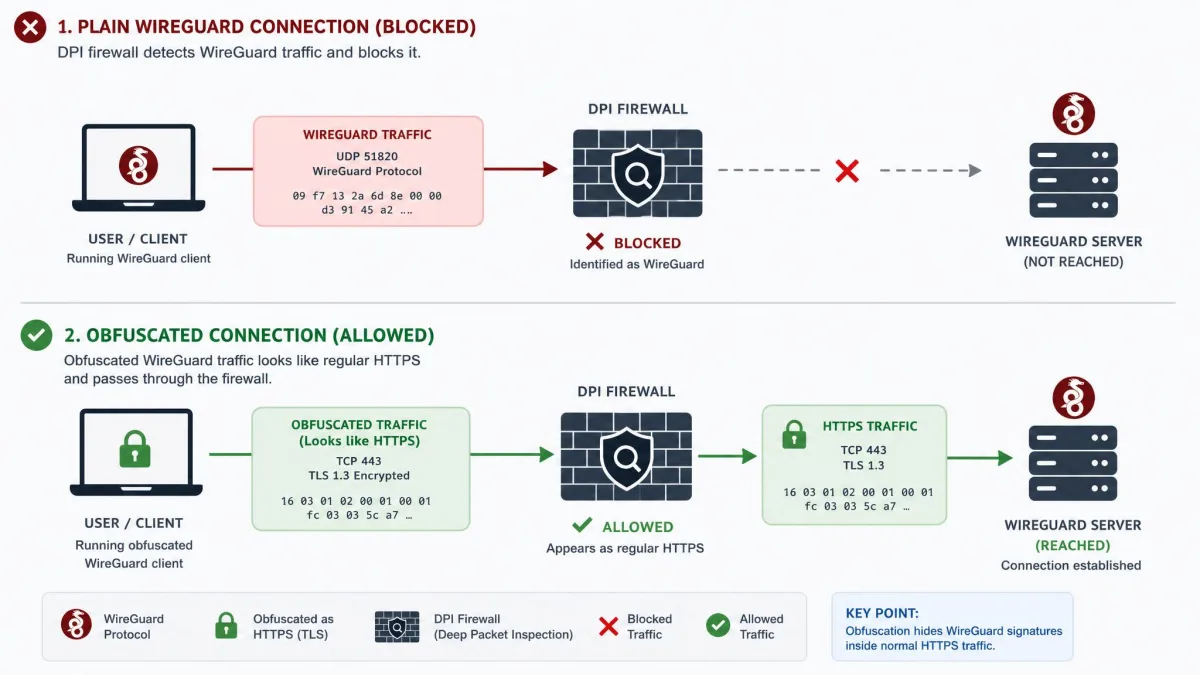
AmneziaWG is a fork of WireGuard. It keeps WireGuard's cryptography and adds junk packets, random padding and changing headers. Those hide it from deep packet inspection (DPI), the filtering that reads traffic patterns to guess which protocol it is. Plain WireGuard has fixed headers and predictable packet sizes (every handshake initiation is 148 bytes), which DPI systems use to identify and block it.
On a censored network, run plain WireGuard or OpenVPN inside an obfuscation layer, and check local rules first, because VPN legality varies.
On an open network, plain WireGuard is the fast, simple option we'd reach for, and it makes a sensible Amnezia replacement there. On a filtered network the picture changed: modern DPI identified plain WireGuard almost instantly, OpenVPN fared no better, and moving either to a different port did not help. AmneziaWG got past that filtering, but its userspace version on Windows, macOS, iOS and Android used noticeably more CPU for us at high speeds than the kernel module on Linux, so plain WireGuard is the better fit wherever you don't need the disguise.
Other Amnezia VPN alternatives worth knowing
Beyond the eight picks, a few tools fill narrower gaps: free circumvention, older protocols, or a different network model.
Psiphon: free censorship-circumvention app
Psiphon is a free, open-source app built for censorship circumvention rather than everyday privacy. It runs on Android, Windows, iOS and Apple-silicon Macs and moves you across constantly changing servers, and it has passed 150 million downloads.
SoftEther VPN, OpenVPN Connect and Mysterium VPN
SoftEther VPN is free, open-source server and client software from the University of Tsukuba. It speaks SSL-VPN, OpenVPN, L2TP and IPsec, can tunnel over HTTPS, ICMP or DNS, and its latest version is 4.44.
OpenVPN Connect is the official OpenVPN client, and it imports the .ovpn files an Amnezia server exports. Mysterium VPN routes WireGuard traffic through residential exit nodes run by individuals; our Mysterium VPN review scores it 4.7/10.
Amnezia VPN vs the alternatives: side-by-side comparison
| Product | Buy | Type | Stealth / obfuscation | Core protocols | Platforms | Open source | Free tier | Starting price | Run your own server? |
|---|---|---|---|---|---|---|---|---|---|
 |
Self-hosted app + Premium | AmneziaWG, Xray REALITY | AmneziaWG, WireGuard, OpenVPN, Xray and more | Windows, macOS, Linux, Android, iOS | Yes | Yes (Amnezia Free: whitelisted sites) | Premium $80/2 yrs; or VPS cost | Optional | |
|
Check price → | Managed | Stealth | WireGuard, OpenVPN, Stealth | Windows, macOS, Linux, Android, iOS | Yes (apps) | Yes, with Stealth | ~$2.99/mo (2-yr) | No |
|
Check price | Managed | NordWhisper servers | NordLynx, OpenVPN, NordWhisper | Windows, macOS, Linux, Android, iOS | No | No | $3.49/mo (2-yr) | No |
|
Check price | Managed | LWO, QUIC, Shadowsocks, UDP-over-TCP | WireGuard | Windows, macOS, Linux, Android, iOS | Yes (apps) | No | EUR 5/mo | No |
|
Check price | Managed | Automatic | Lightway, OpenVPN, WireGuard | Windows, macOS, Linux, Android, iOS | No | No | ~$2.79/mo (2-yr) | No |
|
Check price | Managed | Camouflage (OpenVPN only) | WireGuard, OpenVPN, IKEv2 | Windows, macOS, Linux, Android, iOS | No | No | $2.49/mo (2-yr) | No |
 |
Self-hosted | Shadowsocks (modest) | Shadowsocks | Windows, macOS, Linux, Android, iOS | Yes | Yes | VPS from $4/mo | Yes | |
 |
Self-hosted | REALITY | VLESS, Trojan, Shadowsocks | Linux server; clients on all platforms | Yes | Yes | VPS from $4/mo | Yes | |
 |
Self-hosted protocol | None | WireGuard | Windows, macOS, Linux, BSD, Android, iOS | Yes | Yes | VPS from $4/mo | Yes |
When to stay with Amnezia VPN
The table puts Amnezia alongside the field, and it earns credit on several counts. The client is free and open source, it installs a personal VPN on any VPS you rent, and it supports both AmneziaWG and Xray with REALITY in one app. After the 2026 attacks, Amnezia shipped AmneziaWG 3.1 with better blocking resistance.
Premium is fairly priced at $30 for 6 months, $50 for a year or $80 for 2 years. It offers 20 locations, up to 7 devices, advertised speeds up to 200 Mbps and a 14-day money-back guarantee.
Stay with Amnezia if you are happy running your own VPS, want full control of your server, and have a single IP that is not being blocked. For the full picture, read our Amnezia VPN review.
Why people look for an Amnezia VPN alternative
Most people who leave are not unhappy with the app. They hit the limits of self-hosting, or got caught by the 2026 outage.
One server, one IP: the self-hosting ceiling
A single self-hosted server gives you one IP in one location. Datacenter IP ranges from big cloud hosts are among the first things censors flag, and a fresh VPS can be blocklisted within hours. The Amnezia app also wants root on the VPS and rewrites firewall rules, which can break Docker containers and other services on the same server.
The 2026 outage and AmneziaWG problems on mobile data
After IP blocking began on May 20, a coordinated DDoS attack from June 1 disrupted both Amnezia Free and Premium. Amnezia's developers blamed Russia's regulator, Roskomnadzor. Fresh server IPs were blocked within a few hours of launch, so swapping servers did not help, and paying for Premium bought no immunity.
Older app versions stopped connecting after June 14, and version 4.8.18 or later was required, and self-hosted users were told to update too. Twenty Premium locations were back by June 17, further waves hit on July 7 and July 25, and stable Premium service returned around August 4. More than a million people use Amnezia Free in Russia, so the outage reached a large audience.
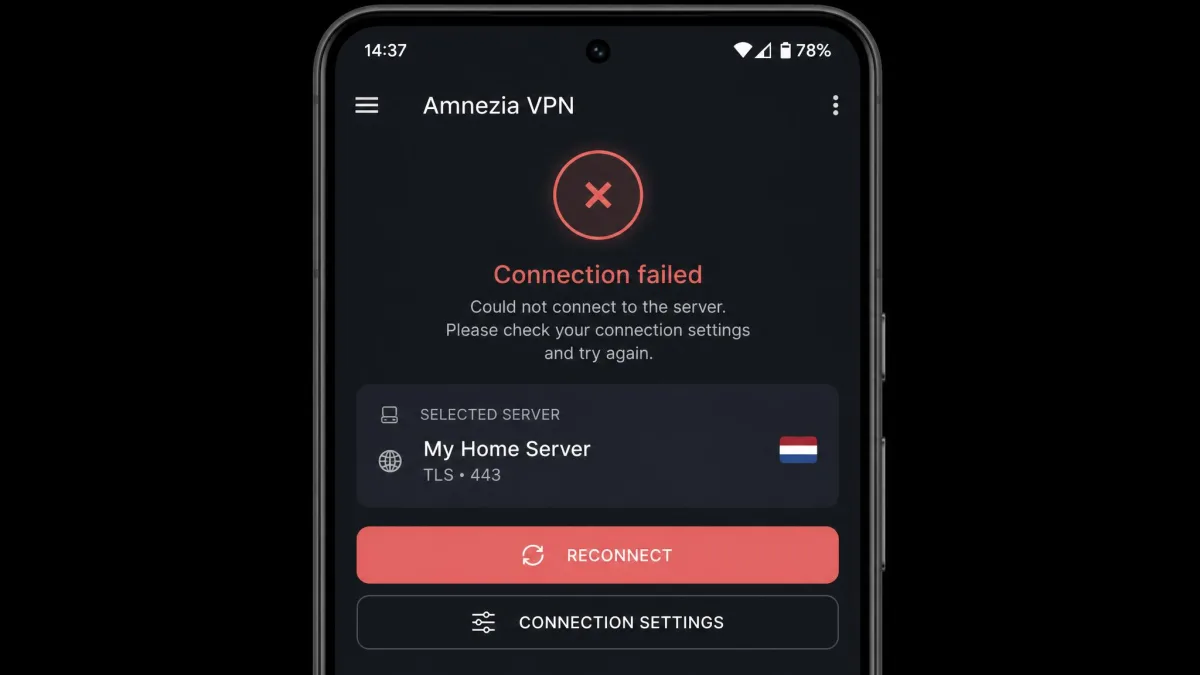
Mobile data is a separate headache. An AmneziaWG connection that is stable on home Wi-Fi can freeze on mobile data, where carriers filter padded UDP packets more aggressively. The most common failure we hit was a handshake that succeeded with no traffic flowing, and lowering the client MTU to 1280 fixed it, especially on iOS.
Keep your Amnezia server but use other apps
You don't have to abandon a working server to change apps. Amnezia's list of compatible third-party apps shows which clients accept its configs:
- AmneziaWG: the AmneziaWG app (Android, iOS, macOS, Windows) or DefaultVPN (iOS 16+)
- WireGuard: the official WireGuard app, using a .conf file
- OpenVPN: OpenVPN Connect or OpenVPN for Android, using an .ovpn file
- Xray REALITY: v2rayNG, Streisand, FoXray, Shadowrocket, V2Box or Nekoray
Amnezia shares connections as vpn:// keys. For apps that don't accept those keys, create a config file in the Amnezia app, then open the other client and import that file.
A standard WireGuard client cannot connect to an AmneziaWG server that has obfuscation parameters set. Export a plain WireGuard config for WireGuard apps, and keep AmneziaWG connections in an AmneziaWG-aware client.
Self-hosted vs managed: which kind of alternative fits you
The split comes down to who holds the keys and who does the upkeep.
| Factor | Self-hosted (Outline, Xray, WireGuard) | Managed (Proton, NordVPN, Mullvad, ExpressVPN, Surfshark) |
|---|---|---|
| IPs and locations | One server, one IP | Thousands of servers |
| Upkeep | You patch and replace blocked servers | The provider does it |
| Cost | VPS from $4/mo, software free | From $2.49/mo (2-yr) to EUR 5/mo |
| Logs | You control them | You trust the provider's policy |
| Apps | Third-party clients, varying polish | Polished first-party apps |
A personal VPN server makes sense when you want control and a private IP that only you and your family use. A managed service makes sense when you want many exit points and no server administration.
What to look for in an Amnezia VPN replacement
Once you know which camp you fall into, start with what Amnezia does for you today. If it gets you past blocks, stealth matters most; if it is just for privacy, speed and apps matter more.
Obfuscation and DPI resistance
Look for a named obfuscation feature and know when it applies. Proton's Stealth and ExpressVPN's automatic obfuscation need little thought, while Surfshark only obfuscates on OpenVPN. For self-hosting, REALITY is harder to spot than Shadowsocks. Our guide on how to make a VPN harder to detect covers the wider techniques.
Protocol support: WireGuard, OpenVPN, Xray and Shadowsocks
WireGuard is the fastest general choice and OpenVPN the most widely supported, but neither hides itself. Xray and Shadowsocks are proxy protocols built for censorship, so they suit Amnezia users who need access to a filtered internet.
Apps for Windows, macOS, Linux, Android and iOS
Every managed pick covers the five main platforms. Self-hosted tools rely on third-party clients whose quality varies, so confirm a reliable client exists for each device before you build.
Open source, audits and no-logs policy
Open source lets anyone inspect the code. Proton and Mullvad publish their apps, and Outline has been audited by Radically Open Security and Cure53. On a self-hosted server, logging is your decision; with a managed VPN, you rely on the provider's no-logs policy.
Amnezia VPN alternatives FAQ
What is the best alternative to Amnezia VPN?
Are there free alternatives to Amnezia VPN?
Can I use my Amnezia server with WireGuard or OpenVPN apps?
Is Amnezia VPN safe, and does it still work?
What VPN protocol is hardest to block?
Do I need my own server to replace Amnezia?
Final verdict: which Amnezia VPN alternative should you choose?
For a managed replacement, choose Proton VPN: Stealth works on every plan, including Free, and you trade one server IP for a network in 140+ countries. For a self-hosted replacement, build Xray with VLESS + REALITY through 3x-ui, or start with Outline if an easy build matters more than maximum stealth. Stay with Amnezia if you enjoy running your own server and your IP still gets through.