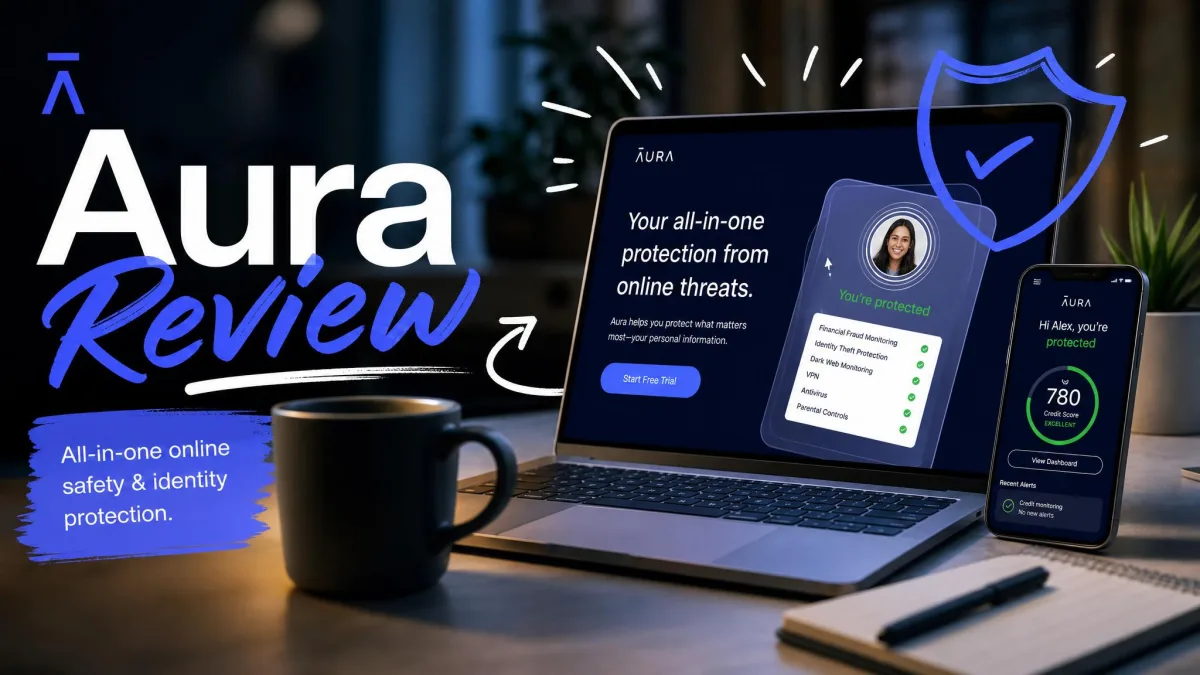
Aura is an all-in-one identity theft protection service. One subscription bundles credit monitoring, dark web and financial alerts, automated data broker removal, a VPN, antivirus and a password manager. It is aimed at people who want one bill and one account for the whole household, rather than four separate security products stitched together by hand.
This review covers what Aura includes and what each plan costs. It also covers how the service behaves day to day, how it compares with LifeLock and IdentityForce, and where it falls short. The verdict below is the short version.
What Is Aura?
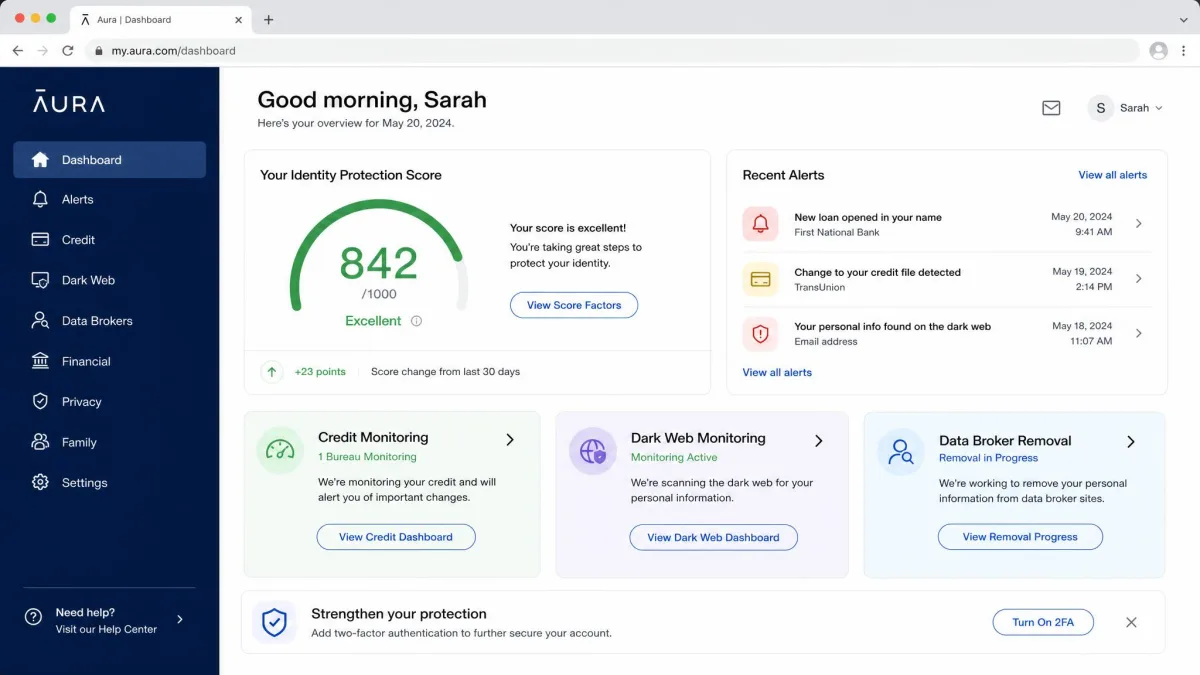
Aura watches the places your personal information can surface, and it tells you when something changes. That means your credit files at all three bureaus, dark web marketplaces, bank and card transactions, public records tied to your home and car titles, and the broker sites that publish your address and phone number. When something looks wrong, the service alerts you, and it puts a fraud resolution specialist on the case.
Around that monitoring core, Aura adds a consumer security bundle. You get a VPN, antivirus, a password manager, a safe browsing extension and parental controls. Every plan carries the same feature list. What changes between tiers is how many adults, children and devices the account covers, and how much insurance sits behind it.
Who Aura Is For
Aura suits a household that wants one service, one login and one renewal date. Families get the clearest value, because the Family plan covers five adults plus unlimited children and devices for a single price. Parental controls are included rather than sold as an upgrade. Parents who want credit freezes and gaming supervision without buying a second product are well served.
It fits less well if you already pay for a good VPN and a serious antivirus. There is no lighter, cheaper tier, so someone who only wants credit monitoring still pays for the VPN, antivirus and password manager they may never open. If that describes you, a monitoring-only service will cost less for the same practical protection.
Aura Pricing and Plans
Those features cost the same on every tier, which makes the plan choice about people and devices rather than capability. Aura prices four plans. The gap between monthly and annual billing is large enough to shape the decision, because paying month to month costs a clear premium on every tier.
Individual, Couple, Family, and Kids Plans
The Individual plan is $15 per month, or $12 per month billed annually. That covers one adult with 10 devices and $1 million in identity theft insurance. The Couple plan is $29 per month, or $22 billed annually. It covers two adults and 20 devices with $2 million in total insurance.
The Family plan is $50 per month, or $32 billed annually. That tier covers five adults plus unlimited children and unlimited devices, with $5 million in total insurance. At the annual rate it is the standout value in the range, since a couple already pays $22 and the step up to full household coverage is $10 more. The Kids plan is $13 per month, or $10 billed annually, for child-only monitoring.
| Plan | Adults covered | Devices | Insurance | Monthly | Annual (per month) |
|---|---|---|---|---|---|
| 1 | 10 devices | $1 million | $15 | $12 | |
| 2 | 20 | $2 million | $29 | $22 | |
| 5 plus unlimited kids | Unlimited | $5 million | $50 | $32 | |
| Children only | Household | Included | $13 | $10 |
Free Trial and Money-Back Guarantee
Every plan comes with a 14-day free trial. That is enough time to run the data removal scan, connect your financial accounts and see how many alerts the service actually generates. Annual subscriptions also carry a 60-day money-back guarantee. By the standards of this category, that window is genuinely generous.
The catch sits after it closes, because annual plans can auto-renew with no advance warning. The charge on your card is often the first notice that the term rolled over. Cancelling mid-term outside the 60-day window generally does not refund the remainder.
Before you buy an annual plan, put a reminder in your calendar for two weeks before the renewal date. The 60-day guarantee is your only clean exit. Read the insurance terms too. The policy excludes identity theft that began before you enrolled, so a case already in progress will not be covered.
Aura Features at a Glance
Pricing aside, the feature list is one of the longest in identity protection. Unusually for this market, it does not thin out on the cheap plan.
Identity Theft and Credit Monitoring
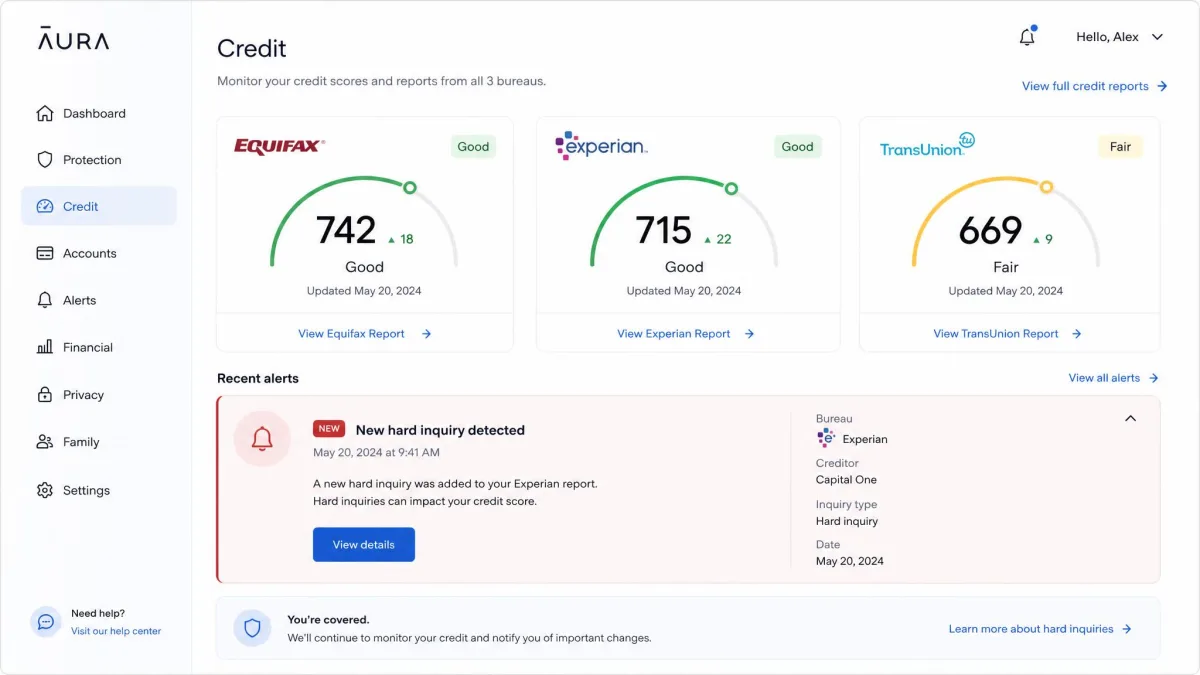
Credit monitoring is where Aura earns most of its price. Every plan monitors Equifax, Experian and TransUnion. A new account opened in your name at any bureau triggers an alert, rather than slipping past because you happened to be on a single-bureau tier. You also get an Experian credit lock you can toggle from the app, annual credit reports and scores, and dark web monitoring for the emails, phone numbers and Social Security numbers you register.
The limits are worth knowing. Credit reports refresh annually rather than continuously. There are no budgeting or score-planning tools, so this is a security product rather than a credit-improvement one. Alerts are also only as good as the accounts you connect, and the setup flow rewards taking ten minutes to add every card and email you use.
Alerts themselves arrive fast. Credit-file changes reached the account in about three minutes in a mystery-shopper study Aura commissioned. An independent 14-month side-by-side test measured roughly four minutes, against three hours or more for LifeLock, Identity Guard and IdentityForce. Treat those intervals as indicative rather than fixed. Alert timing depends on which bureau or data source reports the change, and it does not hold evenly across event types. On dark web coverage the volume is the more telling number. The same head-to-head testing surfaced 18 dark web alerts to the closest competitor's 8.
Financial and Transaction Monitoring
Connect your bank and card accounts and Aura watches for transactions that break your normal pattern. It also flags large withdrawals, balance changes and new account openings. The same idea extends to public records, covering changes to your home and auto titles and sex offender registry entries near your address. Title monitoring is the quiet standout here, since deed fraud is expensive to unwind and most services at this price ignore it.
Personal Data Removal
Aura runs automated opt-outs across 200+ data brokers and people-search sites. Coverage is identical on every plan, so the cheapest tier gets the same clearance results as the family tier. In independent testing the service clears roughly 90 to 91 percent of listings on the brokers it covers. Clearance rates move between testing rounds, because brokers relist records after removal.
Two gaps matter. Several highly visible people-search sites sit outside the automated coverage, including Spokeo, Intelius and BeenVerified. Those are exactly the ones a stranger is most likely to find first. There is also no way to file a custom removal request of your own. Nor is there a real-time alert when a broker relists a record, so a returning listing will not announce itself. A dedicated removal service does this job more thoroughly. As an included feature, though, it is a strong one, and it makes the cheapest plan look better than its price.
Data broker removal is a maintenance task, not a one-time cleanup. Brokers rebuild their records from public sources. The value of an automated service is the repeat sweep rather than the first pass. Judge it after three months, not three days.
VPN, Antivirus, and Password Manager
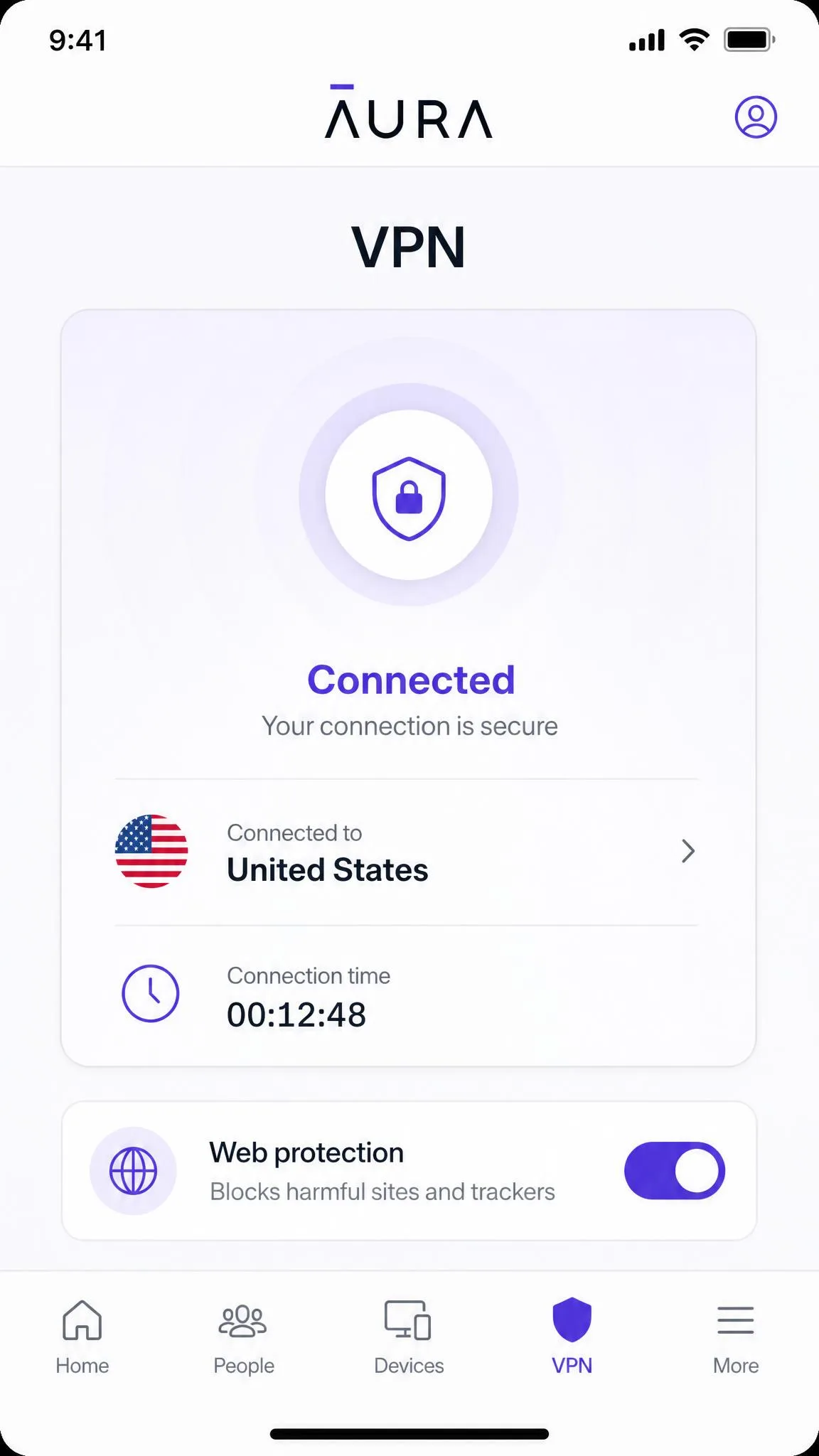
This is the softer half of the bundle. The VPN reaches further than its reputation suggests. There are servers in roughly 80 countries across North and South America, Europe, Asia, Africa and Australia, plus more than 20 US city locations. That still trails standalone services such as NordVPN and Proton VPN, which reach 120 or more countries. Aura also publishes no total server count, no server ownership detail and no information about the underlying server technology.
Non-US coverage exists but is thin on the ground, and the app leans on one-click automatic server selection rather than a full country picker. Picking a specific foreign exit is not the smooth process it is on a dedicated VPN. Download speeds can fall sharply. Foreign geo-blocked streaming does not work, and connections sometimes drop or fail to establish. That is one of the more common friction points in the whole suite.
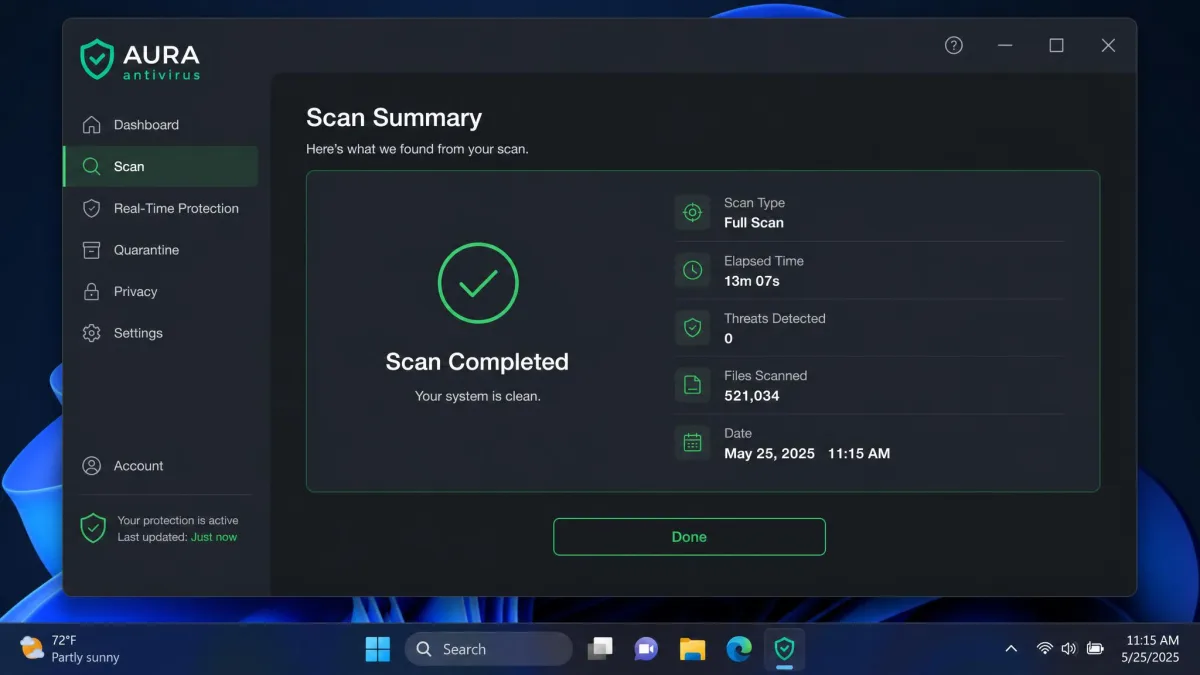
The antivirus is competent for a bundled engine. A full scan finishes in about 13 minutes on a clean machine and blocked every malicious test link. Third-party sample testing puts detection around 98 percent. That figure deserves a caveat, because Aura does not submit its engine to AV-Test or AV-Comparatives, so there is no standing certification behind it. The detection numbers come from ad hoc sample sets rather than a repeatable benchmark. Treat Aura's antivirus as a second layer rather than your only one.
Web protection on mobile is tied to the VPN. Blocking malicious sites means keeping the VPN connected, which is an awkward pairing given the speed cost. On desktop, a Safe Browsing extension for Chrome, Firefox and Edge works without the VPN running. The password manager covers the basics of storage and autofill. It is fine as an upgrade from browser-saved passwords, but it lacks the sharing and audit depth of a dedicated manager.
Parental Controls and Family Safety
On the Family and Kids plans, children get their own monitoring. That covers Social Security number and credit file alerts, a credit freeze workflow at all three bureaus, screen time scheduling, content filtering and video game supervision that flags risky chat. Adding children costs nothing extra on the Family plan. That is the single biggest reason a household with kids should look at that tier rather than stacking two Individual subscriptions.
Getting Started: Setup, App, and Dashboard
Getting that coverage running is where the polish thins. Signup and onboarding are quick, and the dashboard is easy to navigate once the account exists. You create the account, verify your identity, add the personal details you want watched, and connect financial accounts from a list of supported institutions. The initial data broker scan starts on its own and reports back over the following days.
The friction shows up after that. Getting the full feature set running means installing several separate apps rather than one. The suite feels fragmented for a product sold on the promise of everything in one place. The dashboard also takes real navigation effort compared with rival identity services, because related features live in different places rather than in one settings tree. The browser extension occasionally throws verification prompts in the middle of ordinary searches. That is more irritating than harmful, but it happens often enough to notice.
The mobile apps are the better face of the service. Their store ratings reflect that: 4.7 stars on iOS and 4.5 on Android. Alerts land cleanly and the credit lock toggle is one tap away, so most people will end up living in the app rather than the web dashboard.
Aura Identity Theft Insurance and Fraud Resolution
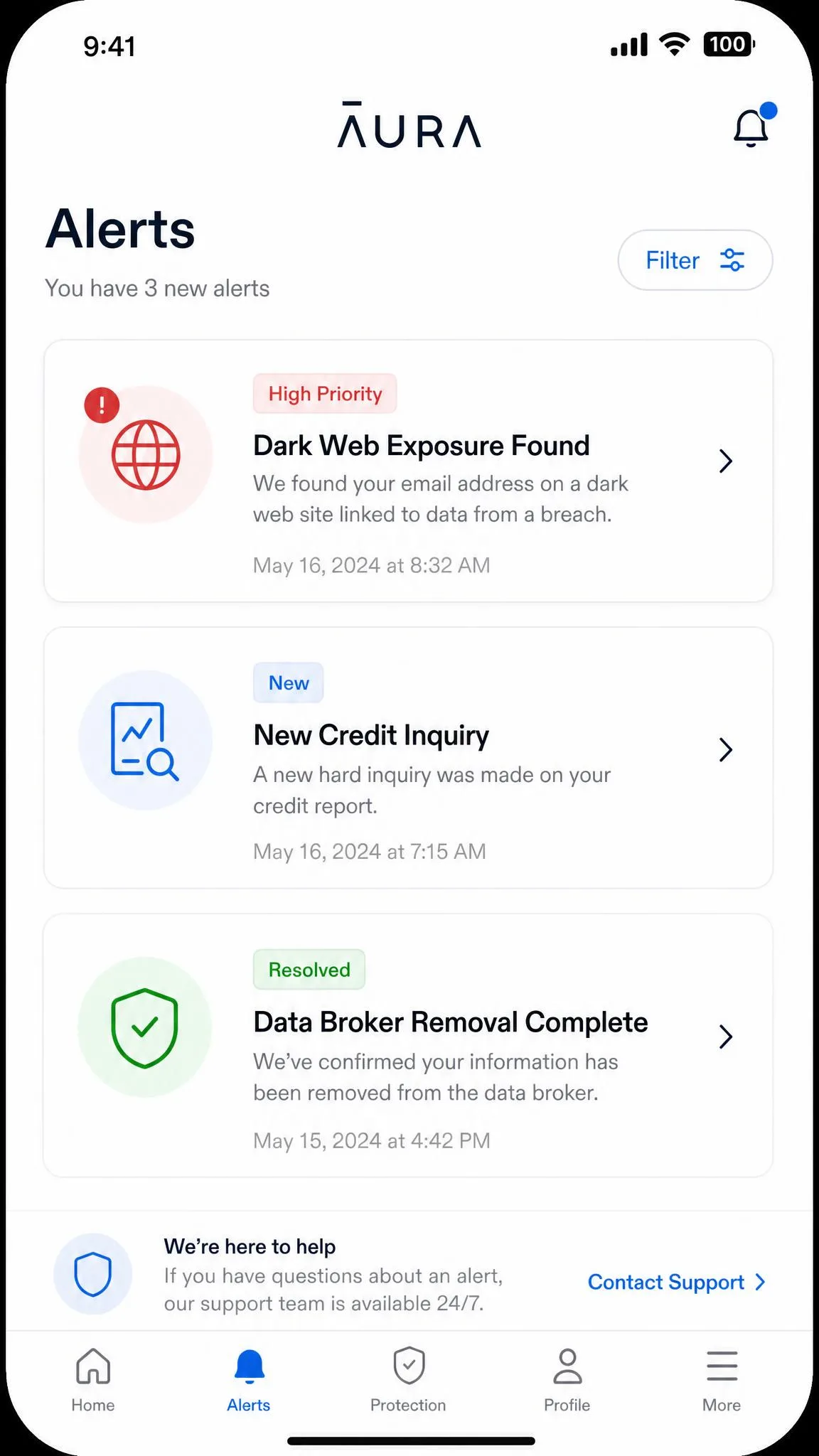
Behind all that monitoring sits the payout you hope never to claim. Every adult on the account is covered by $1 million in identity theft insurance. That rises to $2 million total on the Couple plan and $5 million on the Family plan. The policy is designed to reimburse the costs of recovering from theft: stolen funds, legal fees, lost wages and the administrative expense of putting your records straight. It excludes identity theft that began before enrollment, which is the exclusion that catches people who buy protection the week after they notice a problem.
The resolution service is the part you would actually use. Fraud support is staffed around the clock from the US, and you reach an experienced specialist rather than a general call queue. That specialist handles the calls to creditors and bureaus with you, rather than handing you a checklist.
Insurance is the number Aura markets, but the specialist on the phone is the part you will remember. A payout reimburses costs after the fact; a resolution team helps while the damage is still being done.
How Aura Performed in Testing
Claims aside, here is how the service behaved in use. The monitoring layer held up well, while the security modules were the part that asked for patience.
We treat identity protection the way we treat any subscription. The question is not whether the feature list is long. It is whether the product does something you could not do free with a credit freeze, a password manager and a careful hour on the broker opt-out forms. Aura clears that bar on monitoring and data removal. It does not clear it on the VPN.
Alert Accuracy and Speed
Alerts arrive for the events you would expect: new inquiries, dark web appearances of a registered email, unusual transactions on connected accounts. Coverage breadth, not notification speed, is the metric that separates services here. Aura's breadth sits close to the top of the category, because a single-bureau rival simply cannot see a fraudulent account opened at the other two.
Where the alert stream is thinner is social media. Aura does not monitor social media accounts. Impersonation profiles and compromised logins on those platforms will not reach you through this service. IdentityForce does cover that ground, and it is the clearest single feature Aura lacks.
Performance Impact and Usability
Alerts are one half of daily life with Aura. What the software does to your machine is the other. The antivirus is lighter than most bundled engines. A full scan draws 15 to 18 percent of CPU, against up to 25 percent for competing products, and memory use lands around 350MB, though it scales with how many files a drive holds.
Scan duration moves the same way. A clean machine finishes a full scan in about 13 minutes. A loaded drive holding more than 250,000 files takes closer to two hours and fifteen minutes. Quick scans land around six minutes across roughly 23,000 files. Those quick scans can spike the processor briefly. The spike is short enough that browsing, video playback and games keep running without freezes or lag. On Android, battery use rose only about two percent while a scan ran. Once the machine is back in normal use, the antivirus sits in the background with no noticeable drag. The VPN is the exception among the security modules, both for the speed cost and for connections that occasionally will not establish.
Usability is the honest weak point. A product whose whole argument is consolidation should not require several installs, nor a hunt through the dashboard to find a setting. None of it is disqualifying, but it undercuts the simplicity the brand sells.
Aura Pros and Cons
Pros
- Three-bureau credit monitoring on every plan, including the cheapest tier
- 200+ broker data removal with no tiering, plus spam list removal
- Family plan covers 5 adults and unlimited kids and devices for $32 a month annually
- Home and auto title monitoring, rare at this price
- Fraud specialists staffed 24/7 from the US rather than a general call queue
- 14-day trial and a 60-day money-back guarantee on annual plans
Cons
- The VPN is slow, thin outside the US and prone to dropped connections
- Antivirus has no AV-Test or AV-Comparatives certification behind it
- Several installs required, and the dashboard is harder to navigate than rivals
- No social media account monitoring
- No cheaper monitoring-only tier for people who do not want the bundle
- Annual plans auto-renew without warning and mid-term cancellations are not refunded
- Aura disclosed a data breach of its own in March 2026

Aura vs the Competition
Those strengths look different once you price the alternatives. Aura's pitch against LifeLock and IdentityForce is that it refuses to tier the features that matter. Both rivals reserve three-bureau credit monitoring for their top plan. That changes the real cost comparison considerably.
| Service | Entry price | Credit bureaus | Insurance | Data removal | VPN and antivirus |
|---|---|---|---|---|---|
|
$15/mo | 3 on every plan | $1 million per adult, to $5 million | Yes, 200+ brokers | Both, every plan |
 |
$12.49/mo year one | 1 on Standard and Advantage | Up to $3 million top tier | Limited | Higher tiers only |
 |
$17.95/mo | 3 on UltraSecure+Credit only | $1 million, disputed | No automated removal | VPN only |
Aura vs LifeLock
LifeLock's Standard plan opens at $12.49 per month for the first year, and its Advantage plan at $19.99. Both undercut Aura on the sticker, and both monitor a single credit bureau, with three-bureau coverage arriving only on Ultimate Plus. Its year-one price is quoted anywhere from roughly $20 to $33 per month depending on plan configuration, and it renews higher than the promotional rate either way. Once you match features, Aura's flat $15 monthly plan is the cheaper route.
LifeLock has two real advantages. The first is its insurance ceiling, up to $3 million in total coverage on the top tier across stolen funds, personal expenses and legal fees. The second is the Norton 360 antivirus and Secure VPN bundled at higher tiers, both of which are stronger products than Aura's equivalents. If the security software matters as much to you as the monitoring, that trade is worth considering. Watch the renewal pricing carefully, because the first-year figure is not the price you keep paying.
Aura vs IdentityForce
IdentityForce sells UltraSecure at $17.95 per month, or $179.50 a year. UltraSecure+Credit is $23.95 per month, or $239.50 a year. Three-bureau monitoring, reports and scores appear only on the higher plan. Its trial runs 30 days, longer than Aura's 14-day window. The insurance limit is unsettled. The vendor pricing page lists $1 million on both consumer plans, while several listings cite $2 million for UltraSecure+Credit, so the figure depends on which policy version you are sold.
IdentityForce wins on social media identity monitoring, medical ID fraud protection and its credit score simulator. Aura lacks all three. It loses on data removal, though, since it includes no automated broker opt-outs. It also loses on family pricing, which is not published online at all. For a household, Aura is both cheaper and more predictable.
What Real Customers Say About Aura
Our testing is one input, and the wider customer record is another. Aura's public reputation is split in a way that is worth understanding rather than averaging away.
Trustpilot and BBB Ratings
Aura's Trustpilot rating is 4.3 out of 5, with 84% of reviewers awarding five stars. The positive reviews cluster around fast alerts and helpful fraud specialists. The review total climbs continuously, so any count is a snapshot rather than a settled figure.
Aura's BBB customer reviews tell a different story. The BBB gives Aura an accredited A+ rating as a business, while its own customer review score sits at 1.06 out of 5 across 64 reviews, with 164 complaints logged in the last three years. Those two numbers are not contradictory so much as differently sourced. BBB complaint channels attract billing disputes, and billing is where Aura's friction concentrates. The complaints are overwhelmingly about auto-renewal and refunds, not about monitoring failing to work.
There is one more item in the record. Aura disclosed a data breach in March 2026 after a voice phishing attack on an employee account. About 900,000 marketing-database records were exposed, including names, addresses, phone numbers, email addresses and customer service notes. Aura says fewer than 20,000 active and 15,000 former customers were affected. It also says no Social Security numbers, passwords or financial information were exposed, and that attacker access lasted about one hour. It is a fair thing to weigh when the product being sold is protection of exactly that kind of data.
Customer Support and Cancellation
Fraud resolution support is the strong half, and general customer support is the uneven half. Replies can be slow, and different agents sometimes give conflicting answers about refunds and account access. That is the pattern behind most of the BBB complaint volume.
Cancellation is where to be careful. Annual plans renew without advance warning. Cancelling mid-term outside the 60-day guarantee generally does not refund the remainder. Cancel through the account settings, get written confirmation, and check your statement the following month.
Common Setup Mistakes
Support aside, most disappointment with Aura starts at setup. Two habits get more out of the subscription than any plan upgrade.
First, register everything in the first sitting. That means every email address, phone number and card, not just the primary ones. Unregistered details are invisible to the monitoring. Most people who feel the service is quiet have simply told it very little to watch.
Second, freeze your credit at all three bureaus yourself. It is free, it is the single most effective anti-fraud step available to a consumer, and it works alongside monitoring rather than instead of it. Aura's alerts tell you something happened. A freeze stops it happening in the first place.
Is Aura Worth It? Our Verdict
So which plan, and with what caveats? For most buyers the answer is the Family plan at $32 a month billed annually. Five adults and unlimited children under one renewal date is the best value in the range, and it is the tier we would point a household toward first. A solo buyer is well served at $12 a month, which is the cheapest route to full-bureau coverage plus insurance plus data removal that we found.
Two things should change your mind. If social media impersonation is your specific worry, look elsewhere, because that is the one monitoring category Aura leaves uncovered. If you already own a good VPN and antivirus and want monitoring alone, there is no lighter tier to step down to, so you would pay for components you never open.
Whichever tier you pick, set a calendar reminder two weeks before your renewal date. The billing terms are the least forgiving part of the service, and a reminder is the difference between a clean exit and an argument.