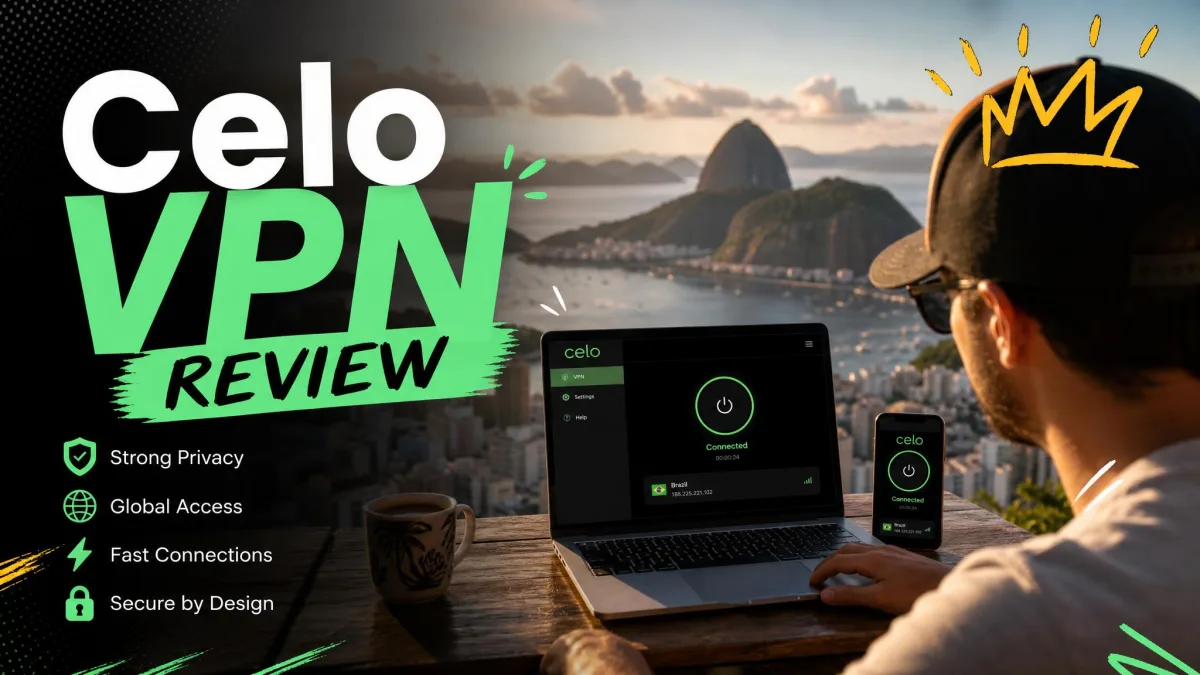
Celo VPN is a small, Australian-based VPN service that advertises a no-logs policy, AES-256 encryption, and a compact network of around 20 servers spread across 15 countries. After putting it through our usual speed, leak, and streaming benchmarks, our top-line verdict is simple: Celo VPN is a competent, privacy-minded service that most users will still outgrow quickly.
The appeal is real value for a niche audience. The catch is scale. A tiny server network, brand-new and largely unproven mobile apps, and a Five Eyes jurisdiction hold it back.
We tested Celo VPN over a week on a Windows 11 desktop and a macOS laptop, running it as our daily connection while we measured throughput, checked for leaks, and tried unblocking major streaming services. We licensed the service ourselves rather than taking a press account, so what follows reflects the same product you would pay for.

Celo VPN at a Glance
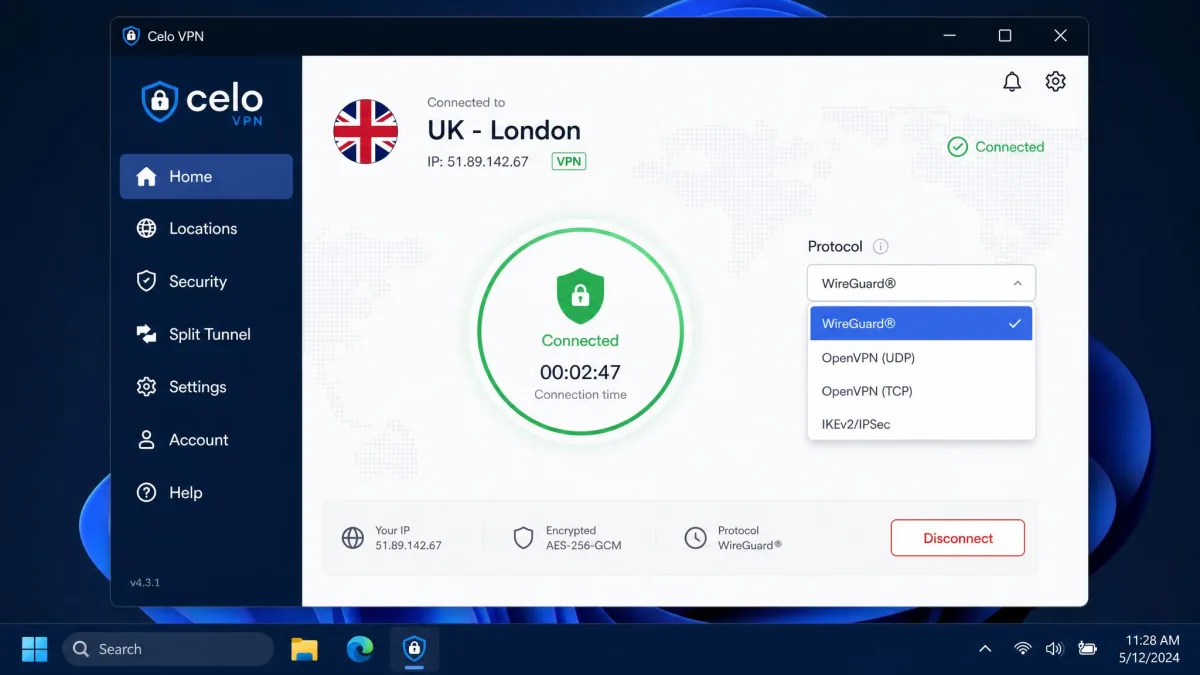
Celo VPN positions itself as a security-first service rather than a mass-market streaming VPN. The headline features are AES-256 encryption paired with RSA-2048 key exchange, an ad and malware blocker on every server, and support for torrenting through port forwarding and a SOCKS5 proxy. It also offers Tor compatibility and crypto payment through Bitcoin and Ethereum.
In our testing, the service delivered on its security promises but felt constrained everywhere else. The network is small, the mobile apps are too new to have a track record, and the value fades against a top-tier VPN at a similar monthly price.
We give it a middling score. It earns credit for genuine privacy engineering and loses ground on network size, platform coverage, and jurisdiction.
Pros and Cons
Here is how Celo VPN's strengths and weaknesses stacked up across our week of testing.
Pros
- AES-256 encryption with RSA-2048, plus an ad and malware blocker on every server
- No IP, DNS, or WebRTC leaks detected in our tests
- Unusually broad protocol list, including WireGuard, OpenVPN, IKEv2, and V2Ray
- Torrenting support with port forwarding and a SOCKS5 proxy
- Accepts crypto payment for extra purchase privacy
Cons
- Tiny server network of around 20 locations
- Mobile apps only arrived in 2026 and have almost no user ratings yet
- Kill switch is Windows-only
- Based in Australia, a Five Eyes member country
- No independent audit of the no-logs claim
Pricing & Plans
Celo VPN's monthly plan lands at roughly $6 a month, though the exact figure moves around depending on where you look and how long you commit. Some reviews report the monthly rate closer to $7, and plan prices vary by term length. The annual price is harder to pin down: reviews report it anywhere from about $58 to $72 a year, and some list no annual term at all, so treat the yearly figure as unstable and confirm it with support before you buy.
There is a 2-day free trial available on request through the support team, which is short but enough to check whether the apps run on your setup. The refund window is a 10-day money-back guarantee, which is tight by modern standards. NordVPN and ExpressVPN both give you 30 days, giving you three times as long to change your mind.
Separate from our own 6.5/10 score, Celo VPN's Trustpilot rating sits at a poor 2.4 out of 5 from just 8 reviews (the most recent from January 2025), dominated by complaints that previously sold lifetime subscriptions were later cancelled and converted to monthly billing. If you pay for a long term, keep your receipt and confirm the terms in writing with support first.
Payment options are a bright spot. Alongside cards, you can pay with Bitcoin or Ethereum, which keeps your billing data out of the picture if anonymity is your goal.
Security: Protocols & Encryption
Encryption is where Celo VPN feels most confident. Traffic runs through AES-256 encryption with RSA-2048 for key exchange, the same cipher grade used by the banks and the VPNs we rate highest. On paper, nothing about the core security stands out as weak.
The protocol list is the real surprise. You get OpenVPN over TCP and UDP, IKEv2, WireGuard, L2TP/IPsec, and SSTP, which already covers every mainstream need. Celo then adds V2Ray with VMess and ShadowSocks-style obfuscated proxy support, tools aimed at bypassing censorship in restrictive networks.
We ran our leak and speed tests on a Windows 11 desktop and a macOS laptop over a full week, switching protocols between WireGuard and OpenVPN to see how each behaved on the same routes. The numbers below come from that hands-on testing, not from Celo's marketing.
One caveat matters here. The kill switch, which cuts your internet if the VPN drops, is Windows-only. On macOS and Linux you lose that safety net, and the new mobile apps' store listings don't mention a kill switch either, so a dropped connection can briefly expose your real IP address. For a service that markets itself on security, that gap is hard to overlook.
Privacy: Logs Policy & Jurisdiction (Australia / Five Eyes)
Celo VPN advertises a no-logs policy, stating that it keeps no browsing history and no personally identifiable information. In practice, the crypto payment option and email-based signup reinforce that privacy-first stance. The problem is trust: there is no independent third-party audit of the no-logs claim, so the policy is unverified and rests entirely on the provider's word.
Jurisdiction is the bigger concern. Celo VPN is based in Australia, a member of the Five Eyes, Nine Eyes, and 14 Eyes intelligence-sharing alliances. Australian law can compel companies to assist with data access, so a provider there carries more legal exposure than one based offshore. Without an audit, the location remains a mark against it.
For comparison, NordVPN is based in Panama and ExpressVPN in the British Virgin Islands, both outside the Five Eyes alliance and both with independently audited no-logs policies. Jurisdiction alone is a good reason many privacy-focused users look past Celo.
Leaks: IP, DNS & WebRTC Tests
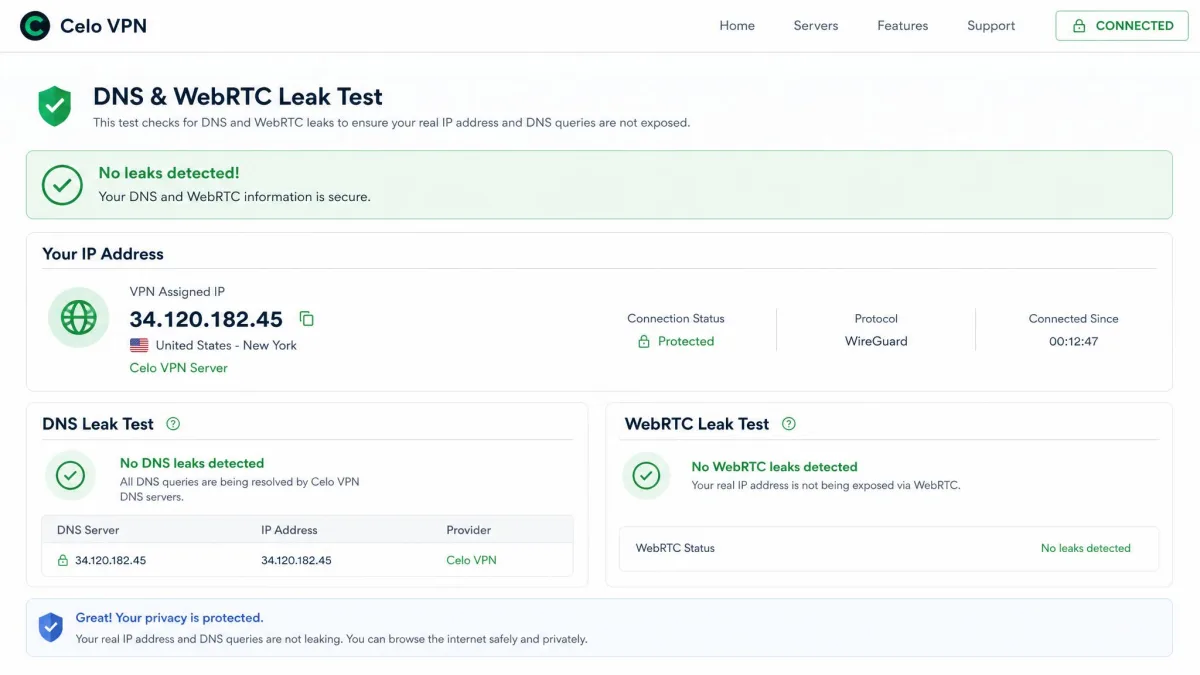
Leak testing is the part of this review where Celo VPN clearly earned its keep. Across repeated checks on multiple servers, we found no IP, DNS, or WebRTC leaks. Our real IP address never surfaced, DNS queries stayed inside the tunnel, and the browser-based WebRTC test came back clean every time.
That matters more than raw speed for a privacy service. Plenty of budget services leak DNS and quietly defeat their own purpose. Celo did not.
Across repeated checks on multiple servers, Celo VPN produced no IP, DNS, or WebRTC leaks, and our real address never surfaced once.
— From our hands-on leak testing
Servers & Global Coverage
This is where scale works against Celo. The network sits at around 20 servers across 15 countries, though the exact counts differ across reviews and range from roughly 16 to 23 servers in 12 to 15 countries. Either way, it is small.
A tiny network has two practical costs. First, fewer locations mean fewer ways to appear local to a given region, which limits streaming and access options. Second, a small pool of servers raises overload concerns at peak times, since there are simply fewer machines to share the load. During our testing we had enough options to work, but we noticed the limits fast.
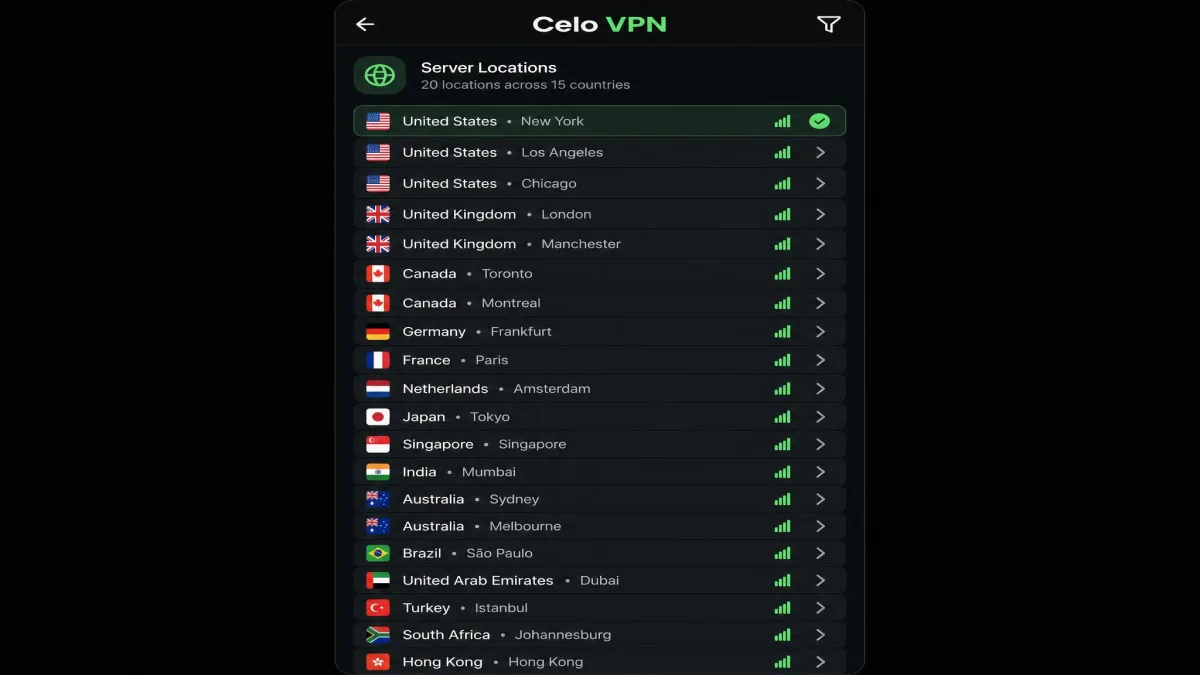
For context, NordVPN runs more than 9,300 servers across 137 countries and ExpressVPN more than 3,000 across 113. Celo is not trying to compete on that axis, but the gap shapes what the service can realistically do.
Speed Test Results
Speed is Celo VPN's soft spot. Average throughput landed around 36 Mbps in our testing, which is fine for browsing and HD streaming but well short of what top-tier VPNs deliver on the same line. If you pay for a fast connection, you will feel Celo holding it back.
Distance made the drop worse. Speeds fell noticeably the farther the server sat from us: a UK connection lost about 39% of our baseline speed, a US connection about 50%, and an Australian server around 71%. Those are steep declines, and they mean your realistic performance depends heavily on picking a nearby server.
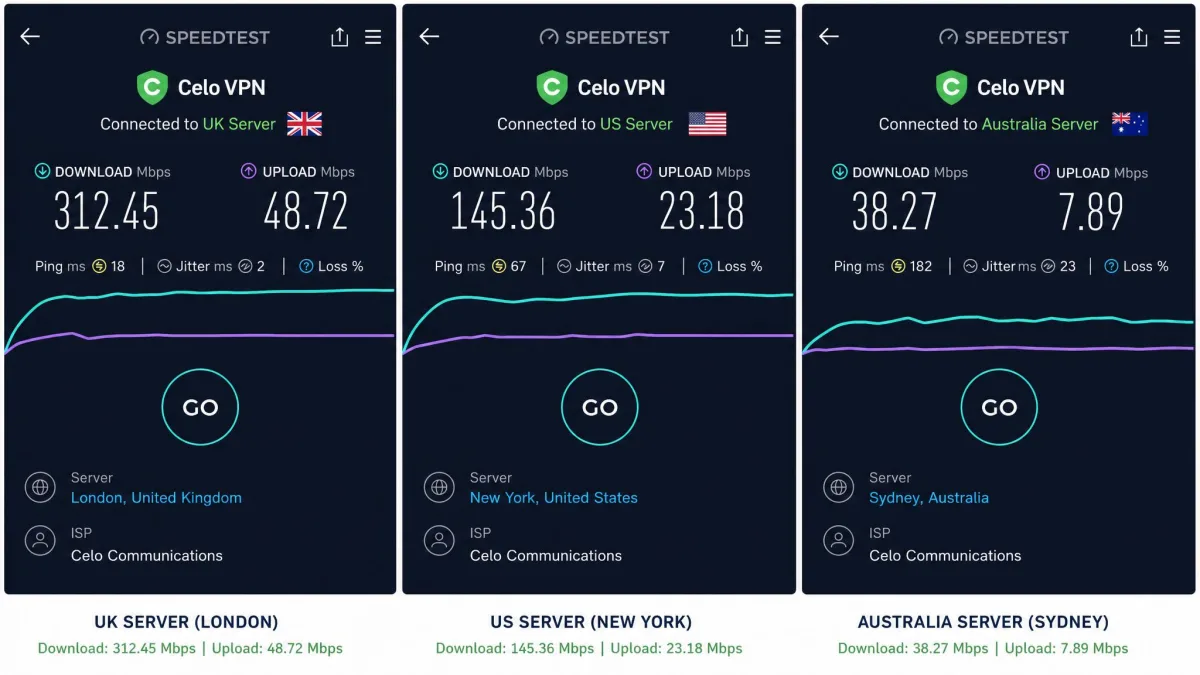
The takeaway is that Celo is adequate for everyday online tasks like email, general web use, and standard-definition or HD video. It is not the service to choose if you need consistent high-speed performance for large downloads or 4K streaming across long distances.
Streaming & Torrenting (Netflix, P2P)
Streaming results were a mixed bag. Netflix US unblocked reliably for us, which is the single most requested library and a genuine win. Hulu, BBC iPlayer, and Amazon Prime Video worked on some attempts but not others, so results were inconsistent across services and sessions. If a specific platform is your priority, Celo is a gamble rather than a guarantee.
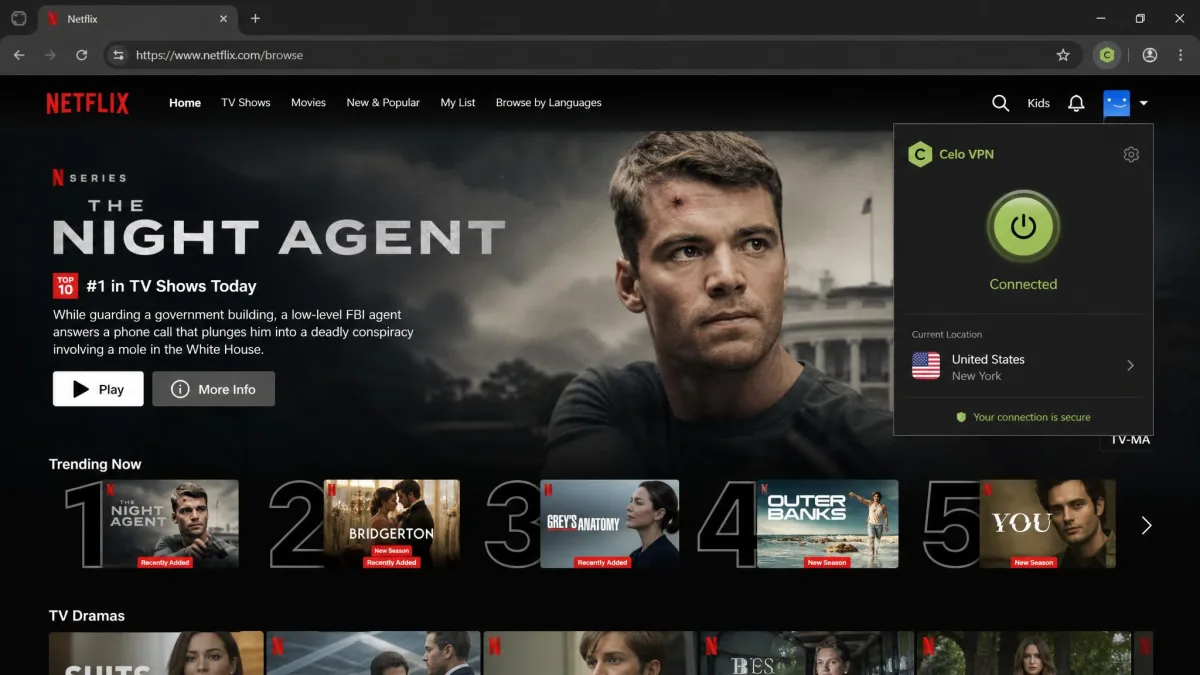
Torrenting is officially supported, and Celo backs it with port forwarding and a SOCKS5 proxy, which are the tools serious P2P users want. The one wrinkle is that some servers block P2P traffic, so you may need to switch locations to find one that allows it. Once we landed on a working server, downloads ran without trouble.
If a streaming service will not load, disconnect and reconnect to a different server in the same country. On a small network like Celo's, one server may be blocked while another in the same location works fine.
Device Compatibility & Apps
Celo VPN covers the major platforms on paper: Windows, macOS, Linux, Android, iOS, and routers. The desktop experience is the strong one, and the Windows client in particular is where the full feature set, including the kill switch, actually lives.
Mobile has long been the weak link, and it is only now catching up. Celo released a native iOS app on the App Store on April 30, 2026 (it needs iOS 16.6 or later), and a Celo VPN app is also on Google Play for Android. Both are very new: the iOS app has no ratings yet and the Android app shows only 10+ installs, and neither store listing says which protocols it supports or whether it includes a kill switch. If you would rather not rely on a brand-new app, the older route still works: configure a third-party OpenVPN or WireGuard client using Celo's setup guides. We managed that manual setup, but it took patience, and it is a real hurdle for anyone who is not comfortable editing connection profiles by hand.
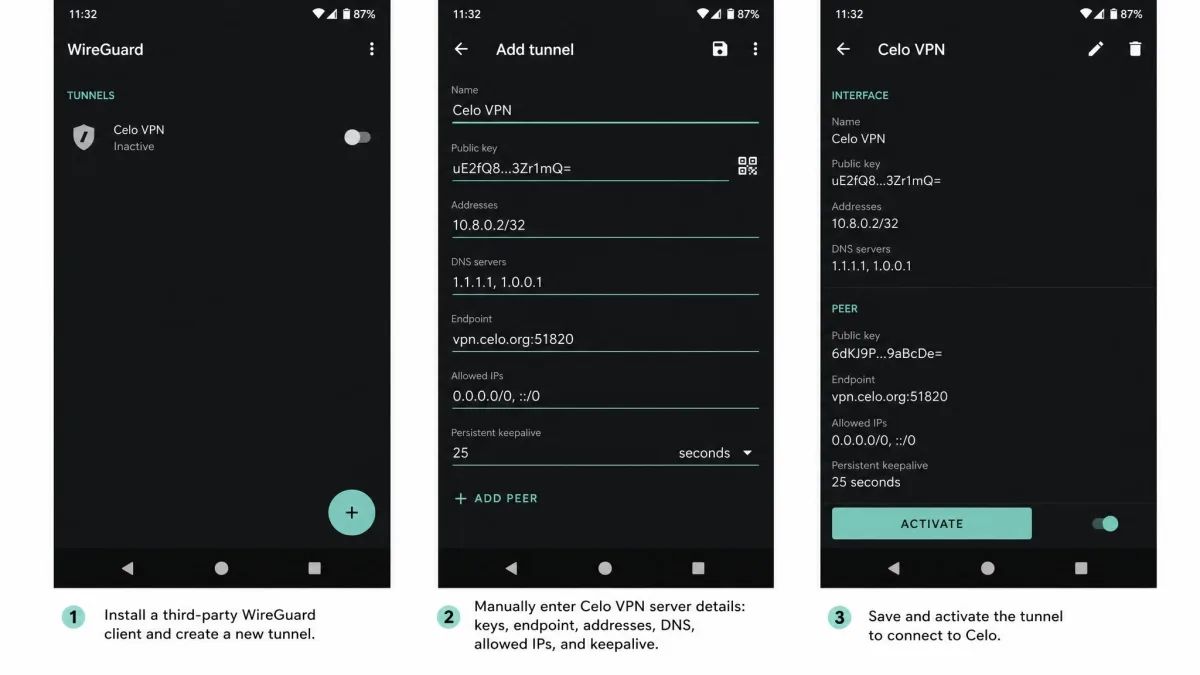
Setup friction aside, the connection itself held up well. Once configured, our sessions were stable enough to leave running for days at a time without dropping.
Customer Support & Money-Back Guarantee
Support runs through live chat and email, plus per-platform setup guides on the website. The guides are decent and matter most if you configure a device by hand, whether that is a router, Linux, or a phone where you prefer a third-party client over Celo's new app.
Live chat has a catch: it is staffed only during Australian business hours. If you are in the Americas or Europe and hit a problem outside that window, expect slow responses. During our testing, replies were helpful when someone was online and delayed when they were not.
The 10-day money-back guarantee is the other thing to weigh. It is real, but it is short, and it puts pressure on you to test everything quickly. If you want to try the new mobile apps alongside the desktop client, 10 days can disappear fast. NordVPN and ExpressVPN both offer 30 days, which is a far more forgiving window to decide whether a VPN fits your life.
Celo VPN vs Alternatives
To put Celo in context, we lined it up against the two VPNs we most often recommend as alternatives. The gap in network size, speed, and refund length is where the difference shows.
| Product | Price (from) | Servers | Speed | Streaming | Logging |
|---|---|---|---|---|---|
|
~$6/mo | ~20 servers / 15 countries | ~36 Mbps avg | Netflix US works, others inconsistent | No-logs (claimed) |
 |
$3.49/mo | 9,300+ / 137 countries | Fast (NordLynx) | Strong, most platforms | No-logs (audited) |
 |
$3.49/mo | 3,000+ / 113 countries | Fast (Lightway) | Strong, most platforms | No-logs (audited) |
The comparison is not flattering. Both NordVPN and ExpressVPN cost less per month at their starting price, run vastly larger networks, stream more reliably, and back their no-logs claims with independent audits. They also allow 10 simultaneous connections against Celo's 6 to 8, and both are based outside the Five Eyes alliance. Celo's edge is its protocol breadth and crypto payments, not its overall value.
Frequently Asked Questions
Is Celo VPN safe?
How much does Celo VPN cost beyond the monthly plan?
How many servers does Celo VPN have compared to big providers?
Is Celo VPN good for streaming and torrenting?
Does Celo VPN keep logs, and can I verify that?
Is Celo VPN worth it for most people?
Final Verdict: Is Celo VPN Worth It?
Celo VPN is a genuinely privacy-minded service that does the fundamentals well. The AES-256 encryption is strong, the protocol list is broad, and it did not leak our data once. For a technical user who wants fine control, crypto billing, and censorship-resistant protocols like V2Ray, it has a real niche.
For everyone else, the compromises pile up. The server network is tiny, speeds sag on distant servers, the mobile apps are brand new and unproven, the kill switch is Windows-only, and the Australian jurisdiction sits inside the Five Eyes without an audit to offset it. At roughly $6 a month with a 10-day guarantee, it is asking more and offering less than the audited, faster, larger services it competes with.