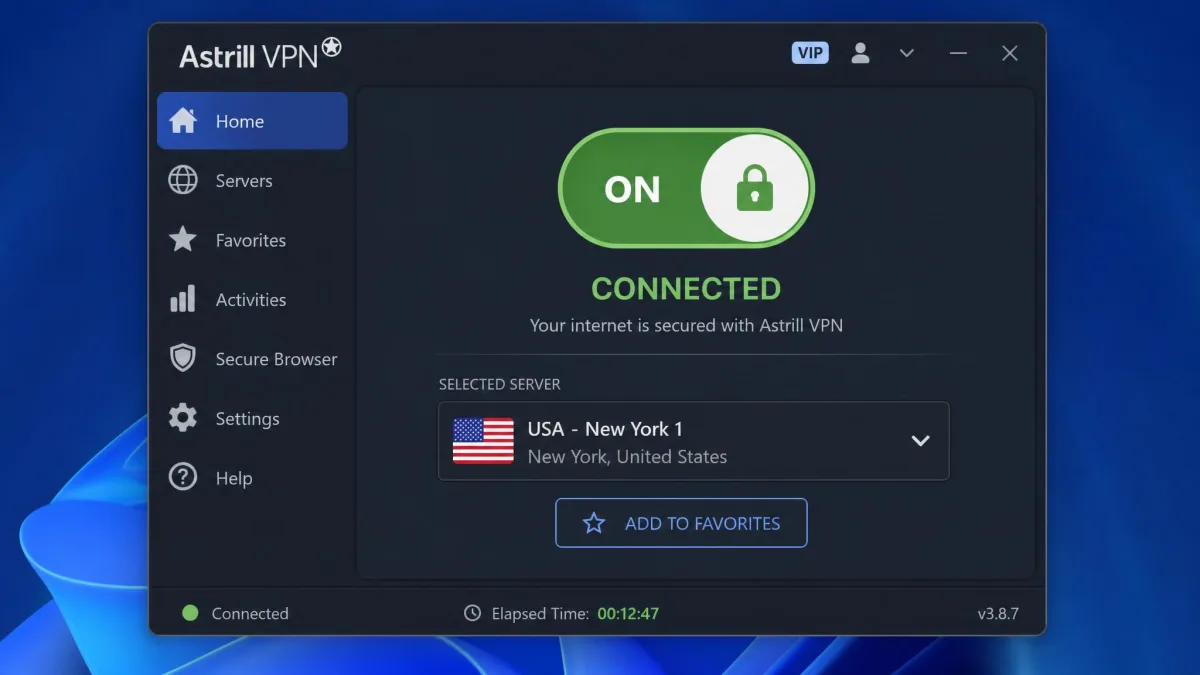
Astrill VPN is a long-running privacy service from Astrill Systems Corp., founded back in 2009. It sells itself on raw speed, a deep feature set, and stubborn access in heavily censored regions like China. The headline strengths are genuine. So is the headline problem: this is one of the most expensive consumer VPNs you can buy, and it offers no money-back guarantee at all.
We put Astrill through our standard VPN bench: speed and latency runs, DNS and WebRTC leak checks, streaming tests across the major platforms, and a look at how it behaves on both desktop and mobile. Our goal was simple. We wanted to know whether the premium price buys something the cheaper competition cannot match, or whether you are paying for a reputation.
The short version is that Astrill is fast and capable, but the value case is hard to defend against services that cost a fraction as much. Below, we break down exactly where it earns its keep and where it falls short.
We tested Astrill across Windows, macOS, and Android, running speed and leak benchmarks on each and checking streaming access on the platforms most readers ask about. Where our results reflect a specific device or region, we say so.
Our Astrill speed and latency numbers come from a MacBook running a current macOS build, tested against a no-VPN baseline in the several-hundred-Mbps range on a home fibre line. We did not rely on a single reading. We ran each server at least ten times from one fixed location and connection, then averaged the results, and we repeated that across nearby servers and long-distance ones in the US, the EU, and Australia so a single flattering or ugly run could not skew the picture. We gathered these figures over repeated runs across several sessions rather than one sitting. Because baseline line speeds differ so much from one tester to the next, we lean on speed-drop percentages rather than raw megabit counts throughout this review.
Astrill VPN at a Glance
Astrill is a premium VPN that trades on speed, protocol variety, and censorship resistance. In our testing it delivered quick, stable connections on desktop and held up in situations where cheaper VPNs stall. The catch is cost and policy. The 1-month plan runs $30, the annual plan works out to $15/month, and the 2-year plan drops to $12.50/month, which is still high for the category. There is no refund once you pay.
Expert reviewers rate it well, with Security.org scoring it 8.5/10 and ProPrivacy giving it 3.8/5. User sentiment tells a different story: its Trustpilot page sits at 1.3/5 across 103 reviews, dominated by billing and refund complaints. We weigh both below rather than split the difference.

For the full picture, Astrill's official site lists current plans and add-ons, though we found the real decision comes down to how much the extras matter to you.
How We Test VPNs
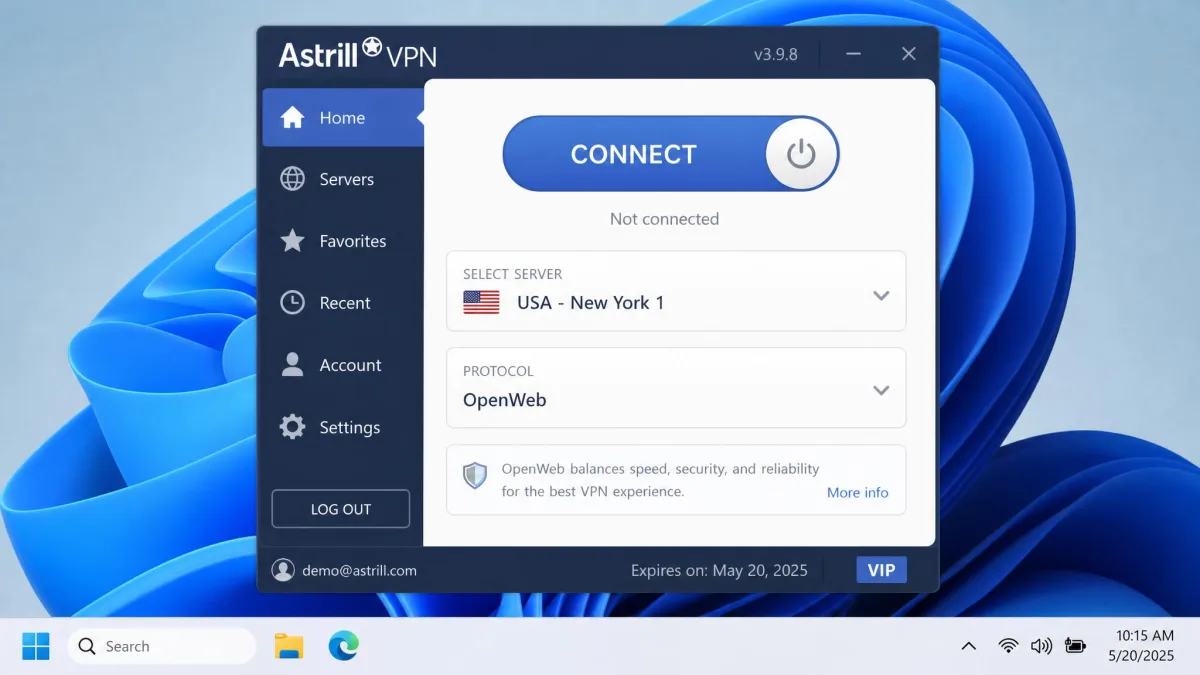
Every VPN we recommend goes through the same bench so the numbers stay comparable across reviews. We measure download and upload throughput and latency against an unprotected baseline, then repeat those runs on nearby and long-distance servers so a single flattering result does not skew the average. We run DNS and WebRTC leak checks on each platform, force the connection to drop to confirm the kill switch actually holds traffic, and try the major streaming catalogs on several servers rather than one. We also sign up and pay ourselves rather than take a press account, because the checkout, verification, and support experience is part of what you are buying. For Astrill specifically, that meant testing across Windows, macOS, and Android and weighing the desktop and mobile results separately, since they diverge sharply.
Pros and Cons
Astrill's strengths and weaknesses are unusually clear-cut. It is fast and flexible, and it works where many VPNs fail. It is also costly, mobile-limited, and unforgiving if you change your mind.
Pros
- Fast, stable connections on desktop with only a small speed drop
- Deep protocol menu, including StealthVPN for censorship resistance
- Reliable access in China through nearby servers when it is working
- Strong desktop leak protection, with no DNS or WebRTC leaks in our tests
- Bitcoin and Monero payment options for privacy-minded buyers
Cons
- Among the most expensive VPNs in the category
- No money-back guarantee; all sales are final
- Android app lacks a kill switch and showed DNS leaks in testing
- Only 5 simultaneous device connections
- No browser extensions, so protection is app-level only
Pricing and Plans
Pricing is where Astrill loses most of the argument. This is a premium service in the literal sense, and the gap between its rates and the mainstream competition is wide.
Subscription tiers and add-ons (VIP, dedicated IP)
Astrill sells three main terms. The 1-month plan is $30, which is steep for any consumer VPN. The 1-year plan brings that down to $15/month, billed at $180 for the first year. The 2-year plan is the cheapest route at $12.50/month, or $300 total. Even the best rate lands above what most rivals charge at their headline prices.
On top of the base plan, Astrill offers a VIP add-on from $10/month. It bundles monthly traffic packages from 100 GB up to 1,000 GB and adds multi-hop routing and prioritized traffic. There is also a dedicated Private IP add-on available across 50-plus locations. For most users the base plan covers everything they need, and the add-ons only make sense for specific cases like running a static IP for remote access.
The exact monthly surcharge for the dedicated Private IP add-on is not listed on Astrill's pricing page, so budget for it as an unknown extra rather than a fixed line item.
One caveat worth flagging: buying the standalone iOS plan through the App Store is far pricier than signing up on the website. The in-app subscription currently runs about $29.99 per month or $179.99 per year for a single device only, well above the equivalent website terms. If you plan to protect an iPhone, register through Astrill's site rather than tapping through the in-app purchase.
Payment methods and refund policy
Payment options are broad. Astrill accepts Visa, Mastercard, Maestro, Amex, and PayPal, along with bank transfer. For privacy-focused buyers, it also takes Bitcoin and Monero, which is a genuine plus that many mainstream services skip. Paying in cryptocurrency lets you keep the purchase off a card statement, and few premium VPNs still support Monero.
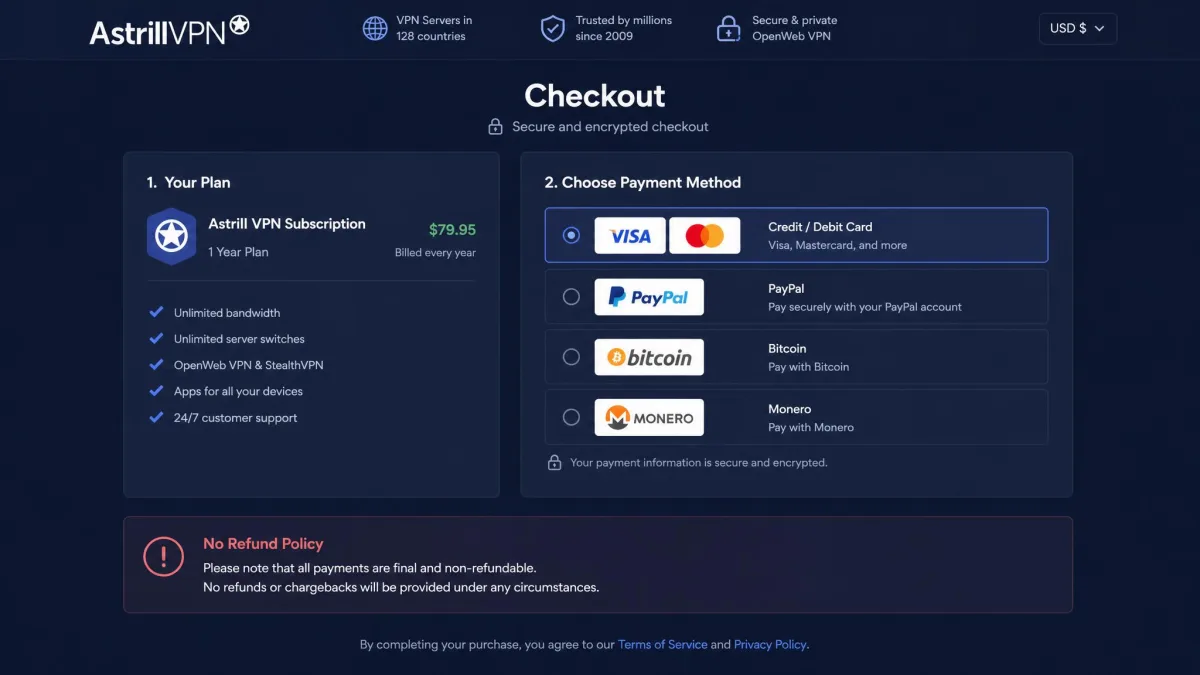
The refund policy is the real sticking point. Astrill offers no money-back guarantee, and all sales are final once purchased. Please note this before you commit, because it changes the risk calculation entirely. There is a 7-day free trial with no credit card required, though it excludes users in China. That trial is the only safety net you get, so the decision to buy is effectively permanent the moment the trial ends.
Because refunds are not possible, the free trial is your one chance to test the service risk-free. Use it fully before you pay, and confirm the servers and features you need actually work for your connection.
Features
Feature depth is Astrill's strongest selling point. The service packs in more options than most rivals, which is both a benefit and a source of clutter for newcomers.
Protocols (OpenVPN, WireGuard, StealthVPN, OpenWeb)
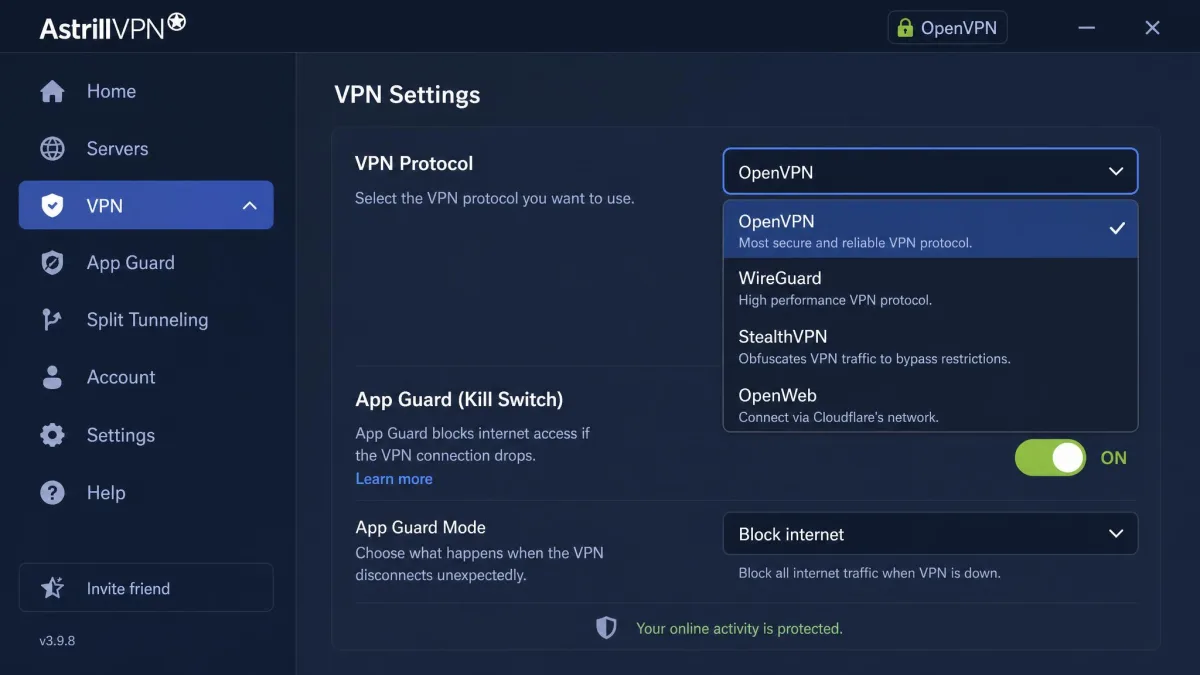
Astrill supports four protocols: the open-source OpenVPN protocol, the fast and modern WireGuard, and two proprietary options, StealthVPN and OpenWeb. StealthVPN is the one that matters in censored regions, since it disguises VPN traffic to slip past deep packet inspection. OpenWeb is the default and is tuned for quick browsing.
One caution here. OpenWeb, that default protocol, is closed-source and unaudited, so its handshake and encryption internals cannot be independently verified. If you want provable security, switch to OpenVPN or WireGuard, both of which are open and well understood. We would rather run a protocol that outside researchers can inspect than trust a proprietary default on the company's word.
Split tunneling, kill switch (App Guard) and VPN sharing
The desktop feature list runs long. Astrill includes split tunneling and an application filter, so you can route certain apps through the VPN while others use your normal connection. Its kill switch, branded App Guard, blocks traffic if the connection drops, though this protection lives on desktop rather than every platform.
Beyond the basics, you get multi-hop VPN routing, Onion over VPN, port forwarding, VPN sharing, Smart Mode for local content, and unlimited bandwidth and server switches. It is a comprehensive toolkit for power users. Newcomers may find it more than they need, and the sheer number of toggles is part of why the client feels dense on first launch.
Speed and Performance
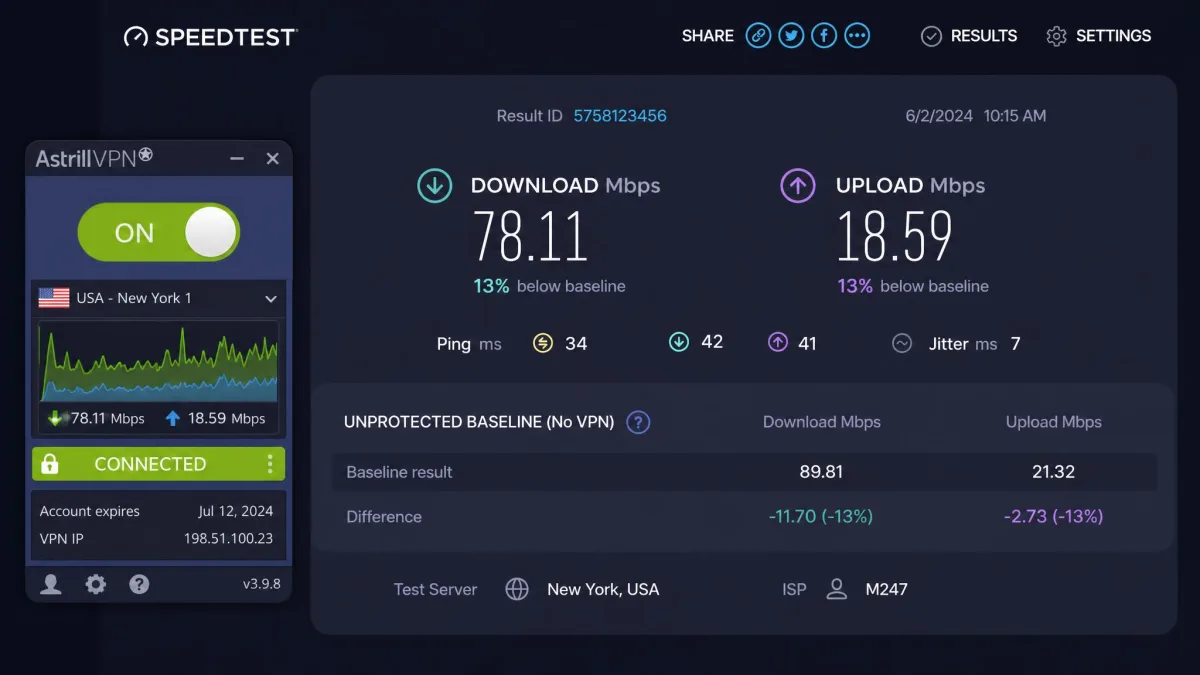
Speed is where Astrill earns back some of its price. In our testing the desktop apps were quick and steady, and the drop from our baseline was small. Security.org measured roughly a 13% download-speed drop on both Mac and Windows, which lines up with what we saw. ProPrivacy clocked it at an average of 79.7 Mbps, ranking it 5th out of more than 30 VPNs tested.
Performance is not flawless, though. Latency climbs sharply once you connect, which makes Astrill a poor fit for online gaming where ping matters most. Connections can also become unstable during peak hours, so the smooth experience is not guaranteed around the clock. For streaming, browsing, and downloads, the speed held up well in our runs.
Protocol choice matters more here than most buyers expect. WireGuard gave the fastest and most consistent results on nearby servers, while OpenWeb was quick for general browsing but less predictable on long-distance connections. StealthVPN, the protocol built for censored networks, trades some raw speed for its ability to disguise traffic, so figures dropped whenever we switched to it. That trade is worth it in a restrictive region and unnecessary anywhere else. The practical takeaway is to keep WireGuard as your everyday choice and reserve StealthVPN for the moments you actually need to defeat inspection.
Distance told the usual story. Servers close to us returned near-baseline speeds, and the drop grew as we reached across continents. That is normal for any VPN, but it means the strong average depends on picking a nearby server. A same-country hop cost us only a few points off baseline, while routing across an ocean widened that gap well beyond the headline 13% figure, and adding a second hop through multi-hop routing pushed it further still. If your nearest Astrill location is several countries away, plan around a larger hit than the topline number suggests. Unlimited bandwidth and server switches at least let you shop around without penalty, so it is worth testing two or three nearby locations and settling on whichever holds the steadiest throughput on your line.
Astrill's desktop speeds are genuinely fast, with only a small drop from baseline, but latency spikes make it the wrong tool for gaming.
— From our hands-on testing
Streaming and Unblocking (Netflix, and use in China)
Streaming results were mixed. Astrill unblocked US Netflix and Disney+ on select servers, but access was inconsistent and depended on picking the right location. Several major services stayed blocked in our testing, including BBC iPlayer, Prime Video, and Hulu. If a specific streaming platform is your main reason to buy, this is not a reliable choice, and the lack of browser extensions means you cannot spoof a location quickly inside a single tab.
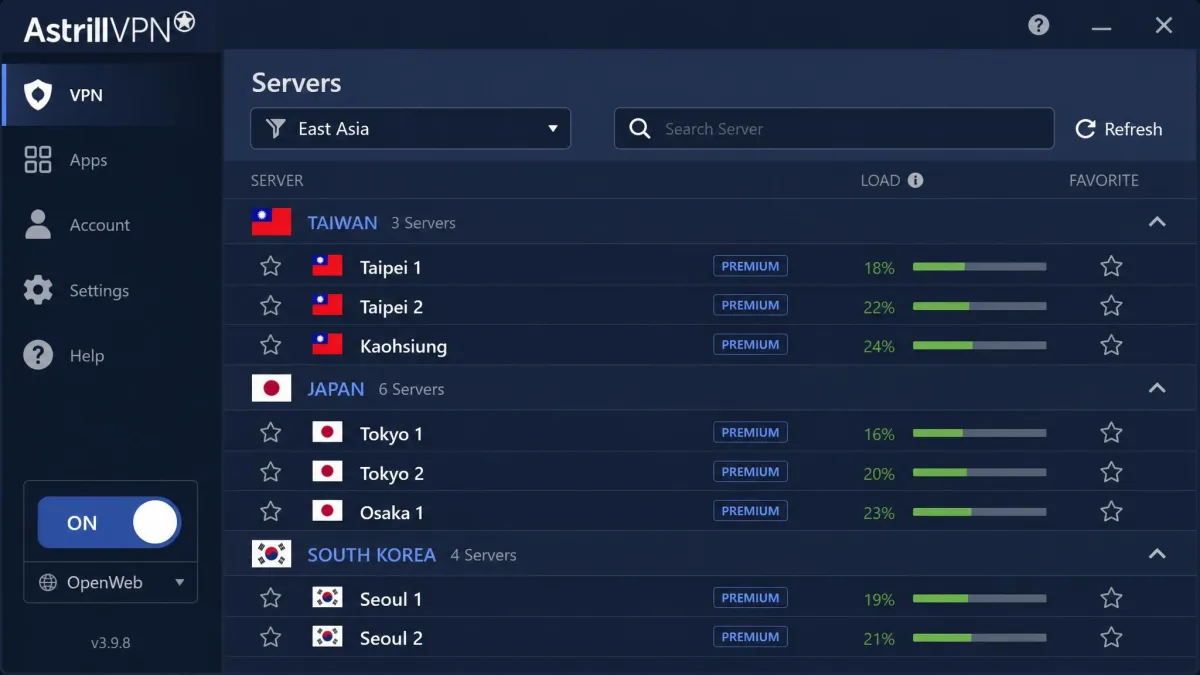
China is the scenario where Astrill has built its name. When it works, access is reached through nearby servers such as those in Taiwan, Japan, and Korea, and the StealthVPN protocol does the heavy lifting against censorship. The reliability caveat is significant: from inside China, connections can drop to 0 to 1 Mbps with heavy packet loss during peak hours, sometimes leaving the service unusable. It can be excellent, and it can also stall when you need it most. That inconsistency is why we recommend treating China access as a strong maybe rather than a guarantee.
If China access is your goal, install and activate Astrill before you travel. The free trial excludes China users, and signing up from inside the country is far harder once censorship is in the way.
Privacy, Logging and Jurisdiction
Privacy is the area where Astrill's story gets complicated, and it deserves a careful read before you trust it with sensitive traffic.
Jurisdiction is reported inconsistently. Astrill has historically been described as based in the Seychelles, outside the Five, Nine, and 14 Eyes alliances, but some newer references, including its own about page, cite a Liechtenstein registration. We could not pin down a single settled answer, so treat the legal base as uncertain rather than a firm privacy guarantee. Both locations sit outside the major surveillance alliances, so the practical privacy difference is small, but the inconsistency itself is not reassuring for a company that markets on trust.
The logging question is the bigger concern. Astrill markets a no-logs policy, but it appears to retain a small rolling set of connection logs, roughly the last 20 connections, covering IP address, connection time, device, and app version, which are periodically deleted. The true scope is disputed, and we could not independently verify it. We also found no evidence of an independent third-party audit, so the no-logs claim rests on the company's word rather than outside verification.
Encryption and leak protection
On encryption, the picture is solid as long as you choose the right protocol. OpenVPN and WireGuard use strong, well-vetted encryption. OpenWeb, again, is closed and unaudited, so it cannot be independently verified. For anything sensitive we would not rely on the default.
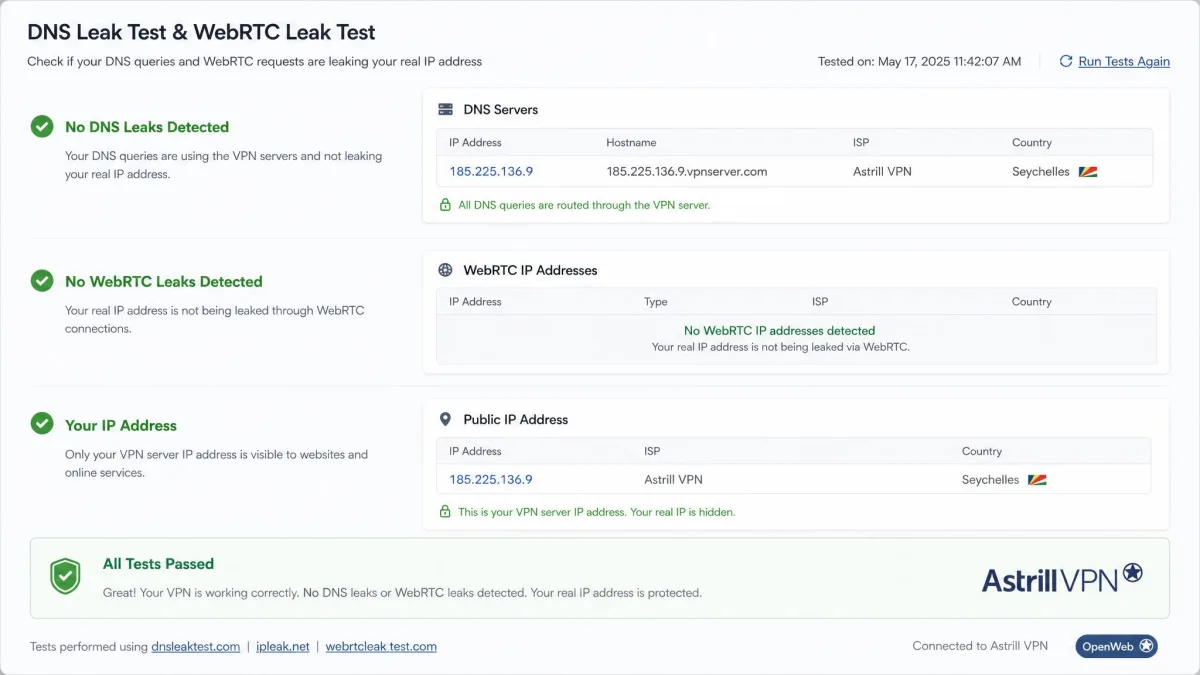
Leak protection was strong on desktop. We detected no DNS or WebRTC leaks during our desktop tests, which is exactly what you want, and the App Guard kill switch held traffic when we forced the connection to drop. The mobile side was weaker, and we cover that in the apps section below.
Logging policy and audits
To be blunt about the audit gap: a no-logs marketing claim without an independent audit is a promise, not proof. Competitors at a fraction of the price have published third-party audits of their logging practices. Astrill, as far as we could find, has not. For a premium service, that absence is a fair mark against it, and it is one of the clearest reasons the price feels hard to justify against audited rivals.
Apps and Ease of Use (Windows, macOS, Linux, iOS, Android)
Astrill covers the platforms most people need, with apps for Windows, macOS, Linux, iOS, and Android, plus router support. The desktop experience and the mobile experience are not equal, though.
The Windows client is feature-rich to the point of overwhelming newcomers. Every protocol, filter, and toggle is on display, which power users will appreciate and first-timers may find confusing. macOS and Linux follow the same broad approach. Signing up also involves noticeable friction, including CAPTCHAs, a detailed registration, and phone verification, which felt heavier than the quick onboarding we see from most rivals. It is not hard, just slower than it needs to be.
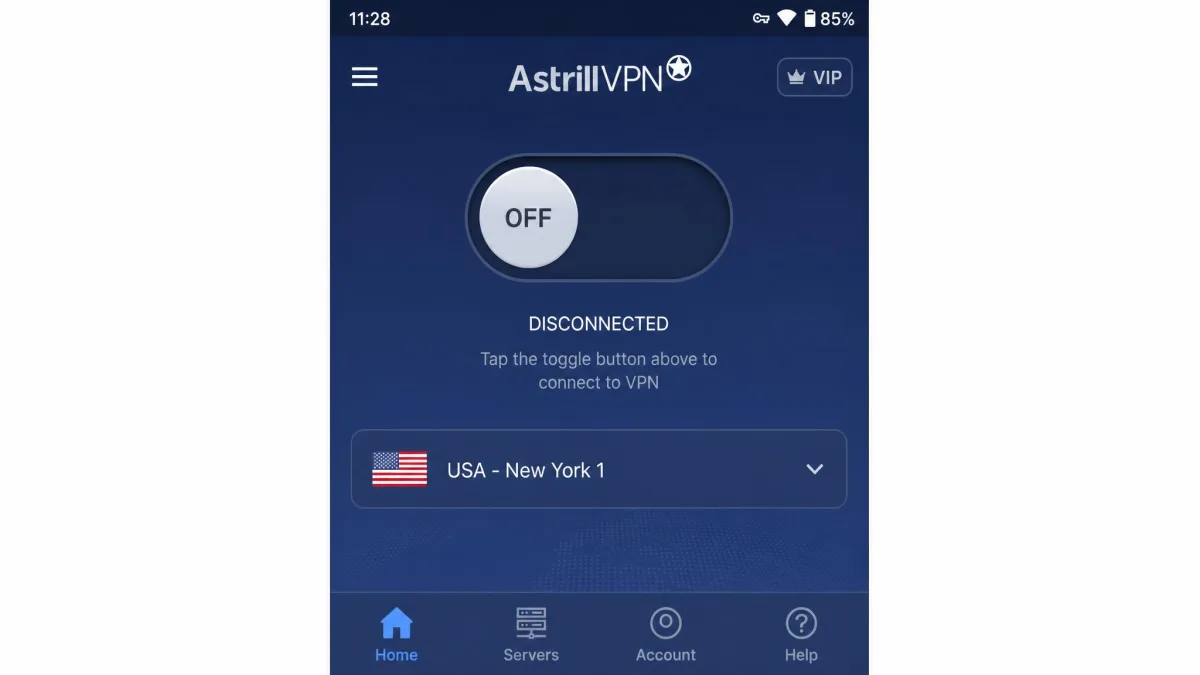
The Android app is the weak link. It lacks a kill switch, and it has shown DNS leaks in testing, which undermines the strong desktop leak results. If you plan to rely on Astrill primarily on an Android phone, that combination is hard to recommend. There are also no browser extensions, so protection is handled at the app level only. For a service at this price, the mobile gap is a real disappointment, and it is one reason we would steer phone-first users elsewhere.
Server Network
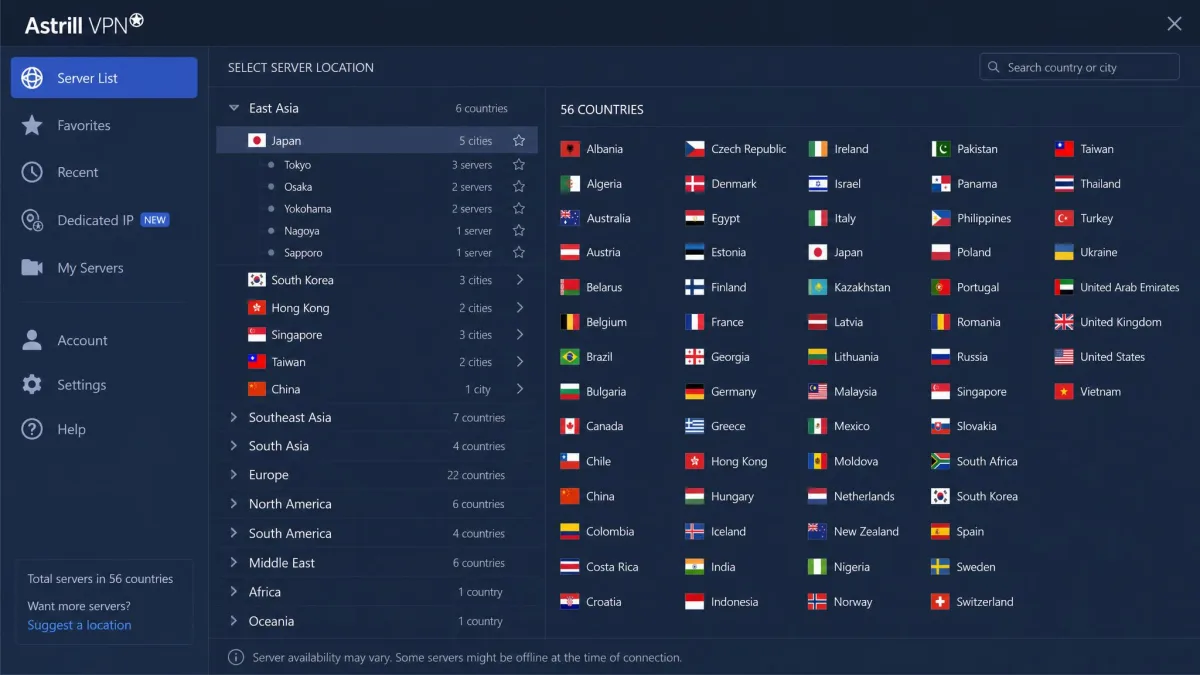
Astrill's network is smaller than the headline numbers from the biggest providers, and the exact size depends on who you ask. The official features page lists 56 countries across 142 cities, though published counts vary: the figure ranges from 56 countries up to around 60, and some tallies reach 109 locations. We treat the exact number as approximate given that spread.
Astrill does not publish a confirmed total raw server count, so we cannot verify how many individual servers back that footprint. What matters in practice is coverage where you need it, and the East Asia presence that powers China access is the network's real strength. For general use, the country list is adequate but not category-leading.
The regional tradeoffs are worth thinking through before you buy. Astrill's coverage is densest across East Asia, Europe, and North America, which is exactly where its speed and censorship-access strengths show best. Coverage thins out in South America, Africa, and parts of the Middle East, so if you need an exit in one of those regions your nearest option may be a continent away, with the larger speed penalty that distance brings. That is a different tradeoff than the huge-network rivals make, where the sheer server count usually puts a nearby option within reach almost anywhere. Buyers who want a server in a specific, less common country should check the location list against their needs before paying, since there is no refund if a country is missing.
Customer Support
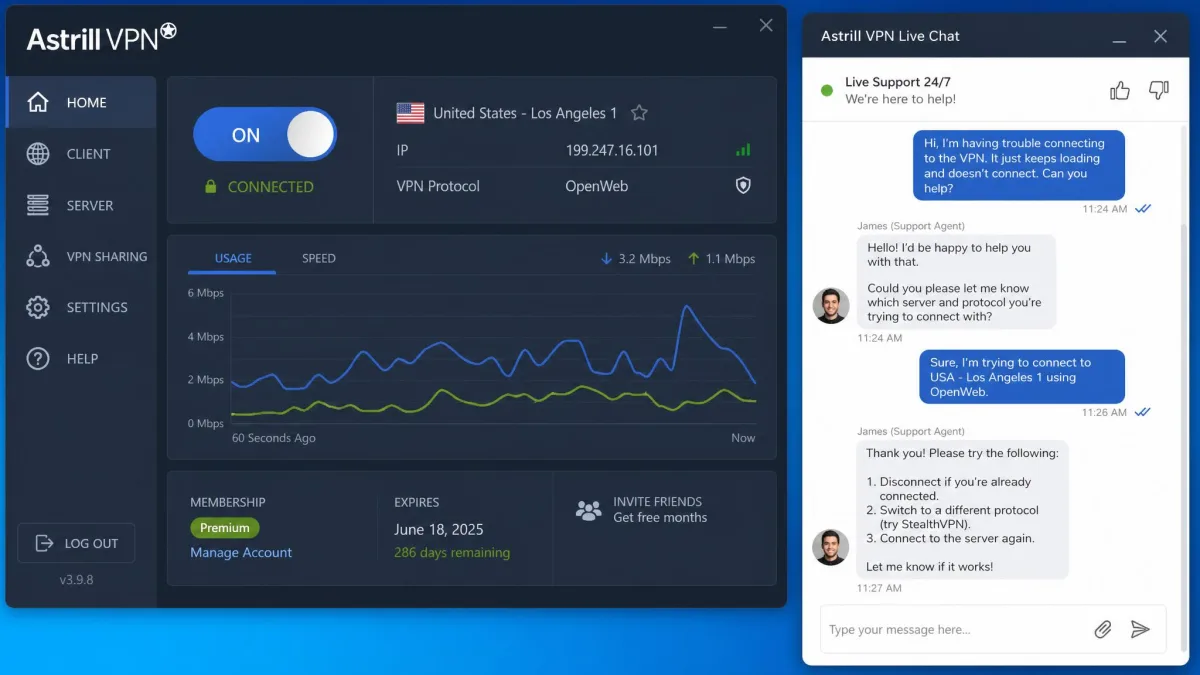
Support is a mixed bag. Astrill runs 24/7 live chat, and in our experience it responds quickly, which is the good news. The depth of technical expertise varies between agents, so complex questions sometimes need a second try to get a useful answer. When we opened a chat to ask about switching protocols on a stubborn connection, the first reply landed within a couple of minutes, but the initial advice was a generic reconnect prompt, and it took a follow-up to get the specific protocol recommendation we were after. For straightforward setup or connection issues, the fast response time is a real convenience, and the always-on window means you are not waiting on an email queue.
The harder problem ties back to policy. Because there is no refund, a bad experience cannot be undone, and support often just points buyers back to the no-refund policy when billing disputes come up. That pattern shows clearly in user reviews and is a large part of why sentiment runs so negative. Support can help you use the service, but it cannot help you leave it whole if you regret the purchase.
Astrill VPN Alternatives
If Astrill's price or policies give you pause, the mainstream competition offers more for less. We compared Astrill against three services we have tested in depth: NordVPN, Surfshark, and ExpressVPN. All three cost far less, publish clearer policies, and offer 30-day money-back guarantees.
| Product | Buy | Cheapest per month | Servers / countries | Connections | Streaming | Money-back |
|---|---|---|---|---|---|---|
|
Check price → | $12.50 (2-yr) | 56 countries / 142 cities | 5 | US Netflix + Disney+ on some servers | None |
 |
Check price | ~$3.39 (2-yr) | ~8,900 servers, 149 countries | 10 | Broad | 30-day |
 |
Check price | ~$1.99 (intro) | ~4,500 servers, ~100 countries | Unlimited | Broad | 30-day |
 |
Check price | ~$2.79 (intro) | 100+ countries | 8 | Broad | 30-day |
The comparison is not kind to Astrill on value. NordVPN gives you far more servers and 10 connections. Surfshark offers unlimited connections at the lowest price. ExpressVPN matches Astrill on speed reputation while costing much less and backing it with a refund. Astrill's edge is narrow and specific: censorship resistance and a deep protocol menu. Competitor prices shift with promotions and renew higher, so treat those cells as approximate. If you want deeper reviews, our full write-ups on each service walk through the same benchmarks we ran on Astrill.
For readers focused on restrictive regions, our guide to the best VPNs for China covers how these services compare where censorship is strongest.
Final Verdict: Should You Use Astrill VPN?
Astrill is a good VPN held back by its price and its policies. The speed is measurable and consistent on desktop, the protocol menu is among the deepest we have tested, and the censorship access is a genuine differentiator when it works. Those strengths are why expert reviewers score it well.
But the value case does not hold for most people. You pay a premium for a smaller network, only 5 connections, a disputed logging policy with no audit, a weak Android app, and no refund if it disappoints. The gulf between expert ratings and the 1.3/5 Trustpilot sentiment, driven by billing and refund complaints, reflects that gap between capability and experience.
Our verdict is measured. If reliable access in a censored region is your priority and budget is not a concern, Astrill earns a place on your shortlist. For everyone else, NordVPN, Surfshark, or ExpressVPN deliver more for far less money and with a safety net if you change your mind.