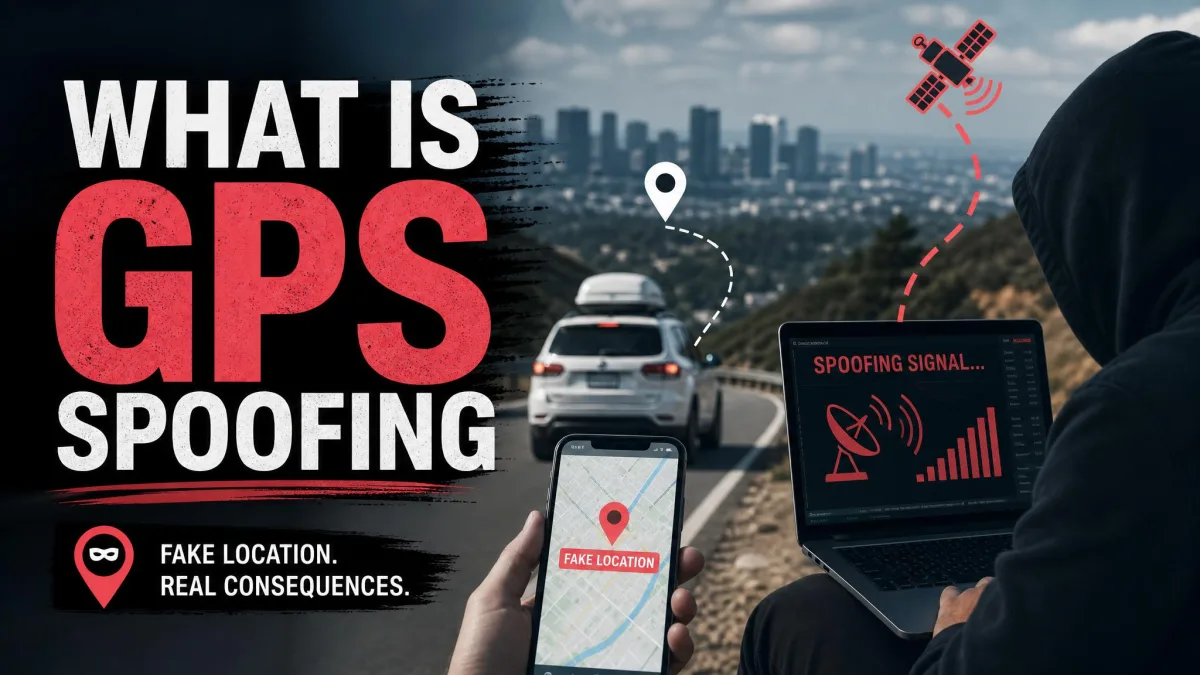
GPS spoofing is an attack that feeds a receiver counterfeit satellite signals so the device calculates a position, a velocity, or a time that is not real. The fake signals are built to look like the genuine ones, and because they arrive stronger than the real broadcast from orbit, the receiver locks onto them and reports the attacker's chosen answer with complete confidence.
That confidence is the whole problem. A jammed device knows it has lost navigation. A spoofed device does not know anything is wrong, and neither does the person, aircraft, ship, or payment system trusting the number on the screen.
Below we walk through how spoofing works at the signal level, the attack types you are likely to meet, the incidents that made this a mainstream aviation and maritime concern, and the defenses available to ordinary users and to fleet operators.
What Is GPS Spoofing?
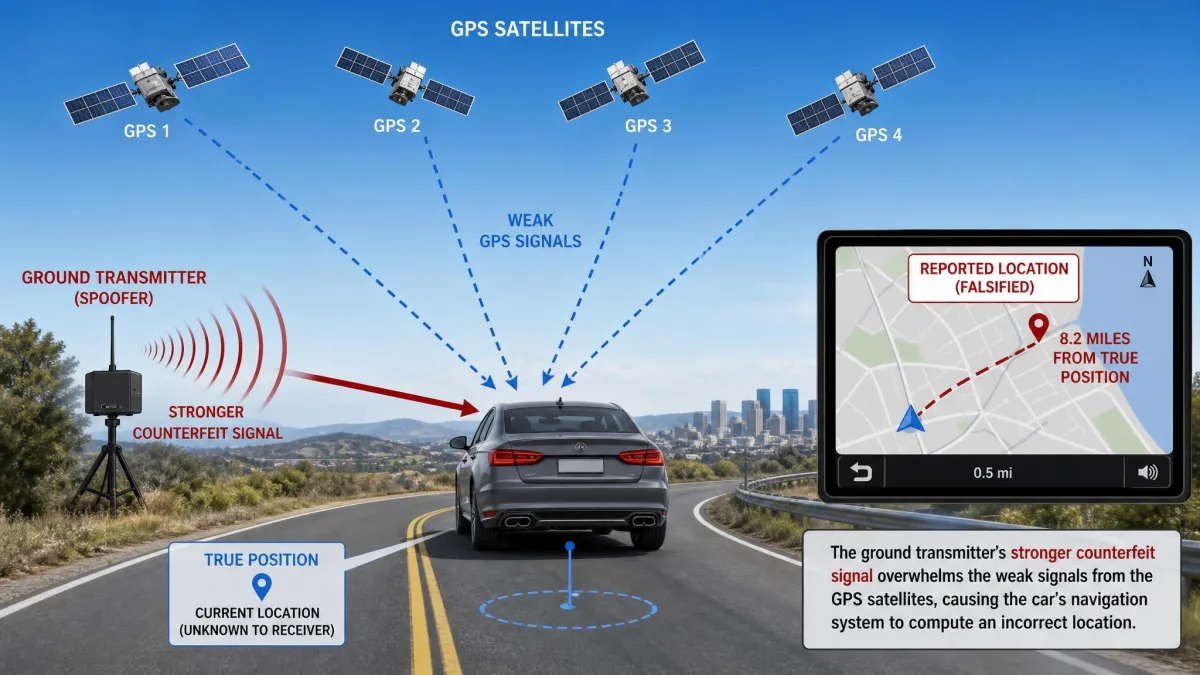
GPS spoofing, more precisely GNSS spoofing, is the deliberate transmission of false satellite navigation signals to make a receiver compute the wrong position or time. The attacker either generates signals that mimic the structure of a real GPS broadcast, or captures genuine signals somewhere else and rebroadcasts them at a different place or a different moment.
The global positioning system was never designed with an untrusted transmitter in mind. Civilian receivers accept any signal that looks correctly formatted, because the 31 satellites known as Navstar broadcast an open, unencrypted service that anyone with an antenna may use. Open access is what makes the system universally useful, and it is also what makes it forgeable.
Spoofing vs. GPS Jamming
Jamming and spoofing are both radio interference, but they fail in opposite directions. A jammer floods the GNSS band with noise until no receiver in range can hear a satellite. The receiver loses lock, raises a lost-signal alarm, and the operator knows at once to fall back on another method.
A spoofer does not deny the service. It replaces it, putting a false position where the actual one should be, and affected devices give no sign of trouble. The receiver keeps a full set of satellites in view, keeps a healthy signal-to-noise reading, and keeps producing a fix. The fix is simply wrong. That is why spoofing goes unnoticed far longer than jamming, and why safety investigators treat hazardously misleading information as a worse outcome than plain loss of service.
| Aspect | GPS Jamming | GPS Spoofing |
|---|---|---|
| What the attacker transmits | Broadband noise across the GNSS band | Counterfeit satellite signals carrying manipulated navigation data |
| What the receiver reports | No fix, or a lost-signal alarm | A confident but false position, velocity or time |
| Whether the user notices | Yes, the fix disappears | Often not, the fix looks normal |
| Typical equipment cost | Low, small illegal jammers are cheap | Low to moderate, commodity SDR hardware such as bladeRF or USRP |
| Detection method | Loss of lock, signal-to-noise collapse | Cross-checks against inertial sensors, Wi-Fi and cellular position, multi-constellation fixes, OSNMA authentication |
| Primary risk | Loss of navigation and timing service | Hazardously misleading position and time data that is trusted as real |
In practice the two travel together. The crowd-sourced daily maps at GPSJam chart aircraft-reported interference across the Eastern Mediterranean, the Black Sea, the Baltic, and the Middle East. Europe has watched the pattern for years, since reports that Russia suspected of jamming GPS signal in Finland during NATO exercises.
How GPS Spoofing Works
A GPS receiver does not measure distance directly. It listens for the timing codes broadcast by several satellites, works out how long each signal took to arrive, and solves for its own position and clock offset. Every part of that calculation depends on trusting the incoming data, and spoofing attacks that trust.
The attacker transmits a signal set the receiver's correlators accept as genuine, then walks the fake solution away from the true one. Done crudely, the position jumps. Done well, it drifts slowly enough that no alarm fires.
Why GPS Signals Are So Easy to Fake
Two physical facts do most of the work for the attacker.
The first is power. Civilian GPS uses the unencrypted L1 C/A signal at 1575.42 MHz, and by the time that signal reaches the ground its power is about -160 dBW. GNSS signals arrive roughly 30 dB below the thermal noise floor, recovered only by correlation against a known code. Anything transmitting nearby is louder than a satellite twenty thousand kilometres away.
The second is openness. The civilian signal structure is published, so a counterfeit is a matter of generating the right codes rather than breaking encryption. Open-source projects produce GPS signals using commodity software-defined radio hardware such as bladeRF or USRP, far below the cost of a commercial GNSS simulator. The feasibility was shown academically in Assessing the Spoofing Threat: Development of a Portable GPS Civilian Spoofer, and hardware has only become cheaper since.
Civilian GPS carries no authentication. There is no signature in the navigation message telling a receiver that the data genuinely came from a satellite, and that is true of all public-access constellations, including GLONASS, BeiDou, and Galileo's basic open service.
What Happens Inside the Receiver
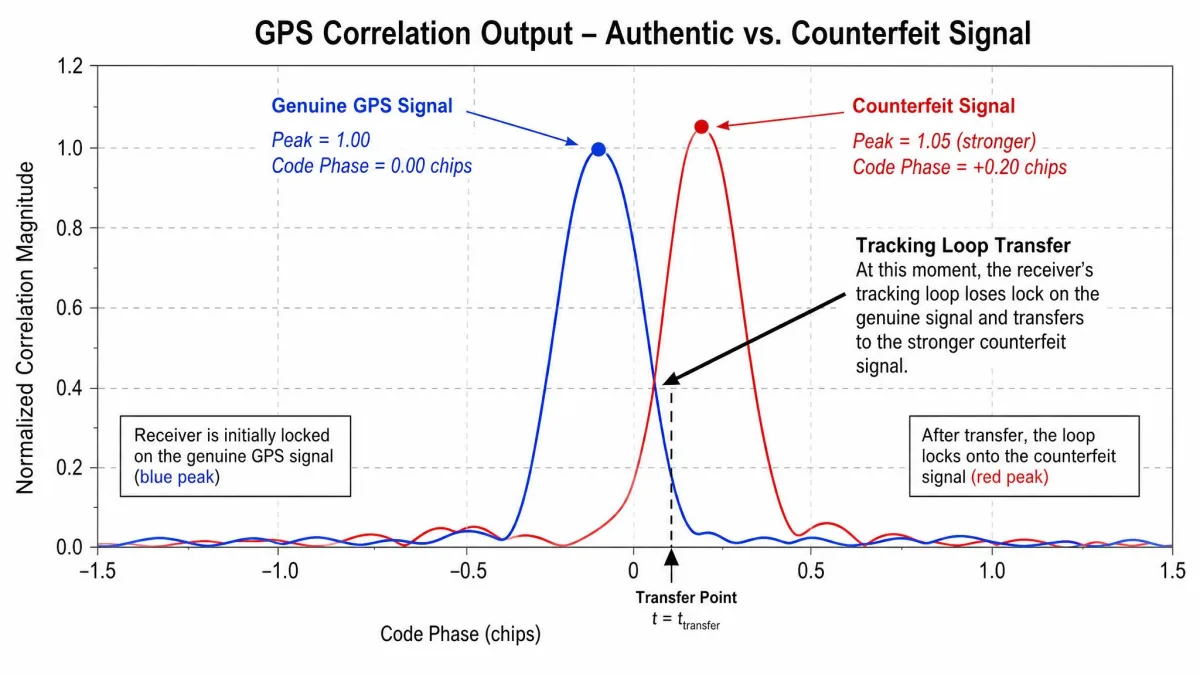
The cleanest attacks begin aligned. The spoofer matches the real signals in code phase and Doppler, raises its power slightly, and captures the receiver's tracking loops without breaking lock. From there it can move position, velocity, or the receiver clock independently.
Effects do not stop cleanly either. The FAA's GPS and GNSS Interference Resource Guide documents that onset can be instantaneous or delayed, and that false or hazardously misleading position, navigation, and date and time information can persist inside equipment after the interference has ended. A receiver fed a bad clock often needs a reboot or a full reset before it behaves again.
Types of GPS Spoofing
Three attack families cover almost everything reported in the wild, and they differ enormously in cost, skill, and blast radius. The technical taxonomy is summarised well in the reference literature on GNSS spoofing.
App-Based (Software) Spoofing
The most common form never touches radio. Mobile operating systems expose a mock-location facility for developers, and a fake-GPS app writes a chosen coordinate straight into the location service. Nothing is transmitted, so only the one device is affected.
On Android, this path runs through the developer settings. Open Settings, then Developer options, then select the mock location app. That setup step is itself detectable, and any app that checks the mock-location flag can block the attempt before it starts.
For the legitimate, on-device version of this, we cover the mechanics in How to spoof location on iPhone and How to spoof location on Android.
Free fake-GPS apps are a common malware and adware vector, and they demand exactly the permissions you would least like to hand a low-trust developer. Many are also fragile in use, triggering in-game warnings, error 12, rubber-banding back to your true position, or an account strike within minutes.
Radio Frequency (Hardware) Spoofing
RF spoofing transmits counterfeit signals over the air, so it affects every receiver in range rather than a single handset. This is the category behind the aviation and maritime incidents. Equipment ranges from a low-cost software-defined radio up to laboratory GNSS simulators, and the skill required has fallen alongside the price. Because it is broadcast, RF spoofing is also unambiguously illegal in most countries.
Meaconing and Replay Attacks
Meaconing sits between the two. Instead of generating signals, the attacker captures the genuine satellite broadcast at one place and rebroadcasts it at another, or plays it back later. Everything about the signal is authentic, so cryptographic checks on message content do not help. Replay is the reason authentication schemes have to bind timing as well as content.
Who Uses GPS Spoofing, and Why
Consumer and Privacy Uses
Most consumer spoofing is small and personal. People fake a location to keep an app from logging where they live, to reach region-restricted content, or to play a location-based game without walking.
Criminal and Fraud Uses
The criminal uses are more consequential. A false location can defeat geofencing on stolen cargo, disguise a vessel's movements, falsify delivery records, or beat location checks used in fraud scoring. Banking, ride-hailing, and gaming apps have responded with anti-spoofing SDKs, sensor validation against gyroscope and accelerometer data, and backend comparison of GPS position against IP geolocation.
Military and State-Level Use
State actors run spoofing as electronic warfare, mainly as a defense against drones and guided munitions. It is also where the largest civilian side effects originate, because a protective bubble around a military site does not stop at the fence line. The best-known early example is the US RQ-170 drone captured by Iran in 2011, though Iran's claim that a spoofing attack brought it down has never been confirmed by the US, so the cause remains disputed.
Real-World GPS Spoofing Incidents
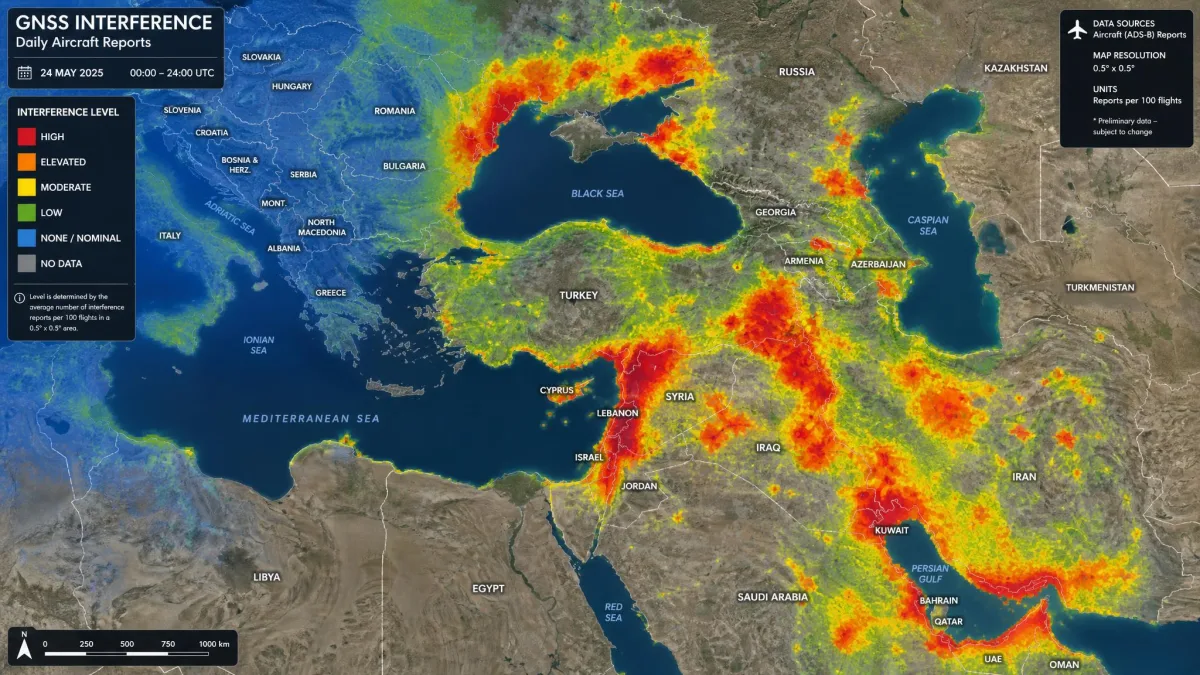
Aviation and the Middle East Corridors
Aviation is where spoofing stopped being theoretical. By late 2024 about 1,500 flights per day were being spoofed, up from around 300 per day earlier in the year, an order-of-magnitude rise across twelve months. In one mid-July to mid-August 2024 window, 41,000 flights experienced spoofing.
The industry response was the OPSGROUP GPS Spoofing Workgroup, whose 128-page final report followed a six-week workshop with more than 950 participants. Its crew survey found that about 1,400 respondents, roughly 70% of some 2,000 replies, rated spoofing a very high or extreme flight-safety concern.
What makes it hard to handle in the cockpit is the cascade. One event can set 20 to 30 unrelated aircraft systems alarming or faulting at once, which buries the root cause under a wall of secondary warnings. In 2024, researchers traced false GPS signals affecting planes and ships in the region to an air base in Israel, after faked GPS locations threw off planes and ships across a wide area.
Shipping and the Persian Gulf
At sea the pattern is similar and older. In June 2017, about 20 vessels in the Black Sea reported GPS positions placing them well inland, in several cases sitting on a nearby airport rather than drifting plausibly. A Lloyd's analysis later concluded that the UK tanker Stena Impero had been redirected by GNSS spoofing before its 2019 seizure.
The controlled demonstration came first. In June 2013, University of Texas researchers spoofed an $80 million yacht at sea, gradually overpowering the genuine signals and steering the White Rose of Drachs off course while the bridge display showed a normal track.
Drones and Delivery Fleets
Drones are unusually exposed. They navigate almost entirely by GNSS, and many refuse to fly or initiate a return-to-home when they believe they have entered restricted airspace. A spoofer can ground a drone, walk it out of its intended area, or hijack a delivery route without touching the aircraft.
The Risks and Dangers of GPS Spoofing
Aviation and Maritime Safety
The immediate safety risk is not that navigation fails, but that it lies. Crews have reported false terrain warnings, clocks jumping by hours, and inertial systems corrupted by a bad GNSS update. The FAA guide is explicit that misleading data can outlast the interference itself, which is why crews isolate GNSS inputs rather than trust the recovery.
Critical Infrastructure and Timing Systems
Position is only half of what GPS delivers. Power grids, telecommunications networks, data centres, and financial trading systems use GPS as a source of precise time, and a spoofed clock propagates into systems that have nothing to do with navigation. The Department of Homeland Security runs a dedicated Positioning, Navigation, and Timing (PNT) Program because timing dependence is a national infrastructure exposure rather than a transport problem.
Fraud, Account Bans, and Financial Exposure
For individuals, the realistic damage is commercial. Location-dependent platforms treat a false position as fraud, and enforcement is automated. Niantic's gameplay fairness policy follows a published three-strike pattern of a warning with limited gameplay, then a suspension of about 30 days, then permanent termination, though operators revise those durations over time. Gig-economy platforms take a harder line still, since falsified location touches pay.
Is GPS Spoofing Illegal?
Broadcasting counterfeit GNSS signals is illegal in the United States under several provisions at once. FCC jammer enforcement rests on Sections 301, 302(b) and 333 of the Communications Act, which prohibit operating unlicensed transmitters, marketing or operating jammers, and willfully interfering with licensed or government radio communications. Penalties are meaningful: the FCC proposed a $31,875 penalty against one individual for operating a GPS jammer, and base forfeiture figures are adjusted for inflation each year, so published historical amounts understate current caps.
Software mock-location is a different question. Changing your own device's reported location transmits nothing, so it is generally not a radio offence. It can still breach the terms of service of the apps you use, and using it to obtain money, benefits, or access dishonestly can be fraud regardless of the technology involved.
The line that matters is not software versus hardware. It is whether you transmit, and whether anyone is deceived to their loss. A phone-only mock location for privacy sits in very different legal territory from an antenna that reaches other people's receivers.
How to Detect GPS Spoofing on Your Device
Warning Signs to Watch For
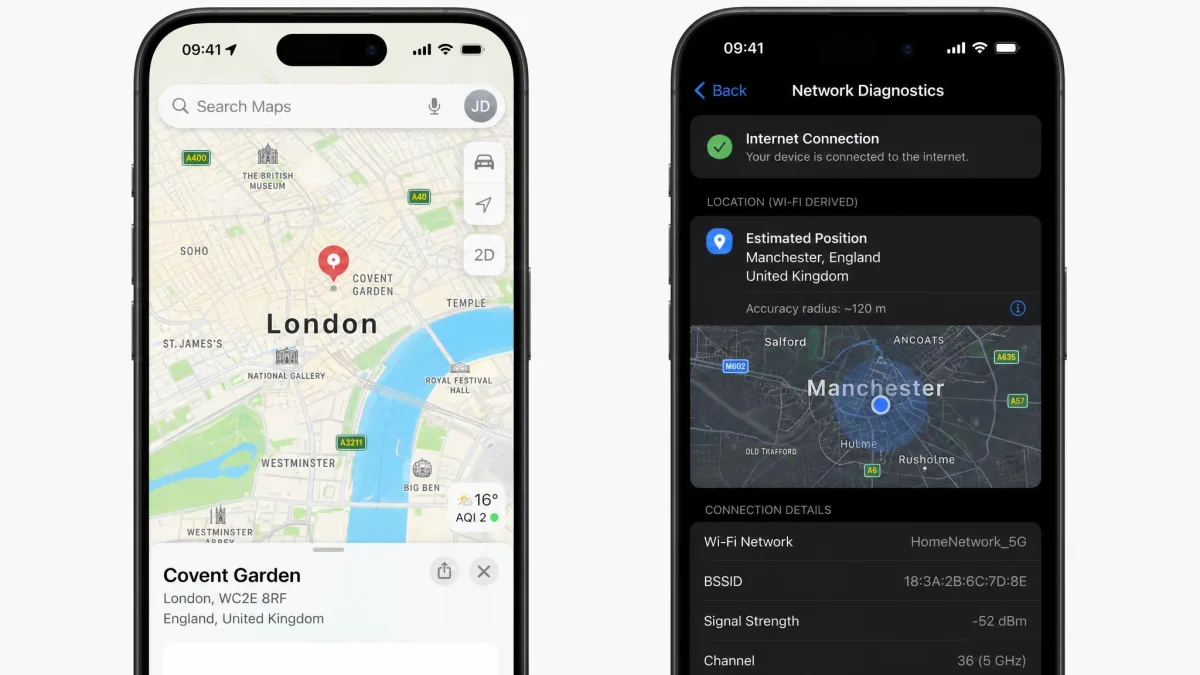
The everyday tells are mundane rather than dramatic. The map pin jumps to a distant or impossible place. Travel speed reads as inconsistent with how you are actually moving. The maps app behaves erratically or crashes. The GPS fix disagrees with what Wi-Fi and cellular positioning suggest.
One counterintuitive sign is worth knowing: a spoofed signal is usually stronger than the genuine satellite signal, so an unusually high signal-strength reading is a warning rather than a reassurance.
If you are worried about location exposure more generally, our guide to the Signs someone is tracking your phone covers the surveillance side of the same problem.
Cross-Checking With Wi-Fi, Cellular, and Sensors
Every practical detection method is a disagreement test. Compare the GNSS fix against another positioning source and see whether the two stories match.
- Compare the GPS position against the Wi-Fi and cellular estimate, which a distant transmitter cannot easily move.
- Watch for position jumps that are physically impossible given your speed.
- Check the reported time and date, since spoofed clocks often drift with the position.
- Use a multi-constellation receiver, so GPS, Galileo, GLONASS, and BeiDou can be compared against each other.
- On vehicles and aircraft, compare the fix against inertial dead reckoning, which no external transmitter touches.
If a device has clearly been spoofed, restart it before trusting it again. Bad position and time data can persist in a receiver after the fake signal has gone, and a reset is the fastest way to clear it.
How to Prevent and Protect Against GPS Spoofing
For Everyday Users
You cannot stop someone transmitting, but you can reduce your exposure and limit what a false fix costs you.
- Turn off mock locations and remove fake-GPS apps you no longer use, since they are a standing malware and account risk.
- Keep the operating system and navigation apps updated, because anti-spoofing checks arrive through those updates.
- Use a phone with a multi-constellation receiver, which almost all recent handsets have.
- Treat a location reading that contradicts your own eyes as wrong, not as a system you must obey.
- Do not rely on a single navigation source in a region known for interference.
For Businesses and Fleet Operators
Operators have stronger options because they control the hardware. Cross-check GNSS against inertial sensors and vehicle telemetry, deploy controlled reception pattern antennas that reject signals arriving from ground level, use fibre-optic gyrocompasses on vessels, and compare reported position against network geolocation on the back end. Receiver selection matters as much as the sensors around it, and the DHS GPS Receiver Whitelist Development Guide helps organisations qualify equipment that behaves sensibly under interference rather than accepting whatever it is fed.
Signal Authentication: Galileo OSNMA and Encrypted GNSS
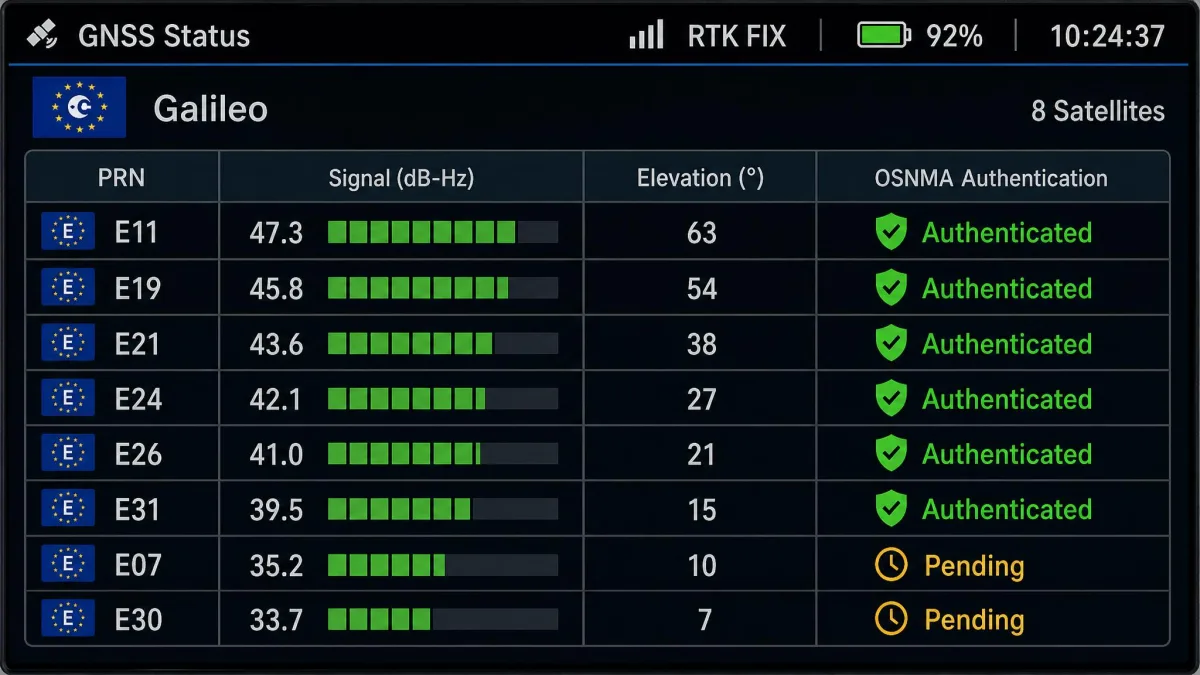
The structural fix is to sign the navigation message so a receiver can prove it came from a satellite. Europe has shipped it. Galileo Open Service Navigation Message Authentication entered its Public Observation Phase in 2021 and had its Initial Service declared operational on July 24, 2025.
OSNMA authenticates the I/NAV navigation message carried on the Galileo E1-B signal component, using reserved data fields so it adds no extra system overhead. It adapts the TESLA broadcast authentication protocol, which releases keys on a delay, and receivers must be synchronised to Galileo System Time within 30 to 300 seconds to process the authentication data. Japan's QZSS has offered signature-based authentication for its own and for GPS and Galileo signals since 2024, and military GPS has long used the encrypted M-code, which civilians cannot access.
Authentication defeats forged navigation data. It does not by itself defeat meaconing, since replayed signals are genuine, which is why the timing constraints in the protocol matter.
Safer Alternatives to Faking Your Location
If your goal is privacy rather than deception, there are calmer routes than a mock-location app, and most involve granting less location data rather than supplying false data.
Start with permissions. Both mobile platforms let you give an app approximate location instead of precise, or restrict it to while-in-use only, which removes most of the tracking value without lying to anyone. Turn off location history, and audit which apps hold background access.
A VPN changes the IP address a service sees, which is enough for many web services, though it does not touch the GPS chip. Where you genuinely need to change the device's reported location, use the supported methods, which we walk through in How to change location on iPhone and How to change location on Android.
Frequently Asked Questions
Is GPS spoofing illegal?
How can I tell if my GPS is being spoofed?
What is the difference between GPS spoofing and jamming?
Can a VPN change my GPS location?
Will a fake GPS app get my game or gig account banned?
Does GPS spoofing affect aircraft and ships?
What is Galileo OSNMA?
The Bottom Line
GPS spoofing works because the civilian satellite signal is weak, open, and unauthenticated, and because a receiver has no built-in way to tell a well-formed lie from the truth. That combination puts everything from a delivery route to an airliner's clock inside the same attack surface.
For most readers the exposure is modest and the defense is proportionate: keep mock locations disabled, avoid free fake-GPS apps, use a multi-constellation device, and treat a location that contradicts reality as the error it is. For operators, the answer is redundancy and receiver quality, backed by antenna and inertial cross-checks.
The longer-term answer is authentication, and it has started shipping. As OSNMA reaches ordinary chipsets, the cheapest version of this attack stops working.
Sources
- FAA GPS and GNSS Interference Resource Guide
- Galileo Open Service Navigation Message Authentication
- UT Austin yacht spoofing demonstration