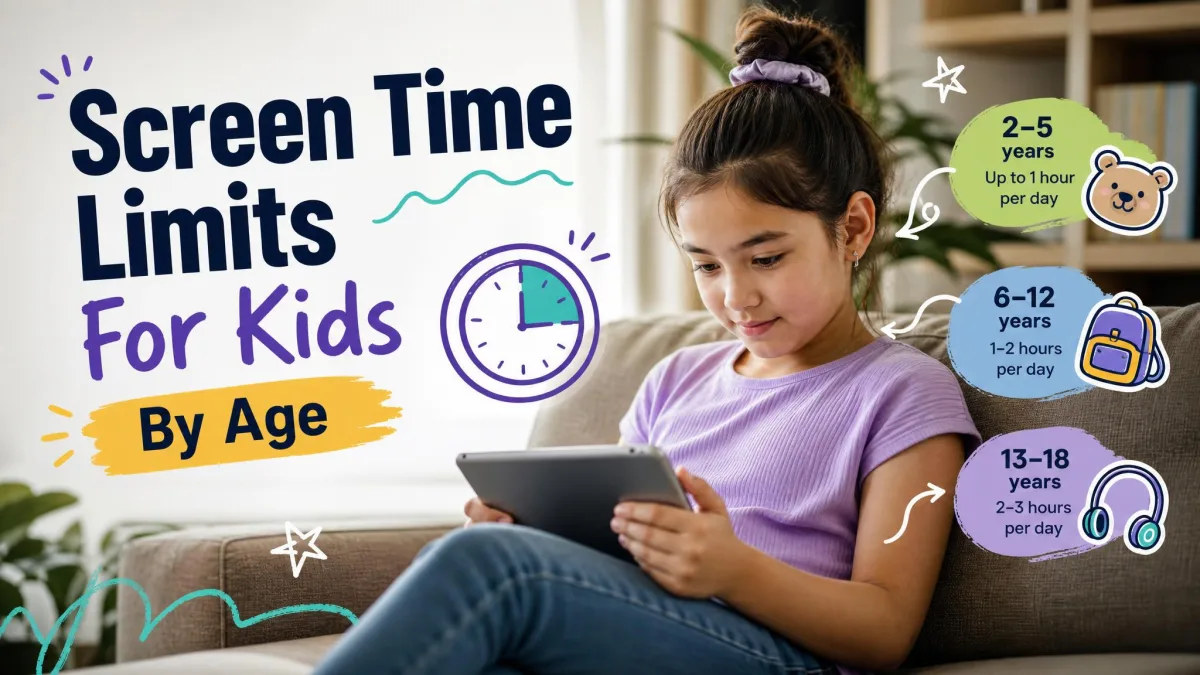
We've all handed over the tablet to buy five quiet minutes. You need to unload the dishwasher, take a call, or finish one sentence without being interrupted. Every parent has done some version of this, and most of us have wondered whether it was too much.
You're not alone in that worry. In a recent Pew Research Center survey of more than 3,000 US parents, 42% said they could be doing a better job managing their children's screen time, while 58% said they're doing the best they can.
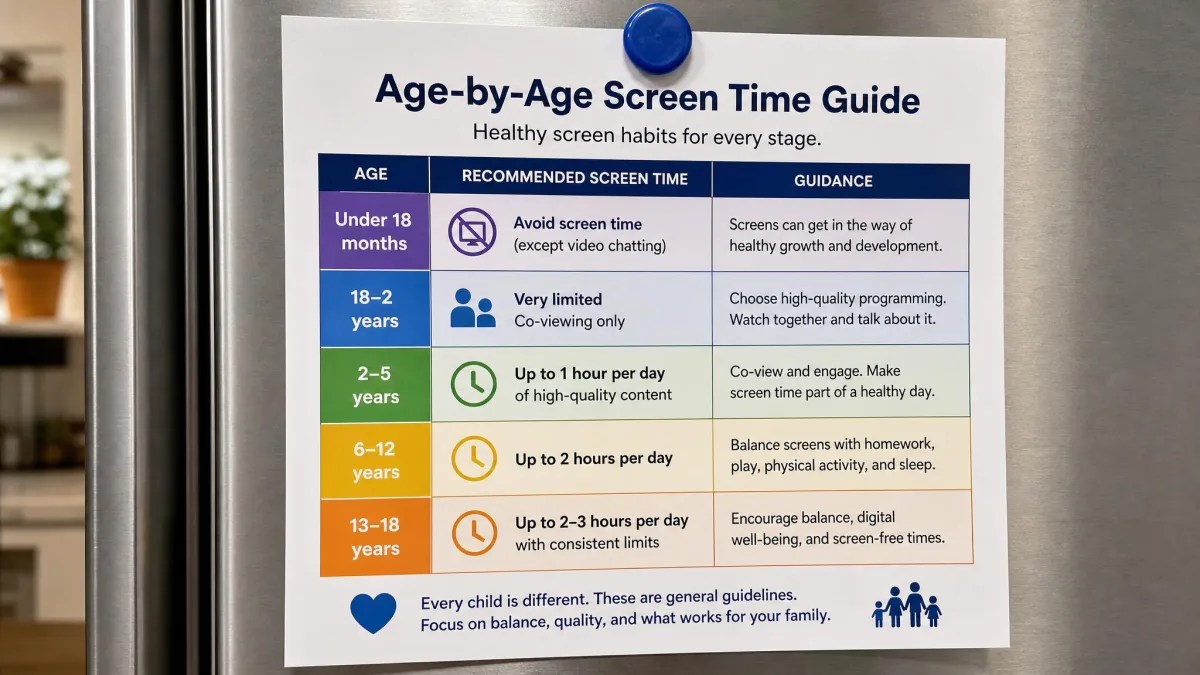
This guide gives you a way forward. We've organized the current guidance from the American Academy of Pediatrics (AAP), the World Health Organization (WHO), the UK's NHS, and AACAP into one age-by-age chart you can print and stick on the fridge. Below it: a working definition of screen time, the warning signs parents miss, enforcement strategies that end the daily battles, and a family media plan you can set up this weekend.

What the Experts Actually Recommend (AAP, WHO & NHS)
The major health bodies agree far more than they disagree, especially for the youngest children. Where they differ, advice varies from one pediatrician to the next.
The 2026 shift: from strict hour caps to content quality
For most of the last decade the conversation revolved around one number: two hours. The guidance has since moved on. The AAP's current rules for young children come from the AAP policy statement "Media and Young Minds", which set the limits below. On January 20, 2026, the AAP published "Digital Ecosystems, Children, and Adolescents," shifting the frame from time limits to content quality and the social world around the screen.
AAP vs WHO vs NHS at a glance
Where the big bodies set numbers, they line up closely. The World Health Organization (WHO) says children under one should have no sedentary screen time, and the same applies to one-year-olds; for ages two to four, no more than one hour a day, with less better. The UK's NHS says under-twos should avoid screens except for shared activities that build connection; two-to-five-year-olds stay under one hour a day, with no screens at mealtimes or in the hour before bed. The AAP holds the same line for ages two to five, about one hour a day of high-quality programming, co-viewed. AACAP (American Academy of Child and Adolescent Psychiatry) adds up to three hours on weekend days. Past age five, the WHO drops out and both the AAP and AACAP treat older kids as a judgment zone.
What too much screen time actually does to kids (research-backed)
The clearest finding isn't that screens are poisonous. It's that they crowd things out. Every hour of recreational screen time is an hour not spent sleeping, talking at dinner, or playing outside, which is why the WHO frames its guidance as "sit less and play more."
Watch out for the slow leak rather than the dramatic damage. Screens don't usually hurt children through one bad evening. They hurt through years of quietly crowded-out sleep, movement, and conversation.
For school-age kids, the useful question stopped being "how many hours?" and became "what are they watching, and what is it crowding out?"
What Counts as Screen Time (And What Doesn't)
Before you set a single limit, agree on what counts. Screen time is any time your child spends looking at or interacting with a screen for entertainment: YouTube, gaming, social media, streaming, and most apps. The AAP draws a line between that and screen use with a clear purpose.
Educational vs recreational screen time
For under-fives, quality matters more than the label. An "educational" app is not automatically better than a picture book, and the AAP's limit for this age is high-quality programming, co-viewed. For school-age children, keep homework and school-required work out of the recreational allowance.
Video calls, schoolwork and background-TV exceptions
Video calls with family don't count, even for babies; the AAP explicitly excepts video-chatting with a known adult for children under 18 months. Schoolwork doesn't count either, as long as it's genuinely assigned. But background TV still counts as screen time even when your child isn't watching it, because it divides attention.
The rule of thumb: if your child chose it and it's for entertainment, it counts. A video call with a grandparent or genuinely assigned schoolwork doesn't. Background TV counts, so decide whether the trade-off is worth it.
Screen Time Limits by Age: The Complete Chart
Here is the short version of what the experts recommend at every age. The school-age rows are labeled because neither the AAP nor the WHO sets a fixed hourly cap past age five.
| Age Group | Recommended Daily Limit (AAP/WHO) | Content Type / Quality | Enforcement Strategy |
|---|---|---|---|
| Under 18 months | None, video-chatting with family excepted | Video calls with a known adult | Keep screens out of daily routines |
| 18-24 months | Limited; high-quality only, co-viewed | High-quality programs and apps, watched together | Watch together and narrate |
| Ages 2-5 | About 1 hour a day; less is better | High-quality, co-viewed; about 1 hour weekday / 3 hours weekend (AACAP) | Timers, co-viewing, no screens at meals or bedtime |
| Ages 6-10 | 1-2 hours recreational (commonly cited range) | Educational content first; schoolwork kept separate | Consistent limits and a family media plan |
| Ages 11-13 | About 2 hours (commonly cited range); hand over gradually | Balance school, sport and sleep | Agreed boundaries and growing autonomy |
| Ages 14+ | No fixed cap | Quality over quantity; protect sleep | Guardrails, device-free zones and a family media plan |
Source: WHO guidelines on sedentary screen time for under-fives, the AAP's "Media and Young Minds" policy, and AACAP's "Screen Time and Children" guidance. The school-age figures are conventional, since no current AAP, WHO, or NHS limit caps hours past age five.
Now the reality check: the actual average.
| Age Group | Recommended (AAP/WHO) | Actual Average (Common Sense 2021) |
|---|---|---|
| Ages 2-5 | About 1 hour a day | No Common Sense data for this band |
| Tweens 8-12 | 1-2 hours recreational | 5 hours 33 minutes a day |
| Teens 13-18 | No fixed cap; balance | 8 hours 39 minutes a day |
Source: The Common Sense Census: Media Use by Tweens and Teens, Common Sense Media, 2021.
The gap in those last two rows is the point. Most tweens and teens run three to four times the recommended amount, and use rose 17% between 2019 and 2021. When your child says everyone else gets more, the data agrees.
Babies & Toddlers (0-2): virtually none (video calls excepted)
The youngest rules are the most absolute. The AAP says no screen media before 18 months other than video-chatting with family, and UK guidance pushes the same spirit to age two. Between 18 and 24 months, choose high-quality programming and watch it together, narrating as you go.
Preschoolers (2-5): ~1 hour, co-viewed
For ages two to five, every major body lands in the same neighborhood: about one hour a day, less if possible, and only high-quality programming. The qualifier that matters is co-viewed: a preschooler watching with you gets more from the hour than one left alone with a tablet.
Ages 6-10: 1-2 hours of recreational time
School-age is where the official numbers stop. Neither the AAP nor the WHO sets a fixed hourly cap for ages six and up; the AAP asks for consistent limits and quality content instead. The one-to-two-hour figure repeated everywhere is a conventional range. Treat it as a reasonable ceiling for recreational time on school days.
Ages 11-13: 2 hours, handed over gradually
Around age eleven, screen use jumps, and so does the need for autonomy. The roughly two-hour figure is conventional rather than official. This is the age to hand over control in small, agreed steps, trading a fixed limit for boundaries your child helps set.
Teens (14+): guardrails, not fixed caps (first phone ~10, later is better)
For teenagers, the experts stop setting numbers almost entirely and lean on guardrails: protect sleep, keep screens out of meals and bedrooms, and let quality win over quantity. The other big decision is the first phone. The average age is about 10, but experts recommend waiting until 13 or later.
7 Signs Your Child Is Getting Too Much Screen Time
The signs usually show up in everyday life before anyone admits it.
- The ending meltdown. A University of Washington study found 93% of parents say their child resists ending screen time; 37% say it almost always ends in a fight.
- Sleep that drifts later. Screens in the bedroom and the hour before bed are the most consistent culprits.
- Meals without conversation. When dinner becomes a device propped against the salt shaker, the balance has tipped.
- Nothing is fun without a screen. If blocks, bikes, and board games draw a shrug, the balance is off.
- Secrecy and sneaking. Hiding devices or staying up late on a phone are clear signs the setup isn't working.
- Mood swings at disconnection. When turning a screen off reliably produces sullenness or snaps, the transition is the problem.
- Interests quietly disappear. The sport or hobby that used to fill the afternoon now gets filled by autoplay.
How to Actually Enforce Screen Time Limits (Without Daily Battles)
The rules are the easy part. Keeping them without a nightly war is the skill.
Timers, not negotiations
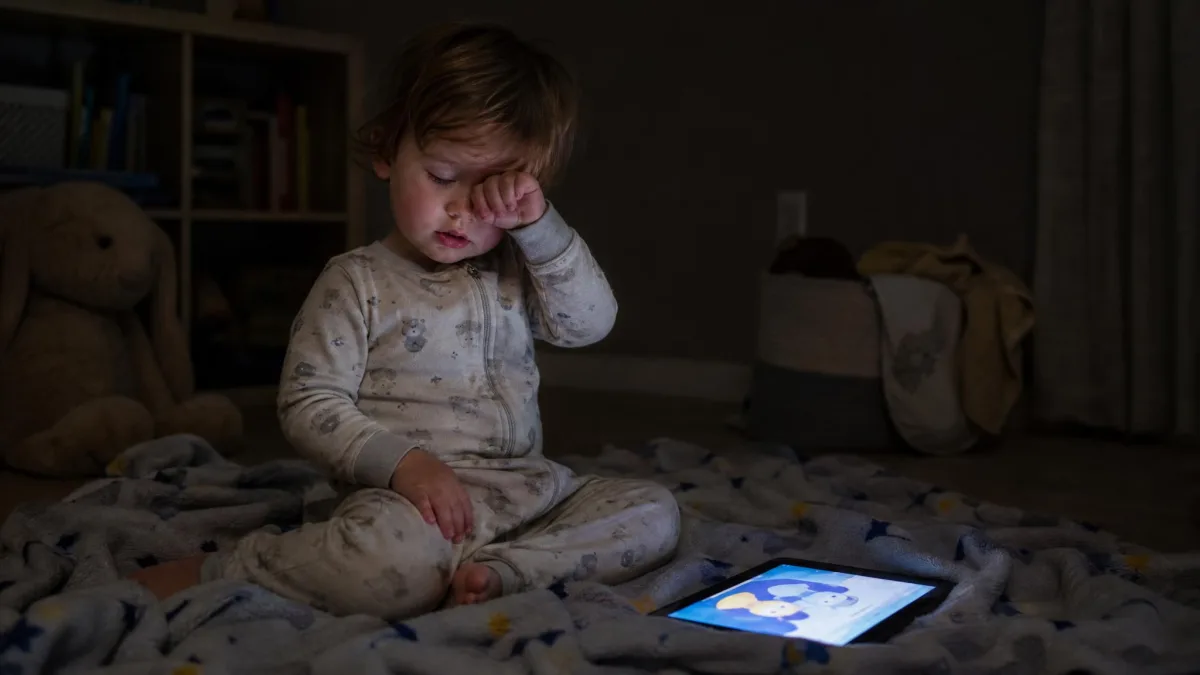
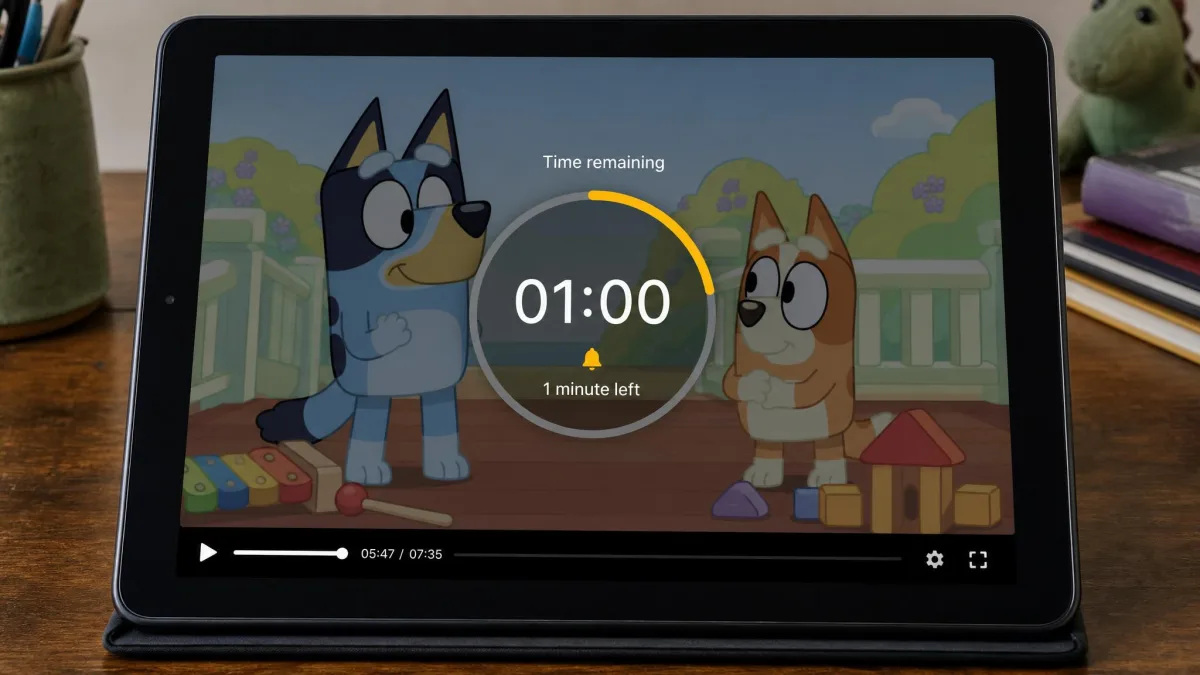
Two-minute warnings can make the ending worse, not better. The struggle is rarely lost interest. It's the forced ending itself, and "two more minutes" twice starts the negotiation. Let the technology end the session instead: children transition far more calmly when the device itself shuts off, through an auto-off timer or a dead battery, than when a parent switches it off.
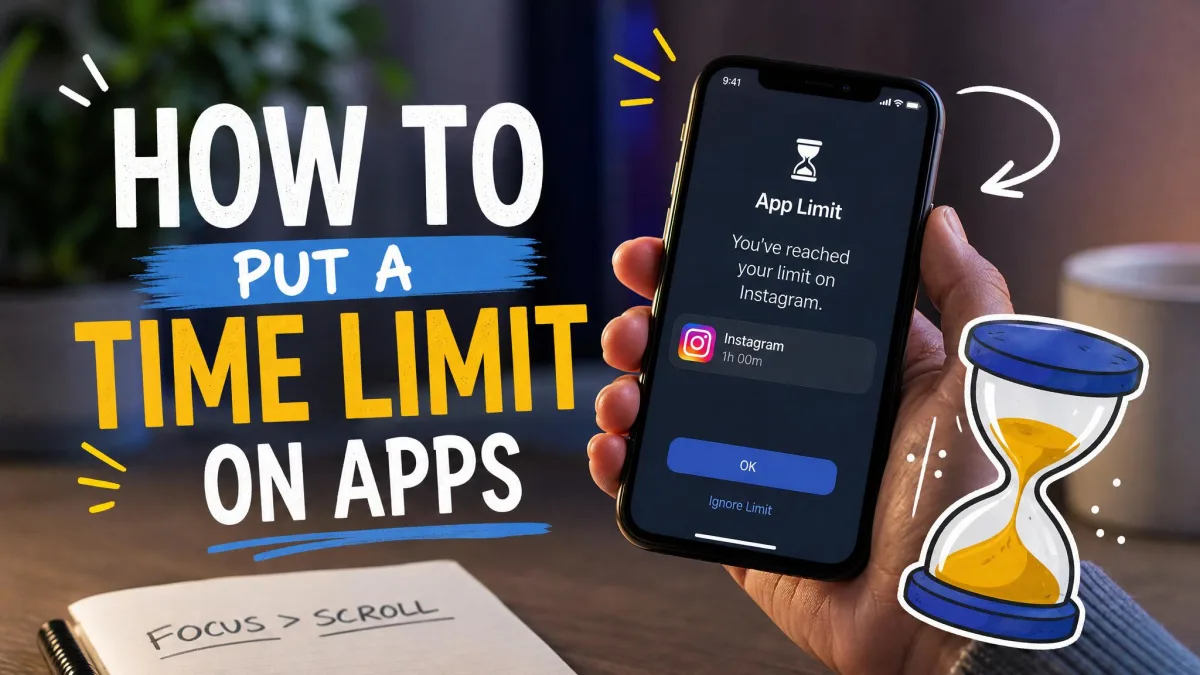
Set the device's own timer at the start, together: "When the timer goes off, the episode ends. What do you want to watch next?" It moves you from enforcer to bystander and removes the negotiation entirely.
Screen-free zones and transition rituals
The most effective rule is also the easiest to remember: some places are simply no-screen zones. Meals and bedrooms are where every major body lands. The AACAP recommends removing screens from bedrooms 30 to 60 minutes before bedtime and turning them off during family meals; the AAP says none during meals or for an hour before bed. Pair the zone with a ritual, because ending screen time is a transition problem.
Earning, not restricting
There's a difference between "you've lost your screen time" and "you've earned your screen time." The second framing keeps you on your child's side, and using screens to calm an upset child makes the next transition harder.
Weekends and school holidays
You don't have to run the same numbers on Saturday. Even the AACAP's strictest weekday rule softens to three hours on weekends. Keep the structure: no screens at meals, none in bedrooms, nothing in the hour before bed.
Protect sleep: evening rules and blue-light cutoffs
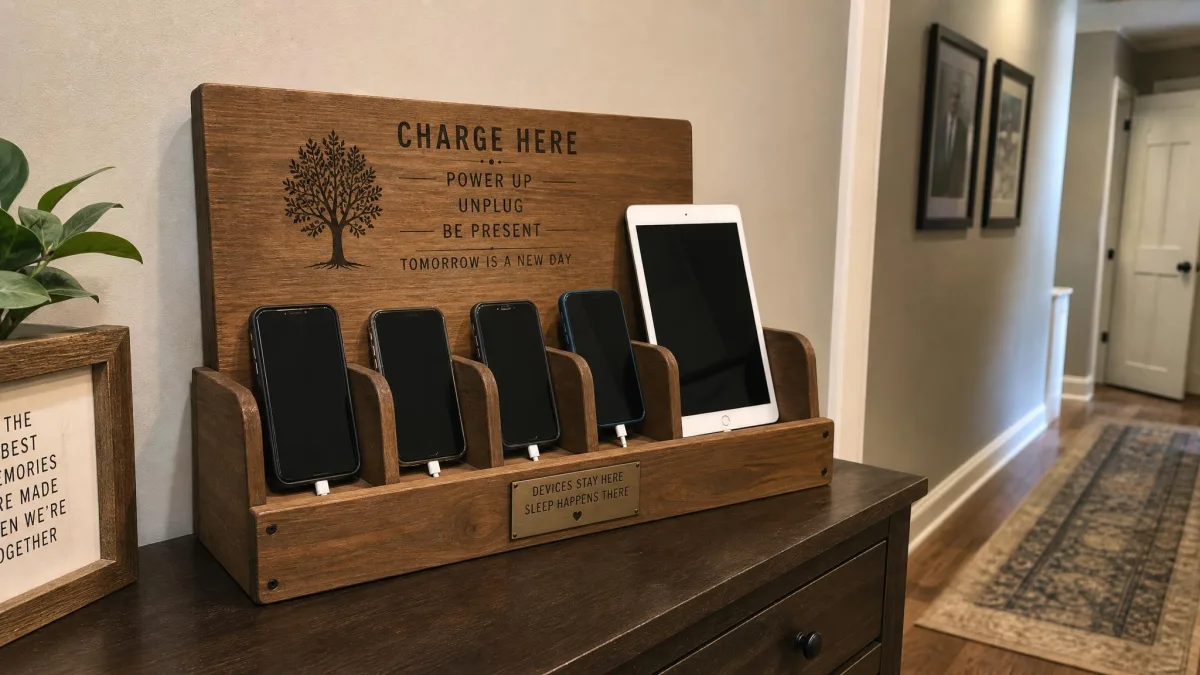
Sleep is the first thing recreational screens attack and the most important to defend. Screens out of the bedroom overnight, a charging station in the hallway, a hard stop in the hour before bed. The AACAP's 30-to-60-minute cutoff is the closest thing to a consensus number.
Build a Family Media Plan That Works
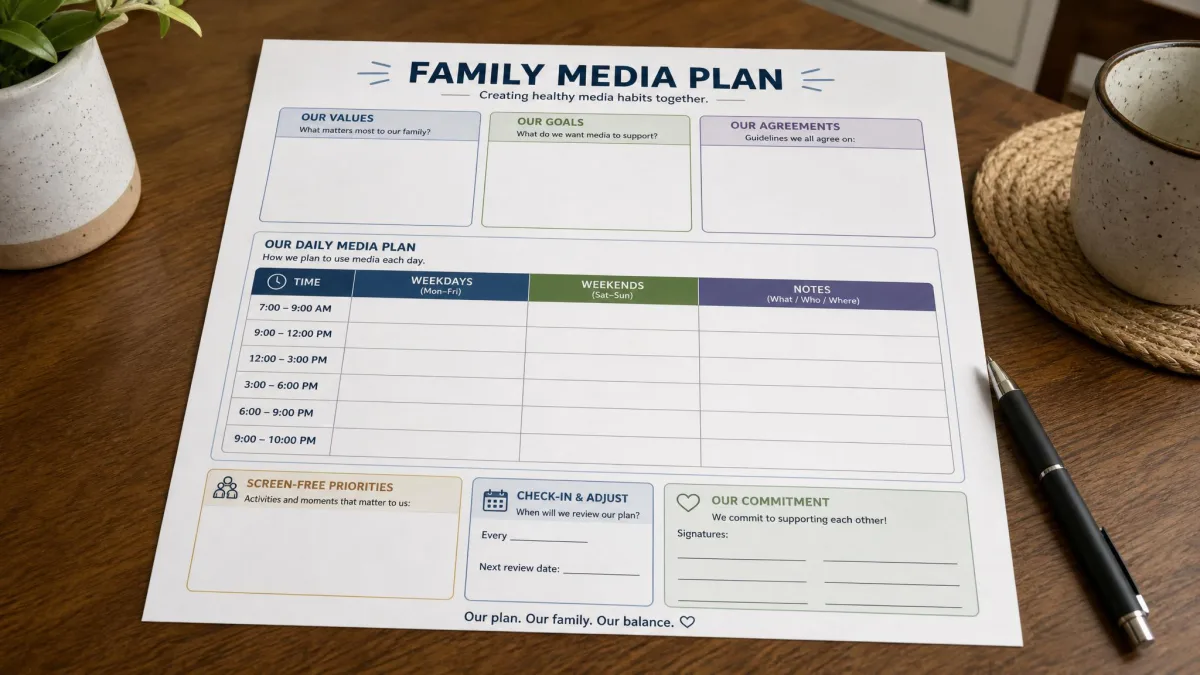
A family media plan is the AAP's umbrella answer and beats any single number you could set. The American Academy of Pediatrics (AAP) publishes a free planning tool built on its 5 C's of Media Guidance: Child, Content, Calm, Crowding Out, and Communication.
Step 1: Audit what's actually happening
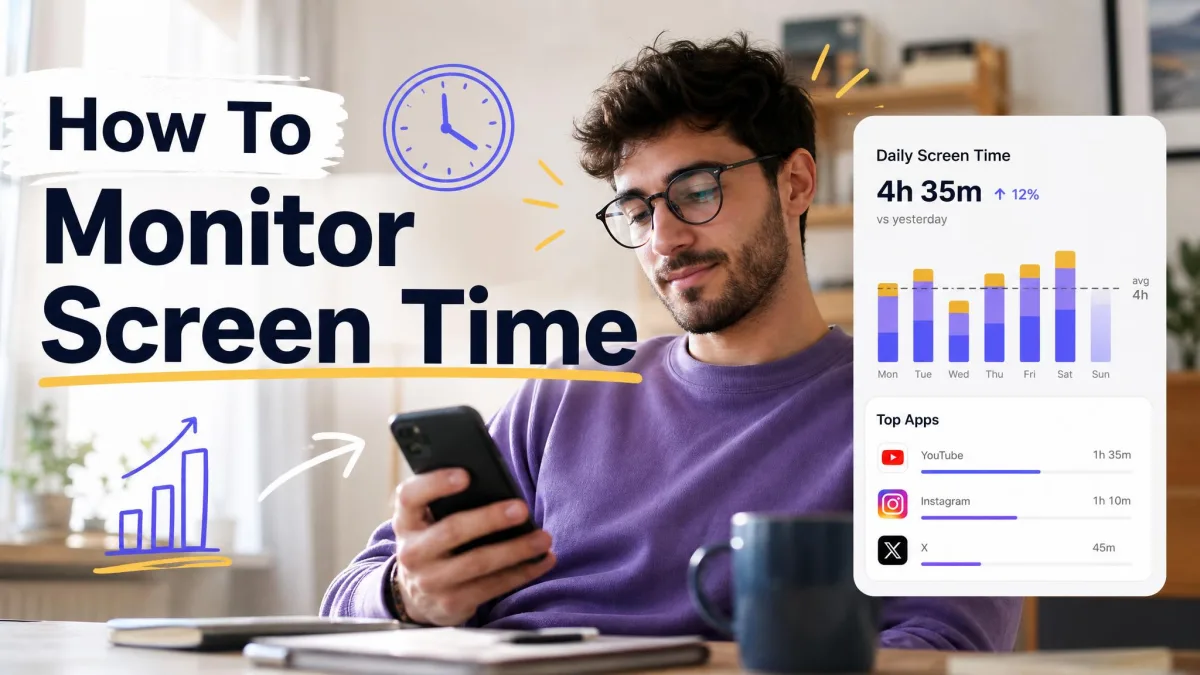
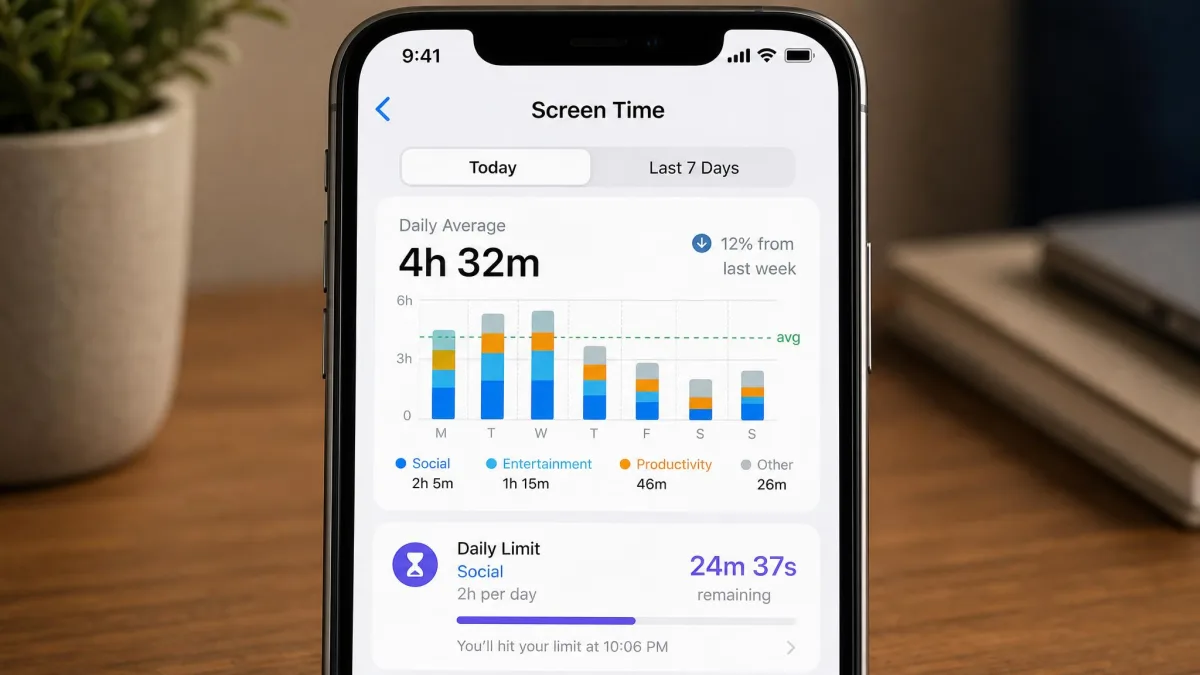
Most families don't know their real number, and it's usually higher than the estimate. Measure for a week before you set any limit. The phone and tablet settings will show you the totals, and we've written walkthroughs for how to check screen time on iPhone and how to check screen time on Android. Compare what you find to the chart above: tweens averaged 5 hours 33 minutes a day in 2021, and teens 8 hours 39 minutes.
Step 2: Set screen-free zones and times
Write down the zones and times you'll actually defend: meals, bedrooms, the first hour of the day, the hour before bed, and one block of family time a week. Two or three defended zones beat a dozen ignored rules.
Step 3: Choose content deliberately
The 2026 guidance is explicit that content quality matters more than the clock, and the AAP's 5 C's of Media Guidance page is the practical starting point. Curate what your child watches rather than letting autoplay decide. Co-view with younger kids and talk about what you see; agree on a shortlist of creators and games with older ones.
Step 4: Model the behavior yourself
The uncomfortable part is the honest part. In the same Pew survey, 65% of parents said they spend too much time on their own smartphones. Children do what we do, not what we say, so the plan needs a parents' column: no phone at the table, no phone in bed.
Screen-Free Alternatives by Age
Every limit is easier to keep when the alternative is appealing.
Babies and toddlers (0-2): your lap, a board book, a textured toy, and time outside.
Preschoolers (2-5): blocks, drawing, dress-up, a picture book, or a trip to the playground. A physical, fun next activity takes the sting out of the ending.
Ages 6-10: board games, bikes, sports teams, building sets, and reading for fun. If the transition is the problem, make the next activity physical.
Tweens and teens (11+): sports, clubs, music, cooking, and in-person social time. The goal isn't to remove screens; it's to keep the non-screen life interesting enough that screens aren't the default.

Frequently Asked Questions
How much screen time should kids get by age?
What are the 2026 AAP guidelines?
Does educational screen time count toward the limit?
Should rules differ on weekends or school holidays?
Why does my child melt down when screen time ends?
What's the best age for a first phone?
Bottom Line
No chart can parent for you, and no single number works for every family. What the experts agree on is simple: protect the youngest with near-zero screens, keep preschool to about an hour of co-viewed quality content, and for everyone older, guard sleep, meals, and real-world movement.
The goal isn't a perfect scorecard. It's a family media plan you can keep and a child who knows the difference between using a screen and being used by one.