VPNs are legal in Angola, website blocking is rare, and the real reason to run one is privacy on mobile data and public Wi-Fi rather than unblocking. Our top pick is NordVPN, which pairs audited no-logs privacy with a large server hub in Johannesburg, the closest major VPN location to Luanda. Proton VPN is the best choice if you want a free plan, ExpressVPN gives the most consistent speeds, Surfshark is the value pick with unlimited devices, and CyberGhost is the easiest to use. We ranked all five by the scores from our full reviews, then checked each one for nearby servers, privacy and streaming. The How we picked these VPNs section below has the details.
Best VPNs for Angola at a glance
| Provider | Buy | Price from | Server countries | South Africa / Portugal servers | Devices | Free plan or trial | Money-back | Best for |
|---|---|---|---|---|---|---|---|---|
 |
Check price → | About $3.49/mo(2-yr) | Well over 100 | 50+ in Johannesburg / about 20 in Lisbon | 10 | No | 30-day | Overall |
 |
Check price | Free; about $3/mo(2-yr) | 140+ | Yes / 20 in Lisbon (paid plans) | 10 (1 on Free) | Free plan | 30-day (prorated) | Free plan |
 |
Check price | $2.99/mo(2-yr) | 113 | Johannesburg / Portugal | 10 to 14 by tier | 7-day mobile trial | 30-day | Consistent speeds |
 |
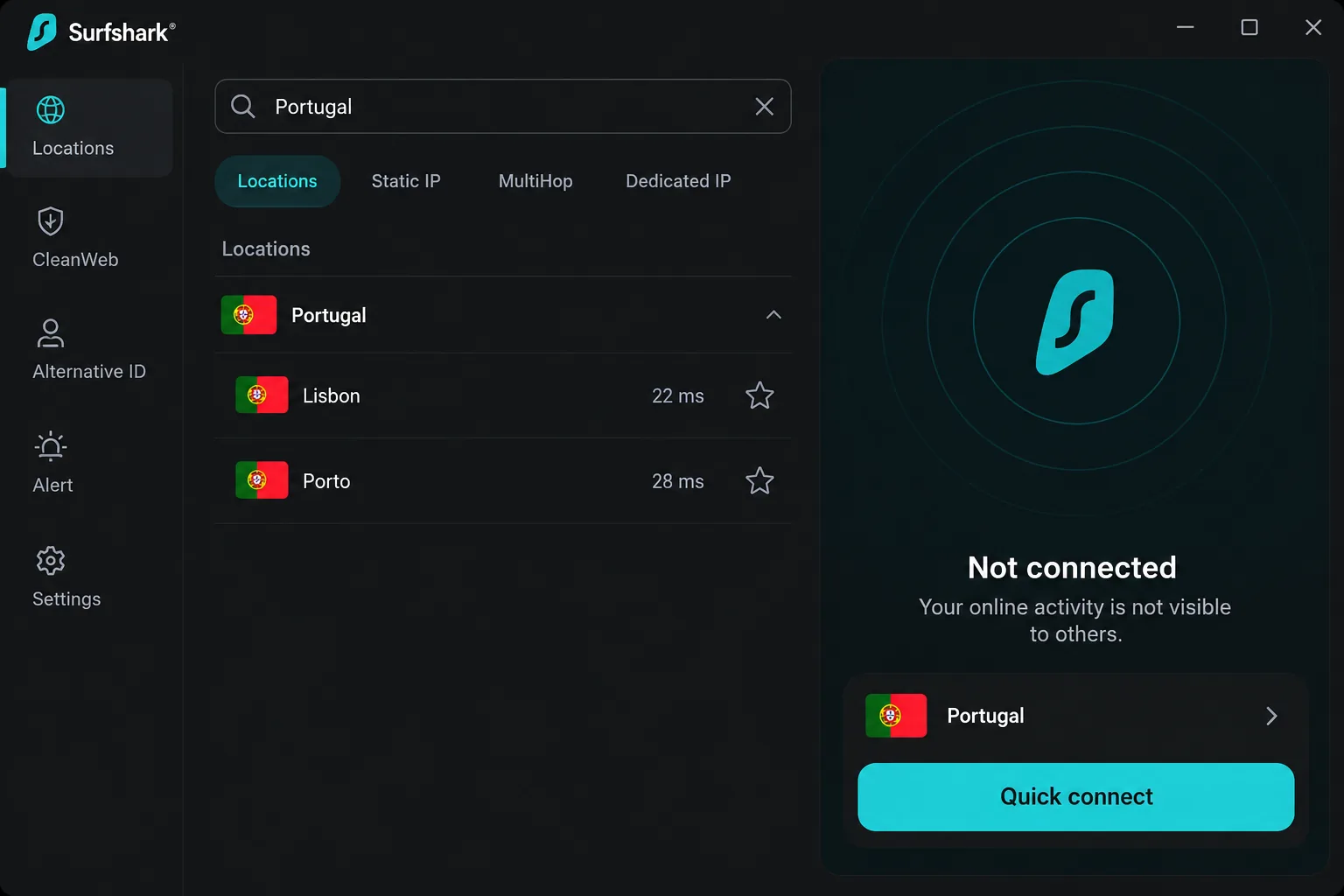
Check price | $2.49/mo(2-yr) | 100 | Yes / Lisbon and Porto | Unlimited | No | 30-day | Value, unlimited devices |
 |
Check price | $2.19/mo(2-yr) | 100 | 67 in Johannesburg / 76 in Lisbon | 7 | Short trials by platform | 45-day | Beginners |
The 5 best VPNs for Angola
All five providers below have servers in South Africa and Portugal, the two locations that matter most from Angola. They differ on price, privacy extras and how they behave when a network gets difficult.
1. NordVPN - best overall for Angola
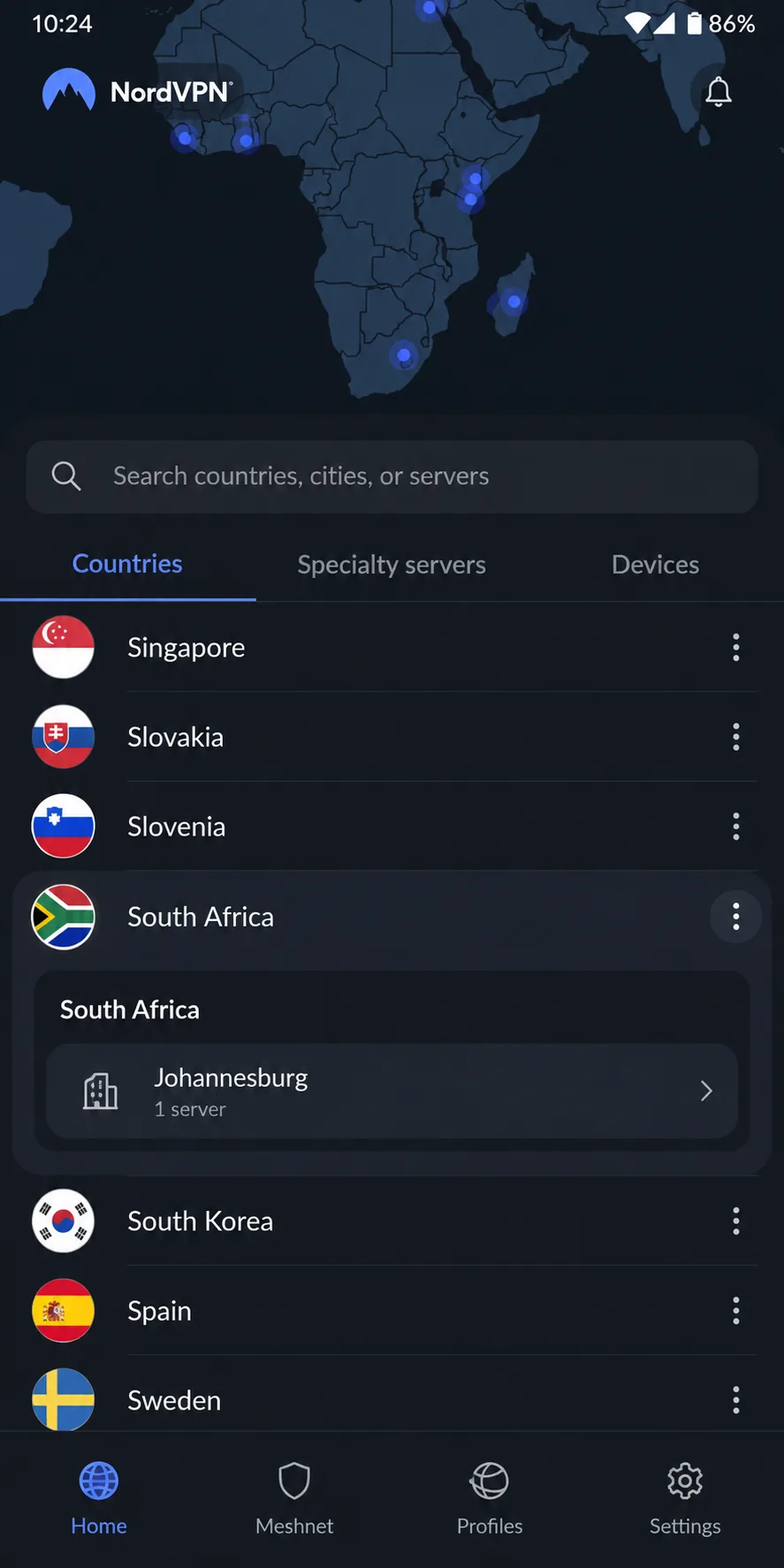
NordVPN shares the top score in our reviews (9.0 out of 10) with Proton VPN. It takes first place here because it is the strongest all-rounder: nearby servers, low speed loss and audited privacy all in one paid plan, without the trade-offs of a free tier. It runs 50+ servers in South Africa, almost all of them in Johannesburg, plus about 20 servers in Lisbon. NordVPN adjusts its per-city counts often, so treat the Lisbon figure as approximate. Its server list also includes Angola (Luanda), although we could not confirm whether that location is a physical server inside the country.
Speed is where NordVPN earned its place on our bench. NordLynx is NordVPN's version of the fast, modern WireGuard protocol, and on nearby NordLynx servers our download-speed loss averaged around 5 percent. The Obfuscated and P2P server categories gave up a little more speed in exchange for their specialty. On Angolan mobile connections, which run in the low double digits of Mbps, that small overhead leaves headroom for HD streaming and video calls.
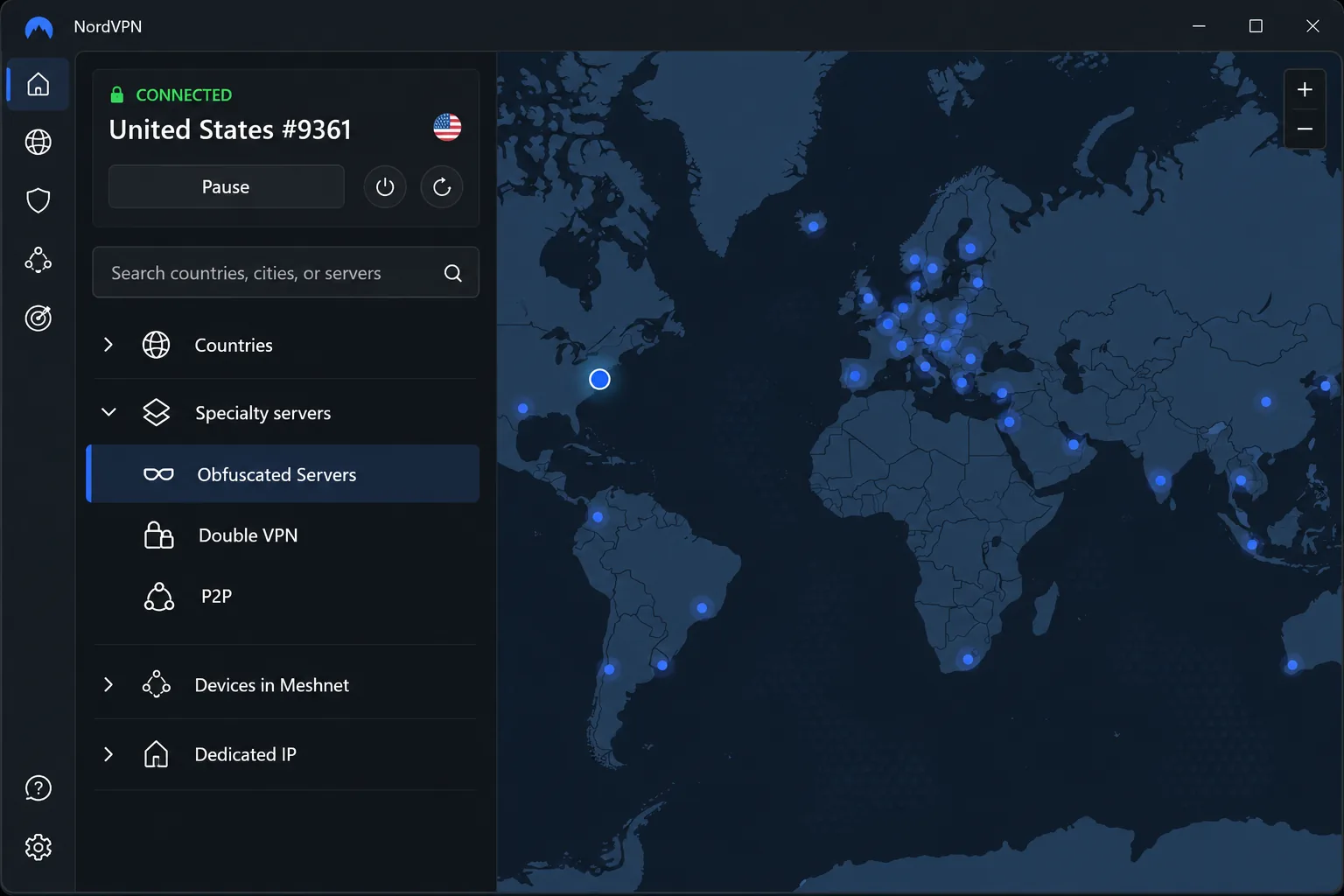
Privacy is backed by six independent no-logs assessments, from PwC in 2018 and 2020 and from Deloitte every year from 2022 through 2025. NordVPN was founded in 2012 and is incorporated in Panama. Traffic is protected with AES-256, the military-grade encryption standard, and Threat Protection blocks malicious sites and trackers. If a network ever starts interfering with VPN traffic, pick the Obfuscated Servers category and connect. That category now runs on NordWhisper and needs no extra setup.
The Basic plan costs about $3.49 a month on a 2-year term, though the promo price shifts with NordVPN's sales and varies by currency. It renews at a noticeably higher rate, and the renewal charge lands about two weeks before the term ends. You get 10 simultaneous connections and a 30-day money-back guarantee.
Pros
- Optional post-quantum encryption on NordLynx
- Six independent no-logs assessments
- Obfuscated Servers work with one tap
- Prompt support, with accurate and specific answers from human agents
Cons
- The interface can feel busy for first-time users
- Picking a specific city on mobile hides behind a three-dot menu
- Renewal is charged two weeks before the term ends
2. Proton VPN - best free plan for Angola
Where NordVPN is the all-rounder, Proton VPN wins on flexibility. It ties NordVPN at 9.0 in our reviews. It is also the only pick with a free plan worth installing and the only provider with a confirmed Angolan IP location. That Angola location is a Smart Routing server physically hosted in Marseille, France, and it is available on paid plans only.
The free plan has no data cap and no ads, but it covers only 1 device and does not let you choose the country. It connects you to one of 10 automatically chosen countries, none of them in Africa or Portugal, and those free servers get crowded at peak hours. Paid plans open up 140+ countries, physical servers in South Africa, 20 servers in Lisbon and 10 devices.
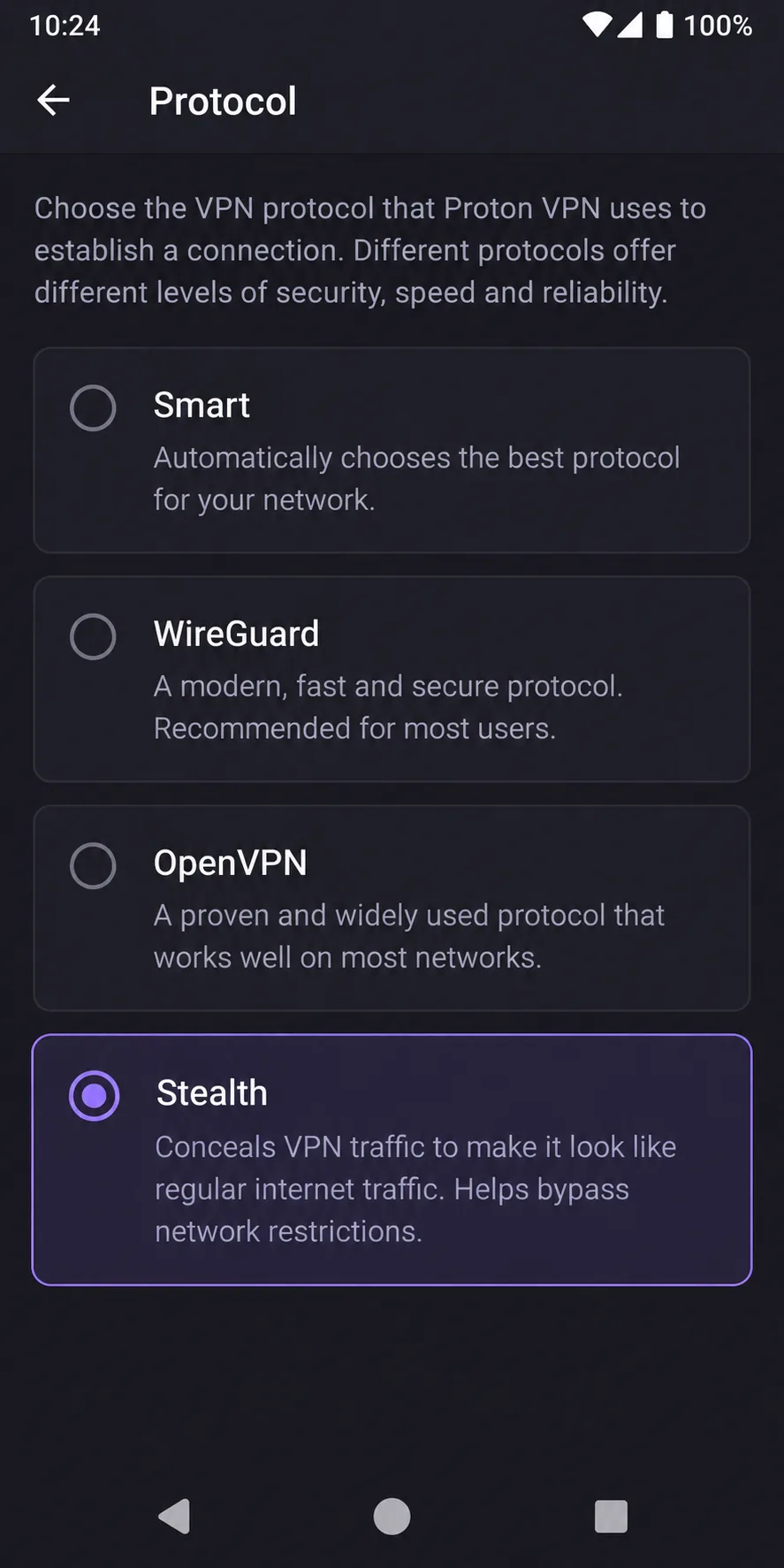
Connection reliability is where Proton surprised us most. When the default Smart protocol struggled to connect in our testing, we switched manually to WireGuard, then OpenVPN, and finally Stealth, which got the connection through. Stealth disguises VPN traffic as ordinary encrypted web traffic, and it works on the free plan too. Download speed held up well on nearby servers, but upload fell off sharply on distant ones. That drop is another reason to stay on Johannesburg.
Proton AG runs the service from Switzerland, its apps are open source, and Securitum has audited its no-logs policy every year from 2022 through 2026. Streaming and P2P support are paid features. VPN Plus costs $9.99 month to month, or from about $3 a month on the 2-year plan; that rate changes between sales. The 30-day money-back guarantee is prorated to the unused part of your plan.
Pros
- Free plan with no data cap and no ads
- Stealth protocol on every plan, including Free
- Only pick with a confirmed Angolan IP location (paid)
- Open-source apps and yearly no-logs audits
Cons
- Free servers exclude Africa and Portugal, and you cannot pick a country
- Support is slower than rivals: live chat can take several minutes and email about two days
- Refunds are prorated rather than full
3. ExpressVPN - most consistent speeds
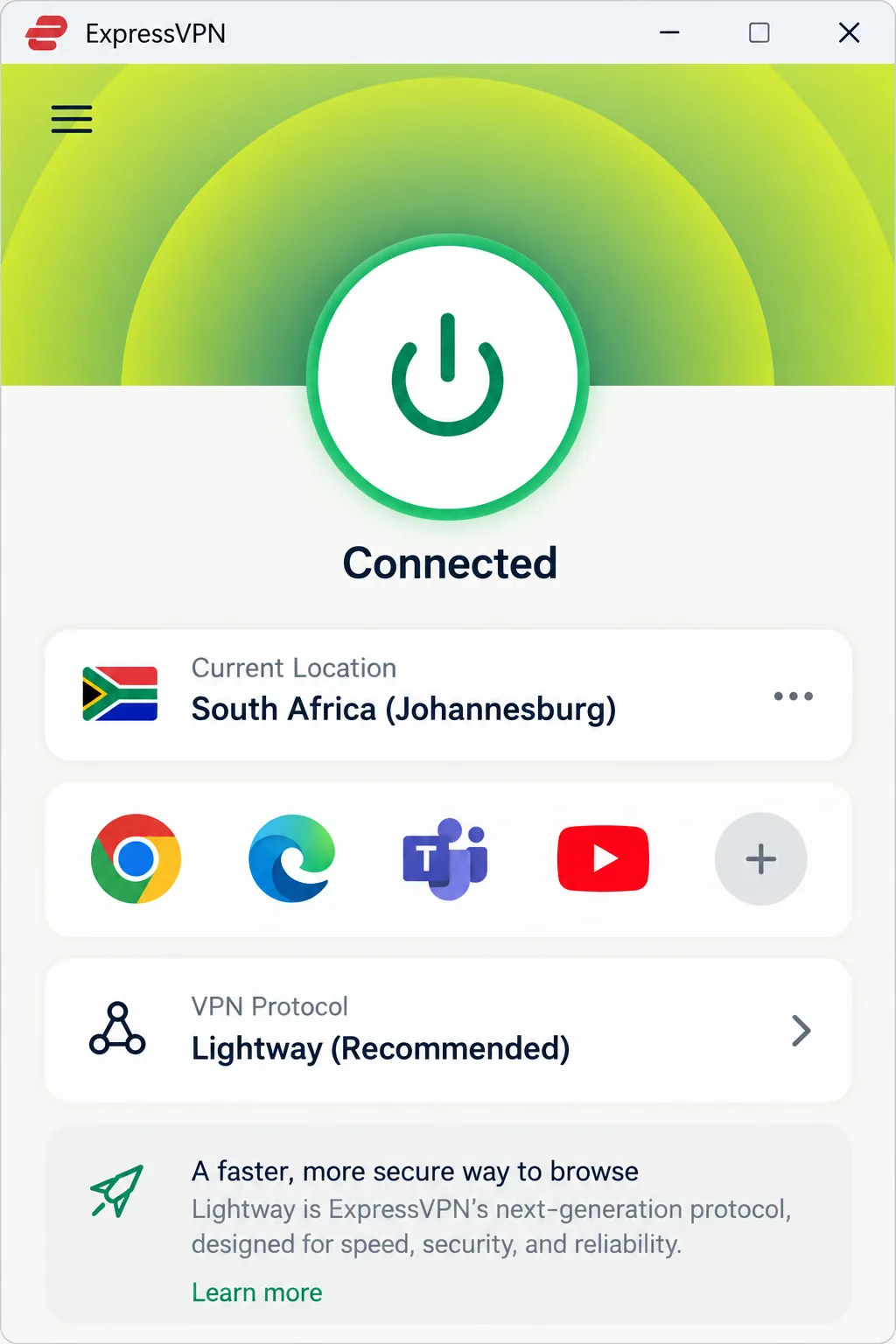
If Proton is the flexible pick, ExpressVPN is the steady one. It scored 8.8 in our review, and its edge is consistency under heavy load rather than the smallest average speed loss. During our everyday test sessions we ran 4K streams and large downloads on the same connection, and ExpressVPN kept roughly 90 to 95 percent of our base download speed throughout. Its Lightway protocol also handled a phone switching between Wi-Fi and mobile data smoothly, with low battery use.
From Angola, the useful locations are Johannesburg and Portugal, both physically inside their named countries. ExpressVPN has no Angola location. It covers 113 countries in total. Obfuscation is always on, so there is nothing to configure before connecting from a restrictive network.
The privacy record is strong. In 2025, KPMG completed a reasonable-assurance assessment of its privacy policy and its TrustedServer setup, which uses RAM-only servers that wipe on reboot. ExpressVPN counts 23 third-party audits to date. The company was founded in 2009, is based in the British Virgin Islands, and has been owned by Kape Technologies since 2021. For streaming on devices that cannot run a VPN app, MediaStreamer adds a smart DNS option.
Pricing starts at $2.99 a month for Basic on the 2-year plan, with Advanced at $4.49 and Pro at $7.49. Basic renews at $99.95 a year, and at that rate ExpressVPN costs more than rivals with a similar core feature set. Device limits run from 10 on Basic to 14 on Pro, new users get a 30-day money-back guarantee, and the mobile app stores offer a 7-day free trial.
Pros
- Speeds stay close to baseline, even during 4K streaming
- Automatic obfuscation on every server
- Beginner-friendly apps with one-click connect
- KPMG-assessed RAM-only server setup
Cons
- Costs more than rivals once the plan renews
- Setup requires copying an activation code into the app
- Split tunneling is not available on iOS
4. Surfshark - best value, unlimited devices
Surfshark undercuts ExpressVPN on price and removes the device cap entirely. It scored 8.6 in our review, and its Starter and One plans cost $2.49 a month on the 2-year plan ($67.23 for the first 27 months). Every plan allows unlimited simultaneous connections, so one subscription can cover a whole household. Surfshark does not print its renewal price on the pricing page. Expect around $79 a year for Starter, though the exact figure varies by term and currency.
The network spans 4,500+ servers in 100 countries, with South Africa listed plus Lisbon and Porto in Portugal. Angola is not on the list. Setup took us under five minutes from download to a connected server, and live chat replied in under a minute with accurate answers.
Our clearest Surfshark moment came from a large torrent download. With the VPN on, the file finished only about 5% slower than without it, though uploads lagged behind downloads. Latency was a different story. It jumped even on nearby servers, enough for us to notice in calls and gaming but not in ordinary browsing. Streaming took some trial and error, because occasional buffering meant switching servers to find the best one.
Surfshark has been based in the Netherlands since 2021, runs RAM-only servers, and had its no-logs policy verified by Deloitte in 2023 and again in 2025. CleanWeb blocks ads and trackers. Its Camouflage and NoBorders modes hide VPN use and hold up best on OpenVPN over TCP, though those connections can still drop on heavily restrictive networks. The money-back guarantee runs 30 days.
Pros
- Unlimited devices on every plan
- Lowest 2-year price among the top four picks
- Two Portuguese cities, Lisbon and Porto
- Fast live chat support
Cons
- Latency jumps even on nearby servers
- Some trial and error to find a smooth streaming server
- Renewal price is not shown on the pricing page
5. CyberGhost - best for beginners
CyberGhost trades away the advanced extras the other picks carry for the simplest apps of the five. It scored 8.4 in our review, highest on value, streaming and ease of use. On mobile, selecting a server connects you automatically, with no extra step.
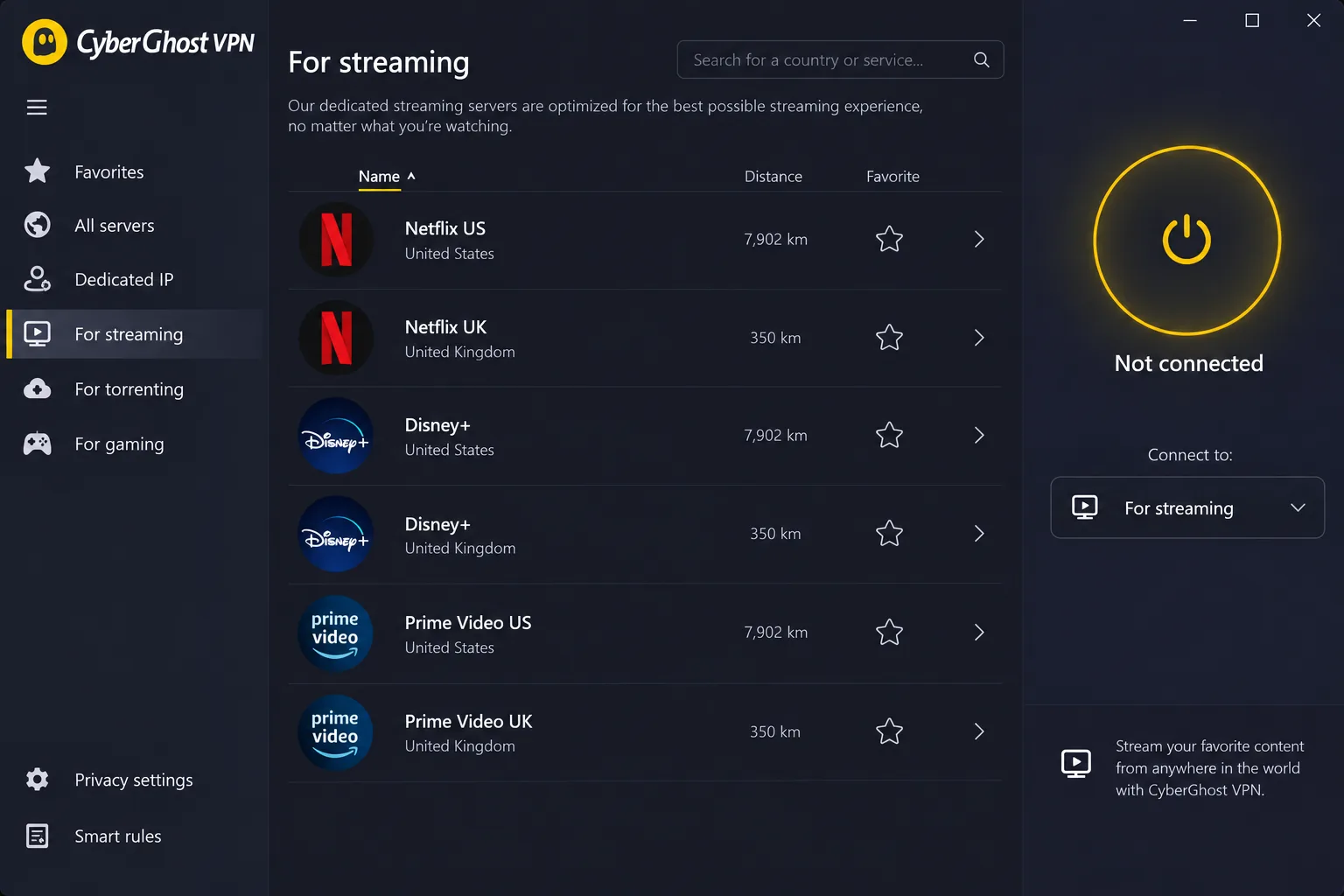
Streaming is where CyberGhost felt strongest in our testing. On a nearby streaming server, HD and 4K streams started quickly without buffering, with latency around 21 to 23 ms. Netflix US, UK and Canada played smoothly, while Disney+, HBO Max and Prime Video worked reliably only on the dedicated streaming servers. DNS and WebRTC leak tests came back clean. Switching locations briefly dropped the tunnel before the new connection settled, and the macOS app sometimes showed a false "no internet" message.
For Angola, CyberGhost offers 67 servers in Johannesburg, physically located in South Africa, and 76 in Lisbon. Its own server page labels Lisbon inconsistently, so whether those Portuguese servers sit inside Portugal is unclear. The full network has 9,600 servers in 100 countries. CyberGhost S.R.L. operates from Bucharest, Romania, under Kape Technologies, and Deloitte Audit Romania issued no-logs assurance reports in 2022, 2024 and 2025.
The 2-year plan (plus 2 extra months) costs $2.19 a month, billed $56.94 for the first term. It covers 7 devices, and the 45-day money-back guarantee is the longest on this list. Free trials run 24 hours on Windows and macOS, 3 days on Android and 7 days on iOS.
Pros
- Very easy apps, with the kill switch on by default
- Dedicated streaming servers that start HD and 4K quickly
- 45-day money-back guarantee
- Lowest 2-year price of the five
Cons
- No obfuscation or stealth mode, the weakest pick if VPN traffic is ever blocked
- Speeds vary more from server to server than with the top picks
- Only 7 simultaneous devices
Why you need a VPN in Angola
You need a VPN in Angola for privacy, not for access. Major platforms such as YouTube, Facebook, X and WhatsApp load normally without one. A VPN adds an extra layer of security on networks you do not control, which matters as more Angolans come online. DataReportal's Digital 2026 Angola report counts 17.6 million internet users, a 44.8% penetration rate.
Privacy and online monitoring
Angolan law gives authorities wide room to collect data. Law 11/20, in force since May 2020, permits electronic surveillance and location tracking by law enforcement with minimal oversight, although it prohibits surveillance on political or discriminatory grounds. Operators must store data for at least one year, and mandatory SIM card registration with ID makes anonymous mobile use difficult.
Spyware is also documented. Amnesty International's 2026 investigation into spyware in Angola gave the first forensic confirmation of Predator spyware in the country: journalist Teixeira Candido's iPhone was infected through a link sent in May 2024, and 11 further infection links appear to have failed. Amnesty could not attribute the attacks to a specific government customer.
A VPN does not remove spyware from a phone. It encrypts traffic between your device and the VPN server, so your operator and anyone on the same network cannot see which sites you visit. Keeping your phone updated and avoiding unexpected links does the rest.
Public Wi-Fi, banking and mobile data
Angola is a frequent cyberattack target, and the National Bank reported an average of 250 attempted attacks per day in 2024. Hotel, airport and café Wi-Fi is where that risk reaches ordinary users, because anyone on the same network can try to intercept unencrypted traffic. We explain what a VPN does on public Wi-Fi in a separate guide.
On mobile data, Unitel carries most traffic, with Africell and Movicel behind it. Whichever operator you use, a VPN keeps your browsing history away from its retained logs. Coverage thins quickly outside Luanda, though, and in rural and wildlife areas there may be no connection for a VPN to protect.
Is using a VPN legal in Angola?
Yes. Using a VPN is legal for personal use in Angola. No Angolan law restricts VPNs, and there are no known cases of travellers being penalised for using one. Freedom House's Freedom on the Net 2025 report on Angola rates the country 60/100, Partly Free, and reports no substantial restrictions on encryption. It scores Angola 6/6 on blocking and filtering, meaning it found no blocked social media or websites.
The same report flags a National Security Law signed in August 2024 that lets authorities restrict telecommunications, including internet services, without court approval in unspecified circumstances.
Not every outage is censorship. An August 2023 disruption came from a rupture in three submarine cables. On July 19, 2025, during fuel-price protests, five Angolan NGOs said the government cut the internet nationwide for eight hours, while Angola Cables blamed a partial outage on a fibre cut from roadworks. Whether that was a deliberate shutdown is still disputed.
Can you use a free VPN in Angola?
You can, but only one free VPN is worth installing. Proton VPN's free plan is the safe choice because it has no data cap, no ads and an audited no-logs policy. We cover its server limits in the Proton review above. In practice, they mean longer round trips than you get on a paid plan's Johannesburg servers.
Most other free apps are a real risk. A CSIRO study of 283 Android VPN apps found that 18% did not encrypt traffic at all and 38% had malware detections. Free servers also get crowded, many cap data, and some providers sell user data to pay the bills. If you want to compare the few exceptions, see our list of truly free VPNs.
How to set up a VPN in Angola
Setting up takes a few minutes, and doing it before you travel saves trouble on arrival. Our general guide shows how to set up a VPN on any device; these are the Angola-specific steps.
- Choose a provider and subscribe before you leave home.
- Install the app from the App Store or Google Play, sign in, and test that it connects. ExpressVPN asks you to paste the activation code from checkout into the app. If the Play Store is unavailable, Proton offers an Android APK directly from its website.
- Pick a fast protocol: open Settings → Protocol and choose WireGuard (NordLynx on NordVPN, Lightway on ExpressVPN).
- Turn on the kill switch so your traffic stops if the tunnel drops. Open the app's settings and switch it on; CyberGhost enables it by default.
- Connect to a Johannesburg server for everyday use, and keep the VPN on when your phone moves between eSIM data and hotel Wi-Fi.
Which server location to use from Angola
Use South Africa as your default and Portugal as your fallback. Round-trip time from Luanda is about 52 ms to Johannesburg versus about 100 ms to Lisbon, so South African servers answer roughly twice as fast. Angolan mobile connections already run in the low double digits of Mbps, so a nearby WireGuard-based server keeps overhead small, while the overhead of a distant one is noticeable.
Portugal makes sense for Portuguese-language services and European content. NordVPN, Proton VPN (paid), ExpressVPN, Surfshark and CyberGhost all offer both countries. To switch regions on any of them, see how to use a VPN to change your location.
Only choose an Angola location when a service specifically needs an Angolan IP. Proton's Angolan address is routed through Marseille, so it adds a European round trip compared with Johannesburg.
How we picked these VPNs
We ranked these five VPNs by the scores from our full, hands-on reviews of each service, where we benchmark speed on nearby servers, run DNS and WebRTC leak tests, and check streaming performance. For this guide we then checked each provider against Angola's needs: servers in South Africa and Portugal, whether an Angolan IP is available, obfuscation for difficult networks, independently audited no-logs policies, and price, device limits and refund terms.
We have not measured speeds on Unitel, Africell or Movicel specifically, so we do not quote Angola-only speed figures. The speed results above come from our standard testing on nearby servers. CyberGhost tied Private Internet Access at 8.4 and kept fifth place on its stronger beginner apps and streaming servers.