Does Proton VPN work in China? Sometimes, but not reliably, and Proton itself does not promise that it will. The Great Firewall blocks standard VPN protocols, so your best chance is Proton's Stealth protocol plus alternative routing, both set up before you arrive.
If you're flying into China, treat Proton as one tool in your kit rather than your only way online. Below, we explain what "partially working" means in practice, why the firewall catches VPN traffic, and which settings to change before you leave. For how the service performs everywhere else, from speeds to privacy, see our full Proton VPN review.
Proton VPN can get through from mainland China on some days, mostly with Stealth switched on, but connections come and go without warning. Plan for it to fail at least part of the time, and pack a backup.

Does Proton VPN work in China right now?
Proton's own China support page says no VPN service can guarantee 100% reliability in China, because the Great Firewall is sophisticated and its restrictions keep evolving. That is an unusually candid position for a VPN company, and we think it is the right one to plan around.
Status trackers split on the details. The vpnpassport tracker rated Proton VPN "partially working" in China as of Aug 11, 2026, while 01net calls it blocked.
Proton VPN China status in 2026: what "partially working" means
The Proton VPN China 2026 picture is one of intermittent connections. Even with Stealth and alternative routing set up before arrival, Proton connected on roughly 3 of 10 attempts in vpnpassport's July 2026 checks. It can work well on a good day, then go dark for an afternoon or a week with no pattern you can plan around. Stealth tends to get through until the firewall's operators update their detection, then stops for a while before recovering.
Signing in and loading the server list usually still work, because Proton's API stays reachable even when the tunnel fails. A working login screen is not proof the VPN will connect.
Conditions got harder in April 2026, when telecom carriers in parts of China were told to comb their networks and block VPN services, and VPN users saw outages.
Proton VPN Free vs Plus in China
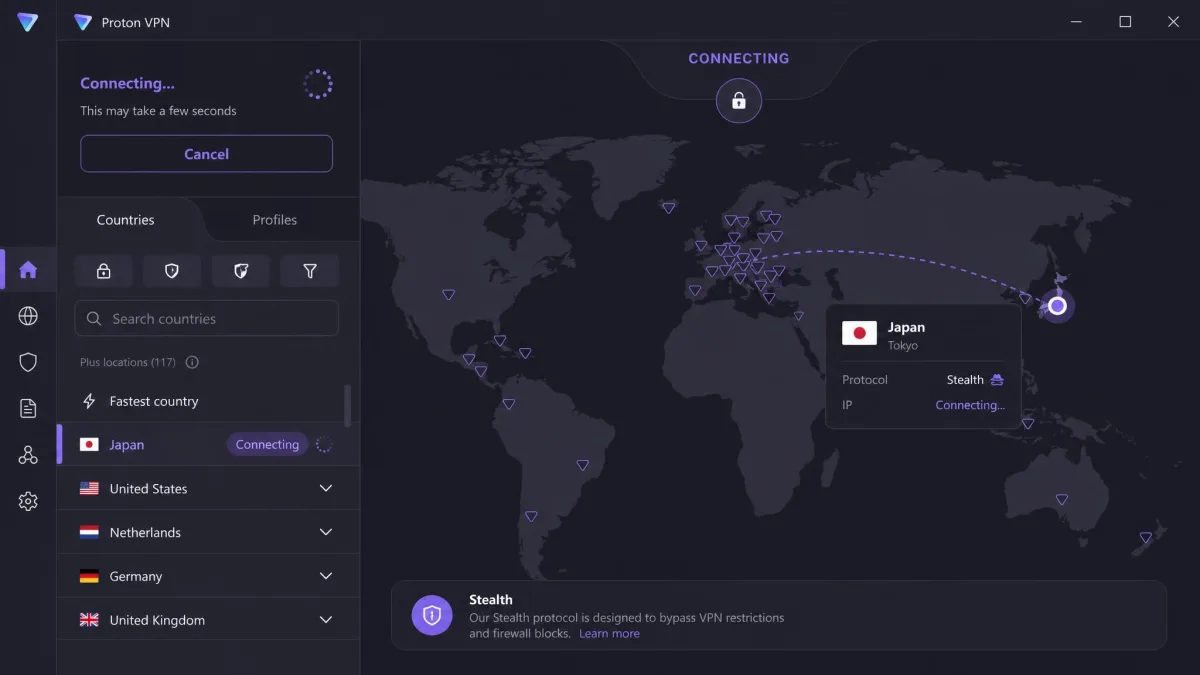
Proton lists Stealth on every plan, including the Free plan, and Free comes with unlimited data and no ads. So the gap between Free and Plus in China isn't obfuscation. It's control. Free connects you to a random server in one of 10 countries, which include Japan and Singapore but not Hong Kong. Plus lets you pick a nearby region and switch when one is blocked.
The free plan fails to connect in China far more often than Plus, which occasionally gets through with Stealth on. Neither version gets through the Great Firewall consistently.
| Plan | Stealth | Server choice from China | Speed | Devices | Price |
|---|---|---|---|---|---|
 |
Yes, per Proton | Random, from 10 countries (no Hong Kong) | Medium, per Proton | 1 device | Free |
|
Yes | Your pick of 140+ countries, including Hong Kong, Japan and Singapore | Highest, up to 10 Gbps | 10 devices | $9.99monthly, or $2.99 per month on the 2-year intro plan |
Why China blocks Proton VPN
Those on-and-off connections come down to how China treats VPNs in general. It blocks Proton VPN for the same reason it blocks most VPNs: they carry traffic the censors cannot read. Back in April 2020, Proton said on X that ProtonMail and ProtonVPN were both banned in China, and nothing since has reversed that.
How the Great Firewall detects VPN traffic
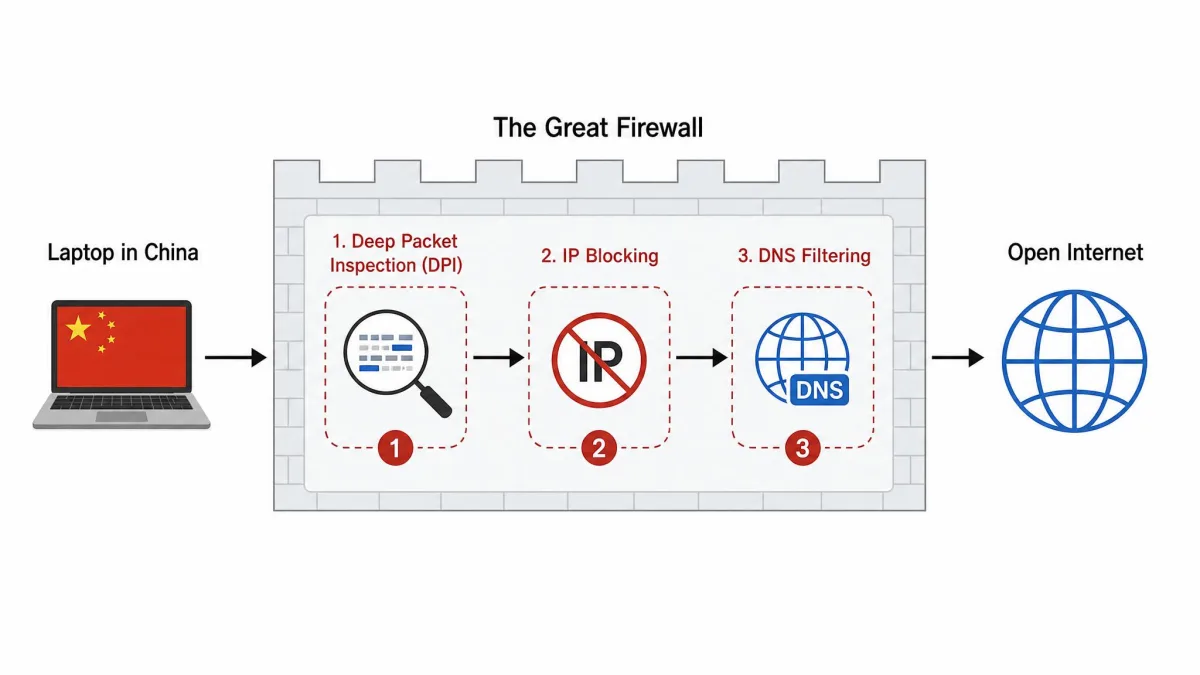
The Great Firewall detects VPN traffic through several methods. Three of them do most of the damage to VPN connections:
- Deep packet inspection (DPI): the firewall examines the shape and pattern of each data packet, not just where it's going, and spots the fingerprints of standard VPN protocols.
- IP blocking: known VPN server addresses go on a blocklist, so the connection never starts.
- DNS filtering: requests for blocked domains get false answers, which is why protonvpn.com won't load on major mainland ISPs.
The firewall can also send forged TCP reset packets that end a connection mid-stream. That is why a VPN can look connected for a few seconds and then drop.
Does Proton VPN have servers in China?
Not in any way that helps you inside China. Proton does offer "China" locations, but they exist to give people abroad a Chinese IP address, and they are Plus-only. From inside the country you need the opposite: a server outside the firewall. That's why Proton points China users to international servers instead.
How Stealth and alternative routing help Proton VPN in China
Those detection methods are exactly what Stealth and alternative routing are built to get around, and Proton VPN in China depends on both. Stealth hides what your traffic is, and alternative routing helps the app find Proton at all. Neither is a guarantee, but without them a standard connection has little chance.
Stealth protocol
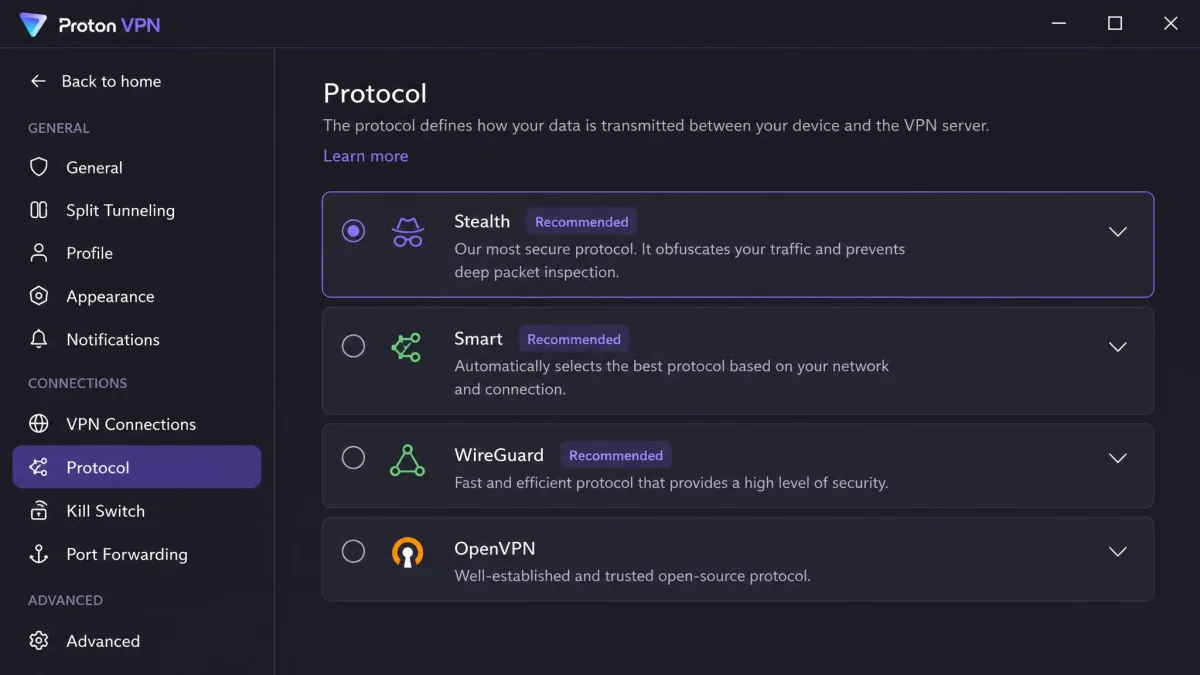
Stealth disguises VPN traffic as regular HTTPS, so it looks like a normal connection to an ordinary website. Under the hood, Proton's Stealth protocol wraps your VPN traffic in an obfuscated TLS tunnel over TCP, which makes it much harder for deep packet inspection to flag. Proton launched Stealth in 2022, and it now runs on Windows, macOS, Android, iOS and iPadOS, Android TV and Linux. On Linux it arrived in GUI app version 4.18.0, and you must switch on the Proton Protocols beta before it appears.
Stealth isn't unique to Proton, and we've written about how other VPNs handle stealth obfuscation if you want a comparison. Proton's Stealth works well against censorship in Russia, Iran and Egypt, but China's firewall is a harder target.
Alternative routing
Alternative routing solves a different problem. If the app can't reach Proton's servers directly, it sends the request through third-party infrastructure that is unlikely to be blocked, such as Amazon Web Services, Cloudflare or Google. It's on by default and only kicks in when Proton detects censorship.
It helps the app reach Proton's API for sign-in and the server list, but it doesn't disguise the VPN tunnel itself. That's Stealth's job. Your data stays encrypted, but those third parties could see your IP address and that you are connecting to Proton. Proton also says plainly that it will not always succeed.
Which Proton VPN servers to use from China
Proton says servers in nearby regions such as Japan, Hong Kong and Singapore are likely to give the best speeds from China. If those are blocked, you may need to try more distant servers. When they do connect, Hong Kong and Japan servers are the fastest from China, but they are also the least predictable. On Plus, keep two or three of these handy so you can switch quickly.
How to set up Proton VPN for China before you travel
Both features only help if they are switched on before you land, so getting Proton VPN for China ready means doing everything at home. Proton tells travellers to create an account, install the app, and sign in to check the connection works before leaving. It takes several manual changes beyond the default one-tap connect.
Install and configure before you land. Proton's website is blocked on major mainland ISPs and VPN apps are missing from app stores inside China, so you can't set Proton up once you're there.
Work through this checklist a few days before you fly:
- Create your Proton account, and buy Plus now if you want server choice.
- Install the app on each device you'll carry.
- Open Settings, go to Protocol, and choose Stealth. On Windows it's under Connections, on macOS it's in the Connection tab, and on iOS it sits under Security Options.
- Check that alternative routing is still switched on.
- Connect once to Japan, Hong Kong or Singapore and confirm that pages load.
- Install a backup VPN or Tor Browser as well.
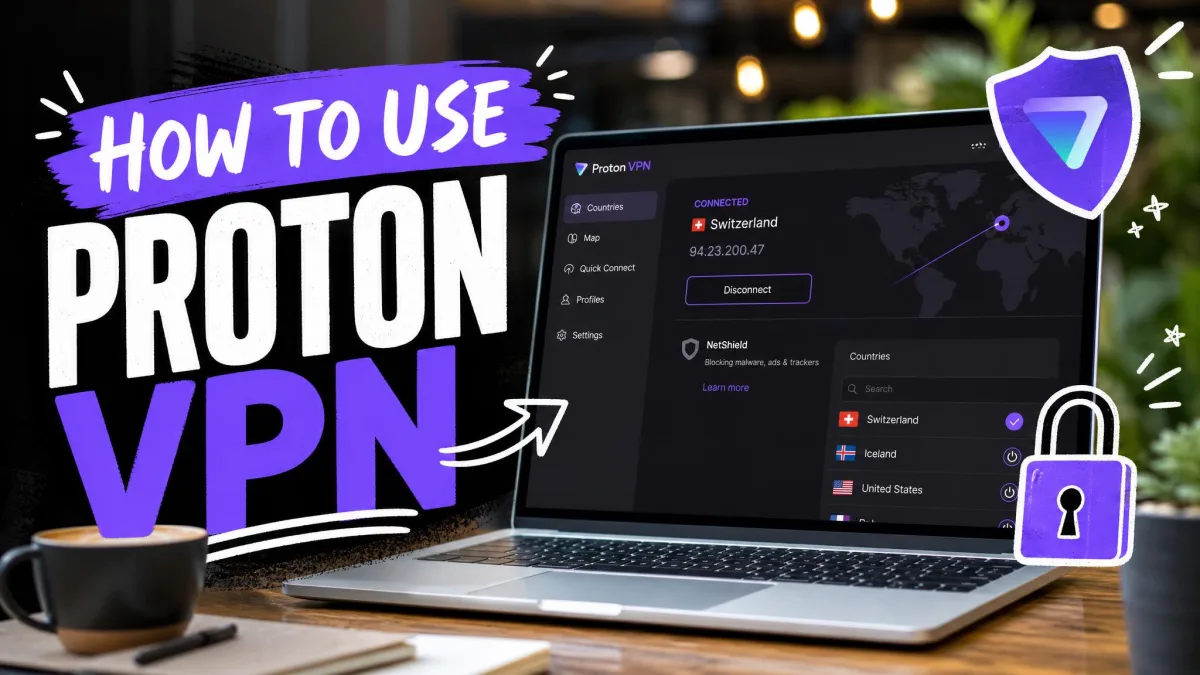
If you're new to the app, our guide on how to set up Proton VPN covers the install and first connection step by step.
Proton VPN not working in China? Troubleshooting steps
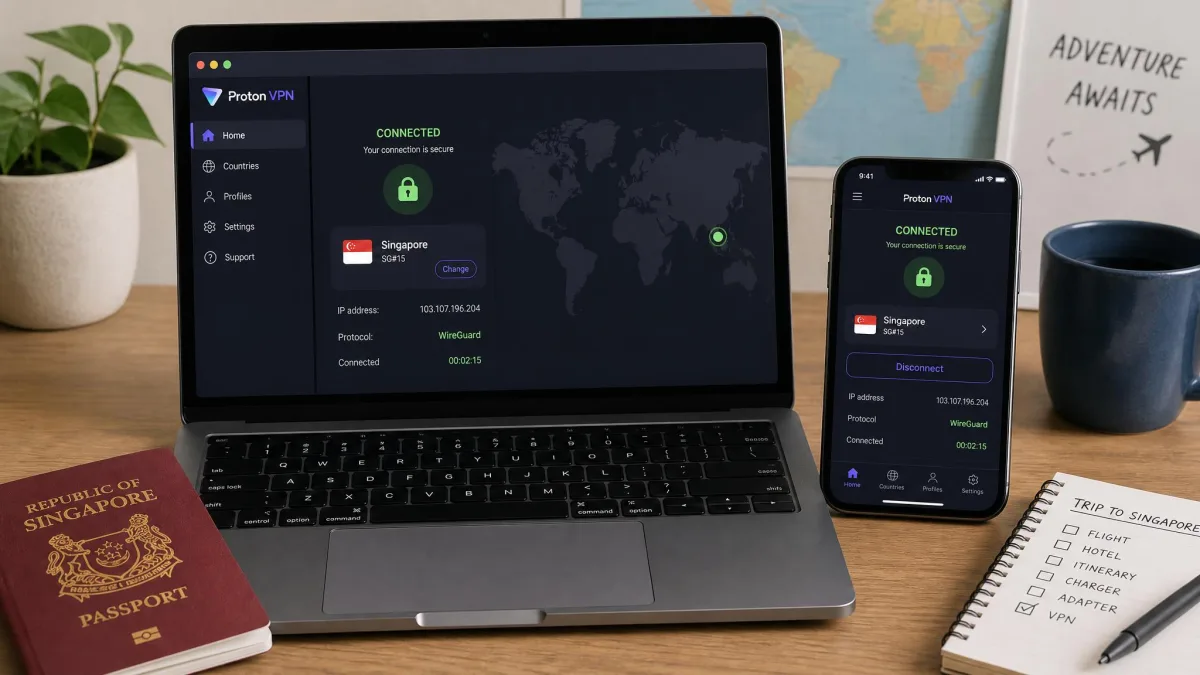
When Proton VPN stops connecting in China, the fix is usually persistence rather than one magic setting. Proton's own advice is to switch between the Stealth and Smart protocols, restart the app, and try again. Work through it in this order:
- Switch protocols. Move from Stealth to Smart, or cycle through Stealth, WireGuard and OpenVPN TCP on port 443. No single protocol reliably wins.
- Change servers. Try another nearby region, then a more distant one.
- Restart the app fully and retry the connection.
- Share anonymous usage statistics with Proton, which it says helps the team improve connectivity.
If none of that works, the firewall may simply be blocking Proton that day. For problems that aren't specific to China, such as login loops or an app that won't open, our general Proton VPN connection fixes cover the basics.
If Proton VPN fails in China: Tor and other options
If Proton won't connect after a day of retries, move on to your backup rather than spending your trip on it. Proton's Great Firewall explainer names Tor with bridges and pluggable transports such as obfs4, along with Shadowsocks, as showing some effectiveness. It also admits there are no reliable ways to consistently bypass the firewall.
Older ProtonVPN China guides sometimes say Proton's support page recommends Tor. Proton has since rewritten that page, and the Tor advice now lives in its blog post instead. Tor with bridges is slow, so it suits messaging and email better than video.
If you want a primary tool built for this job, compare the VPNs that work more reliably in China before you book, and install your pick alongside Proton.
Is it legal to use a VPN in China?
Whichever tool you end up connecting with, the legal question is the same, and using a VPN in China sits in a legal grey area. Only state-approved VPNs are authorized. In January 2017, China's Ministry of Industry and Information Technology launched a 14-month campaign under which nobody may set up or lease cross-border lines, including VPNs, without telecom-authority approval. Officials later said the rules target unlicensed VPN providers.
Proton's explainer notes there are no laws specifically against using a VPN in China, though unauthorized use has led to isolated fines. Enforcement has mostly focused on providers and Chinese residents. The best-known case came in August 2023, when police in Chengde confiscated 1.058 million yuan a programmer had earned working for a foreign company over a VPN, plus a 200 yuan fine.
There are no widely documented fines against foreign tourists for personal VPN use. China doesn't publish enforcement data, though, so that reflects what has been reported rather than a formal exemption. If privacy is part of your decision, see our look at whether Proton VPN is safe.
Bottom line: should you rely on Proton VPN in China?
Proton VPN in China is a sensible second line, not a first one. If you already pay for Proton, set it up with Stealth before you fly. If you're choosing a VPN specifically for a China trip, pick one built around that job and keep Proton for everything else it does well. Plus carries a 30-day money-back guarantee, so buying a few days before departure leaves room to test it at home first.