Most of Venezuela's internet traffic runs through CANTV, the state-owned telecom company and the country's largest internet provider. When the authorities want a news site, a social app or a VPN provider's website out of reach, CANTV and the other ISPs block it by DNS, by IP address or at the HTTP level. Freedom House's Freedom on the Net 2025 report rates Venezuela's internet as Not Free, with a score of 26/100. Our top pick is NordVPN, because its obfuscated servers get past CANTV's blocks and its no-logs policy has passed a sixth independent audit.
We compared six VPNs on what matters on a Venezuelan connection: obfuscation that survives CANTV's filtering, a Venezuelan IP, steady speeds and audited privacy. If you're in the country now, install your VPN before you need it. Most provider websites are already blocked, but an app installed on your phone beforehand keeps working.
Quick picks: the best VPNs for Venezuela at a glance
- NordVPN: best overall, with obfuscated NordWhisper servers.
- Surfshark: best value, with an automatic anti-censorship mode.
- IPVanish: best for unlimited devices, but it has no stealth servers.
- Private Internet Access: best for a Venezuelan IP.
- CyberGhost: easiest to use, with no obfuscation.
- ExpressVPN: always-on obfuscation, pricier than most of this list.
The best VPNs for Venezuela, ranked
We ranked these six first on how well they handle Venezuela's blocks, then on speed, privacy and price. A VPN that can't connect on CANTV is no use, however cheap it is.
1. NordVPN: Best overall for Venezuela
NordVPN earned the top spot with its Obfuscated Servers, which now run on the NordWhisper protocol. These servers got past CANTV's filtering and loaded independent outlets such as Efecto Cocuyo and Crónica Uno, both blocked at the time. One quirk tripped us up early. The obfuscated servers only appear when the protocol is set to Auto or NordWhisper, so on NordLynx they seem to be missing. When the app sat on "Connecting" on a restricted network, switching to OpenVPN (TCP) or a manual IKEv2 profile got us through.
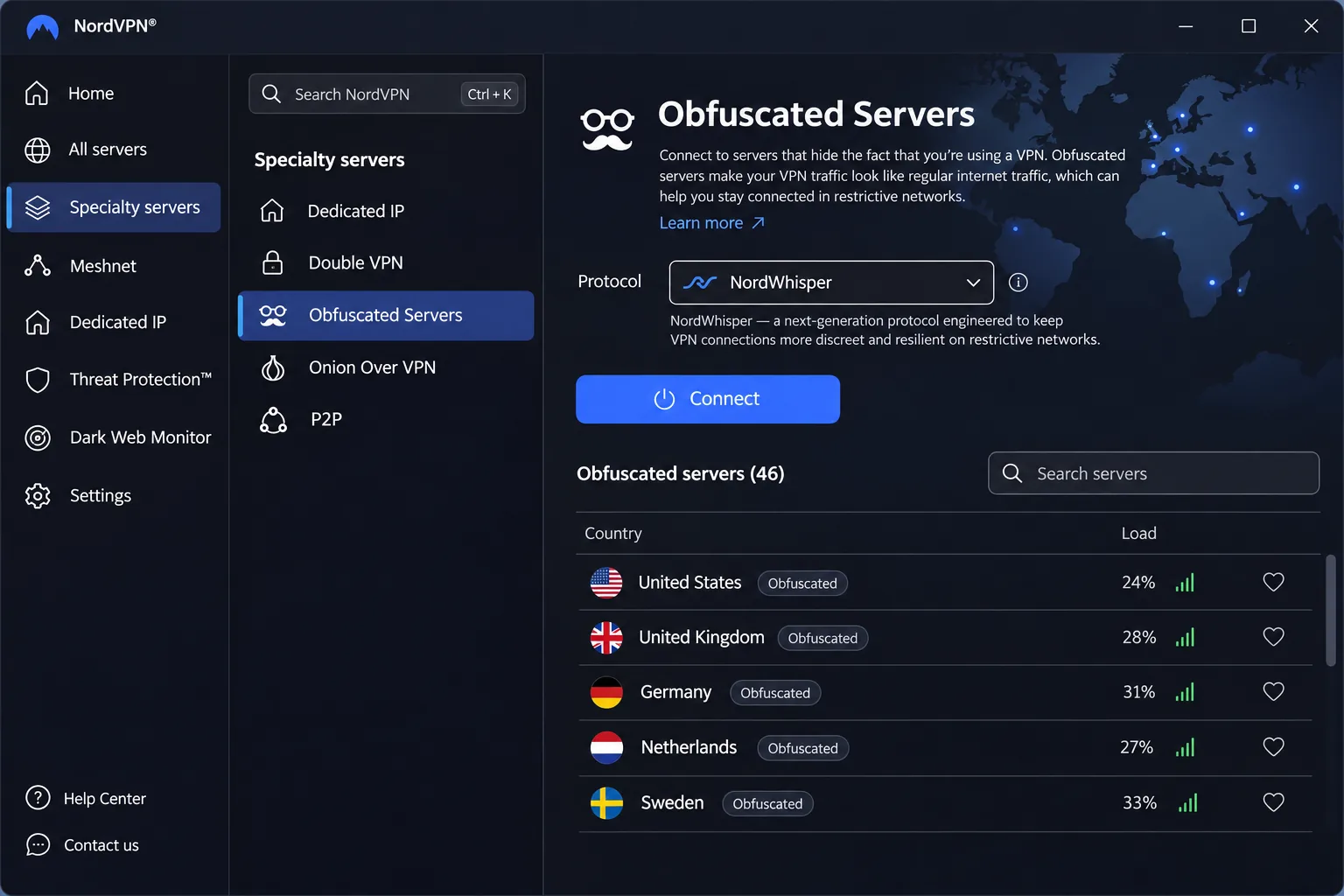
Speeds stayed close to the unprotected connection on NordLynx, NordVPN's WireGuard-based protocol. Double VPN cuts speed by about 80% on average, so save it for when you really need it. The obfuscated servers came in slower than ExpressVPN's always-on obfuscation but quicker than Surfshark's Camouflage Mode.
Deloitte completed NordVPN's sixth independent no-logs assessment in December 2025, and that assessment also covered the obfuscated servers. One plan covers 10 simultaneous connections, with a 30-day money-back guarantee. Basic costs about $3.49 a month on the two-year offer, though rotating promotions move that between about $2.91 and $3.49.
Pros
- Obfuscated NordWhisper servers that get past CANTV's blocks
- Caracas virtual location for local apps from abroad
- NordLynx speeds close to an unprotected line
Cons
- The interface can feel complex at first
- Renews at $139.08 a year after the first term
- Obfuscated servers hide on other protocols
2. Surfshark: Best value, with Venezuelan servers
Where NordVPN makes you choose obfuscated servers yourself, Surfshark tries to do it for you. Its NoBorders mode switched itself on when the app detected a restricted network, then offered a shortlist of servers that work under the restriction. The trade-off came when we wanted extra cover from Camouflage Mode, Surfshark's obfuscation. It only works over OpenVPN, so we had to move off WireGuard and accept slower speeds.
Surfshark also took longer to connect than its rivals. On a 100 Mbps line it held 81.32 Mbps down and 76.12 Mbps up, a little behind ExpressVPN. Its kill switch cut access the instant the tunnel dropped, but it isn't on by default. It installed without trouble on Fire TV sticks, smart TVs and consoles.
Surfshark runs 4,500+ servers in 100 countries, including a Caracas location. Deloitte's 2025 no-logs audit confirmed that connection IPs are deleted within 15 minutes of a session ending. Starter costs $2.49 a month for the first 27 months, which is top value for money, but Surfshark doesn't show its higher renewal rate. Our full Surfshark review covers extras such as CleanWeb.
Pros
- NoBorders turns on automatically on restricted networks
- Unlimited simultaneous connections for a whole household
- 30-day money-back guarantee
Cons
- Camouflage Mode needs OpenVPN, so you lose WireGuard speed
- Slower to connect than most rivals
- Kill switch is off by default
3. IPVanish: Best for unlimited devices
IPVanish shares Surfshark's unlimited-device policy but not its anti-censorship toolkit. It has no obfuscated or stealth servers and no stealth protocol. Its only obfuscation is a Scramble toggle in the OpenVPN settings. That toggle is less dependable than rivals' tools when an ISP actively blocks VPN traffic. If CANTV starts blocking VPN connections rather than just VPN websites, IPVanish is not the one to rely on.
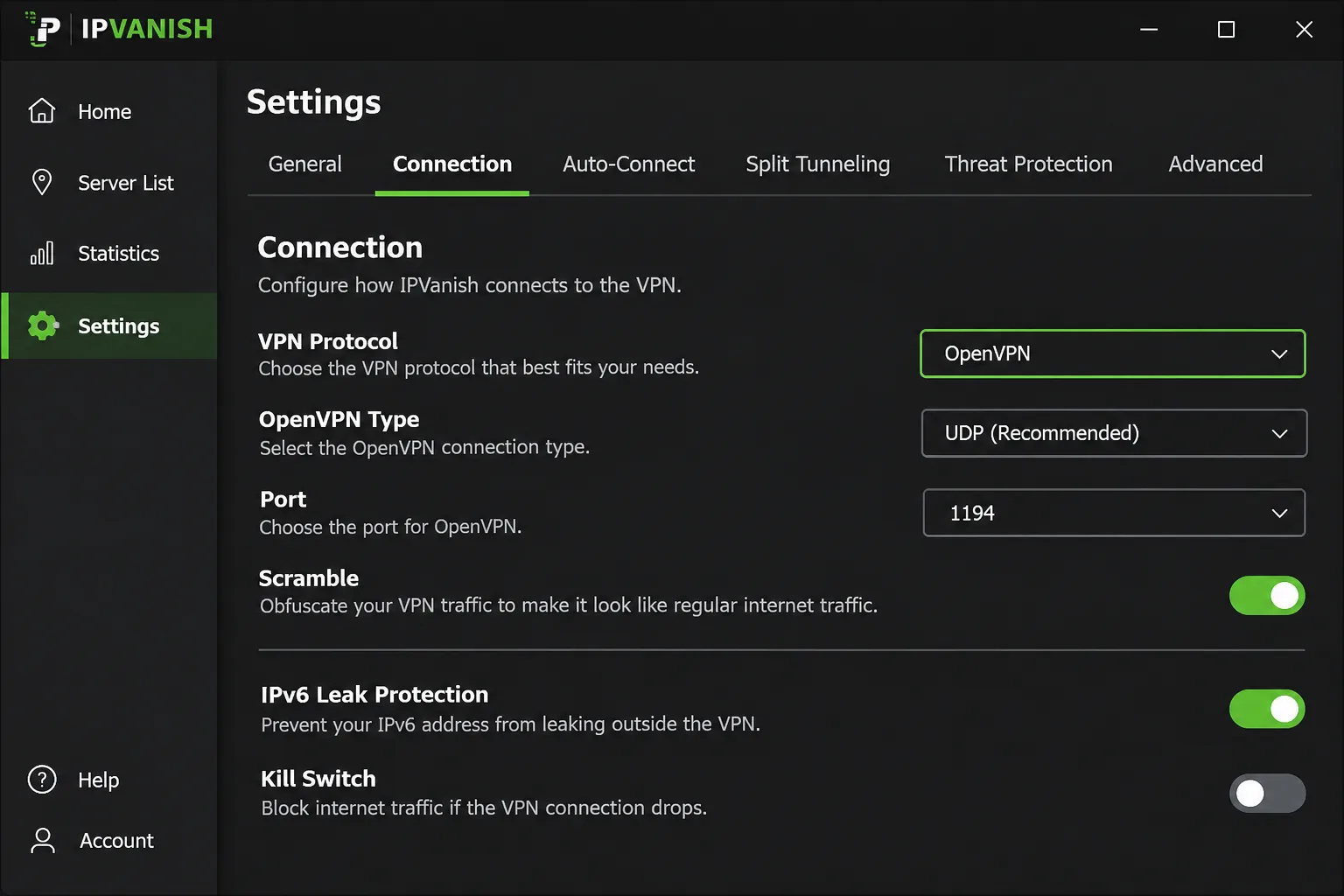
On a less restrictive network, it's quick and generous. When we ran six devices on one account at once, there was no cap and no noticeable slowdown. Downloads stayed near the 94.6 Mbps baseline even on distant servers, at 93.1 Mbps in the US and 90.78 Mbps in Australia. Turning on Scramble means giving up WireGuard, and on Windows it can't run alongside High-Speed Mode.
Schellman ran IPVanish's latest no-logs audit. IPVanish's server list now includes Caracas, though the company doesn't say whether that server is physical or virtual. Essential costs $2.19 a month for two years, but IPVanish restructured its plans in late 2026, so expect prices to shift. The 30-day refund only covers one- and two-year plans. Our IPVanish review has the full feature set.
Pros
- Unlimited connections with no slowdown
- Download speeds near baseline on distant servers
- Caracas server now listed
Cons
- No stealth servers or protocol, only an OpenVPN Scramble toggle
- Kill switch off by default on Windows and missing on iOS
- No refund on monthly plans

4. Private Internet Access: Best for servers in Venezuela
If IPVanish is the device-count pick, PIA is the one we'd choose for a Venezuelan IP. Its Caracas virtual location is hosted in New York and gives you a Venezuelan address. The apps show a ping rating next to each server, which made picking a fast nearby location easy. During extended use the connection dropped a few times, and the kill switch caught every drop.
PIA's obfuscation uses Shadowsocks, which needs OpenVPN and runs on servers in six countries. Switching obfuscation on costs about 25% of your speed, which is a big chunk. Without it, downloads were only about 4.84% slower on average, but uploads dropped hard: a video upload took about 35 minutes over PIA against about 11 minutes without a VPN. On slow Venezuelan lines, you can drop encryption from AES-256 to AES-128 for a small gain.
Streaming worked only through PIA's dedicated streaming servers, and live chat sometimes failed to load for us. Deloitte completed its latest no-logs assessment in December 2025. The long plan costs about $2.03 a month, though Black Friday pricing moves it toward $2.19. Our PIA review goes deeper on port forwarding.
Pros
- Caracas virtual location with a Venezuelan IP
- Unlimited connections
- 30-day money-back guarantee on direct purchases
Cons
- Shadowsocks obfuscation cuts speed by about 25%
- Upload speeds drop hard
- Streaming only works on dedicated servers
5. CyberGhost: Easiest to use, with local servers
Where PIA rewards a little setup, CyberGhost asks for none. It's also the pick with the clearest weakness. It connected in under ten seconds on first launch with no configuration. It has no obfuscation, though, so when an ISP blocks VPN traffic itself, CyberGhost is the most likely to fail.
Where it works, it's dependable. Its kill switch held in all 10 of our manual disruption tests, and DNS and IP leak checks came back clean on all five locations we tried. Speeds were good nearby, at 76.4 Mbps on a US East server against a 94.0 Mbps baseline. Long routes cost more than half the speed, with Australia falling to 41.2 Mbps.
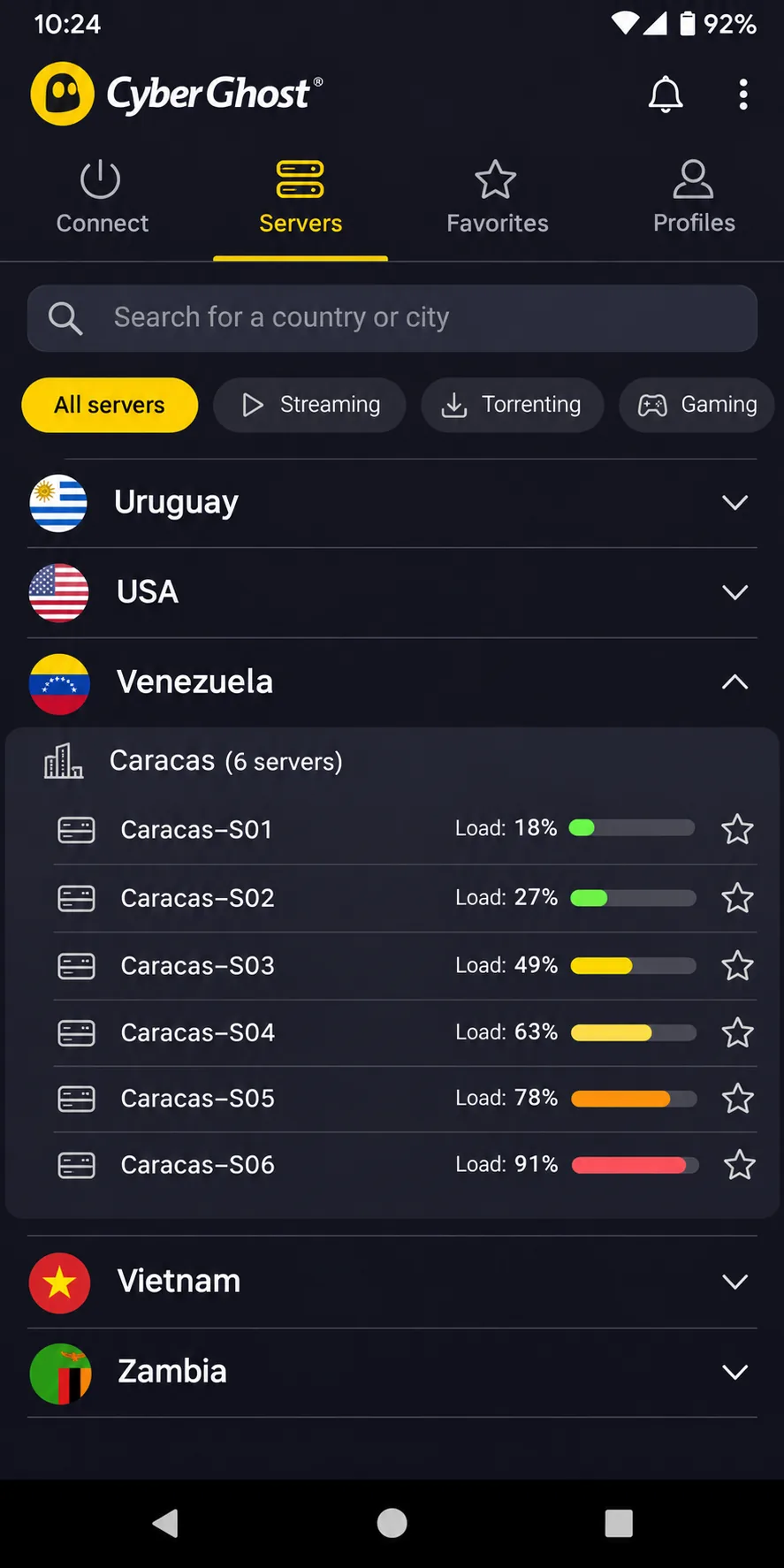
CyberGhost has 14 servers in Caracas and covers 100 countries overall. Its Wi-Fi protection switches the VPN on when you join an untrusted hotspot. Up to 7 devices can connect at once, and Deloitte audited the no-logs policy in 2025. The long plan costs $2.19 a month for 28 months, then renews at $61.32 a year. See our CyberGhost review for its full scores.
Pros
- Connects in seconds with no setup
- 14 servers in Caracas
- 45-day money-back guarantee (14 days on monthly)
Cons
- No obfuscation at all
- Loses more than half its speed on long routes
- Renewal more than doubles the intro price
6. ExpressVPN: Reliable obfuscation, at a premium
ExpressVPN takes the opposite approach to CyberGhost: obfuscation is always on, across every server. We left the protocol on Automatic and it disguised VPN traffic on its own, with nothing to configure. It also lost very little speed with obfuscation active, where most rivals slow down noticeably. On a 100 Mbps line it held 89.42 Mbps down and 84.64 Mbps up, ahead of Surfshark on the same line.
During throttling and partial outages, ExpressVPN stayed the most stable of these six. Its Venezuela location is hosted virtually in Brazil, and the network covers 113 countries. Basic covers 10 devices, and Express Pro raises that to 14. KPMG assessed its privacy policy most recently in June 2025.
So why is it last? Basic costs $2.99 a month for the first 28 months, more than Surfshark, IPVanish, PIA or CyberGhost, and renews at $99.95 a year, above IPVanish's $89.99 and CyberGhost's $61.32. NordVPN costs more still, but its obfuscated servers and Caracas location earn it the top spot. ExpressVPN's Advanced and Pro tiers, by contrast, climb fast, and their promo prices changed within a single week. Email support can also take almost two days to answer. Our ExpressVPN review covers its Lightway protocol.
Pros
- Automatic obfuscation, nothing to set up
- Very little speed loss with obfuscation on
- Most stable connection during throttling
Cons
- Pricier than most of this list once Advanced or Pro is added
- Email support can take almost two days
- Higher tiers change price often
Venezuela VPN comparison table
Every price below is an introductory rate on the longest plan. Prices move with seasonal promotions and renew higher, so confirm the rate at checkout before you pay.
| Product | Buy | Servers in Venezuela | Server countries | Obfuscation / stealth | Simultaneous connections | Audited no-logs policy | Streaming | Starting price | Money-back guarantee |
|---|---|---|---|---|---|---|---|---|---|
|
Check price → | Yes, virtual (Caracas) | 130+ (totals vary) | Obfuscated Servers (NordWhisper) | 10 | Yes, Deloitte (Dec 2025) | Venezuelan TV via virtual location | $3.49/mo (27 mo) | 30-day |
|
Check price | Yes, Caracas (host not stated) | 100 | NoBorders (auto) + Camouflage Mode (OpenVPN) | Unlimited | Yes, Deloitte (2025) | Venezuelan channels from abroad | $2.49/mo (27 mo) | 30-day |
|
Check price | Caracas listed (type not stated) | 150+ locations | No stealth servers; Scramble toggle (OpenVPN only) | Unlimited | Yes, Schellman | Less consistent than rivals | $2.19/mo (24 mo) | 30-day (1- and 2-year plans) |
|
Check price | Yes, virtual (hosted in New York) | 91 to 113 (varies by source) | Shadowsocks (OpenVPN, 6 countries) | Unlimited | Yes, Deloitte (Dec 2025) | Streaming servers only | about $2.03/mo (28 mo) | 30-day |
|
Check price | Yes, 14 servers in Caracas | 100 | None | 7 | Yes, Deloitte (2025) | Streaming-optimized servers | $2.19/mo (28 mo) | 45-day (14-day on monthly) |
|
Check price | Yes, virtual (hosted in Brazil) | 113 | Automatic on every server | 10 (Basic), up to 14 (Pro) | Yes, KPMG (2025) | Venezuelan channels from abroad | $2.99/mo (28 mo) | 30-day |
Why you need a VPN in Venezuela
The table shows what each VPN offers. Here's why those features matter: a VPN encrypts your traffic and routes it through a server outside your ISP's control, and in Venezuela that one step solves several separate problems.
Censorship and blocked sites (CANTV DNS blocks)
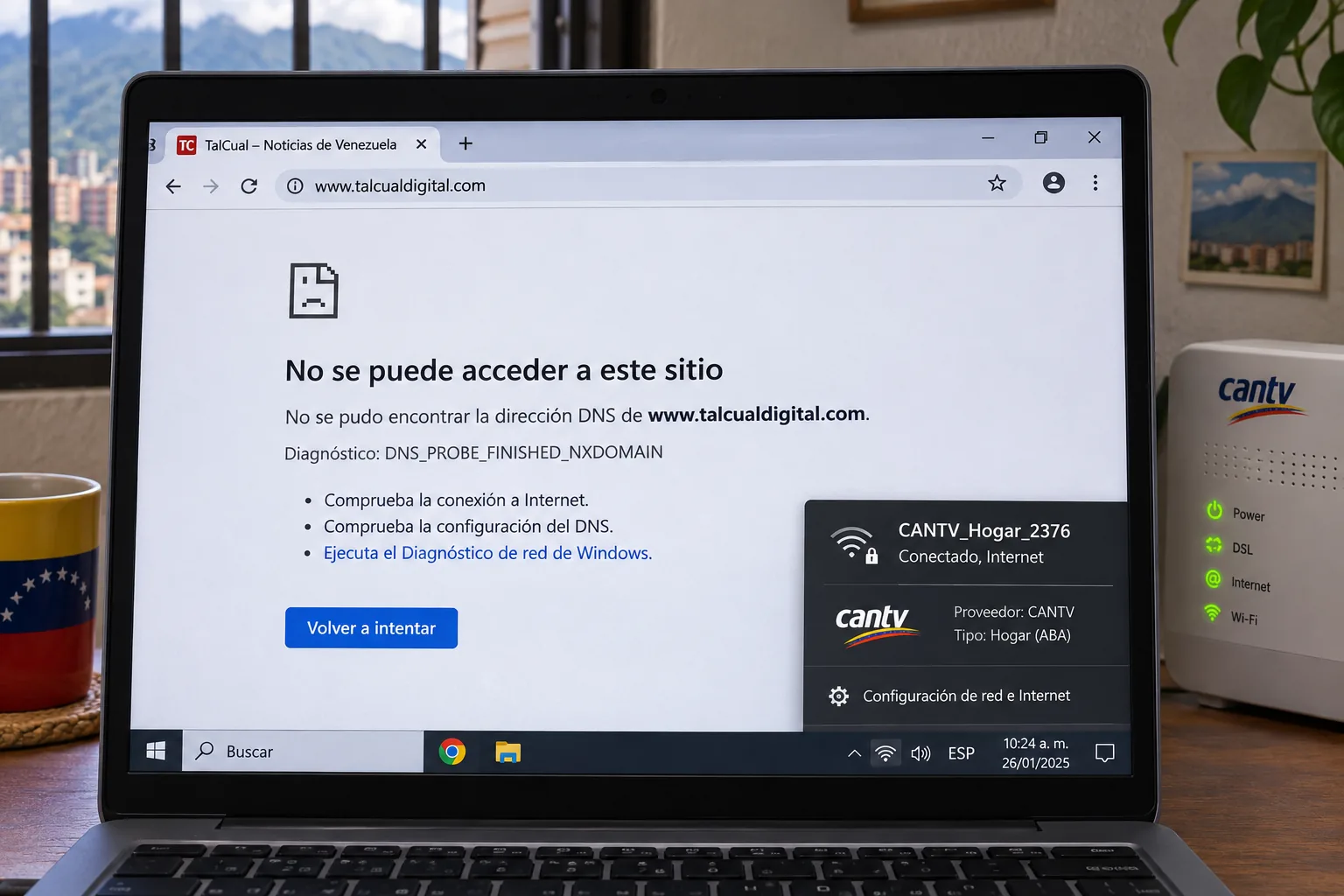
Blocking orders usually trace back to Venezuela's telecom regulator CONATEL, and CANTV applies them by IP, HTTP and DNS. Freedom House counts more than 200 domains blocked between July 2024 and January 2025, including opposition vote-tally sites. Circumvention tools get hit too. Venezuela's largest ISP blocked Tor back in 2018, and in January 2025 CANTV and G-Network restricted the Tor network again.
Changing your DNS no longer works as a workaround. In January 2025, CANTV blocked 33 public DNS servers, including Google's 8.8.8.8 and Cloudflare's 1.1.1.1. Switching to a public resolver didn't reliably get us around CANTV's blocks, because filtering also happens at the IP and HTTP level. Blocking also differs by ISP, so a site that fails on CANTV or Movistar can load on Digitel. Venezuela's situation is a milder version of what we cover in our VPN guide for Cuba.
Surveillance and data collection
Monitoring has grown alongside censorship. Freedom House reports that VenApp, a state app for public-service complaints, was extended so people could report protests and dissent. Authorities have also arrested perceived dissidents and publicized those arrests on social media. One opposition activist received 15 years in prison over critical social media comments.
Your ISP is the main point of collection, and a VPN hides the sites you visit from it. An audited no-logs policy means the VPN provider has nothing to hand over either, and all six of our picks have one.
Throttling and unstable connections
Throttling spikes around protests, speeches and other politically sensitive moments. That's when Instagram, X and YouTube slow to a crawl and uploads stall. Freedom House also describes localized disruptions that lined up with opposition leader María Corina Machado's speeches. Because a VPN hides which apps you're using, it can help when ISPs slow down specific services.
Public Wi-Fi, banking, and payments
Cafés, airports and hotel hotspots are open networks, and anyone sharing one can try to snoop on your traffic. A VPN wraps everything in AES-256 encryption, often called military-grade. For Venezuelans abroad, a Venezuelan IP keeps local banking apps working. NordVPN's Caracas location did that for us over the encrypted tunnel.
Which VPNs have servers in Venezuela?
All six of our picks offer a Venezuelan IP, mostly through virtual locations. A virtual server gives you a Venezuelan address while the hardware sits in another country, outside CANTV's network.
PIA hosts its Caracas location in New York, and ExpressVPN hosts its Venezuela location in Brazil. NordVPN and Surfshark don't publish where their Caracas hardware sits, and CyberGhost doesn't say whether its 14 Caracas servers are physical or virtual. IPVanish now lists Caracas too, so older reviews that say it has no Venezuelan server predate its 2024 expansion.
You don't need a Venezuelan server while you're inside the country. Nearby servers in Brazil, Colombia or Costa Rica gave us lower latency and steadier connections than distant European ones.
How we tested and picked these VPNs
We scored each VPN on six things, weighted toward getting online in the first place:
- Obfuscation: whether it disguises VPN traffic, and how well that holds up against active VPN blocking.
- Venezuelan IP: whether it offers a Caracas location, and where that server is really hosted.
- Speed and stability: speeds on nearby servers, and how often connections drop.
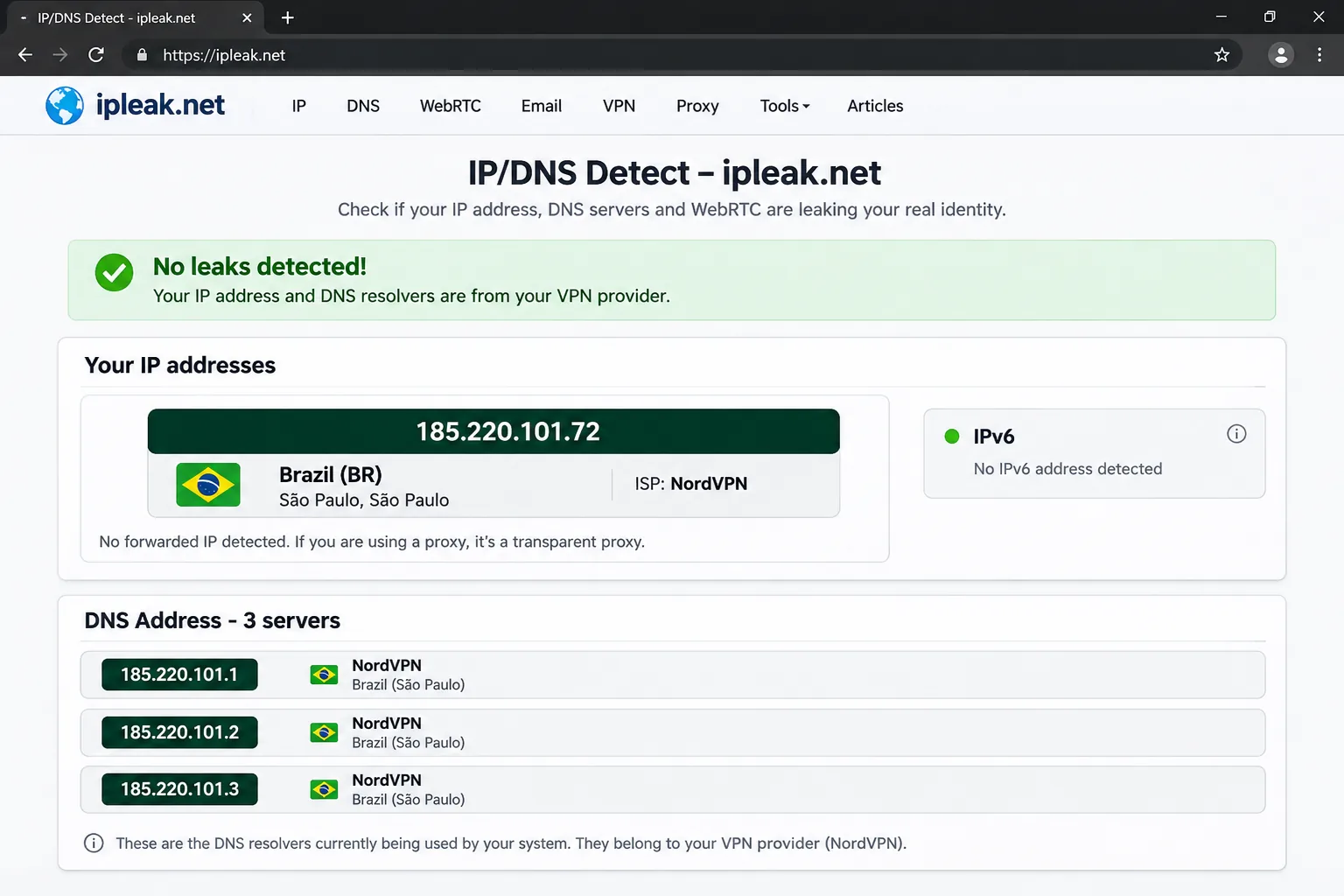
- Leak protection: a working kill switch and clean DNS and IP results. With the VPN on, ipleak.net should show no ISP address.
- Privacy: an independently audited no-logs policy.
- Value: intro and renewal prices, device limits and the refund window.
CyberGhost sits at #5, because obfuscation carried the most weight. Value and device count moved IPVanish up and ExpressVPN down.
How to use a VPN in Venezuela (and get a Venezuelan IP)
The order of these steps matters. If you're new to this, our step-by-step guide to using a VPN covers the basics.
- Install before you need it. Download the app, sign in and test it on every device while you can still reach the provider's site.
- Turn on obfuscation. Choose NordVPN's Obfuscated Servers, Surfshark's NoBorders or Camouflage Mode, IPVanish's Scramble or PIA's Shadowsocks. ExpressVPN does it automatically.
- Switch on the kill switch. It's off by default on Surfshark and on IPVanish for Windows.
- Pick a server. Inside Venezuela, use a nearby country such as Brazil or Colombia. Abroad, connect to Caracas for a Venezuelan IP.
- Check for leaks at ipleak.net with the VPN on.
Before you travel, test obfuscation and the kill switch on mobile data as well as home Wi-Fi, so you know your settings hold on a second network.
Can you use a free VPN in Venezuela?
You can, but most free VPNs won't get you far. They tend to be slow and overcrowded, so they do little against throttling, and most of them lack obfuscation.
Proton VPN's free plan is the exception worth knowing. It works in Venezuela, includes Proton's Stealth obfuscation protocol and has no data cap. The catch is that it picks the server for you and covers only one device. Proton's website is blocked in Venezuela too, so install the app ahead of time. For more options, see our tested free VPN picks.
What to do if your VPN stops working in Venezuela
Most VPN trouble in Venezuela comes from a blocked protocol, not a dead server. Work through these fixes in order:
- Switch protocols. On NordVPN, set the protocol to NordWhisper or Auto so the Obfuscated Servers appear. If that fails, try OpenVPN (TCP), which resists blocks better than UDP, or a manual IKEv2 connection.
- Turn on obfuscation manually. In Surfshark, open Settings, then VPN settings, then Advanced settings, and switch on NoBorders.
- Reset your network settings and reconnect.
- Try another connection. Mobile data on a different carrier can work when your home line doesn't.
If none of that works, our guides on how to bypass a VPN blocker and how to make your VPN undetectable cover more advanced options.
Frequently asked questions
Are VPNs legal in Venezuela?
Does Venezuela block VPNs?
Which websites are blocked in Venezuela?
Can I watch Venezuelan TV from abroad with a VPN?
Which VPN is best for mobile in Venezuela?
Will a VPN work during a blackout in Venezuela?
Final verdict: the best VPN for Venezuela
NordVPN is our pick for most people. It gets past CANTV's blocks and recovers well on a restricted network, and an audited no-logs record backs that up. If you'd rather not fiddle with settings, Surfshark's NoBorders mode handles obfuscation for you at a lower intro price. Venezuelans abroad who mainly want a local IP should look at PIA.
Whichever you choose, install it before the next block and test the obfuscation setting while you can still reach support. Venezuela's politics and blocking policy have changed month to month through 2026, so a VPN that's already set up is the one most likely to keep working.