IVPN is a privacy-focused VPN run by IVPN Limited in Gibraltar since 2009, known for account-ID sign-up, cash and Monero payments, open-source apps and multi-hop on every plan. People leave it because its network is small, streaming is unreliable, port forwarding is gone, and most plans stop at five devices at a price that feels high for what you get.
Our top pick is Proton VPN. It keeps the audited no-logs policy and open-source apps that drew you to IVPN, then adds servers in 140+ countries, 10 devices and a usable free plan. Below we rank seven alternatives by our review scores and explain where each one beats IVPN and where it falls short.
Why Look for an IVPN Alternative?
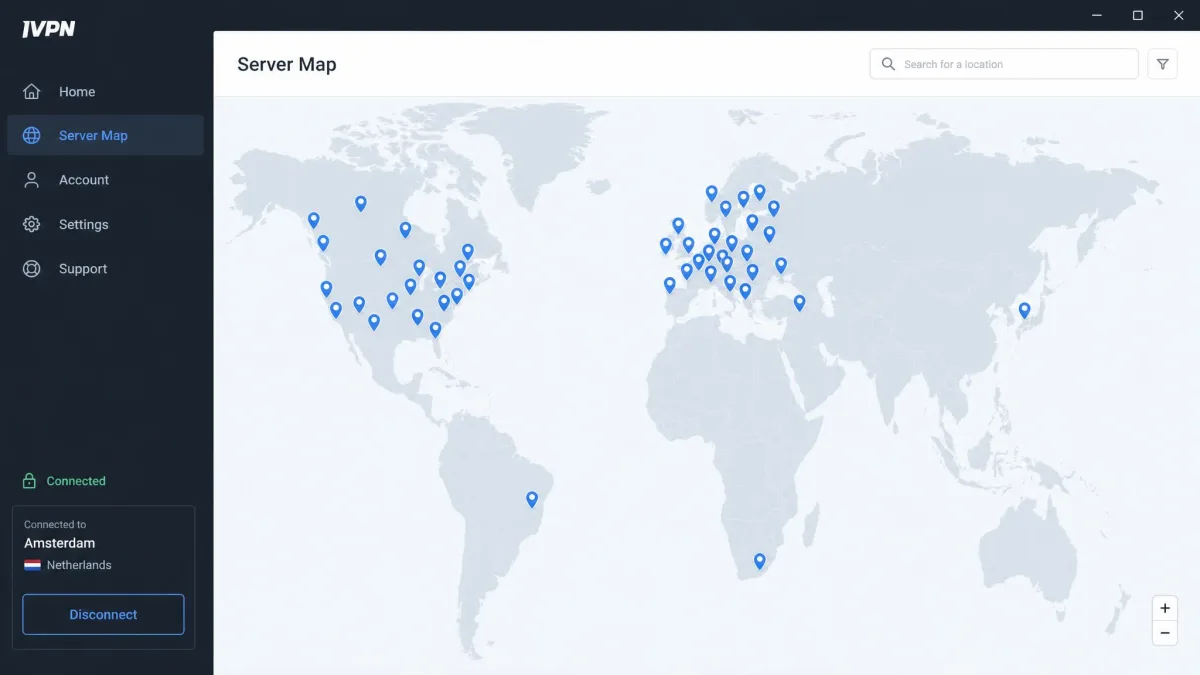
IVPN's weak spot is reach. Its network lists 89 gateways across 58 locations in 41 countries, and it thins out fast outside North America and Europe, with single locations in regions like Africa and South America. Nearby WireGuard connections lost only about 5-10% of our download speed, but a US-to-Canada connection dropped about 64%, and latency on distant servers ran too high for gaming.
Streaming is the second reason. IVPN makes no streaming guarantees, and in our runs Netflix loaded in some regions while Max and Disney+ failed. The third is flexibility: IVPN removed port forwarding completely on 30 September 2023, and P2P traffic is blocked on its US servers.
For many, price is the last straw. Since the plan changes IVPN announced on 8 May 2026, Standard costs $6 a month or $60 a year, Plus costs $8 or $80, and Pro Suite costs $10 or $100. Standard and Plus cover 5 devices, and only Pro Suite reaches 10.
IVPN Alternatives Compared
Every rating below is our own review score. Prices are the cheapest per-month rate on a long plan, and IVPN sits in the last row as the baseline.
| Provider | Buy | Price per month | Free plan | Jurisdiction | Audited no-logs | Anonymous payment | Open-source apps | Multi-hop | Devices |
|---|---|---|---|---|---|---|---|---|---|
 |
Check price → | $2.99(2 yr) | Yes (1 device) | Switzerland | Yes (Securitum, annual) | Cash, Bitcoin | Yes | Secure Core (paid) | 10 |
 |
Check price | ~$3.39-$3.49(2 yr) | No | Panama | Yes (Deloitte) | Crypto | Linux only | Double VPN | 10 |
 |
Check price | $2.49(2 yr) | No | Netherlands | Yes (Deloitte) | Crypto (web only) | No | Dynamic MultiHop | Unlimited |
 |
Check price | €5flat | No | Sweden | No (infrastructure audits only, Cure53) | Cash, Monero | Yes | Yes | 5 |
 |
Check price | $5.75($69/yr) | Yes (10GB/mo) | Canada | No (infrastructure audit only) | Crypto incl. Monero | Yes | Double Hop | Unlimited |
 |
Check price | ~$2.03(3 yr + 3 mo) | No | US | Yes (Deloitte) | Crypto via BitPay | Yes | Proxy-based only | Unlimited |
 |
Check price | €2.75(3 yr) | No | Italy | No | Crypto incl. Monero | Yes (Eddie) | No | 5 |
 |
$5($60/yr) | No | Gibraltar | Cure53 (2019) | Cash, Monero | Yes | Yes (all plans) | 5 (10 on Pro Suite) |
1. Proton VPN - Best Overall IVPN Alternative With a Free Plan
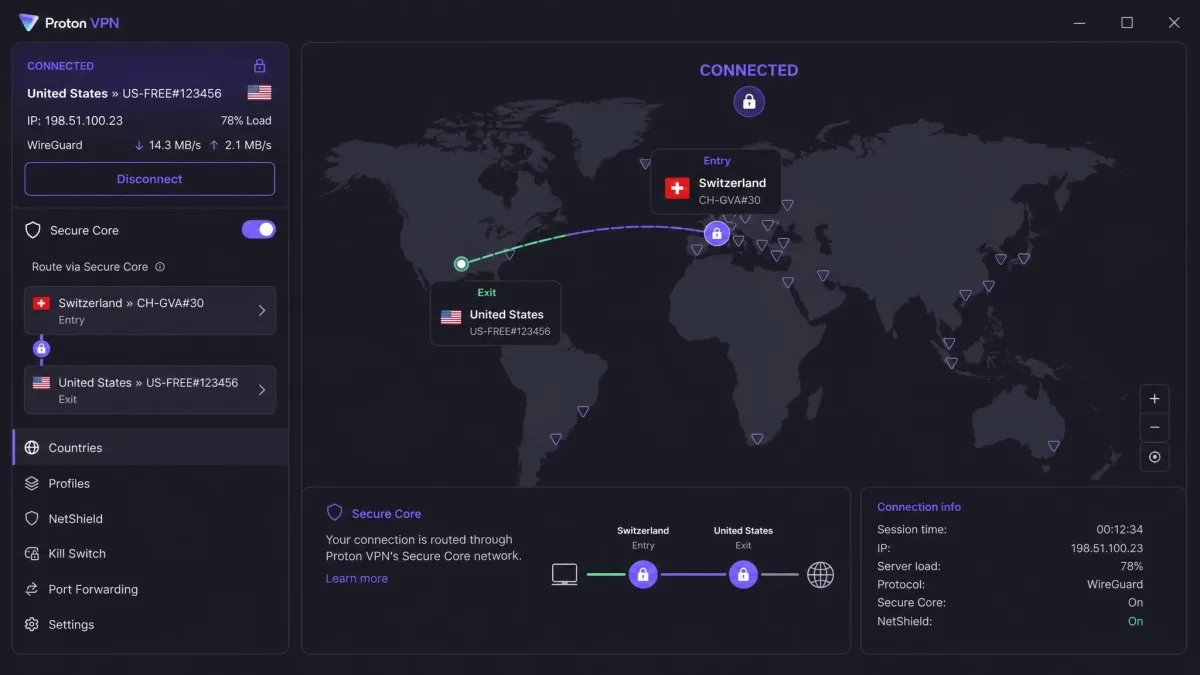
Proton VPN matches IVPN on the privacy basics and beats it nearly everywhere else. Proton AG is based in Switzerland, its apps have been open source since January 2020, and it publishes Securitum's annual no-logs audits of Proton VPN, with the fifth published in 2026. You can also pay with cash or Bitcoin.
We ran DNS, IPv6 and WebRTC leak checks across dozens of countries, and every one came back clean. Nearby servers kept about 90% or more of our baseline download speed, and distant servers averaged around three-quarters, far better than IVPN's long-haul drop. On a US server, the US Netflix library loaded without any server hopping, one of many results in our Proton VPN review.
Proton falls short of IVPN in one notable way: Secure Core, its multi-hop mode through Iceland, Switzerland or Sweden, needs a paid plan, while IVPN includes multi-hop on Standard. VPN Plus costs $9.99 monthly, $3.99 a month on one year, or $2.99 a month on two years. The longer plans renew at about $83.88 a year, though that shifts with regional pricing.
Pros
- Servers in 140+ countries, far more than IVPN
- Free plan with no data limits and no ads
- Port forwarding on P2P servers
- Covers 10 devices on VPN Plus
Cons
- Secure Core multi-hop needs a paid plan
- Live chat is not 24/7
- Connects only about half the time in China or Russia
2. NordVPN - Best for Speed and Streaming
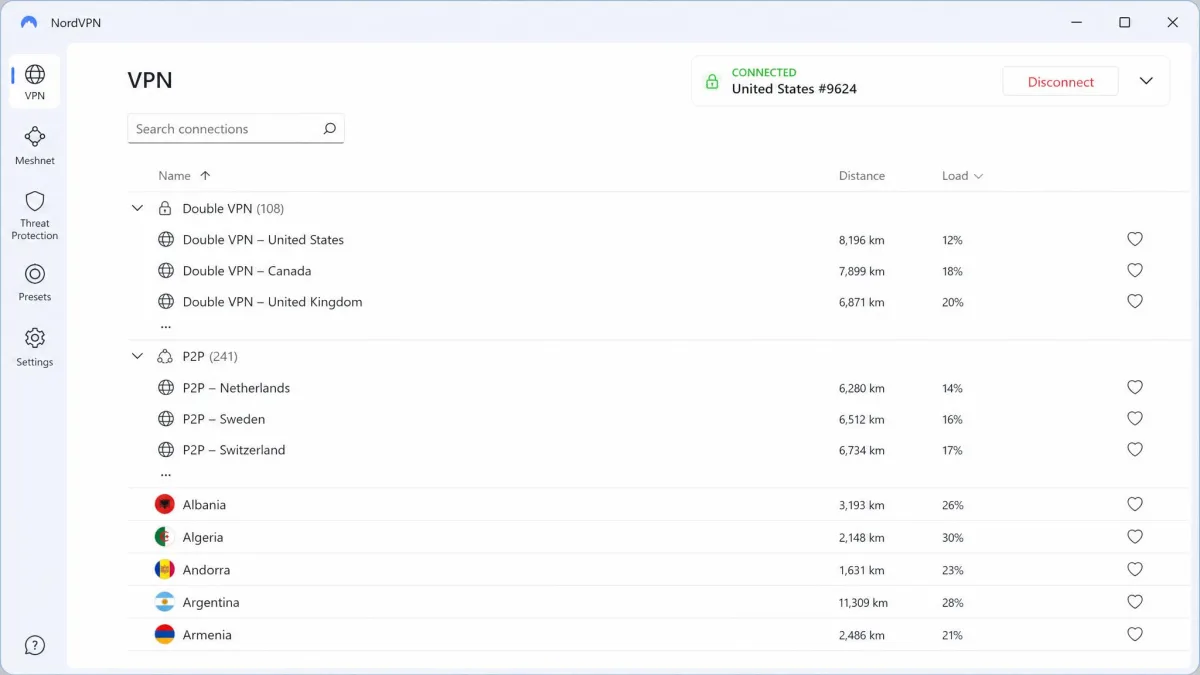
NordVPN ties Proton's 9.0 score but gives up some transparency for raw performance. On nearby servers we lost only about 4% of download and 7% of upload speed, and 4K streams played with no buffering. In our NordVPN review testing, Netflix, Hulu, BBC iPlayer and Prime Video unblocked reliably, which is exactly where IVPN struggles.
NordVPN is based in Panama and completed its sixth Deloitte no-logs assurance engagement, announced in February 2026. The catch for IVPN users is openness, since only the Linux app is open source. Double VPN is the other disappointment. It cut our speed by around 80% and only runs on preset server pairs, so it is far less flexible than IVPN's multi-hop.
NordVPN costs $14.99 on a monthly term, and the two-year Basic plan moves between about $3.39 and $3.49 a month with promotions. It covers 10 devices and accepts Bitcoin, but offers no port forwarding.
Pros
- Minimal speed loss on nearby servers
- Reliable access to major streaming services
- Six Deloitte no-logs engagements
Cons
- Only the Linux app is open source
- Double VPN is slow and limited to preset pairs
- No port forwarding
3. Surfshark - Best for Unlimited Devices on a Budget
Surfshark trades NordVPN's 10-device cap for unlimited simultaneous connections on every plan, which also answers IVPN's five-device limit. Its network covers 4,500+ servers in 100 countries, and Netflix unblocked in 15+ regional libraries for us, along with Max, Disney+, Hulu and BBC iPlayer.
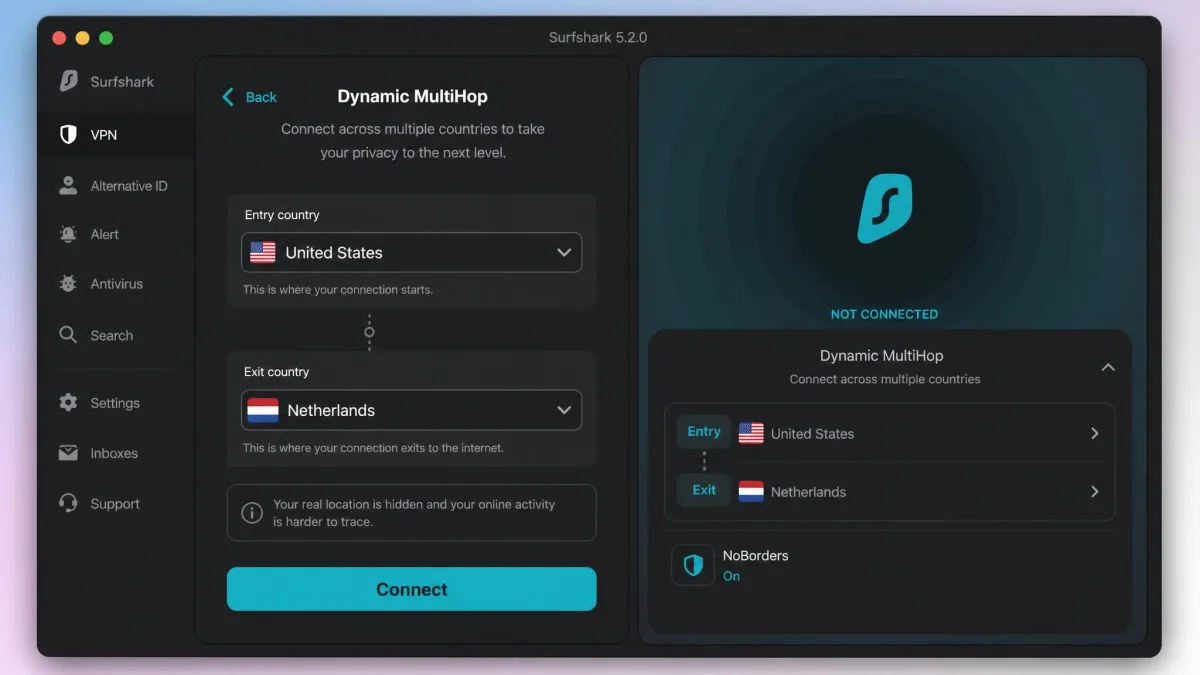
On a transatlantic server, our macOS downloads slowed by only about 10%. The Windows app showed bigger slowdowns and occasional ping spikes, but the kill switch held and no IPv4, IPv6, DNS or WebRTC leaks appeared. Dynamic MultiHop lets you choose both the entry and exit server, which is more flexible than NordVPN's fixed pairs, though it slowed our connections significantly.
Surfshark is based in the Netherlands, and its no-logs policy was verified by Deloitte in 2023 and again in 2025. It has not open-sourced its apps as of 2026, and crypto checkout through CoinGate only works on the website. Starter costs $2.49 a month on the two-year plan, billed $67.23 for 27 months, then renews at $79 a year. Our Surfshark review covers the other plans.
Pros
- Unlimited devices on every plan
- Native Android TV, Apple TV and Fire TV apps
- Deloitte-verified no-logs policy
Cons
- Apps are not open source
- Month-to-month plan is among the priciest in the category
- Crypto payment is web-only
4. Mullvad VPN - Best IVPN Alternative for Anonymity
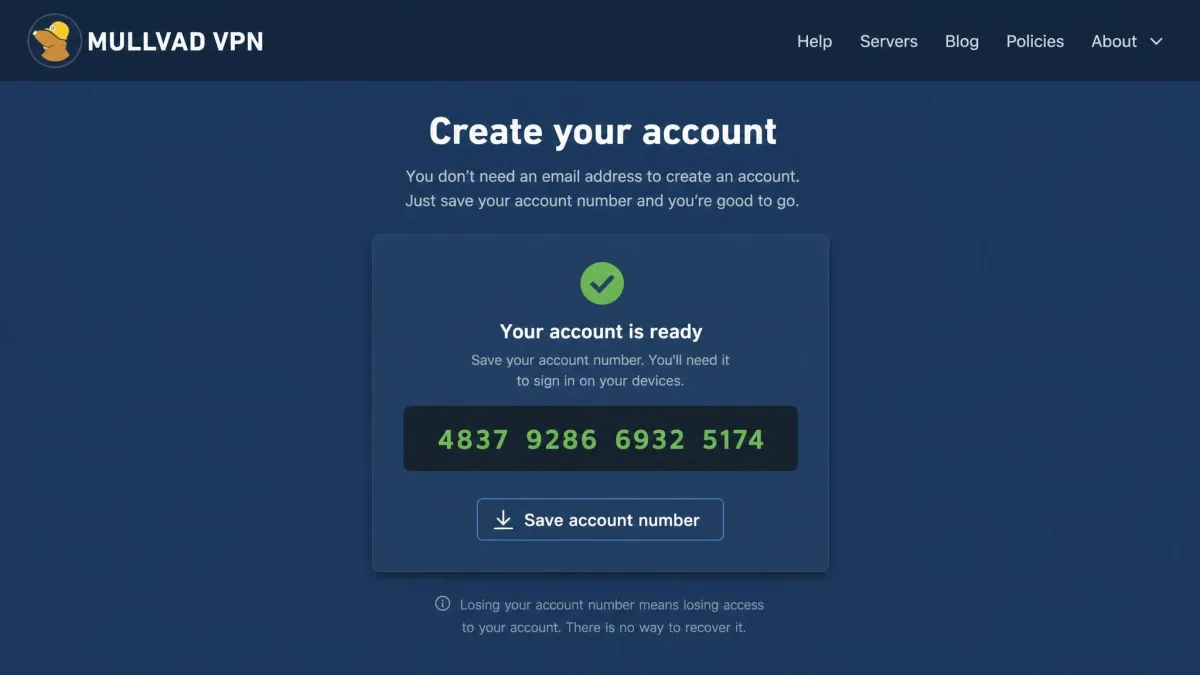
Mullvad VPN gives up Surfshark's reach but is the closest like-for-like match to IVPN. Sign-up took us seconds, because the site issued a random account number and asked for no email or name. You can pay by cash in the mail, Monero, Bitcoin or card, and the flat price is €5 a month for any length, with 10% off for cryptocurrency.
Mullvad VPN AB is based in Sweden. When Swedish police visited its office with a search warrant in 2023, they left with no customer data. The company has passed more than ten independent audits since 2018, including Cure53's fourth infrastructure audit of Mullvad in June 2024. Nearby servers held about 92 of our 95 Mbps baseline, with predictable slowdowns on distant servers in South America and Asia.
Mullvad has some of the same gaps as IVPN. It removed port forwarding on 1 July 2023, streaming was unreliable in our runs, and split tunneling is missing on macOS and iOS, a gap our Mullvad VPN review looks at app by app. It has run on WireGuard only since 15 January 2026, and accounts cover 5 devices. Its live list showed 566 servers in 50 countries, a snapshot that changes as servers come and go.
Pros
- Account-number sign-up with no email
- Cash and Monero payment, plus a crypto discount
- Open-source apps and repeated independent audits
Cons
- No port forwarding
- Email-only support, and router setup takes technical work
- 14-day refund window that excludes cash payments
5. Windscribe - Best Flexible-Pricing Alternative
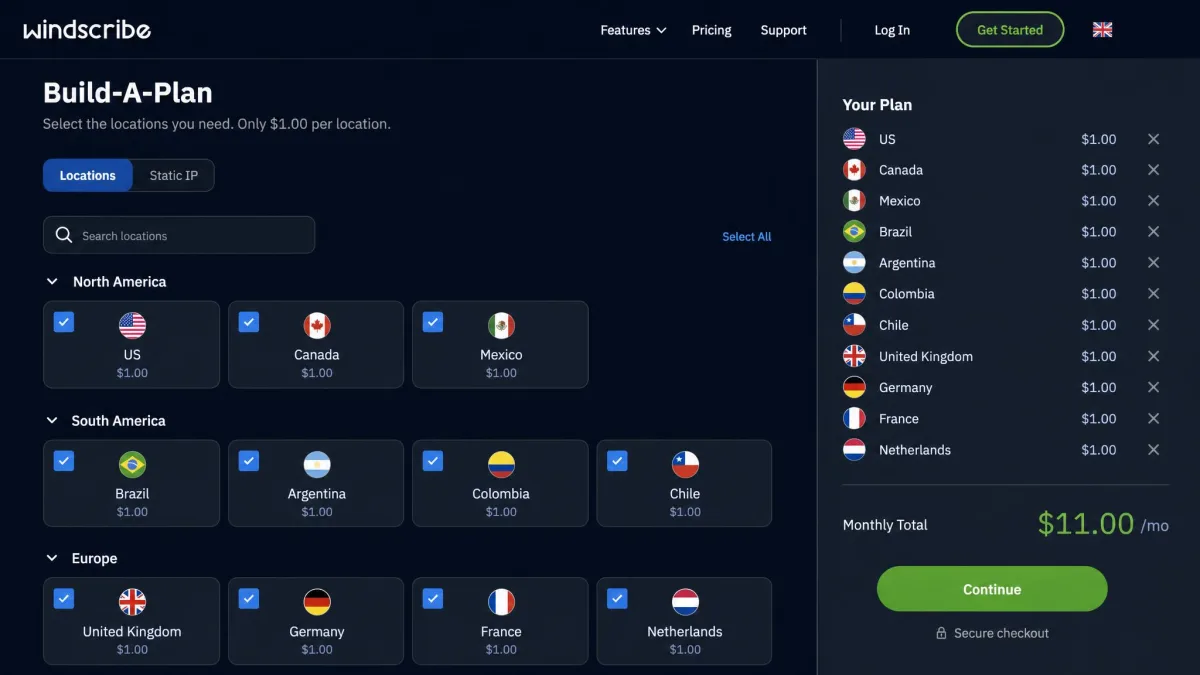
Windscribe keeps Mullvad's open-source apps but adds the port forwarding that both Mullvad and IVPN dropped. Pro costs $9 a month or $69 a year, and Build-A-Plan starts at $3 with $1 per location per month. The free plan offers servers in 10 countries, and every plan allows unlimited devices.
US connections kept about 91% of our download and 90% of upload speed, while Singapore dropped to about 68 Mbps from 92 Mbps nearby. Prime Video and BBC iPlayer unblocked first time, but Netflix needed several server switches. Repeated leak checks showed no IP, DNS or WebRTC leaks, although the cluttered interface and unintuitive icons slowed us down at first.
On Pro, port forwarding rules last 7 days, or you can make forwarding permanent with a paid static IP. Windscribe publishes its apps on GitHub and has had a Packetlabs infrastructure audit, but no dedicated no-logs audit. Its no-logs claim did hold up in a 2025 Greek court case, which our Windscribe review covers in detail. It is based in Canada today, though that may change if Canada's Bill C-22 passes the Senate.
Pros
- Build-A-Plan pricing from $3
- Port forwarding and Double Hop on Pro
- Accepts over a dozen cryptocurrencies, including Monero
Cons
- No dedicated no-logs audit
- Refund only within 7 days and under 10GB of use
- Human ticket replies take around 18 hours
6. Private Internet Access - Best for Customization and Port Forwarding
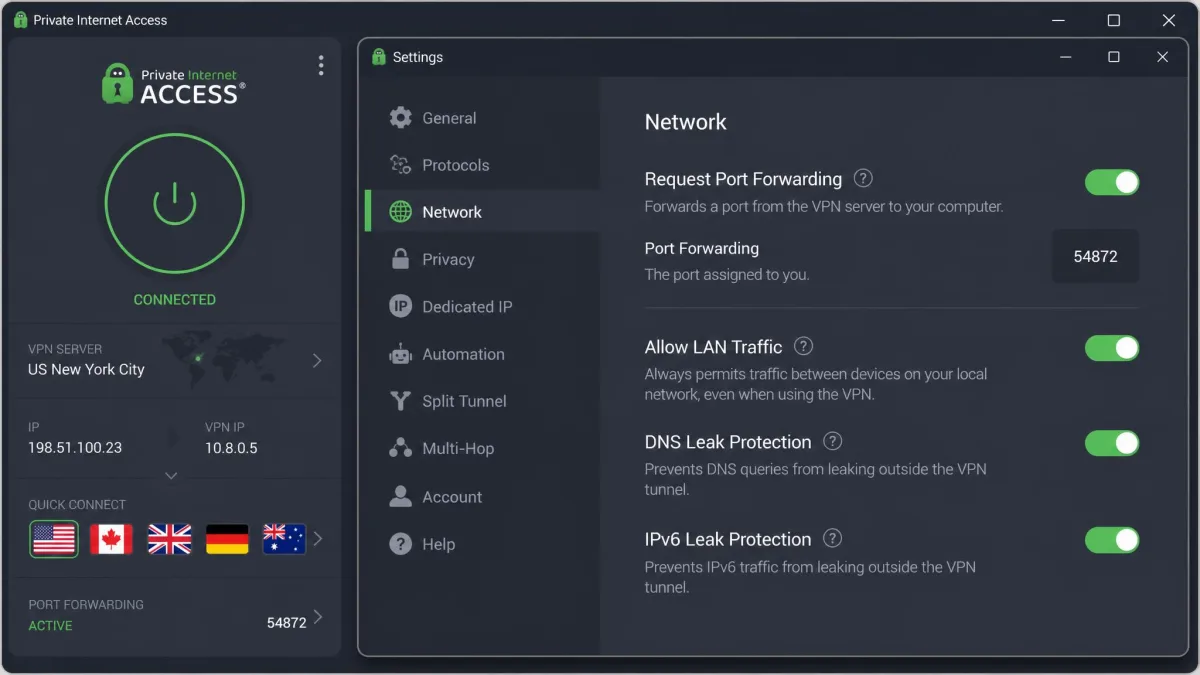
Private Internet Access goes further than Windscribe on port forwarding, which works on every server except US locations. Torrenting with it on cost us only about 4% of speed, though the forwarded port changed each time we reconnected. Overall speed loss was about 4% on local servers and 18% internationally.
The desktop app's long settings list, which our Private Internet Access review walks through, felt overwhelming at first and became easy once we had tuned it. You can choose AES-128 or AES-256 encryption and pick servers in 91 countries plus all 50 US states. The apps are open source, and PIA's third Deloitte no-logs assurance finished on 19 December 2025. Streaming was weak, though: US and UK Netflix no longer unblocked, and Disney+ and Hulu detected the VPN.
PIA is based in the US and owned by Kape Technologies since 2019. Its Multi-Hop routes you through a Shadowsocks or SOCKS5 proxy first, not a second VPN server, so it is no match for IVPN's multi-hop. Official pricing is $11.95 monthly or about $2.03 a month on a 3-year-plus-3-month deal, though the term and bonus months change by date and region.
Pros
- Port forwarding on all non-US servers
- Open-source apps and unlimited devices
- Deep encryption and split tunneling controls
Cons
- US jurisdiction
- Weaker mobile upload speeds
- Auto-renewal is on by default, and renewals are not refundable
7. AirVPN - Best for Advanced and Technical Users
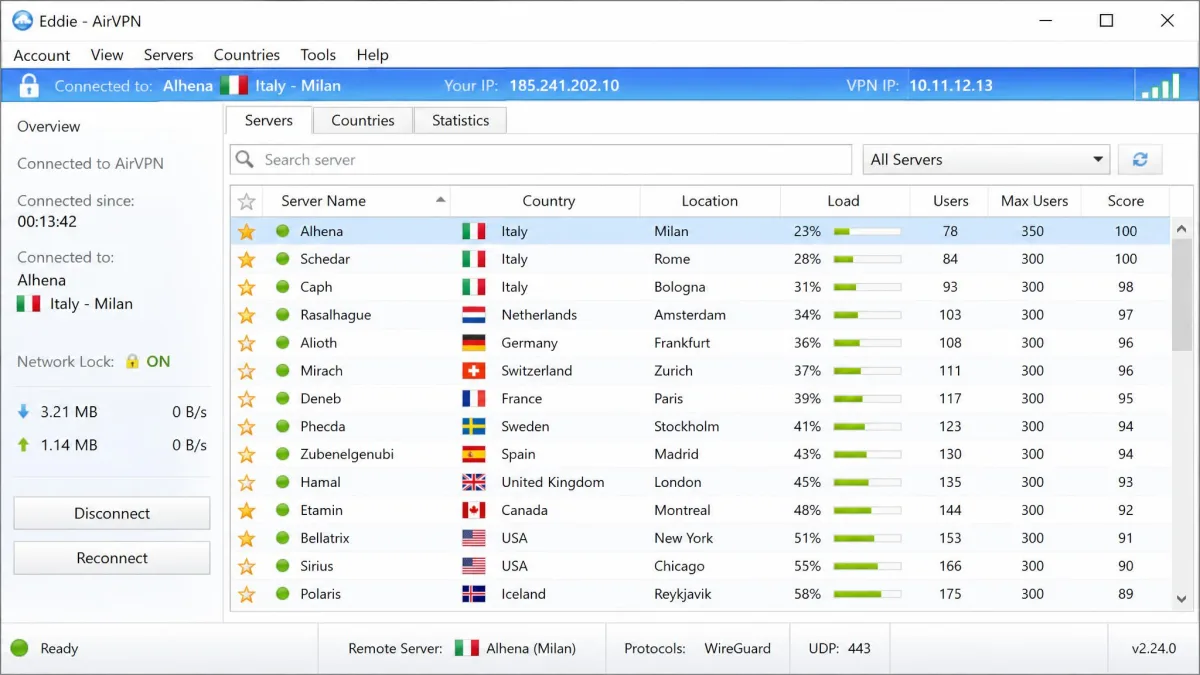
AirVPN is even more hands-on than PIA. Started in 2010 by activists and hackers in Perugia, Italy, it offers inbound port forwarding on all servers, and new accounts can reserve up to 5 ports. Its Eddie client is open source under GPL-3.0 and adds OpenVPN over Tor or SSH.
Eddie paused roughly 10 to 30 seconds every time we connected or disconnected. Its dated interface exposes so many advanced settings that we needed some trial and error, and servers are named after stars rather than listed by country. Same-country connections stayed fast at around 5% speed loss, but long-distance servers lost over half our download speed. DNS and IP leak checks came back clean.
AirVPN is a harder switch than it appears. It has no independent no-logs audit, a gap our AirVPN review weighs, and no native iOS app, so iPhone users import configs into WireGuard or OpenVPN Connect. It covers 23 countries and 5 devices, and residents of Italy may not use it. Pricing is €7 a month, €49 a year, or €99 for three years (€2.75 a month).
Pros
- Port forwarding on every server
- Cheap €2 three-day plan to try it
- Clear ticket replies within minutes to about 90 minutes
Cons
- No independent no-logs audit
- No live chat
- Slow connects and a dated interface
How to Choose an IVPN Alternative
To choose well, decide which parts of IVPN's protection you refuse to give up. These five criteria map to the reasons people pick IVPN in the first place.
Audited No-Logs Policy and Jurisdiction
A no-logs audit is an independent firm checking that a provider does not store records of what you do online. Proton VPN, NordVPN, Surfshark and PIA have recent no-logs audits, and Mullvad has repeated Cure53 infrastructure audits. IVPN's Cure53 no-logs audit dates to 2019, and its later annual audits covered security and newer services such as Mailx and modDNS. Jurisdiction is the country whose laws govern the company, and PIA is the only pick here under US law.
Anonymous Sign-Up and Payment Options
Mullvad is the pick that matches IVPN's account-number sign-up with no email. Mullvad and Proton VPN accept cash, and Mullvad, Windscribe and AirVPN take Monero, a privacy-focused cryptocurrency. NordVPN, Surfshark and PIA accept crypto too, through standard checkout.
Open-Source Apps and Security Audits
Open-source apps protect you in a quieter way, because anyone can inspect the code for hidden tracking. The comparison table above shows which picks publish their code, and only Surfshark keeps every app closed.
Multi-Hop, Kill Switch, and Tracker Blocking
Multi-hop sends your traffic through two VPN servers, so neither one sees both your IP address and your destination. Surfshark's Dynamic MultiHop is the most flexible true chain, while PIA's version is only a proxy hop. For tracker blocking, Proton has NetShield, Surfshark has CleanWeb and Windscribe has R.O.B.E.R.T., all similar to IVPN's AntiTracker.
Price, Free Plans, and Device Limits
Against IVPN's $60-a-year Standard plan, most picks cost less per month on multi-year terms, and only Mullvad and Windscribe land close to IVPN. The table above lists every device limit, so if five devices already feel tight, rule out Mullvad and AirVPN first.
When to Stay With IVPN
IVPN is still worth keeping if anonymity and simplicity matter more than reach, and its core privacy features remain strong. Sign-up took us seconds with an auto-generated account ID and no email or password. DNS and WebRTC leak checks passed, and the kill switch held when we switched servers. Multi-hop, obfuscation and a SOCKS5 proxy come on every plan, including Standard.
IVPN still suits you if you mostly connect to nearby servers in Europe or North America, do not stream, and do not need port forwarding.
The trade-offs we hit were small annoyances, and our IVPN review logs both. The apps logged us out now and then, which meant re-entering the account ID, and multi-hop with obfuscation cut our speeds by about 45%.
Frequently Asked Questions
Is it hard to switch from IVPN to another VPN?
Is Mullvad better than IVPN?
Is there a free alternative to IVPN?
Why does VPN jurisdiction matter?
Did IVPN's 2026 Bitcoin incident expose users?
Bottom Line
Your choice comes down to what you miss most about IVPN. Streaming points to NordVPN, a house full of devices to Surfshark, and lost port forwarding to Windscribe or PIA. For everyone else, our overall pick is below.