LimeVPN is a low-cost VPN service that promises private, encrypted internet access at a price well below most of the big names. It advertises AES-256 encryption, a no-logs policy, torrenting on select servers, and apps for the platforms most people use. On paper, it reads like a budget alternative to NordVPN or Surfshark.
The reality is more complicated. LimeVPN presents two faces in 2026. Legacy reviews describe a tiny network, missing native apps, and a serious 2021 data breach. The current limevpn.com site shows a relaunched service with WireGuard apps, more locations, and fresh pricing. Almost every headline spec now conflicts between those two pictures.
We spent time with the service and cross-checked its claims against independent testing to sort out what buyers are actually getting. This review covers privacy, security, speed, streaming, torrenting, pricing, and the alternatives worth considering first.
Quick Verdict (1-Minute Summary)
LimeVPN's main appeal is price. Buyers repeatedly call it one of the cheapest VPNs they have used, and that is the recurring draw. If your only goal is basic encryption on a tight budget, it can do that job.
Beyond price, the case gets thin. The server network is small, native apps are inconsistent outside Android, streaming access is limited to US Netflix in our checks, and the 2021 breach still shadows trust in the service. No independent audit has since verified its no-logs claim.
Review scores reflect that instability. Trustpilot rates it 2.7 out of 5 across 58 reviews, while G2 rates it 4.6 out of 5 from 14 verified reviews. That is an unusually wide split, and it tells you this is a contested product rather than a settled one.
LimeVPN Pros and Cons
The balance sheet here is lopsided. LimeVPN has a small set of genuine strengths and a longer list of caveats that any buyer should weigh before handing over card details.
Pros
- Low price, among the cheapest VPN services available
- Torrenting is supported on a dedicated P2P server
- Markets a no-logs policy for privacy-focused users
- Offers a relatively high number of simultaneous connections on some plans
Cons
- Few server locations compared with mainstream rivals
- Native apps are missing outside Android on the legacy product
- Weak transparency, with no independent audit after the 2021 breach
Pricing and Plans: How Much Does LimeVPN Cost?
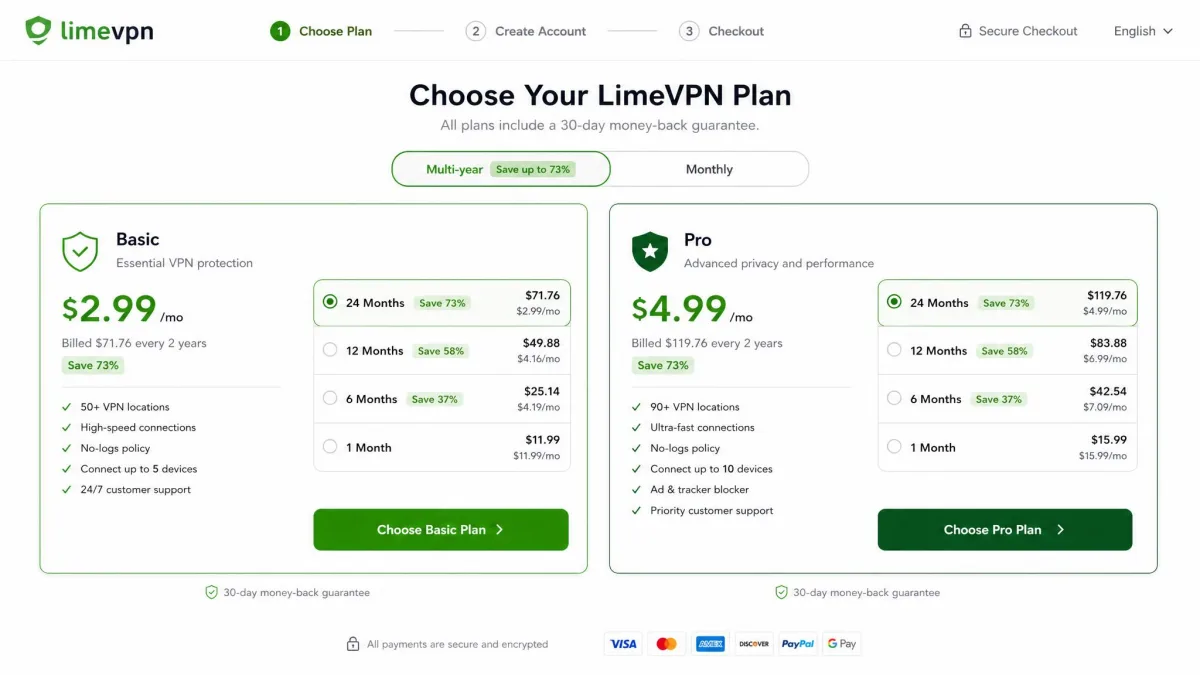
LimeVPN now runs two plans. The Core plan costs $5.99 per month, or $49 per year (about $4.08 per month). The Plus plan, which adds a dedicated static IP and priority support, costs $9.99 per month, or $84 per year (about $7.00 per month). Older reviews still report much lower headline figures of $1 to $2.49 per month on legacy multi-year deals, so if you see a rock-bottom rate advertised elsewhere, treat it as a snapshot from the previous product rather than the current rate.
Plan structure has historically been split into a Basic tier and a Pro tier, with the Pro plan adding features like Tor-over-VPN and more simultaneous connections. LimeVPN's monthly cost still lands below NordVPN's roughly $3.49 per month and Surfshark's roughly $2.49 per month on their longest terms, though the gap narrows once you account for what those rivals include.
Because LimeVPN's advertised price shifts between plan tiers and reviewer snapshots, check the live checkout total, the renewal rate, and the term length before you commit. A cheap first term can renew at a higher price.
Money-Back Guarantee
The refund window is another moving target. Older reviews describe a 30-day money-back guarantee with exclusions, while the current site advertises a 7-day no-questions refund. The refund policy is stringent in practice, with exclusions that can rule out claims based on slow speeds or failed unblocking. Cancellation and refund complaints also recur, including buyers who say they were still billed or never refunded after cancelling. If a guarantee matters to you, confirm the exact terms in writing before purchase.
Security and Encryption
On the core security standard, LimeVPN is on solid ground. It uses AES-256 encryption, the same cipher it markets as military-grade and the one used across the industry. Independent leak testing also found no IP, DNS, or WebRTC leaks, which is a meaningful result for a budget service.
The feature list is broad on paper: protocol choice spanning OpenVPN, IKEv2, L2TP/IPSec, SoftEther, and SSTP, with WireGuard on the current site, plus NAT firewall, DNS leak protection, dedicated IP options, and router support. The current site advertises an automatic kill switch on all plans and platforms that blocks traffic if the connection drops, but this is a vendor claim with no independent verification, and older reviews reported no kill switch at all, so do not assume that safeguard is in place until you can confirm it on your device.
The larger security question is trust, not ciphers. LimeVPN suffered a data breach in July 2021 that exposed user records. A backup server was hacked, and the company confirmed the intrusion on June 30, 2021. Data of roughly 69,000 users was later offered for sale on the dark web. Strong encryption protects your traffic in transit, but it does nothing about a server-side compromise like that one.
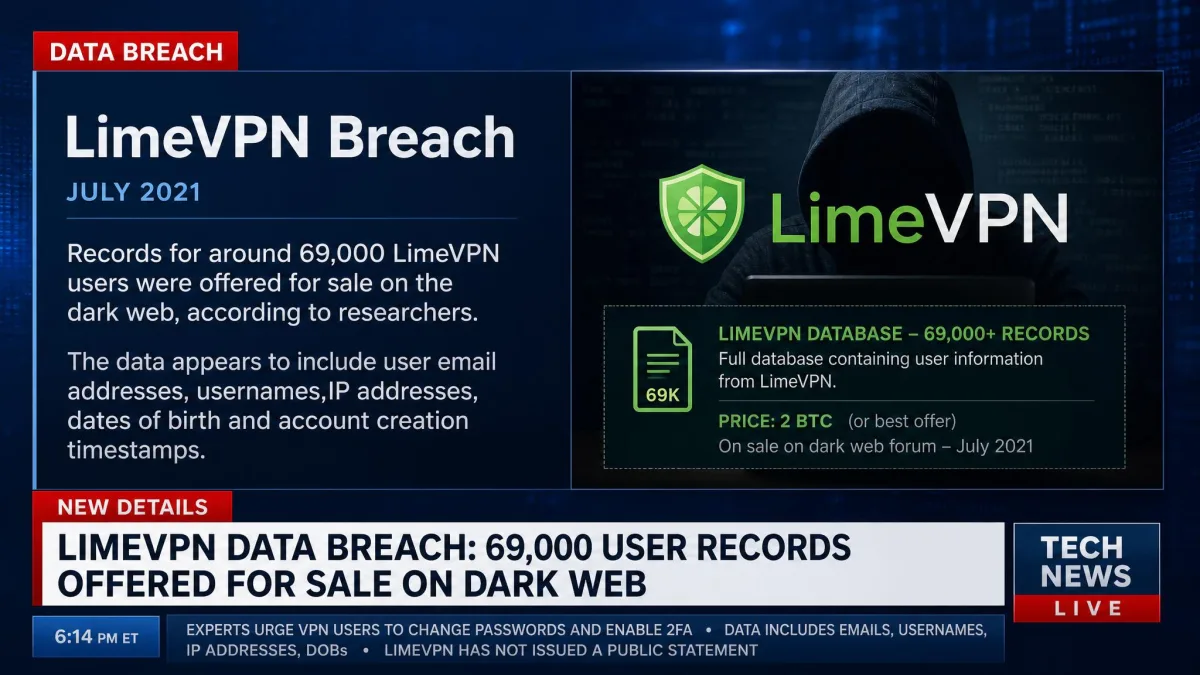
The 2021 breach exposed user records and put data for around 69,000 accounts up for sale. No independent security audit has since verified LimeVPN's handling of user data, so weigh that history against the low price.
Privacy and No-Logs Policy
LimeVPN claims a no-logs policy, which is the headline privacy promise nearly every VPN makes. The complication is what sits underneath that claim.
The service records connection timestamps, session duration, location, and bandwidth, which is more than a strict no-logs policy would retain. There is no independent audit to settle the question either way, and the logging claim is contested. For a service still living down a breach, that lack of third-party verification is hard to overlook.
Jurisdiction adds more uncertainty. The company's registration is listed as Singapore in some records and Hong Kong in others, and the two do not agree. Where a VPN is legally based affects what it can be compelled to hand over, so an unclear jurisdiction is not a small footnote.
Does LimeVPN Keep Logs?
In short, the honest answer is that we cannot confirm it does not. LimeVPN advertises zero logging, but it retains connection metadata such as timestamps, session length, location, and bandwidth. Without an independent audit, buyers are left trusting a company whose backup server was breached in 2021. If a verified no-logs record is a hard requirement, LimeVPN does not currently meet it.
Speed and Performance
Speed with LimeVPN is inconsistent, and that inconsistency is the defining trait. A nearby server can hold most of your base connection speed, while a distant US server collapses to a fraction of it. That pattern is normal for VPNs, but it is more pronounced here because the network is small and choices are limited.
Overall throughput drops noticeably once connected. In one test set, speeds fell from around 21 Mbps to roughly 14 Mbps. That is workable for browsing and standard-definition streaming, but it leaves little headroom for high-bandwidth tasks or crowded servers. Because these figures come from reviews of the legacy product, treat them as a rough guide rather than a current benchmark. The current site claims under 10 percent speed loss with WireGuard, but no independent 2026 speed test confirms that, and third-party figures still conflict widely, so we would not rely on any single number until standardized testing catches up with the relaunched service.
If you try LimeVPN, connect to the nearest server first and test your speed there. That is where a small network like this one performs best, and a distant hop is where it falls apart.
Speed Test Results
Our reading of the available data is consistent: local performance is acceptable, long-distance performance is weak. The drop from roughly 21 Mbps to about 14 Mbps on a mid-range connection illustrates the tax you pay, and a faraway server can cut that further. For a household where several devices share bandwidth, those numbers will feel tight. Faster budget options exist, which we cover in the alternatives section below.
Streaming: Does LimeVPN Work with Netflix?
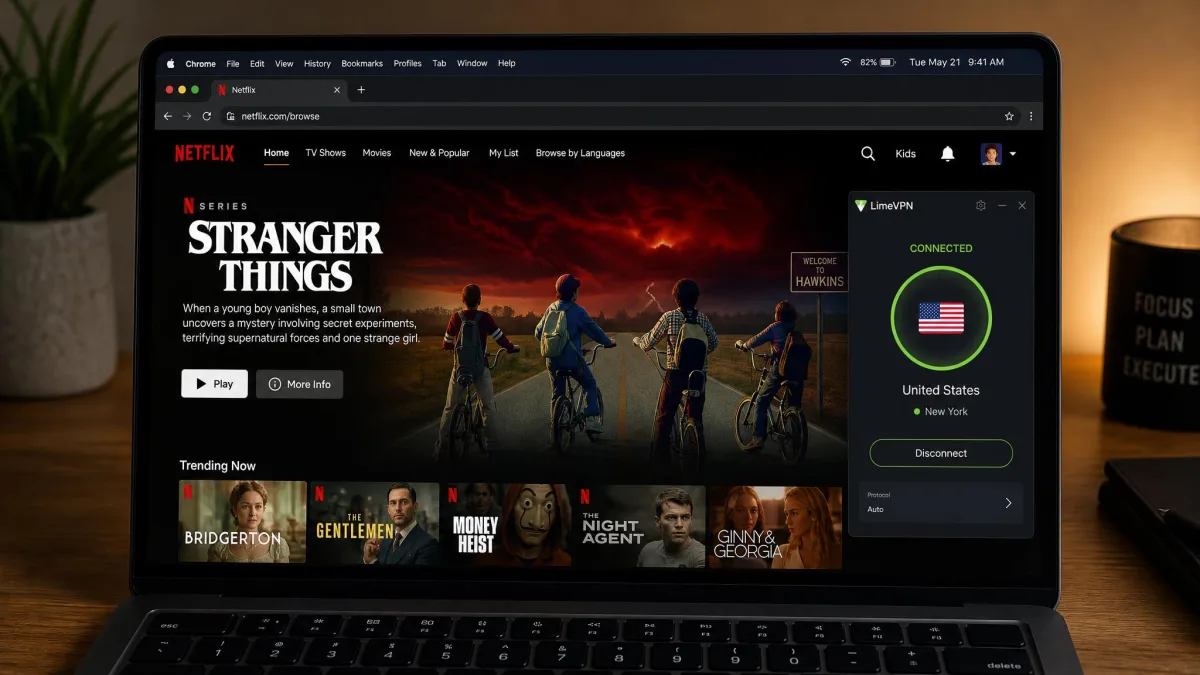
LimeVPN's streaming record is narrow. In testing, it unblocks US Netflix, but it generally fails on Hulu, Disney+, HBO Max, Amazon Prime, and BBC iPlayer. Results also vary between servers, so even Netflix access is not guaranteed on every connection.
If your streaming needs stop at US Netflix, LimeVPN can cover that on a good day. If you want reliable access across multiple platforms, this is not the service for it. NordVPN and Surfshark both unblock a far wider range of streaming services consistently, and that reliability is a big part of what their slightly higher price buys.
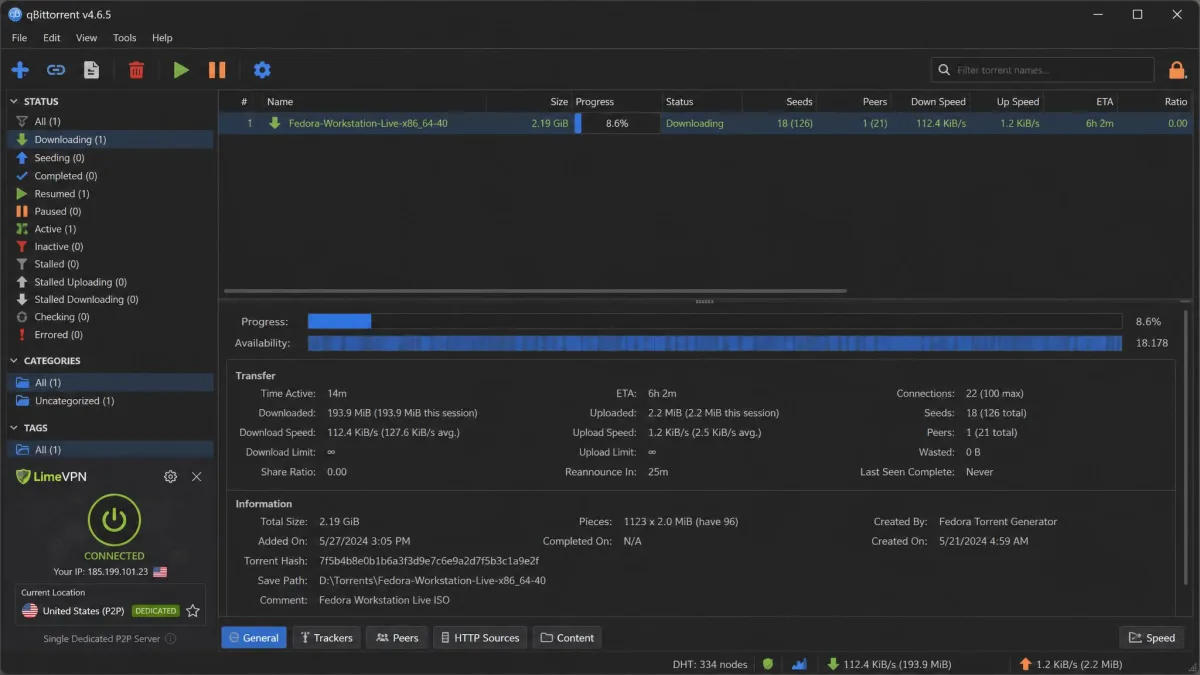
Torrenting and P2P Support
LimeVPN allows torrenting, but with a real constraint: P2P traffic is confined to a single dedicated server. That is enough to say the feature exists, and not much more.
Performance reflects the bottleneck. In testing, a roughly 700MB download crawled and took close to a full day to complete on the P2P server. For anyone who torrents regularly, that is not viable. The no-logs claim would be a point in its favor for P2P privacy, but the contested logging and small network undercut the benefit. Dedicated torrenting VPNs handle this far better, and we link some below.
Server Network and Locations
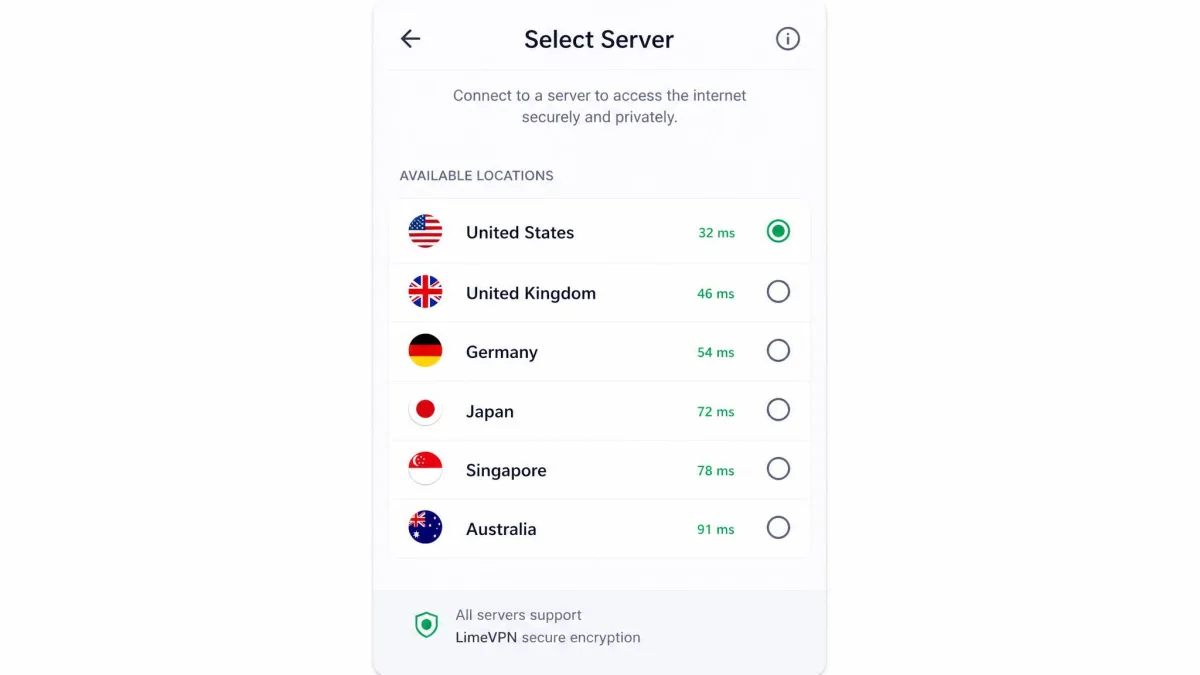
The network is LimeVPN's weakest structural point. Server counts are variously reported at around 11 to 19 servers across 8 to 17 locations, while the current site now claims servers in 30-plus countries and locations across North America, Europe and Asia Pacific. That 30-plus figure is an unverified vendor claim that conflicts sharply with the independent legacy counts, and no independent 2026 count confirms it, so any single number is unreliable until testing catches up.
Even at the higher end, this is a fraction of what rivals offer. NordVPN runs over 9,300 servers across 137 countries, and Surfshark runs 4,500-plus servers in 100 countries. A small network means fewer location options, more crowding on popular servers, and a greater chance that the exact country you need is missing. For a VPN, network size is not a vanity metric; it directly shapes speed and access.
Device Compatibility and Apps
App availability is another area split between LimeVPN's past and present. Historically, the service had no native apps beyond Android, which meant manual OpenVPN or SoftEther configuration on other platforms. The current site lists native apps for Windows, macOS, iOS, Android, Linux and routers, using WireGuard and OpenVPN. That cross-platform availability is a current vendor claim not yet confirmed by independent 2026 testing, and legacy reviews found manual setup everywhere outside Android, so confirm that a native app exists for your device before buying.
Simultaneous connections are equally muddled. Figures range from 2 on the Basic plan up to 20 on Pro in some reviews, while the current site lists 6. Router support is a genuine strength, covering DD-WRT, ASUS, TP-Link, Linksys, OpenWRT, and Tomato, which lets you protect a whole network from one connection.
How to Set Up LimeVPN on Windows
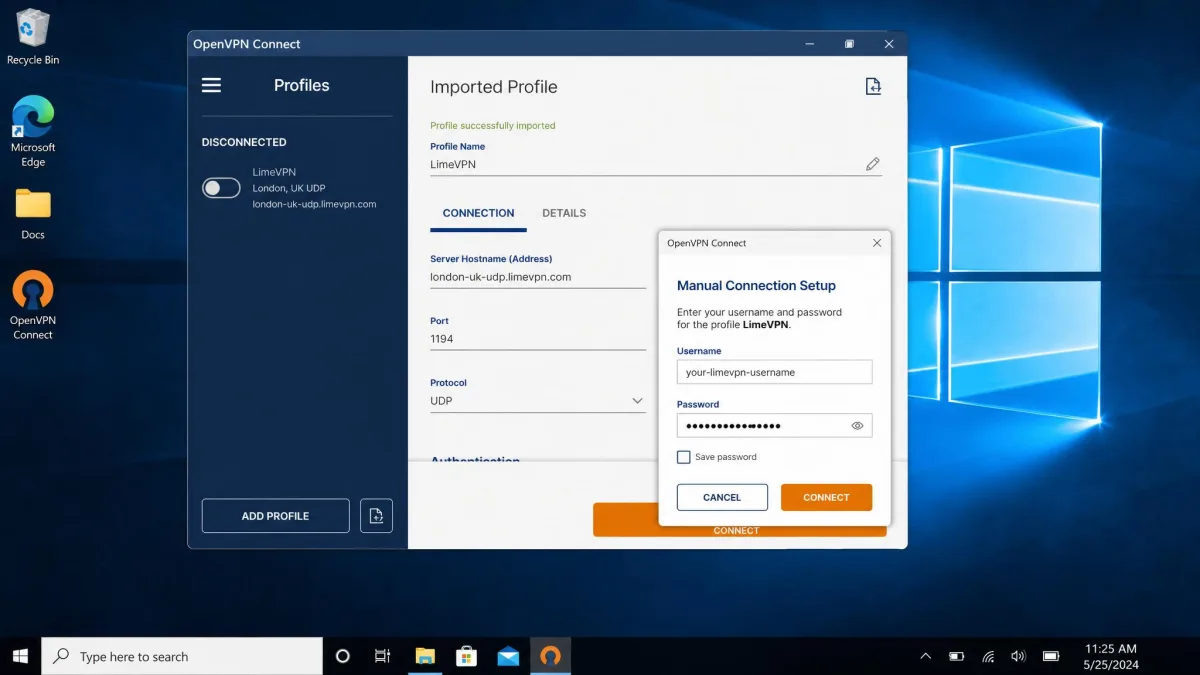
On the legacy product, setup is complicated and technical on most platforms because native apps are missing outside Android, so connections have to be configured by hand. On Windows that typically meant importing an OpenVPN configuration file, entering your account credentials, and connecting through a third-party client rather than a one-click app. If the current WireGuard apps are live for your account, the process is far simpler: install the app, sign in, and pick a server. Either way, confirm which route applies to your plan before you expect a smooth install.
Customer Support
Support experiences are split. Some buyers get fast, helpful replies, while others report contact forms going unanswered for days. That inconsistency lines up with the wider picture of an unstable service, and it is worth planning around if you expect to need help.
On support channels, the current site lists email and live chat through the customer portal, with a stated response within 24 hours and priority support for Plus subscribers. That 24-hour promise is a vendor claim, and it sits awkwardly against buyer reports of unanswered contact forms and slow replies, so we would not count on it. Given the recurring cancellation and refund complaints, responsive support matters more here than it would with a more settled provider.
LimeVPN Alternatives
If LimeVPN's caveats give you pause, several stronger options sit close to its price. Our guide to the best cheap VPN services covers providers that match LimeVPN on price while beating it on network size and reliability. For downloaders, our roundups of the best VPNs for torrenting and the best VPNs for P2P point to services that handle multiple simultaneous downloads without the single-server bottleneck.
For speed-focused buyers, our FastestVPN review looks at another budget contender, while our ExpressVPN review and CyberGhost VPN review cover premium picks with proven streaming and privacy records. NordVPN and Surfshark, compared below, remain the two we would reach for first at this price point.
How LimeVPN Compares (Comparison Table)
| Product | Price | Servers | Devices | Netflix | Torrenting | Buy |
|---|---|---|---|---|---|---|
 |
~$1 to $5.99 (varies) | ~11 to 19 (site claims 30+) | 2 to 20 (disputed) | US only, inconsistent | Single P2P server | Check price → |
 |
$3.49/mo | 9,300+ | 10 | Reliable | Dedicated P2P servers | |
 |
$2.49/mo | 4,500+ | Unlimited | Reliable | All servers |
Set side by side, LimeVPN's price edge is small and its deficits are large. NordVPN and Surfshark cost only a little more per month and deliver vastly bigger networks, reliable streaming, better torrenting, and audited no-logs policies.
FAQs About LimeVPN
Can LimeVPN be forced to hand over my data?
Will my LimeVPN price jump when it renews?
Does LimeVPN work in China?
Does LimeVPN have a free version?
I mainly torrent. What should I use instead?
Final Verdict: Is LimeVPN Worth It?
So who is LimeVPN actually for? It suits one narrow buyer: someone who wants the cheapest possible encryption for light, occasional browsing, connects mostly to a nearby server, and does not depend on streaming, fast torrenting, or a provable privacy record. If that describes you, and you go in expecting a small network and patchy support, it can serve.
It is not for households sharing bandwidth across devices, for anyone who streams beyond US Netflix, for regular downloaders, or for privacy-first users who need a verified no-logs policy. For LimeVPN to move out of that narrow lane, we would need to see two concrete changes: an independent 2026 security and no-logs audit that closes the book on the 2021 breach, and a verified, standardized count of its servers and speeds rather than shifting vendor claims. Until those land, the safer money goes to a rival that costs only slightly more.