IKEv2, or Internet Key Exchange version 2, is a VPN protocol that sets up and manages a secure, encrypted connection between your device and a VPN server. It is almost always paired with IPsec, and you will often see the pair written as IKEv2/IPsec. If you use a VPN on a phone, there is a good chance IKEv2 is doing the quiet work behind your connection.
The protocol handles the handshake, the authentication, and the ongoing key management that keep a tunnel alive. IPsec then does the encryption of the data that flows through it. Together they give you a connection that is fast, stable, and secure enough for daily use on mobile networks.
Across our own VPN testing, IKEv2 is one of the protocols we reach for most on phones. It reconnects quickly, it holds a session together as you move between networks, and it needs very little setup on modern devices. This guide explains how IKEv2 works, why it needs IPsec, how it compares to OpenVPN and WireGuard, and where its limits show.
Key takeaways: IKEv2 is a fast, mobile-friendly VPN protocol paired with IPsec for encryption. It uses UDP ports 500 and 4500, supports AES-256, and stays connected as you switch networks thanks to MOBIKE. Its main weakness is that its fixed ports are easier for firewalls to block than OpenVPN over TCP 443.
What Is IKEv2? (Definition)
IKEv2 is a key management protocol. Its job is to negotiate, authenticate, and refresh the cryptographic keys that a VPN tunnel relies on. It does not encrypt your traffic on its own. Instead, it establishes the security associations that IPsec uses to encrypt and authenticate every packet.
The protocol was developed jointly by Cisco and Microsoft, which is why it has such strong native support on Windows and other major platforms. It is the second generation of the Internet Key Exchange standard, and it improves on the original in almost every practical way.
IKEv2 was first introduced in RFC 4306 in December 2005. The specifications were later combined in RFC 5996 in September 2010. Today the protocol is defined by RFC 7296, the IKEv2 specification, which was elevated to full Internet Standard in 2014.
How Does IKEv2 Work?
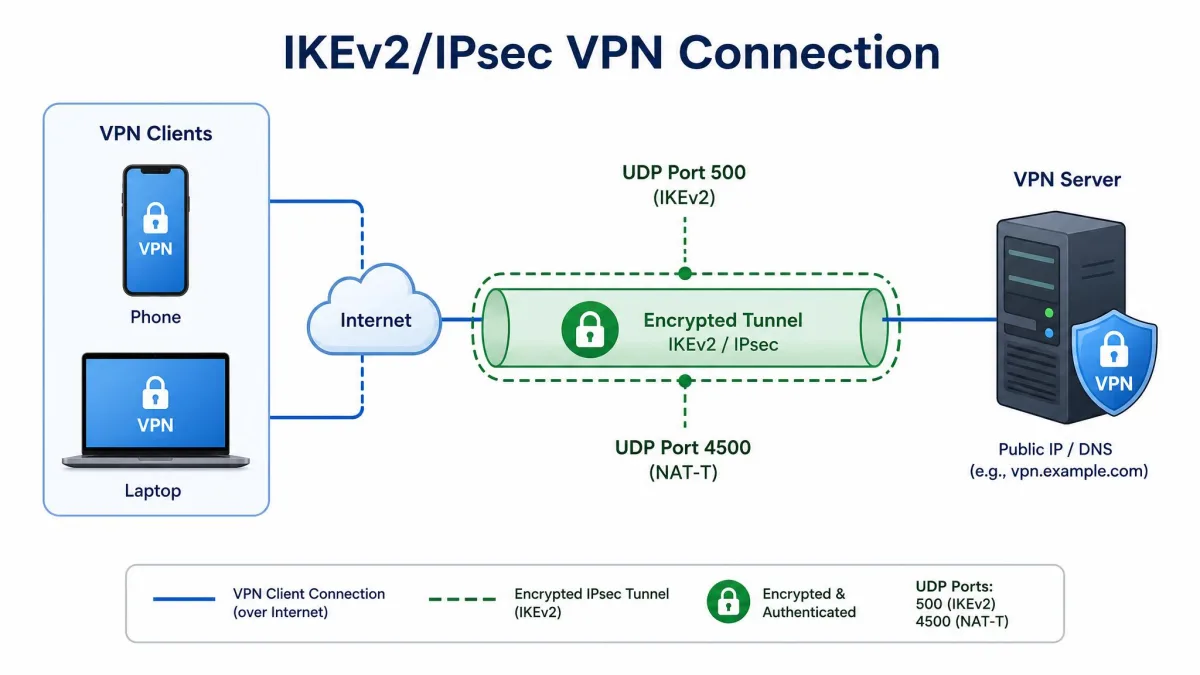
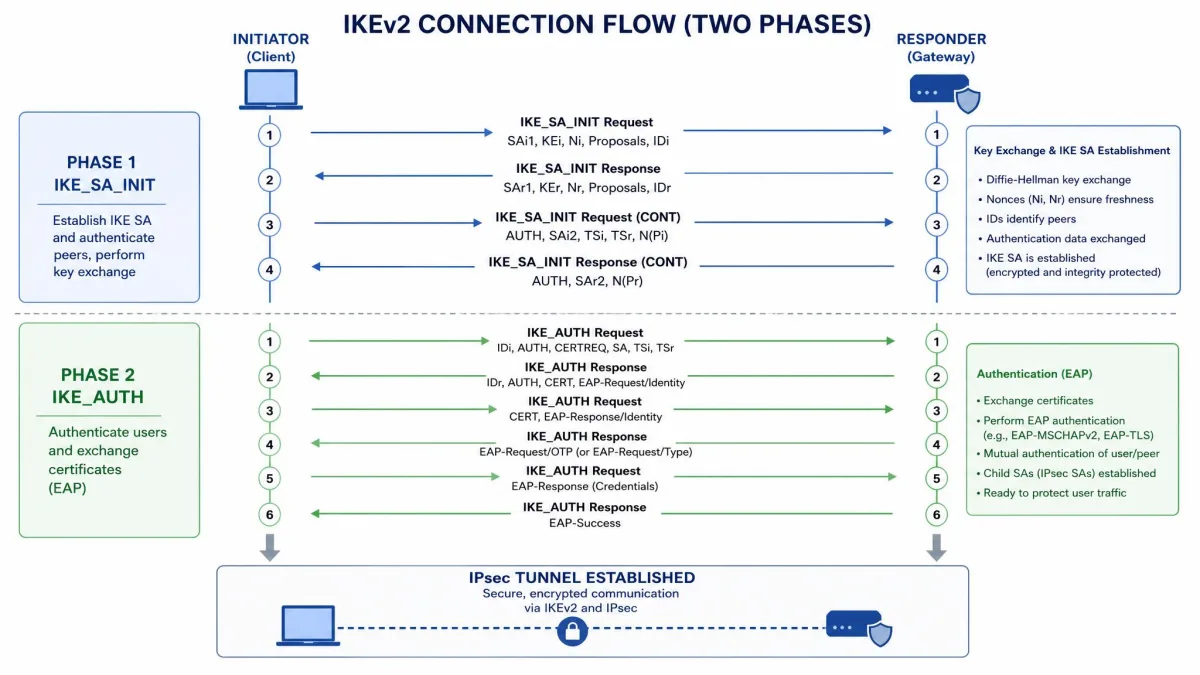
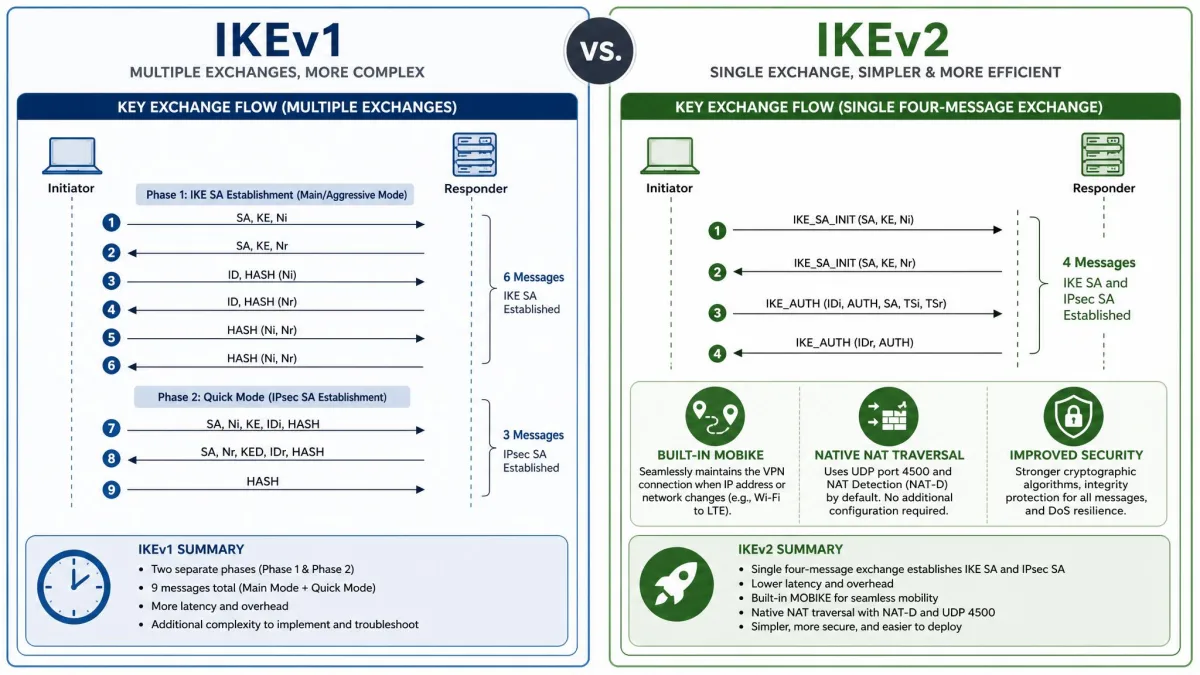
IKEv2 builds a connection in two phases, using a compact four-message initial exchange. This is one of the reasons it feels quick to connect. Where older protocols traded many packets back and forth, IKEv2 gets the essentials done in a single tight negotiation.
The two phases have formal names: IKE_SA_INIT and IKE_AUTH. The first phase creates a secure channel and agrees on encryption keys. The second phase authenticates both sides and sets up the actual data tunnel. Once both are complete, IPsec takes over and encrypts your traffic.
Phase 1: IKE_SA_INIT (handshake and key exchange)
The first phase is the handshake. Your device and the VPN server exchange two messages that agree on the cryptographic algorithms they will use and perform a Diffie-Hellman key exchange. This produces shared keys without either side ever sending a secret across the network.
This phase also establishes Perfect Forward Secrecy, so each session gets fresh keys. Even if one session key were later exposed, past and future sessions would stay protected. The result is a secure channel that the next phase can safely use for authentication.
Phase 2: IKE_AUTH (authentication and tunnel setup)
The second phase confirms that both sides are who they claim to be. IKEv2 supports certificate-based authentication using X.509 certificates, and it also supports EAP, which is common when a username and password are involved. EAP even allows certificate-less authentication in some configurations.
Once authentication succeeds, the IPsec security associations are created and the encrypted tunnel is ready. From here, your data flows through IPsec using strong ciphers such as AES-256. The whole exchange usually completes fast enough that a connection feels close to instant.
MOBIKE and connection maintenance
MOBIKE, short for Mobility and Multihoming, is defined in RFC 4555 and is one of the features that makes IKEv2 so good on mobile. It lets an established tunnel survive a change of network. Your device can move from Wi-Fi to mobile data and the VPN keeps running.
In our testing this is the standout everyday benefit. Switching between Wi-Fi and mobile data does not drop the tunnel, so a download or a call continues without a reconnect. IKEv2 also reconnects automatically and quickly after a genuine drop, which matters most to mobile and commuting users who move through dead zones.
There is a battery benefit too. Because IKEv2 avoids constant key re-negotiation, a phone connected all day does not drain its battery the way some older protocols cause it to. That combination of stability and efficiency is why IKEv2 remains a default choice for mobile VPN apps.
Why Is IKEv2 Always Paired with IPsec?
IKEv2 and IPsec do different jobs, and neither is a full VPN protocol on its own. IKEv2 handles key exchange and authentication. IPsec handles the encryption and integrity of the data itself. Pairing them gives you a complete, secure tunnel.
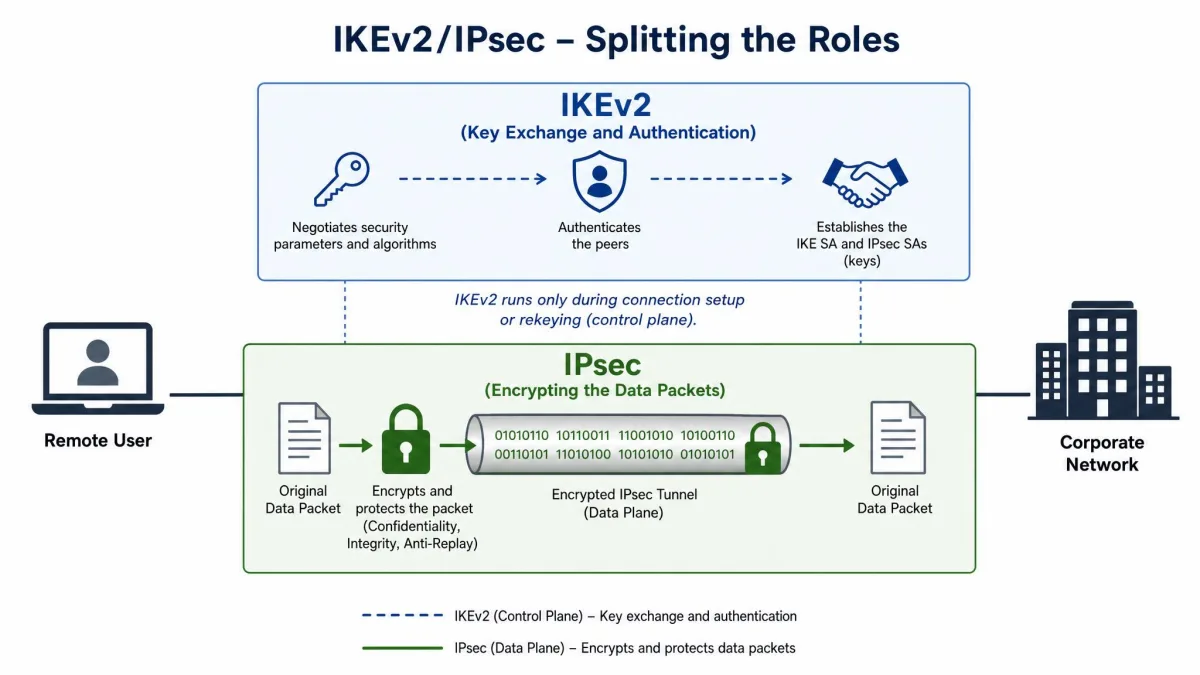
This division of labour is by design. IKEv2 negotiates the security associations, and IPsec then uses those associations to encrypt each packet with algorithms such as AES-256. Because IKEv2 was built specifically to manage IPsec keys, the two fit together cleanly with very little overhead.
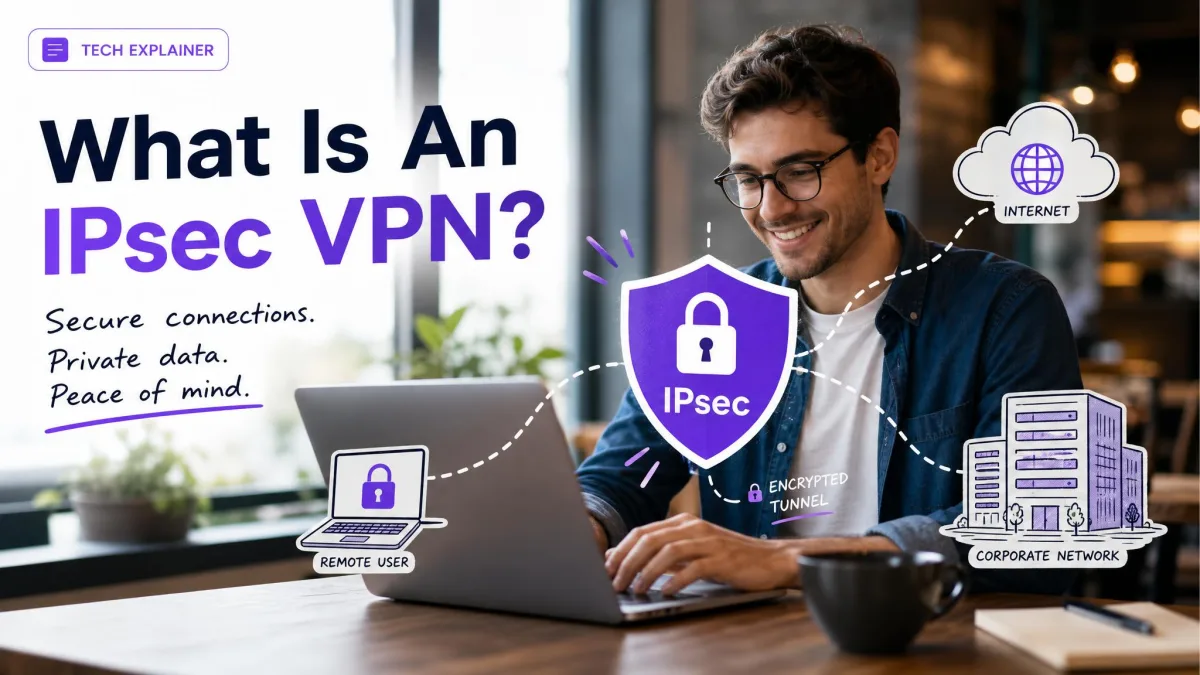
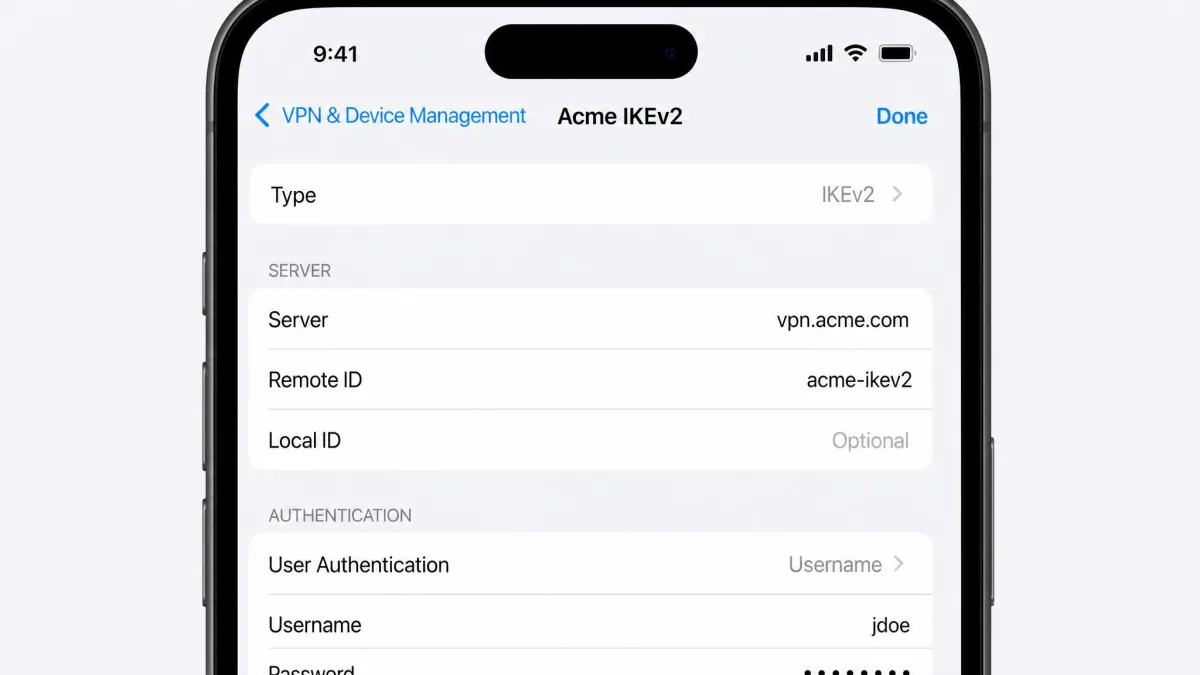
In practice you rarely choose one without the other. When a VPN app lists "IKEv2" in its settings, it means IKEv2/IPsec. If you want the fuller picture, our guide to what is an IPsec VPN covers that layer in depth. The IPsec layer is what actually protects your data, while IKEv2 keeps the keys fresh and the connection authenticated.
IKEv1 vs IKEv2: Key Differences
IKEv2 replaced IKEv1, and the improvements are substantial rather than cosmetic. The biggest change is the streamlined four-message initial exchange, which replaces the multiple exchange types IKEv1 used. Fewer packets and round trips mean faster, more reliable connections.
IKEv2 also builds in features that IKEv1 lacked entirely. MOBIKE mobility support, EAP authentication, and native NAT traversal are all part of the protocol rather than bolt-on add-ons. It also uses a strict request and response model, so lost messages are retransmitted and the negotiation is far more reliable.
| Feature | IKEv1 | IKEv2 |
|---|---|---|
| Initial exchange | Multiple exchange types, more round trips | Single four-message exchange |
| MOBIKE mobility | Not supported | Built in |
| EAP authentication | Not supported | Supported |
| NAT traversal | Add-on | Native |
| Reliability | Weaker | Request and response with retransmission |
| Efficiency | Slower negotiation | Simpler and faster |
Pros and Cons of IKEv2
No protocol is perfect for every situation, and IKEv2 is no exception. Its strengths cluster around speed, mobile stability, and easy setup on modern devices. Its weaknesses come mostly from its fixed ports and its closed-source implementations. The list below reflects what we have seen using it across networks and platforms.
Pros
- Fast and stable speeds, very good for daily use
- Excellent mobile stability thanks to MOBIKE when switching networks
- Native operating system support on Windows, iOS, and macOS
- Quick automatic reconnection after a dropped signal
- Strong security with AES-256 and Perfect Forward Secrecy
Cons
- Fixed UDP ports 500 and 4500 are easier for firewalls to block
- Supported on fewer platforms than OpenVPN without third-party clients
- Many implementations are closed source rather than open
- Harder to disguise than OpenVPN on networks using deep packet inspection
- Some providers drop IKEv2 support on certain platforms
Advantages of IKEv2
The main advantage is the balance of speed and stability. IKEv2 delivers very good, consistent speeds and rarely stutters on a healthy connection. It is not the fastest protocol we test, but it is dependable, which often matters more day to day.
Mobile users get the most. MOBIKE keeps the tunnel alive across network changes, reconnection is quick, and native support means setup is effortless on iOS, macOS, and Windows 10 and later through built-in system settings. On those platforms, turning on an IKEv2 profile takes a minute.
Disadvantages of IKEv2
The clearest drawback is firewall traversal. Because IKEv2 relies on fixed UDP ports 500 and 4500, restrictive networks such as schools, offices, and some public Wi-Fi can block it entirely. When that happens, a protocol like OpenVPN over TCP 443 often gets through where IKEv2 cannot.
There are smaller limits too. IKEv2 is harder to disguise than OpenVPN on networks that use deep packet inspection to spot VPN traffic. Many implementations are closed source, which some users prefer to avoid. And setup on older Android versions and manual configurations is more cumbersome than the one-tap experience on newer platforms.
IKEv2 is the protocol we reach for on phones: it holds the tunnel together as you move between networks, then reconnects in a blink when the signal drops.
— From our hands-on VPN testing
Is IKEv2 Secure?
Yes. IKEv2/IPsec is considered a secure, modern VPN protocol when it is configured correctly. It supports strong ciphers including AES-256, uses Perfect Forward Secrecy so each session has unique keys, and authenticates both sides of the connection before any data moves.
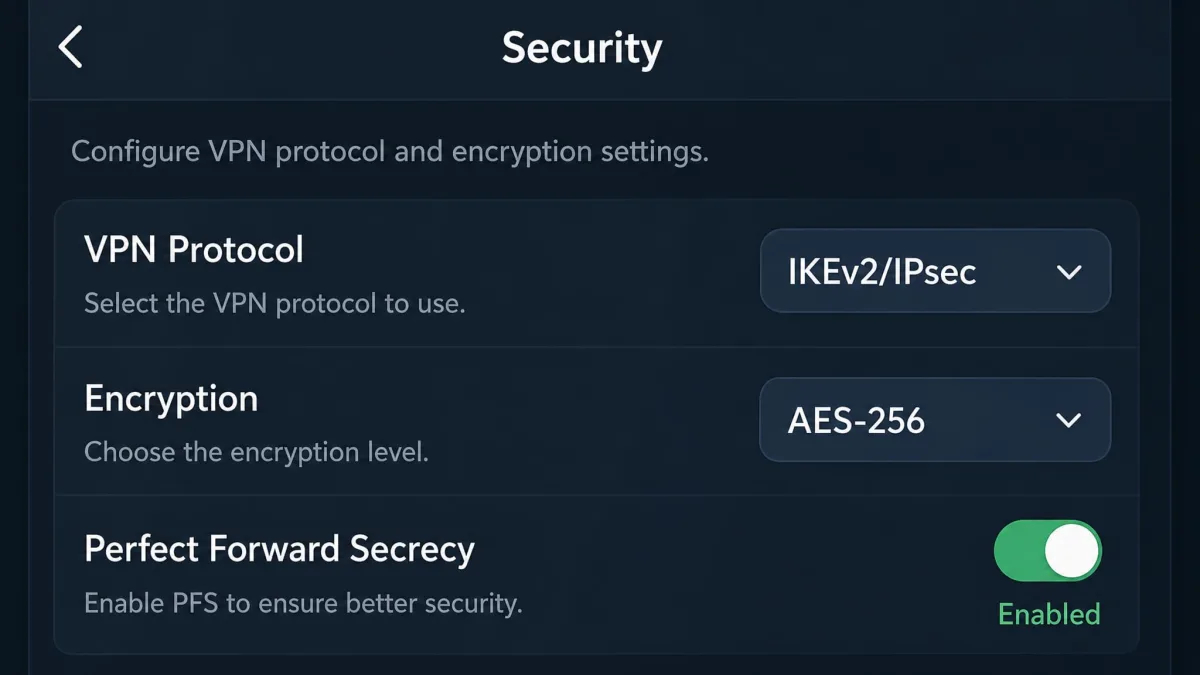
The authentication options are a real strength. Certificate-based authentication using X.509 certificates is well suited to enterprise use, while EAP covers username and password logins. This flexibility lets IKEv2 fit both consumer VPN apps and corporate networks.
The encryption itself leans on well-vetted algorithms. AES is defined in NIST FIPS-197 (AES), and AES-256 remains the standard we look for in any VPN. As long as your provider uses current ciphers and keeps its servers updated, IKEv2 is a sound choice for privacy and security.
What Is IKEv2 Used For? (Device Compatibility)
IKEv2 is used most where mobility matters, which is why it is a favourite for phones and tablets. Its ability to hold a connection across network changes makes it ideal for anyone who moves between Wi-Fi and cellular during the day. It is also common in corporate remote-access VPNs.
Device compatibility is broad on modern systems. IKEv2 has native iOS support since iOS 8 and native macOS support since OS X 10.11, so Apple devices can use it without extra apps. Windows has supported it natively for years, which reflects Microsoft's role in developing the protocol.
Android support is more mixed. Newer Android versions and VPN apps handle IKEv2 well, but coverage across older versions is inconsistent, and some setups rely on third-party clients. If you use Android, it is worth confirming your provider's app supports IKEv2 on your version before relying on it.
IKEv2 Ports (500 and 4500)
IKEv2 uses two UDP ports. It uses UDP port 500 for the initial key exchange and UDP port 4500 for NAT traversal, known as NAT-T. Port 4500 lets IKEv2 work when your device sits behind a router that performs network address translation, which is almost every home network.
These fixed ports are both a convenience and a weakness. They make IKEv2 easy to identify, which is helpful for routing but unhelpful for evasion. A network administrator who wants to block VPNs can simply block UDP 500 and 4500, and IKEv2 traffic stops.
If you are on a network that blocks UDP 500 or 4500, IKEv2 will fail to connect. The same failure can happen when a device clock is badly out of sync or when the server does not support MOBIKE. In those cases, switch to OpenVPN over TCP 443 or WireGuard.
IKEv2 vs Other VPN Protocols
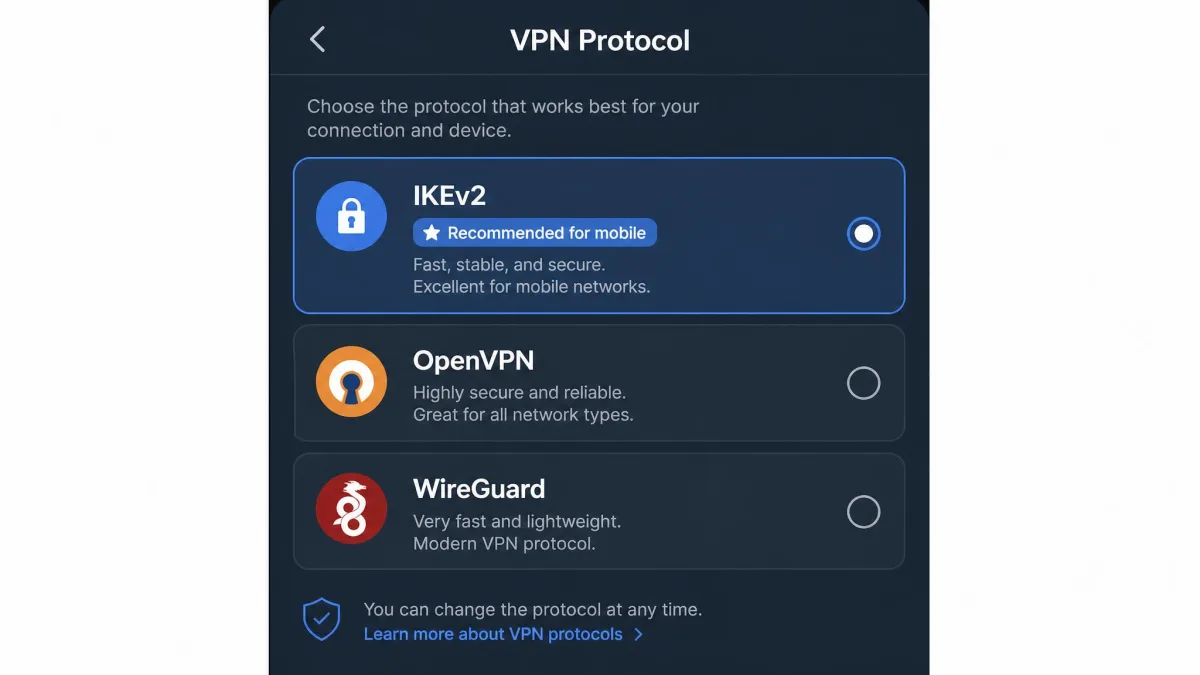
IKEv2 is one of several protocols a good VPN offers, and the right one depends on your network and your priorities. The table below sums up how IKEv2 compares with OpenVPN, WireGuard, and L2TP/IPsec on the factors we weigh most in testing.
| Factor | IKEv2 | OpenVPN | WireGuard | L2TP/IPsec |
|---|---|---|---|---|
| Speed | Fast, very good | Moderate | Fastest | Slow |
| Security | Strong, AES-256 and PFS | Strong, SSL/TLS | Strong, modern crypto | Adequate via IPsec |
| Stability | Excellent, especially mobile | Good | Good, roaming | Moderate |
| Firewall traversal | Weaker, fixed UDP ports | Strong, TCP 443 | Weaker, UDP | Weak, often blocked |
| Platform support | Native on major systems | Broad via apps | Growing, broad | Native, legacy |
| Encryption | AES-256 via IPsec | AES via OpenSSL | ChaCha20 | AES via IPsec |
IKEv2 vs OpenVPN
OpenVPN is the more flexible protocol. It runs over TCP or UDP and, on TCP 443, its traffic blends with normal HTTPS, which makes it far harder to block than IKEv2's fixed ports. It is also open source and available on almost any platform through apps.
Where IKEv2 wins is mobile stability and native speed. It reconnects faster, handles network switches better through MOBIKE, and needs no third-party client on Apple and Windows systems. We tend to pick IKEv2 on phones and OpenVPN on restrictive networks, and we break the trade-offs down further in our IKEv2 vs OpenVPN compared guide.
IKEv2 vs WireGuard
WireGuard is the newer, leaner protocol, and it generally outperforms IKEv2 in raw speed and low latency. In latency-sensitive tasks such as gaming, WireGuard usually has the edge. It runs over UDP and uses fixed modern cryptography, which keeps its codebase small.
IKEv2 still holds its own on stability and native support. It delivers very good, stable speeds even if it does not match WireGuard at the top end, and its MOBIKE mobility handling is excellent. For many phone users, that stability outweighs the raw speed gap, a call we weigh up in our IKEv2 vs WireGuard comparison.
IKEv2 vs L2TP/IPsec
L2TP/IPsec is the older pairing, and IKEv2 improves on it in almost every way. L2TP has no encryption of its own and relies on IPsec, and its double encapsulation makes it slower. It uses UDP 500 and 4500 plus UDP 1701, and it is widely blocked.
IKEv2 is faster, more stable, and more efficient, while offering the same native operating system support that made L2TP popular. There is little reason to choose L2TP/IPsec today if IKEv2 is available on your device and provider.
IKEv2 vs PPTP and SSTP
PPTP is the oldest of these options and is no longer considered secure, so we do not recommend it for any use where privacy matters. IKEv2 is dramatically more secure and only marginally more complex to set up on modern systems.
SSTP, like OpenVPN over TCP 443, can slip through firewalls by using standard HTTPS ports, which is its main advantage over IKEv2. However, SSTP is essentially a Windows-only protocol, whereas IKEv2 has broad native support across platforms and stronger mobile handling.

Frequently Asked Questions
Is IKEv2 safe to use?
Is IKEv2 fast?
What devices support IKEv2?
Can IKEv2 be blocked by firewalls?
Is IKEv2 TCP or UDP?
Does IKEv2 require certificates?
Conclusion
IKEv2 is a fast, secure, and remarkably stable VPN protocol, and its pairing with IPsec gives you strong AES-256 encryption with very little fuss. Its four-message handshake connects quickly, and MOBIKE keeps the tunnel alive as you move between networks, which is why it is such a natural fit for phones.
Its limits are real and worth knowing. The fixed UDP ports 500 and 4500 make it easier for firewalls to block than OpenVPN, and it is harder to disguise on networks that inspect traffic. On older Android versions, setup can be more work than on Apple and Windows systems.
For everyday mobile use, IKEv2 is one of the protocols we recommend first. If you hit a network that blocks it, keep OpenVPN over TCP 443 or WireGuard as a backup, and you will have a fast, secure connection in almost any situation. A good VPN app lets you switch between all three in a couple of taps.