You are staring at the protocol dropdown in your VPN app, and two names keep coming up: IKEv2/IPsec and WireGuard. You want to know which one to leave selected and forget about. Here is the short answer we reached after running both across our test machines: WireGuard is the faster, simpler, modern default, and IKEv2 is the better fit if you live inside Apple's ecosystem, need rock-solid mobile roaming, or plug into an enterprise IPsec setup.
Neither protocol is a product you buy. Both are free and open-source, so this is not a price fight. It is a question of speed, security, mobile behavior, and how much setup pain you are willing to tolerate. We tested both on Windows, macOS, iOS, Android, and Linux, moving between Wi-Fi and cellular, and pushing throughput on wired and congested links.
Before we get into the why, here is the picture at a glance.
IKEv2 vs WireGuard at a Glance (Comparison Table)
If you only read one section, read this one. The table below is the whole debate compressed into nine rows, drawn from how each protocol behaved across our testing.
| Feature | IKEv2/IPsec | WireGuard |
|---|---|---|
| Speed | Fast, but IPsec encapsulation adds overhead | Higher throughput, lower latency in most tests |
| Security/encryption | Configurable, PFS, strong when set well | Modern fixed suite, PFS built in |
| Cipher suite | AES-256-GCM plus SHA-2, negotiable | ChaCha20-Poly1305, Curve25519, BLAKE2s |
| Mobile roaming (MOBIKE) | MOBIKE keeps the tunnel alive across switches | Brief reconnect, no dedicated mobility protocol |
| Firewall resistance | Fixed UDP 500/4500, easy to block | Any UDP port, but UDP-only, no TCP fallback |
| Native OS support | Native on Windows, macOS, iOS | Kernel-native on Linux 5.6+, apps elsewhere |
| Setup ease | Certificates, keys, and policy, more complex | Small readable config, quick |
| Codebase size | Large IPsec suite, orders of magnitude bigger | Roughly 4,000 lines |
| Best for | Apple and mobile-native, enterprise IPsec | Modern default: speed, everyday use, gaming |
Our practical rule: start with WireGuard. It is faster and simpler, and it is the right pick for most people. Only switch to IKEv2 if WireGuard gives you trouble on a specific network, or if your device or employer pushes you toward native IPsec.
What Is IKEv2/IPsec and How Does It Work?
IKEv2 stands for Internet Key Exchange version 2. It is the part that negotiates and manages the secure connection, and it rides on top of IPsec, the suite that actually encrypts and moves your data. When people say "IKEv2" in a VPN context, they almost always mean the IKEv2/IPsec pairing working together.
The protocol is mature. IKEv2 was introduced around 2005 with RFC 4306 and later refreshed by RFC 7296 in 2014. That long history is why it is baked directly into Windows, macOS, and iOS, and why enterprise firewalls and hardware appliances speak it natively.
How IKEv2 Handles Key Exchange, IPsec, and MOBIKE
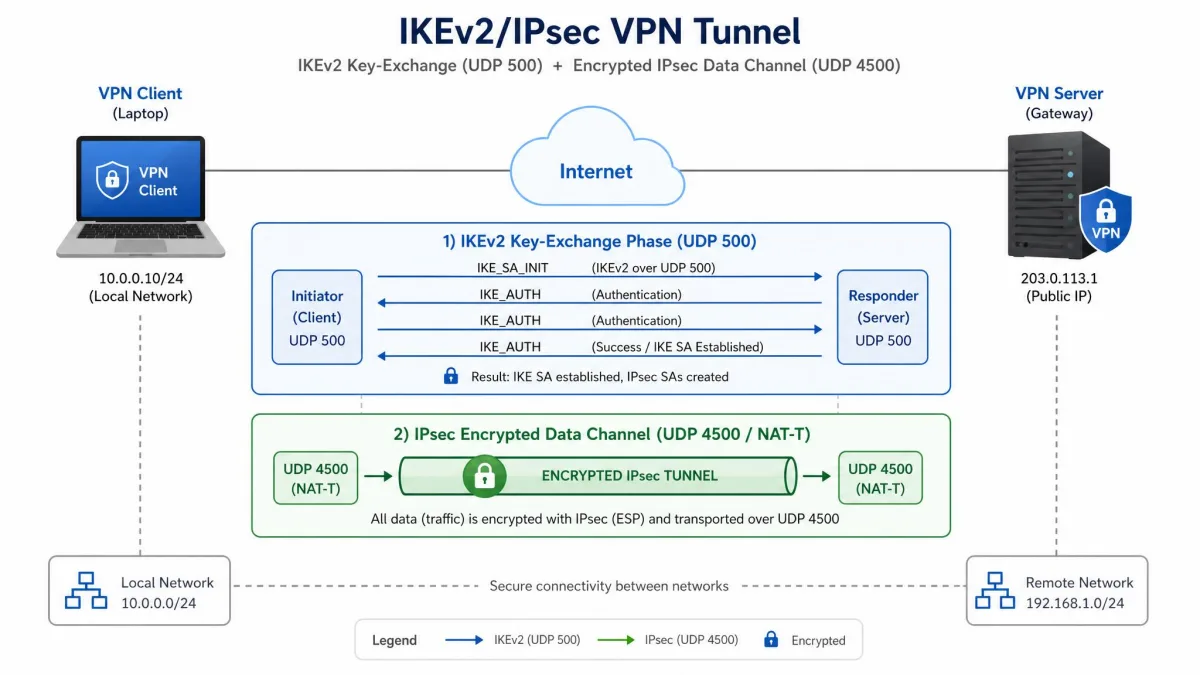
The connection starts with a key exchange over UDP port 500. IKEv2 authenticates both ends, usually with certificates or a pre-shared key, then agrees on the ciphers both sides will use. Once that handshake completes, IPsec takes over the encrypted data channel, and when there is a NAT in the path, traffic shifts to UDP port 4500 for NAT traversal.
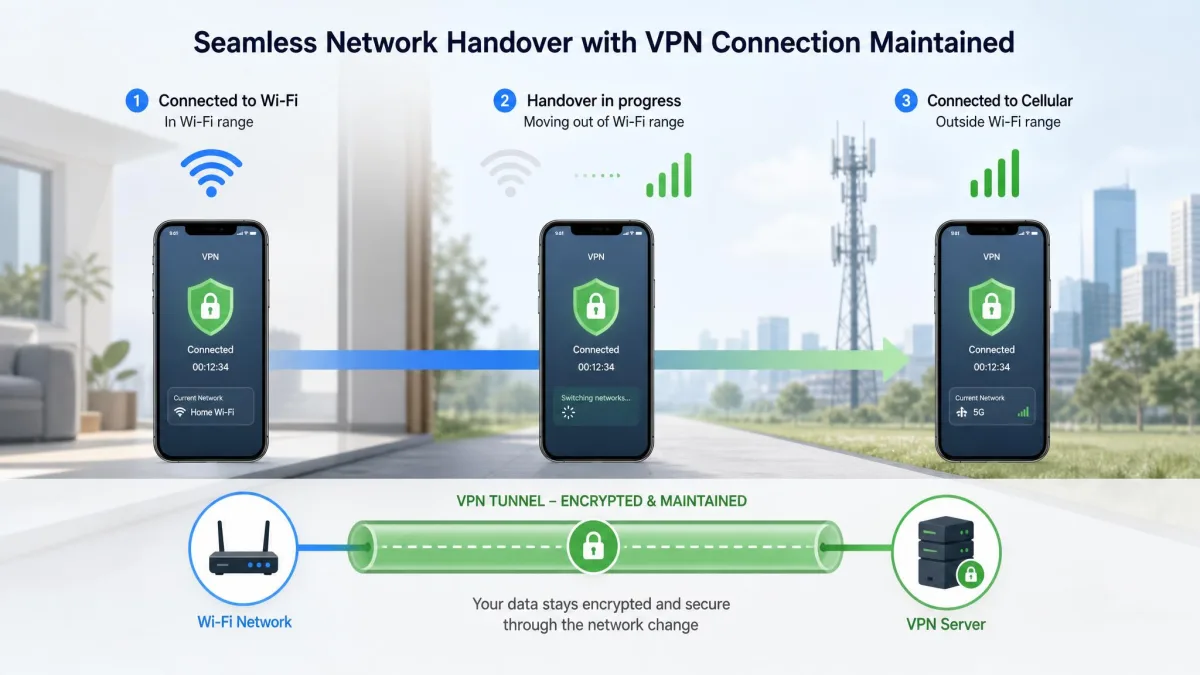
The standout piece is MOBIKE, short for Mobility and Multihoming, defined in MOBIKE (RFC 4555). MOBIKE lets an established tunnel survive a change of network. When your phone hops from Wi-Fi to cellular, the tunnel keeps its identity and simply updates the address, so you do not have to renegotiate from scratch. In our testing that switch was nearly seamless, which is the single biggest reason IKEv2 still wins on mobile.
What Is WireGuard and How Does It Work?
WireGuard is the newer protocol, first published in 2015 and reaching broader release around 2016. It was built to be small, fast, and easy to audit, and it took a very different design path from the sprawling IPsec suite.
The headline number is the codebase: WireGuard is roughly 4,000 lines of code. That is tiny, and it is deliberate. A small codebase means fewer places for bugs to hide and far less for a security researcher to review. The design got a major vote of confidence when WireGuard was merged into the Linux kernel in version 5.6, released in March 2020, making it kernel-native on modern Linux systems.
WireGuard's Fixed Cryptographic Suite (ChaCha20, Curve25519, BLAKE2s)
Where IKEv2 negotiates its ciphers, WireGuard does not. It ships one fixed, non-negotiable cryptographic suite, and that is the point. It uses ChaCha20-Poly1305 for authenticated encryption, Curve25519 for the elliptic-curve key exchange, BLAKE2s for hashing, and SipHash24 for its internal hashtable keys. The whole design is built on the modern Noise protocol framework.
A fixed suite removes a whole class of mistakes. There is no downgrade negotiation to attack and no weak cipher to accidentally leave enabled. If you want the full technical picture, WireGuard's protocol and cryptography page lays out every primitive and why it was chosen. The tradeoff is that upgrading the crypto means upgrading WireGuard itself, which the project accepts in exchange for simplicity.
A fixed cipher suite is not a limitation, it is a feature: there is no downgrade to negotiate, no weak option to misconfigure, and far less code to audit.
Speed and Performance: Which Is Actually Faster?
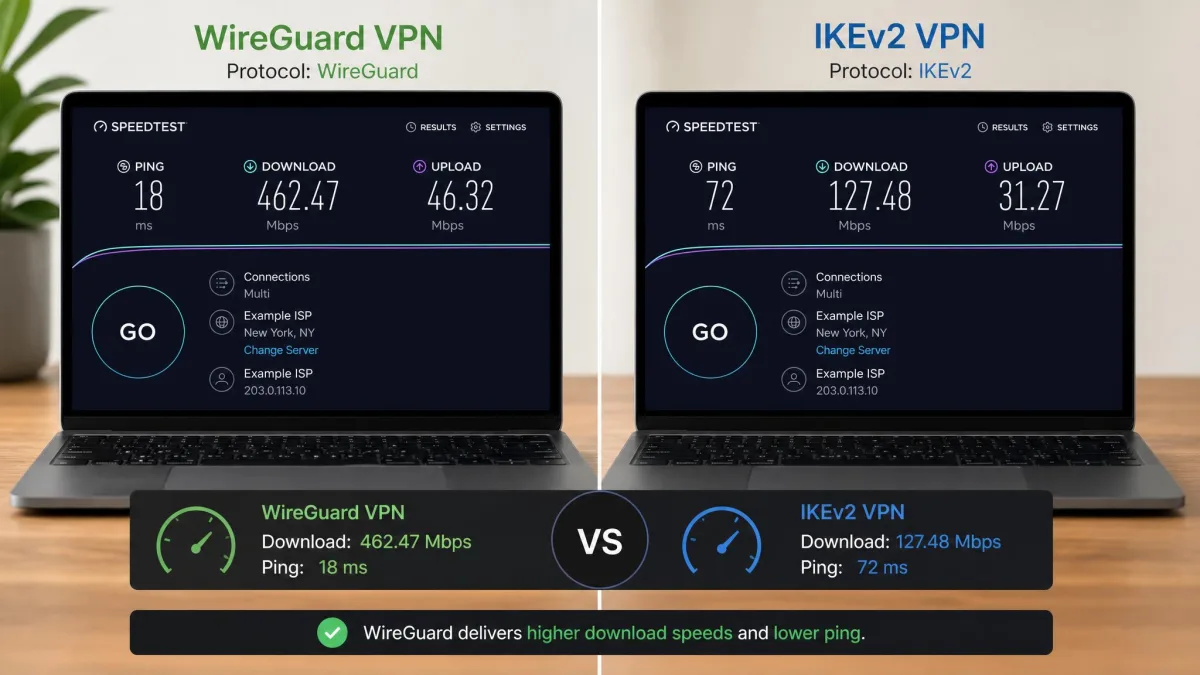
WireGuard is faster. That was true across every like-for-like test we ran, and it matches what the wider community reports. The gap is not always dramatic on a fast wired link, but it is consistent, and it widens on mobile and congested networks.
We are deliberately not quoting hard megabit-per-second figures here, because throughput depends heavily on your hardware, server, and network, and published benchmarks disagree wildly. What holds steady is the direction: WireGuard leads on throughput and latency, and IKEv2 stays competitive but pays a small tax for IPsec encapsulation.
Throughput, Latency, and Handshake Overhead
WireGuard's small, stateless design keeps its handshake cheap and its per-packet overhead low, so more of your bandwidth goes to actual data. IKEv2 does more work per connection: it negotiates ciphers, manages IPsec policy, and wraps traffic in more layers. That overhead is modest on a strong link and more visible on a weak one.
Latency is where the difference shows up for real-world use. WireGuard was the smoother pick for gaming and other low-latency work, while IKEv2 added small but noticeable delays on congested links. If milliseconds matter to you, WireGuard is the safer bet.
CPU Efficiency and Battery on Mobile
The efficiency story carries over to phones. WireGuard felt lighter on battery and CPU during long mobile sessions, while IKEv2 ran a bit warmer under sustained load. On a full day of tethered work, that difference adds up.
This matters more than raw speed for many people. A protocol that sips battery and stays cool is the one you leave on all day without thinking about it, and WireGuard is built for exactly that kind of always-on use.
Security and Encryption Compared
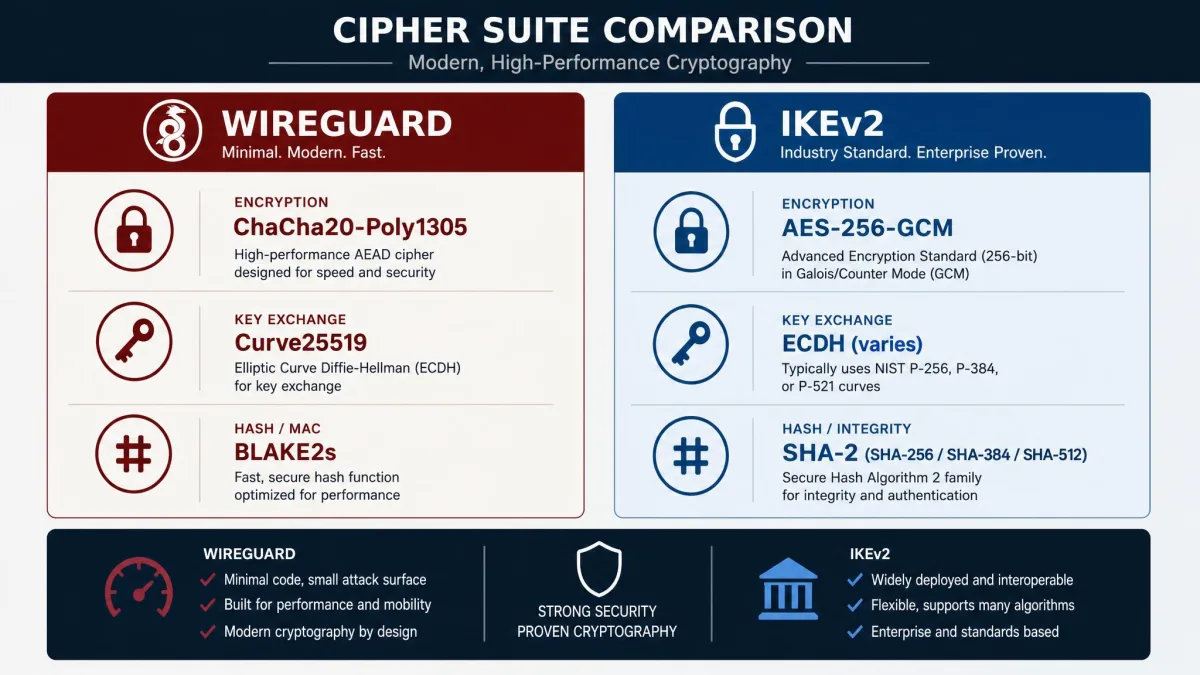
Both protocols are secure when configured correctly. This is not a case of one being safe and the other being dangerous. The real differences are in how each handles ciphers, how much code you have to trust, and how easy each is to get wrong.
Perfect Forward Secrecy is standard on both. That means each session uses fresh keys, so a compromise of one session key does not unlock past or future traffic. Neither protocol asks you to choose between security and modern key handling here.
Cryptography and Cipher Suites
WireGuard's approach is a fixed modern suite: ChaCha20-Poly1305, Curve25519, and BLAKE2s, with no options to tune. IKEv2 is configurable, and AES-256-GCM with SHA-2 family hashing is the commonly recommended pairing. When IKEv2 is set up well, its cryptography is every bit as strong as WireGuard's.
The difference is philosophy. IKEv2's flexibility is useful in enterprise environments that must match specific compliance requirements or interoperate with older gear. WireGuard's rigidity is safer for everyone else, because there is simply nothing to misconfigure.
Codebase Size, Auditability, and Attack Surface
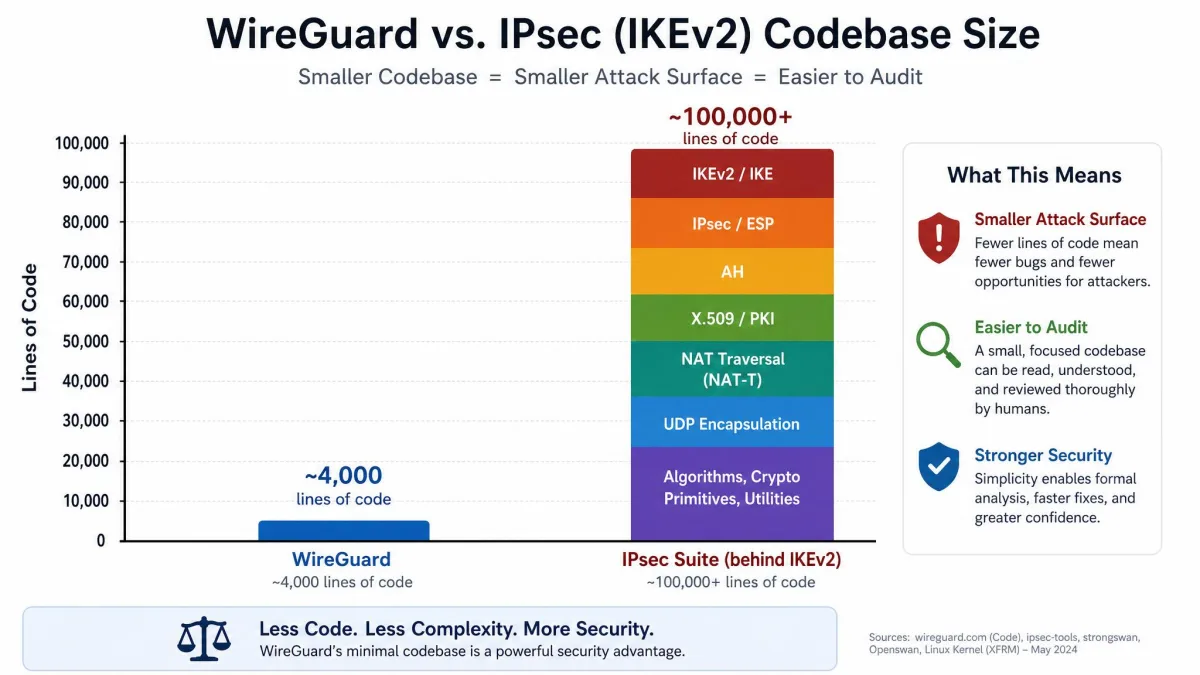
This is WireGuard's clearest structural win. At roughly 4,000 lines, its entire codebase can be read and audited by one person in a reasonable amount of time. The full IPsec suite that IKEv2 relies on is orders of magnitude larger, sprawling across many components and implementations.
More code means more attack surface and more places for a subtle bug to live. That does not make IKEv2 insecure, and its long life means many of those bugs have been found and fixed. But if you value a small, readable, auditable core, WireGuard is built around that principle from the ground up.
Perfect Forward Secrecy and What "More Secure" Really Means
Both protocols provide Perfect Forward Secrecy, so on the pure cryptography question they are close to even. When people ask which is "more secure," what actually separates them is auditability and the chance of human error, not the strength of the ciphers.
By that measure WireGuard has the edge for most users: a smaller codebase, a fixed suite, and less to get wrong. IKEv2 can match it, but it depends more on the person configuring it. One privacy note worth knowing: WireGuard's base design assigns static internal IP addresses to clients, so serious VPN providers add a layer that rotates or masks those addresses to protect no-logging promises.
Mobile and Roaming: Wi-Fi to Cellular Handover
This is the category where IKEv2 earns its keep. Phones constantly switch between Wi-Fi and cellular, and how a protocol handles that switch decides whether your connection feels solid or flaky.
How MOBIKE Keeps IKEv2 Alive on Network Switches
IKEv2 has MOBIKE, and it makes a real difference. When we carried a phone out of Wi-Fi range and onto cellular, the IKEv2 tunnel held open and updated its address without dropping. Apps streaming in the background barely noticed the change. That near-seamless handover is why IKEv2 remains a default on iPhones and why it is a favorite for people who are always on the move.
How WireGuard Reconnects After an IP Change
WireGuard has no dedicated mobility protocol. Because it is stateless, it waits for the next authenticated packet before it re-establishes after an IP change, which means a brief pause of a couple of seconds during the switch. In practice this is minor for browsing or messaging, and WireGuard reconnects almost instantly and stays fast once it does. But for a live call or a session that hates any interruption, IKEv2's smoother handover still feels better.
Compatibility and Platform Support
Both protocols run everywhere that matters now, but they got there differently, and that shapes which one is easier to use on a given device.
Native OS Support (Windows, macOS, iOS, Android, Linux)
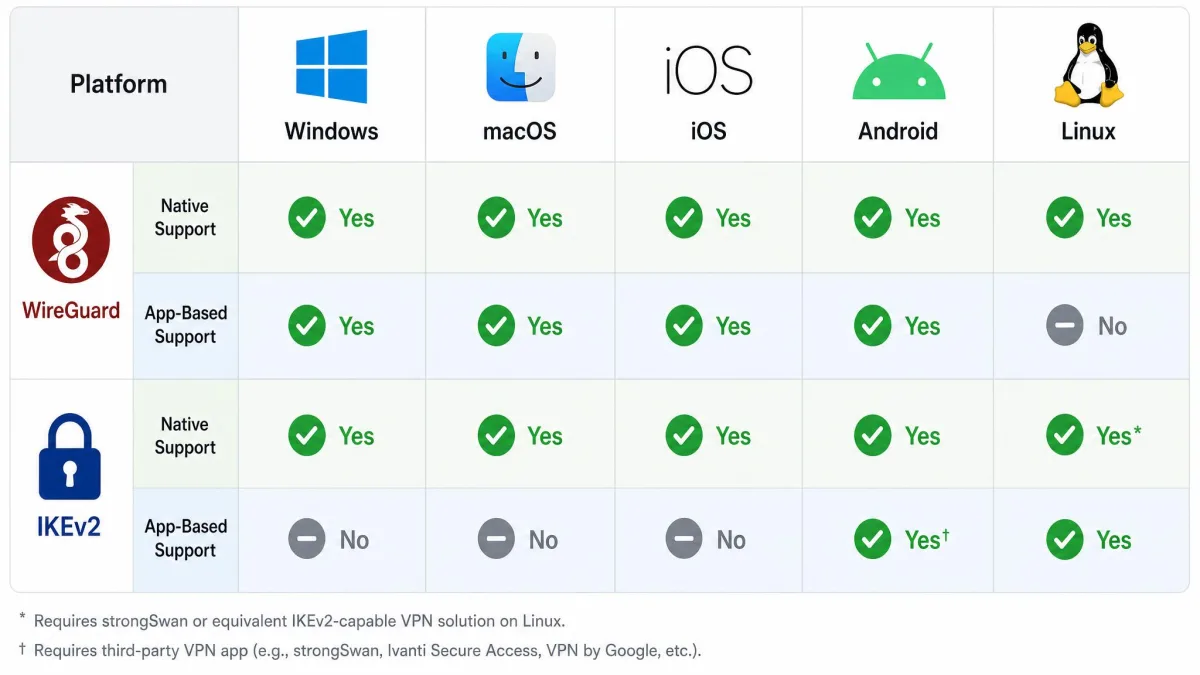
IKEv2 is native on Windows, macOS, and iOS, so it can run without any extra app, which is handy on locked-down or managed devices. WireGuard is kernel-native on Linux since version 5.6 and ships clean, first-party apps for Windows, macOS, BSD, iOS, and Android.
For everyday users the practical difference is small, because most people use their VPN provider's app either way. On Apple hardware IKEv2's native support gives it a slight edge; on Linux, WireGuard's kernel integration makes it the natural choice.
Routers, Firewalls, and Enterprise Appliances
Here IKEv2 has a longer reach. Because IPsec has been an enterprise standard for two decades, firewalls, routers, and dedicated VPN appliances speak it out of the box. If you are connecting to corporate infrastructure, IKEv2 is often what is already there.
WireGuard support on that hardware is growing fast and is excellent on Linux-based routers, but it is newer, so coverage on legacy enterprise gear is less universal. For a home network or a modern router, WireGuard is usually the smoother path.
Firewalls, Ports, and Restrictive Networks
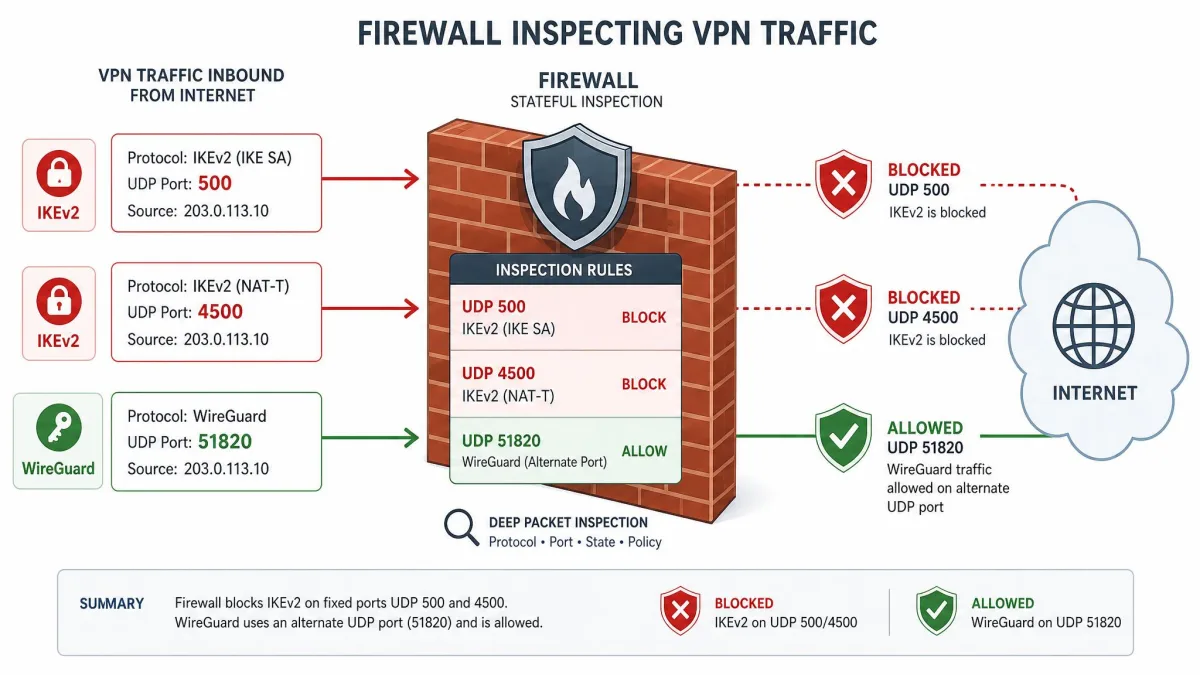
How a protocol behaves on a hostile network can decide whether you connect at all. This is a nuanced category where each side has a real weakness.
IKEv2 traffic is easy to fingerprint because it lives on the fixed UDP ports 500 and 4500. Restrictive firewalls and some ISPs recognize that signature and block or throttle it. WireGuard can move to any UDP port, which helps it slip past simple port-based filtering, but it is UDP-only with no TCP fallback. A network that blocks all UDP stops WireGuard cold.
On heavily censored or UDP-blocking networks, neither protocol is a reliable escape hatch on its own. WireGuard's port flexibility helps against basic filtering, but with no TCP fallback it fails where all UDP is blocked, and IKEv2's fixed ports are an easy target. In those environments you need an obfuscated or TCP-capable protocol, often OpenVPN over TCP 443 or a provider's stealth mode.
There is also a longer-term signal worth noting. Some providers are moving away from IKEv2 in favor of newer protocols, as Proton VPN's IKEv2 phase-out shows. It is not disappearing tomorrow, but the momentum in the industry is clearly toward WireGuard.
Setup and Ease of Use
If you use a commercial VPN app, you may never touch either protocol's configuration. But if you are self-hosting or managing your own tunnels, the difference in effort is large.
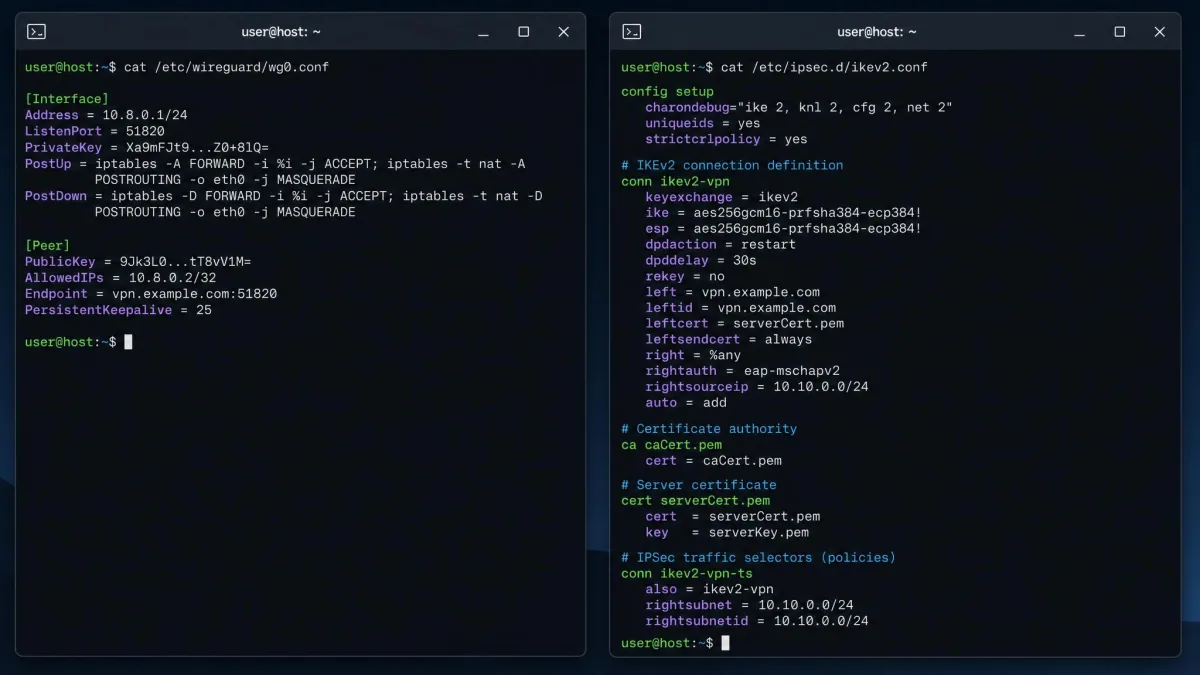
Server Deployment and Configuration Complexity
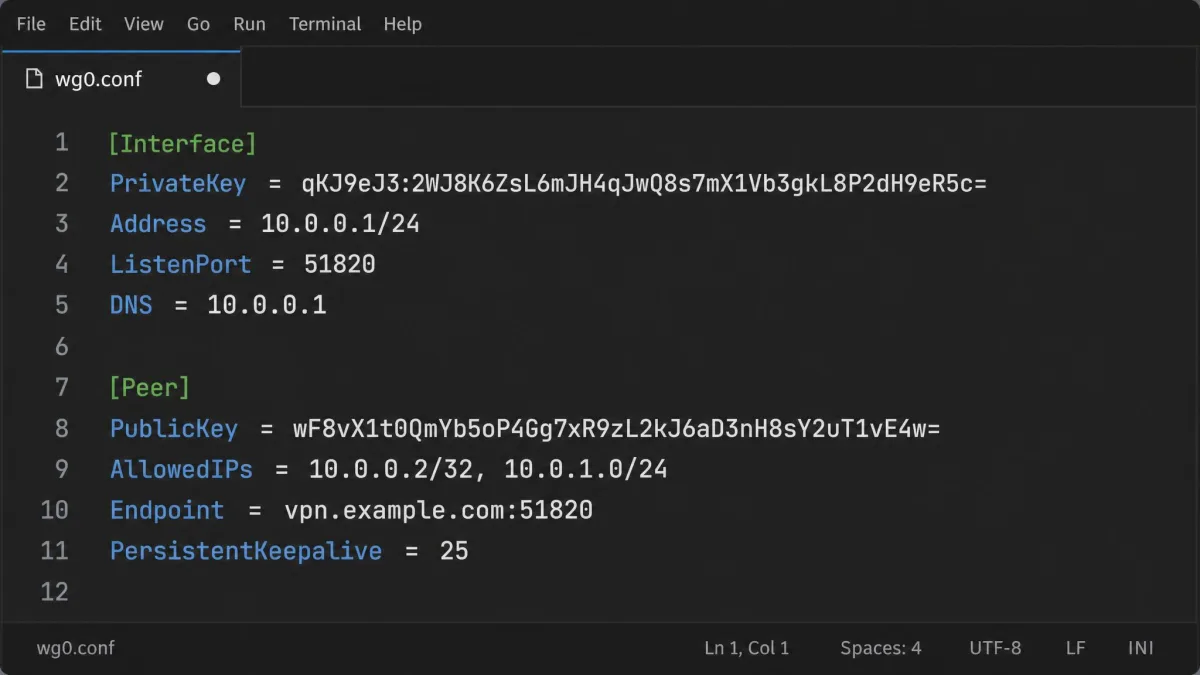
WireGuard's small, readable config makes standing up a tunnel quick once keys are exchanged. You define an interface and a peer, and you are essentially done. We had working tunnels running in minutes, and the config is short enough to read top to bottom and understand completely.
IKEv2 setup is fiddly by comparison. Certificates, keys, and policy configuration mean more moving parts and more chances to misconfigure something. On Linux you typically lean on strongSwan or Libreswan to run it at all. The common IKEv2 failures we see in practice are expired certificates, broken NAT traversal, and weak cipher choices left sitting in a negotiated config.
Key Management Differences
WireGuard uses simple public and private key pairs, and its config is easy to audit at a glance. The one common self-inflicted mistake is setting overly broad allowed-IP ranges, which can route more traffic than you intended, so it is worth checking that field carefully.
IKEv2 leans on a heavier certificate infrastructure, which is powerful for enterprises that already run a certificate authority but is more to manage for an individual. If you want the least key-management overhead, WireGuard wins clearly.
Best Use Cases: When to Choose Each
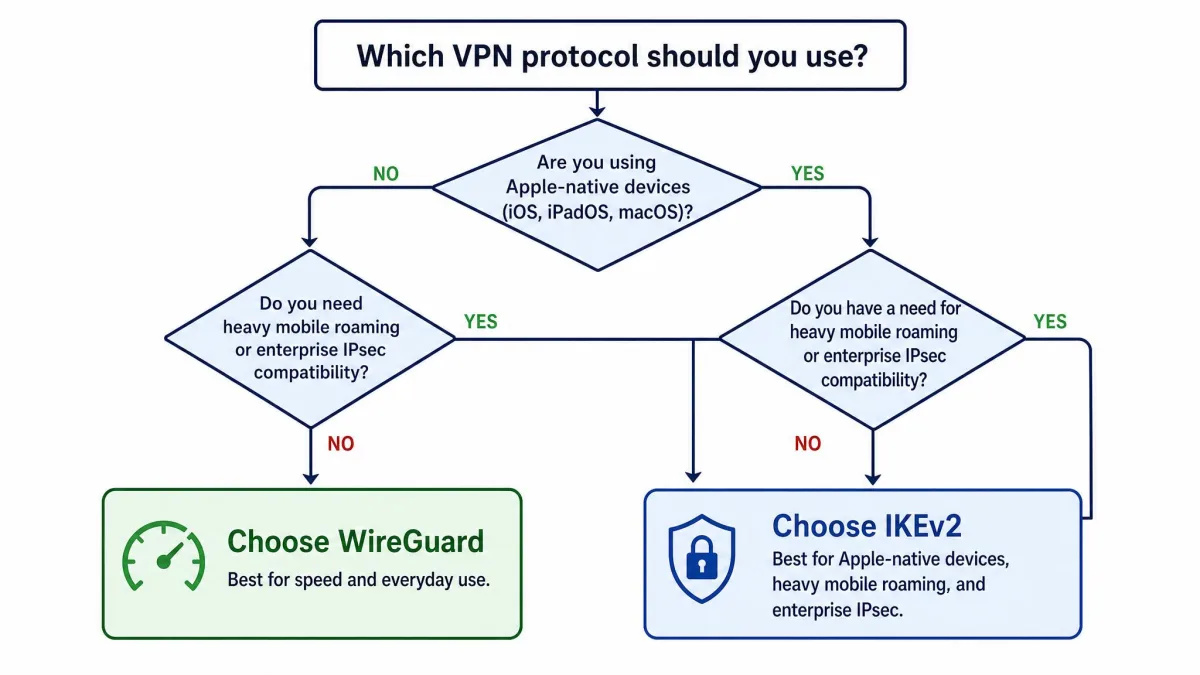
Both protocols are battle-tested and safe. The right choice comes down to your devices, your network, and what you are optimizing for.
Choose WireGuard When
Choose WireGuard when you want the fastest, lightest option for daily use. It is the best pick for gaming and low-latency work, for long mobile sessions where battery matters, and for self-hosting where a simple, auditable config saves you time. On Linux it is the natural default. For most people, most of the time, WireGuard is the answer.
Choose IKEv2 When
Choose IKEv2 when seamless mobile roaming is your top priority, especially on an iPhone where it is native and MOBIKE keeps the tunnel alive across network switches. It is also the practical choice when you connect to enterprise IPsec infrastructure that already supports it, or when you need a protocol built into the operating system without installing an app.
The Verdict: Which Protocol Wins?
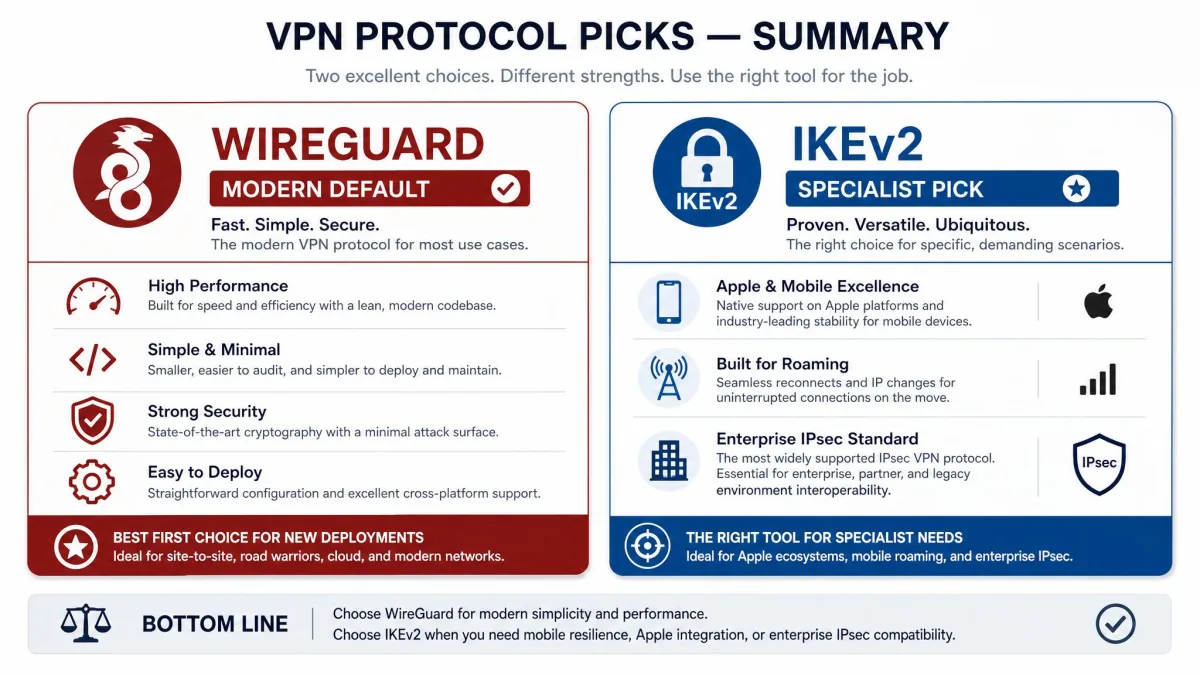
For most people in 2026, WireGuard wins. It is faster, lighter on battery, simpler to set up, and easier to audit, and the whole industry is moving its way. It is the protocol we leave selected by default and recommend you do the same.
IKEv2 is not a loser here. It remains the better choice for seamless mobile roaming, native Apple support, and enterprise IPsec ecosystems, and it will stay relevant for years. But it is now the specialist pick rather than the default.