If you have opened your VPN app's settings and stared at a protocol menu, you have probably wondered whether IKEv2 or OpenVPN is the better choice. Both are mature and secure. Both are used by nearly every major VPN service, so the label alone does not tell you much. The real answer depends on how you connect and what you connect for.
We put both protocols through the same real-world tests we run on every VPN feature. We connect, drop the link, switch networks, and push traffic through restrictive firewalls. In our testing, the two behave very differently once you move past the marketing. One is faster to reconnect and easier to set up on a phone. The other is harder to block and easier to trust when it comes to open code.
This guide breaks down the differences that actually matter, from speed and encryption to MOBIKE roaming and port behavior. It ends with a clear recommendation for each type of user. WireGuard gets a mention too, because for many people it now sits alongside these two as a serious option.
What Is IKEv2 and How Does It Work?
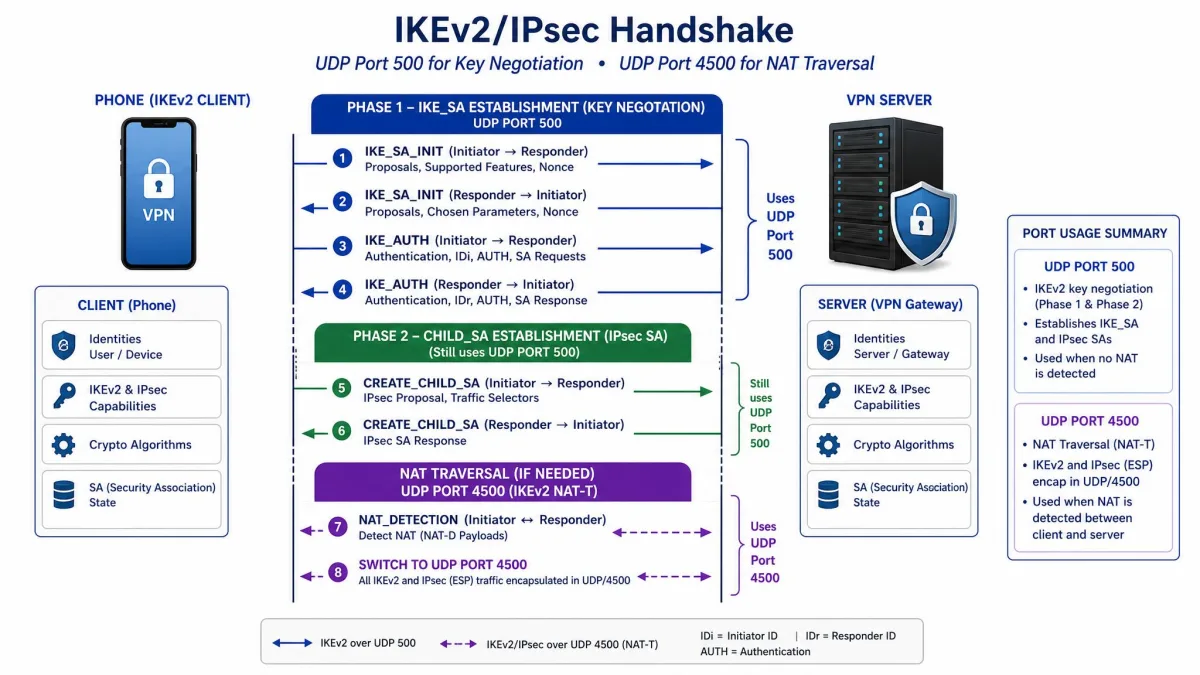
IKEv2 stands for Internet Key Exchange version 2. In a VPN it is almost always paired with the IPsec suite, which is why you often see it written as IKEv2/IPsec. IKEv2 handles the handshake that sets up a secure session and agrees on keys. IPsec then encrypts and moves the actual data. The protocol is defined by the IKEv2 standard (RFC 7296), and it leans on the wider IPsec framework for its encryption work.
IKEv2 was developed jointly by Microsoft and Cisco. That heritage shows in how deeply it is built into modern operating systems. It communicates over UDP port 500 for the key negotiation and UDP port 4500 for NAT traversal. It supports strong AES-256 encryption, typically in the AES-256-GCM mode. On some platforms it runs in kernel space, which keeps CPU use low.
The feature people notice most is MOBIKE, the Mobility and Multihoming Protocol. MOBIKE is what lets an IKEv2 tunnel survive a change of network without dropping. We will come back to why that matters so much on a phone.
What Is OpenVPN and How Does It Work?
OpenVPN is an open-source protocol that has been the default for privacy-focused VPNs for well over a decade. Its code is fully open and publicly reviewable. That means independent researchers can audit exactly what it does. For a lot of security-minded users, that transparency is the whole reason they choose it.
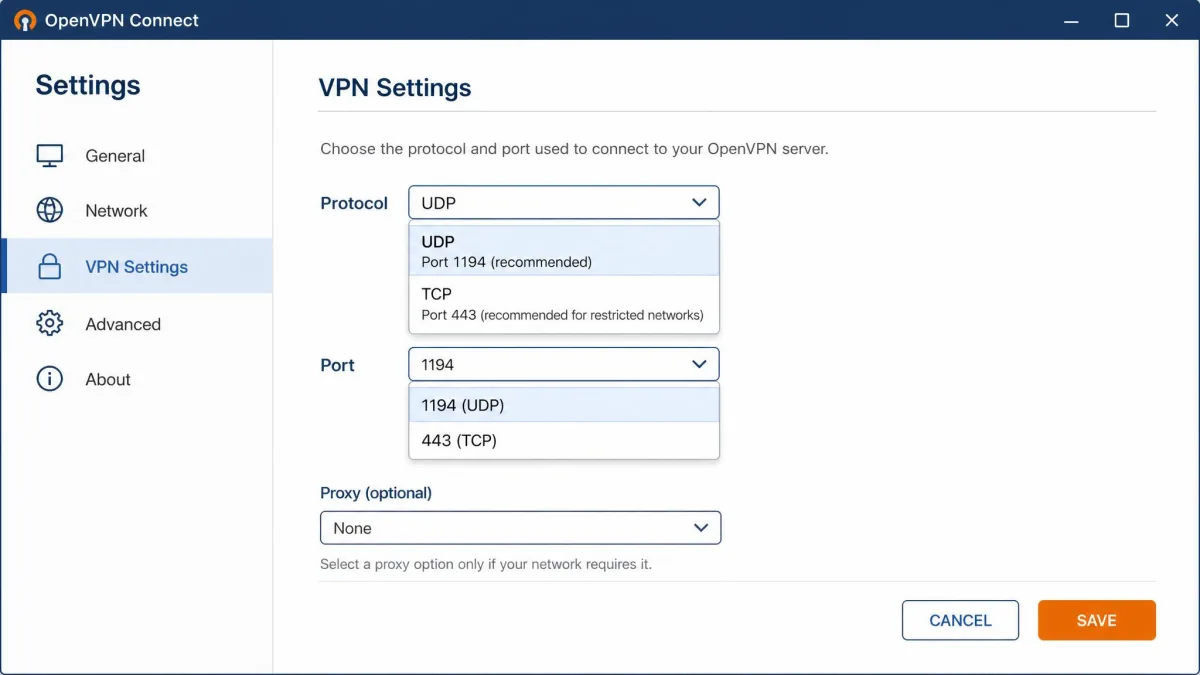
The other thing that defines OpenVPN is flexibility. It can run over either UDP or TCP, on almost any port. Most services use UDP 1194 by default for speed. But OpenVPN can also run on TCP port 443, the same port normal HTTPS web traffic uses. That single trick is why it is so good at slipping past firewalls. For encryption it uses the OpenSSL library, which gives it AES-256 support plus a wide range of other ciphers including ChaCha20 and Camellia.
The trade-off is setup. OpenVPN is not built into any operating system, so it always needs a dedicated app or manual configuration. Historically it also ran in user space, which used more CPU than IKEv2. That gap has narrowed since Data Channel Offload arrived in 2023, moving encryption into the kernel, though the real-world gains depend heavily on your hardware, cipher, and VPN provider.
Similarities Between IKEv2 and OpenVPN
Before the differences, it helps to know how much these two protocols have in common. A lot of the "which is safer" worry disappears once you see it.
Both are mature and battle-tested. Both are offered by nearly every major VPN provider, and both are considered secure choices in 2026. They also share the same core cipher, so the strength of the tunnel itself is effectively the same. Neither has a known, practical weakness that should scare you off. When it comes to keeping your traffic private from your internet service provider or a public Wi-Fi snoop, either one does the job well.
IKEv2 vs OpenVPN: Key Differences at a Glance
The interesting part is where they diverge. We tested each of these areas the same way, and the results line up consistently.
Speed and Performance
IKEv2 is generally the faster of the two, with lower overhead. Part of that comes from its ability to run in kernel space on some platforms, which uses less CPU than OpenVPN's traditional user-space operation. In our testing, IKEv2 tends to feel snappier, especially for real-time activity.
That said, the raw speed gap has narrowed in practice. OpenVPN's Data Channel Offload closed much of the distance. Both protocols now handle streaming and large downloads comfortably on a modern connection. We avoid quoting exact Mbps figures because they swing wildly with your hardware and the specific server you connect to. But the direction is steady. IKEv2 is typically a little leaner, while OpenVPN is fast enough that most people will not notice a difference day to day.
Security and Encryption
On paper this is close to a draw. Both protocols use AES-256, and both are trusted by security professionals. The meaningful difference is transparency. OpenVPN is fully open-source, so its code can be and has been audited in the open. IKEv2 is standards-based and defined publicly in RFC 7296. But the client stacks that ship inside Windows and other systems are often proprietary Microsoft and Cisco implementations. IKEv2 itself is not closed-source. The common versions of it are simply not as openly reviewable as OpenVPN.
On a network that actively blocks VPNs, the fix is often just one setting: switch to OpenVPN over TCP port 443 and your traffic starts to look like ordinary HTTPS.
— From our hands-on protocol testing
Connection Stability and Mobility (MOBIKE)
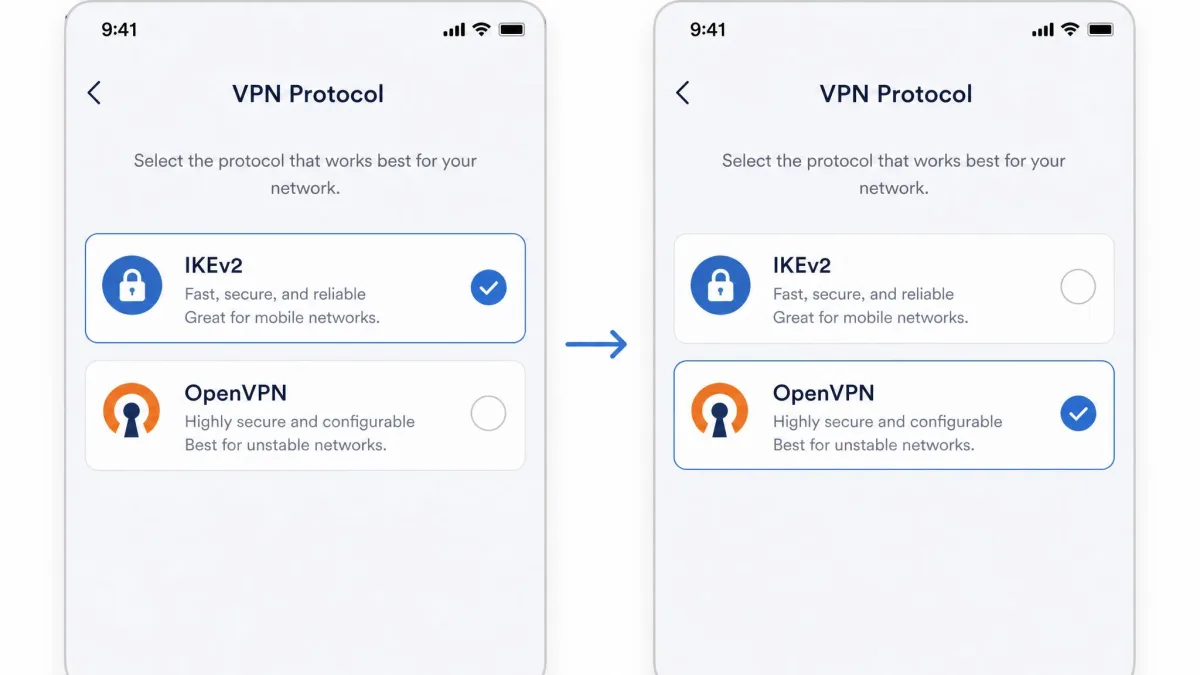
This is where IKEv2 pulls clearly ahead for mobile users. Thanks to MOBIKE, an IKEv2 tunnel holds the connection when you switch between Wi-Fi and cellular. In our testing, walking out of the house and off the home network barely registered on IKEv2. OpenVPN, by contrast, pauses to reconnect on a network change. It can also be slow to re-establish the tunnel after any drop. IKEv2 reconnects almost instantly. If you move between networks often, this single behavior can decide the whole comparison for you.
Firewall and Censorship Resistance (Ports)
Here the roles flip. OpenVPN can run on TCP port 443 and blend in with normal HTTPS traffic, so it gets through restrictive networks that block VPNs. IKEv2 uses fixed UDP ports 500 and 4500, which are easy for a firewall to spot and block. On networks that actively filter VPN traffic, OpenVPN on TCP 443 often connects when IKEv2 simply fails.
If you are on a school, office, or hotel network that blocks VPNs, switch your app to OpenVPN over TCP port 443 before you assume the VPN itself is broken. The fixed UDP ports IKEv2 relies on are the first thing restrictive firewalls tend to block.
Device and OS Compatibility
IKEv2 is built natively into Windows, macOS, iOS, and Android, so it works out of the box with no extra app. That native support makes it especially easy to set up on a phone. OpenVPN requires a dedicated app or manual configuration on every platform. That creates more friction, particularly for non-technical users. On the other hand, OpenVPN's compatibility is broader overall, reaching legacy systems and routers that IKEv2 does not. IKEv2 is also not natively supported on Linux without third-party packages such as strongSwan.
Streaming, Gaming, and Everyday Use
For streaming and large downloads, both protocols are fine on a modern connection. For gaming and other real-time use, IKEv2 tends to feel more responsive. OpenVPN in TCP mode feels slower because of its error-correction overhead. So if you care about latency, IKEv2 or OpenVPN in UDP mode is the better call. For everyday browsing, the choice mostly comes down to which one connects reliably on your network.
Pros and Cons of IKEv2
Pros
- Reconnects almost instantly after a dropped connection
- Holds the tunnel when switching between Wi-Fi and cellular thanks to MOBIKE
- Built natively into Windows, macOS, iOS, and Android for easy setup
- Generally faster with lower overhead and low CPU use
Cons
- Fixed UDP ports 500 and 4500 are easy for firewalls to block
- Common implementations are proprietary, not openly auditable
- Not natively supported on Linux without extra packages
Pros and Cons of OpenVPN
Pros
- Fully open-source with publicly reviewable, audited code
- Runs on TCP port 443 to bypass firewalls and censorship
- Very broad compatibility, including legacy systems and routers
- Flexible transport over UDP or TCP on almost any port
Cons
- Slower to reconnect and pauses on a network change
- Requires a dedicated app or manual setup on every platform
- TCP mode adds latency that hurts real-time activities
IKEv2 vs OpenVPN: Side-by-Side Comparison Table
| Feature | OpenVPN | IKEv2/IPsec |
|---|---|---|
| Speed | Fast, faster with DCO | Generally faster, lower overhead |
| Security/Encryption | AES-256-GCM via OpenSSL | AES-256-GCM via IPsec |
| Open Source | Yes, fully open | Standards-based (RFC 7296), often proprietary implementations |
| Firewall Bypass | Strong, TCP 443 mimics HTTPS | Weaker, fixed ports are blockable |
| Native OS Support | Requires a separate app | Built into Windows, macOS, iOS, Android |
| Mobile Roaming (MOBIKE) | No native equivalent | Yes, via MOBIKE |
| Configuration | More involved, third-party app | Simpler, especially on mobile |
| Compatibility | Very broad, includes legacy systems | Major modern OSes, not native on Linux |
| Ports | UDP 1194, TCP 443, almost any | UDP 500 and UDP 4500 |
How to Choose the Right Protocol for Your Needs
There is no single winner. The honest answer is that it depends on how you connect. Here is how we would decide.
When to Use IKEv2
Choose IKEv2 if you are mostly on a phone or tablet and move between Wi-Fi and mobile data throughout the day. Its native support means setup is quick, and MOBIKE keeps the connection alive when you switch networks. It is also the better default for gaming and anything latency-sensitive. And it suits anyone who just wants a fast, reliable tunnel that reconnects the moment the signal comes back.
When to Use OpenVPN
Choose OpenVPN if you are on a network that blocks VPNs. Running it over TCP port 443 is the most reliable way through a firewall. It is also the pick for privacy-focused users who want fully open, auditable code rather than a proprietary stack. And it is the choice for anyone connecting older devices or a router that IKEv2 does not natively support.
When to Consider WireGuard Instead
WireGuard is the newer, lightweight option that many VPNs now offer alongside these two. It has a much smaller codebase, uses the modern ChaCha20 cipher, and is often the fastest of the three. If your VPN supports it and you want speed with a simple, modern design, WireGuard is well worth trying. It does not yet match OpenVPN's firewall evasion, but for everyday speed it is hard to beat.
WireGuard's small codebase makes it easier to audit than either older protocol, and its performance is excellent. If raw speed is your priority and your provider offers it, test WireGuard against IKEv2 on your own connection before settling.
Frequently Asked Questions
Is IKEv2 being "proprietary" an actual security risk?
Why does IKEv2 reconnect faster?
Can my network block IKEv2 but not OpenVPN?
Which is better for mobile?
Which protocol should I pick for 4K streaming on a network that blocks VPNs?
Should I use IKEv2 or WireGuard?
Conclusion: The Bottom Line
Neither protocol is a bad choice, and that is the point. If you live on your phone and hop between networks, IKEv2 is the easier, faster-reconnecting pick. If you value open code or need to get through a firewall, OpenVPN is the one to reach for. Most quality VPNs offer both. So the smartest move is to keep IKEv2 as your daily default and switch to OpenVPN on TCP 443 whenever a network fights back.