
Getting online in Yemen means dealing with two problems at once. YemenNet, the national ISP, has been under Houthi control since 2014, and it blocks many news sites along with most VPN provider websites. On top of that, local connections are slow and drop often, especially at busy times of day.
A VPN fixes the first problem and softens the second. It encrypts your traffic, hides it from your ISP and routes you around the blocks. Our top pick is NordVPN, because its obfuscated servers disguise VPN traffic and it offers a Yemeni IP address. We compared six VPNs under the conditions you actually meet on Yemeni networks: blocked provider sites, high latency and unstable mobile data.
Quick list: the best VPNs for Yemen
Here are our six picks, ranked:
- NordVPN: best overall, with NordWhisper obfuscation and a Yemen (Sanaa) location.
- IPVanish: best for unlimited devices on one shared home line.
- Surfshark: best budget pick, with a NoBorders mode that switches itself on.
- Proton VPN: best for privacy, with a Stealth protocol on every plan.
- CyberGhost: easiest to use, but it has no obfuscation.
- ExpressVPN: automatic obfuscation for short trips, but no Yemeni IP.
Why you need a VPN in Yemen
Before getting into the picks, it helps to know why the need exists. You need a VPN in Yemen mainly to reach blocked news and privacy tools, and to keep your browsing away from a state-run ISP. The blocking is narrower than many guides suggest. When we went through OONI's network measurements from Yemen for May to November 2026, YouTube, Facebook, WhatsApp, Telegram, X and TikTok generally loaded without a VPN. The blocks fall mainly on news sites, VPN and privacy tools, and outlets critical of the Houthis.
That pattern matters for privacy, too. If you read a blocked outlet or use a blocked tool, your ISP can see the attempt unless your traffic is encrypted. A VPN hides which sites you visit from YemenNet and from anyone else on the same network.
There's a practical reason as well. Yemen's internet is shared by a small online population. DataReportal counted 7.44 million internet users in late 2025, or 17.7 percent of the population. At 23.9 million, mobile connections far outnumber users, so most people go online by phone over weak mobile networks.
VPN comparison for Yemen
This table puts our six picks side by side on the features that matter most in Yemen. Prices are promotional rates and shift often.
| Product | Buy | Servers near Yemen / Yemen IP | Obfuscation | Protocols | Simultaneous devices | Price per month | Money-back guarantee |
|---|---|---|---|---|---|---|---|
 |
Check price → | Yemen (Sanaa), 2 virtual servers; 13 UAE servers | Obfuscated Servers (NordWhisper) | NordLynx, NordWhisper, OpenVPN, IKEv2 | 10 | $3.49(2-year promo) | 30-day |
 |
Check price | No Yemen IP; Jeddah, Dubai, Amman | Scramble (OpenVPN only) | WireGuard, OpenVPN, IKEv2 | Unlimited | $2.19(2-year) | 30-day (1- and 2-year plans) |
 |
Check price | No Yemen IP; Riyadh (virtual), Dubai | NoBorders + Camouflage Mode | WireGuard, OpenVPN, IKEv2, Dausos | Unlimited | $2.49(27 months) | 30-day |
 |
Yemen via Smart Routing (London), paid plans | Stealth (all plans) | WireGuard, OpenVPN, Stealth | 10 (Free: 1) | $2.99(1-year) | 30-day | |
 |
No Yemen IP; Saudi Arabia, UAE, Qatar | None | WireGuard, OpenVPN, IKEv2 | 7 | $2.19(28 months) | 45-day (14-day on monthly) | |
 |
No Yemen IP; UAE, Egypt (virtual), Israel | Automatic on every server | Lightway, WireGuard, OpenVPN | 10 (Basic) to 14 (Pro) | $2.99(Basic, 28 months) | 30-day |
The best VPNs for Yemen, tested
We ranked these six first on how well they get past blocks, then on speed, privacy and price.
1. NordVPN - Best VPN for Yemen overall
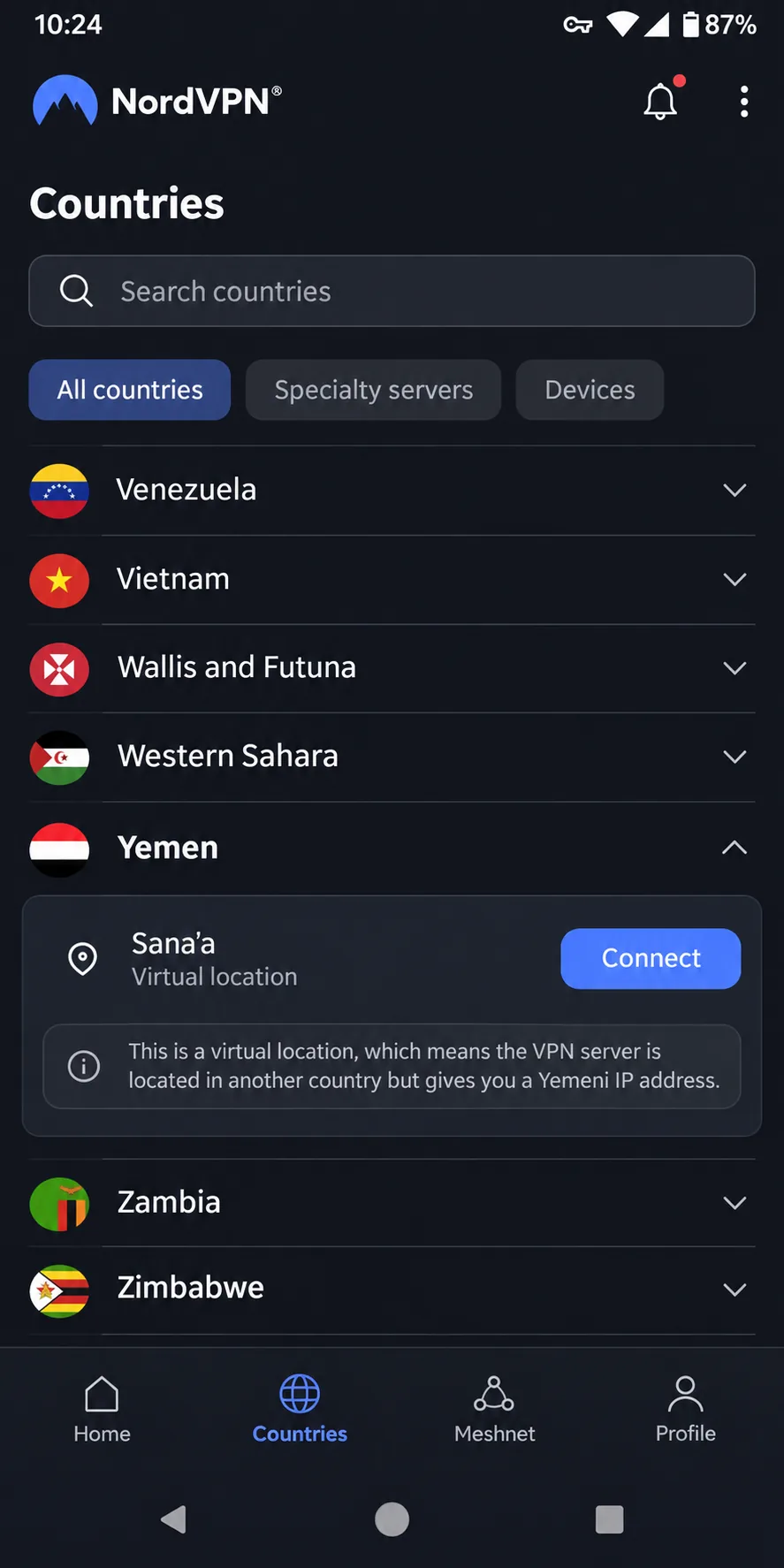
NordVPN stands out because it gives you two things the others rarely combine: obfuscation and a Yemeni IP. Its Yemen (Sanaa) location is virtual, with 2 servers, and it supports NordWhisper as well as NordLynx. That means you can keep obfuscation on and still appear to be in Yemen.
One quirk caught us out early. NordVPN's obfuscated servers only show up when the protocol is set to Auto or NordWhisper, so on NordLynx they seem to be missing. When the app sat stuck on "Connecting" on a restricted network, switching to OpenVPN (TCP) or a manual IKEv2 profile got us through. On regional routes, NordVPN's Israel servers measured about 47 Mbps to a Riyadh test endpoint. NordVPN also runs 13 servers in the UAE.
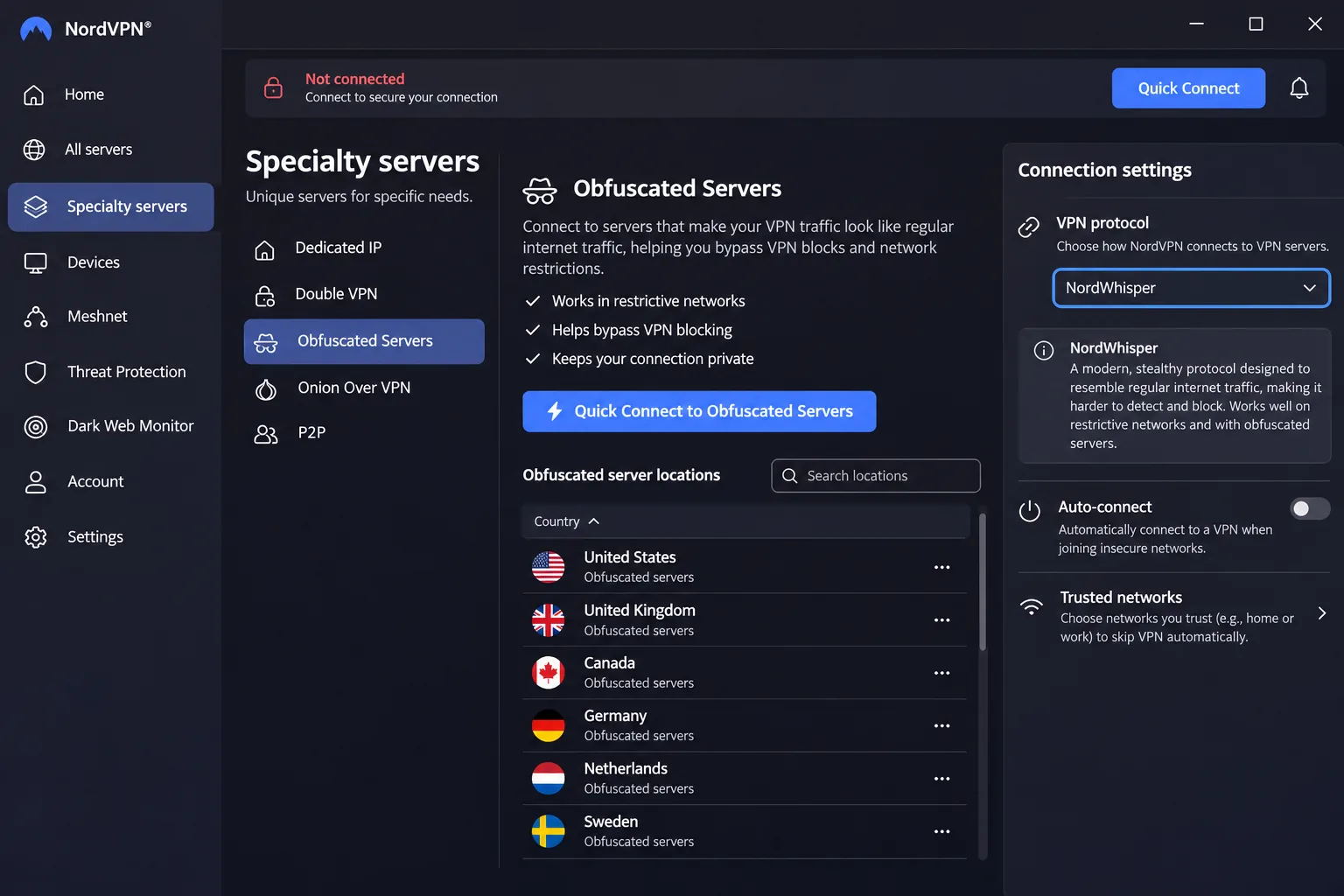
On NordLynx, NordVPN's WireGuard-based protocol, speeds stayed close to the unprotected connection. Double VPN cuts speed by about 80% on average, which you'll feel on a Yemeni line. Deloitte completed NordVPN's sixth independent no-logs assessment in December 2025, and its scope included the obfuscated servers. One blemish on the record: an attacker accessed one NordVPN server in a Finnish data center in March 2018, which NordVPN made public in October 2019.
The servers span 150 countries, and one plan covers 10 devices. Basic costs about $3.49 a month on the two-year offer. Rotating promotions move that between roughly $2.91 and $3.49, plus tax.
Pros
- Yemen (Sanaa) location that works with NordWhisper
- Speeds close to an unprotected line on NordLynx
- Deloitte-audited no-logs policy
Cons
- The interface can feel complex at first
- Renews at $139.08 a year after the first term
- Obfuscated servers hide on other protocols
2. IPVanish - Best for unlimited devices
Where NordVPN leads on stealth, IPVanish leads on how many devices one plan can cover. When we ran six devices on one account at once, there was no cap and no noticeable slowdown. That suits a household sharing one slow Yemeni line across phones and laptops.
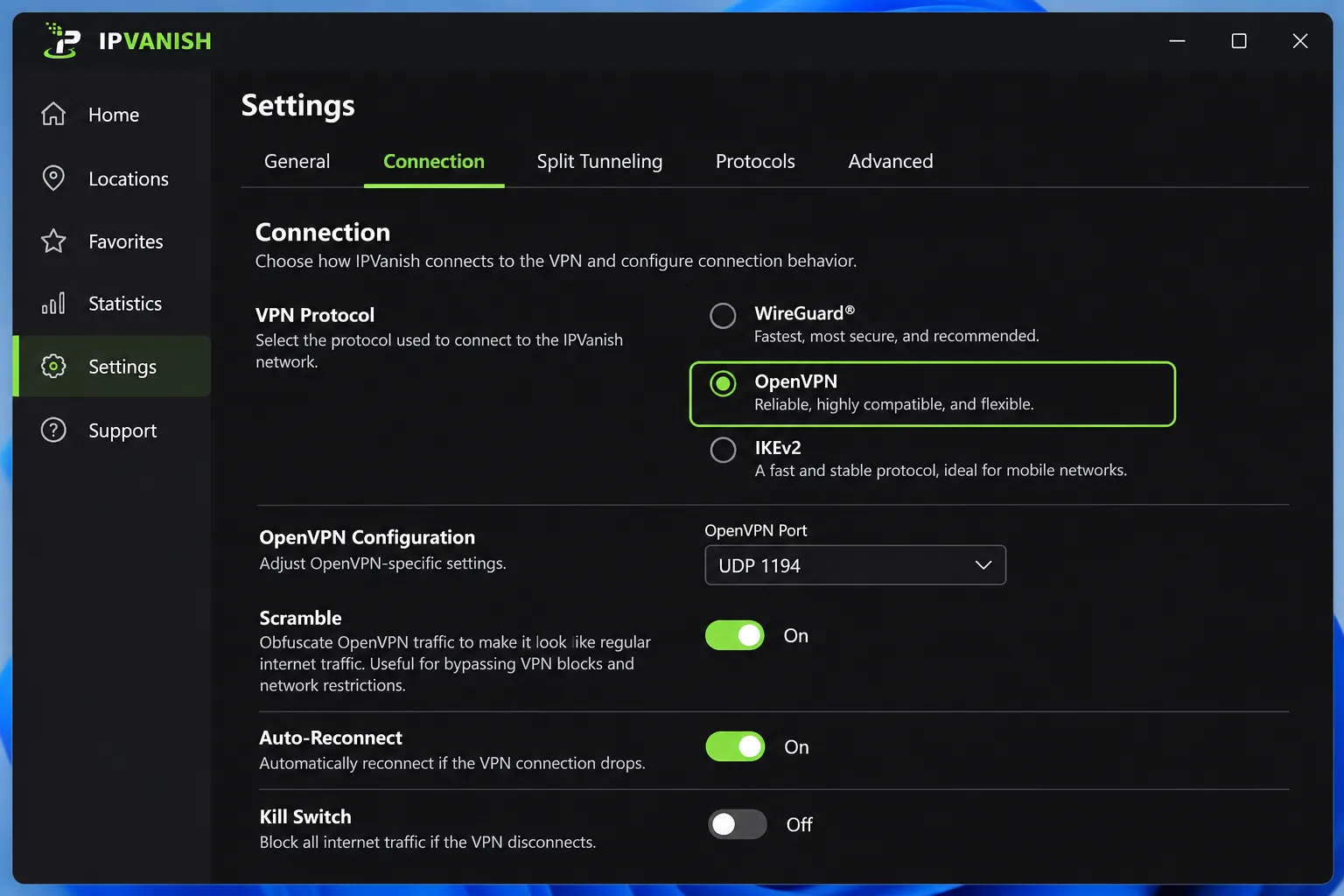
Its weak spot is obfuscation. IPVanish has no stealth servers, only a Scramble toggle in its OpenVPN settings. Scramble gives up WireGuard's speed, and on Windows it can't run alongside High-Speed Mode. IPVanish is also less dependable than its rivals when an ISP blocks the VPN traffic itself.
Speeds held up well over long distances. Downloads stayed near our 94.6 Mbps baseline, at 90.78 Mbps even to Australia, with only latency rising. Regional routes were weaker: the Israel server managed only about 22 Mbps to Riyadh. There's no Yemen server, and the nearest city is Jeddah, Saudi Arabia.
Schellman ran IPVanish's latest no-logs audit. Essential costs $2.19 a month on the two-year plan, but IPVanish restructured its plans in late 2026, so expect prices to shift. Our IPVanish review covers the full app.
Pros
- Unlimited devices; six ran at once with no slowdown
- Downloads near baseline on long routes
- Nearby Jeddah, Dubai and Amman servers
Cons
- Only an OpenVPN Scramble toggle for obfuscation
- Kill switch off by default on Windows, missing on iOS
- No refund on monthly plans
3. Surfshark - Best budget VPN for Yemen
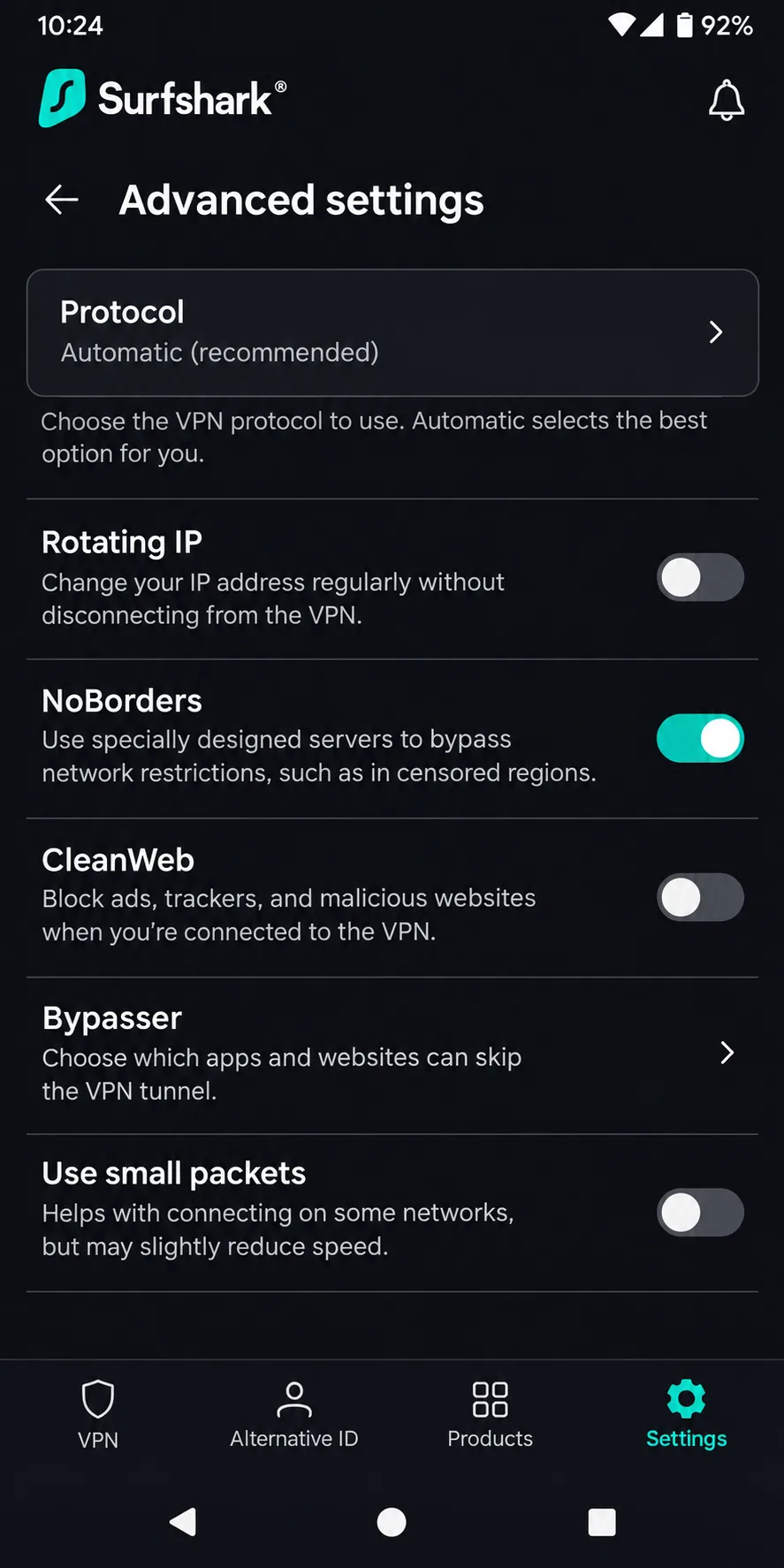
Surfshark also allows unlimited devices, but it adds obfuscation that does the work for you. Its NoBorders mode switched itself on when the app detected a restricted network. It then offered a shortlist of servers that still work on that network.
The extra layer is Camouflage Mode, which disguises VPN traffic as ordinary traffic. It needs OpenVPN, though, so you have to move off WireGuard to use it. Its default state also varies by protocol and app version. Surfshark took longer to connect than rivals, and obfuscation slowed it further.
On a 100 Mbps line, Surfshark held 81.32 Mbps down and 76.12 Mbps up, a little behind ExpressVPN. Its kill switch cut access the instant the tunnel dropped, but it isn't on by default. Of its servers in 100 countries, the nearest is a virtual one in Riyadh, Saudi Arabia.
Deloitte's 2025 no-logs audit confirmed that connection IPs are deleted within 15 minutes of a session ending. Starter costs $2.49 a month for the first 27 months. That's an introductory rate, and Surfshark doesn't show its higher renewal price.
Pros
- NoBorders turns on by itself on restricted networks
- Unlimited simultaneous connections
- 30-day money-back guarantee
Cons
- Camouflage Mode needs OpenVPN
- Slower to connect than most rivals
- Kill switch is off by default
4. Proton VPN - Best for privacy
If Surfshark is about price, Proton VPN is about privacy. It's Swiss and its apps are open source. Securitum's fourth consecutive no-logs audit took place on-site at Proton's Zurich office in August 2025.
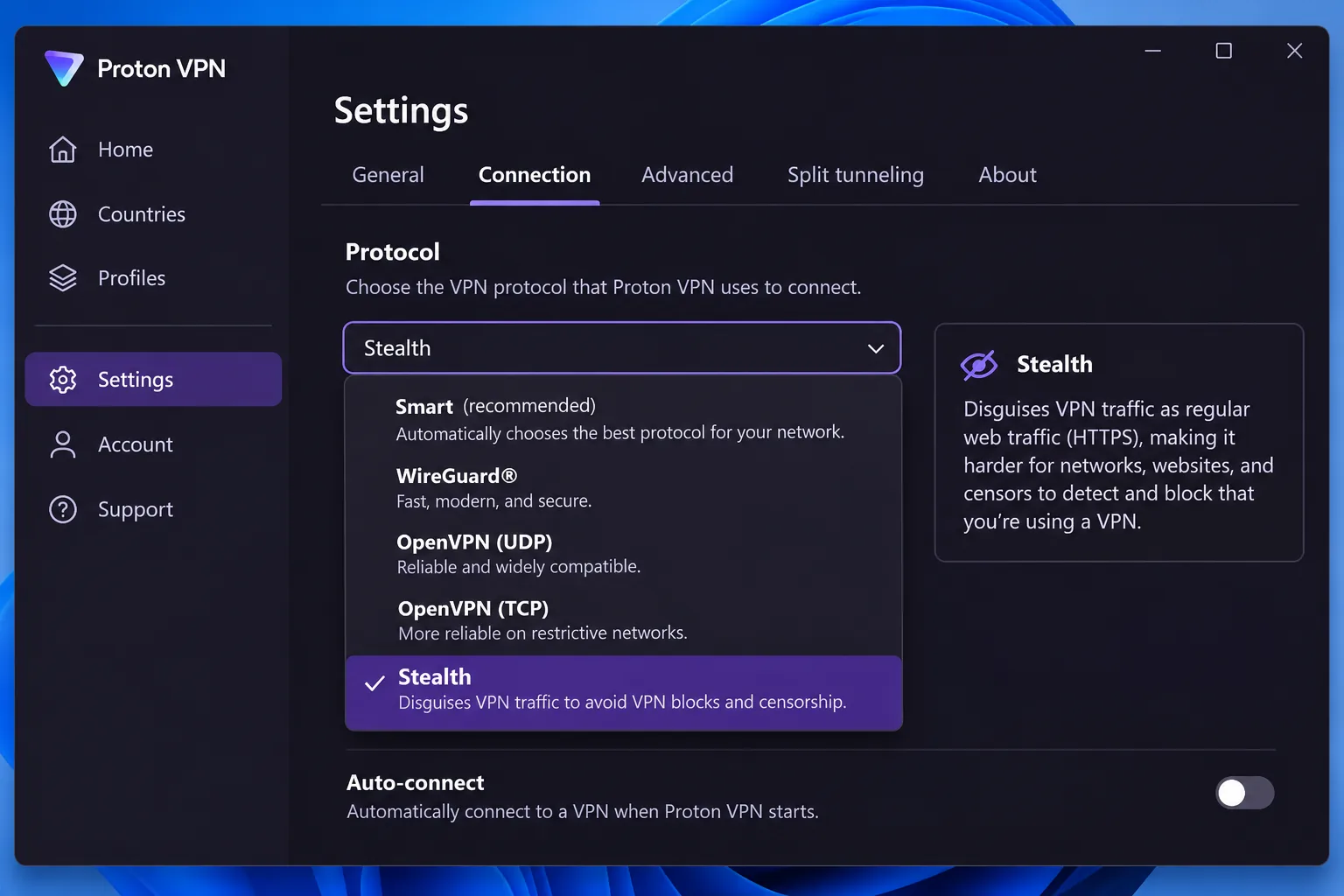
Its Stealth protocol is the strongest anti-block tool on this list. Stealth wraps VPN traffic so it looks like ordinary HTTPS, and it got past network-level VPN blocks consistently. The trade-off is speed: Stealth runs about 10% slower than OpenVPN and up to 35% slower than WireGuard. During throttling, WireGuard sometimes failed to connect while Stealth kept connecting.
Proton reconnected more often than NordVPN or Surfshark on throttled networks. Its kill switch blocked unprotected browsing during those drops. Without obfuscation, downloads fell only from 93.7 to 86.1 Mbps. Secure Core multi-hop runs about a third slower, which hurts on an already slow line.
Proton offers Yemen as a Smart Routing location on paid plans, with the hardware in London. VPN Plus covers 10 devices and costs $2.99 a month on the 1-year plan, then renews at $83.88. Proton reshuffles plan lengths, so older listings tie that price to the 2-year plan. Our Proton VPN review goes deeper on Secure Core.
Pros
- Stealth protocol on every plan, including Free
- Yemeni IP via Smart Routing on paid plans
- Apps install in about two minutes
Cons
- Reconnects more often on throttled networks
- Live chat is for paid users only and not 24/7
- Secure Core slows an already slow line
5. CyberGhost - Easiest to use
CyberGhost is the simplest app here, but it gives up the anti-censorship tools that put Proton above it. It connected in under ten seconds on first launch with no configuration. Its server lists are labelled by task, such as streaming, torrenting and browsing, so you don't have to guess.
The catch is that CyberGhost has no obfuscation at all. When an ISP blocks VPN traffic itself, it's the pick most likely to fail. It's fast on nearby servers but loses more than half its speed on long routes. On a 94.0 Mbps line, WireGuard held 76.4 Mbps to US East but only 38.7 Mbps to South Africa. Its Israel server ran slowest of the group to Riyadh, at about 15 Mbps.
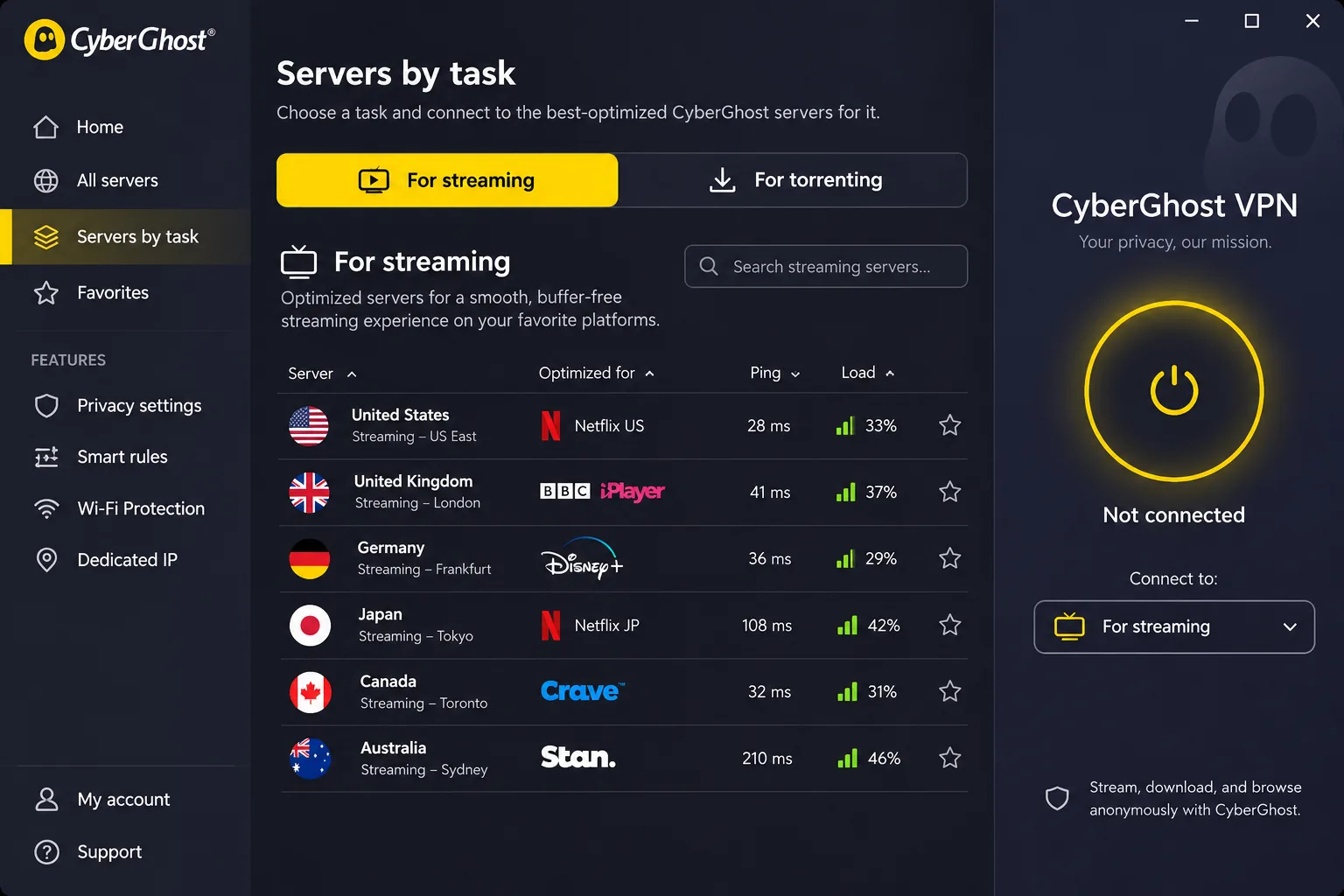
Its kill switch worked in all 10 manual disruption tests, and leak tests were clean. Streaming servers for Netflix US, BBC iPlayer, Disney+ and Prime Video worked on the first try. The 28-month plan costs about $2.19 a month, though promotions move it between roughly $1.99 and $2.19. Renewal roughly doubles the intro rate. See our CyberGhost review for more.
Pros
- Connects in seconds with no setup
- 45-day money-back guarantee on longer plans
- Streaming servers that work first time
Cons
- No obfuscation or stealth protocol
- Big speed losses on long routes
- 7 devices, fewer than most picks
6. ExpressVPN - Best for travelers on short trips
ExpressVPN takes the opposite approach to CyberGhost. You don't configure obfuscation at all: leave the protocol on Automatic and it disguises VPN traffic on its own. It also lost very little speed with obfuscation active, where most rivals slowed down noticeably.
That makes it easy for a short trip. On regional routes, ExpressVPN's Egypt server reached about 106 Mbps to Riyadh, the fastest result in that comparison. On a 100 Mbps connection, Lightway held 89.42 Mbps down. One tip: the app hides some regional cities from the Recommended tab, so open the All tab to find Middle East servers.
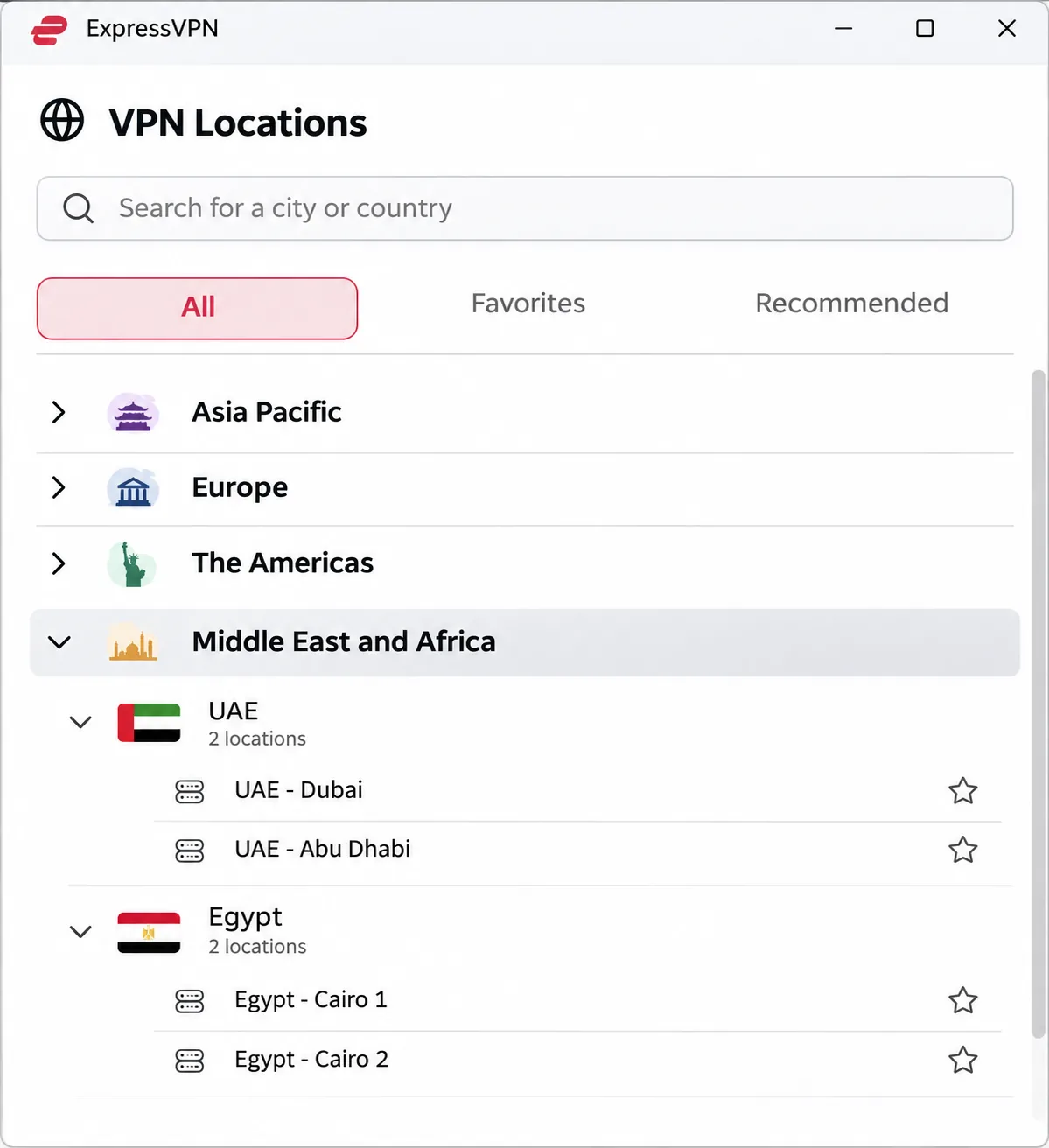
There's no Yemen location, and the servers span 113 countries. KPMG ran its latest privacy-policy assessment in 2025. Basic costs $2.99 a month for 28 months and covers 10 devices, up to 14 on Pro. Prices for the higher tiers have moved within the same week, and email support took almost two days to answer.
Pros
- Automatic obfuscation with no setup
- Small speed loss with obfuscation on
- Fastest regional result to Riyadh
Cons
- No Yemeni IP address
- Advanced and Pro tiers cost noticeably more
- Slow email support
How we chose the best VPNs for Yemen
We chose these VPNs by matching each one against what Yemeni networks actually do. Obfuscation came first. This technique disguises VPN traffic as ordinary web traffic, so an ISP can't easily spot and block it. A VPN that can't connect on YemenNet is no use, however cheap it is.
Next we looked at location. Fixed-line latency in Yemen already runs around 130 ms before any VPN is added, so a nearby Gulf server matters more than raw server count. We also checked which picks offer a Yemeni IP for local apps.
Then we scored speed, price and audited no-logs policies. A no-logs audit means an outside firm has checked that the provider doesn't keep records of what you do. Finally, we used the refund window as our safety net. Testing several nearby and European servers with browsing, video calls and app-store downloads shows quickly whether a VPN holds up on Yemeni networks.
Internet censorship and surveillance in Yemen
Behind those blocks, censorship in Yemen is targeted rather than total. Since 2014 the Houthis have controlled the largest mobile operators and YemenNet, which Citizen Lab called the most-used ISP in the country. In October 2015, Citizen Lab found Netsweeper filtering products on YemenNet blocking political content, independent media and all .il domains it tested.
Surveillance claims are harder to pin down. A 2014 GISWatch country report on communications surveillance described an anonymous claim of backdoor access to YemenNet's servers. The report itself called such claims largely speculative, and it predates Houthi control. Freedom House scores Yemen 10/100 (Not Free) in Freedom in the World 2025, though that is a general freedom score rather than an internet-specific one.
What is blocked in Yemen
The heaviest blocking falls on news sites and on VPN tools. The Yemeni Journalists Syndicate counts about 200 news sites blocked since 2014. No one publishes a live list, so counts vary. Citizen Lab, for one, found 61 in 2015. In September 2025, the Houthis blocked the Marib-based outlet Barran Press through YemenNet and TeleYemen. It stayed reachable through a VPN.
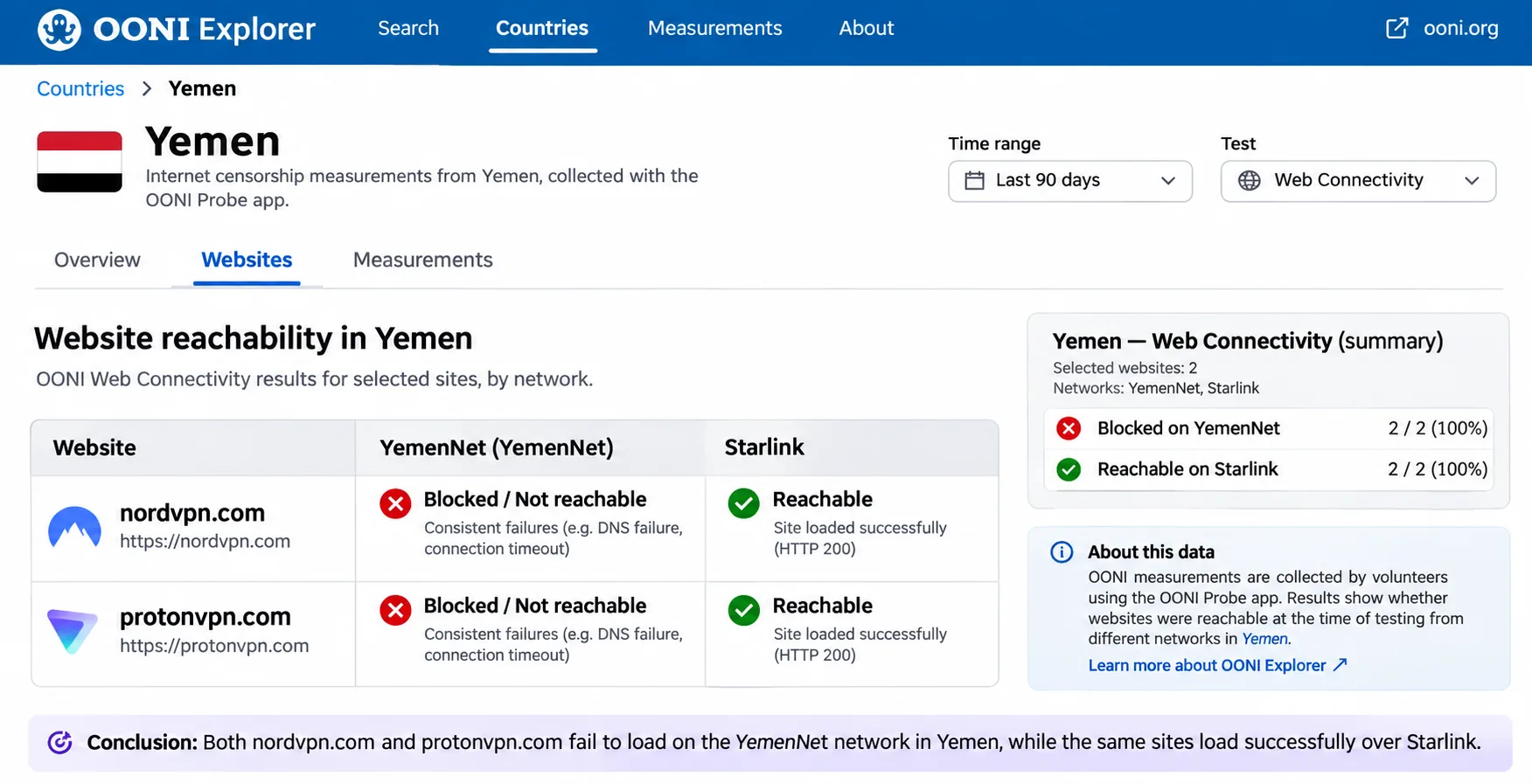
VPN sites are the most consistent target. On YemenNet, nordvpn.com showed anomalies in 89 of 91 OONI tests, and protonvpn.com in 90 of 93. The same sites loaded normally over Starlink and Aden Net. Al Arabiya and Al Hadath also failed on YemenNet but loaded over Starlink, while Al Jazeera and BBC mostly loaded everywhere. OONI treats these as anomalies, not confirmed blocks.
Other targets with high failure rates include Proton Mail, Tor bridges, Baha'i sites, and adult and gambling sites. Calls have been hit, too. The Houthi-run ministry once banned Zoom, Imo and other video-calling apps, and VPN apps got around it. That report dates to 2022, and in 2026 zoom.us loads normally on Yemeni networks.
On March 18, 2025, the Houthi Ministry of Information banned posting images of US strikes or naming victims. A VPN hides your traffic from your ISP, but it doesn't make banned posts on public social media anonymous.
Internet shutdowns, slow speeds and unstable mobile connections
Yemen's connection problems are often physical, not political. Citizen Lab noted in 2015 that YemenNet had only two international submarine fiber links. In late February 2024, three Red Sea cables were damaged, most likely by the anchor of a ship hit by the Houthis, who denied responsibility. Further cable outages in September 2025 degraded connectivity across the region, though no investigation has confirmed the cause.
Speed is the daily issue. Ookla's Speedtest Global Index put Yemen's median fixed broadband at 16.02 Mbps in September 2026, ranked 146th. Ookla publishes no current mobile median, but mobile data is very slow, in the low single-digit Mbps. Connections can collapse during afternoon peaks, and throttling tends to hit at tense moments and in anti-Houthi areas like Taiz.
Starlink launched in Yemen in September 2024 and delivers about 100 to 150 Mbps. A kit costs about $500. The Houthis declared it illegal within a day and later announced confiscations.
Is it legal to use a VPN in Yemen?
Given that crackdown on online speech, it's fair to ask about the VPN itself. Using a VPN in Yemen appears to be legal, but it's tolerated rather than clearly protected. We found no Yemeni law that specifically bans or licenses VPN use. Proton VPN's Yemen page states that using a VPN there is legal, and we found no report tying any arrest to VPN use.
The caveat is that Yemen has two rival authorities and no published VPN law. The Houthis have outlawed other connectivity tools, such as Starlink, by decree. They also arrest journalists and activists over online expression. So a VPN is a privacy tool, not legal cover for what you post.
How to set up a VPN in Yemen
Once the legal question is settled, the most important setup step is to install your VPN before you need it. VPN provider websites rarely load on YemenNet, so download, install and sign in before you arrive, or while you're on another network.
- Choose a VPN with obfuscation, such as NordVPN, Surfshark, Proton VPN or ExpressVPN.
- Download the app and sign in outside Yemen or over a network such as roaming data.
- Turn on obfuscation before connecting: Obfuscated Servers on NordVPN, NoBorders on Surfshark, Stealth on Proton, or Scramble on IPVanish. ExpressVPN does it automatically.
- Connect to a nearby server, such as the UAE or Saudi Arabia.
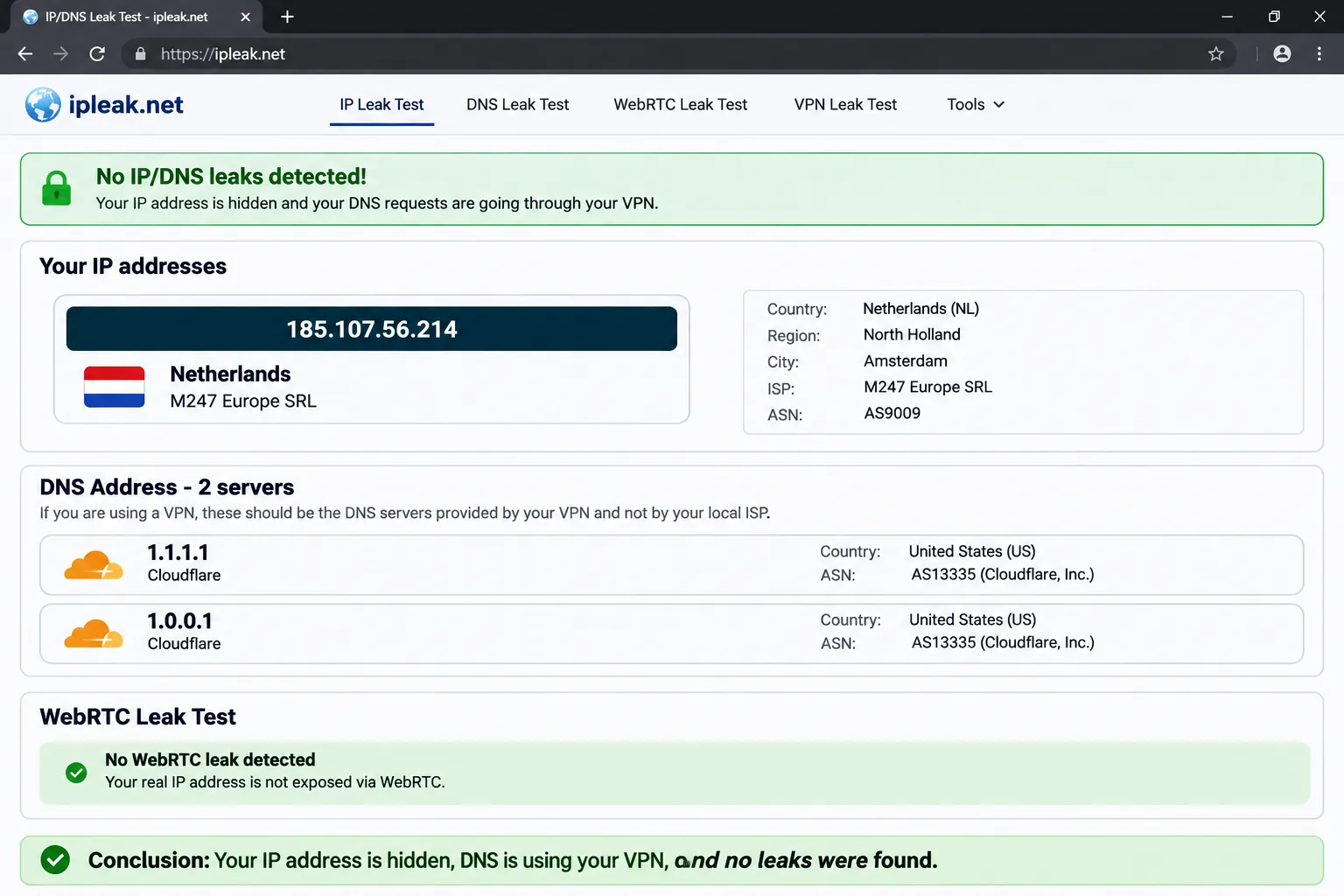
- Open ipleak.net and check that no Yemeni ISP address appears.
Turn on the kill switch while you're setting up. On Surfshark and IPVanish for Windows, it's off by default.
How to get a Yemen IP address
To get a Yemeni IP, you need NordVPN or Proton VPN. On NordVPN, open the country list and choose Yemen, then Sanaa. It works on any plan. On Proton VPN, pick Yemen from the country list on a paid plan; Proton routes it through London.
IPVanish, Surfshark, CyberGhost and ExpressVPN have no Yemen IP. Keep in mind that a virtual Yemen server doesn't guarantee a smooth connection, because your traffic still travels to hardware outside the country.
Troubleshooting VPN problems in Yemen
Even with a careful setup, most VPN failures in Yemen come from a blocked protocol or a weak line, not a dead server. Work through these fixes in order:
- Switch protocols. On NordVPN, set the protocol to NordWhisper or Auto so the obfuscated servers appear.
- Try OpenVPN (TCP) on port 443. It's more resilient against blocks than UDP, and turning on a stealth mode alongside it usually steadies the connection.
- Set up a manual IKEv2 connection if the app stays stuck on "Connecting."
- Reset your network settings and reconnect.
- Change networks. VPN sites that fail on YemenNet often load over Starlink or Aden Net.
A blocked site on YemenNet often shows a fake network-error page rather than a block notice. If one site won't load but others will, assume a block and connect first. No VPN helps during a nationwide outage, though. The January 2022 airstrike on Hodeidah's telecom building took the whole country offline for four days.
Can I use a free VPN in Yemen?
You can, but we don't recommend relying on one. Free VPNs tend to be slow and overcrowded. They throttle speeds, cap bandwidth, and most lack obfuscation, which is the one feature you need most on YemenNet.
The exception is Proton VPN's free plan. It includes Stealth and has no data limit, so it's worth keeping as a backup. If you want a Yemeni IP or faster speeds, a paid plan with a money-back guarantee is the safer, risk-free way to try a VPN.
FAQ
Is it legal to use a VPN in Yemen?
Is it safe to use a VPN in Yemen?
Which VPN has servers in Yemen?
Can a VPN help access blocked websites and apps in Yemen?
Should I set up a VPN before traveling to Yemen?
Which VPN works best on slow or unstable connections in Yemen?
Bottom line
After all that testing, the right VPN for Yemen still depends on your network and your household. NordVPN is our overall pick, but if you need every device in the house covered, IPVanish is the stronger value. Surfshark is the cheapest way to get obfuscation that runs itself, and Proton VPN's Stealth is the one to try when nothing else connects.
Whatever you choose, install it before the next block and test the obfuscation setting while you can still reach the provider's website. Use the 30-day refund window to try it on your own connection.