People in Syria look for a VPN for two main reasons. They want to reach sites and apps that a network blocks, and they want to keep their browsing away from the local network. A VPN encrypts your traffic and routes it through a server you choose, so the network sees a tunnel instead of the sites inside it. Below we compare five providers on the features that matter most for restricted networks: obfuscation, privacy evidence, device support, cost and refund terms.
One limit comes first. We could not verify how any of these five perform on Syrian networks today, so this comparison rests on documented features and our hands-on checks of the apps, not on measured Syrian results.
Best VPNs for Syria at a glance
The table below sets out the documented facts side by side. Prices are introductory offers shown on the vendor sites on 8 November 2026, so the checkout total will differ by region, tax and promotion. The last row deliberately offers no praise: we found no reproducible per-provider test on a named Syrian network, so every provider is marked unverified there.
| Provider | Buy | Restriction-related features | Privacy evidence | Paid devices | Refund | Syrian-network result | Key limitation |
|---|---|---|---|---|---|---|---|
 | NordWhisper, upgraded Obfuscated Servers | Deloitte no-logs assurance, late 2025 | 10 | 30-day | Unverified | Busy mobile app | |
 | Automatic obfuscation on supported platforms | Published audits, RAM-only servers | 10 on Basic, 12 Advanced, 14 Pro | 30-day | Unverified | Settings harder to find | |
 | Camouflage mode, NoBorders | Deloitte reconfirmation, June 2025 | Unlimited for personal use | 30-day | Unverified | Uneven streaming, slow email support | |
 | Port randomization only | Deloitte report, 2024 | 7 | 45-day on long plans | Unverified | Weak against advanced VPN blocking | |
 | Stealth, including on Free | Securitum assessments, open-source apps | 10 | 30-day | Unverified | Free server choice is limited |
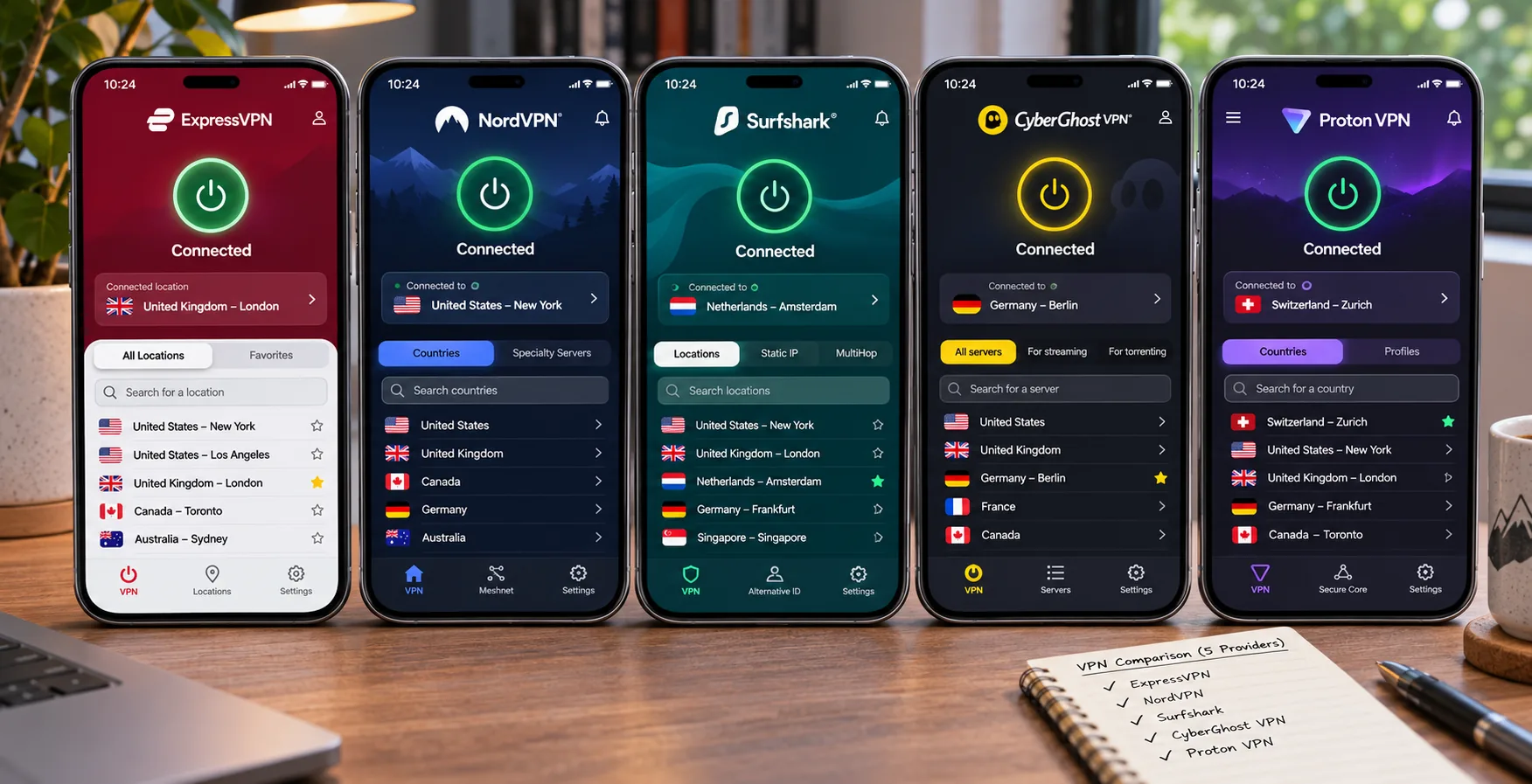
How we evaluate VPNs for Syria
We compared the five providers on documented features, privacy evidence, device support, cost and refund terms, and we ran each app ourselves to judge the interface, setup and everyday behavior. We did not test from inside Syria, so no provider earns a Syrian performance claim from us.
Obfuscation, privacy policies and leak protection
Obfuscation means disguising VPN traffic so a network cannot easily recognize and block it. We weighted documented obfuscated modes (NordWhisper, Stealth, Camouflage) above basic port switching. We evaluated privacy through independent assessments of the no-logs claim, and leak protection through a kill switch and the leak checks we could run.
Connection reliability, server choices and device support
We looked at how clearly each app lets you change protocol and server, how many devices a plan covers, and which operating systems each current app supports. Protocol capability on paper is not the same as demonstrated local performance, and we kept those two ideas apart throughout.
Evidence, verification dates and testing limitations
Vendor prices and policies were checked on 8 November 2026. Several prices and policies are regional or promotional, and a few conflict across a vendor's own pages; we note those conflicts where they matter. Syrian payment-card acceptance, sanctions-related account eligibility and app-store access were not confirmed for any provider, so check that you can actually subscribe before you plan around one.
1. NordVPN
NordVPN is our first pick because its restriction-handling features are the most clearly documented of the five. Its desktop and mobile apps cover the usual platforms, it allows 10 simultaneous devices per account, and it publishes recent independent assurance of its no-logs claim.
Features to check for use in Syria
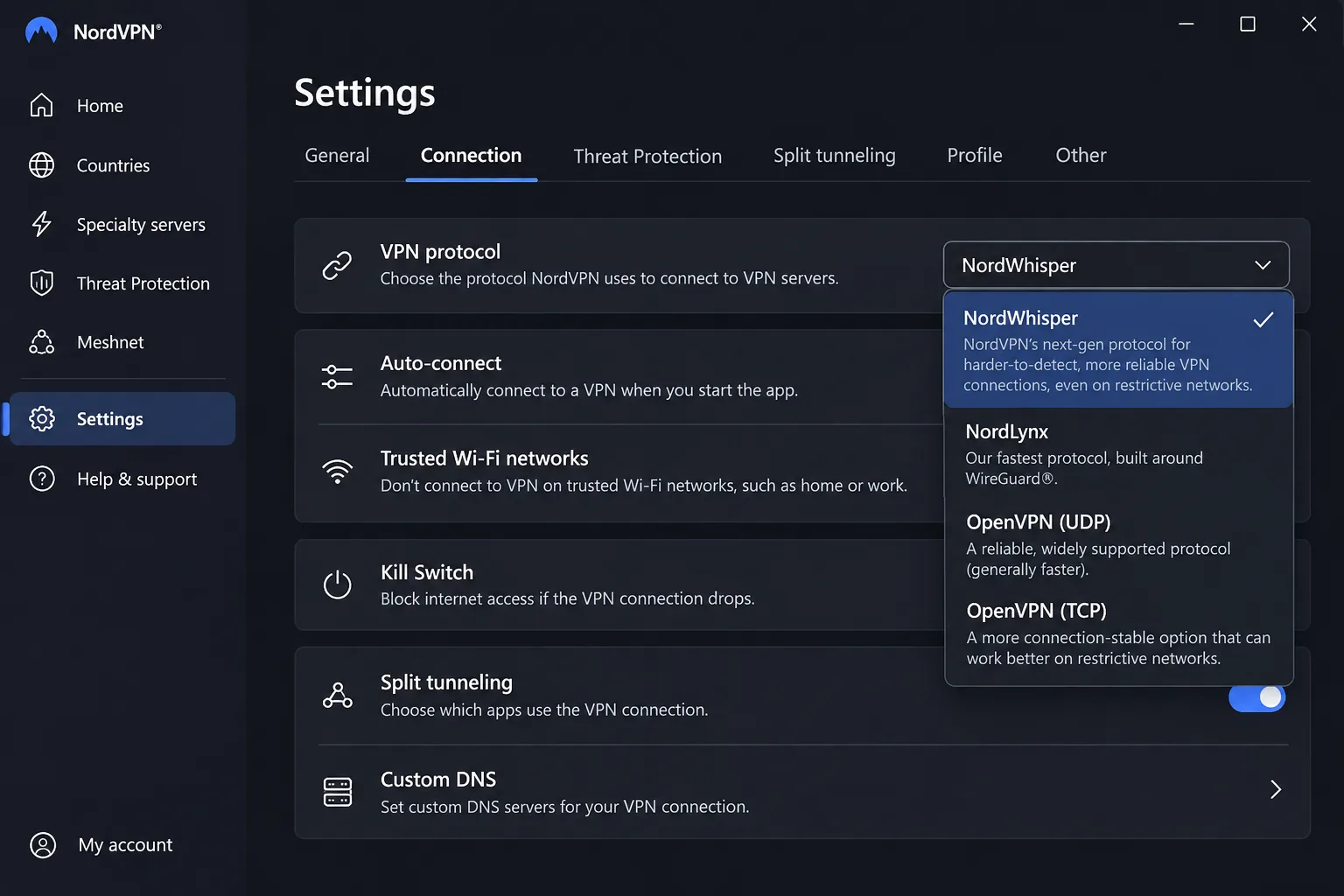
The feature that matters most here is NordWhisper. NordVPN's support pages explain that its Obfuscated Servers are being upgraded from OpenVPN to NordWhisper. NordWhisper disguises VPN traffic as ordinary web traffic, and it is documented on Windows, macOS, Linux, Android and iOS. It does not work alongside Dedicated IP, Meshnet or Onion over VPN, so you choose between obfuscation and those extras.
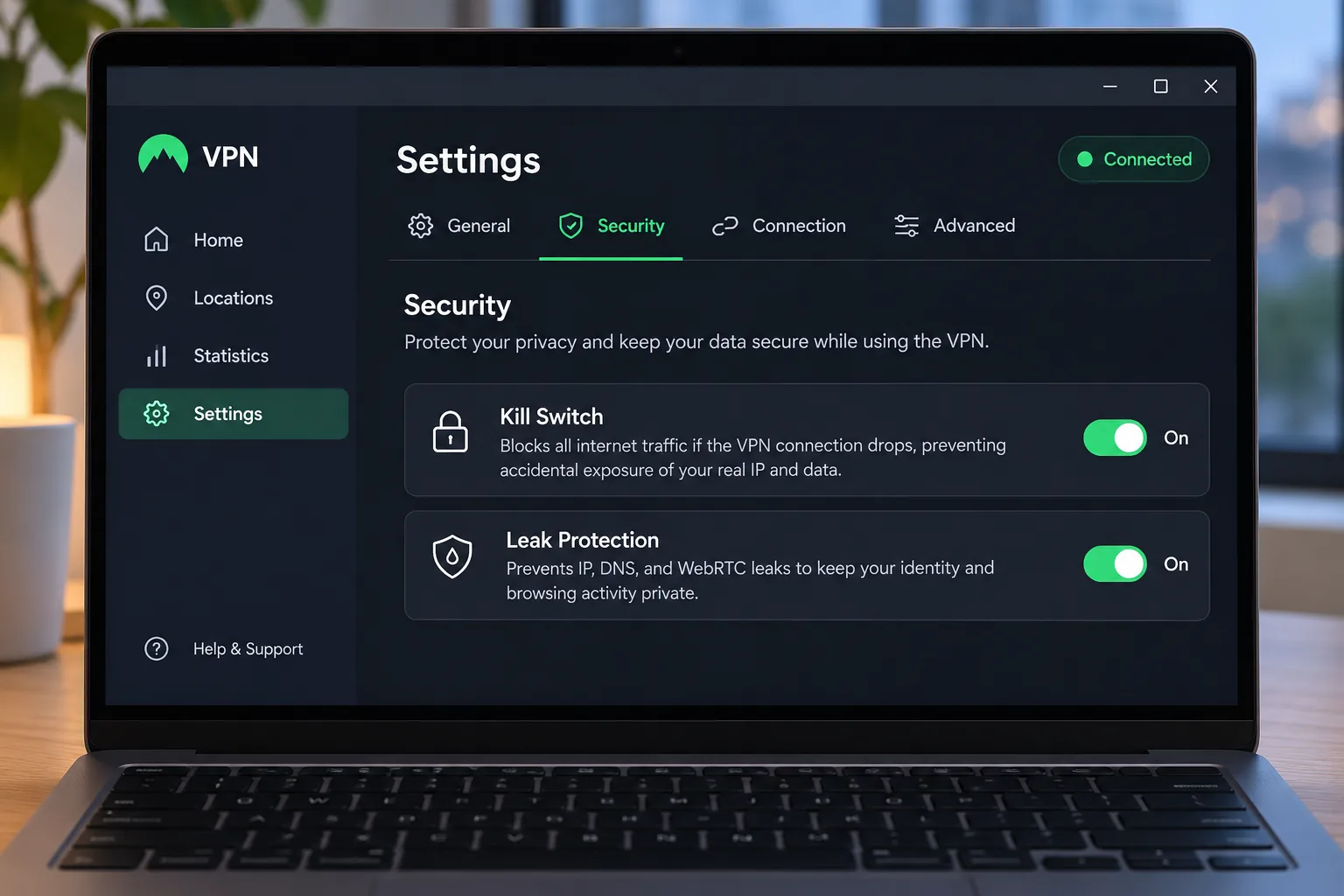
Beyond obfuscation, the app offers NordLynx, OpenVPN, a kill switch, leak protection, Double VPN and split tunneling on selected platforms. Deloitte Lithuania carried out the sixth no-logs assurance engagement in late 2025, and NordVPN announced the result in February 2026. An audit covers defined systems over a defined period, so treat it as evidence about the provider's practices rather than a promise about your own safety.
In our hands-on checks, the kill switch resisted forced-connection and process-interruption leak tests. On a Mac, closing the app behaves differently from a system-wide network cutoff, so check the coverage before you rely on it. We also found that a restrictive Wi-Fi network can reject NordLynx while accepting an OpenVPN connection. That is a good reason to learn where to switch protocols before you need to. The desktop interface takes some getting used to before every control feels obvious, and the mobile app can feel cramped.
NordVPN's live chat gave useful help with our setup questions, which matters when a connection fails and you need a quick answer.
Pros
- NordWhisper obfuscation documented on all five major platforms
- Recent Deloitte no-logs assurance from late 2025
- Kill switch held up in forced-connection leak tests
- Live chat that helps with setup problems
Cons
- Mobile app feels cramped
- Desktop controls take time to learn
- NordWhisper cannot be combined with Dedicated IP, Meshnet or Onion over VPN
Limitations, supported devices and cost
The current support list covers Windows 10 64-bit version 1607 onward, Windows 11, Android 9 onward and iOS 17 onward, plus recent macOS releases. Older systems use separate legacy or sideloaded builds with fewer features, so check your device against the support page before you pay.
The displayed offer was $3.49 per month equivalent, or $94.23 prepaid for 27 months, with a renewal of $139.08 per year. Promotional months, tax and renewal terms depend on your checkout region. The 30-day money-back guarantee applies to initial subscriptions, not ordinary renewals, and you request it through support. Apple purchases go through Apple's refund process instead. Trial terms differ by storefront and country, and the website trial is not advertised for Syria.
2. ExpressVPN
Where NordVPN gives you the most controls, ExpressVPN hides most of them. It is the easiest of the five to install and start using. We found it straightforward to set up and connect across desktop and mobile platforms, although you may need to restart your laptop after installation.
Features to check for use in Syria
ExpressVPN applies obfuscation automatically on supported platforms, so you do not have to hunt for a special mode. The catch is that its documentation does not fully specify which protocols and platforms support automatic obfuscation, so we cannot tell you exactly where it applies. Its Lightway protocol, kill switch, private DNS and split tunneling on supported platforms round out the toolset.
On privacy, ExpressVPN runs RAM-only TrustedServer infrastructure, states a no-activity-logs policy and publishes audit reports. Those are strong signals, but the same caution applies as for every provider here: published audits describe past conditions, not future behavior.
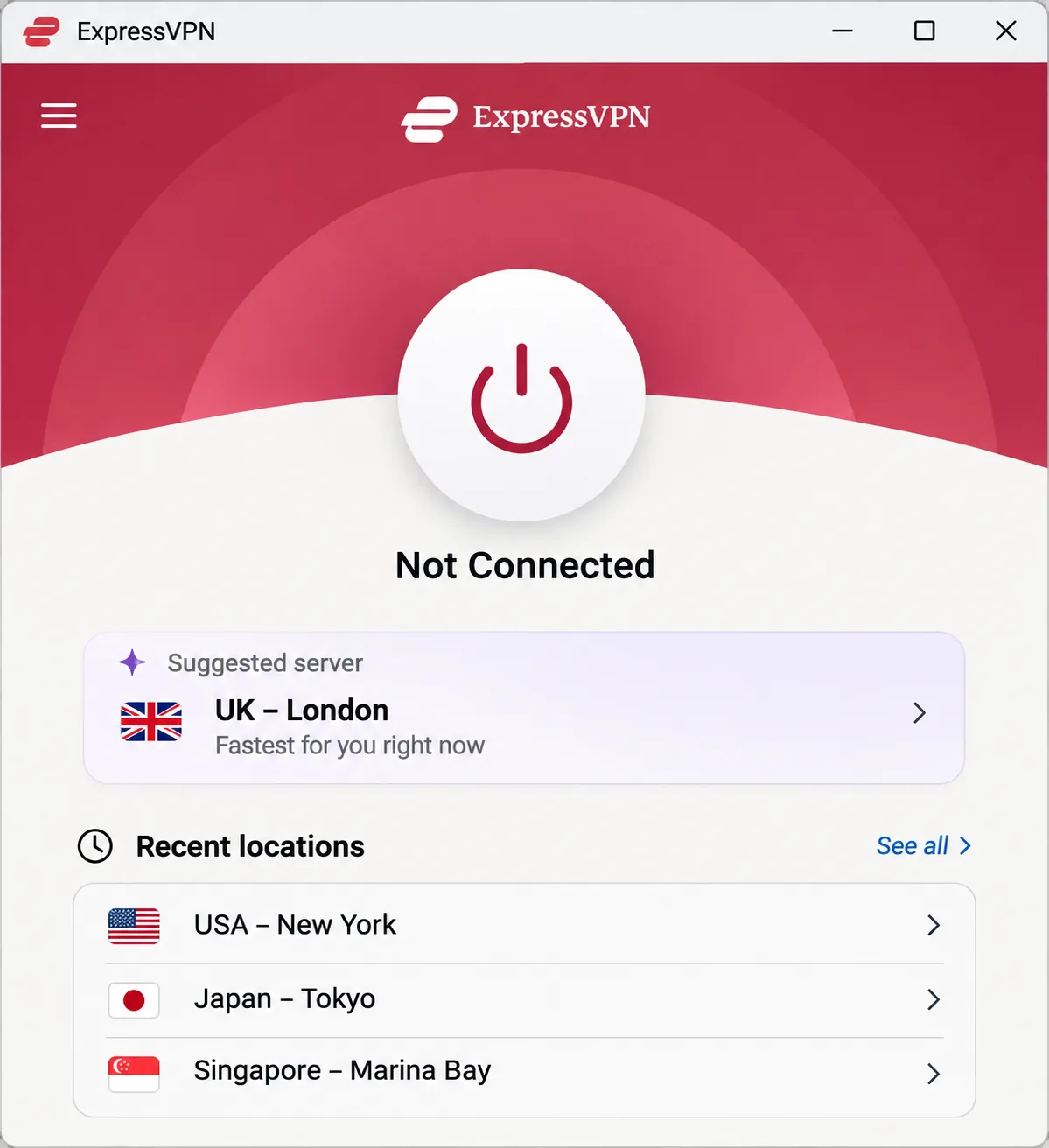
In daily use, the server suggestions and recent-location list made it easier for us to reconnect. The redesigned interface adds clutter, and some settings are harder to find under Profile and Add Ons. Customer service was responsive and the setup instructions are detailed, which helps if you are configuring the app on a restricted network for the first time.
Pros
- Simple install and connection on desktop and mobile
- Automatic obfuscation on supported platforms
- RAM-only servers and published audit reports
- Responsive support and detailed setup guides
Cons
- Redesigned interface adds clutter
- Obfuscation coverage by platform is not fully documented
- Device allowance depends on plan tier
Limitations, supported devices and cost
Current apps need Windows 10 or later, Android 7.0 or later, iOS 15 or later and macOS 11 Big Sur or later. Older versions require legacy software. Linux, smart-TV apps and router options exist, though feature availability differs by device type.
Device limits depend on the tier. Basic allows 10 simultaneous devices, Advanced 12 and Pro 14, and older comparisons describe different allowances for legacy subscriptions. Basic was displayed at $2.99 per month equivalent, or $83.72 for the first 28 months, then $99.95 a year. Advanced and Pro cost more and bundle extra apps. A 30-day refund window covers eligible first-time direct subscribers, and prior refunded users are ineligible. App Store and Google Play purchases follow the store's own refund policy.
3. Surfshark
After two single-purpose picks, Surfshark suits households with many devices. Its paid plans include unlimited simultaneous VPN connections and bandwidth, subject to personal-use and anti-abuse terms. That is a true unlimited claim, which is the only sense in which we use the word here.
How Surfshark handles blocking
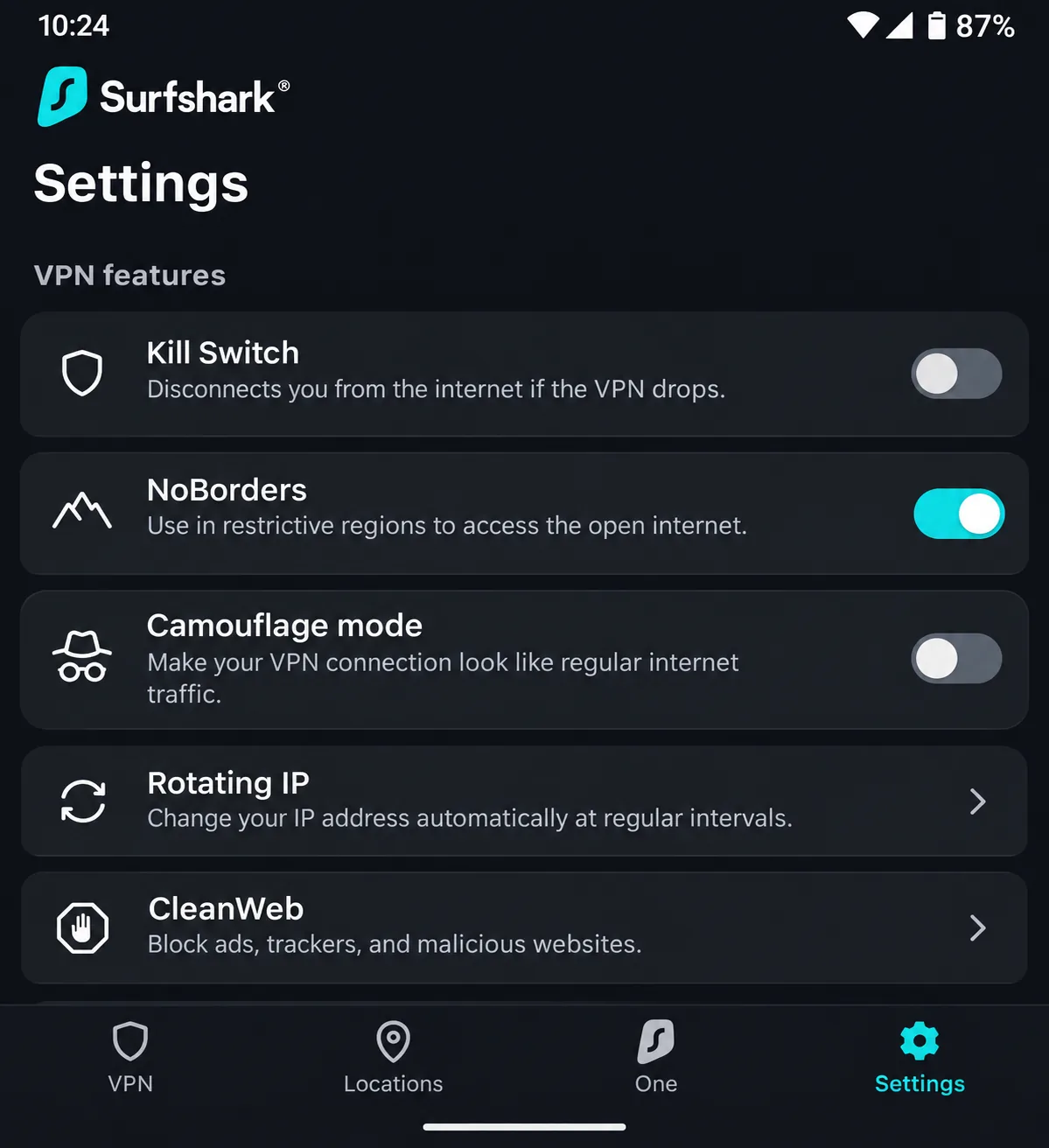
Surfshark offers two restriction tools. Camouflage uses OpenVPN to hide typical VPN traffic patterns. NoBorders supplies a selected server list when it detects restrictions, and you can switch it on manually on Windows, macOS, Android and iOS.
The wider toolset includes WireGuard, OpenVPN, a kill switch, CleanWeb, Bypasser split tunneling, rotating IP, Dynamic MultiHop and Alternative ID. Deloitte reconfirmed the no-logs policy in June 2025, with the assessment covering systems and internal processes.
In use, Surfshark opened many geographically restricted sites reliably and delivered strong everyday throughput alongside a large set of optional privacy tools. Streaming access was uneven across services, even though Netflix and BBC iPlayer worked well. Email support can take much of a day to respond, so do not plan on it during an urgent connection problem.
Pros
- Unlimited simultaneous connections on paid plans
- Camouflage and NoBorders for restricted networks
- Strong everyday throughput
- Large set of optional privacy tools
Cons
- Streaming access is uneven across services
- Email support can take most of a day
- Renewal pricing is not clear until checkout
Apps, trial and pricing
Apps cover Windows, macOS, Linux, Android, iOS, Apple TV, Fire TV, Android TV, routers and browser extensions. Legacy Windows builds differ, and we could not confirm exact minimum OS versions across every app. The browser extension protects only browser traffic, and running the extension and the app together can interrupt connectivity.
The prices we retrieved were for Australia: the equivalent of A$3.49 per month or A$94.23 prepaid for 27 months. These are not quotes for Syria or prices in US dollars. We could not confirm the renewal amount. A 30-day money-back guarantee covers eligible initial purchases. A 7-day website trial exists for new users on eligible annual or two-year plans with specified payment methods, allows three devices during the trial, and charges automatically afterward unless you cancel.
4. CyberGhost
Surfshark's tools help on filtered networks; CyberGhost's barely do. It is the weakest fit for a heavily filtered network, and we say so plainly. It earns a place because it is beginner-friendly, has the longest refund window on the list and is cheap, but its restriction tools are thin.
Where CyberGhost falls short
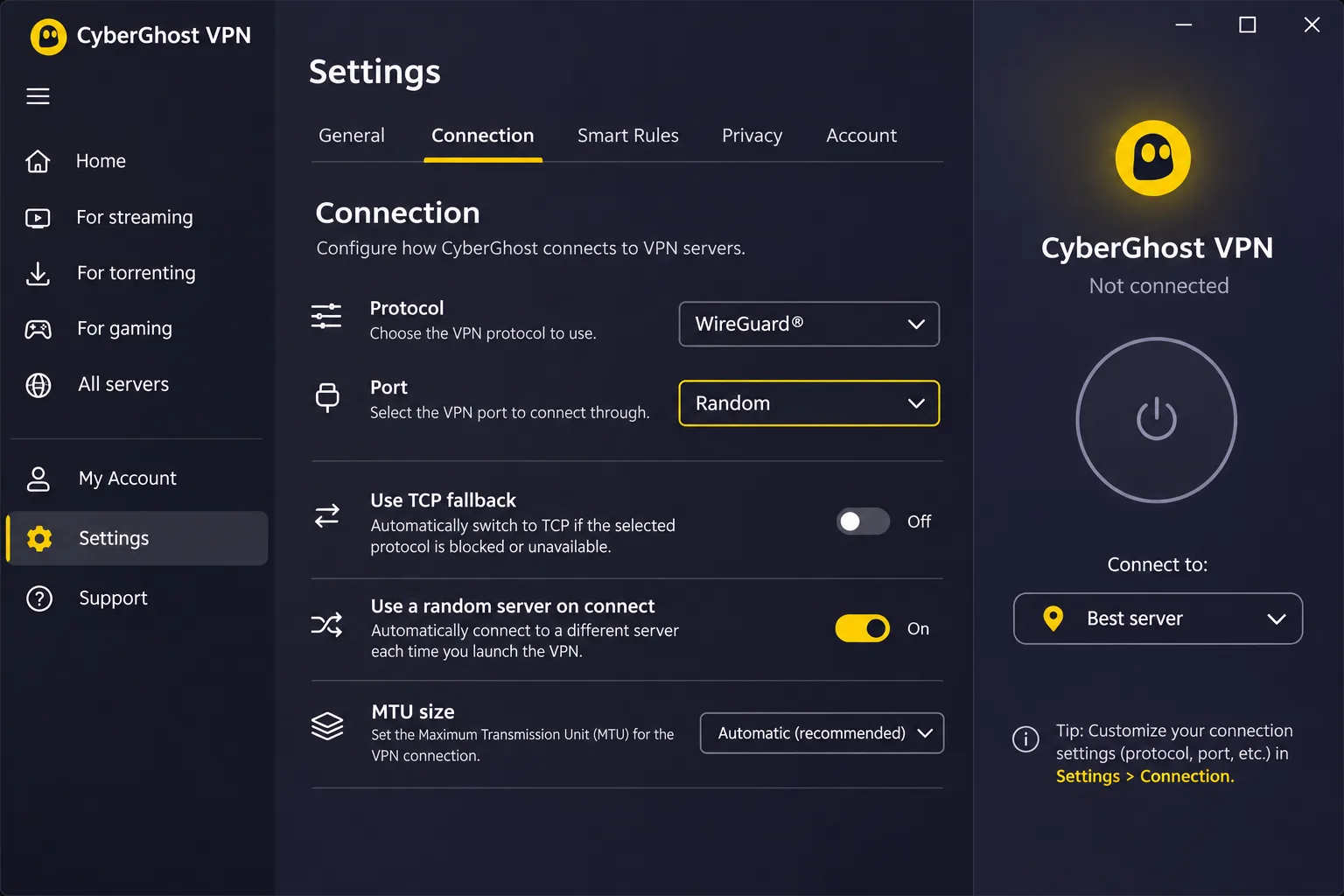
CyberGhost offers port randomization, which can help against basic port blocking. The company itself distinguishes that feature from true obfuscation, and we found no advanced equivalent to NordWhisper or Stealth. In our checks, the port-switching option helped only against basic port blocking and did not provide sophisticated traffic disguise. If your network inspects traffic patterns, this is a real limit.
The rest of the toolset includes a kill switch, leak protection, split tunneling on supported platforms, unlimited bandwidth, a no-logs policy and live chat support. The vendor offers a Deloitte assurance report dated 2024 that predates the audits for NordVPN and Surfshark.
The basic interface is approachable for beginners. One of its streaming-labelled servers failed for its named service, while another streaming server in the same country worked. Try a second server before giving up. WireGuard performance suits bandwidth-heavy use better than the slower OpenVPN connections.
Pros
- Approachable interface for beginners
- 45-day refund window on longer plans
- WireGuard suits bandwidth-heavy use
- Live chat support
Cons
- No advanced obfuscation established
- Port switching only helps against basic blocking
- Streaming-labelled servers can fail
- Only 7 devices per subscription
Devices, pricing and refunds
A subscription covers 7 devices. The current download page confirms Windows 10 and Windows 11 support. Apps also exist for macOS, Android and iOS, and one comparison source lists Linux. We could not confirm exact minimum versions for the other platforms.
The Australian checkout showed AU$3.27 per month and an AU$91.56 first payment with an annual renewal of the same amount, but the term labels contradicted each other, listing 24, 26, 27 and 28 months. Read the final order summary before paying. The monthly plan was AU$18.79. Longer plans carry a 45-day money-back guarantee, while monthly plans get a 14-day refund window.
5. Proton VPN
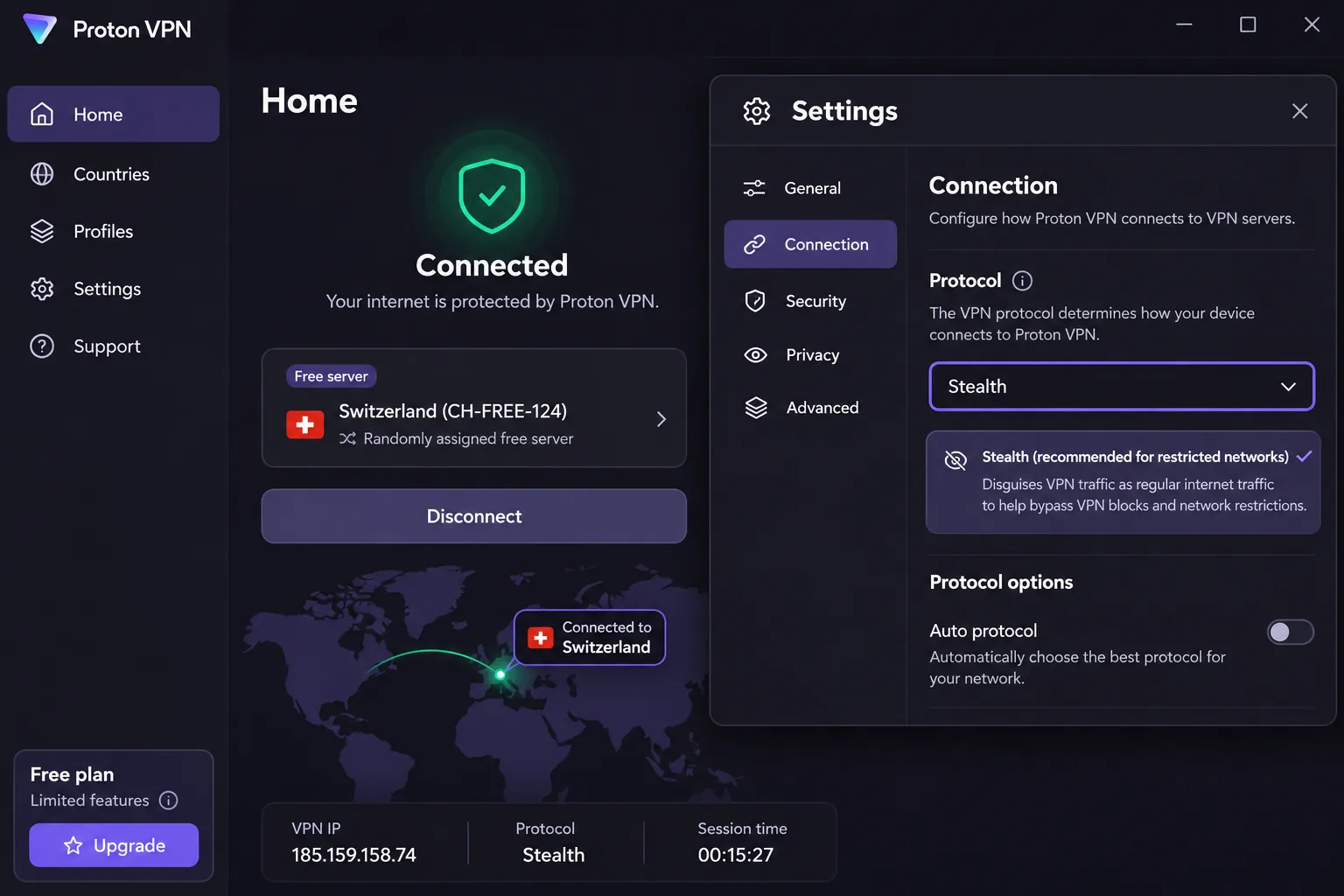
Cost is where Proton VPN pulls ahead of CyberGhost's cheap plans. It is the one to try first if cost is the obstacle, because its free plan is a real, ongoing service rather than a trial. It also includes Stealth, its protocol for restricted networks, on every tier.
Features to check for use in Syria
Stealth is available on Free and paid tiers and is documented for Windows, macOS, Android and iOS. Linux support is unclear, because Proton's roadmap says the Linux app now supports Stealth while its product-lifecycle table says it does not. If you run Linux, check the current app build.
Proton's apps are open source, its no-logs policy has been independently assessed by Securitum, and the kill switch is available on all subscription tiers. Paid Plus adds chosen locations, streaming support, P2P, Secure Core, NetShield filtering and priority support.
Proton's official Syria server page offers a Syrian exit location and Syrian IP addresses. A Syrian exit location does not establish that you can connect from inside Syria. We did not verify that the exit works as advertised, so treat it as a listing, not a result.
In use, the advanced controls can feel busy for beginners, although saved profiles reduce repeated configuration. The redesigned mobile navigation removed the old centrally placed disconnect control that could invite accidental taps. The paid service handled routine browsing, video and gaming smoothly, with longer-distance connections losing more throughput.
Pros
- Free plan with no data limit and Stealth included
- Open-source apps and independently assessed no-logs policy
- Kill switch on every tier
- Saved profiles cut repeat setup
Cons
- Free plan picks locations for you
- Advanced controls can overwhelm beginners
- Stealth on Linux is inconsistently documented
Free-plan and paid-plan differences
Proton Free costs $0.00 per month, with no data limit and no artificial speed limit. The first connection selects the fastest free server, and later changes are random and subject to a cooldown. Proton's support page gives 45 seconds for the first change and 10-minute intervals after that, while another review gives a longer figure, so rely on the countdown in the app. The random locations make it frustrating to target one country's content.
Paid Plus lets you choose locations and adds streaming support, P2P and Secure Core. The displayed price was equivalent to $3.49 per month, or $83.76 for the first 24 months, renewing at $83.88 every 12 months. It protects 10 devices at a time. Paid subscriptions advertise a 30-day money-back guarantee, and canceling renewal and requesting a refund are separate actions.
Why use a VPN in Syria?
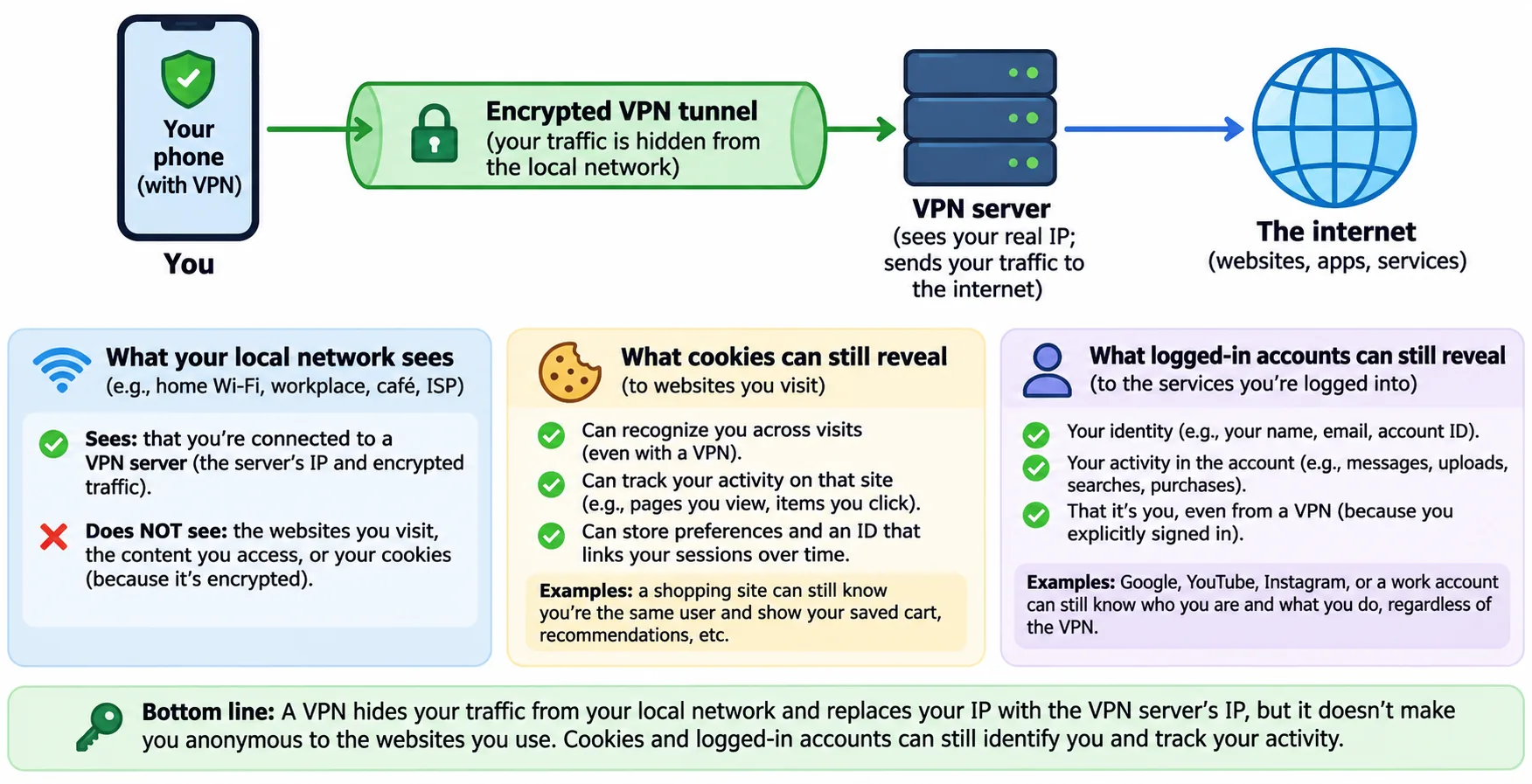
A VPN does two jobs for a person in Syria. It hides which sites you visit from the local network, and it replaces the address that websites see. Both can matter when apps are blocked or when you do not want your connection details visible to the network operator.
Internet access and restrictions: check current conditions
Conditions change, and older reporting on Syrian censorship describes a very different government and network. We did not find comprehensive, network-by-network measurements that show which messaging, social, streaming or VPN services are blocked today, so we cannot list current blocks. That includes the VPN providers' own websites, which can be blocked or slow to load.
Two recent official items show why caution is sensible. Syrian Telecommunications reported a disruption to the Tartous to Alexandria submarine cable in June 2026, and state media later announced that repairs were complete on June 17, 2026. That was an infrastructure fault whose repair was publicly announced, not evidence of an ongoing shutdown. Separately, a July 2026 ministry statement anticipated reduced international technology restrictions and less need for VPN workarounds. Announced easing does not prove that every app, payment provider or platform is reachable on every Syrian network.
A VPN protects the connection, not the person. Dated evidence in this guide (audits, price displays, official announcements) describes a specific moment, and older claims about Syrian censorship should not be read as today's conditions. Never treat any VPN as a guarantee of safety.
What a VPN protects and what it cannot protect
A VPN conceals destination metadata from the local network, but trust shifts to the VPN operator. HTTPS still matters, because the VPN does not encrypt traffic between its exit server and the site. Cookies, browser fingerprinting, GPS, logged-in accounts and history stored on your device can still identify you.
For people at higher personal risk, SMEX's Syria digital safety guidance, published in May 2025, covers device and account security, encrypted communications and limiting what you share online alongside VPN use. A VPN is one layer, not the whole plan.
Streaming, messaging and other platform restrictions
People also use a VPN for streaming, messaging and other platform restrictions. Results vary by service and by day. In our hands-on checks, Surfshark worked with Netflix and BBC iPlayer but gave uneven results elsewhere. A CyberGhost streaming server failed for its named service while a neighboring server worked. Treat any streaming promise as a starting point, and use the refund window if a service you rely on does not load.
How to set up and use a VPN in Syria
The steps below follow the same flow in all five apps. If you can, download and subscribe while you have an unrestricted connection, because VPN websites and app downloads can themselves be blocked.
Install the app and configure privacy settings
Create an account, install the official app for your device, and sign in. Use only the vendor's official download, since a counterfeit VPN app defeats the purpose. Turn on the kill switch and leak protection, then find the protocol setting so you know where to change it later. On NordVPN that means selecting NordWhisper in the protocol settings.
Choose a server and check the connection
Pick a nearby server first for speed, then connect and open a site you know is working. If you are using obfuscation, enable it before you connect. Check that your visible IP address changed using any IP lookup page, and keep the app on a single connection until it is stable.
What to check if the VPN connects but pages do not load
Work through these in order:
- Confirm your operating system meets the app's current minimum.
- Check that your account is active and the device limit has not been reached.
- Switch to another server, then another protocol.
- Enable the documented restricted-network mode, such as NordWhisper, Stealth or NoBorders.
- Remember a kill switch can intentionally block all traffic after a drop, so a blocked connection may mean the VPN is doing its job.
- Contact support if the failure persists.
A restrictive Wi-Fi network that rejects one protocol can accept another, so changing protocols is often the fastest fix.
Can you use a free VPN in Syria?
You can, with caveats. Among these five, only Proton VPN offers an ongoing free plan. It costs $0.00 a month, has no data limit and includes Stealth, though the server location is assigned rather than chosen. For reading news or messaging, that can be enough.
The other four are paid services. Surfshark has a conditional 7-day website trial, and NordVPN's trial depends on storefront and country. The official content we could retrieve did not establish exact trial durations for ExpressVPN and CyberGhost. A trial or a refund window is not a free tier. Refund windows are 30-day for NordVPN, ExpressVPN, Surfshark and Proton VPN, and CyberGhost gives 45-day on longer plans and 14-day on monthly ones.
Be careful with free VPN apps outside this list. A free service still has to pay for its servers somehow, and some do it with ads or data. We did not review any, so we cannot vouch for them.
Are VPNs legal in Syria?
We could not find a current, authoritative Syrian statute or regulator statement establishing whether VPN use is legal or prohibited, or whether authorities take enforcement action against it. We checked on 8 November 2026. Provider marketing and digital-safety guides are not legal rulings, so none of them settles the question.
Because the government changed and rules may be revised, treat any claim of blanket legality or prohibition as unconfirmed. If you face real legal exposure, ask a qualified local lawyer or a digital-rights group such as SMEX before relying on a VPN.
Final recommendation
NordVPN is our top pick for Syria. For the other roles, choose Surfshark if you have many devices to cover, ExpressVPN if you want the simplest setup, and Proton VPN if you need a free plan with Stealth.
CyberGhost is the one to skip if your network blocks VPNs actively. Whichever you pick, buy a plan with a refund window and test it on your own connection first, because none of these providers has proven performance on Syrian networks.