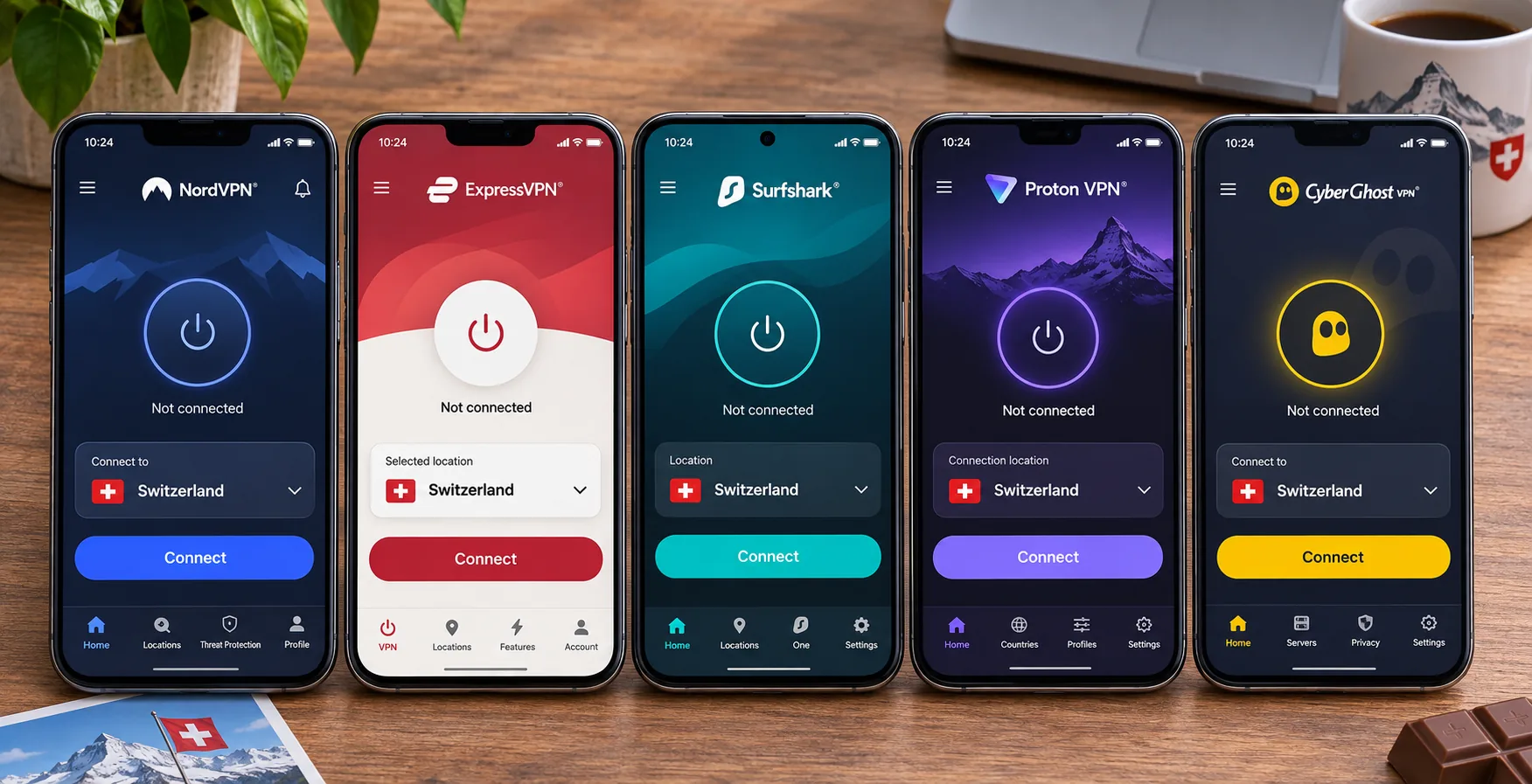
Most people searching for a VPN for Switzerland have one of two jobs in mind. Some live in Switzerland and want a VPN to protect their traffic on café Wi-Fi, hotel networks and shared office connections. Others are abroad and need a Swiss IP address so Swiss TV, Swiss streaming apps and Swiss online accounts behave as they would at home. Those are different needs, and the best VPN for one is not always the best for the other.
We compared five providers on Swiss server locations, privacy evidence, device support, streaming results and cost. Below you will find the shortlist, our method, five reviews, a short setup guide and a plain answer on free VPNs. Prices change often, so check the checkout page before you pay.
Best VPNs for Switzerland at a glance
The table below puts the five providers side by side. "Swiss access" means the Swiss exit locations the provider lists. "Jurisdiction" is where the company is based, which is a separate question from where its servers sit. Prices are introductory offers we saw on official pages and they vary by region, currency and checkout.
| Product | Buy | Swiss access | Privacy evidence | Devices | Streaming evidence | Price and refund |
|---|---|---|---|---|---|---|
 |
Check price → | Zurich | Deloitte engagement, 2025 | 10 | SRF, Netflix, Zattoo | JPY 15,660 for 27 months on the regional offer we saw; 30-day refund |
 |
Swiss servers | Deloitte, 2023 and 2025 | Unlimited | SRF, Netflix; occasional interruptions | USD 67.23 for 27 months; 30-day refund | |
 |
Zurich | KPMG assessment, 2025 | 10 Basic, 12 Advanced, 14 Pro | Zattoo, BBC iPlayer, Netflix | USD 84 for 28 months; 30-day refund | |
 |
Swiss exits on paid plans | Securitum review, 2026 | 10 on Plus | Swiss TV, Netflix US, BBC iPlayer | USD 3.49 per month on a two-year plan; 30-day refund | |
 |
Check price | Zurich and Huenenberg | Deloitte assurance report, 2025 | 7 | Zattoo, SRF and RTS, Netflix US | USD 56.94 for 26 months; 45-day refund on long plans |
How we evaluate Switzerland VPNs
We judged each provider on five things: Swiss access and exit locations, privacy evidence, device and platform support, streaming results with Swiss and international services, and full cost. For cost, we included renewals and refund terms. We read the official pages for each provider's server, pricing, refund and audit claims, and we compared them with our own results on Swiss television and international streaming services.
We paid attention to limitations as much as strengths. In each review, we plainly describe one meaningful weakness, such as NordVPN's connection delay or CyberGhost's missing port forwarding. Where official sources disagree, as they do on Swiss server counts and several price quotes, we say that instead of picking a number.
No VPN guarantees access to every streaming service or title. Licensing, your subscription, your country and the service's own VPN blocking all affect what plays. We do not claim any provider is guaranteed to work.
The 5 best VPNs for Switzerland
Each review below covers how the VPN handles Swiss access, its privacy evidence, devices, cost and one limitation you should weigh. NordVPN leads, and the order after that reflects fit rather than a strict ranking.
1. NordVPN
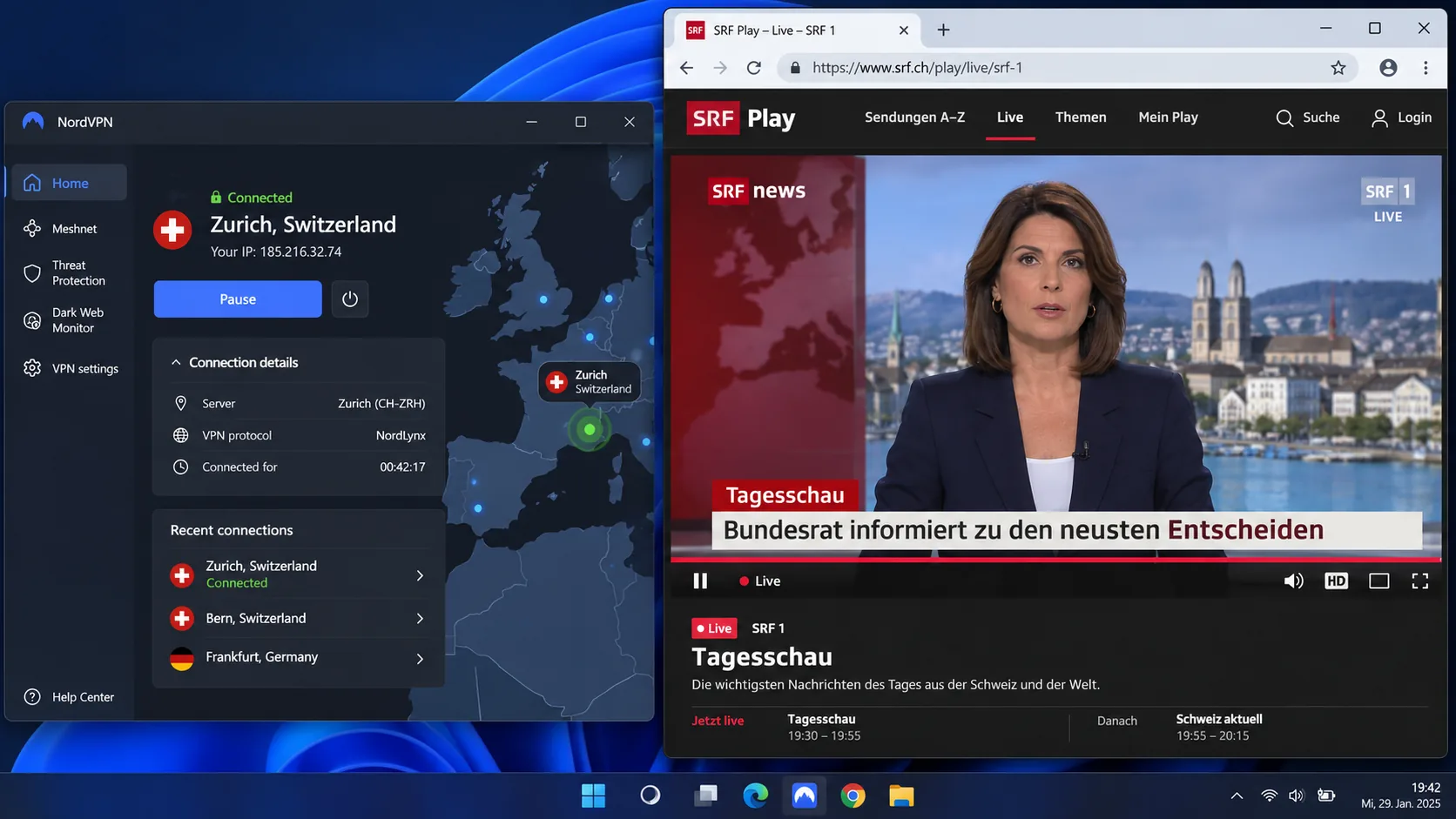
NordVPN is the one we would install first for Switzerland. It offers a Zurich exit, and in our testing it reliably reached SRF and Netflix. Its Swiss servers also worked with Zattoo and Suisse Play, which matters if you are a Swiss resident travelling or an expat missing home television. The apps cover Windows, macOS, Linux, Android, iOS, Android TV and Apple TV, alongside browser extensions and router configurations.
On the privacy side, Deloitte performed the sixth no-logs engagement in 2025, after the first two reviews were done by PwC. NordVPN also offers NordLynx, Double VPN, Onion Over VPN, obfuscated servers, a kill switch and DNS leak protection. Threat Protection features depend on your plan and platform, so check what your tier includes. You can protect 10 devices at once, and a router that you configure uses one of those slots.
One point to note concerns location. NordVPN is a Panama-based service, and the Swiss exit does not change that. Its Swiss server page lists 151 servers. Counts vary, so check the provider's list.
The weak spot we noticed is the initial connection: it takes a moment to establish. Once it is up, streaming is smooth. Beginners may also find the Android interface a little less approachable than Surfshark's.
Pros
- Reliable access to SRF and Netflix in our testing
- Swiss servers work with Zattoo and Suisse Play
- 10 simultaneous devices and wide platform coverage
- Recent Deloitte no-logs engagement in 2025
Cons
- The initial connection takes a noticeable moment
- Android interface is less approachable for beginners
- Panama-based, not Swiss-based
Best for: Swiss expats and travellers who want dependable Swiss streaming plus solid everyday privacy. Skip if: You specifically want a provider that is incorporated in Switzerland. Price: Regional offer of JPY 15,660 upfront for 27 months, then JPY 21,960 per year. A Swiss-franc quote was not available, and taxes may apply. 30-day money-back guarantee.
2. Surfshark
The limitation to weigh with Surfshark comes first. It leaked unencrypted traffic during our crash and reboot tests, although the kill switch behaves reliably in ordinary use. If that is acceptable, Surfshark is the household pick. It offers unlimited simultaneous devices, so one subscription can cover a family's phones, laptops and TVs without anyone logging out. It supports WireGuard and OpenVPN, and features include CleanWeb, a kill switch, NoBorders, and customizable MultiHop and IP rotation. Availability of those features differs by operating system.
Surfshark lists Swiss exits, and we could access SRF and Netflix in our testing. Its Swiss connections sustained streaming and video calls with little variation in speed. Streams can occasionally drop. When that happens, reconnecting can restore playback, and disabling CleanWeb or IP rotation can help.
For privacy, Deloitte verified the no-logs policy in 2023 and again in 2025. Surfshark is based in the Netherlands. The apps cover Windows, macOS, Linux, Android and iOS, and compatible routers need manual setup.
If you work with sensitive material on a laptop that might crash, the leak matters. Customer support can also be slow to respond, so do not count on a quick chat answer if setup goes wrong.
Pros
- Unlimited simultaneous devices
- Little speed variation on Swiss connections
- Deloitte verification in 2023 and 2025
- Customizable MultiHop and IP rotation
Cons
- Leaks unencrypted traffic in crash and reboot failure scenarios
- Customer support can be slow
- Streams occasionally drop and need a reconnect
Best for: Households with many devices that want one subscription to cover everything. Skip if: You handle sensitive data and cannot accept any leak risk during a crash. Price: USD 2.49 per month, billed as USD 67.23 upfront for the first 27 months, with VAT possibly added. The renewal price depends on your plan and region. 30-day money-back guarantee.
3. ExpressVPN
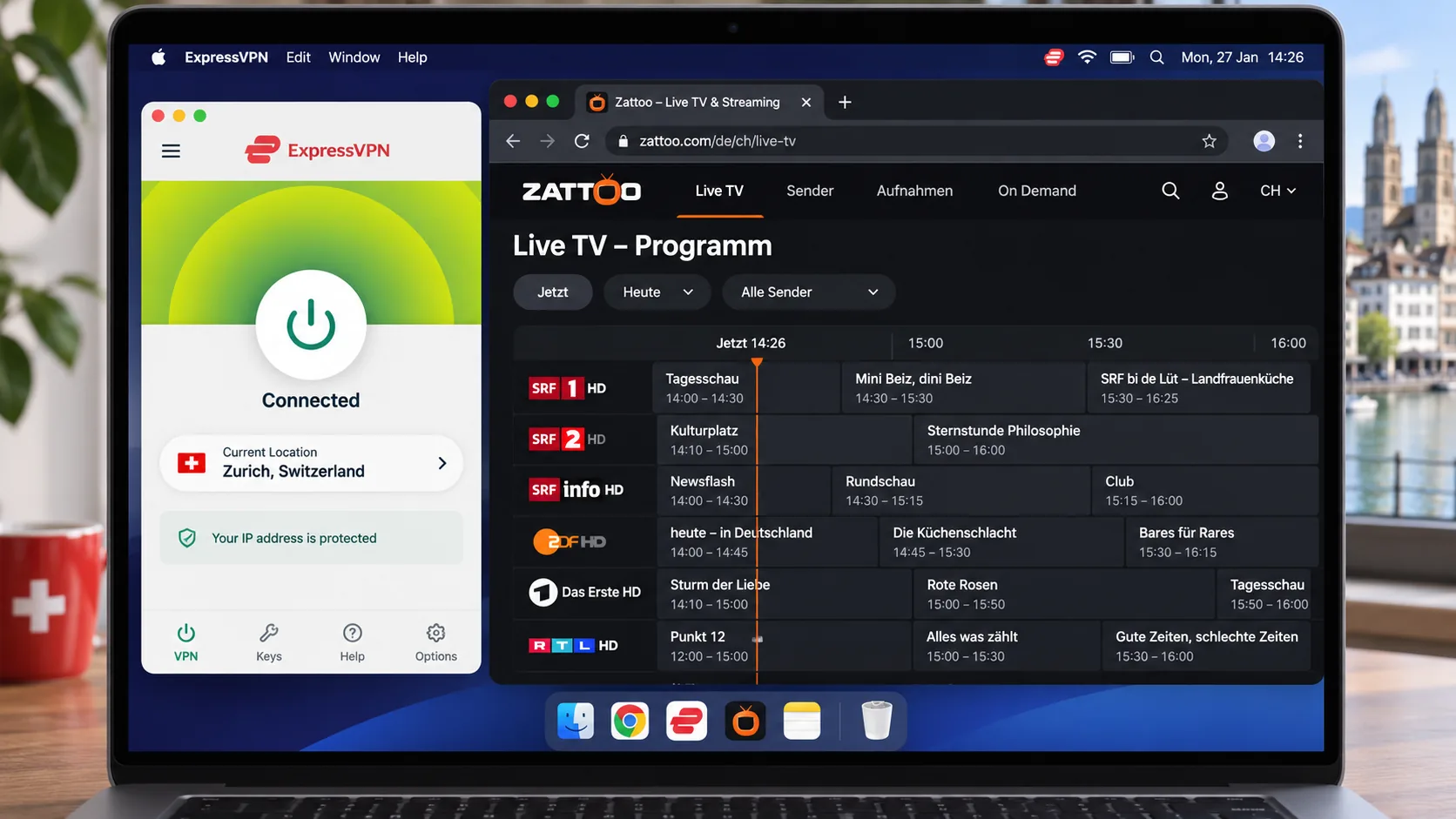
ExpressVPN suits people who want a VPN that simply works without much setup. We found its applications accessible and its setup tutorials detailed in our testing. It also reliably accessed difficult streaming platforms. Its Lightway protocol handled streaming smoothly, including Zattoo and BBC iPlayer. It also reached the US, UK and Australian Netflix libraries consistently, which makes it handy if you are in Switzerland and want a home-country library.
Swiss access comes through Zurich servers. The service also runs TrustedServer, a RAM-based architecture, and an internet kill switch. Apps cover Windows, macOS, Linux (with a GUI), Android and iOS, plus routers and TV devices. The current Windows app needs Windows 10 or above.
On the audit front, KPMG examined TrustedServer and privacy-policy controls as of 28 February 2025. The official summary describes reasonable assurance with no identified activity-logging safeguard issues. ExpressVPN is headquartered in the British Virgin Islands, with Kape as its parent group.
The limitation is the tiered connection limit. Basic allows 10 simultaneous devices, Advanced allows 12 and Pro allows 14, while your tier determines the Advanced Protection features and bundled products you get. The listed price is USD 3 per month, or USD 84 upfront for 28 months, then USD 99.95 per year. A separate official variant shows USD 2.99 per month, so the checkout total can differ slightly. First-time direct customers get a 30-day refund window, while app-store purchases follow the store's own rules.
Pros
- Accessible apps and detailed setup tutorials
- Reliable access to difficult streaming platforms
- Zurich servers and RAM-based TrustedServer design
- KPMG assessment as of February 2025
Cons
- Connection limits and extras depend on your tier
- Renewal price is noticeably higher than the intro rate
- Registered in the British Virgin Islands, not Switzerland
Best for: People who want simple apps and strong results on tough streaming services. Skip if: You want the cheapest long-term renewal or a Swiss-incorporated company.
4. Proton VPN
If you want the company itself to answer to Swiss law, take a closer look at Proton VPN. It combines Swiss jurisdiction with open-source apps and a feature set aimed at privacy-minded users. That feature set includes Secure Core, NetShield, WireGuard, Stealth, a kill switch, split tunneling and port forwarding. Platform support varies, and streaming and P2P support are paid benefits.
On a paid plan, you can choose Swiss exits directly. In our testing, Proton VPN accessed Swiss TV, Netflix US and BBC iPlayer, and its Swiss connections kept stable speeds suitable for high-resolution streaming. VPN Plus protects 10 simultaneous devices. The apps cover Windows, macOS, Linux, Android, iOS and iPadOS, Android TV, Apple TV, Fire TV, browser extensions and router configurations. On Windows, split tunneling and the kill switch now work together, so the earlier incompatibility has been remedied.
For privacy evidence, the 2026 Securitum engagement is the fifth annual no-logs review. Its scope covers server configurations, procedures, activity and connection metadata, and logging-change controls across subscription tiers. One caution: an audit summary describes what was covered at a particular time, so it does not promise that nothing can ever go wrong.
The limitation is that streaming may need another try. Proton VPN may require you to try another server in the same country for Prime Video or Disney Plus. Quoted Swiss server counts also conflict between sources, so we would not rely on any figure.
Proton VPN Plus shows USD 3.49 per month on the two-year selector, but the renewal total was not established from the offer we saw. Direct purchases allow cancellation and a full-refund request within 30 days of the initial purchase. Both actions must happen within the window, and each user is allowed one refund. Cash and bank transfers are excluded.
Pros
- Swiss-based company with open-source apps
- Selectable Swiss exits on paid plans
- Most recent no-logs review on this list, in 2026
- Split tunneling and kill switch work together on Windows
Cons
- Streaming sometimes needs another server in the same country
- Renewal price is unclear from the offer
- Streaming and P2P are paid-only benefits
Best for: Readers who want Swiss jurisdiction, open-source apps and strong privacy controls. Skip if: You want unlimited devices or the lowest possible subscription price. Price: USD 3.49 per month displayed on the two-year plan, with the renewal total unconfirmed. 30-day refund for eligible direct purchases.
A Swiss IP address and a Swiss company are two separate things. Proton VPN offers both. NordVPN, Surfshark, ExpressVPN and CyberGhost offer Swiss exits but are headquartered in Panama, the Netherlands, the British Virgin Islands and Romania respectively. Choose by exit location if you need a Swiss IP, and by jurisdiction if you care where the company answers to the law.
5. CyberGhost
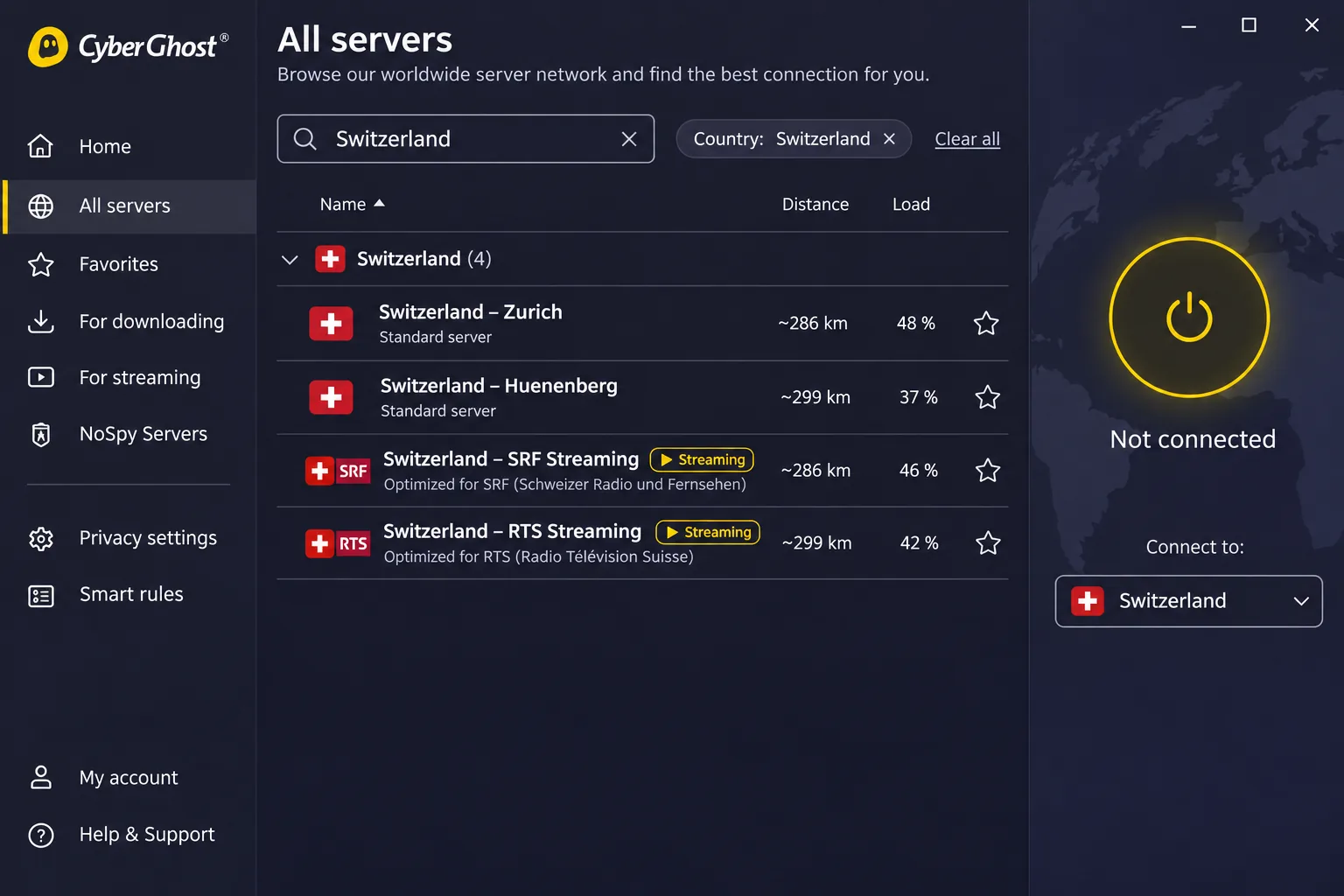
CyberGhost is the best fit if you want the app to pick the server for you. It labels servers by purpose, so finding one for a particular streaming service is easy. In our testing it worked with Zattoo and offered dedicated SRF and RTS choices. Its official catalog lists Play SRF, Play RTS, Play RSI, Zattoo, Netflix CH, Disney Plus CH and Amazon Prime CH among its Swiss streaming targets. It also accessed Netflix US, Hulu and Disney Plus.
Swiss exits are in Zurich and Huenenberg, and the servers are RAM-only. Features include a kill switch, DNS and IP leak protection, WireGuard, OpenVPN and IKEv2, and unlimited bandwidth. Smart Rules automate connections, reducing manual steps on unsecured Wi-Fi or when you open an app. Apps cover Windows, macOS, Android and iOS. Windows setup requires Windows 10 version 1903 or later, or Windows 11, and the support page excludes ARM-based processors. The service is Romania-based.
The third Deloitte Romania engagement covers server architecture, change and incident controls, and dedicated-IP token separation. CyberGhost links a 2025 report from a page updated in February 2026.
The limitation is torrenting flexibility. CyberGhost lacks port forwarding, which limits seeding options. It also allows only 7 simultaneous VPN connections, the lowest on this list.
On refunds, six-month and longer subscriptions carry a 45-day money-back guarantee, while monthly plans carry a 14-day guarantee. Pricing is the messiest of the five. The monthly rate is USD 12.99, and the long plan is advertised at USD 2.19 per month, but the official pages disagree on the upfront total and bonus months. Treat the checkout page as the final word.
Pros
- Purpose-labelled servers make streaming easy
- Zurich and Huenenberg exits
- 45-day refund window on long plans
- Smart Rules automate connecting
Cons
- No port forwarding
- Only 7 simultaneous connections
- Long-plan pricing differs across official pages
Best for: Streaming-focused users who prefer labelled servers and automation. Skip if: You need many devices or rely on port forwarding for torrenting. Price: USD 12.99 monthly, or about USD 56.94 for the 26-month plan on the Swiss page. Checkout may show a different total. 14-day refund on monthly plans, 45-day on long plans. Link: https://www.cyberghostvpn.com/vpn-server/vpn-switzerland
How to choose a VPN for Switzerland
Start with what you need the Swiss connection to do. If you live in Switzerland, your priorities are privacy on public networks, connection stability and a nearby server. If you are abroad, your priorities are a Swiss exit that streaming apps accept and apps that make switching easy.
Swiss server locations and access from abroad
Inside Switzerland, a nearby endpoint tends to be more responsive, because distance affects VPN performance. Connecting to a Swiss server from within Switzerland gives you protection but little else, since your traffic already looks Swiss. From abroad, the Swiss IP is the point. Your connection appears to come from Switzerland, which is what Swiss services check.
The server location decides what IP address you present, while corporate jurisdiction decides which legal system governs the company and its records. Our Proton VPN review goes deeper on what Swiss jurisdiction does and does not change.
Compare the renewal price, not the introductory monthly figure.
— The short version
Privacy, speed, device support and total subscription cost
For privacy, look for an independent no-logs engagement with a clear date and scope. All five providers here have one. Treat audits as evidence of controls at a point in time. A VPN masks your public IP but does not guarantee anonymity or stop all tracking.
For speed, test during your own evening hours, since results shift with distance, time and load. On device support, count your real devices. A family of six with phones and TVs runs past a 7-device limit quickly, so Surfshark's unlimited allowance and ExpressVPN's higher tiers matter there. Also check that your operating system version is supported, because minimum version requirements differ by provider and app build.
For total cost, compare the renewal price, not just the introductory monthly figure. Intro offers for 26 to 28 months look cheap, but renewal terms are where the bill grows. None of the figures in this guide are Swiss-franc quotes, so your final price depends on currency and tax at checkout.
How to use a VPN and get a Swiss IP address
The process is quick on any of the five. Most of the trouble comes from picking the wrong server or from a streaming service blocking one particular address.
Install the app, choose a server and check the connection
Install the official app on your device, sign in and select Switzerland by name. Do not use a generic "fastest" or nearest-server option, because it may pick another country. After you connect, check your public IP address and confirm it shows Switzerland. Also check your browser for WebRTC and DNS leaks, since these leaks can reveal your real location even when the IP looks right.
Our step-by-step guide to setting up a VPN on your router is worth reading if you want every device in the house on a Swiss IP. On NordVPN, a configured router uses one device slot.
What to try when a streaming service or banking app fails
Work through the simple fixes first. Switch to a different Swiss server, clear your browser cache and cookies, or open a private window. Restart and update the VPN app, and turn off any proxy or ad-blocking extension that might conflict. Changing the protocol sometimes helps too.
Confirm that your subscription to the streaming service itself is active, because it is separate from your VPN subscription. On Surfshark, try disabling CleanWeb or IP rotation. On Proton VPN, a different server in the same country may be needed for Prime Video or Disney Plus.
Banking apps are a separate case. We could not verify compatibility with any particular Swiss bank, so if your banking app blocks the connection, pause the VPN for that session and reconnect afterward.
Why you need a VPN in Switzerland
Switzerland has strong privacy traditions, but your traffic still crosses networks you do not control. A VPN does not change those privacy traditions. It adds an encrypted tunnel between your device and the VPN server, which is exactly what Switzerland's national cyber agency recommends for secure, authenticated access to your home network.
Public Wi-Fi, privacy and the limits of VPN protection
On hotel, train station and café networks, a VPN stops other users on the same network from reading your traffic. It also hides your real IP address from the sites you visit, and it can help if you work remotely and want a consistent connection.
The limits are just as important. A VPN does not make you anonymous, it does not stop all tracking, and it will not protect you from malware you download yourself. VPN advertising often overstates protection against malware and surveillance, so treat a VPN as one layer of security rather than a complete answer.
Swiss TV abroad and international streaming in Switzerland
Swiss residents often travel and lose access to services like SRF, RTS, RSI and Zattoo, and a Swiss IP address restores that access. The opposite is also common. People in Switzerland use a VPN to reach their home country's Netflix library or BBC iPlayer. ExpressVPN, Proton VPN and CyberGhost each handled some of those streaming needs in our testing.
Always check the terms of any service you stream from. A VPN can change what a service thinks your location is, but it does not change the service's licensing terms.
Can you use a free VPN for Switzerland?
Only partly. Of the five providers here, only Proton VPN offers a permanent free plan. The other four provide a money-back guarantee, which is a different thing.
Free plans, Swiss server access and data limits
Proton VPN Free has no data limit and picks the fastest free server for your first connection. Switzerland is in the free country pool, but later server changes are randomly assigned, so you cannot choose Switzerland on purpose. Reaching a particular country with randomized changes is frustrating. The official free-server change cooldown starts at 45 seconds and then moves to 10-minute intervals, though waits can run longer after repeated changes.
Paid plans add selectable destinations and supported streaming and P2P. For a reliable Swiss IP abroad, free is not the right tool.
A refund window is not a free plan. With NordVPN, Surfshark, ExpressVPN and Proton VPN you pay first and request a refund within 30 days. CyberGhost gives 14 days on monthly plans and 45 days on long ones. Proton VPN requires both cancellation and the refund request inside its window, and app-store purchases follow the relevant store's rules.
Free trials versus money-back guarantees
A trial lets you try before paying. A money-back guarantee has you pay first and recover the money if you cancel in time. We could not fully confirm platform-specific trial lengths or payment requirements across providers, so we compare the verified refund windows instead. Test a Swiss server on your own streaming apps during that window, before it closes.
Final recommendation
Let your household and budget guide your final choice. A single person or couple with a handful of devices fits NordVPN's 10-device allowance comfortably, and a router uses one of those slots. A family of six or more is better served by Surfshark's unlimited devices, since CyberGhost's 7 connections run out quickly. If you plan to stay beyond the first term, price the renewal for each provider before you commit, and use the 30-day window to test a Swiss server on your own streaming apps. Choose Proton VPN if Swiss jurisdiction and open-source apps are the priority, ExpressVPN for the easiest apps, and CyberGhost if labelled streaming servers appeal.