Picking a VPN protocol sounds like a job for a network engineer, but it lands on regular users more often than you'd think. Your VPN app hands you a dropdown, and suddenly you're choosing between IPsec and WireGuard with no idea which one actually fits how you connect. That single choice quietly shapes your speed, your battery life, how smoothly the tunnel survives a walk out the front door, and how much trust you're placing in the code underneath.
We test VPNs the way you'd actually use them: real connections on real devices, watching throughput, checking for leaks, and paying attention to the little moments of friction that never show up in a spec sheet. Over that work, IPsec and WireGuard keep coming up as the two protocols worth arguing about, so this guide breaks them down side by side. We'll cover what each one is, how they differ on speed, security, setup, and compatibility, and which one we'd reach for depending on what you're doing.
Neither protocol is "best" in a vacuum. WireGuard is the fast, modern option that most people will love. IPsec is the entrenched, flexible workhorse that still wins in specific places, especially on iPhones and inside big organizations. The right answer depends on your needs, so let's start with what each protocol actually is before we put them head to head.
When a consumer VPN app lists "IPsec," it almost always means IKEv2/IPsec, the modern pairing of the IKEv2 key-exchange protocol with the IPsec encryption suite. That's the version we compare against WireGuard throughout this guide, since it's the one you'll actually meet in a VPN client.
What Is IPsec? (How It Works)
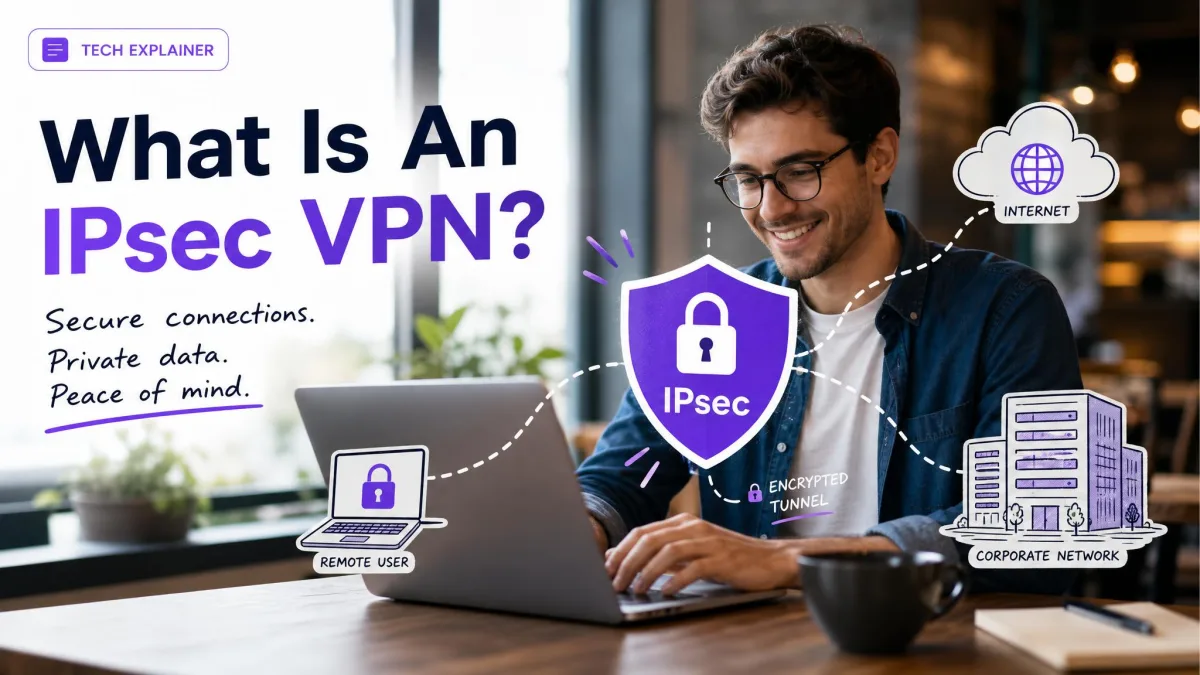
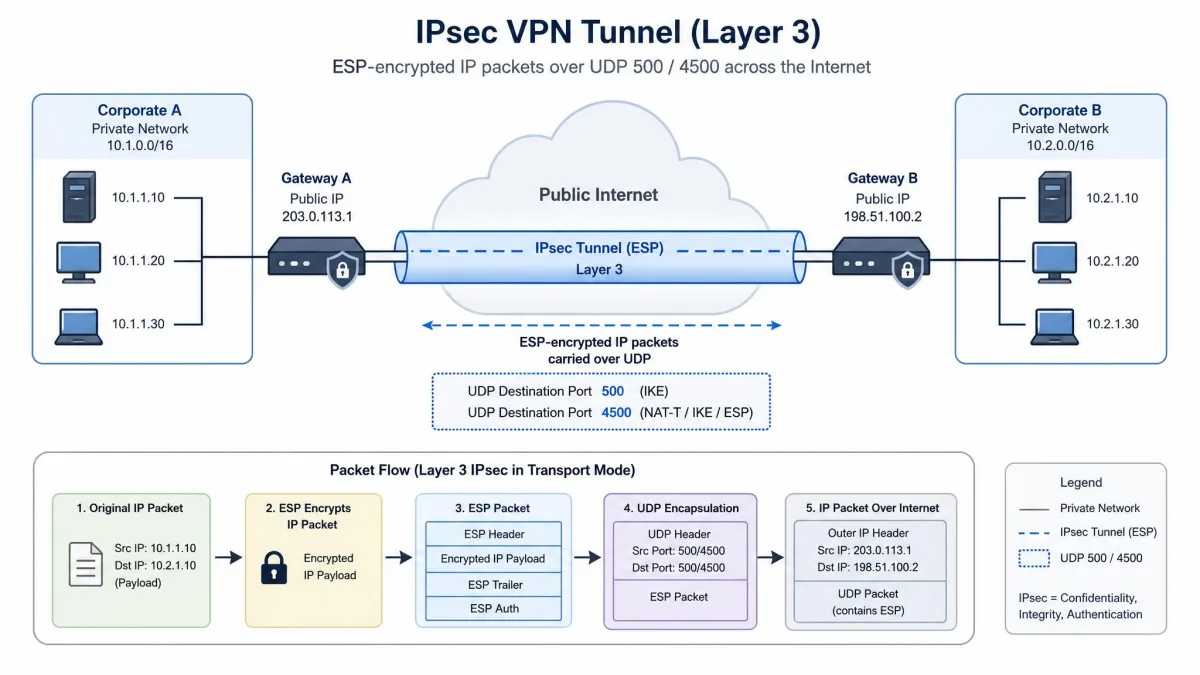
IPsec, short for Internet Protocol Security, isn't a single program. It's a suite of standards that secures traffic at Layer 3, the network layer, which means it protects the IP packets themselves rather than any one application. That low-level design is a big part of why it became the backbone of corporate and carrier networks decades ago and never left.
Because it operates so deep in the stack, IPsec can encrypt everything flowing between two points without individual apps needing to know it's there. It supports both TCP and UDP encapsulation, which gives it flexibility on awkward networks. That flexibility is also its reputation problem: there are a lot of moving parts, and a lot of options to get wrong.
IKEv2/IPsec and the IPsec suite (AH, ESP, IKE)
The IPsec suite is built from three main components. AH, the Authentication Header, verifies that a packet hasn't been tampered with. ESP, the Encapsulating Security Payload, does the actual encryption that hides your data. IKE, the Internet Key Exchange, is the negotiation layer that sets up the secure connection and agrees on keys between the two sides.
The version you'll use today is IKEv2, defined in the IETF's RFC 7296 specification for IKEv2. It replaced the clunkier original and added smarter behavior for mobile connections. If you want the full technical lineage, Wikipedia's overview of Internet Key Exchange traces how the negotiation protocol evolved, and the broader IPsec reference on Wikipedia maps out how AH, ESP, and IKE fit together into one suite.
One defining trait of IPsec is that it's cipher-agile. It supports AES, including the fast AES-GCM mode, along with older options like 3DES and even ChaCha20, plus multiple authentication algorithms. The ciphers are negotiable, so two endpoints agree on what to use when they connect. That's powerful for compliance and future-proofing, since you can swap algorithms as standards move on.
What Is WireGuard? (How It Works)
WireGuard came at the problem from the opposite direction. Instead of a sprawling, flexible suite, it's a lean protocol with a deliberately narrow design. It runs over UDP only, uses a single fixed set of modern cryptography, and aims to be simple enough that one person can read the whole thing and understand it. That minimalism is the entire point.
In practice, this makes WireGuard feel less like enterprise plumbing and more like a tool built for the way people connect today: laptops, phones, and quick tunnels that need to come up fast and stay out of the way. It's newer than IPsec by a couple of decades, but it earned its place quickly.
![A WireGuard configuration file open in a text editor showing the [Interface] and [Peer] sections with PrivateKey, PublicKey, AllowedIPs, and Endpoint fields highlighted.](wireguard-config-file-keypair.webp)
WireGuard's fixed cipher suite and lean codebase
WireGuard doesn't negotiate ciphers at all. It ships one non-negotiable suite built on the Noise protocol framework: ChaCha20-Poly1305 for authenticated encryption, Curve25519 for the key exchange, BLAKE2s for hashing, plus SipHash24 and HKDF supporting the machinery. There's no menu, which means there's nothing to misconfigure and no weak legacy option for an attacker to trick your connection into using.
The other headline is size. The Linux implementation is roughly 4,000 lines of code, which is tiny next to IPsec's sprawling codebase. A small, focused codebase is far easier to audit, and WireGuard's core protocol even has a formally verified blueprint, though not every implementation has been individually verified. When it comes to trusting the code your privacy rests on, fewer lines and fewer options is a genuine advantage.
WireGuard handles identity with SSH-style public and private key pairs. Each peer has a private key it keeps and a public key it shares, and the two ends recognize each other by those keys. It's elegant once it clicks, though we'll be honest that the key pairing is the part that trips up newcomers the first time.
IPsec vs WireGuard: Head-to-Head Comparison
This is where the trade-offs get concrete. Both protocols will encrypt your traffic reliably, so the real differences show up in speed, security posture, setup effort, compatibility, and how they behave when your connection moves around. We'll take them one at a time.
Speed and performance (throughput, latency, handshake)
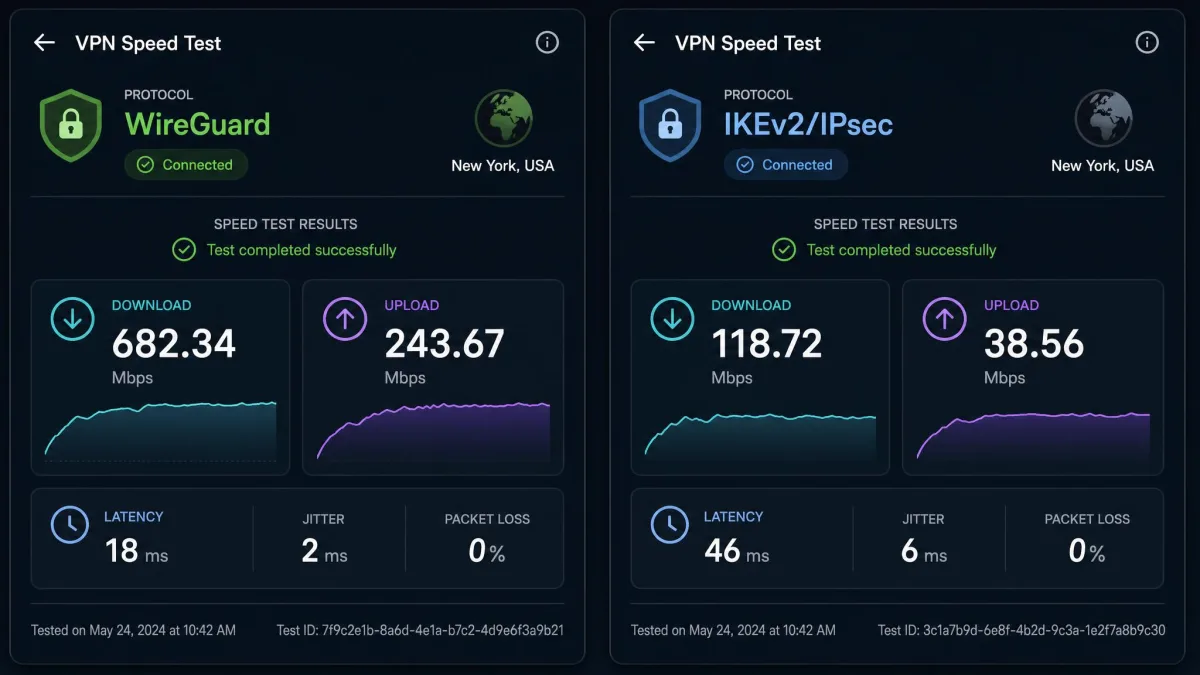
WireGuard's reputation for speed is well earned. In WireGuard's own 2018 benchmark of protocol throughput, WireGuard reached roughly 1011 Mbps against IPsec's roughly 825 Mbps in the same test. That's a real gap, but it's worth being honest about its age. Those are 2018 lab figures, and IPsec implementations like StrongSwan have optimized heavily since, narrowing the raw-throughput difference. We wouldn't quote a fixed percentage advantage today.
Latency and connection setup are where WireGuard's lead feels more durable. Its handshake typically completes in under 100ms, and in our testing that snappiness is noticeable: WireGuard feels responsive to connect, coming up almost the instant you tap it. IPsec, by contrast, can feel like it pauses to think before the tunnel comes up, thanks to its multi-step negotiation. That difference matters less on a desktop you leave connected all day and more on a phone that reconnects constantly.
There's a CPU story too. WireGuard's overhead can stay as low as about 2% in the right conditions, and because ChaCha20-Poly1305 doesn't lean on hardware AES acceleration, it's lighter on processors that lack it. In our experience that plays out as better battery and CPU behavior, especially on older phones and cheaper hardware. IPsec with AES-GCM is fast on modern chips with AES built in, but it asks more of devices that don't have that help.
Speed numbers from any protocol benchmark are only as good as the hardware and network behind them. A 2018 lab result tells you which protocol had the edge under one specific setup, not what you'll see on your phone over hotel Wi-Fi. Treat published throughput figures as directional rather than a promise.
Security and cryptography (ciphers, codebase, audit history)
Both protocols are secure when set up correctly, so the interesting question is how they get there. WireGuard's approach is to remove choices. Its single modern cipher suite means there's no weak legacy algorithm to fall back to and no negotiation for an attacker to manipulate. Combined with that roughly 4,000-line codebase, it's small enough to audit thoroughly, which is a meaningful security property in its own right.
IPsec earns its trust a different way: time. It has roughly 25 years of battle-tested scrutiny behind it, and that kind of exposure is hard to fake. The flip side is complexity. Its large codebase carries a heavier maintenance burden and a bigger attack surface to keep patched, and older variants like IKEv1 and L2TP/IPsec have historical vulnerabilities you'll want to steer clear of. Cipher agility is a double-edged sword here too. It lets IPsec adopt new algorithms, but a poor configuration can quietly leave the tunnel weaker than you intended.
WireGuard bets on doing one thing perfectly and letting you read every line. IPsec bets on 25 years of scrutiny and the freedom to swap ciphers as the world changes. Both bets have paid off.
On future-proofing, neither protocol is post-quantum secure by default, and both are exposed to "store now, decrypt later" attacks where captured traffic is banked for a future quantum computer to crack. WireGuard can mitigate this with an optional pre-shared key layered on top, while IPsec's cipher agility means it can adopt post-quantum algorithms as they standardize, such as the ones in NIST's FIPS 203 post-quantum encryption standard. Neither should be your reason to panic today, but it's a point in favor of IPsec's swappable design if long-horizon secrecy is your job.
Ease of use and configuration
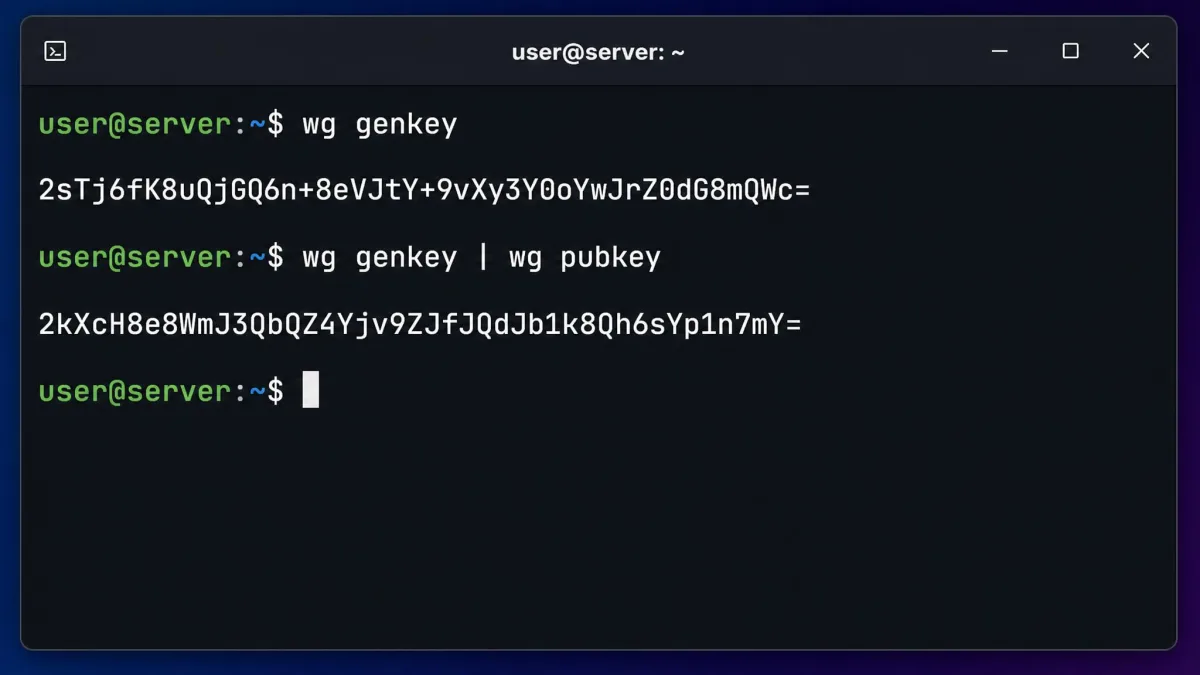
For most people, WireGuard is the easier protocol to live with. It's genuinely straightforward to set up once you understand its public and private key pairing, and modern VPN apps hide even that behind a single toggle. The one honest caveat is that the key exchange trips up newcomers the first time they configure it by hand, because it works differently from the username-and-password model people expect.
IPsec is the fiddlier of the two. Its many negotiable options make it tricky to configure, and that's not just a nuisance. A poor configuration can quietly leave the tunnel less secure without any obvious warning, which is exactly the kind of mistake you don't want in a security tool. When it comes to standing up a connection yourself, WireGuard forgives more and demands less.
IPsec's flexibility is also its trap. Because so many settings are negotiable, a misconfigured IPsec tunnel can still connect and appear to work while using weaker protection than you meant to. If you set up IPsec by hand, verify the ciphers and authentication your tunnel actually agreed on rather than assuming the defaults are strong.
Compatibility and platform support
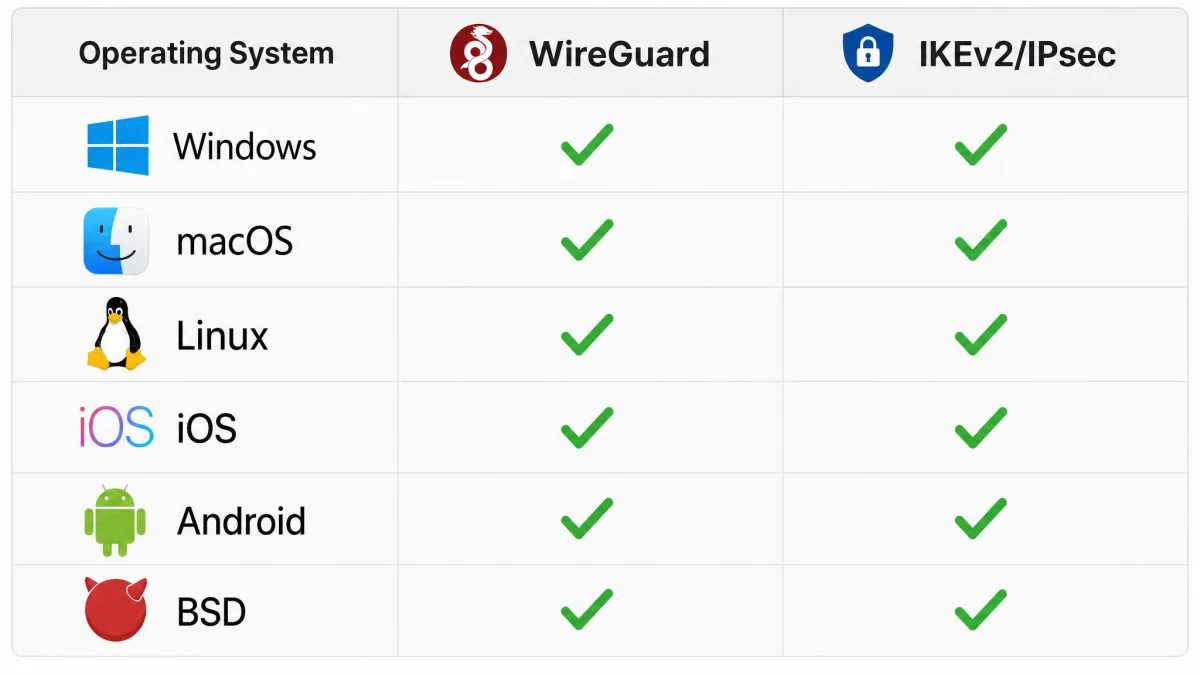
WireGuard is genuinely cross-platform, with solid implementations on Linux, Windows, macOS, BSD, iOS, and Android. It's strongest on Android, Windows, macOS, and Linux, where it feels like a first-class citizen. Where it shows its youth is on older and more unusual hardware, where support can be thinner or missing entirely.
IPsec wins the breadth contest decisively. It has excellent compatibility that reaches back to legacy systems WireGuard never touched, and it's built into iOS at the kernel level. It's also deeply entrenched in enterprise gear and carrier networks, so if you need a tunnel that terminates on a corporate firewall or an old router, IPsec is far more likely to be supported out of the box. On raw reach, this is IPsec's category.
Mobile, roaming, and NAT traversal
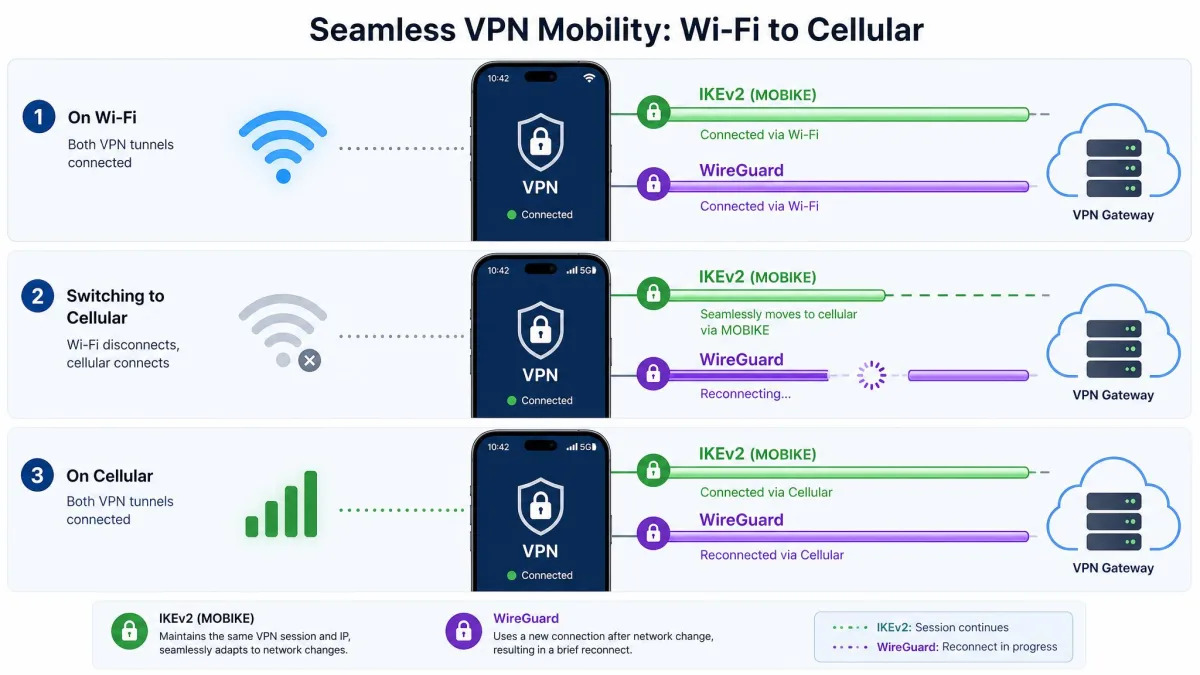
Roaming is the difference that surprises people most, and it's where IPsec earns its keep on phones. IKEv2/IPsec supports MOBIKE, a mechanism for handing a live tunnel from Wi-Fi to cellular without dropping it, and on iOS that's backed by kernel-level integration. In our testing, IKEv2/IPsec handles Wi-Fi-to-cellular handoffs smoothly on iPhones, and the tunnel just follows you.
WireGuard has no native roaming or handoff protocol. Instead, the client simply sends packets from its new IP address and the server updates where it thinks the peer is, with a persistent-keepalive setting keeping NAT mappings alive. That works fine for browsing, but it can feel bumpy for real-time voice or video on iOS. We've seen WireGuard connections drop during phone calls on iPhones when the OS backgrounds the app, and those dropped sessions are a well-known source of support tickets. If your phone is an iPhone and you're on calls all day, that's a real consideration.
On NAT traversal, IPsec uses UDP port 500 for IKE and UDP 4500 for NAT-Traversal, a well-understood pair that firewalls and routers have handled for years. WireGuard runs over a single UDP port, which is simpler. One myth worth puncturing: WireGuard's single-port design gets marketed as more firewall-friendly, but that's overstated. On genuinely restrictive networks, both protocols get blocked, and only an added obfuscation layer reliably gets traffic through.
Network efficiency and overhead
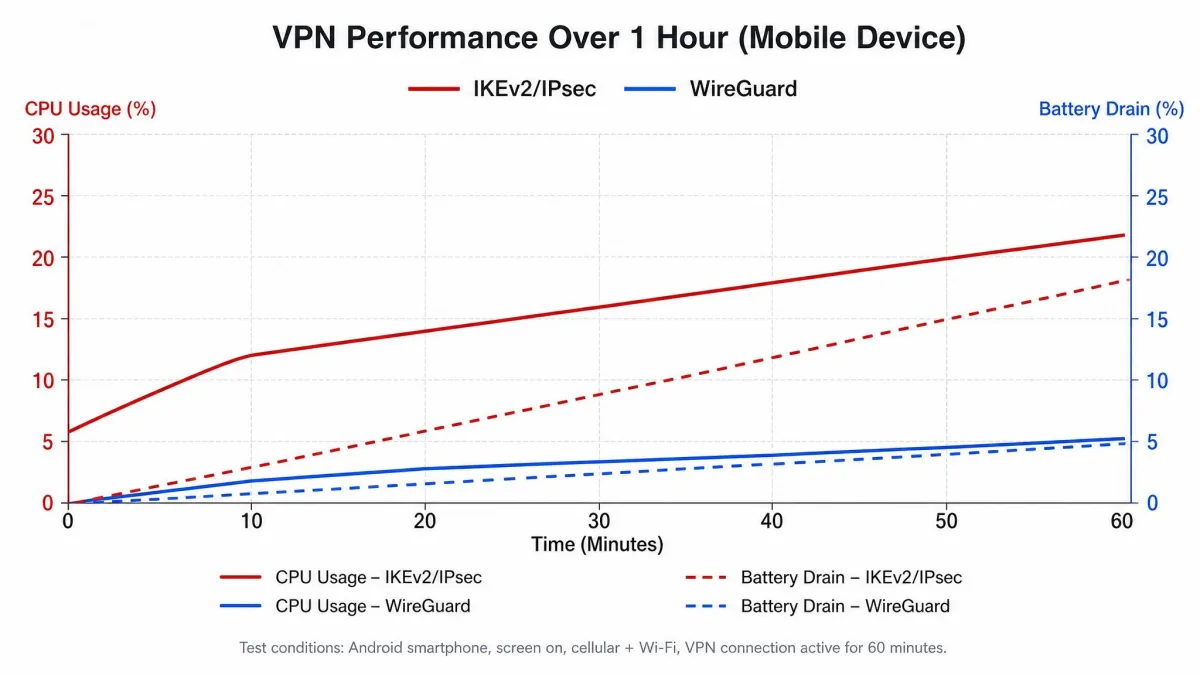
Efficiency ties the speed and battery stories together. WireGuard's lean design and light cipher suite mean less per-packet overhead and lower CPU cost, which is why it stays kinder to battery on phones and holds up better on hardware without AES acceleration. For a device you carry around all day, that adds up.
IPsec isn't inefficient, especially on modern processors with AES-GCM acceleration built in, where it's fast and comfortable. Its overhead is simply higher on average, and the gap widens on older or lower-powered devices. If you're optimizing for a fleet of aging phones or a low-power router, WireGuard's efficiency edge is the practical difference you'll feel.
Use Cases: When to Choose Each Protocol
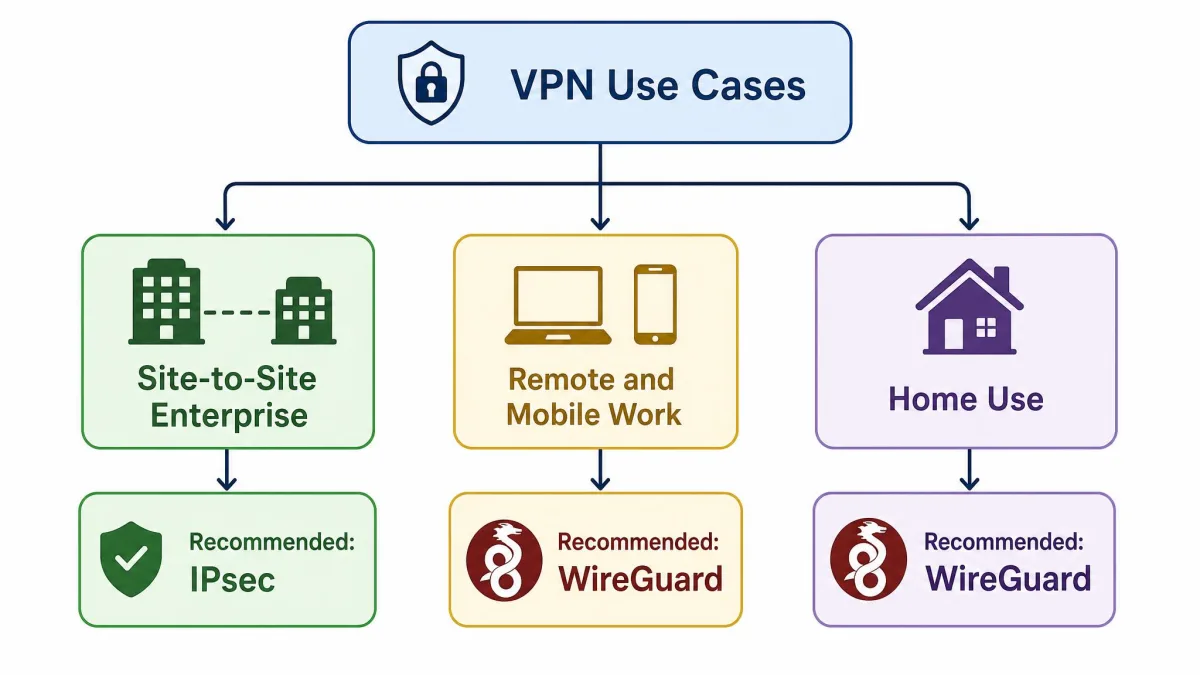
Specs only matter once you map them to what you're actually doing. Here's how the two protocols sort out across the three situations most readers land in.
Site-to-site and enterprise VPNs
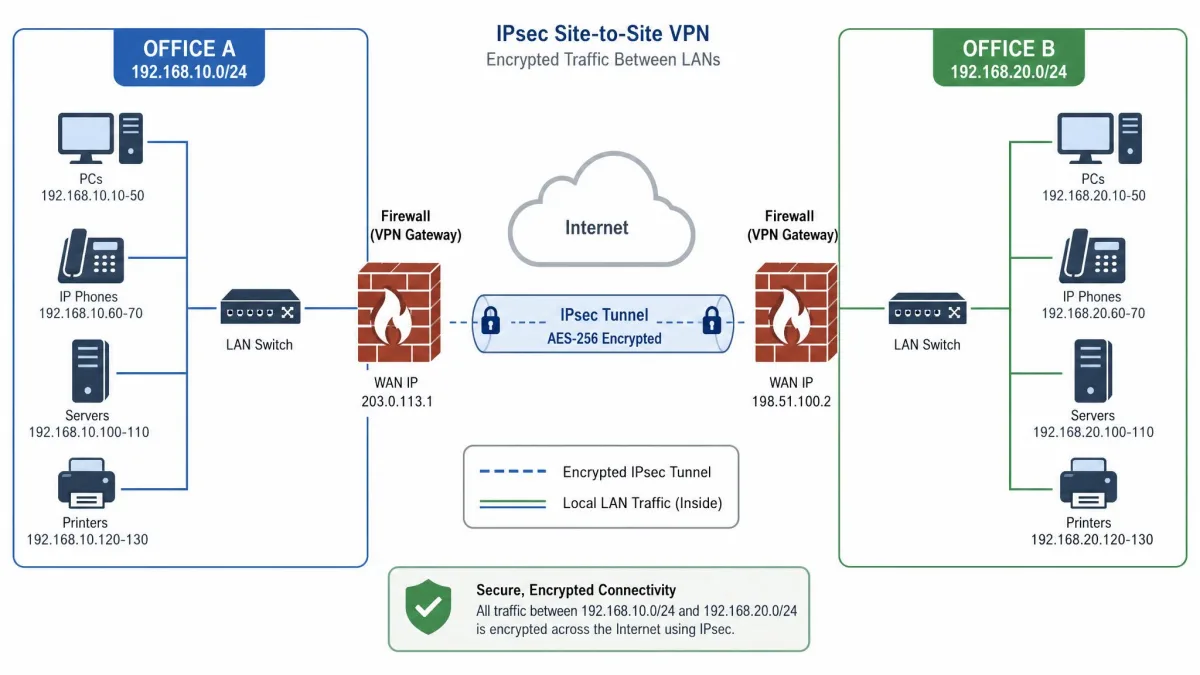
For connecting whole networks together, or plugging into existing corporate infrastructure, IPsec is usually the right call. It's the entrenched standard in enterprise firewalls, routers, and carrier gear, so it interoperates with equipment you probably already own. Its cipher agility also plays well with compliance regimes that mandate specific algorithms, since you can configure exactly what auditors require. WireGuard is increasingly used site-to-site and it's excellent when both ends are modern, but IPsec's compatibility and negotiability still make it the safer default for mixed or legacy environments.
Remote work and mobile devices
This one splits by platform. For Android laptops-and-phones users, WireGuard is a fantastic remote-work protocol: fast to connect, light on battery, and simple to deploy at scale. For iPhone-heavy teams, IKEv2/IPsec often wins because of that smooth MOBIKE roaming and native iOS integration, which keeps tunnels alive as people move between Wi-Fi and cellular during calls. Many organizations pick based on whichever platform dominates their fleet.
Home and personal use
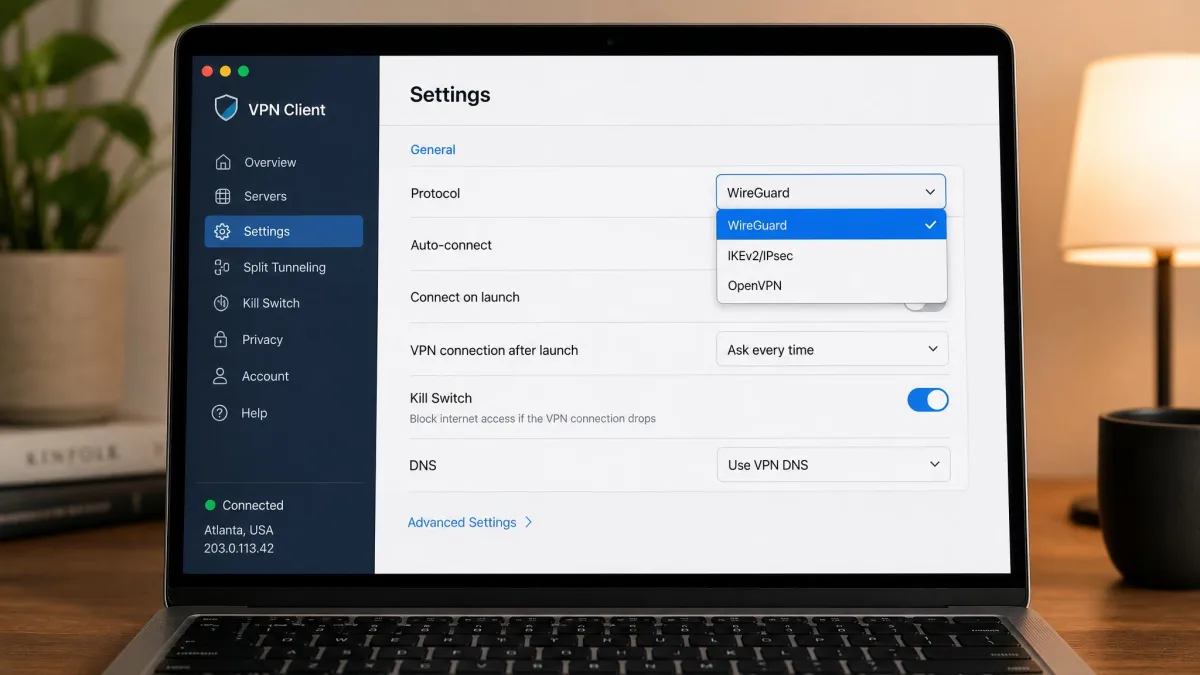
For most home users, WireGuard is the one we'd steer you toward. If you're running your own VPN server to reach your home network, setting up a tunnel on a Raspberry Pi, or just want the fastest general-purpose option in your commercial VPN app, WireGuard's speed and simplicity are hard to beat. The exception is the iPhone user who's constantly moving between networks on calls, where IKEv2/IPsec's roaming may serve you better day to day. Try both if your app offers them; the right feel is easy to notice once you switch.
IPsec vs WireGuard at a Glance (Comparison Table)
Here's the head-to-head in one view. Read it as a summary of the sections above, not a scoreboard, since the winner of each row depends on what you personally weight.
| Feature | WireGuard | IPsec (IKEv2) |
|---|---|---|
| Throughput / speed | ~1011 Mbps in 2018 lab test; consistently fast, low overhead | ~825 Mbps in the same test; gap has narrowed since |
| Latency / handshake | Sub-100ms handshake; snappy to connect | Slower, multi-step handshake |
| Encryption ciphers | Fixed: ChaCha20-Poly1305, Curve25519, BLAKE2s | Cipher-agile: AES / AES-GCM, 3DES, ChaCha20 |
| Codebase size | Roughly 4,000 lines on Linux; easy to audit | Much larger and harder to audit |
| Ease of setup | Simple, SSH-style keys | Complex, many negotiable options |
| Platform support | Linux / Windows / macOS / BSD / iOS / Android; weak on legacy | Excellent including legacy; native in iOS |
| Mobile / roaming | Endpoint roaming plus keepalive; no native handoff | MOBIKE seamless handoff, kernel-level on iOS |
| NAT traversal | Single UDP port | UDP 500 plus 4500 (NAT-T) |
| Maturity / audit | Newer, formally verified core, easy to audit | Roughly 25 years battle-tested, complex |
The Verdict: Which Protocol Wins?
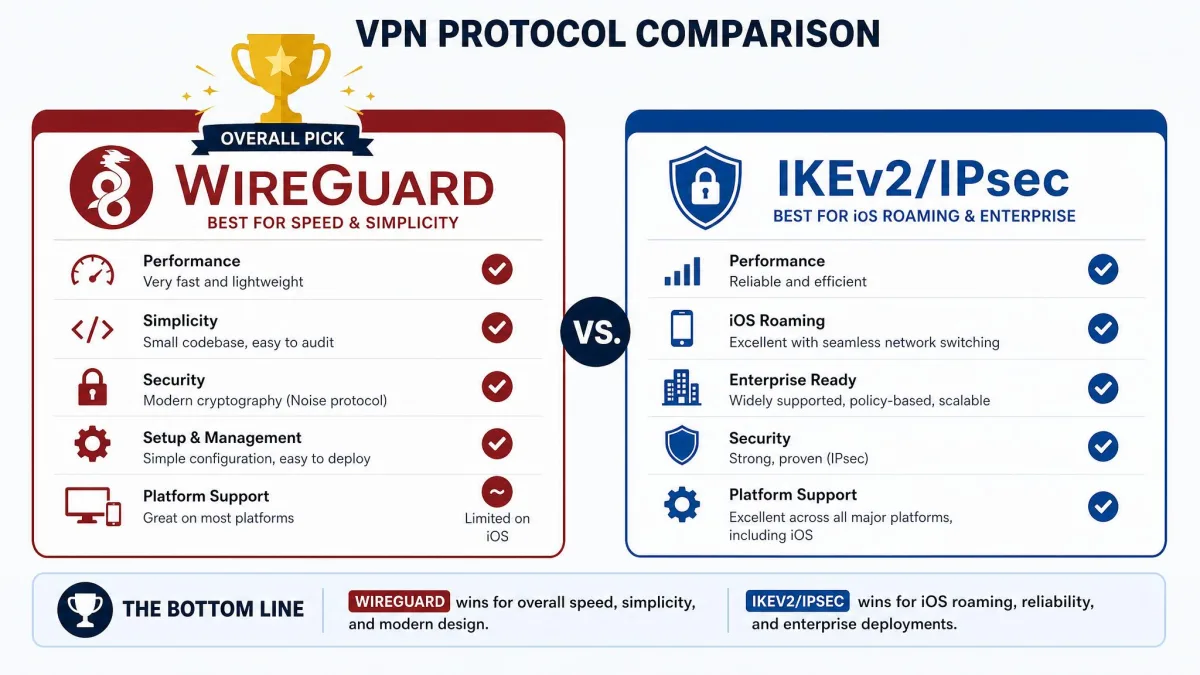
If we have to crown one for the widest set of readers, it's WireGuard. It's faster to connect, lighter on your battery and CPU, easier to set up, and small enough that trusting its code is a rational act rather than a leap of faith. For home users, Android and desktop remote workers, and anyone standing up their own tunnel, it's the modern default, and it's the protocol we reach for first.
But "wins overall" isn't "wins for you." IPsec, in its IKEv2 form, still takes specific and important categories. It's the better choice on iPhones where MOBIKE keeps calls from dropping as you roam, in enterprises where it interoperates with gear you already run, and under compliance rules where cipher agility lets you match required algorithms exactly. Its 25 years of scrutiny and unmatched compatibility aren't going anywhere in 2026.