Most people searching for a VPN for Morocco want one of three things. Some are travelers who want their home streaming apps and banking to behave normally from a hotel or café network. Some are expats or people abroad who want a Moroccan IP address so they can reach Moroccan services. Others just want a private connection on shared Wi-Fi. Those are different jobs, and not every VPN does all of them equally well.
We compared five providers against those three needs, looking at Moroccan exit locations, device limits and refund terms, along with the weaknesses recorded in our hands-on notes. The shortlist below comes first, then the reasoning behind it.
Best VPNs for Morocco at a glance
All five providers list a Moroccan exit IP, but each provides it through a virtual location. The server answering your connection is physically in another country, and that matters for speed and for how you describe the connection to a streaming service. Prices below are not listed because introductory offers change with term and region.
| Product | Buy | Best for | Moroccan IP | Devices | Refund or trial |
|---|---|---|---|---|---|
 |
Check price → | General streaming and travel | Yes, virtual (hosted in Spain) | 10 | 30-day money-back |
 |
Many personal devices | Yes, virtual | Unlimited on paid plans | 30-day money-back, 7-day trial | |
 |
Approachable apps | Yes, virtual Rabat (hosted in Germany) | 10 on Basic | 30-day for new users | |
 |
Privacy controls and a free tier | Yes, paid plans only (hosted in London) | 10 on Plus, 1 on Free | 30-day on initial purchase | |
 |
Detailed configuration | Yes, virtual Rabat | Unlimited | 30-day for new subscribers |
How we chose these Morocco VPNs
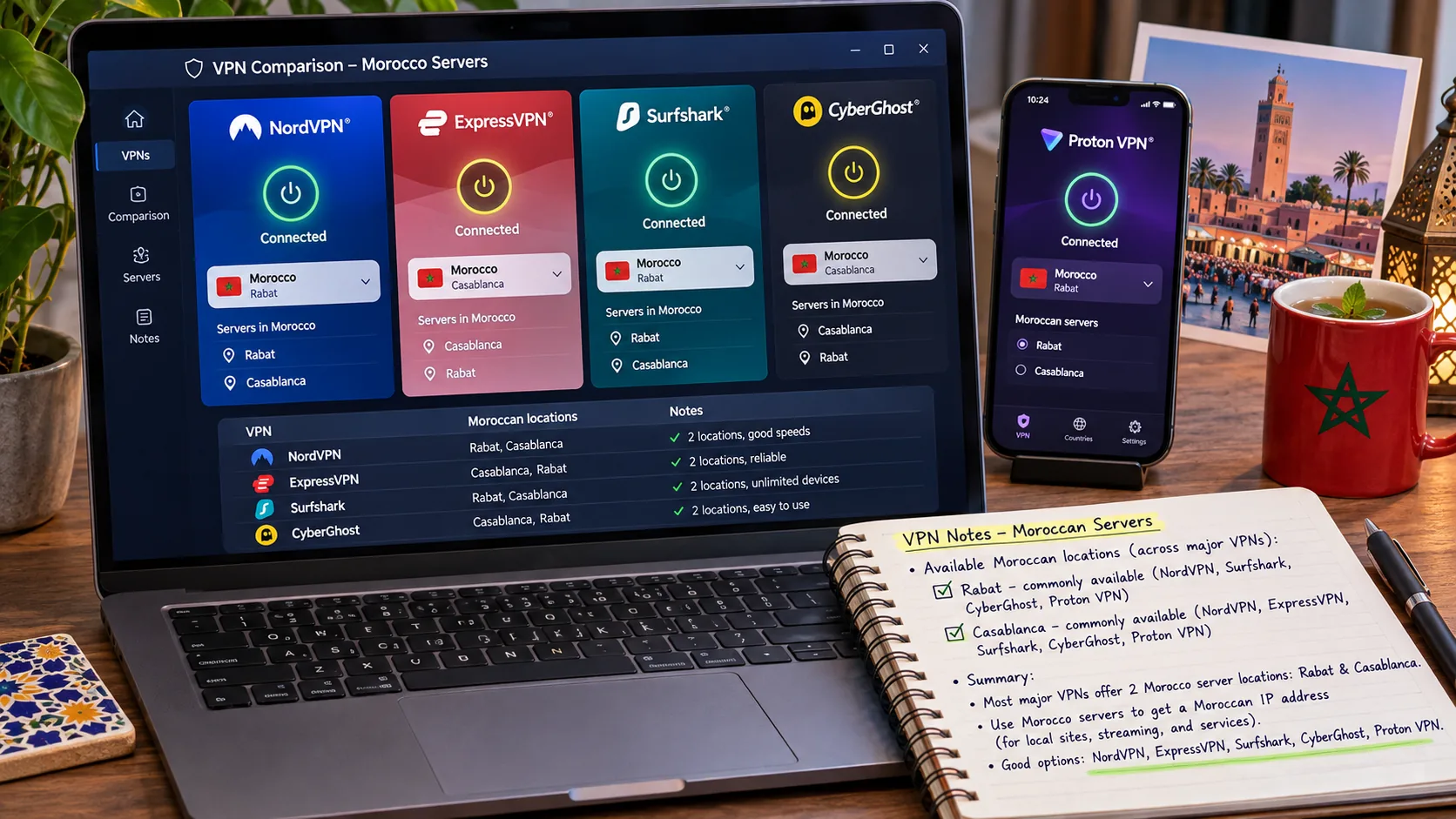
We scored each provider on five questions. Does it offer a Moroccan exit location, and is it honest about where the server physically sits? How many devices does one plan cover? How clear are its refund and trial terms? How did it hold up in streaming and extended use? And what does it do badly? We treat vendor pages as the source for offers and our own hands-on notes as the source for performance, and we leave out any claim we could not back up. That is why there is no carrier-by-carrier speed ranking for Maroc Telecom, Orange Maroc or inwi: we have no verified numbers for them.
The 5 best VPNs for Morocco
1. NordVPN
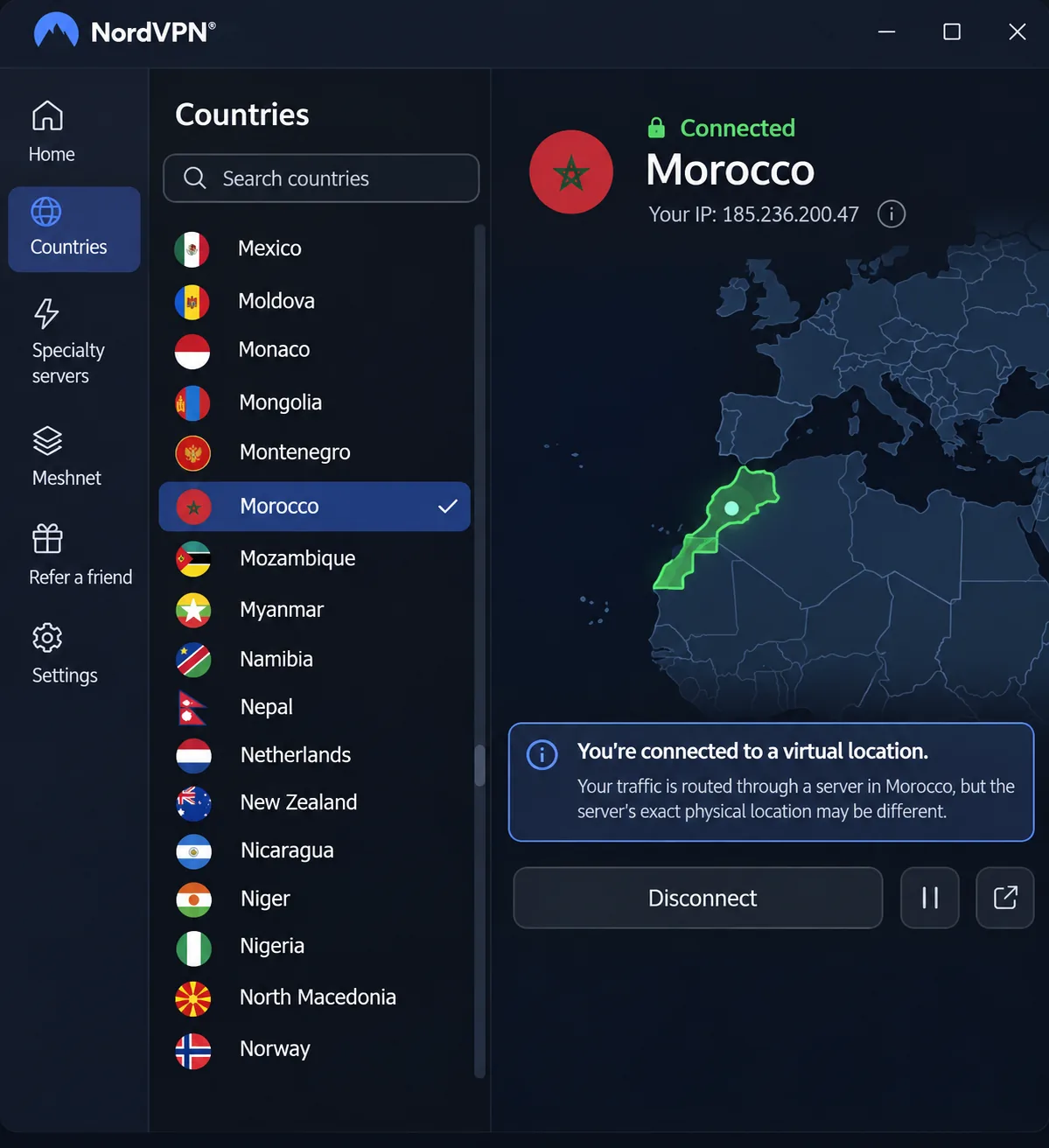
NordVPN is our first pick for travelers who want one subscription that covers streaming, public Wi-Fi and a Moroccan IP. You can select Morocco as a country in the app, and the exit is a virtual location physically hosted in Spain. Plans cover 10 devices, bandwidth is unlimited, and apps exist for Windows, macOS, Linux, Android and iOS.
When we put it through our streaming checks, live and on-demand streams played without buffering or connection drops, and most major libraries opened on the first try. It was not flawless. Netflix Japan and Disney Plus Canada sometimes needed a second or third attempt before they loaded, and a few regional Prime Video and YouTube libraries never opened at all. The mobile app also feels cramped, and its configuration options are thinner than PIA's.
Check the pricing carefully here. The Basic offer we observed was $4.99 a month equivalent, which is really $74.85 paid upfront for the first 15 months, followed by $139.08 a year at renewal. Apple App Store purchases follow Apple's refund policy instead of NordVPN's.
Pros
- Morocco is selectable in the app
- Strong results across major streaming libraries
- Unlimited bandwidth on 10 devices
Cons
- Cramped mobile interface
- Some streaming regions still need retries
2. Surfshark
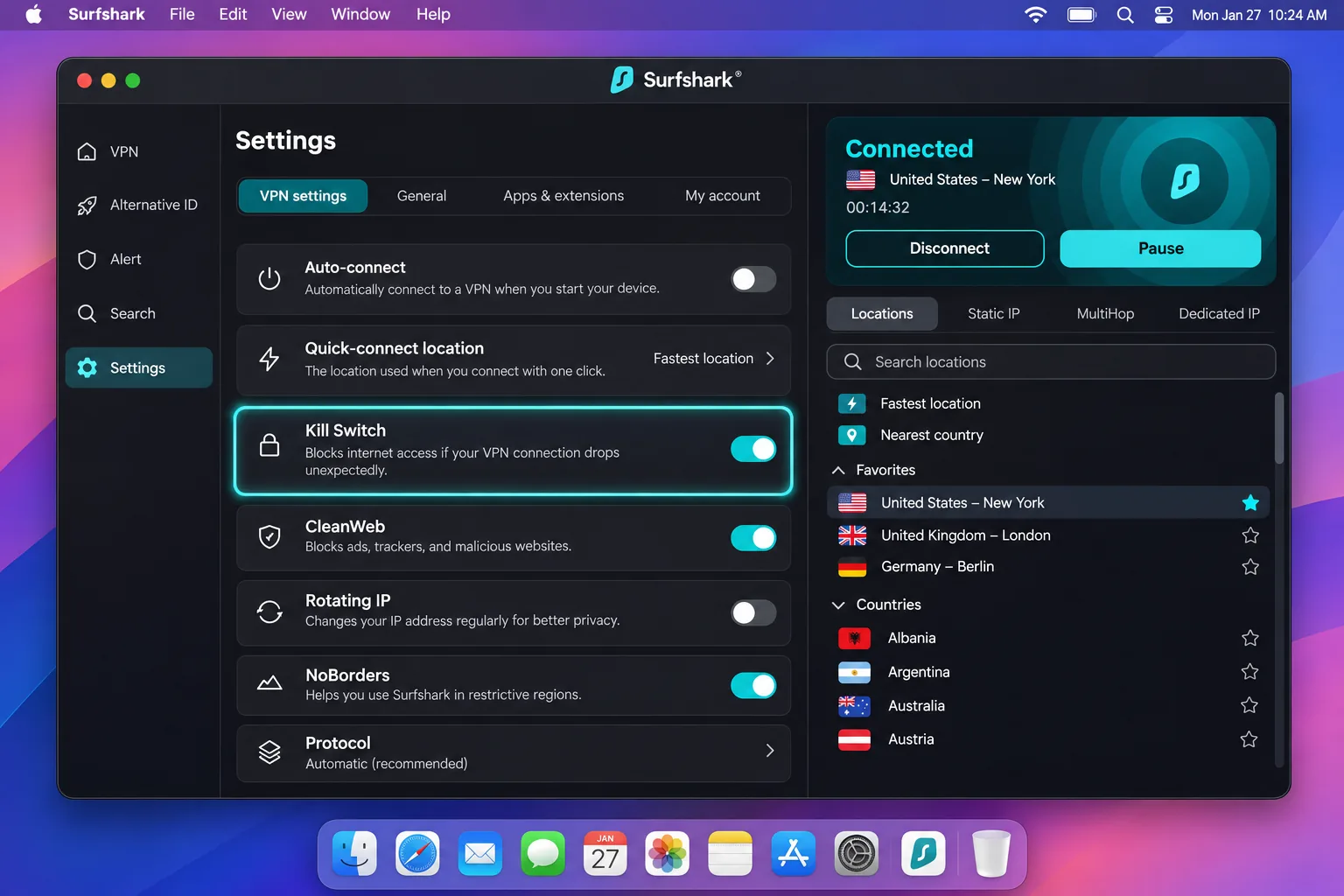
Where NordVPN suits one traveler, Surfshark suits a household with many phones, tablets and laptops. A paid subscription supports unlimited simultaneous devices and offers a Moroccan IP through virtual servers. It also includes MultiHop routing and nearby-server selection. Bypasser split tunneling, CleanWeb ad and malware filtering and obfuscated servers round out the feature list.
The interface is less cluttered than most, though the menu placement beside the server list took us a moment to get used to. Latency and jitter have improved in repeat testing but still sit slightly above the comparison average. The kill switch needs manual enabling, so after installing we went straight into settings and switched it on. On macOS we then found that changing servers can leave a short gap in kill-switch protection. Turn the kill switch on during setup and test it before you travel.
Surfshark advertises a 30-day money-back guarantee and a 7-day trial that is limited to three simultaneous devices. The chosen paid plan charges automatically when the trial ends unless you cancel, and discounted introductory subscriptions renew at a different, higher rate.
3. ExpressVPN
Surfshark rewards a little tinkering, but ExpressVPN is the one we would hand to a first-time VPN user. The organized menus let us find split tunneling, Network Lock and the protection controls without hunting. The Android app also explains its options clearly. The Moroccan option is a virtual Rabat location hosted physically in Germany, and Lightway, its own protocol, handles the connection. Obfuscation is available across locations, which helps on restrictive networks, and router protection covers devices that cannot run a VPN app.
Latency and jitter stay low in our checks. The catch is that Lightway Turbo's accelerated mode can clash with some websites, apps or games. Switch it off if a service misbehaves. Basic allows 10 devices, Advanced 12 and Express Pro 14, and a dedicated IP is an add-on on the lower two tiers.
ExpressVPN offers a 30-day money-back guarantee for new users. The observed Basic offer was $2.99 a month equivalent, paid as $83.72 for the first 28 months and then $99.95 annually, so it is a multi-year commitment, not a cancel-anytime monthly price.
4. Proton VPN
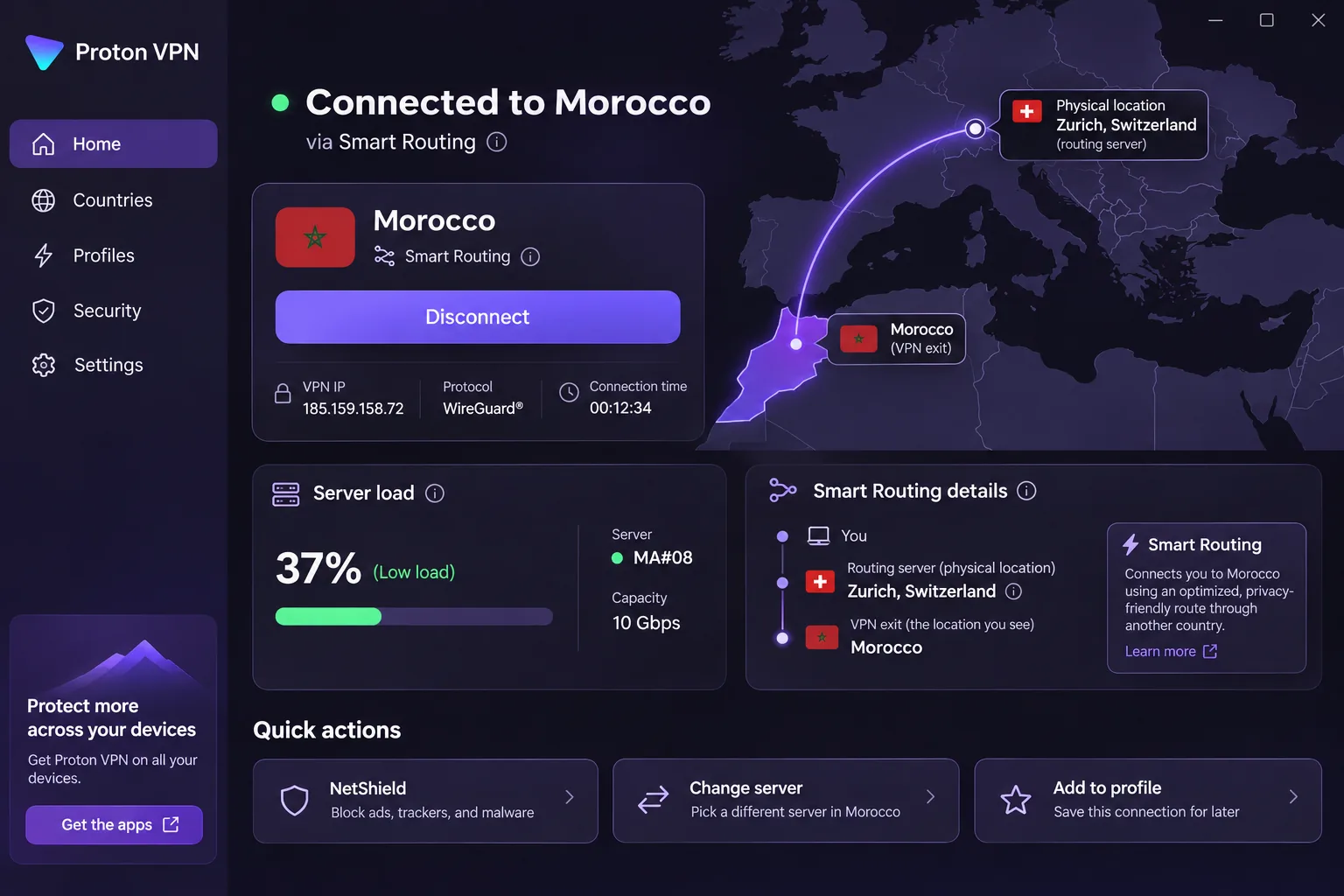
Where ExpressVPN leads on simplicity, Proton VPN is the privacy-first option. Plus includes NetShield filtering, Secure Core multi-hop, P2P support, a kill switch, DNS leak protection and open-source apps, and it covers 10 devices. When we forced the connection to fail, the kill switch blocked traffic every time. On Windows, it can run alongside split tunneling. The home screen shows server load and the physical location behind Smart Routing, which is useful when you want to know where your traffic really exits.
A Moroccan exit IP requires a paid plan and uses Smart Routing through a server physically located in London. There is no in-country server. Secure Core noticeably reduces speed because traffic takes an extra hop, so save it for sensitive sessions rather than everyday streaming.
Read the refund terms carefully. Proton gives a 30-day window on an initial purchase, and the current terms describe a full refund, though older explanations describe prorated refunds for unused time. Check the terms for your own purchase before relying on either.
5. Private Internet Access
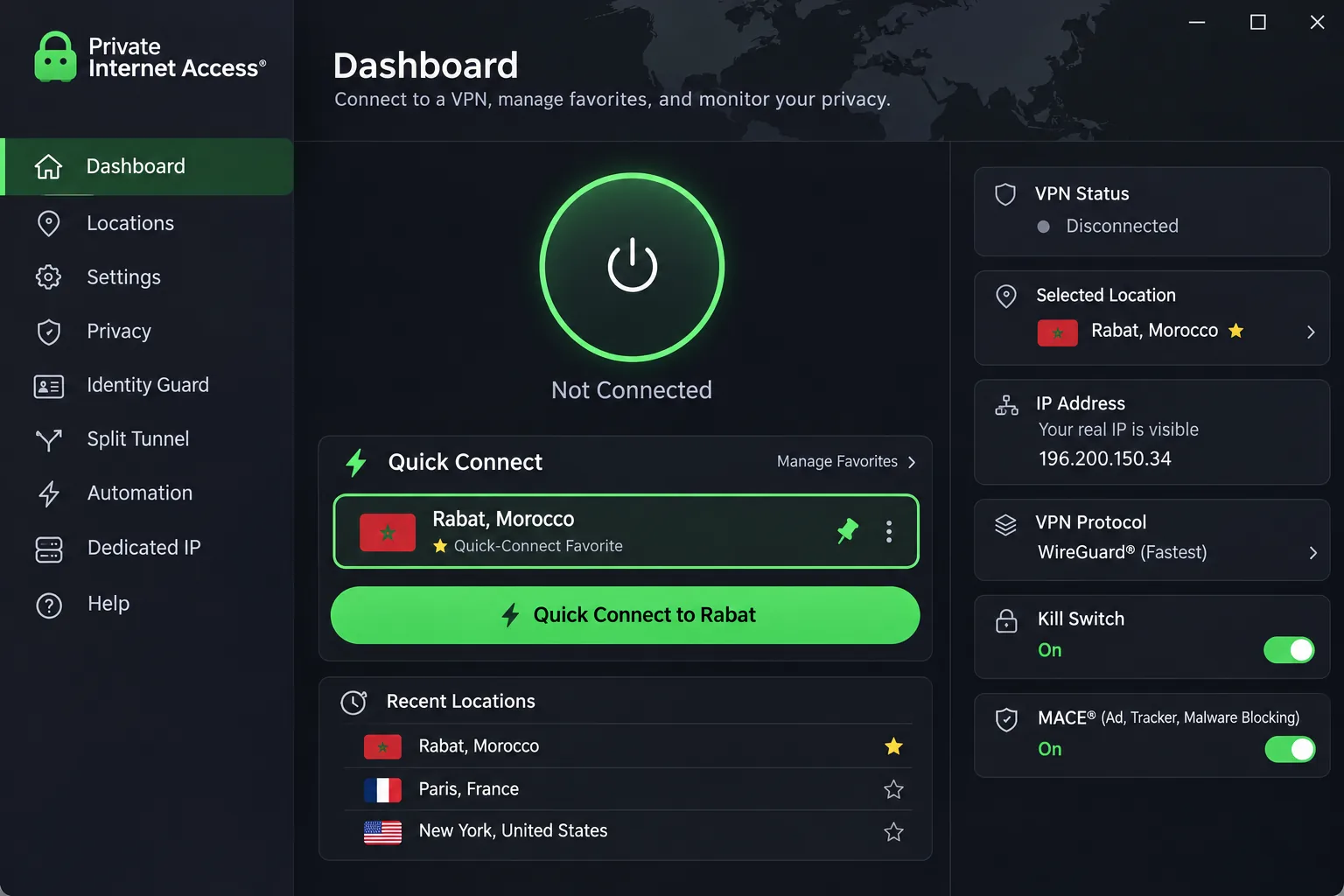
Proton leans on privacy tools, while PIA is for people who like to adjust things. It offers unlimited simultaneous personal devices and bandwidth, WireGuard, split tunneling, obfuscation, multi-hop, port forwarding, router setup options and live chat and email support. Morocco is a virtual Rabat location with a shared IP, and the hardware sits outside Morocco. A Moroccan dedicated IP is not offered.
The detailed session and protocol controls come at a cost. The apps can feel complex, and connections are slower than the leading rivals, although they stayed stable in extended use. The compact dashboard hides advanced statistics until you want them, and quick-connect favorites make it easy to jump between familiar locations. Streaming was uneven: Netflix libraries opened, while some Prime Video and Disney Plus regions failed. When we moved to a Fire TV Stick, playback of all three services was reliable despite the limited interface. PIA does not guarantee access to any named streaming app.
PIA advertises a 30-day money-back guarantee for new subscribers. Its checkout and its Morocco landing page show different introductory rates and renewal totals, so read the final order summary before you pay.
Why use a VPN in Morocco?
Freedom House's Freedom on the Net 2025 report rates Morocco Partly Free, 54/100. For the period from June 2024 to May 2025 it describes surveillance, arrests and harassment tied to online activity, along with widespread self-censorship. It flags no network restrictions or blocked websites. A VPN does not change any of that. What it changes is who can see your traffic on the network you are using.
Home streaming, banking, and public Wi-Fi
Hotel, café and airport networks are shared, so a VPN encrypts your traffic between your device and the VPN server. It also lets you reach home streaming libraries and banking apps that expect a familiar location. No VPN guarantees a particular streaming app will open, and services can restrict VPN traffic at any time.
WhatsApp calls, censorship, and VPN limitations
VoIP calling was restored across fixed and mobile networks in Morocco in November 2016. We could not confirm how WhatsApp calls behave today on each carrier or hotel network, so we do not claim a current nationwide ban. If calls fail on one connection, a VPN is one thing to try, but it is not a guaranteed fix.
A "Moroccan IP" from a VPN usually comes from a virtual location. The exit address is registered to Morocco, but the hardware may be in Spain, Germany or the UK. A Moroccan exit address helps with sites that check your IP's country, but it will not make the connection as fast as a server physically in Rabat.
Is a VPN legal in Morocco?
VPN vendors describe personal VPN use in Morocco as legal. We could not confirm that from a current Moroccan legal source. Moroccan encryption regulation uses broad authorization language, and the material we retrieved does not establish how it applies to individual VPN use. Treat this as an open question, not legal advice. Whatever you do online while connected remains subject to local law.
How to use a VPN in Morocco or get a Moroccan IP
These are two separate jobs. Using a VPN while visiting Morocco means installing and connecting before you land, since app stores and provider sites are easiest to reach on a home connection. Getting a Moroccan IP from abroad means choosing a Moroccan location in the app. Our step-by-step guide on how to use a VPN covers the basics.
Choosing a nearby, home-country, or Moroccan server
Pick a Moroccan location when you need a Moroccan IP. Pick a physically nearby server, such as one in Spain, for a shorter route and better speed. Pick your home country when you need your home streaming and banking services. A virtual exit country does not tell you which country the hardware is in, so check the provider's server page.
Setup and connection troubleshooting
If a connection fails, follow these steps in order: check the underlying internet connection, update the app, change the VPN location or protocol, and check whether security software is interfering. If it still fails, contact the provider's support. A VPN runs over your phone's existing internet connection, so it does not replace mobile data.
Are free VPNs for Morocco worth using?
For a short trip with light needs, a free tier can work. Proton VPN Free has no data or time cap, no ads and a no-logs policy, but it protects 1 device at a time and picks servers for you. Morocco is not in its free-country list, so it will not give you a Moroccan IP. Streaming on the free tier is inconsistent, and speeds can fall during sustained downloads. Unlimited data does not guarantee consistent speeds.
For streaming, a Moroccan IP, or more than one device, a paid plan makes more sense. Money-back guarantees are not free trials, because you pay first and then request a refund. Surfshark's 7-day trial is the clearest trial we found, and it bills automatically afterward. Our guide to the best free VPN options goes deeper on the tradeoffs.
Which Morocco VPN should you choose?
Choose NordVPN if you want one subscription for travel, streaming and a Moroccan IP. Choose Surfshark if you have many devices, ExpressVPN if you want the easiest apps, Proton VPN if privacy controls matter most, and PIA if you want deep configuration. Whichever you pick, use the 30-day refund window to test it on the networks you will actually use.