
You are sitting in a Vilnius cafe on public Wi-Fi, or you are abroad and want your home streaming library back. Both situations call for a VPN, but they are different jobs. Using a VPN while you are physically in Lithuania is about privacy on the network you are connected to. Getting a Lithuanian IP address from abroad means choosing a server inside Lithuania.
Most providers cover both, though the details vary by plan, device count, and price. We compared NordVPN, Surfshark, ExpressVPN, CyberGhost, and Proton VPN on Lithuanian exit IPs, protocols, device limits, refund terms, and the practical trade-offs that show up in daily use. Our shortlist is an editorial one, so we do not claim any provider is verified as the fastest or the most private.
Best VPNs for Lithuania at a glance
The table below uses details we could verify for each provider. Prices are advertised introductory offers in US dollars, so your checkout total can differ with currency, tax, and the term you choose.
| Product | Buy | Lithuanian exit IP | Protocols | Devices | Intro price | Renewal | Refund |
|---|---|---|---|---|---|---|---|
 | Check price → | Yes, select Lithuania | NordLynx, OpenVPN, NordWhisper | 10 | $3.49/mo equivalent, $94.23 for 27 months | $139.08/year | 30-day |
 | Yes, Vilnius shown | Dausos, WireGuard, OpenVPN, IKEv2 | Unlimited | $2.49/mo equivalent, $67.23 for 27 months | About $79/year, account quote controls | 30-day | |
 | Yes | Lightway, WireGuard, OpenVPN, IKEv2 | 10 on Basic | $2.99/mo equivalent, $83.72 for 28 months | $99.95/year on Basic | 30-day | |
 | Yes, Vilnius listed | WireGuard, OpenVPN, IKEv2 | 7 | EUR 2.19/mo on a localized page | EUR 61.32/year, initial term unclear | 45-day (6+ months), 14-day monthly | |
 | Yes, on paid plans | WireGuard, OpenVPN, Stealth | 10 on Plus | $3.49/mo equivalent, $83.76 for 24 months | $83.88 per 12 months | 30-day |
Provider order reflects fit for a typical Lithuania use case, not a ranking by measured speed. We have no Lithuania-specific speed or latency dataset, and we would rather say so than invent one.
In-Lithuania use and a Lithuanian exit IP are separate needs. If you live in or visit Lithuania and want privacy on public networks, you can connect to almost any country. If you are abroad and want a Lithuanian IP address, you must connect to a server in Lithuania, and the provider has to offer one.
1. NordVPN
Where it fits and what to check
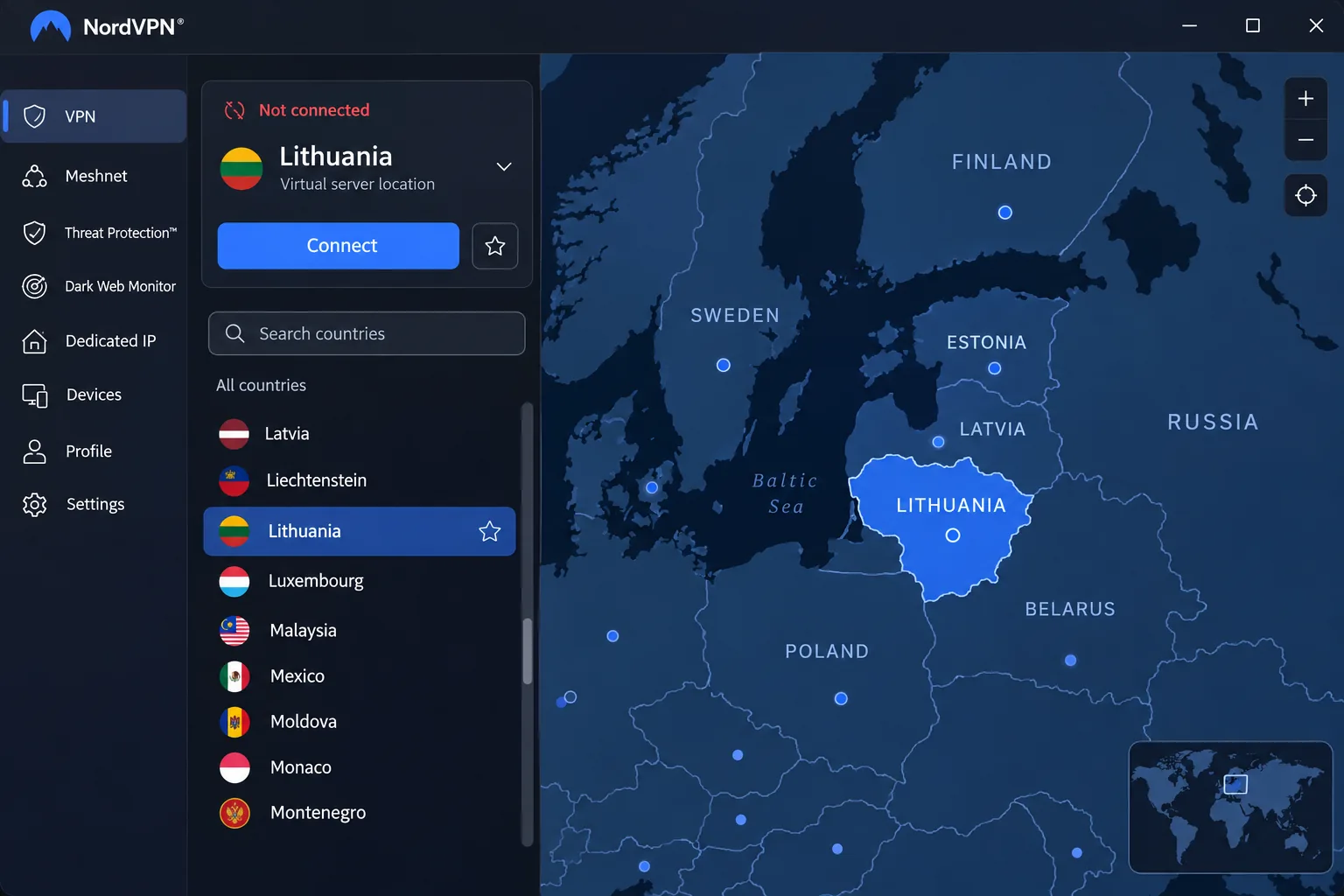
NordVPN is where we would start for most Lithuania scenarios. You select Lithuania in the app for a Lithuanian exit IP, and the country list and map make nearby-server selection straightforward for local browsing. The service also offers Double VPN, Onion Over VPN, and obfuscated connections for readers who want more than a basic tunnel.
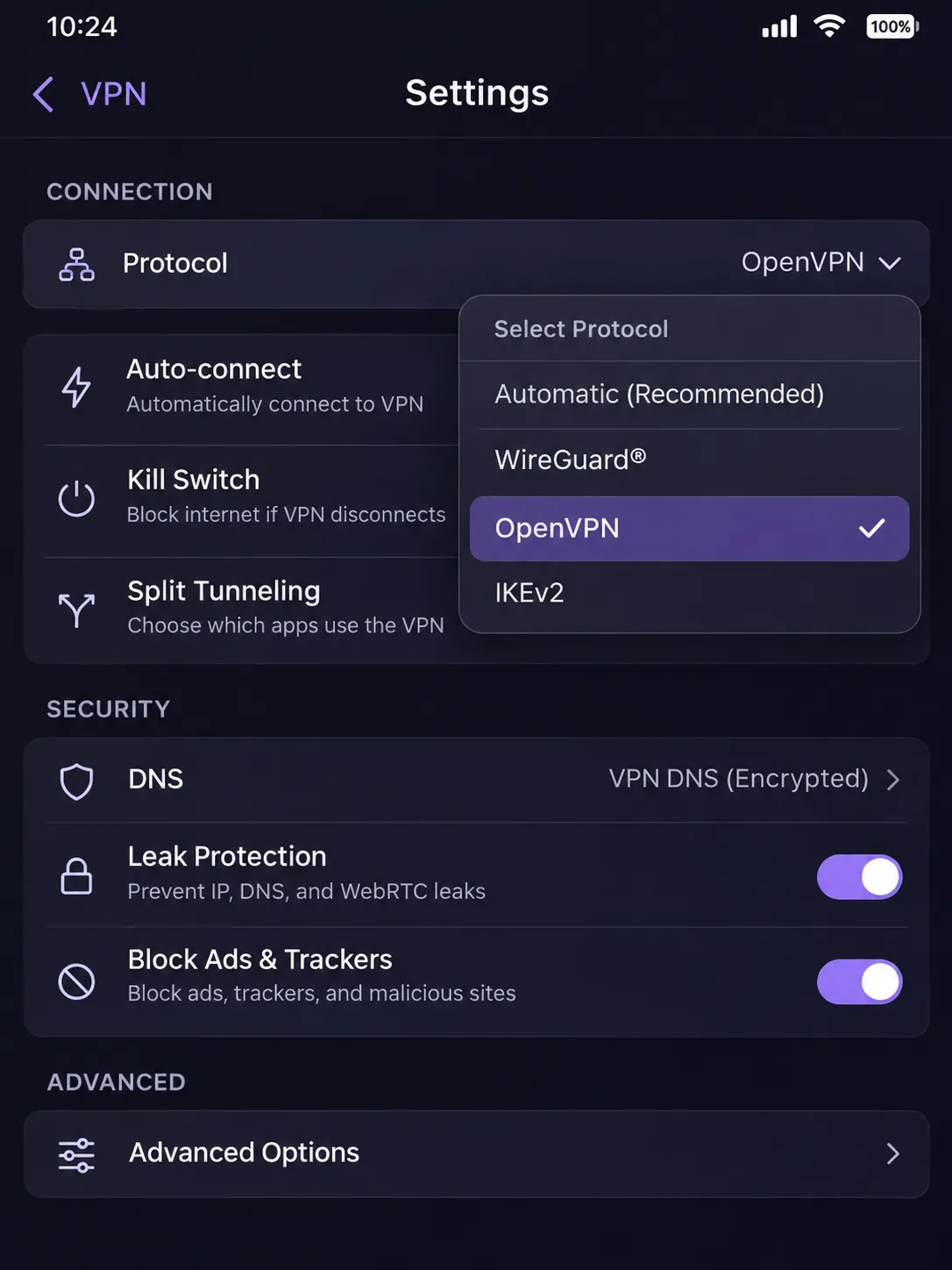
In general use we found NordVPN delivers strong streaming access and fast connections. Three protocols are on offer: NordLynx for speed, OpenVPN, and NordWhisper for restrictive networks. That choice mattered on a locked-down Wi-Fi network, where OpenVPN restored connectivity when NordLynx could not connect. If you hit a similar network at a hotel or a workplace, open Settings, then select Protocol and try OpenVPN.
The weak spots are mostly about polish. The mobile interface can feel cramped, and the desktop app takes some familiarization. NordVPN can also have occasional connection trouble, so expect to switch servers now and then. The Lithuania page lists 17 servers, though a server count tells you little about capacity or speed.
Up to 10 devices can connect at once, and the apps cover Windows, macOS, Linux, Android, and iOS, plus browser extensions. The current Windows app supports Windows 10 (64-bit) and Windows 11. The 30-day refund covers first-time customers, and Apple App Store purchases go through Apple instead. Prime plans on the website advertise a 7-day trial for new customers, while Google Play has a separate 3-day Android trial. The trial is not a Basic-plan offer, so check eligibility before you rely on it.
Price deserves a close look. Basic is advertised at $3.49 per month, which works out to $94.23 prepaid for the first 27 months. The renewal is $139.08 per year, a noticeable jump. Promotional terms, currency, and taxes change, so confirm the figure at checkout.
Pros
- Lithuanian exit IP available by selecting Lithuania in the app
- Strong streaming access and fast connections in general use
- Up to 10 devices on one account
- NordWhisper and OpenVPN options for restrictive networks
Cons
- Mobile interface can feel cramped
- Occasional connection trouble
- Renewal of $139.08 per year is well above the intro rate
2. Surfshark
The many-devices case
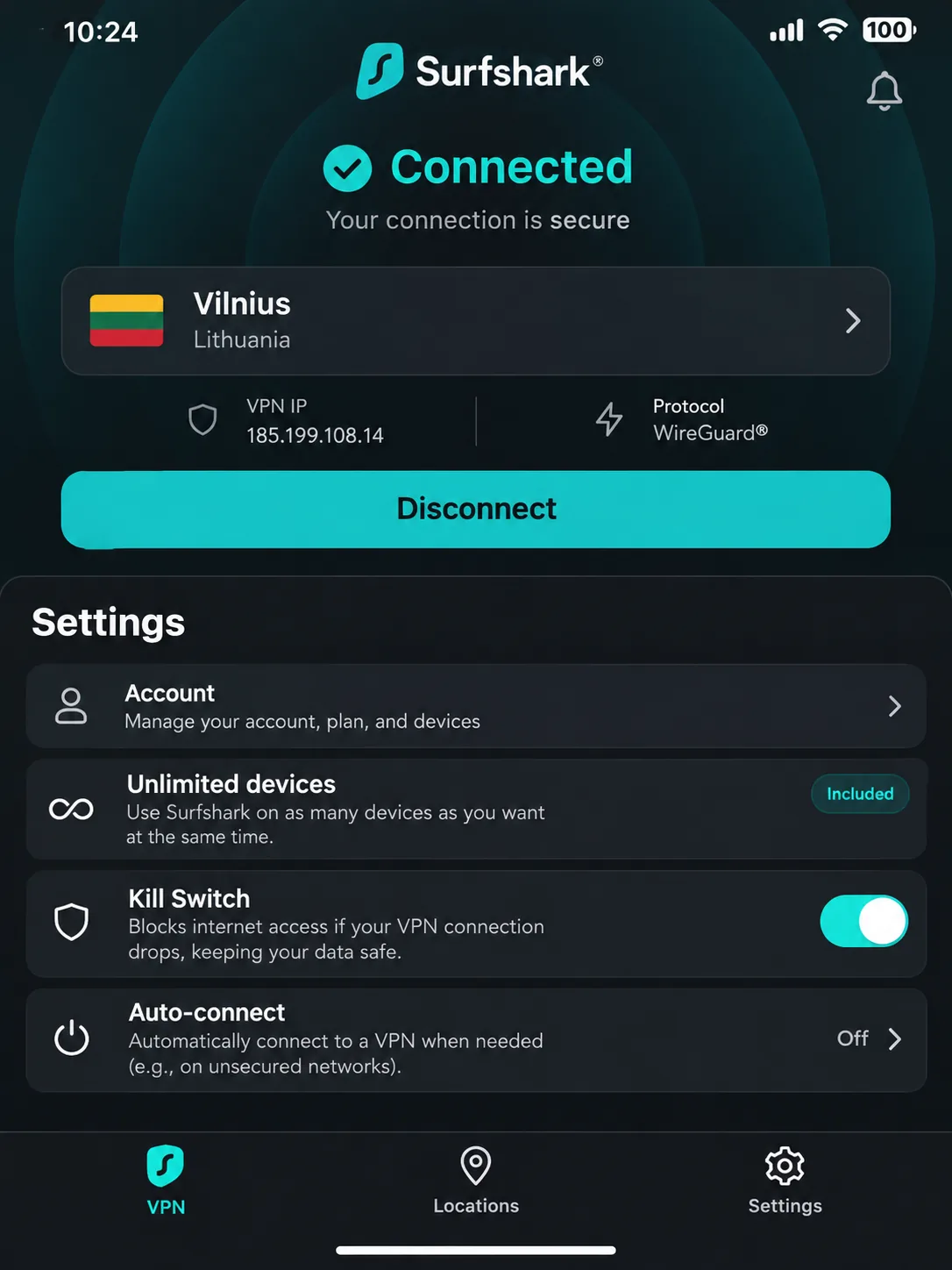
If NordVPN's 10-device cap is tight for your household, Surfshark removes the counting. It shows a Vilnius location, and the Lithuania page lists 14 servers in that one Lithuanian location. CleanWeb, a kill switch, and Alternative ID come with the Starter plan. Antivirus, monitoring, and data-removal extras depend on higher tiers.
The apps are easy to navigate, with a consistent design on desktop and mobile. Surfshark's simple toggles leave less room for advanced customization, which suits beginners and frustrates tinkerers. Protocols include Dausos, WireGuard, OpenVPN, and IKEv2, depending on the app. Apps are available for Windows, macOS, Linux, Android, iOS, Apple TV, and Fire TV, with Chrome, Firefox, and Edge extensions. Windows 10 and 11 are supported on x64 and ARM64 devices.
Server choice can materially affect speed with Surfshark, and some locations are noticeably slower than others. If a Lithuanian server drags, try a nearby location for ordinary browsing and keep Lithuania for when you need the local IP. The rotating IP feature can interrupt sessions on sites that tie logins or activity to an IP address, so turn it off for banking and account-based services.
Reliability is where we pushed hardest. Ordinary Wi-Fi dropouts did not cause any reconnection trouble. When we ran invasive fault testing, though, the app needed a restart to reconnect. The kill switch still kept the real IP hidden during that outage, so the failure cost us convenience rather than exposure. Earlier kill-switch problems appear resolved in ordinary use.
Starter is advertised at $2.49 per month, or $67.23 for the first 27 months, and VAT may apply. Annual renewal has been reported around $79, but your account quote controls. Website purchases qualify for a full refund within 30 days of the first purchase.
Pros
- No device counting on a family account
- Lowest advertised introductory price on our shortlist
- Easy-to-navigate apps with a consistent design
Cons
- Speed varies noticeably by server location
- Fewer advanced customization options
- Rotating IP can interrupt sessions tied to a fixed address
3. ExpressVPN
Day-to-day use and streaming
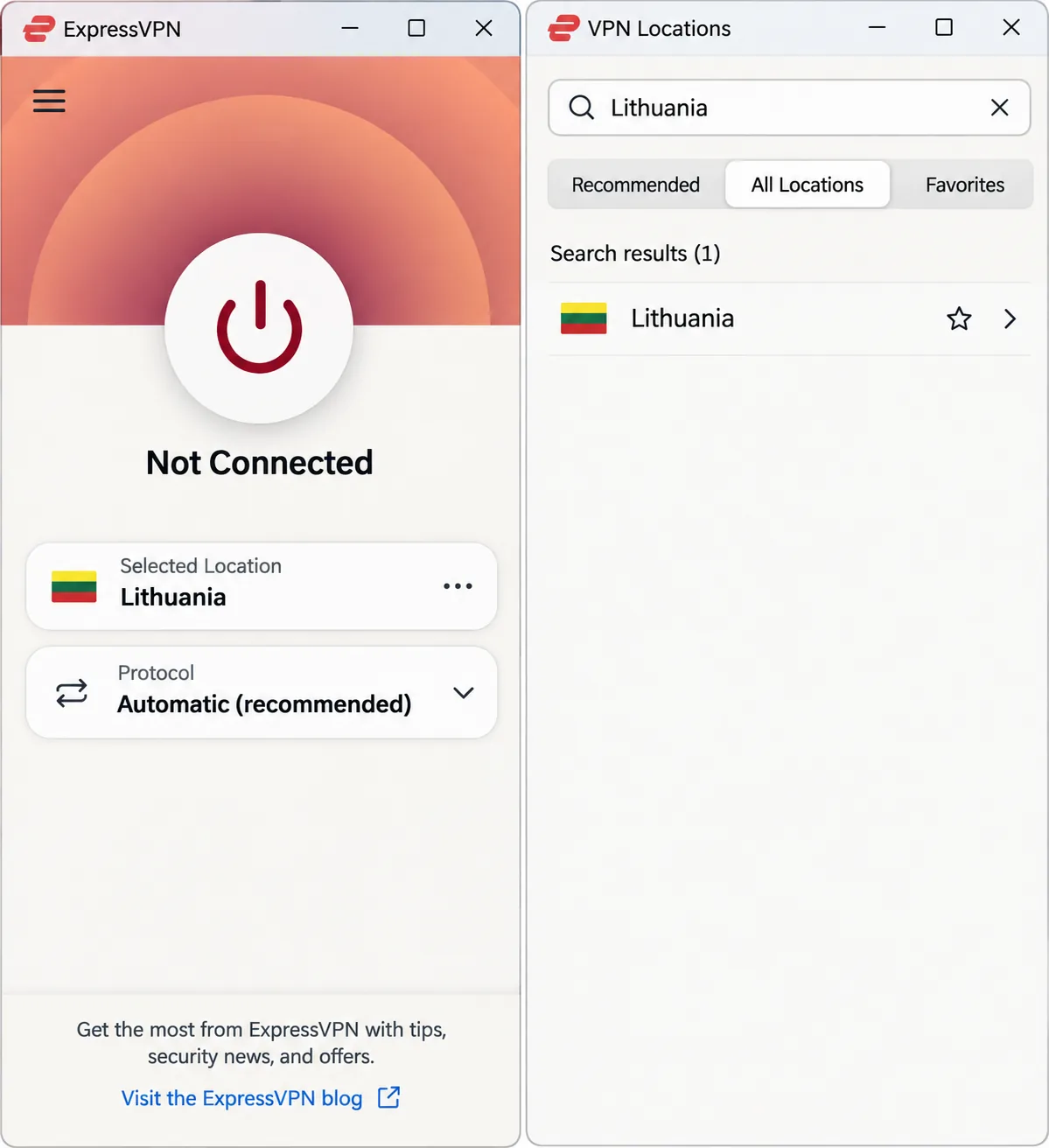
Where Surfshark leans on toggles, ExpressVPN is the simplest of the five to pick up. The interface is straightforward to learn, and customer support is helpful. A Lithuanian exit IP is available, and the service lists Lightway, DNS leak protection, automatic obfuscation, encrypted connections, and live support.
Protocols include Lightway, WireGuard, OpenVPN, and IKEv2, with availability depending on the app. Automatic mode selects a suitable protocol, usually Lightway. The fastest Lightway Turbo performance is concentrated on Windows, so Mac and mobile users should not expect identical results. On iOS, the app lacks the split-tunneling and auto-connect options found in some competing apps.
For streaming, we pointed ExpressVPN at BBC iPlayer and the major Netflix libraries. Netflix opened, but BBC iPlayer loaded on some connections and refused on others, so a failed attempt there called for a different server instead of a different provider. Access varies by endpoint and time of day, so treat any provider's streaming record as a tendency instead of a promise.
Device allowance depends on the tier: Basic allows 10, Advanced 12, and Pro 14 simultaneous devices. Older comparison pages quote a flat limit of five, which no longer matches the current plans. Basic is advertised at $2.99 per month, or $83.72 prepaid for 28 months, then $99.95 annually. Promotional links sometimes show lower figures than the public checkout, so compare the initial term and the renewal bill separately.
The current Windows app works with Windows 10 and above. Official support lists macOS 11 or later, Android 7.0 or later, and iOS 15 or later, so older devices may need an OS update. A 30-day money-back guarantee applies to first-time customers, and in-app purchases on iOS and Android are refunded by Apple or Google at their discretion.
Pros
- Straightforward interface and helpful support
- Lithuanian exit IP and automatic protocol selection
- 10 devices on Basic, more on higher tiers
Cons
- Fastest performance is concentrated on Windows
- iOS app lacks split tunneling and auto-connect
- Can struggle with BBC iPlayer on some connections
4. CyberGhost
What the refund terms look like
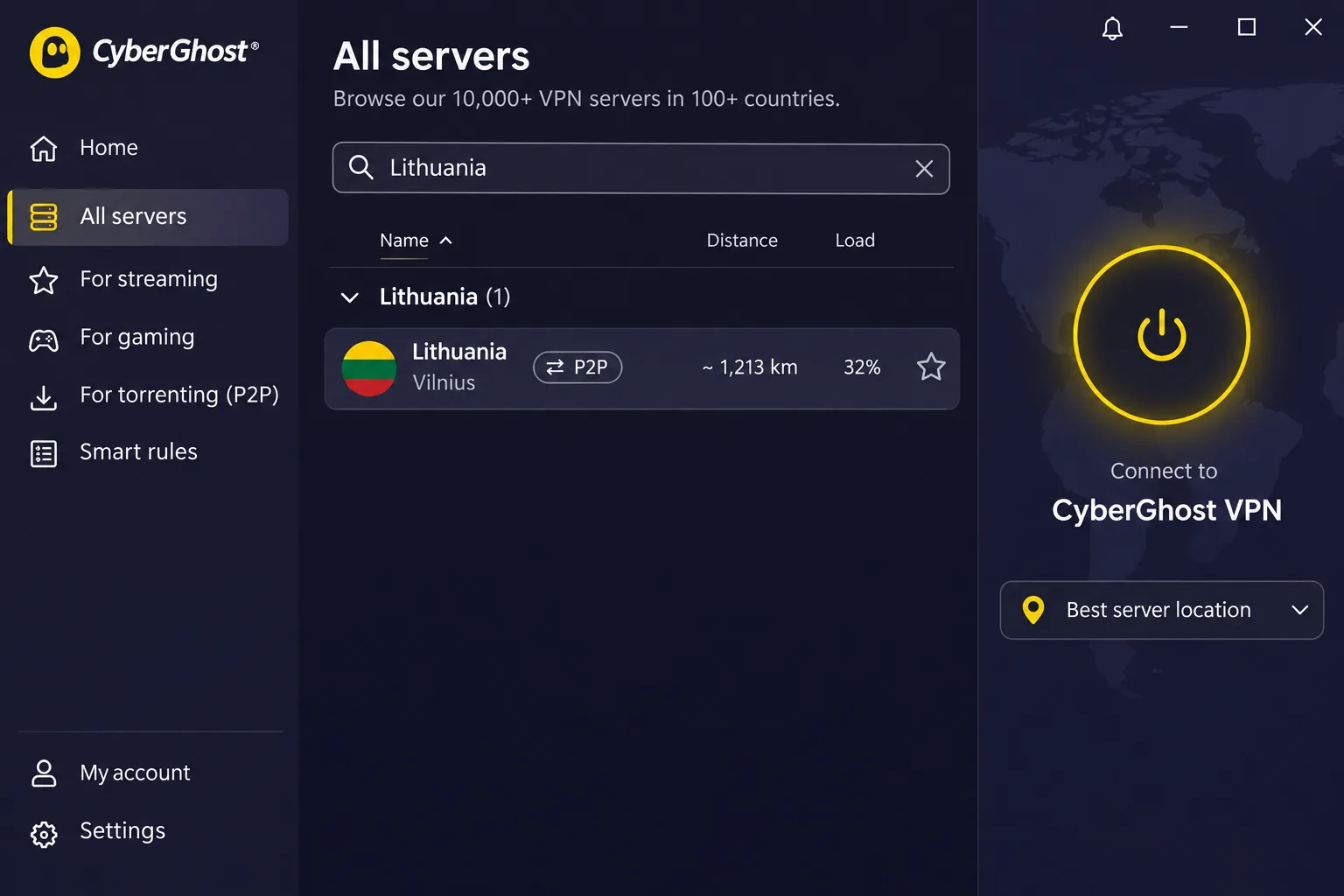
If ExpressVPN's settings still feel like too many choices, CyberGhost is the pick for readers who want protection that works without much setup. Its protections arrive preconfigured, which suits people who do not want to open a settings menu. The official server directory lists Lithuania and Vilnius with P2P availability, and the network includes streaming, gaming, and torrenting-oriented server selection.
The service supports WireGuard, OpenVPN, and IKEv2, with an automatic kill switch, IP and DNS leak protection, a no-logs policy, and unlimited traffic. Apps cover Windows, macOS, Android, and iOS. On Windows you need Windows 10 version 1903 or newer, or Windows 11, and the official instructions exclude ARM processors.
Expect friction in two places. Up to 7 devices can be protected, and the device registration limit can be less convenient than a limit based only on active connections. The iOS app is also less capable than the desktop offering, and its ad blocker is weak. Live chat replies quickly, but the support website is harder to use effectively.
For streaming, we tried CyberGhost against US Netflix, BBC iPlayer, and Amazon Prime Video, and all three opened. Australia's 10 Play failed, which is a reminder that a provider can clear most services and still miss the one you wanted.
CyberGhost's 45-day money-back covers eligible subscriptions of six months or longer, and one-month plans get 14 days. A refund requires contacting support, not merely disabling renewal. Pricing is harder to pin down. The localized order page we could access showed EUR 2.19 per month and EUR 61.32 upfront, with the same amount on renewal, but the page described the initial term inconsistently. We cannot give you a dependable US dollar comparison, so read the checkout screen carefully.
Pros
- Protections preconfigured, with little setup
- Longest refund window on our shortlist
- Lithuania and Vilnius listed, with P2P support
Cons
- Device registration limit and 7-device cap
- iOS app and ad blocker are weaker
- Initial pricing term is unclear on the checkout page
5. Proton VPN
Who the advanced controls are for
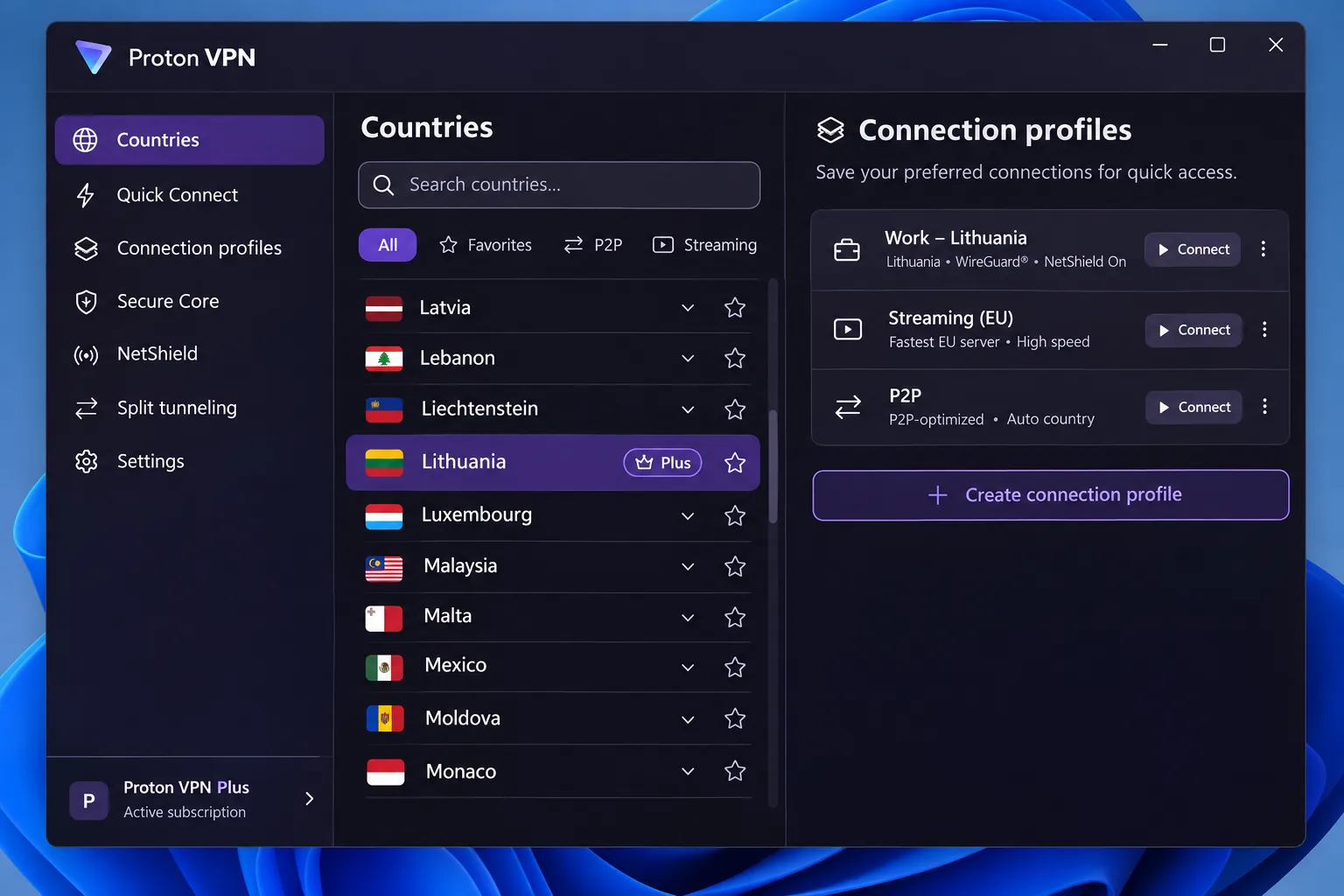
After CyberGhost's preset approach, Proton VPN goes the other way: it is the option for readers who want advanced privacy controls, and it is the only one here with a usable free plan for general browsing. A Lithuanian IP is available through its Lithuanian servers on paid plans. The apps are open source, and the service offers a kill switch and a no-logs policy across Windows, macOS, Linux, Android, iPhone and iPad, and TV.
Beyond the basics, Proton VPN offers Secure Core, Tor routing, NetShield, VPN Accelerator, connection profiles, port forwarding, split tunneling, and an advanced kill switch in supported apps. Windows protocols include OpenVPN, WireGuard, and Stealth, with Smart Protocol selection. Many of these features require a paid plan. Windows 11 and Windows 10 64-bit build 19045 are supported.
The paid service performs well for streaming and fast everyday connections. The apps feel well organized, though the settings can initially feel complex and the large FAQ can be overwhelming for beginners. Support can be less responsive than you would expect, so plan on solving small problems yourself.
The free plan protects 1 device at a time and has no data cap, but free countries are chosen automatically. Lithuania is not on the free-server list, so the free plan cannot give you a Lithuanian IP. VPN Plus protects 10 devices, and adds country selection, streaming, P2P, and ad and malware blocking.
Plus is advertised at $3.49 per month, or $83.76 for 24 months, then $83.88 every 12 months. Set that against NordVPN's $139.08 renewal and the long-term cost looks very different. Promotional review links show lower prices, so confirm at checkout. A 30-day money-back guarantee applies, subject to the terms.
Pros
- Open-source apps and deep privacy controls
- Renewal price close to the intro rate
- Free plan with no data cap for general browsing
Cons
- Settings can feel complex at first
- Lithuania is not available on the free plan
- Support can be less responsive
How to choose a VPN for Lithuania
Start with the job. If your goal is privacy on public Wi-Fi inside Lithuania, almost any reputable VPN works and server location matters little. If your goal is a Lithuanian IP from abroad, the provider must list Lithuania, and you should check that the plan you buy unlocks it. All five providers here do, but Proton VPN requires a paid plan.
Lithuanian IP availability and nearby server locations
Check the provider's Lithuania page before you pay. NordVPN lists 17 servers there and Surfshark lists 14 servers in one Lithuanian location. The network totals each provider quotes for its global fleet are not synchronized with independent reviews, so we would not choose on server counts alone. We also could not confirm for every provider whether the Lithuanian servers are physical or virtual, or whether cities beyond Vilnius are offered.
For ordinary browsing from inside Lithuania, a nearby server is a reasonable starting point, since encryption and routing through a remote server can reduce speed. Distance adds to that slowdown, so the closest healthy server usually feels best.
A Lithuanian IP does not prove that a Lithuanian streaming service will open. We found no evidence that confirms current access to Go3, TV3 Play, or individual licensed LRT streams for every provider. Test with the trial or refund window before committing for years.
Privacy safeguards, speed, device support, and total cost
Look for a kill switch, DNS leak protection, and a clear no-logs policy. Landing pages and reviews mention independent audits, but we did not examine full audit reports or their current scope, so we do not treat any provider as proven private.
Speed depends on the server, the protocol, and your connection. NordLynx, WireGuard, and Lightway are the fast options in their respective apps. Device support matters too: unlimited connections suit large households, while a cap of 7 or 10 is plenty for one person with a phone, laptop, and tablet.
Total cost is the last filter. Introductory monthly prices are equivalents of an upfront payment of 24 to 28 months. The renewal bill, taxes, and currency change the real cost, so divide what you will pay across the whole term. The price comparison table above shows how far some renewals sit from the intro rate.
How to set up a VPN for Lithuania
Setup takes a few minutes on any of the five providers. Our step-by-step guide on how to use a VPN covers the basics if you have never installed one.
Choose a server for your location and intended service
Pick a server based on what you want. For privacy on public Wi-Fi in Lithuania, use a nearby country or Lithuania itself. For a Lithuanian IP from abroad, select Lithuania, or Vilnius where the app offers it. Lithuania's data protection authority recommends VPN use on public networks and also advises using trusted Wi-Fi or mobile data where you can.
On a restrictive network, change the protocol. In NordVPN, open Settings, then select Protocol and choose OpenVPN. In Proton VPN, choose Stealth or Smart Protocol. In ExpressVPN, leave the setting on Automatic first.
Check your connection and troubleshoot access problems
After connecting, confirm your IP address and country with any IP lookup page, and run a DNS leak test. If the country is wrong, reconnect and pick a different server.
If a service refuses the connection, change servers, clear the site's cookies, or contact support. Switching protocols can also fix a failed connection. A matching exit country does not guarantee that a service will accept the VPN, so persistence and a refund window are your safety nets.
Use the refund window as your test period. Install the app, connect to a Lithuanian server, and try the services you care about during the first week.
Can you use a free VPN for Lithuania?
Sometimes, but not for every need. Proton VPN's free plan has no data cap, yet it protects only one device and assigns the country for you, and Lithuania is absent from its free list. It is a reasonable choice for private browsing on public Wi-Fi, and a poor choice for obtaining a Lithuanian IP.
Other free VPNs often cap data, restrict servers, or monetize in ways that conflict with the reason you wanted privacy. A paid plan with a refund window costs little, and it gives you country selection, streaming support, and live help. Our guide to the best free VPN options explains the trade-offs in more depth.
Why use a VPN in Lithuania?
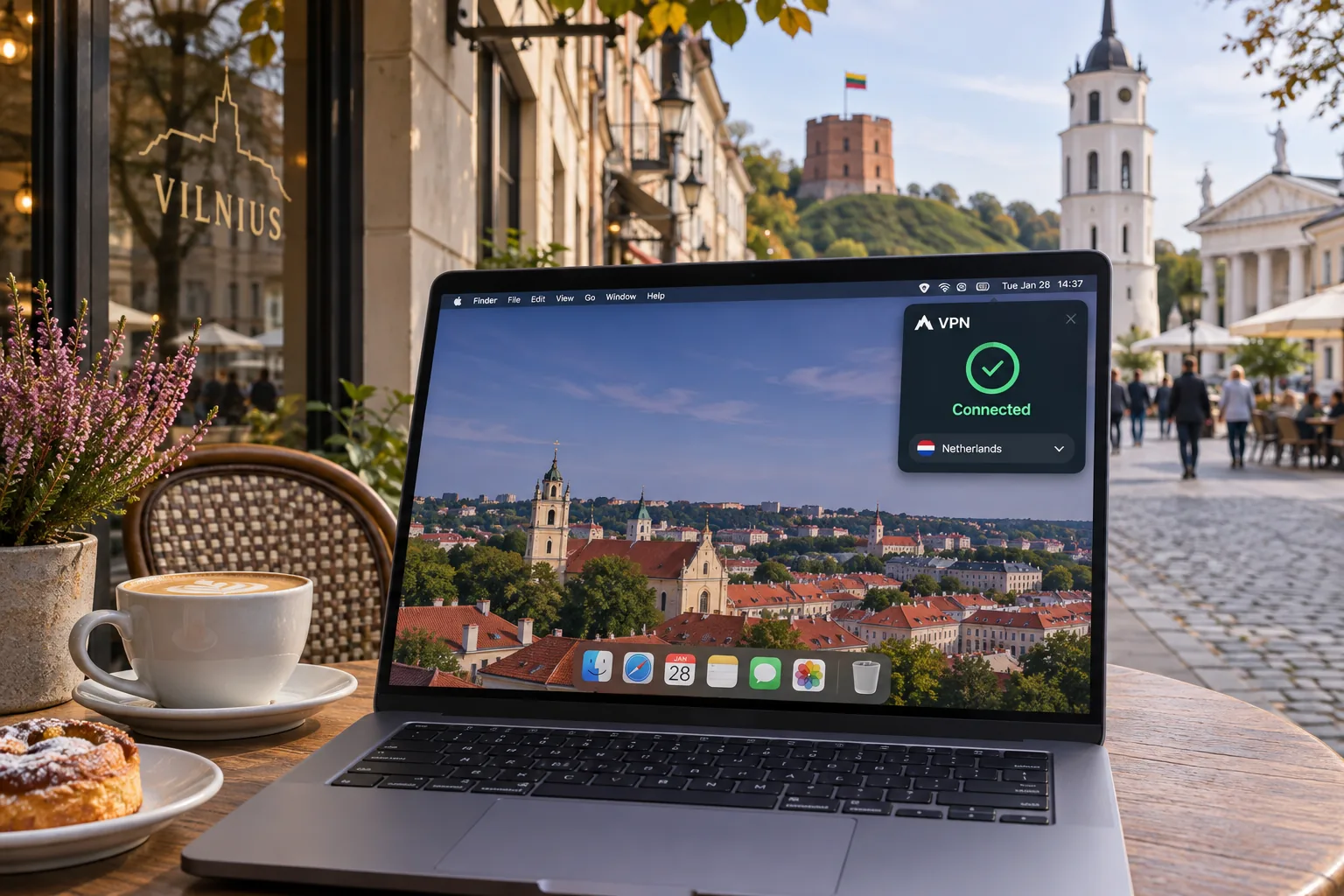
Two situations account for most readers: staying private while on the move, and reaching content across borders.
Privacy on public Wi-Fi and while travelling
Cafes, hotels, airports, and coworking spaces all run shared networks where you cannot see who else is connected. A VPN encrypts your traffic between your device and the VPN server, which limits what the network operator can read. It does not make you anonymous, and it does not replace careful habits such as keeping apps updated.
A VPN also works over cellular data, which is useful when you travel across the Baltic region. Encrypted tunneling adds data overhead, so a VPN will not replace your mobile-data subscription or stretch your allowance.
International streaming and Lithuanian services abroad
If you live outside Lithuania and want local services, a Lithuanian exit IP is the starting point. It is not a guarantee. Streaming platforms update their blocking regularly, and results differ by provider, server, and day. The reverse case also applies: a visitor in Lithuania may want a server in the United States or the United Kingdom to reach home libraries.
Streaming results we saw varied. NordVPN and Proton VPN performed well in general use. ExpressVPN opened BBC iPlayer on some connections and not others. CyberGhost opened US Netflix, BBC iPlayer, and Amazon Prime Video, but not Australia's 10 Play.
Common mistakes to avoid when buying
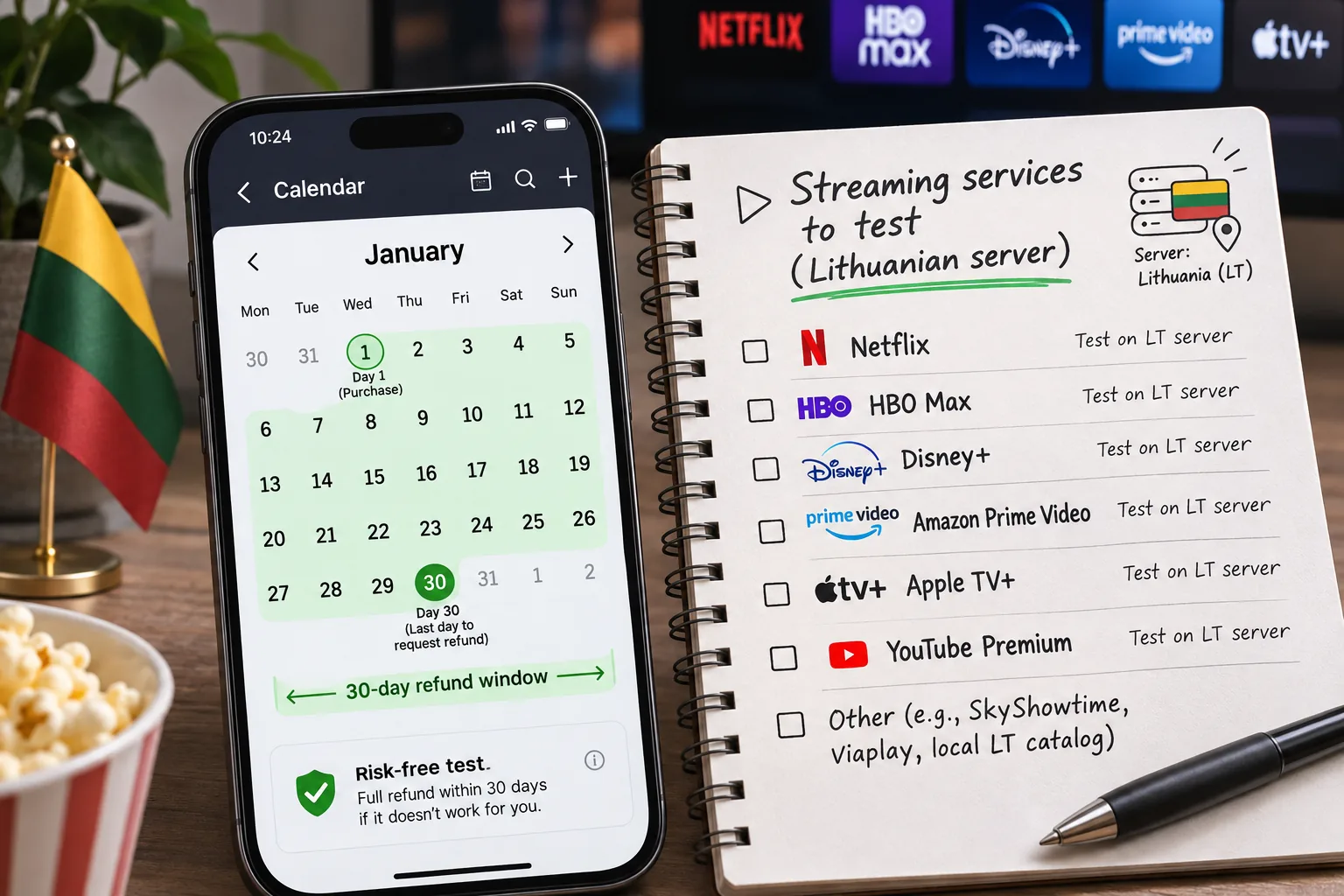
Buying on the intro price alone is the most frequent error, since several renewals sit well above the first-term rate. Another is assuming a Lithuanian IP unlocks every local service. A third is skipping the refund window, which is the cheapest way to test a service you plan to use for years.
Lithuania VPN FAQs
Are VPNs legal in Lithuania?
Can I get a Lithuanian IP address from abroad?
Will a Lithuanian IP cause trouble with my bank login?
Will a VPN work behind a hotel captive portal?
Conclusion: choose a VPN for your needs
One caution the verdict does not cover: if a Lithuanian IP is the whole point, skip Proton VPN's free plan, since it cannot select Lithuania. Whichever paid provider you pick, spend the first week of the refund window testing the services you care about on a Lithuanian server.