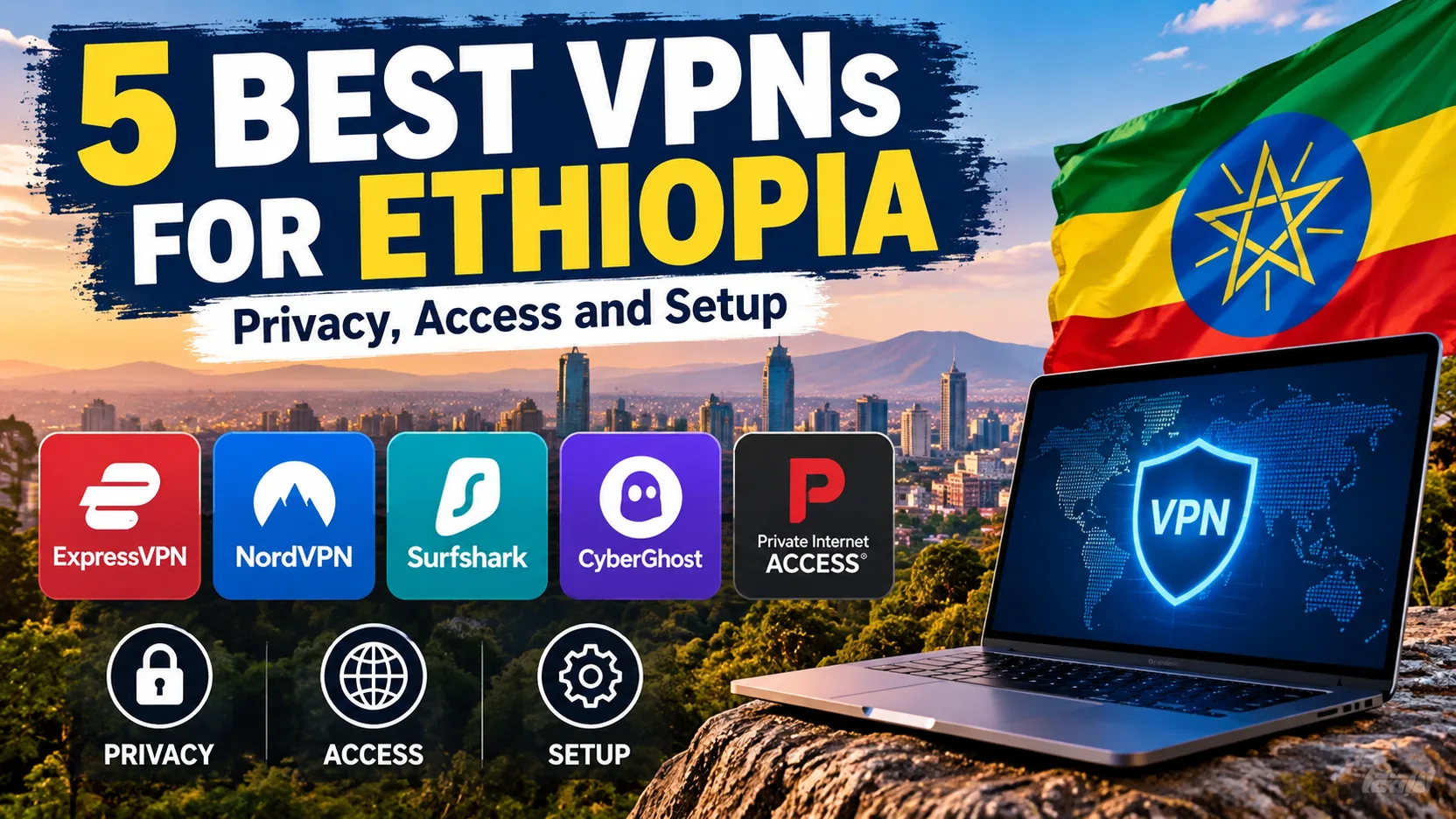
When a news site refuses to load or a calling app stalls halfway through a conversation, a VPN is usually the first fix people try. In Ethiopia the problem is documented. Measurements have found news sites blocked, and Freedom House rates the country's internet Not Free. A VPN encrypts your traffic and sends it through a server in another country, which can restore access and keep your browsing away from prying eyes on the local network. It cannot create a connection that does not exist. Below are five VPNs worth shortlisting, followed by selection advice, setup steps and troubleshooting.
Best VPNs for Ethiopia at a glance
Here is how the five services compare on the details that matter most for a country with filtered networks. Prices are promotional offers we observed on 2026-10-31 and change often, so confirm the billed amount and the renewal rate at checkout. We have not verified an Ethiopia-specific connection success rate for any of them, and nothing here promises access.
| Product | Buy | Simultaneous connections | Observed intro offer (USD) | Refund window | Restrictive-network tool | Main limitation |
|---|---|---|---|---|---|---|
 | Check price → | 10 | $3.49/mo equivalent, $94.23 upfront for 27 months | 30-day | NordWhisper Obfuscated Servers | Settings differ between platforms; renewal jump |
 | Unlimited | $2.49/mo equivalent, $67.23 upfront for 27 months | 30-day on first direct purchase | OpenVPN Camouflage and NoBorders | Legacy OS support varies; no separate Camouflage-off switch | |
 | 10 Basic, 12 Advanced, 14 Pro | $4.99/mo equivalent, $74.85 for 15 months | 30-day for new direct subscribers | Automatic obfuscation on supported platforms | iOS lacks some automation; fastest mode is Windows-only | |
 | Unlimited | $2.19/mo equivalent, $52.56 for two years | 30-day on yearly and two-year plans | Scramble mode | Strict kill switch can look like an outage | |
 | 10 | $2.15/mo equivalent, $58.20 for a two-year offer | 31-day from initial purchase | OpenVPN-based obfuscation | Added latency; protocol differences by platform |
The 5 best VPNs for Ethiopia
The order below is editorial, based on current obfuscation support, platform coverage, refund terms and general performance. It is not a measured ranking of speed inside Ethiopia.
1. NordVPN
NordVPN is where we would start for most readers, because it pairs a dedicated restrictive-network feature with broad app coverage. Its Obfuscated Servers now run on NordWhisper rather than OpenVPN, and you reach them by choosing the Obfuscated category inside the app. Manual OpenVPN connections cannot use that upgraded category, so older setup guides that tell you to configure OpenVPN by hand are out of date.
In our testing, NordVPN handled most major streaming services with little buffering or interruption, though individual services can still reject connections from a VPN exit. Local NordLynx connections were fast, while long-distance throughput can fall behind other leading VPNs. That matters in Ethiopia, where your exit server will usually be far away.
The weak spot is consistency. Settings and feature availability differ across platforms, so switching from your laptop to your phone is less predictable than it should be. Each account covers 10 devices, and the app supports Windows 10 version 1607 or later, Windows 11, Android 9 and newer, and iOS 17.0 or later. The 30-day money-back guarantee gives you time to test the obfuscated servers on your own network, and in our experience a live-chat refund request gets a faster answer than email.
The $3.49 monthly equivalent requires an upfront payment of $94.23 for 27 months, followed by $139.08 per year. Taxes may apply. Promotions and regional availability change, so treat these figures as a snapshot.
Pros
- Obfuscated Servers built on NordWhisper
- Fast local NordLynx connections
- Smooth streaming across major services
Cons
- Feature differences between platforms
- Slower over long distances
- Renewal price jumps after the intro term
2. Surfshark
Where NordVPN is built around a restrictive-network category, Surfshark is built around household coverage. It allows unlimited simultaneous connections, so one subscription can protect every phone, laptop and streaming box in a family. That is a practical advantage in a country where relatives often share one plan.
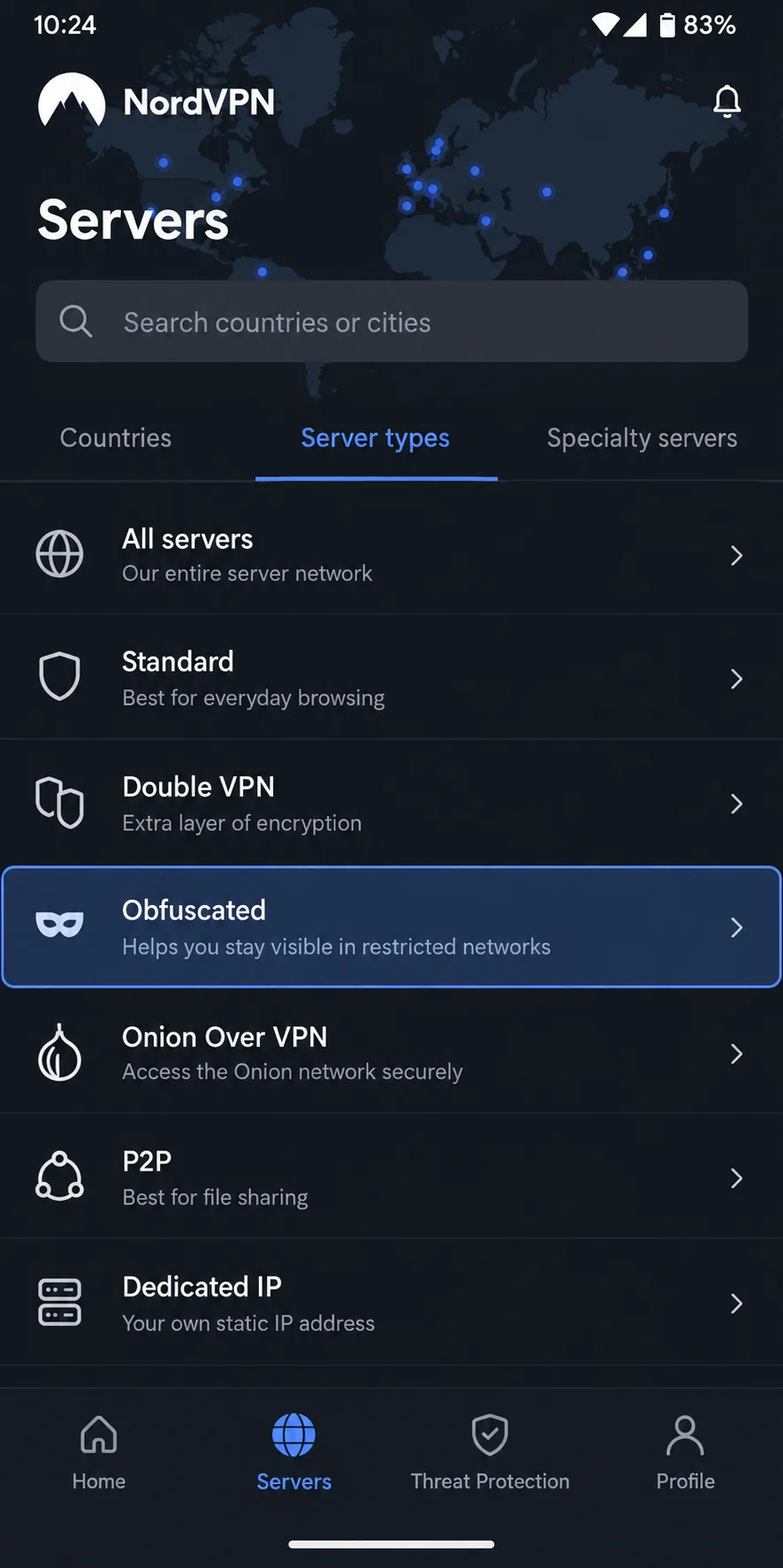
Surfshark offers WireGuard, OpenVPN and IKEv2, and changing protocol is an official troubleshooting step. In our testing, WireGuard connected quickly, and switching to OpenVPN let us connect on a restrictive network where WireGuard failed. That result came from an office network rather than an Ethiopian one, but the lesson transfers: keep both protocols in mind. Camouflage obfuscation activates with OpenVPN, and NoBorders is aimed at restrictive networks. One quirk is that there is no separate switch to turn Camouflage off while keeping an OpenVPN connection.
The interface is straightforward and support is helpful, which makes the first setup easy for people new to VPNs. The Alternative ID tool also saves typing when you fill out online forms. The current Google Play app works on Android 7.0 or newer, with a separate download for Android 6, while Surfshark's own pages describe Apple-device support inconsistently. Check your iPhone's version in the App Store before paying.
The observed offer is $2.49 a month equivalent, or $67.23 upfront for 27 months. Starter renewals have been reported at $79 a year and One at $99, and you can claim a 30-day refund on a first direct purchase.
Pros
- Unlimited simultaneous connections
- Quick WireGuard connections and an OpenVPN fallback
- Easy first-time setup
Cons
- Legacy OS support differs by platform
- No separate Camouflage-off option
3. ExpressVPN
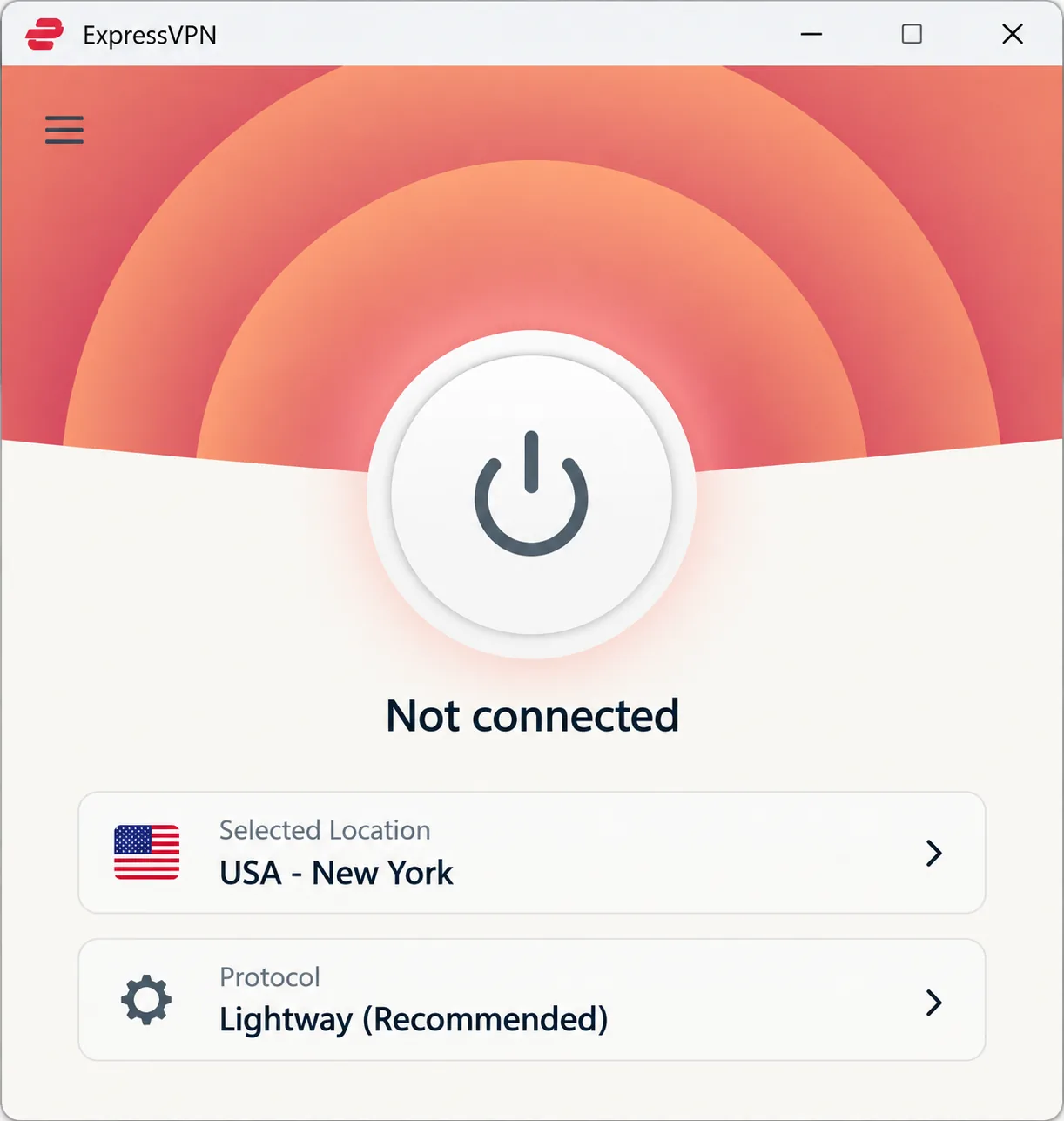
ExpressVPN takes simplicity a step further. Its desktop interface is uncluttered, protocol settings are easy to reach, and the mobile app keeps a plain connect button. It is easy to install and navigate with no prior VPN experience, which counts for a lot if you are setting up in a hurry before a trip.
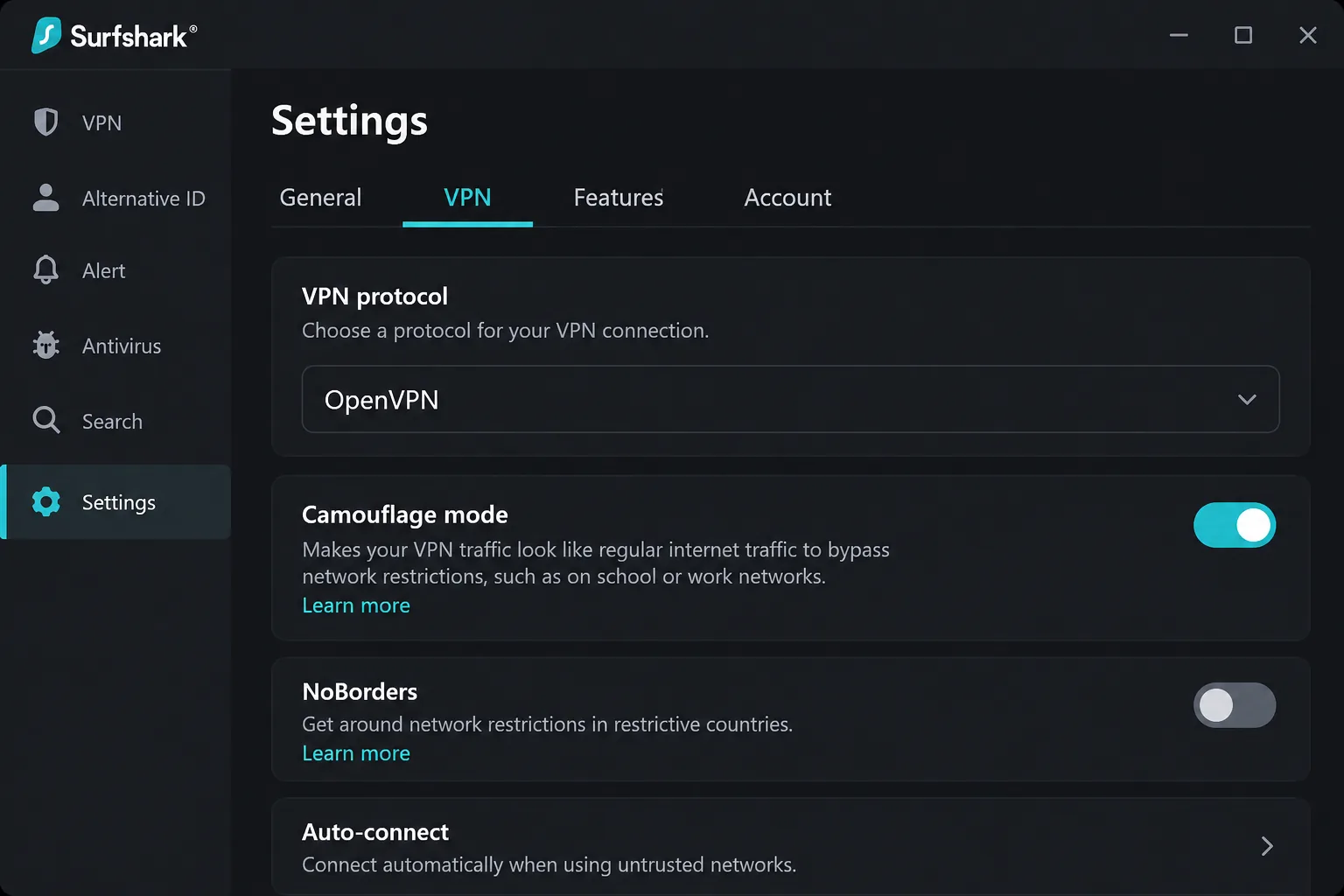
For restrictive networks, ExpressVPN activates obfuscation automatically on supported platforms, so there is no manual switch to hunt for. The features page does not list exactly which platforms are covered, so confirm that on your device. The Basic plan allows 10 simultaneous connections, Advanced allows 12 and Pro allows 14.
There are caveats. Its fastest Lightway Turbo performance is specific to Windows, and other devices do not get the same peak speeds. ExpressVPN's server list includes South Africa and a virtual Kenya location, but a virtual location identifies only the advertised exit country, not necessarily where the physical server is. Neither is an Ethiopian IP.
The observed annual offer is $4.99 a month equivalent, which is $74.85 for 15 months and then $99.95 a year. A 30-day money-back guarantee applies to new direct subscribers, while App Store and Google Play purchases follow those stores' refund processes.
Pros
- Clean, beginner-friendly apps
- Automatic obfuscation on supported platforms
- Up to 14 connections on Pro
Cons
- Highest introductory price of the five
- iOS lacks split tunneling and auto-connect
- Fastest mode is Windows-only
4. IPVanish
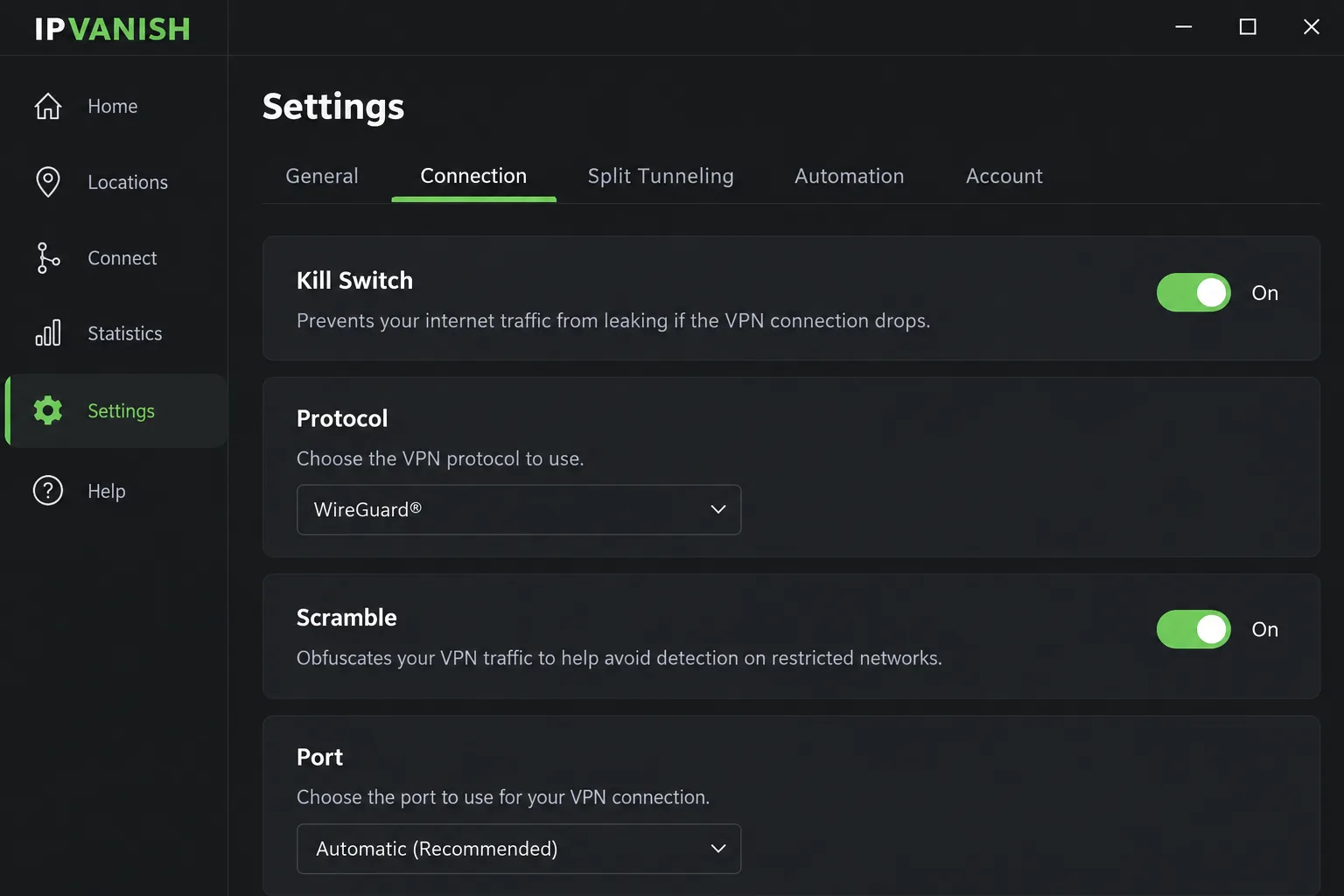
IPVanish shares Surfshark's unlimited connections but takes a more forceful approach to safety. Its kill switch is strict. In our testing, it blocked traffic and tried to reconnect after forced VPN interruptions, which is what you want on a monitored network. The same behavior can stop ordinary internet access after you disconnect on purpose, and that can feel like an outage until you restore the VPN or change the setting.
The service includes WireGuard and OpenVPN, split tunneling, multi-hop and Threat Protection, though availability differs by app. Threat Protection removes banner and video ads on many web pages, and support agents were helpful with our queries. Scramble is its anti-censorship mode, but it has failed against heavily censored networks such as China's. Its presence does not guarantee circumvention in Ethiopia, and we have not tested it there.
Pricing is the murkiest of the five. Recent checks list the Essential plan at $2.19 a month equivalent, $52.56 upfront for two years, then $99.99 annually. Older review tables show different rates because of plan restructuring and promotions, and we could not load IPVanish's official terms. A 30-day money-back guarantee covers new yearly and two-year subscribers, but monthly plans do not get it.
Pros
- Unlimited simultaneous connections
- Strict kill switch with automatic reconnection
- Threat Protection ad blocking
Cons
- Scramble can fail on heavily filtered networks
- Kill switch can resemble an outage
- Pricing and terms are harder to confirm
5. PureVPN
PureVPN is the low-outlay option. The observed Standard offer is $2.15 a month equivalent, billed as $58.20 for a two-year offer with three extra months, and a standalone month costs $12.95. We could not verify the renewal amount, so keep that in mind when budgeting. Read the refund policy closely too: a 31-day window runs from your first purchase, and it excludes renewals and trial-based renewals. The 7-day trial renews automatically into a paid plan, and that renewal charge is non-refundable.
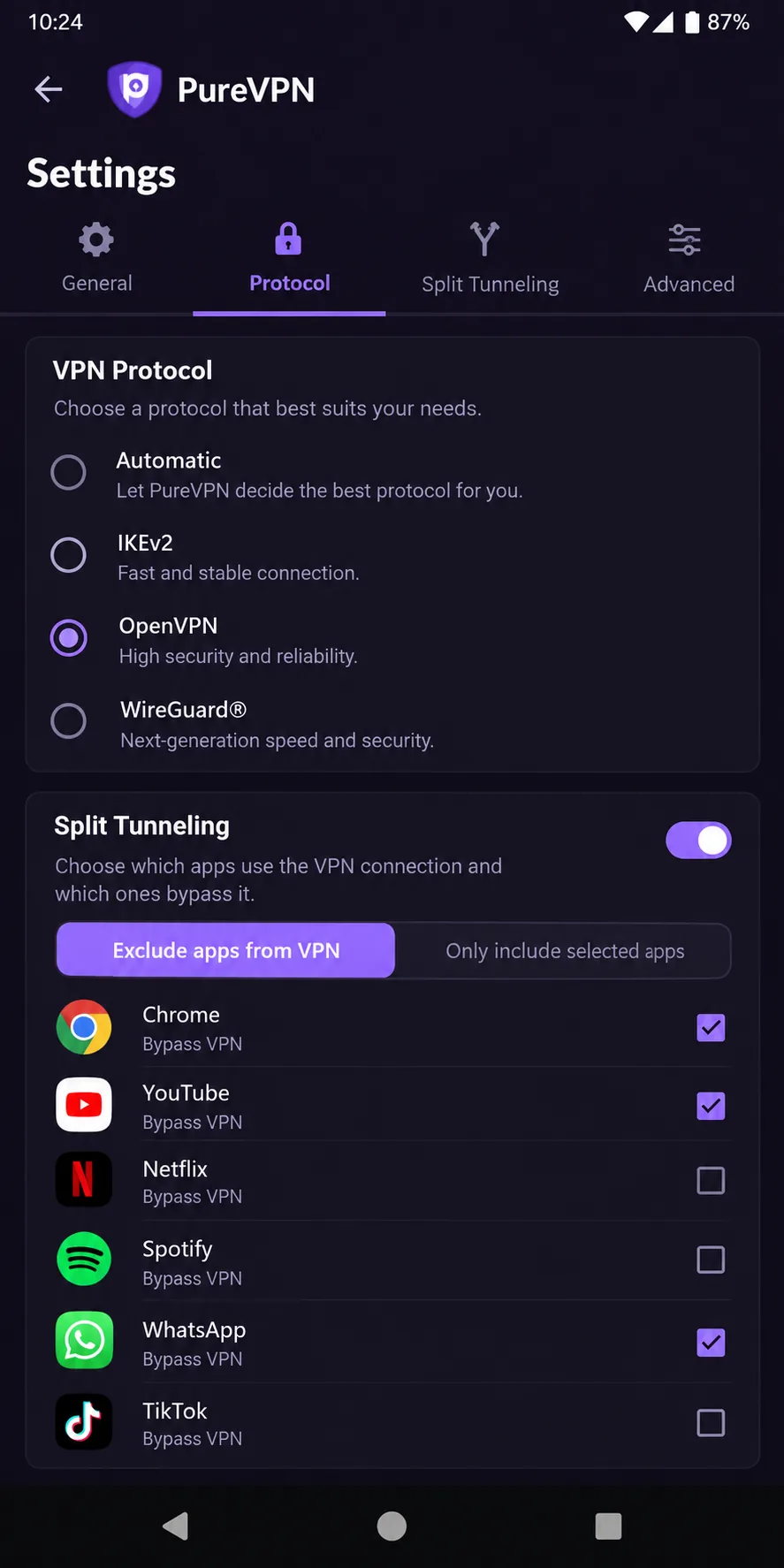
It covers Windows, macOS, iOS, Android and Linux natively, plus Apple TV, Android TV and Fire TV, and one account supports 10 devices. Features include a kill switch, DNS leak protection, split tunneling and tracker blocking. The tested Windows and Mac configurations prevented DNS and browser WebRTC leaks. We would not extend that to Linux, where leak behavior is unconfirmed.
Differences between platforms are the catch. Android split tunneling needs OpenVPN, while WireGuard split tunneling works on Windows, so a setup does not carry over unchanged. The Android app handles streaming well but does not connect automatically on public Wi-Fi. For restrictive networks, official guidance says to enable obfuscation by selecting OpenVPN in the app. How well it works varies, so test it on your own network.
Pros
- Low introductory price
- Broad native app and TV support
- No DNS or WebRTC leaks on tested Windows and Mac setups
Cons
- Noticeable latency increase
- Settings differ by platform
- Trial renewals are non-refundable
How to choose a VPN for Ethiopia
Start with what you need the VPN to survive. A service working on your home Wi-Fi in another country tells you little about how it will perform on a filtered mobile network in Addis Ababa. We lean on a few questions, covered in the next two sections.
Obfuscation, privacy and connection reliability
Obfuscation disguises VPN traffic so it is harder to pick out and block. NordVPN, Surfshark, ExpressVPN, IPVanish and PureVPN all advertise a version of it, but advertising is not proof. We have no evidence for any of them specifically in Ethiopia, so favor services that give you several protocols to cycle through. Check that a no-logs policy exists, that a kill switch is available on your device, and that leak protection is on by default.
Pick the service with the most fallback options, not the one with the loudest promise. Whether any of them connects on a given Ethiopian network is still something only a trial will tell you.
— Our advice on testing before you commit
Reliability is mostly about having more than one way in. Download the apps for two services if you can, use the refund windows to test them, and keep the one that connects when the other does not.
Server locations, device support and total cost
You will almost certainly connect to a server outside the country, so look for nearby regions with good routes. Long-distance throughput matters here, as it was NordVPN's soft spot in our notes. Then count your devices: Surfshark and IPVanish offer unlimited connections, NordVPN and PureVPN cap at 10, and ExpressVPN ranges from 10 to 14 depending on tier.
Total cost is the next filter. Every promotional price above requires paying upfront for a long term, and each service renews at a higher rate. Multiply the renewal figure, not the intro figure, by the years you expect to keep it. Four of the five services offer money-back guarantees lasting 30 days, with PureVPN at 31, but none refund every kind of purchase.
How to set up and use a VPN in Ethiopia
Unlike picking a provider, setup has a hard deadline: you want the tool working before you rely on it. The sections below cover the order we would follow.
Install and test your apps before travel
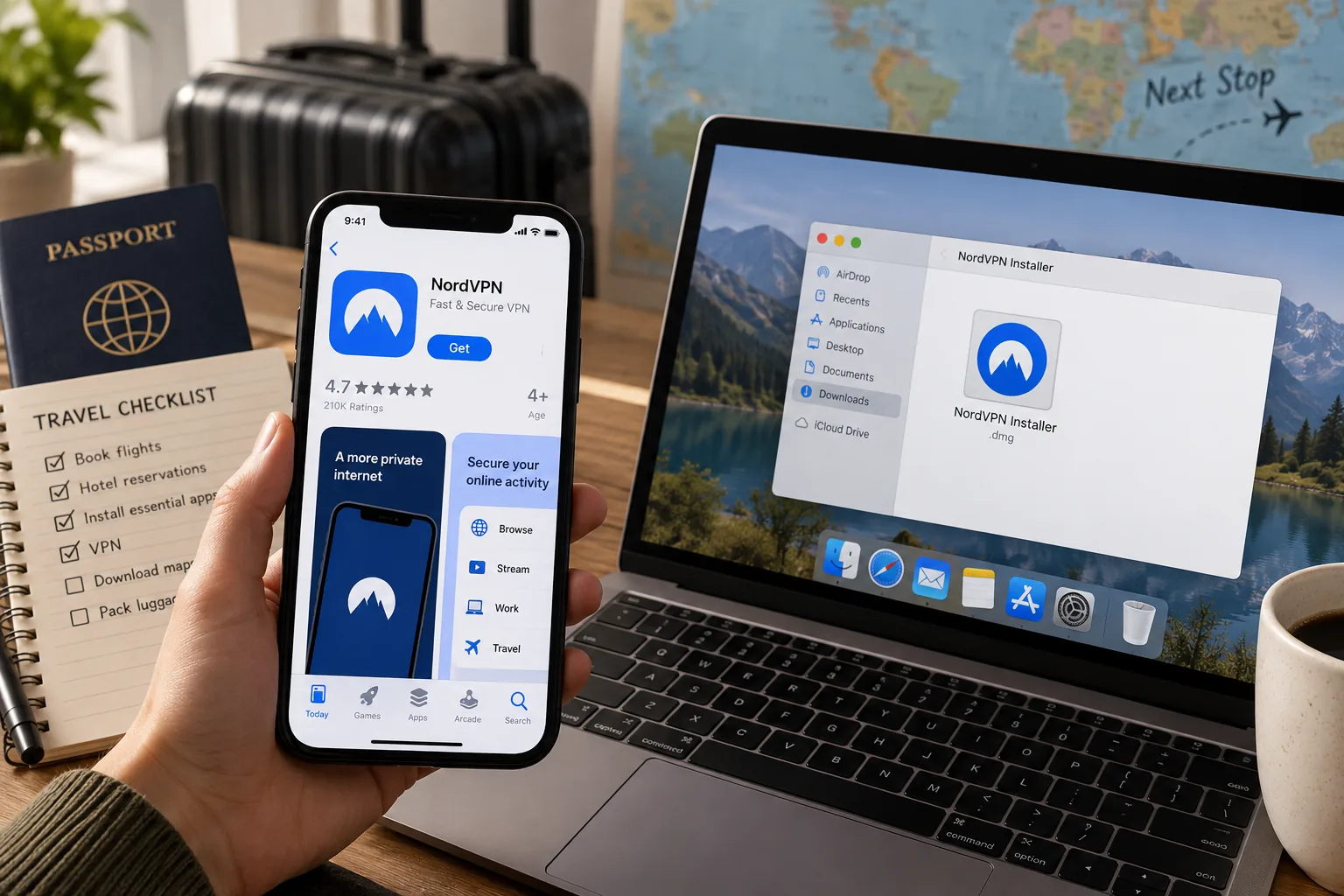
If you can, install before you arrive. Vendor websites and app stores may themselves be blocked on a local connection, and Access Now's #KeepItOn guidance points out that downloading circumvention tools in advance avoids depending on a VPN website that may be unreachable. Check that your phone meets the minimums (our roundup of the best VPN for Android covers general app choices): Android 9 for NordVPN's main app, iOS 17.0 for its iPhone app, and Android 7.0 for Surfshark's Play Store version.
Sign in on every device, run each protocol once on your home connection, and confirm the kill switch works by switching networks. Save the account details offline.
Choose a server and check privacy settings
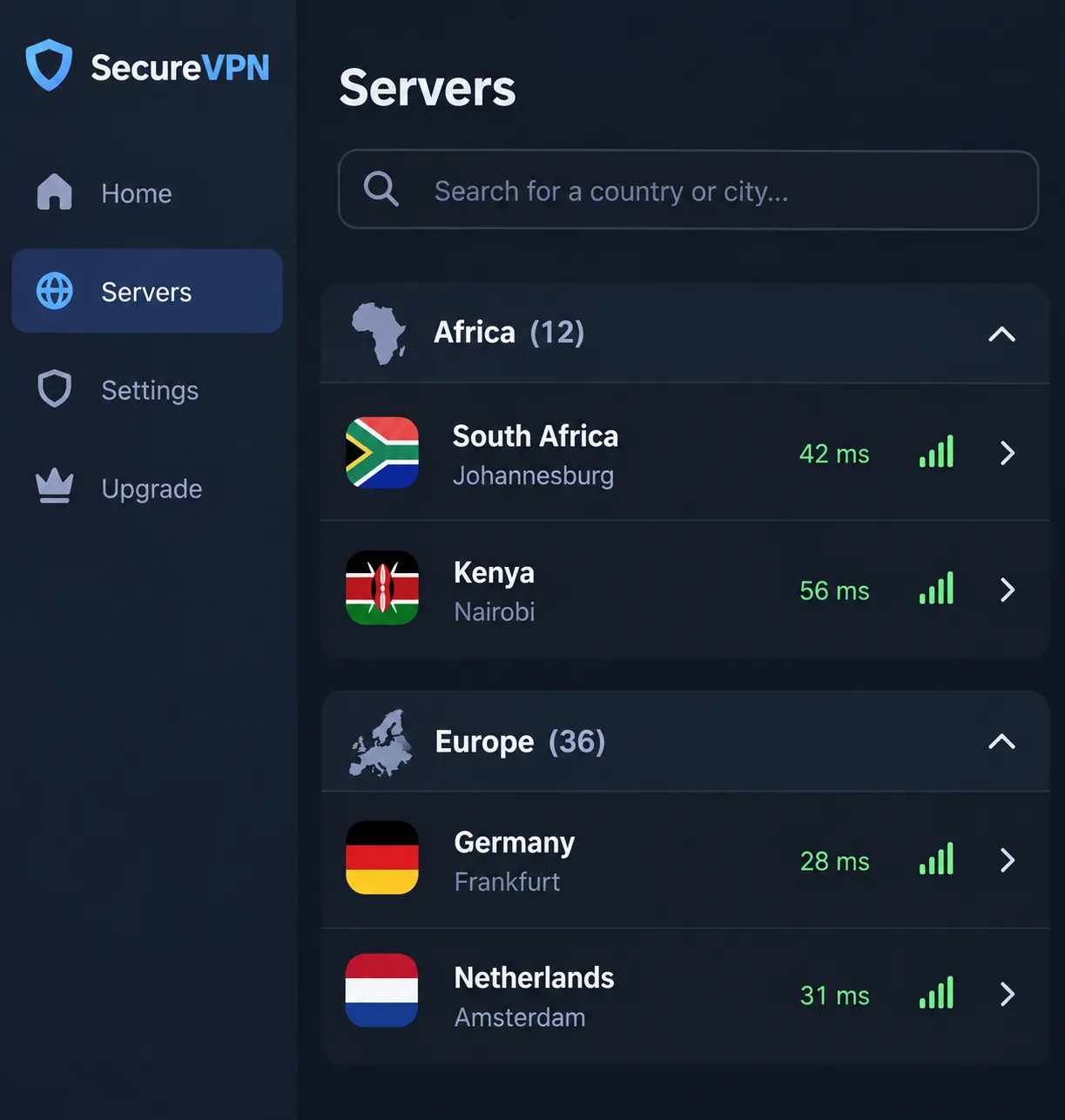
Pick a nearby country first, such as South Africa or Kenya, since shorter routes tend to be faster. Turn on the kill switch, enable obfuscation if the app offers it (NordVPN's Obfuscated category, Surfshark's Camouflage, or OpenVPN in PureVPN), and enable DNS leak protection. Open an IP-check page after connecting to confirm the address shown is the server's, not yours.
Note the difference between two goals people often mix up. An overseas server while you are in Ethiopia gives you access to blocked sites. An Ethiopian IP address, used to browse Ethiopian sites from abroad, is a separate capability, and we could not verify an Ethiopian exit for any of the five.
Why use a VPN in Ethiopia?
There are three practical reasons to use one.
Website restrictions, VoIP and surveillance
OONI's report on website blocking in Ethiopia found news-site blocking and interference with circumvention sites in measurements collected between June and October 2016. That is a historical dataset, not a current block list, and we could not verify today's blocked domains. More recently, Freedom House's 2025 Freedom on the Net assessment classifies Ethiopia as Not Free, with a score of 30/100.
Surveillance is the other driver. The 2016 Computer Crime Proclamation No. 958/2016 allows court-warranted search or access to computer systems, networks or data for investigations in Article 32. A VPN encrypts the content that your local network sees, though it does not hide that you are using a VPN, and it does not shield you from a device that is physically examined. Calling apps are the third reason, and what applies depends on how they are used.
Encryption protects traffic in transit. It does not protect an unlocked phone, a compromised device or accounts you log in to with your real name.
What a VPN cannot do during an internet shutdown
A VPN tunnel needs an underlying connection, so it cannot restore a fully disconnected link. If mobile data or Wi-Fi is cut off at the network level, no app will bring it back. Treat a VPN as a tool for blocked sites and apps while an internet path exists.
No VPN can guarantee access. If the network itself is down, the VPN has nothing to tunnel through, and no provider here has verified success rates for Ethiopia.
VPN not working in Ethiopia?
Work from the simple causes outward, and start with the tunnel before the network.
Try supported protocols, obfuscation and another server
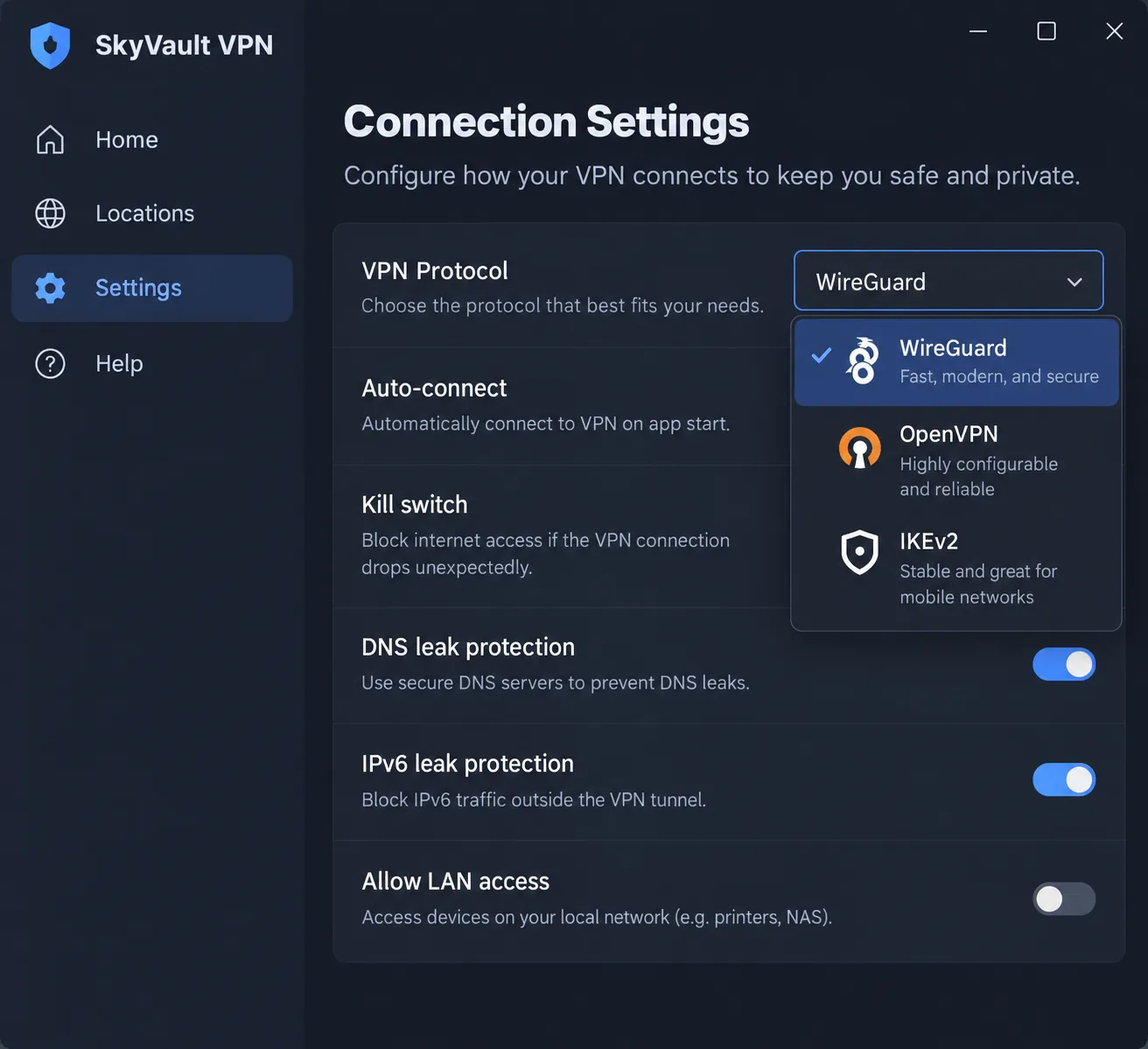
Change the protocol first. Surfshark documents this as an official connection step, and in our experience switching from WireGuard to OpenVPN is the quickest way past a network that rejects WireGuard. Turn on the obfuscated option, then try a different server, since another one can offer a different route. If IPVanish's kill switch is on and you disconnected deliberately, the lack of internet is the kill switch rather than an outage.
Check whether the underlying internet connection works
Turn the VPN off and try a plain site or message. If nothing loads without the VPN either, the problem is the connection, not the tunnel. Moving between Wi-Fi and mobile data can help, and ExpressVPN's Lightway is built to handle those transitions. A working data connection can carry a VPN, but getting that connection through a SIM or an eSIM depends on the carrier and its coverage.
Free VPNs for Ethiopia: limits and trade-offs
Free is tempting when money is tight, but free VPN apps have a documented record of problems. These have a history of insecure tunneling, DNS and IPv6 leakage, TLS interception and traffic manipulation. This is not universal, yet it shows what to look for before installing anything with no price tag.
Proton VPN Free is a better example of a free VPN than most, with no data cap, no ads and a no-logs policy. Its paid plans add streaming support, P2P and a wider choice of locations. We list it as a free-plan example rather than a sixth recommendation. The refund windows at the five paid services above are a safer way to try a VPN without paying for it, provided you cancel in time.