Most people in Nepal look for a VPN for one of two reasons. Either you want private browsing on public Wi-Fi and unreliable networks, or you live abroad and want a Nepal IP address to reach local services. Those are different jobs, and they need different server choices. NordVPN is our lead recommendation because it pairs fast everyday connections with a Nepal location, a 30-day refund window and support for 10 devices. Surfshark, ExpressVPN, Proton VPN and Private Internet Access each win in a narrower case, which we explain below. Keep one distinction in mind as you read: using a VPN inside Nepal means picking an overseas exit, while getting a Nepal IP abroad means picking a Nepal exit.
Best VPNs for Nepal at a glance
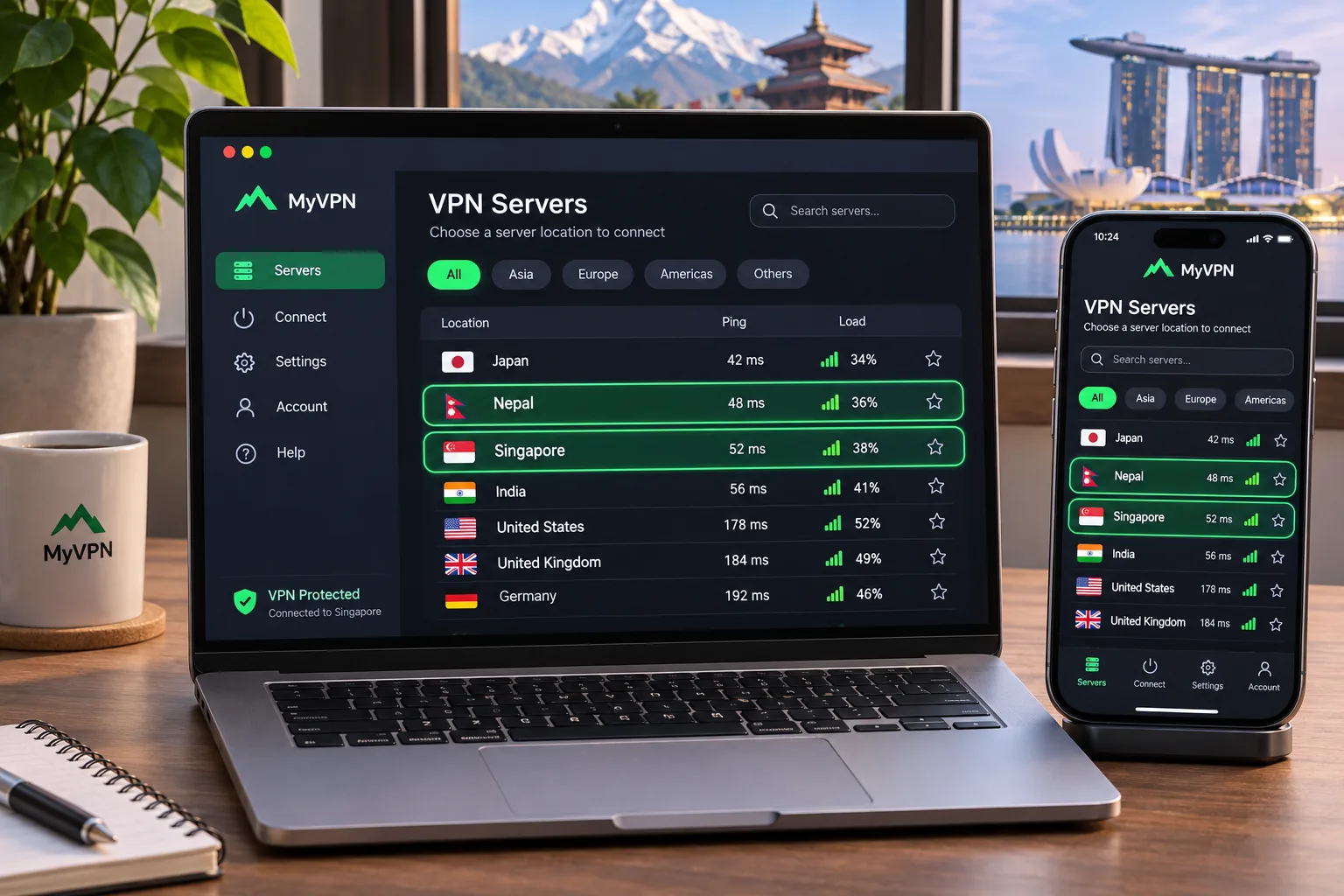
All five services advertise a Nepal IP address, and every one lists a 30-day money-back guarantee. The Nepal location is virtual on most of them, meaning the IP is assigned to Nepal while the hardware sits elsewhere, usually Singapore. Prices below are the introductory offers displayed on official pages when we checked, and they change with promotions, billing region and tax.
| Product | Buy | Nepal IP | Regional routing | Devices | Intro offer (USD) | Main limitation |
|---|---|---|---|---|---|---|
 |
Check price → | Yes, virtual | Singapore listed | 10 | $94.23 for 27 months | Renewal rises to $139.08/year |
 |
Yes, 4 servers advertised | Singapore listed | Unlimited | $67.23 for 27 months | Renewal increase; bundle terms unclear | |
 |
Yes, virtual via Singapore | Singapore | 10 to 14 by tier | $84 for 28 months | Price varies by tier | |
 |
Yes (paid), via Singapore | Singapore | 10 | $83.76 for 24 months | Free plan cannot select Nepal | |
 |
Yes, virtual via Singapore | Singapore, Mumbai | Unlimited | $2.03/month equivalent for 40 months | Proxy multihop setup friction |
The 5 best VPNs for Nepal
We ranked these on privacy features, how well they handle streaming, device support and what you pay over the full term rather than the headline monthly figure. The order reflects our judgment rather than a lab ranking. We have not measured speeds on Nepali ISPs such as NTC, Ncell or WorldLink, so we do not publish speed numbers for them.
1. NordVPN
NordVPN is the one we would reach for first. Its Windows app connects promptly without noticeable laptop strain, and in daily use it gave us consistent streaming unblocking and fast everyday connections. The mobile server list is easier to navigate than swiping across the map. We found two small annoyances. The Disconnect control sits under Pause and takes a moment to find, while the sheer number of security controls can feel overwhelming until you settle on defaults.
The feature set covers NordLynx, OpenVPN, NordWhisper, a kill switch, split tunneling on supported apps, Double VPN and private DNS, with apps for Windows, macOS, Linux, Android and iOS plus Chrome, Firefox and Edge extensions. Nepal access uses a virtual location, and the physical host is not published. Singapore is a listed regional option if you simply want a nearby exit. It supports 10 simultaneous devices and carries a 30-day money-back guarantee.
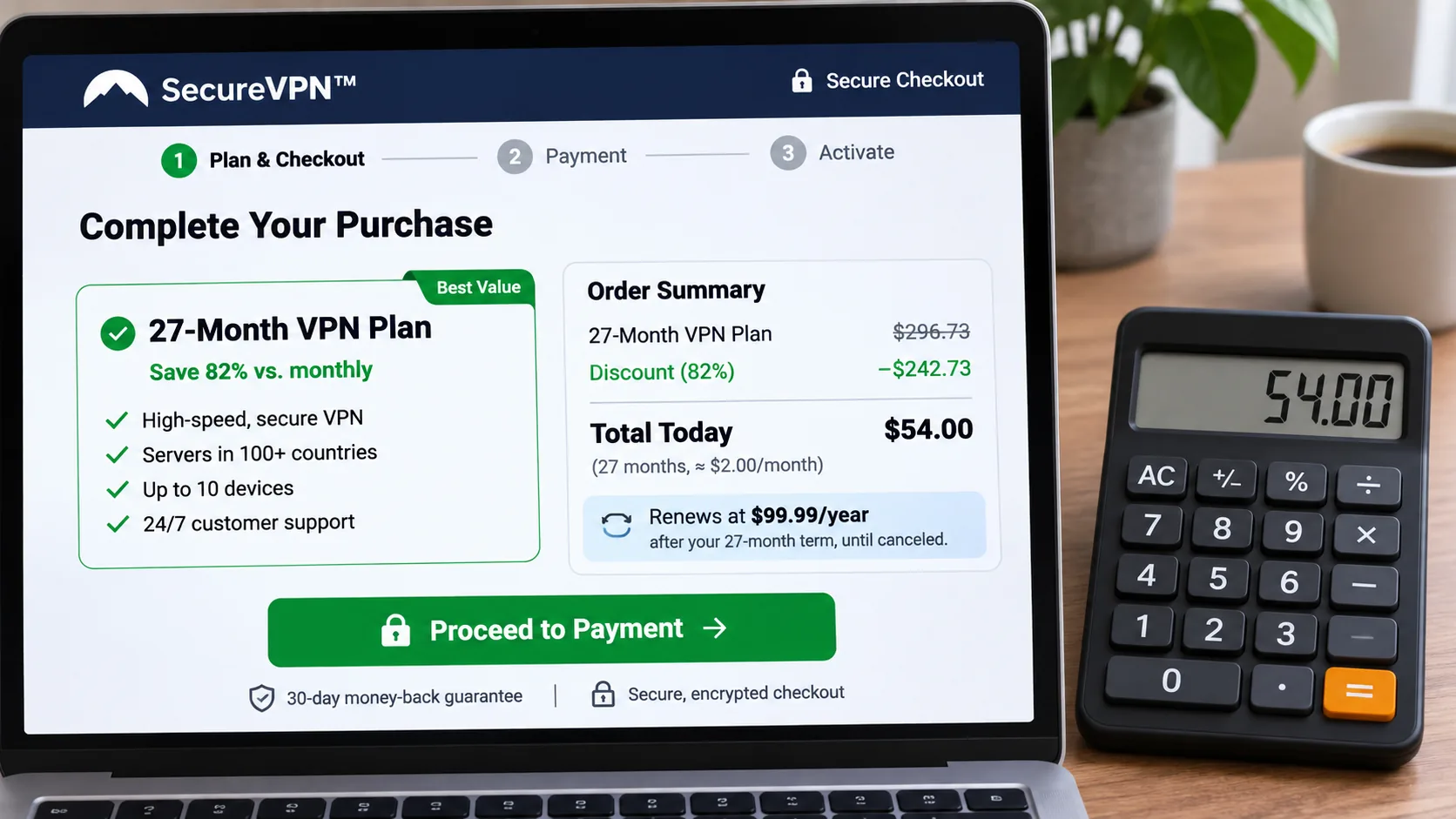
The displayed Basic offer cost the equivalent of $3.49 per month, paid as $94.23 upfront for 27 months. Renewal was $139.08 per year, with sales tax potentially extra. Introductory promotions and billing region change the checkout total, so confirm it before you pay.
Pros
- Prompt connections and consistent streaming unblocking
- Wide protocol and security toolkit
- Apps and browser extensions across all major platforms
Cons
- Renewal costs far more than the intro offer
- Disconnect control is less obvious than it should be
2. Surfshark
Surfshark is the value pick, with unlimited simultaneous devices at the lowest displayed intro price. Its Nepal page advertises 4 servers in one location, though we could not confirm whether they are physical or virtual. Singapore also appears in its server list.
In use, its split tunneling is straightforward to configure, including on Mac and iOS, and it delivers enough throughput for smooth live streaming. Alternative ID has quick-copy controls that make filling forms convenient. Dynamic MultiHop lets you choose entry and exit points, and obfuscation helps on restrictive networks.
The Starter offer displayed $2.49 per month equivalent, or $67.23 for 27 months. Renewal runs around $79 per 12 months but depends on your subscription and billing region. Ask for a quote specific to your account. It also carries a 30-day money-back guarantee.
3. ExpressVPN
ExpressVPN costs more than Surfshark, but it is the easiest to move between devices. The app layouts are similar everywhere, and the account activation code simplifies adding another device. Installation on a laptop can require a restart before first use, which is a minor hurdle. Lightway connections support streaming without persistent buffering.
Its Nepal location is virtual and hosted in Singapore. Basic supports 10 devices, Advanced 12 and Pro 14. You get Lightway, WireGuard and OpenVPN, automatic obfuscation on supported platforms, an internet kill switch, RAM-only servers and published no-logs audits. Platform coverage reaches Chromebook, Apple TV, Fire devices and routers.
The official page listed Basic at the equivalent of $3 per month: $84 for the first 28 months, then $99.95 annually. Figures vary slightly between sources, so confirm at checkout. The 30-day refund applies to new direct subscribers; Apple and Google store purchases follow store policies.
4. Proton VPN
Where Surfshark chases price, Proton VPN is our pick for privacy-first readers. Its apps are open-source and independently audited, and the no-logs policy covers free users too. Secure Core multihop, Stealth and alternative routing give you options if a network interferes with connections.
Paid Nepal access uses Smart Routing through Singapore. Free accounts cannot select Nepal at all. The paid Plus plan protects 10 devices, and the displayed offer was $83.76 for the first 24 months ($3.49 equivalent), renewing at $83.88 every 12 months. That renewal is the gentlest of the group, which matters if you plan to keep your subscription. Profiles make it convenient to reuse combinations of server, protocol and filtering settings.
The catches are streaming related. NetShield blocks ads effectively but can interfere with ad-supported streaming sites, and Disney+ access can be inconsistent. The refund window lasts 30 days, subject to the linked terms.
5. Private Internet Access
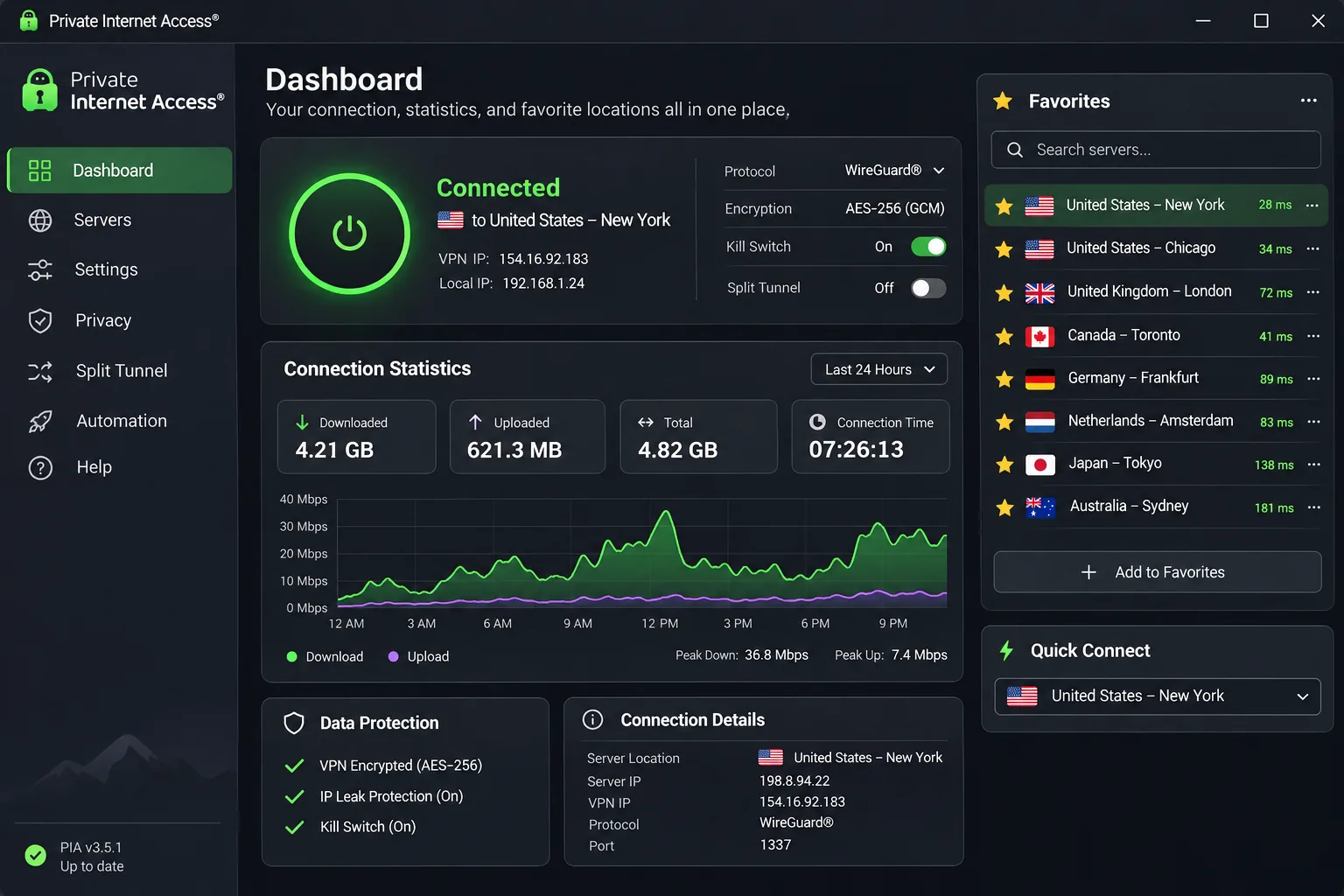
Where Proton VPN leads on privacy, PIA suits tinkerers who want unlimited devices on a modest budget. It offers WireGuard and OpenVPN, split tunneling, an advanced kill switch, port forwarding on selected servers and RAM-only servers with an audited no-logs policy. Its Nepal location is virtual and hosted in Singapore, as is its Mumbai exit.
Day to day, favorites and recent-server quick-connect controls make repeated location changes convenient, and the server-list latency display helps narrow down promising connections. The expanded desktop dashboard shows connection statistics without a separate window. On the downside, setting up proxy multihop is less straightforward, and switching to WireGuard can stop multihop without warning. PIA can also struggle to unblock Hulu even after changing US servers.
The long offer works out to $2.03 per month equivalent for 3 years plus 4 months, renewing at $81.20 every 3 years. The annual plan listing shows $47.88 for the first year and $47.88 per year thereafter. Offers vary by term and currency, and checkout should confirm the initial total. The 30-day guarantee applies to new subscribers.
Why use a VPN in Nepal?
A VPN encrypts traffic between your device and the VPN server, which keeps your network operator and anyone on the same Wi-Fi from reading it. It also lets you choose where websites think you are. Neither benefit is magic, and neither makes illegal activity legal.
Privacy, public Wi-Fi and restricted networks
Cafes, hotels, co-working spaces and shared hostel networks are the classic cases for an extra layer of protection. A VPN also helps when a network blocks sites you are entitled to use.
Stick to official app stores and the provider's own site. Nepal's police have warned about unreliable VPNs that leak data, carry malware or lead to financial loss. A sketchy free app can undo the privacy you were trying to gain.
Using a VPN in Nepal versus getting a Nepal IP abroad
These two goals pull in opposite directions. Inside Nepal, you connect to an overseas server so your traffic exits somewhere else. If you live abroad and want Nepali services, you pick a Nepal location so the site sees a Nepal IP. Every provider here sells that Nepal option, but the IP is virtual on most of them, so a Nepal label does not mean a server in Kathmandu.
Streaming access also differs by region, device and network, and the content service's own terms still apply. We would test a Nepal location during your refund window before relying on it for a particular channel.
How to choose a VPN for Nepal
Regional routing, protocols and Nepal server availability
Start with where the exit really is. Since four of the five route their Nepal IP through Singapore, a nearby Asian server may be quicker than one labeled Nepal when your only goal is privacy. Then look at protocols. NordLynx, Lightway and WireGuard are the fast options, and obfuscation helps if a network interferes with VPN traffic.
A Nepal label on a server list tells you which country the IP belongs to, not where the hardware sits.
Privacy evidence, device support and total subscription cost
Look for audited no-logs claims, open-source apps and RAM-only servers. Count your devices: Surfshark and PIA are unlimited, while NordVPN and Proton VPN cover 10. Then do the arithmetic across the whole term. A cheap 27-month introductory offer followed by a steep renewal can cost more than a mid-priced plan with a modest renewal. Compare renewal prices as well as introductory monthly prices.
How to set up a VPN in Nepal
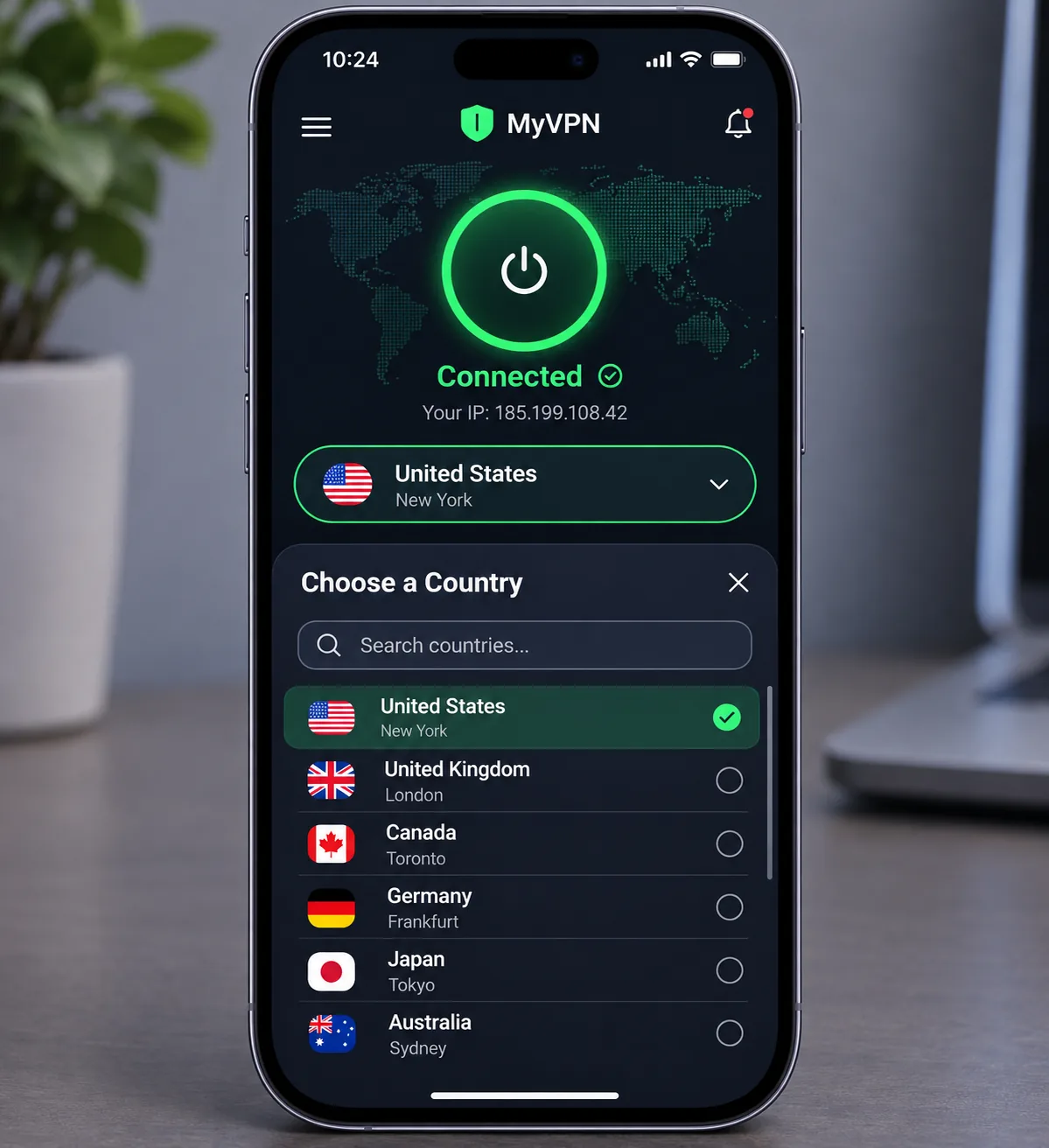
The steps are the same for every provider here. Create an account, install the official app, sign in and pick a country. Quick-connect chooses an available route and is fine for ordinary privacy use. A Nepal IP requires choosing Nepal explicitly. If you are new, our guide on how to use a VPN walks through the basics step by step.
Turn on the kill switch, enable auto-connect on your phone and laptop, and test for leaks before relying on the VPN. If an app will not connect on a restrictive network, try obfuscation or a different protocol.
Can you use a free VPN in Nepal?
Sometimes, with limits. Proton VPN Free has unlimited data, no advertising and no artificial speed cap, and its no-logs policy applies to free users. But free accounts cannot select Nepal, and the automatic server allocation makes picking a specific country cumbersome. Throughput can drop temporarily and recover after waiting or reconnecting. We could not establish that any of the other four offers an ongoing free tier. They offer only a refund window after purchase, which is not the same as a free trial.
For occasional privacy on public Wi-Fi, Proton's free plan is reasonable. For a Nepal IP or steady streaming, pay for a service and avoid unknown free apps.