If you need a VPN for Myanmar, you are probably trying to reach blocked sites and messaging apps, or to hide your browsing from a network you do not trust. NordVPN is the option we would start with, because it pairs a restricted-network protocol called NordWhisper with a recent no-logs audit, and apps for Android, iOS, and computers. Its limit is just as important. No VPN can promise access from inside Myanmar, and none can make you anonymous.
Freedom House's 2025 report scored Myanmar 9/100 for internet freedom and recorded blocking of major VPNs during 2024. So treat every pick below as a tool that may fail on a given network on a given day, not as a guarantee. We built this list from vendor documentation and the hands-on findings in our research, and we have not tested any of these services from inside Myanmar.
Best VPNs for Myanmar at a glance
Here is the short version. Each provider has a different strength, and the right one depends on how you will use it.
- NordVPN: best overall for restricted networks, with NordWhisper on Windows, macOS, Linux, Android, and iOS.
- Surfshark: best for many devices, with unlimited paid connections and obfuscated OpenVPN servers.
- ExpressVPN: best for simple apps and the only provider here with a documented Myanmar virtual location.
- Proton VPN: best for a free fallback, with Stealth on every plan and no data cap on the free tier.
- Private Internet Access: best for tinkerers who want detailed settings and Shadowsocks on desktop.
Myanmar VPN comparison
The table below puts the features that matter most for Myanmar side by side. Prices are introductory monthly equivalents that change often, so confirm them at checkout. We list no speed numbers or success rates, because we could not verify any for Myanmar networks.
| Product | Buy | Obfuscation | Kill switch and leaks | Audit evidence | Regional endpoints | Connections | Intro price (monthly equiv.) |
|---|---|---|---|---|---|---|---|
 | Check price → | NordWhisper on Windows, macOS, Linux, Android, iOS | Kill switch; Android relies on OS protection | Deloitte assessment in 2025, announced 2026 | Singapore, Thailand | 10 | $3.49on a 27-month term |
 | Obfuscated OpenVPN on Windows, macOS, Linux, Android, iOS | Kill Switch; recovery may need manual action | Deloitte verification in 2023 and 2025 | Singapore | Unlimited | $2.49on a 27-month term | |
 | Lightway and other protocols; exact obfuscation matrix unverified | Internet Kill Switch and IP/DNS safeguards | KPMG privacy audit, June 2025 | Myanmar virtual location via Singapore hardware | 10 on Basic | $2.99on a 28-month term | |
 | Stealth on Windows, macOS, Android, iOS | Kill switch; Android uses OS control | Securitum no-logs audit, 2026 | Singapore, Thailand on paid plans | 10 paid, 1 free | $3.49on a 24-month term | |
 | Shadowsocks on desktop Multi-Hop; mobile parity unverified | Kill switch and DNS leak protection | Deloitte infrastructure review, 2025 | Singapore-hosted virtual routes | Unlimited | $2.03on a long offer |
All five advertise a 30-day money-back window for new customers. Exact exclusions for payment method, app-store purchases, and repeat buyers differ, so read the refund terms before you pay.
How we evaluate VPNs for Myanmar
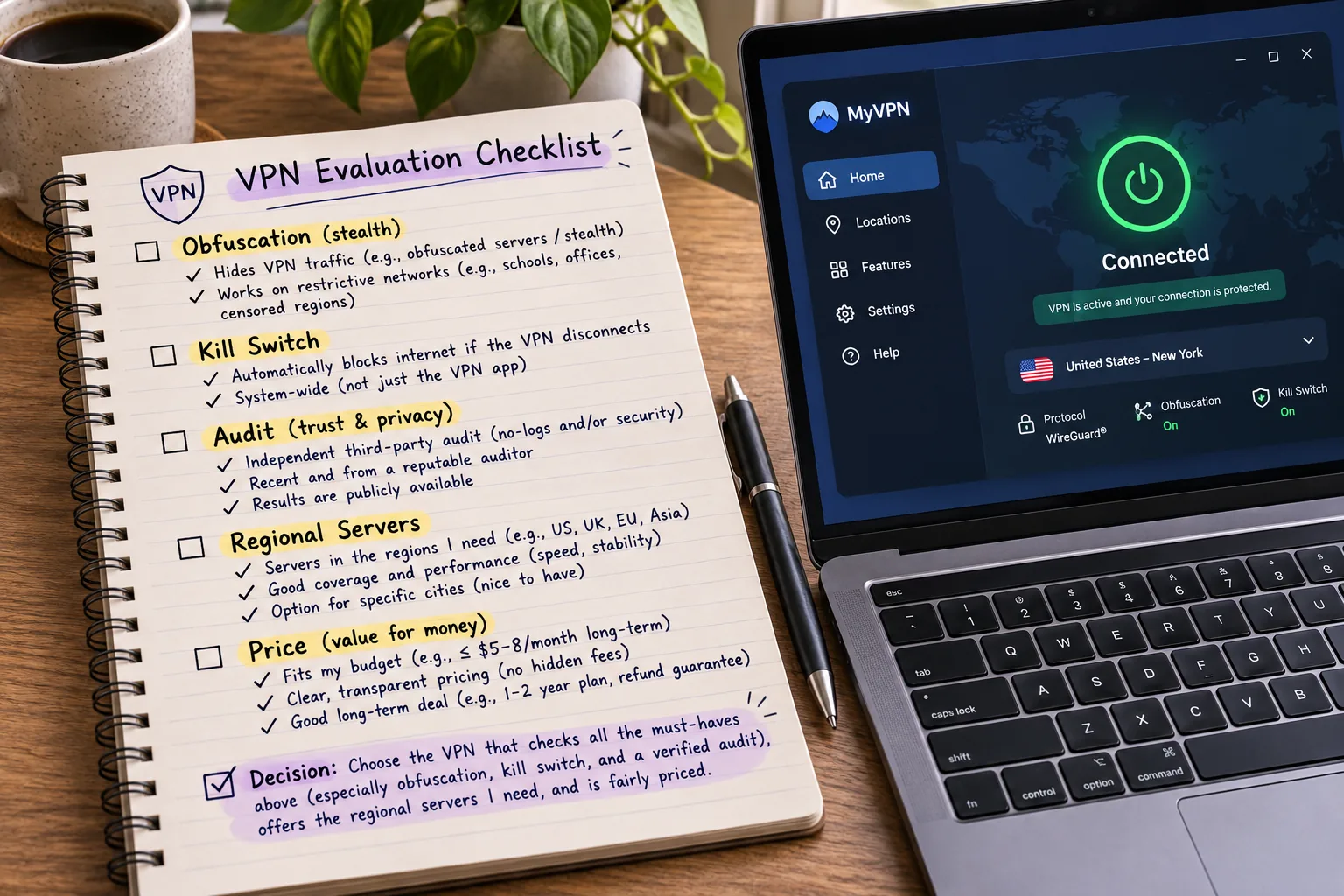
We scored each provider on documented features and policies, then adjusted for the usability problems that hands-on reviews of the apps kept surfacing. We also set clear limits on what we claim. We have no carrier-by-carrier connection results, Facebook access rates, or fastest-provider data for Myanmar, so none of those appear in this guide. Where a fact was missing or changed between sources, we say so instead of filling the gap.
Connection reliability, obfuscation, and regional servers
Reliability comes first, since a VPN that will not connect has no other value. We looked for a restricted-network option on every major platform, including NordWhisper, obfuscated OpenVPN, Stealth, or Shadowsocks. We also noted which providers publish a recovery order for blocked connections, because that tells you whether the vendor expects censorship.
Regional servers came next. Nearby countries such as Singapore and Thailand are the usual first choices, so we checked which vendors list them. A server directory shows what exists. It does not show what a given carrier lets through, and server counts drift over time, so we did not rank on counts.
Privacy policies, audits, kill switches, and leak protection
To evaluate policies, we looked for independent assessments dated 2025 or later: Deloitte for NordVPN and Surfshark, KPMG for ExpressVPN, Securitum for Proton VPN, and Deloitte Audit Romania for PIA. Treat audits as evidence of past practice, not a promise. ExpressVPN's own audit page makes the same point about scope.
For kill switches, we weighed how each one behaved in forced-failure testing and how clearly the app told you what was happening. A kill switch that blocks traffic but leaves you confused still protects you. One that sits off by default and hides its toggle does not.
Android and iOS apps, device limits, support, and pricing
Most readers will use a phone, so we gave mobile apps considerable weight. We checked the platforms each protocol runs on, the stated minimum operating systems where a vendor publishes them, and the number of simultaneous devices allowed. For price we compared the introductory monthly equivalent and the renewal bill, since the gap between the two is where many buyers get surprised. We treat every promotional figure as changeable.
Minimum operating system versions for NordVPN and Surfshark could not be confirmed from official pages. Check the app store listing for your phone before you pay.
The 5 best VPNs for Myanmar
We ordered these picks by how well each fits a restricted network, then by privacy evidence and everyday usability. A rank here reflects features and documented policies, not measured performance from inside Myanmar.
1. NordVPN
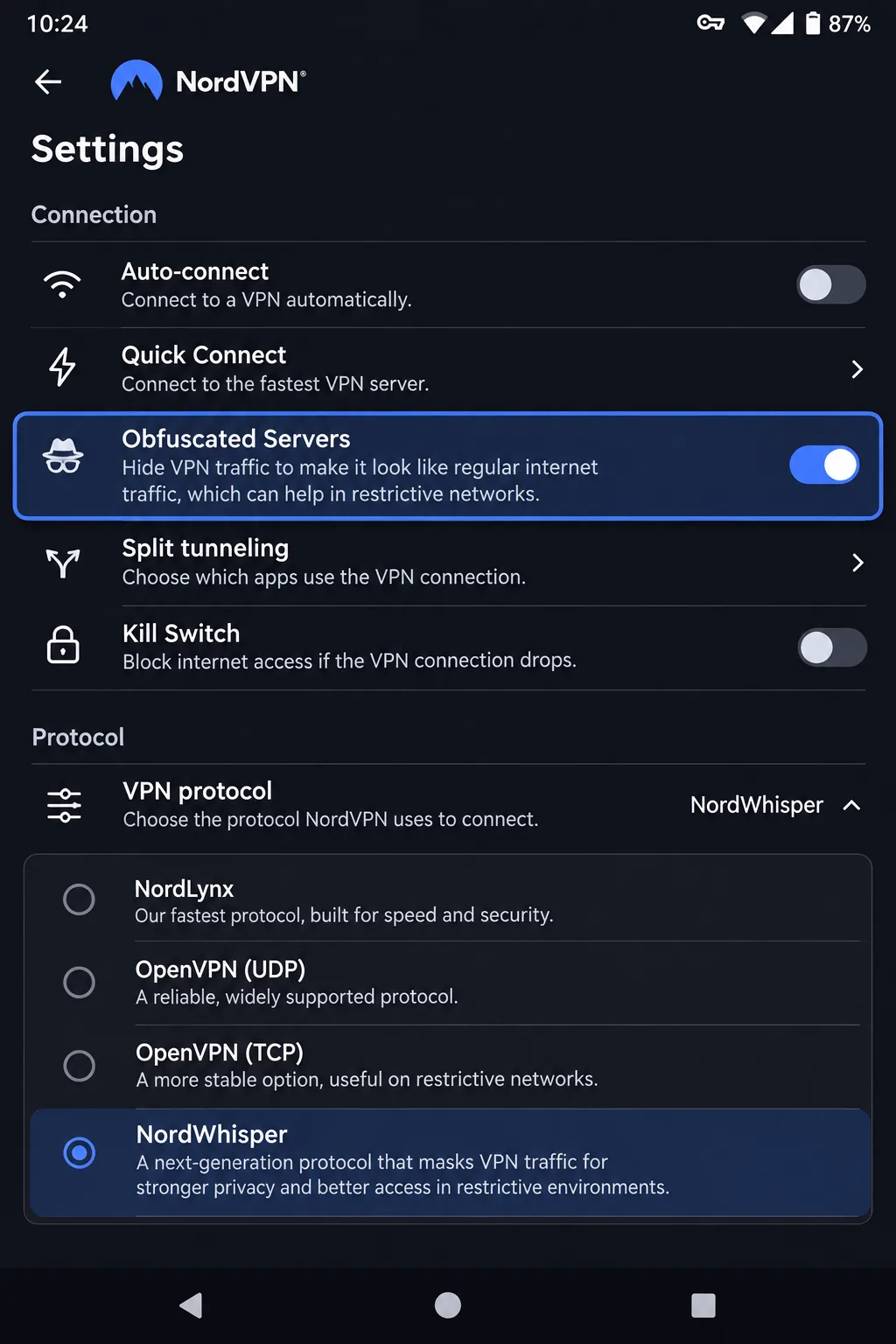
NordVPN fits best if your priority is staying connected on a network that blocks VPN traffic. Its Obfuscated Servers category now uses NordWhisper instead of OpenVPN, and NordWhisper runs on Windows, macOS, Linux, Android, and iOS. One caveat: it is incompatible with Dedicated IP, Meshnet, and Onion Over VPN, so you give up those extras while it is active. Ignore older setup tutorials that tell you to switch to OpenVPN for obfuscation, because manual OpenVPN connections cannot use the updated category.
When a connection fails, NordVPN's own restricted-network guide gives you a clear sequence of options to try. Choose NordWhisper, select Obfuscated with Auto or NordWhisper, then try OpenVPN TCP, and finally follow the platform-specific manual guides. We would write that order down before travelling, because the support pages themselves may be hard to open once you are on a filtered network.
The kill switch is where NordVPN earned our trust. In the desktop tests we drew on, it blocked traffic through severe connection failures, repaired a removed network-adapter driver, and reconnected without an IP leak. On Android the kill switch relies on the operating system, so a dropped VPN can leave the phone offline until you reconnect. Staying offline is safer for privacy, but it can feel like the internet has died. You should know this is expected behavior.
The app has rough edges. NordVPN hides protocol and kill-switch controls inside settings instead of the main connection screen, and the mobile interface can feel cramped. Its streaming servers are unlabeled, so picking the right endpoint for a given service takes some trial and error. If streaming is your main goal, our guide to the Best VPN for Amazon Prime Video covers that use case in more depth. None of that matters much for a privacy-first user, but it does slow down setup.
NordVPN's no-logs page lists a sixth assessment carried out by Deloitte in 2025, with the announcement published in February 2026. An audit covers defined systems during a defined period, so it does not prove future protection or successful censorship bypass. NordVPN's server directory lists Singapore and Thailand endpoints, which are the nearest countries worth trying first.
At publication, the Basic plan costs the equivalent of $3.49 a month, billed at $94.23 upfront for 27 months. Renewals cost $139.08 a year before tax. Promotional terms, region, and taxes can change that. One account covers 10 devices, and the 30-day money-back guarantee applies to the initial purchase only.
Pros
- NordWhisper restricted-network protocol on all five major platforms
- Published fallback order for blocked connections
- 2025 Deloitte no-logs assessment, announced in 2026
- Singapore and Thailand endpoints for nearby routing
Cons
- Protocol and kill-switch settings are buried in menus
- Mobile interface can feel cramped
- Renewal price of $139.08 a year is well above the intro rate
- NordWhisper cannot be combined with Dedicated IP, Meshnet, or Onion Over VPN
2. Surfshark
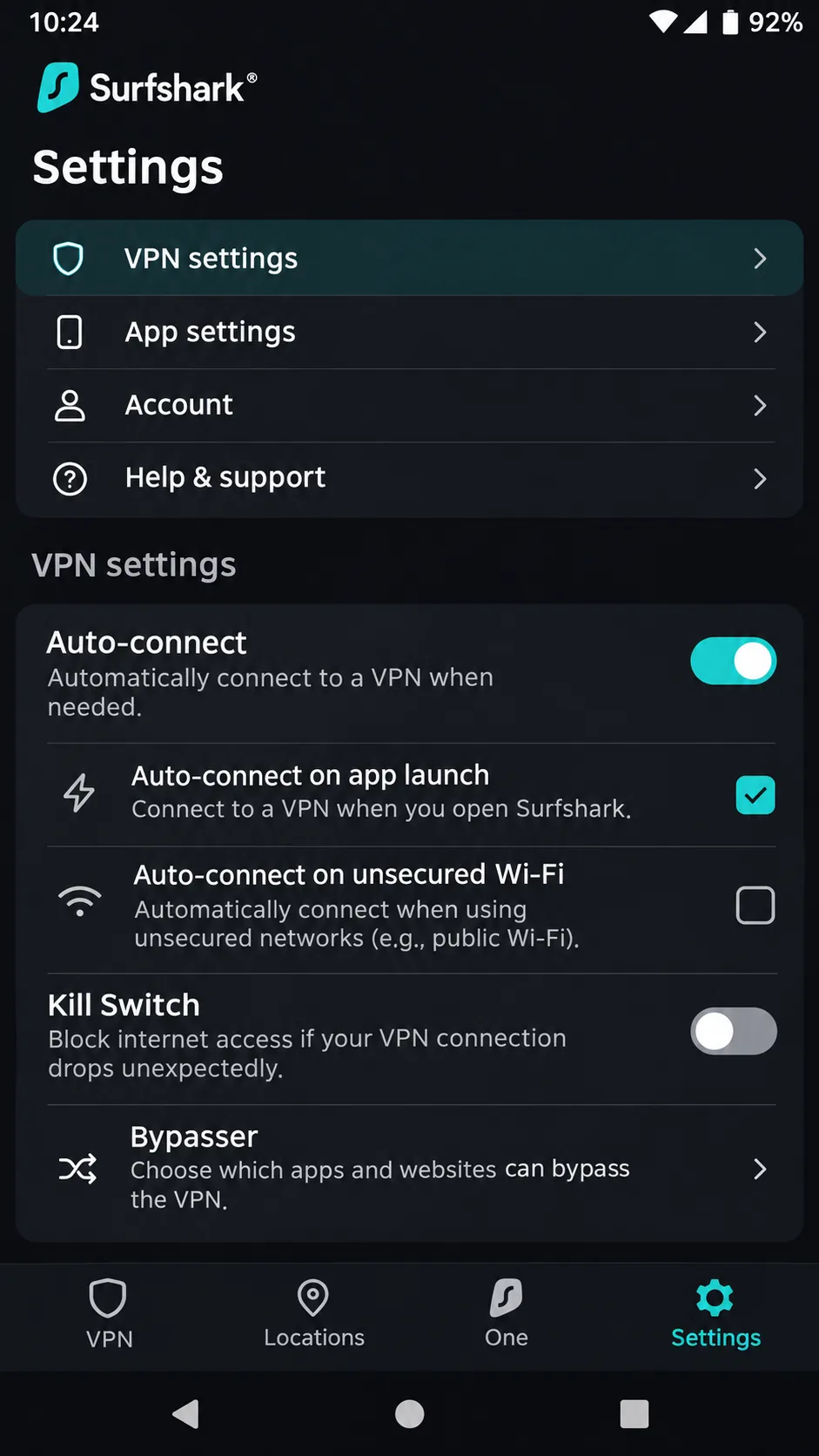
Where NordVPN is built around beating a block, Surfshark is built around breadth. It suits a household that wants to cover phones, laptops, a tablet, and a TV on one subscription. Paid plans allow unlimited simultaneous connections, a feature matched here only by Private Internet Access. For restricted networks it offers NoBorders server selection, and its OpenVPN connections use obfuscated servers on Android, macOS, Windows, iOS, and Linux. TCP can trade speed for stability, so if the default connection drops, a TCP attempt is the natural next step.
We liked how easy it is to live with. Auto-connect presets protect untrusted networks without making you choose a server each time, and the apps are visually approachable. Under ordinary test-network conditions it also reached multiple streaming libraries smoothly. Keyboard-only navigation is weak, which matters for some users with accessibility needs.
The kill switch needs a closer look. Surfshark blocks traffic when a connection breaks, but you may need to intervene if it cannot repair and reconnect automatically. The connection screen can also make an inactive kill switch less obvious than an enabled one, so check the toggle yourself after installing. A privacy setting you cannot see at a glance is easy to leave off.
Extras include CleanWeb for ad and malicious-domain blocking, Bypasser split tunneling, Dynamic MultiHop, and paid dedicated-IP options, though availability varies by platform. Deloitte verified the no-logs policy in 2023 and 2025, and Singapore appears in the server directory.
The Starter plan is $2.49 a month equivalent, charged as $67.23 for the first 27 months, with VAT where it applies. Promotions vary by region and term. The introductory rate does not tell you what you will pay at renewal, so check that price before you commit. A 30-day money-back guarantee is advertised for new signups.
Pros
- Unlimited simultaneous connections on paid plans
- Obfuscated OpenVPN servers on all five major platforms
- Auto-connect presets for untrusted networks
- Deloitte no-logs verification in 2023 and 2025
Cons
- Recovery after a broken connection may need manual action
- An inactive kill switch is easy to overlook
- Weak keyboard-only navigation
- Renewal price is not published clearly
3. ExpressVPN
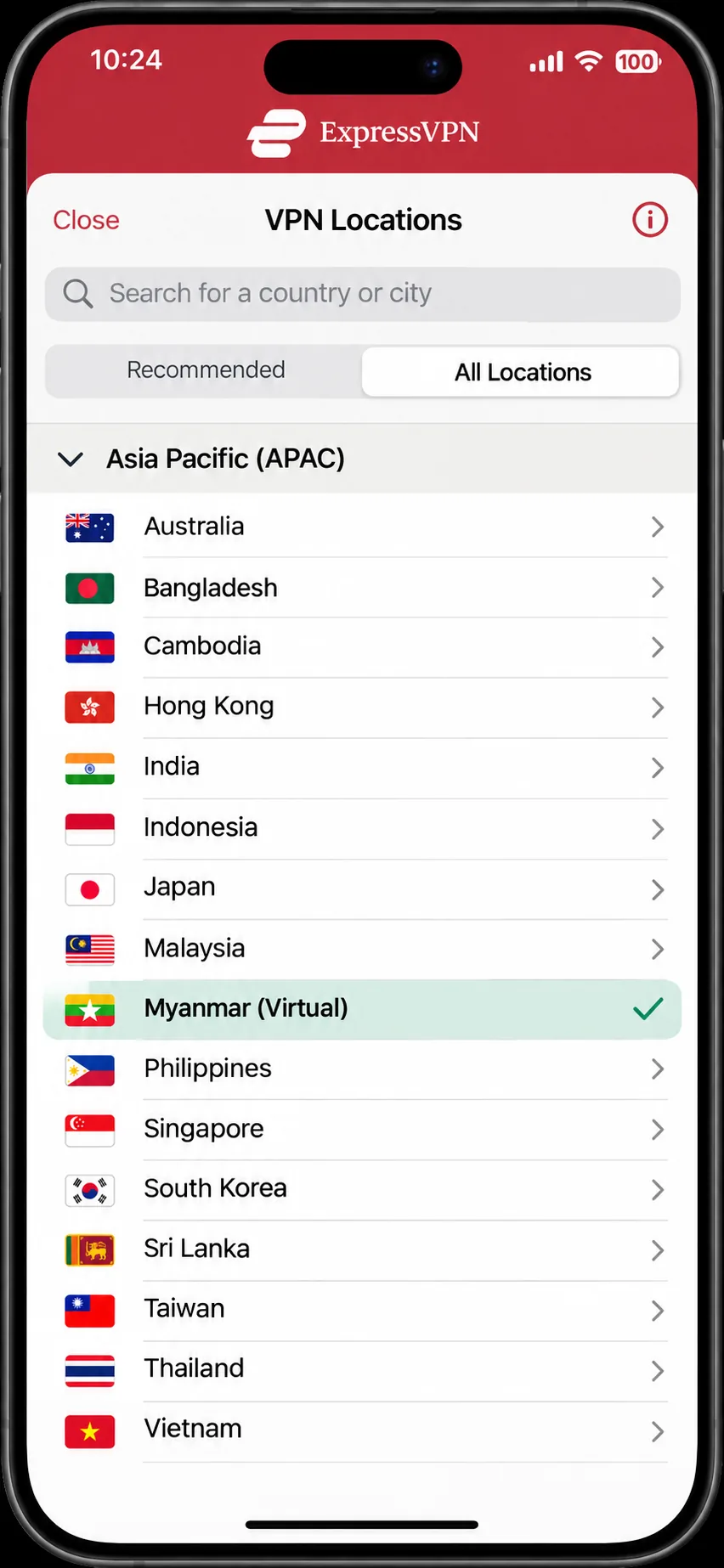
Surfshark stretches across devices, but ExpressVPN solves a different problem. It is the pick for readers who want the plainest apps and care about getting a Myanmar IP address. It is the only provider in our research with an officially documented Myanmar virtual location. Its support page distinguishes the Myanmar IP location from the physical server hardware in Singapore. That distinction matters, and we explain it in the section on whether you need a Myanmar IP.
The apps are straightforward on major platforms, and with a working connection, ExpressVPN can maintain uninterrupted playback on major streaming services. It offers Lightway, OpenVPN, and WireGuard, with the Internet Kill Switch and IP and DNS leak safeguards on supported platforms. Protocol and split-tunneling availability vary by platform. Automatic obfuscation is described in reviews, but we could not confirm the exact platform behavior from official documentation, so do not assume it matches NordWhisper or Stealth.
The kill switch blocks traffic during forced disconnections. However, notifications do not always explain the resulting loss of internet, so you may sit offline wondering what happened. After an unusual failure you may also need to reconnect by hand. Its content filtering does not reliably replace a dedicated malware-protection tool, so keep your regular security software.
Basic supports 10 simultaneous devices, Advanced supports 12, and Express Pro supports 14. The trust center lists a KPMG privacy-commitments audit in June 2025. The mobile apps require Android 7 or later and iOS 15 or later. These requirements matter for the older phones common in many markets.
Basic costs the equivalent of $2.99 a month, billed at $83.72 for the first 28 months, then $99.95 a year before sales tax. Introductory promotions and regional checkout terms can change. The pricing page and an older support page disagree on whether Basic includes tracker blocking, so confirm the bundle at checkout. A 30-day money-back guarantee is advertised for new users.
Pros
- Only provider here with a documented Myanmar virtual location
- Straightforward apps on major platforms
- KPMG privacy audit in June 2025
- Supports Android 7 and above and iOS 15 and above
Cons
- Myanmar IP runs on Singapore hardware, not in-country
- Kill switch notifications can be unclear
- Exact automatic obfuscation behavior is unconfirmed
- Pricier renewal than most rivals at $99.95 a year
4. Proton VPN
After three paid services, Proton VPN is the one that adds a free option. It is the best fit if you want a free fallback that is not capped or throttled, or if you value open-source apps. The free plan has no data cap or artificial speed limit, no ads, and no activity logs. It allows 1 device at a time and assigns free server countries at random, so you cannot choose a nearby country. Paid plans add country selection, streaming and P2P support, and premium filtering.
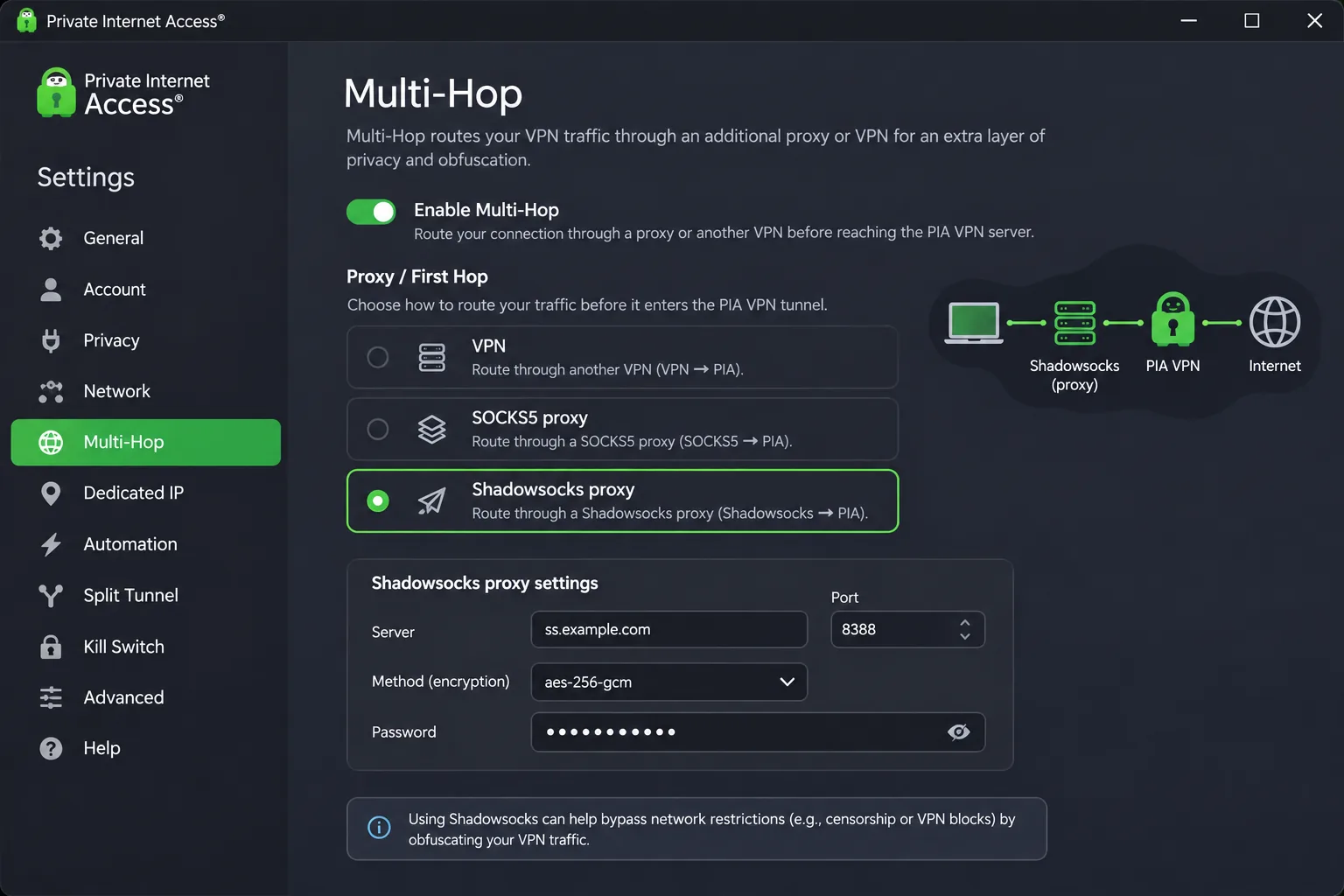
Stealth is included on both free and paid plans and works on Windows, macOS, Android, and iOS, but not on Linux or router setups. That makes the free tier unusually useful as a backup when a paid VPN stops connecting, and we suggest keeping the Proton app installed alongside your main one. Its kill switch blocked traffic across forced failures using Stealth, WireGuard, and OpenVPN in the desktop configurations we drew on. Note that the official lifecycle table marks OpenVPN as end-of-life on iOS and Android, so do not count on it for mobile.
The app explains complex settings clearly, and desktop app detection makes split-tunneling setup easier. On Android, app-based split tunneling cannot independently select website shortcuts that are part of Chrome. The interface is feature-dense and can overwhelm beginners. Speeds can fluctuate on distant routes, and OpenVPN can be appreciably slower than WireGuard. Support chat can be hard to find, and responses can be slow. That makes it a poor fit if you may need help during an outage.
Paid plans add Secure Core routing, NetShield filtering, a kill switch, and port forwarding on supported systems. Securitum completed the fifth consecutive annual no-logs audit in 2026, examining server activity and identifiable connection metadata. The paid directory includes Singapore and Thailand.
VPN Plus costs $3.49 a month equivalent, charged as $83.76 upfront for 24 months and then $83.88 every 12 months. Offers and currency vary, and the introductory and renewal prices differ. VPN Plus supports 10 devices, and a 30-day money-back guarantee is advertised, subject to the terms.
Pros
- Free plan with no data cap, no ads, and Stealth included
- Open-source apps
- Fifth consecutive annual no-logs audit completed in 2026
- Lowest renewal cost of the big-name paid plans at $83.88 a year
Cons
- Free plan covers one device and assigns servers randomly
- Dense interface can overwhelm beginners
- Speeds can fluctuate on distant routes
- Support chat is hard to find and slow
5. Private Internet Access
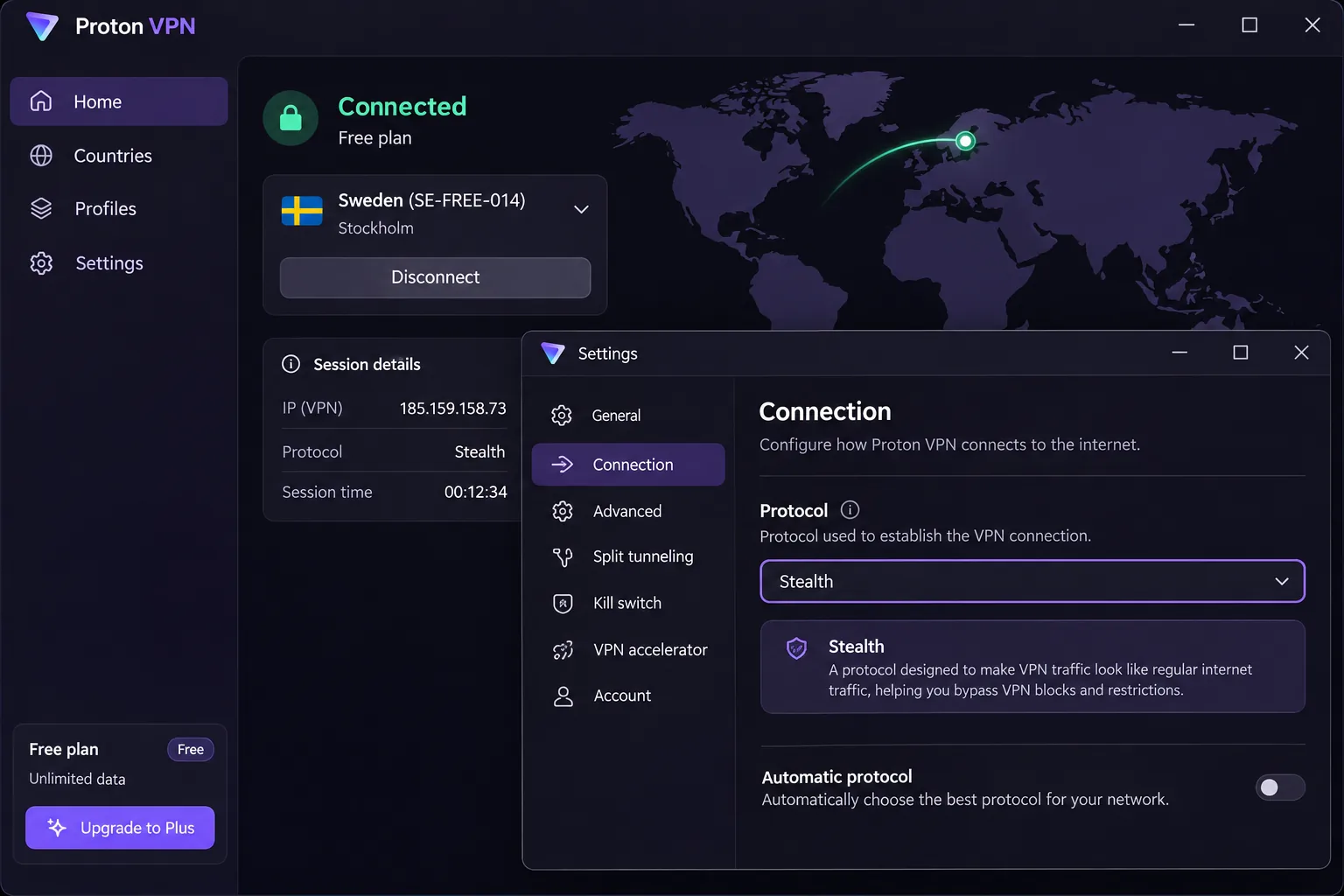
Proton VPN keeps things approachable, while Private Internet Access takes the opposite approach, giving you more control. It suits people who enjoy configuring things and want unlimited simultaneous connections at a low long-term price. Its desktop Multi-Hop feature offers Shadowsocks and SOCKS5 proxy options. Shadowsocks provides obfuscation, while SOCKS5 does not offer the same benefit, so pick Shadowsocks if blocking is your concern. We could not confirm whether the same obfuscation is available on Android and iOS, which makes PIA a weaker choice for a phone-first user.
The expandable desktop dashboard lets you keep frequently used connection details visible and hide panels you do not need. Network-based automation cuts repeated manual steps on unfamiliar Wi-Fi. The configurable interface rewards exploration, but it is less approachable than simpler apps, and it can feel clunky. Speeds can also trail faster competitors, which is a fair trade for some users and a dealbreaker for others.
Privacy basics are solid. The kill switch can stop traffic reliably during connection failures, and the leak checks in our research found no exposed DNS or source IP. The apps are open source, with WireGuard and OpenVPN options, split tunneling, DNS leak protection, MACE domain filtering on supported apps, and selected-server port forwarding. Deloitte Audit Romania completed a third independent infrastructure review associated with the 2025 audit.
PIA's regional picture is the weakest here for Myanmar. Virtual country locations can use hardware elsewhere; India served via Singapore is one example. The directory also warns that its location table is incomplete during network updates. A selectable Singapore endpoint was not confirmed. On mobile, Android 7.0 or newer is required, and current iOS guidance says iOS 15.0 or newer, although an older PDF lists iOS 12.1.
The advertised long offer is $2.03 a month for three years plus four months, with renewal at $81.20 every three years. The annual alternative is billed $47.88 for the first year and renews at the same figure. Promotions vary by region. A 30-day guarantee applies to new subscribers, and app-store refunds follow store terms.
Pros
- Unlimited simultaneous connections
- Shadowsocks obfuscation on desktop Multi-Hop
- Open-source apps with detailed settings
- Network-based automation for unfamiliar Wi-Fi
Cons
- Mobile obfuscation support is unconfirmed
- Interface can feel clunky
- Speeds can trail faster rivals
- No confirmed selectable regional endpoint near Myanmar
Why use a VPN in Myanmar?
A VPN is worth considering in Myanmar because the network itself is restrictive and monitored, but it works only within narrow limits. Freedom House's 2025 report gave the country a score of 9/100 and a Not Free rating. Its 2025 assessment recorded localized shutdowns, surveillance infrastructure, and blocking of Signal and major VPNs during June and July 2024.
Blocked websites, messaging, and network surveillance
The practical case rests on three uses. A VPN can route around some blocked websites and messaging services. It can hide the content of your traffic and the sites you visit from your local internet provider. And it can protect you on public Wi-Fi at cafes or hotels. When it comes to blocked content, the tunnel works only if it connects, and that is exactly what censors target.
An encrypted tunnel masks your source IP from destination sites and shifts who can see your network traffic from your local provider toward the VPN operator. You are choosing whom to trust, not removing trust from the picture. That is why audits and a clear policy matter.
What a VPN cannot protect against
The Electronic Frontier Foundation's VPN guide is blunt about limits. VPNs can bypass some network blocks, but they do not guarantee access, prevent all surveillance, eliminate malware, or make you anonymous. Websites still see your account identity, cookies, and browser fingerprint, and an app with location permission can still read your GPS.
A VPN changes who can see your traffic. It does not change who you are once you log in.
Associated Press reporting from January 2025 documented fines and detention after phone inspections found VPN apps, and noted that many free VPN connections failed during the earlier crackdown. Enforcement varies by place and time. Weigh your personal risk before you keep a VPN app on your phone, and do not assume any tool makes you invisible.
How to set up a VPN for Myanmar
Setup is short, but order matters. Do the first step before you need the VPN, not after a block is already in place.
Obtain the official app and configure its protection settings
Download the app from the Google Play Store or the Apple App Store, or from the vendor's own site, and create the account while you still have unblocked internet. Our research did not independently confirm whether app stores, vendor sites, or payments work from Myanmar. Plan to download the app and create your account abroad or on a trusted connection if you can.
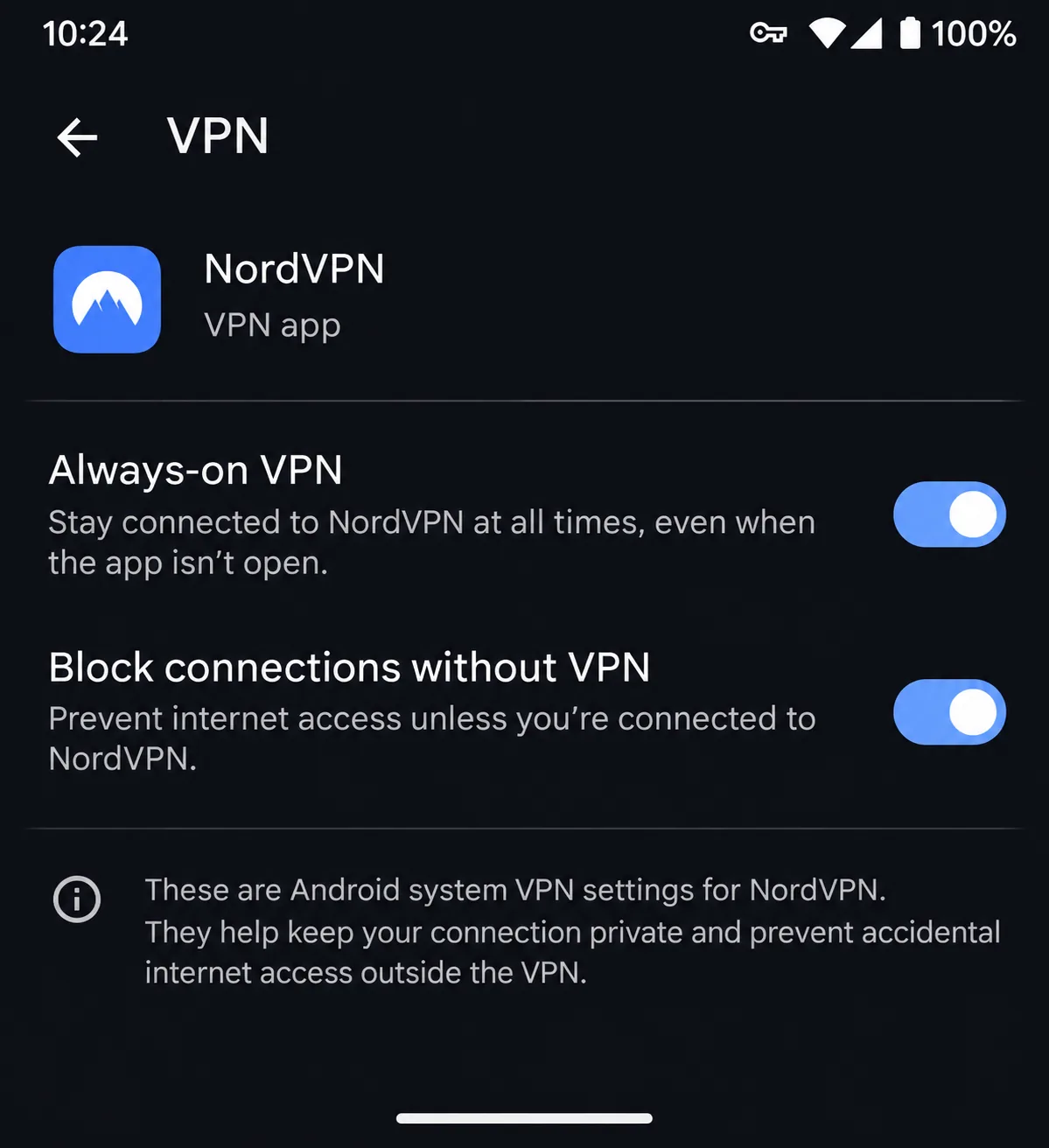
Then open settings before connecting. Turn on the kill switch, and on Android enable the operating system's always-on and block-connections-without-VPN options if the app points you there. Choose the restricted-network protocol: NordWhisper for NordVPN, an obfuscated OpenVPN server for Surfshark, Stealth for Proton VPN, or Shadowsocks on PIA desktop. Switch on auto-connect for untrusted networks, which Surfshark and PIA both make easy.
Choose a server and check the connection
Pick a nearby country first, such as Singapore or Thailand, since both are listed by NordVPN and Proton VPN. Free Proton servers are assigned at random, so you take what you get. Connect, then confirm the protection is working before you rely on it.
Open a site that shows your public IP address and check that it differs from your real one and matches the country you chose. Run a DNS leak test from the same page, then toggle the kill switch on and off once to see how the app reacts. Surfshark's inactive state is easy to miss, so this check matters most there.
What to do if the VPN is blocked or cannot connect
Change one variable at a time. First switch protocol to the restricted-network option, then change the server country, then try TCP instead of UDP where the app offers it. NordVPN's order is NordWhisper, then Obfuscated with Auto or NordWhisper, then OpenVPN TCP, then the manual guides. Surfshark notes that TCP can trade speed for stability.
If nothing connects, try a second VPN. This is why we like keeping the Proton VPN app installed as a backup on its free plan, which includes Stealth. Also expect that a working setup can stop working after a network change. Freedom House recorded VPN blocking in 2024, and nothing guarantees the same server stays reachable next week.
Are VPNs legal in Myanmar?
The honest answer is that the law is unclear for individual users, and enforcement has been uneven. The cybersecurity law was enacted on January 1, 2025, and legal analysis from Tilleke & Gibbins on the law taking effect identifies July 30, 2025 as the commencement date under Notification 113/2025. Early news coverage described January commencement, so you may see conflicting dates.
The law requires permission to establish or provide VPN services. Tilleke & Gibbins and Human Rights Myanmar's analysis of the cybersecurity law both distinguish providing or establishing VPN services from individual use. What counts as establishing a VPN and how the law will be enforced remain uncertain.
That legal reading does not settle what happens on the street. The Associated Press reported in January 2025 fines and detention after phone inspections found VPN apps. We could not establish a full record of later amendments, implementing rules, or local enforcement through November 2026. We are not lawyers, and this is not legal advice. If your situation carries real risk, get local advice and read current reporting from rights groups.
Do you need a Myanmar IP address?
Most people do not. If you want to reach blocked sites, a server in Singapore or Thailand does the job. You connect from Myanmar to an overseas server. A Myanmar IP address serves a different purpose: it makes websites think you are inside the country. That only matters if you are abroad and need a service that checks for a Myanmar location, such as a local banking or government site.
ExpressVPN is the only one of our five with an officially documented Myanmar virtual location. Its support page states the Myanmar virtual location uses hardware in Singapore, so the IP address registers as Myanmar while the traffic leaves from Singapore. PIA similarly runs some virtual locations on hardware elsewhere, with India via Singapore as its example. We could not confirm a Myanmar IP for the other providers, but that does not prove they lack one, so check each app's location list directly.
A virtual location carries a trade-off: the IP address and the physical route point to different places. Some services may notice the mismatch. Do not choose a Myanmar IP for privacy. It is a convenience feature for reaching location-checked services from abroad.
Can you use a free VPN in Myanmar?
You can, but free VPNs are the riskiest option for this country. Associated Press reporting noted that many free VPN connections failed during the earlier crackdown, and free services are the ones most likely to be blocked, throttled, or funded by selling your data.
Proton VPN's free plan is the exception worth naming. It has no data cap or artificial speed limit, no ads, and no activity logs, and it includes Stealth. Its limits are one device at a time and randomly selected server countries. We would use it as a backup or a trial, not as a primary connection that you depend on every day.
Free-plan limits and privacy trade-offs
Free plans usually restrict one or more of these: data volume, speed, server choice, number of devices, and support. Without country selection you cannot choose a nearby server, and without paid features such as streaming support you may not get the content you want. The bigger concern is the business model. A service that charges nothing has to pay for servers some other way, which can mean ads, tracking, or sold data.
Because a VPN operator can see what your ISP would otherwise see, you are moving trust, not removing it. That trust is unearned when you cannot verify the policy and there is no independent audit. If you are comparing free apps, treat a missing audit as a reason to skip an app.
Warning signs when choosing a VPN
Be wary of any provider that shows the following:
- Claims of "100% anonymity" or "unblockable" access, since the EFF notes no VPN guarantees either
- No named company, no jurisdiction, and no published privacy policy
- No independent audit, or an audit with no date or scope
- Unlimited free service with no stated way of paying for servers
- Apps from unofficial stores or links sent through chat groups, which can carry malware
- Aggressive review language and fake-looking five-star reviews
A paid plan with a 30-day money-back guarantee costs little to try. All five of our picks advertise one, and the cheap introductory monthly equivalents range from $2.03 to $3.49.
Myanmar VPN FAQs
Which server locations should I consider?
Can a VPN access Facebook in Myanmar?
Which VPN is fastest on my connection?
Can I use the same VPN on Android, iPhone, and a computer?
Should I keep a backup VPN installed?
Final thoughts
No VPN here can promise access from inside Myanmar. Install the app early, learn the protocol fallback order, and keep a second VPN as a spare. Pay with the money-back window in mind, test on your own network, and read current legal reporting before you carry a VPN app on your phone.