
7 Best Duplicate File Finders for Windows in 2026 (Free & Paid)

If duplicate files have quietly filled your drives and slowed your file searches, the fastest fix is a dedicated duplicate file finder. Years of downloads, copied photo folders, and synced backups leave most Windows PCs carrying gigabytes of redundant files you will never open, and two files with different names can hold identical content. A good tool scans your folders, groups exact and similar files, and lets you delete the extras safely. We tested 7 tools for speed, accuracy, and safety to find the best options for Windows in 2026.
Table of Contents
- The 7 Best Duplicate File Finders for Windows
- The 7 Best Duplicate File Finders at a Glance
- Why We Trust These Picks (How We Tested)
- How to Choose a Duplicate File Finder
- How to Find and Remove Duplicate Files Safely (Step by Step)
- Frequently Asked Questions
- Final Verdict: The Best Duplicate File Finder
The 7 Best Duplicate File Finders for Windows
1. Wise Duplicate Finder
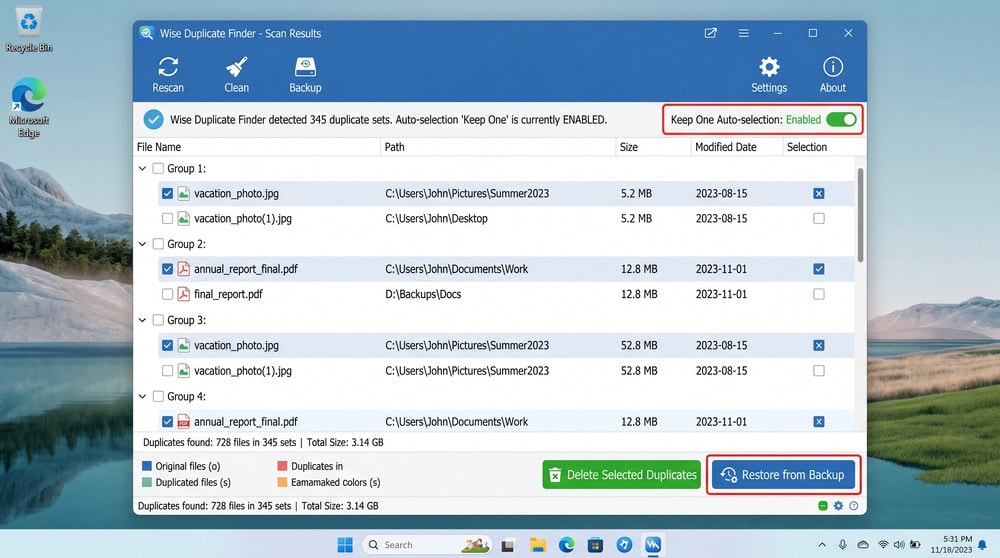
Wise Duplicate Finder is a lightweight, Windows-only tool for a simple scan. It compares files by name, size, or content, finds empty zero-byte files, and offers a "Keep One" auto-selection plus restore from backup. The current build is version 2.1.9, and the free download is under 10 MB. Pro runs around $20 per year for up to three PCs and carries a 60-Day money-back guarantee.
Pros & Cons
Pros
- Simple, lightweight interface
- "Keep One" auto-selection and backup restore
Cons
- No fuzzy or visual similarity detection
- Windows only
2. Auslogics Duplicate File Finder
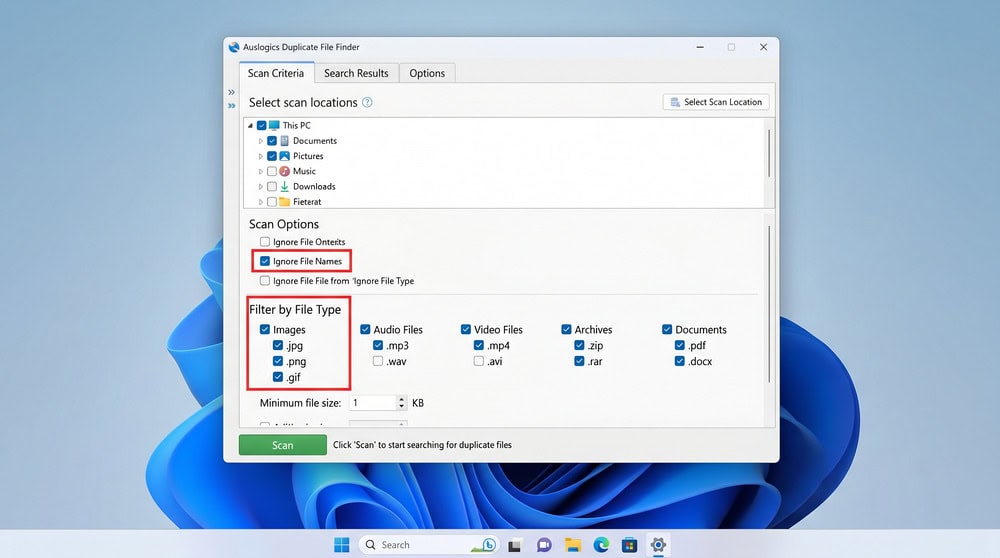
Auslogics Duplicate File Finder is the most thorough content-based scanner among the Windows-only tools we tested. It uses MD5 checksums and byte-by-byte verification to remove duplicates even when names differ, with an "Ignore File Names" option and EXIF/ID3 tag matching. It officially supports Windows 11 along with Windows 7 through 10, deletes to the recycle bin or a backup, and includes a rescue center. Pro lists at $29.95 per year for three PCs, often discounted.
Pros & Cons
Pros
- MD5 plus byte-by-byte content matching
- "Ignore File Names" catches renamed copies
Cons
- Windows only
- No visual or fuzzy photo similarity
3. dupeGuru
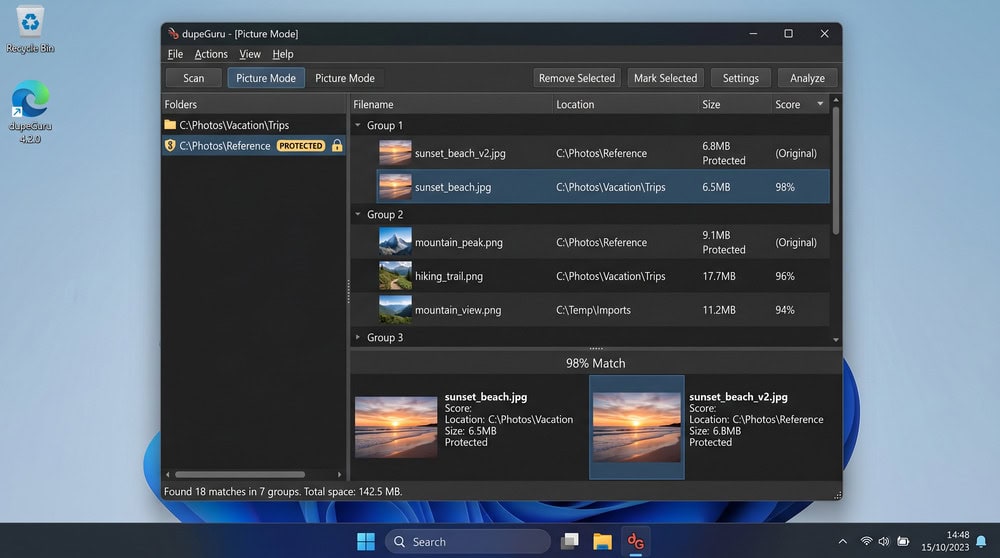
dupeGuru is the standout free pick and the most capable similar-file detector here. It is free and open-source with no paid tier, and runs on Windows, macOS 10.12 and later, and Linux. It ships three scan modes: a standard mode with fuzzy name matching, a duplicate photo cleaner for visually similar images, and a music mode that scans tags. Reference directories and grouping safeguards help you avoid deleting the wrong copy. Being 100% free, it offers similar-file detection that usually costs money.
Pros & Cons
Pros
- Free and open-source, no paid tier
- Fuzzy name plus visual image matching
Cons
- Plainer, less polished interface
- Duplicate photo finder can be slow on huge libraries
4. CCleaner
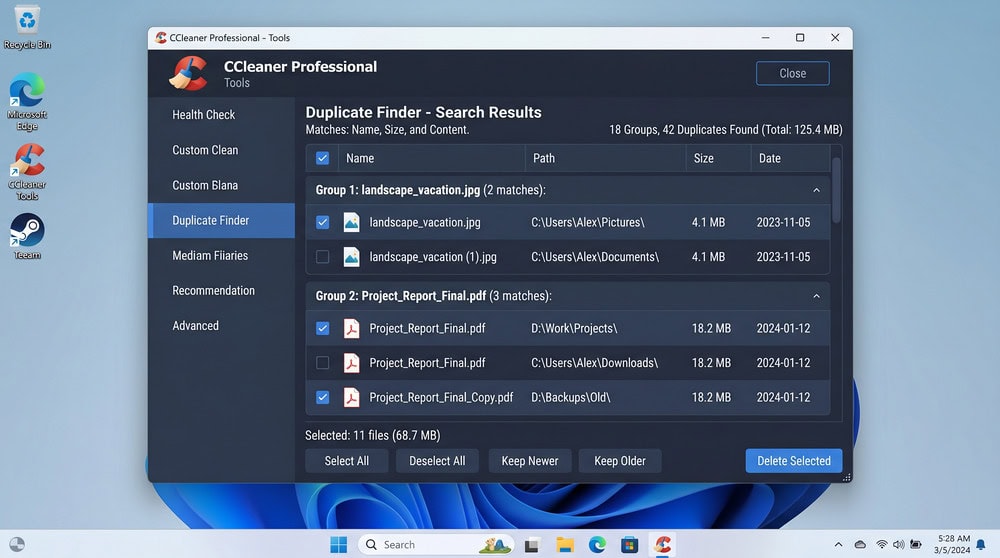
CCleaner bundles its Duplicate Finder inside the same app that handles junk and temp file cleanup. It matches by name, size, modified date, and content in the free version, detecting exact, criteria-based duplicates rather than visually similar files. CCleaner Professional pricing varies by source, landing around $30 to $45 per year and frequently discounted.
Pros & Cons
Pros
- Duplicate Finder included in the free version
- Flexible matching by name, size, date, and content
Cons
- No similar or visual photo detection
- Pro pricing is inconsistent across sources
5. Nektony Duplicate File Finder
Nektony Duplicate File Finder is the one Mac-only tool we include, since many cleanup searches span both platforms. It is not available for Windows, so skip it if you are PC-only. On macOS it finds exact duplicates by size and binary content, and adds Similar Photos detection with five strictness levels plus Similar Audio matching. It also merges duplicate folders and scans iCloud, OneDrive, Dropbox, and Google Drive. A free version is on the Mac App Store. Listings put Pro around $34.99 one-time or $14.95 per year, which we could not confirm officially. Mac users should also read our MacPaw Gemini 2 review.
Pros & Cons
Pros
- Similar Photos detection with five strictness levels
- Cloud-storage scanning across major services
Cons
- Mac only, no Windows version
- Pro pricing not confirmed on the official store
6. Easy Duplicate Finder
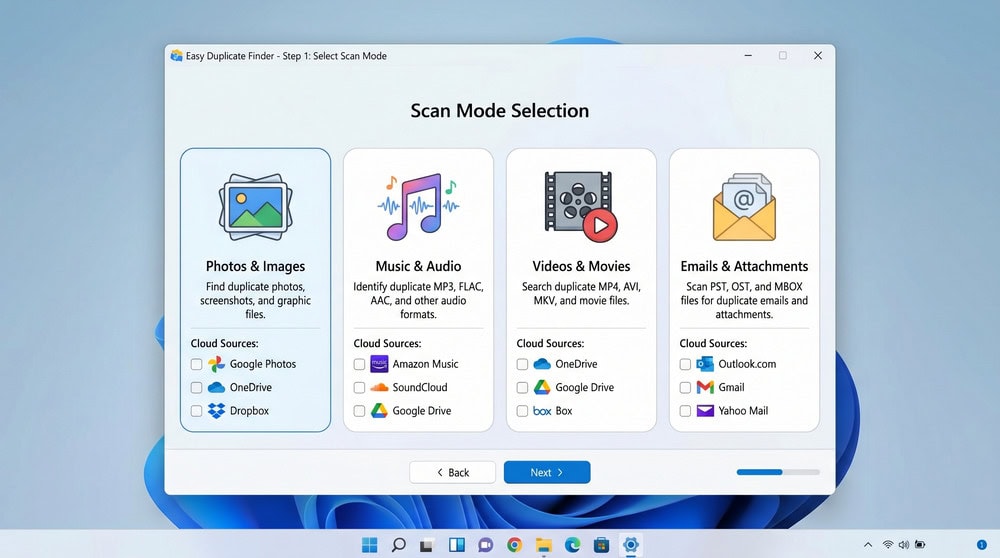
Easy Duplicate Finder leans on breadth, with more than ten scan modes and a guided wizard. It targets photos, MP3s, videos, and email, scans Google Drive, Dropbox, and OneDrive, and includes an Undo button. It runs on Windows from XP through Windows 11 and on Mac. One caveat: it is a free trial, not a permanently free tool, and its matching claims to go beyond names and extensions without confirming a true visual-similarity algorithm, so treat it as content-aware. Pro lists at $59.95, often discounted to around $39.95.
Pros & Cons
Pros
- More than ten scan modes plus email scanning
- Cloud and media-library support
Cons
- Free trial only, not a free version
- Similarity matching is unconfirmed
7. MindGems Duplicate File Finder
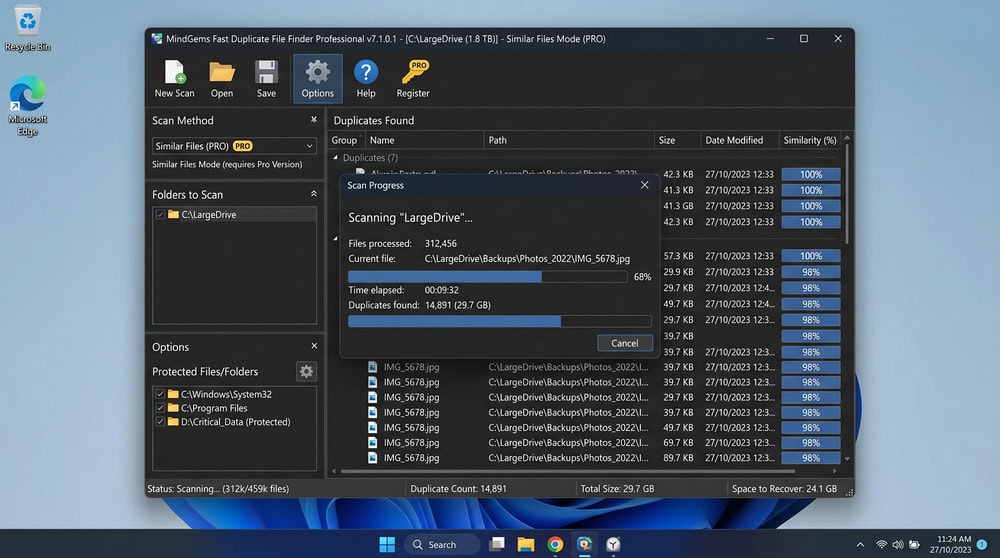
MindGems Fast Duplicate File Finder is built for speed on large drives, using fast binary comparison to confirm exact duplicates quickly. The free version does exact binary matching, while Pro adds a Similar Files mode, a Similar File Names mode, command-line automation, and a protected-files list. It supports Windows 11, 10, 8.1, 8, and 7, plus Windows Server 2008 and later. Similar (fuzzy) detection is Pro-only. Pro is cited around $39.95 one-time for one PC, which we could not confirm on the About page.
Pros & Cons
Pros
- Very fast binary comparison on large drives
- Pro adds Similar Files and automation
Cons
- Similar detection locked behind Pro
- Windows only
The 7 Best Duplicate File Finders at a Glance
| Tool | Platform | Free vs Paid / Price | Similar/fuzzy detection | Best for |
|---|---|---|---|---|
| Auslogics Duplicate File Finder | Windows | Free + Pro (~$29.95/yr) | Partial (MD5/byte, ignore names) | Thorough content-based dedup |
| Wise Duplicate Finder | Windows | Free + Pro (~$20/yr) | No (name/size/content) | Simple free Windows dedup |
| CCleaner | Windows, Mac | Free + Pro (~$30–$45/yr) | No (exact/criteria match) | All-in-one cleaning plus dedup |
| dupeGuru | Windows, Mac, Linux | 100% free, open-source | Yes (fuzzy name + visual image) | Free fuzzy photo matching |
| Nektony Duplicate File Finder | Mac only | Free + Pro (~$34.99) | Yes (similar photos + audio) | Mac similar-photo cleanup |
| Easy Duplicate Finder | Windows, Mac | Free trial + Pro ($59.95, often $39.95) | Content-aware | Many scan modes, cloud and email |
| MindGems Fast Duplicate File Finder | Windows | Free + Pro (~$39.95 one-time) | Yes, Pro only | Power users with large drives |
Why We Trust These Picks (How We Tested)
Every tool below earned its place on results, not marketing claims. We favored content-based detection over name matching, and weighted safety heavily. Prices reflect listed figures at the time of writing and shift with discounts.
How to Choose a Duplicate File Finder
Start with platform: on Windows, every tool here except Nektony works, while dupeGuru and Easy Duplicate Finder also run on Mac. Next, decide whether you need similar-file detection or just exact copies. For downloads, documents, and synced backups, an exact-match tool like Wise or CCleaner is enough; for years of nearly identical photos, choose fuzzy or visual matching, such as dupeGuru or MindGems Pro. The free options are genuinely capable, so weigh price against features, and prioritize safety: recycle-bin support, backups, and a protected-files list.
Exact vs. Similar (Fuzzy) Duplicates and Safe-to-Delete Files
An exact duplicate is a byte-for-byte copy of another file, even if the two have different names. Content-based tools confirm these with checksums, so they are safe to remove once you keep one copy. Similar or fuzzy duplicates are not identical: two photos from the same burst, or a slightly edited document. Only tools with fuzzy or visual matching flag these, and they need more care, since the "duplicate" may be a version you want to keep. Some files are not copies but pointers, such as symbolic links, which let one file appear in two places. Deleting a link target can break programs that rely on it, so a good finder protects system directories.
How to Find and Remove Duplicate Files Safely (Step by Step)
Using a Duplicate File Finder
The safest workflow is the same across every tool here. First, back up the folders you plan to scan, or confirm your tool deletes to the recycle bin. Second, choose the folders and exclude Windows and Program Files. Third, pick your match type: exact content for documents, or fuzzy and visual matching for photos. Fourth, run the scan and review the grouped results rather than trusting auto-selection blindly. Finally, use a "keep one" rule so every set keeps a copy, delete the rest, and confirm your programs still open before emptying the recycle bin.
Using Built-in Windows Tools (File Explorer / Storage Sense)
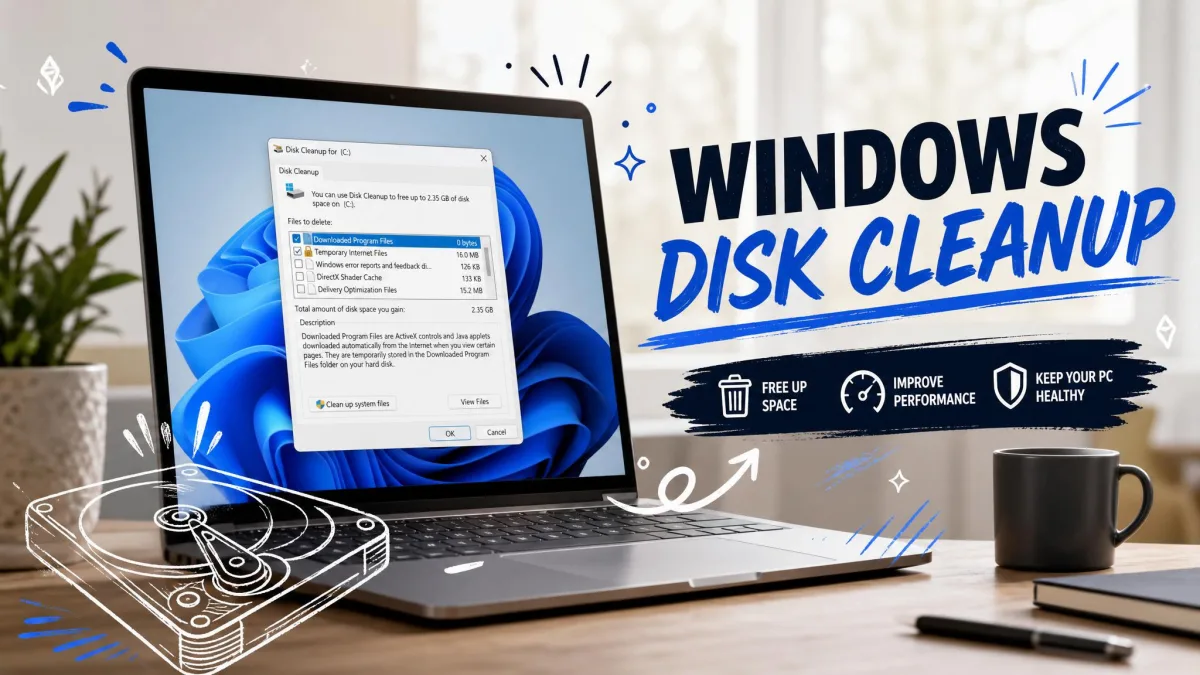
Windows 10 and 11 have no dedicated built-in duplicate file finder. Storage Sense and Disk Cleanup remove temporary files, recycle-bin contents, and unused system data, but they do not detect duplicate user files like photos or documents. To sort candidates by hand, open File Explorer → the target folder, then switch to Details view and sort by Name or Size to spot repeats. To free up system space, go to Settings → System → Storage and turn on Storage Sense, which clears junk but leaves duplicates untouched. Advanced users can hash files with a PowerShell script for exact matching, but a dedicated finder is faster and safer.
Frequently Asked Questions
Does Windows have a built-in duplicate file finder?
No. Windows 10 and 11 do not include one. Storage Sense and Disk Cleanup remove temporary and system junk files, but they do not detect duplicate user files such as photos or documents, so you need a third-party tool.
Is it safe to delete duplicate files?
Yes, if you keep one copy of each set and avoid system and program folders. Use a tool that deletes to the recycle bin or creates a backup, exclude Windows and Program Files, and review results before confirming.
What is the fastest way to find duplicate files on Windows?
A dedicated duplicate file finder is fastest. Tools like MindGems use fast binary comparison to scan large drives quickly, and content-based tools like Auslogics catch renamed copies that manual sorting would miss.
What's the difference between free and paid duplicate file finders?
Free tools usually handle exact, content-based matching well, and dupeGuru even adds fuzzy and visual photo detection at no cost. Paid tiers typically add similar-file detection, automation, cloud and email scanning, and support.
Can duplicate finders detect similar photos or files with different names?
Some can. Tools with fuzzy or visual matching, such as dupeGuru and MindGems Pro, find similar photos and renamed copies. Content-based tools like Auslogics catch identical files with different names, while CCleaner and Wise focus on byte-level copies.
Will removing duplicates speed up my PC?
It frees up disk space and can make file searches and backups faster, especially on a nearly full drive. It will not directly boost processor or memory performance, but reclaiming space often makes file work feel quicker.
Final Verdict: The Best Duplicate File Finder
After testing all seven, dupeGuru is the best duplicate file finder for most Windows users, pairing true fuzzy and visual matching with a price of zero across Windows, Mac, and Linux. For the most thorough content-based detection, Auslogics Duplicate File Finder is our paid pick, especially for renamed copies. CCleaner suits anyone who wants dedup bundled with everyday cleanup, while MindGems is the speed choice for large drives. Whichever you choose, back up first, keep one copy of every set, and delete to the recycle bin.

 Best Disk Cleaner Software
 Best Computer Cleaner
 MacPaw Gemini 2 Review
 How to Free Up Disk Space
 Best Mac Cleaner Software
 Best Free Computer Cleaner
 CleanMyMac Review
 Windows Disk Cleanup