
5 Best Android GPS Trackers for 2026 (Tested & Compared)
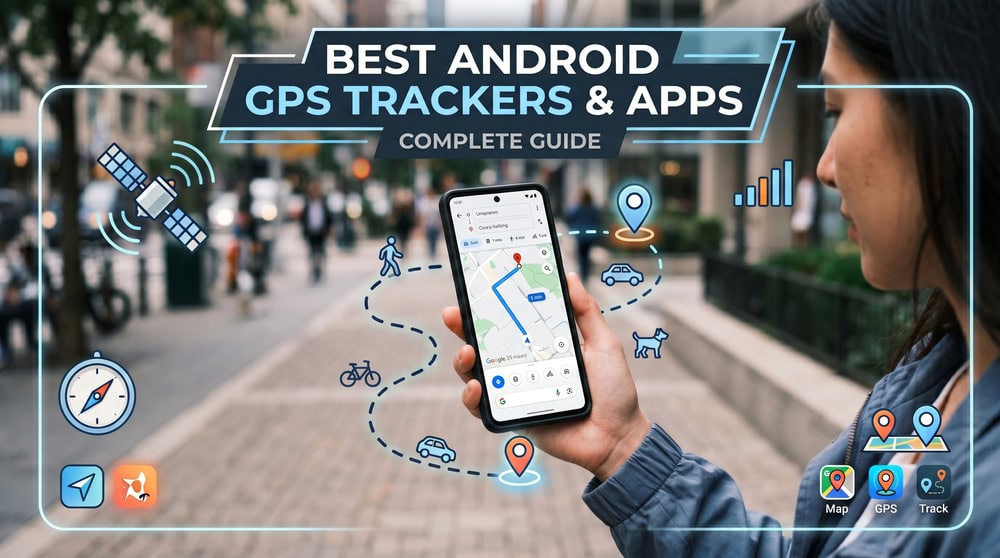
Over the past several weeks our team carried these trackers through airports, parks, parking garages, and daily commutes to see which ones held a signal when it mattered. We clipped tags to keychains, slid one into a car, and handed phones to family members to watch the updates roll in. Some held a lock without a hiccup; a couple drifted the moment we stepped indoors. If you want to track your phone, your car, or your loved ones on Android, here is how we tested these picks and which one fits your needs.
The Best Android GPS Trackers & Apps Reviewed
Here are the five we kept, each matched to the job it does best.
1. Samsung Galaxy SmartTag2 - Best Overall
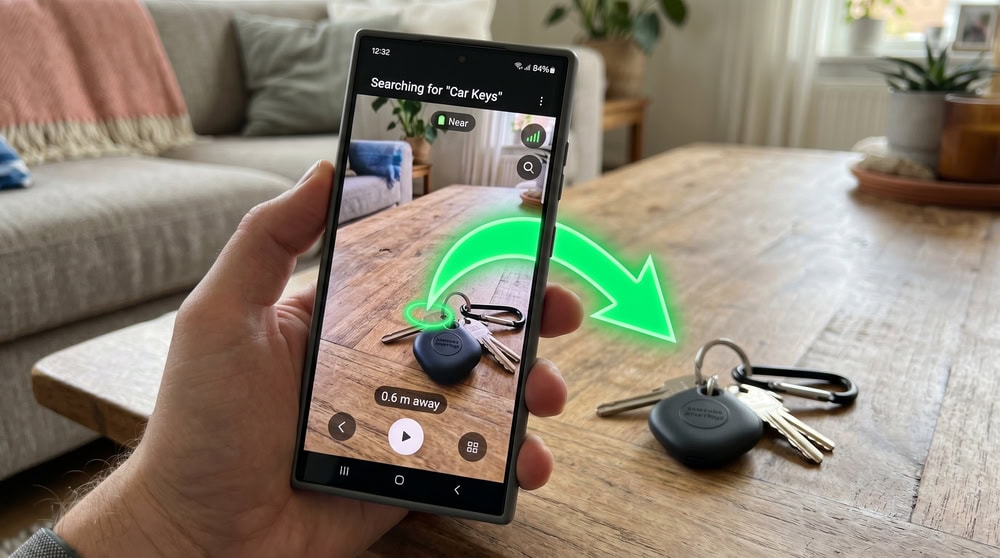
The Samsung Galaxy SmartTag2 was the most dependable tag in our testing for Samsung owners. It pairs Bluetooth with UWB (ultra-wideband) precision finding, so an AR view points you to a misplaced bag in the last few feet, and it is IP67 rated on a replaceable CR2032 battery.
Pricing: Around $30 device, no subscription.
Battery life is the headline: Samsung rates it at up to 700 days in power-saving mode and about 500 days in normal mode. The catch is that it works only with Samsung Galaxy phones despite the Android 11 minimum on the listing.
Pros
- Outstanding battery life, rated up to 700 days
- UWB precision finding guides you the last few feet
- IP67 rating; no subscription; replaceable battery
Cons
- Works only with Samsung Galaxy phones
- No real-time tracking; last-seen location only
- Limited geofencing versus app-based picks
2. Life360 - Best for Families & Kids
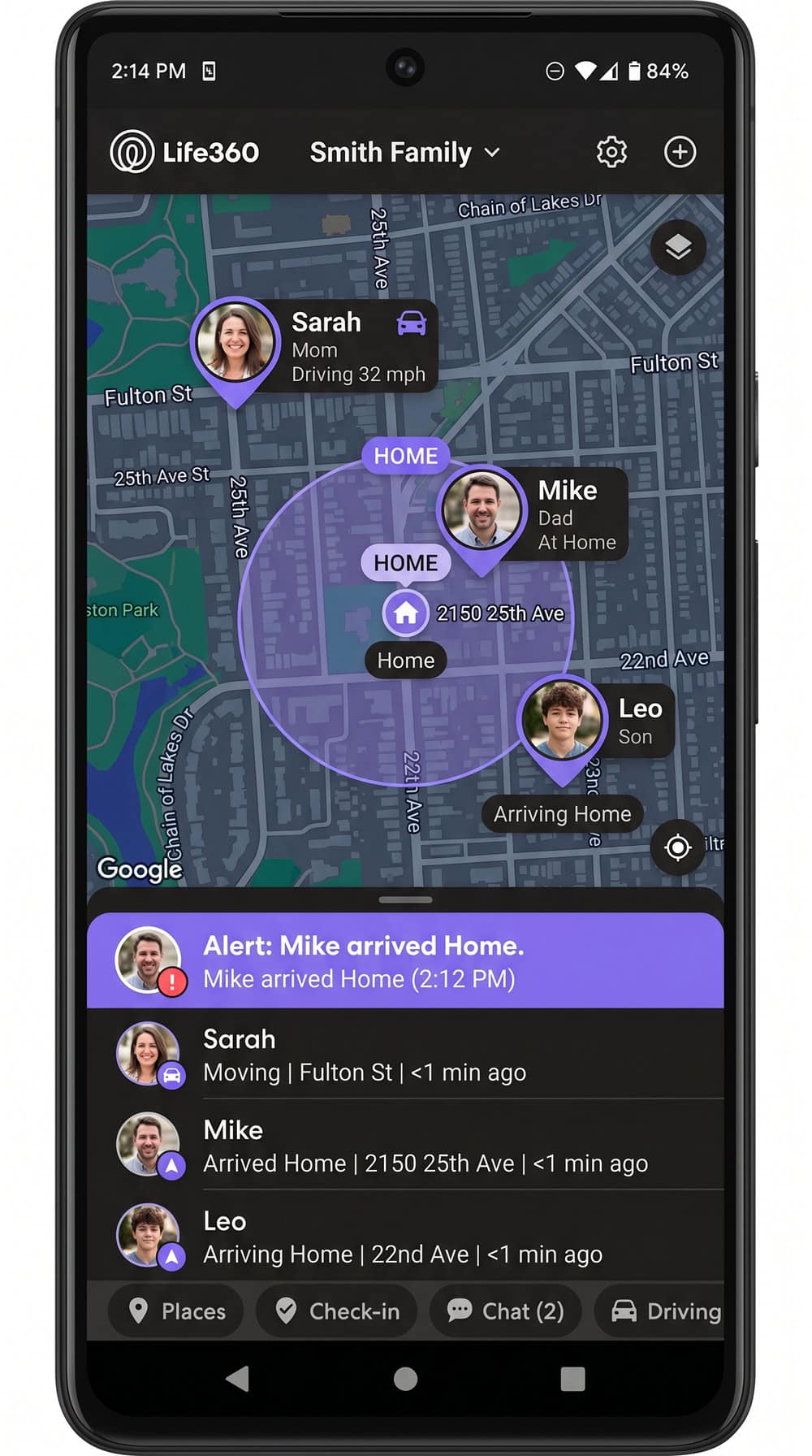
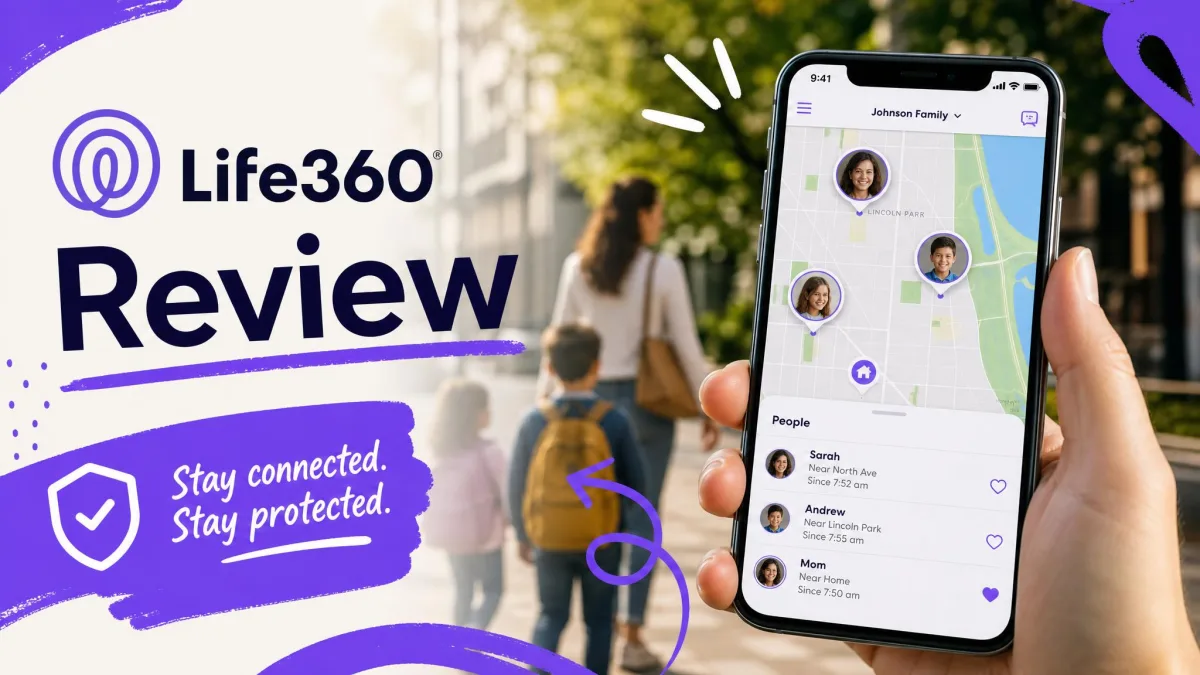
Life360 was the pick our testers reached for to keep tabs on loved ones, because it does live location sharing better than any tag can. It shows real-time family location on a shared map, supports unlimited Circles, and fires place and geofence alerts, plus crash detection, SOS, and driver reports.
Pricing: Free tier; Gold $14.99/month or $99.99/year; Platinum $199.99/year.
The free tier is usable, with two days of location history, two place alerts, crash detection, and SOS. Gold adds a longer history window and more alerts (confirm the exact day count on Life360's plan page), and Gold and Platinum bundle a free Tile tracker. A Silver tier sits in between, but its annual price varies by source, so check it in the app.
Pros
- True real-time location sharing for the whole family
- Usable free tier with crash detection and SOS
- Geofence and place alerts that fired reliably
- Bundles a free Tile tracker on paid tiers
Cons
- Best features sit behind paid tiers
- Depends on the tracked phone being on and connected
- Some find constant location sharing intrusive
3. Chipolo One Point - Best AirTag Alternative (Find Hub / Bluetooth)
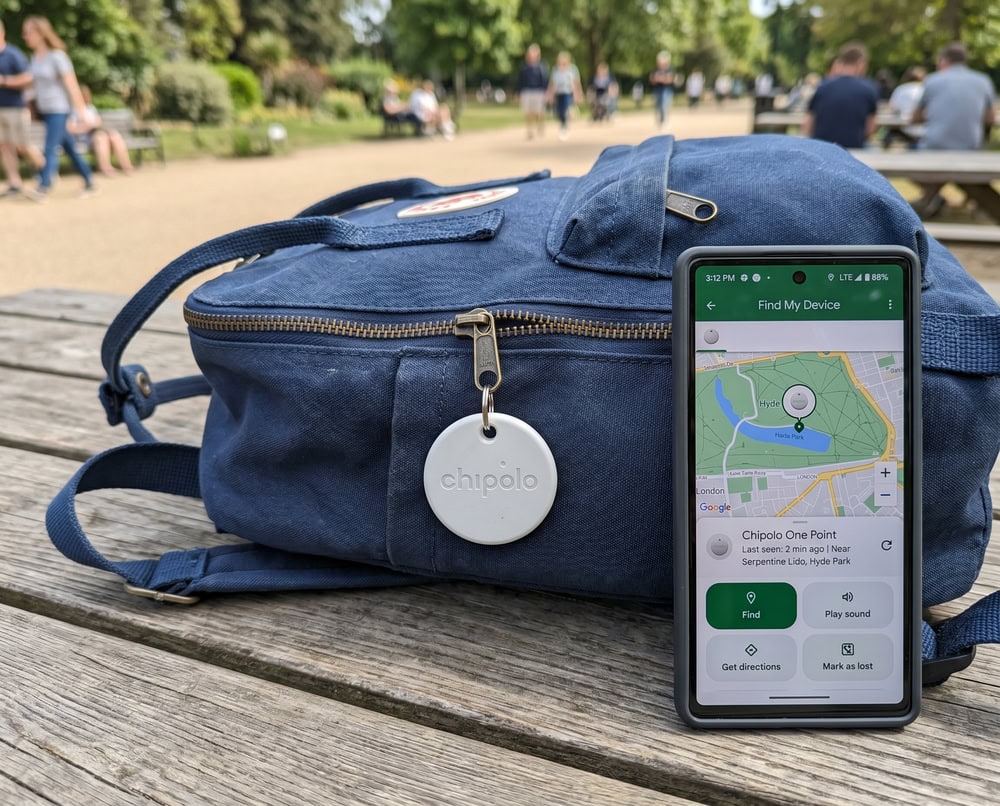
For a non-Samsung Android phone that needs a tag working across the whole ecosystem, the Chipolo One Point is our pick. It joins the Google Find My Device and Find Hub network, so any of those 1 billion Android devices can relay its location, and it adds two-way finding plus IPX5 resistance.
Pricing: $28 for one, or $79 for a four-pack.
Battery life is up to 1 year on a replaceable CR2032, which matched our experience. The finder ring is rated up to 120 dB, though that vendor figure felt quieter in the open; for a wallet, the Chipolo CARD Point runs a 2-year battery. Like every tag, it reports a last-seen location, not a live dot.
Pros
- Works across all Android via Google Find Hub
- Up to a year of battery on a replaceable cell
- Loud ring and two-way finding
- Cheaper in the four-pack at $79
Cons
- Last-seen location only, no live tracking
- No built-in geofencing
- Does not work with Apple's Find My network
4. Tracki Pro - Best for Vehicles / Real-Time Cellular GPS
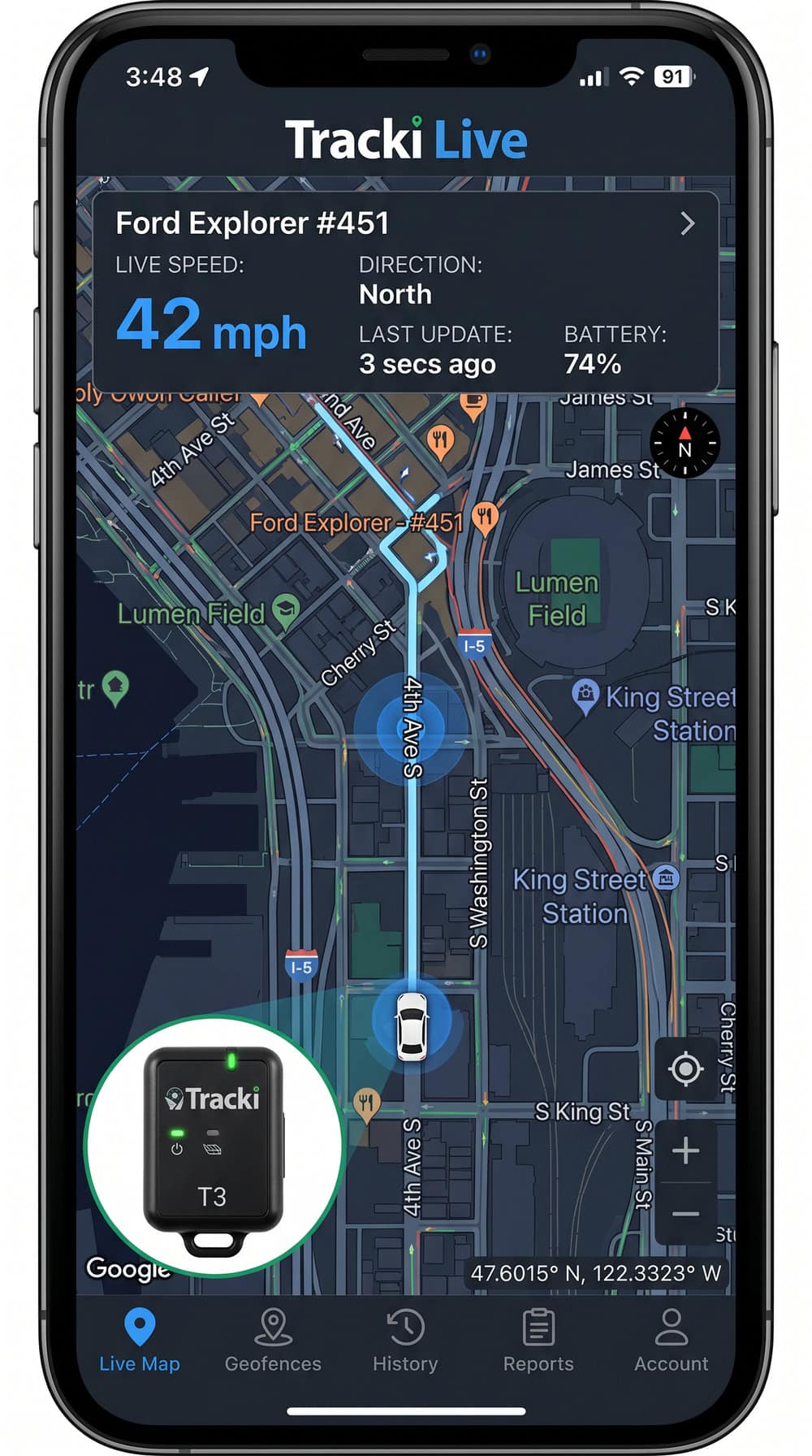
When we needed to watch a vehicle move in real time, the Tracki Pro delivered. It uses 4G LTE cellular with a built-in SIM and 3G/2G fallback to track worldwide, and the app shows live location, geofence and speed alerts, history, and SOS, with magnetic mounts for cars.
Pricing: Device around $35.86 plus a subscription from $19.95/month, dropping to about $9.95/month annually.
Real-time updates run as fast as every 15 seconds, depending on your plan. Battery life is the trade-off: Tracki quotes 2–12 months, but expect only a few days in fast real-time mode versus months in battery-save mode, so always state the mode.
Pros
- True real-time GPS over 4G LTE, worldwide
- Geofence, speed, and SOS alerts
- Affordable device price up front
- Magnetic, waterproof mounting for vehicles
Cons
- Subscription required, from $19.95/month
- Battery lasts only days in fast real-time mode
- More setup than a simple tag
5. Google Find Hub - Best Budget / Free Option
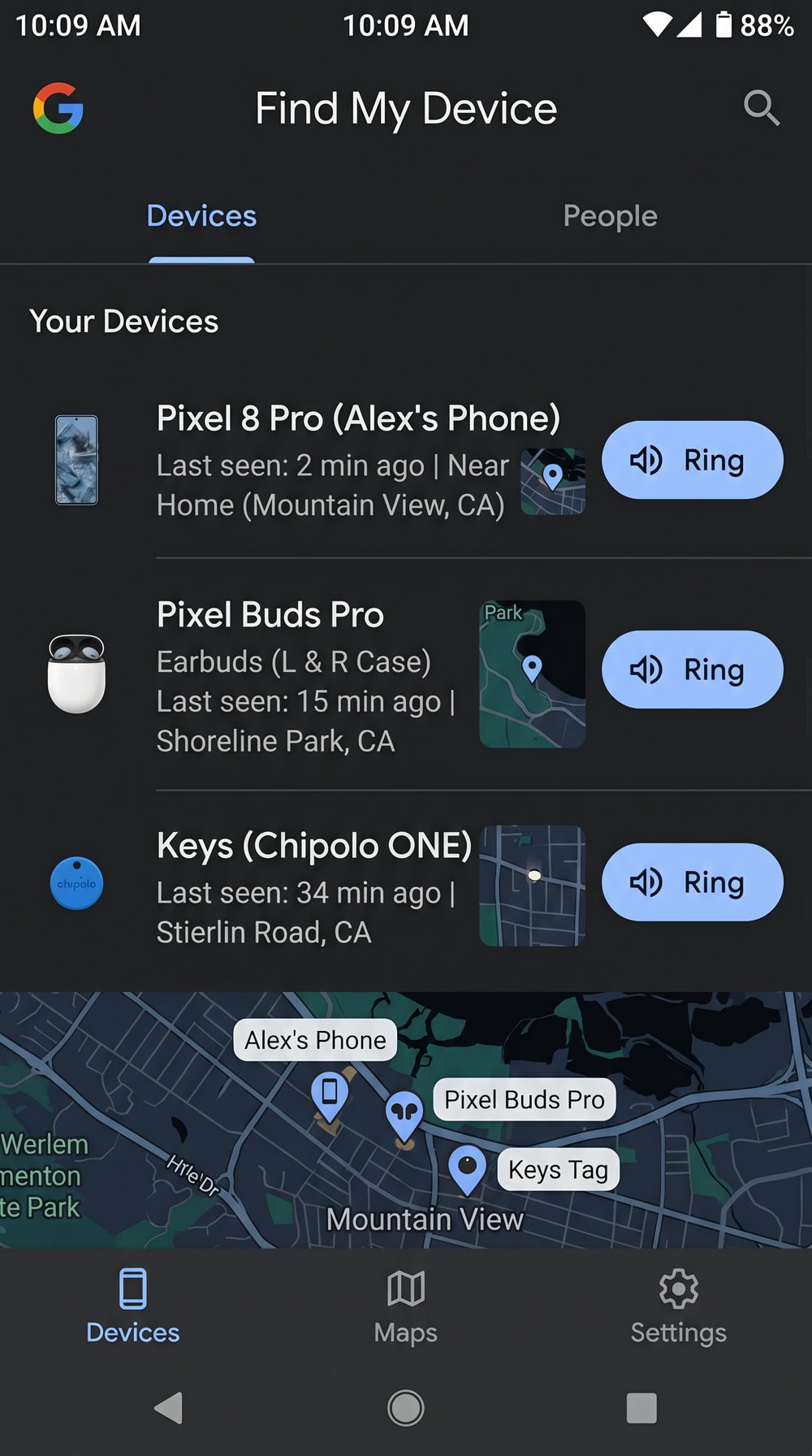
You may already own the best free tracker on Android. Google Find Hub, formerly Find My Device, is built into Android with no subscription and was rebranded to Find Hub in 2025. It locates, rings, locks, and erases lost phones, tablets, watches, and earbuds, and its expanded offline Bluetooth network launched in April 2024.
Pricing: Free, built into Android.
The network is the real story, drawing on over 1 billion Android devices to surface a last-seen location fast. It needs Android 6 (Marshmallow) or higher and pairs with Fast Pair tags from Chipolo, Pebblebee, and Motorola. It does not do live tracking, but as a free safety net for your own devices, nothing beats it.
Pros
- Completely free and built into Android
- Huge offline network of over 1 billion devices
- Works with third-party Fast Pair tags
- End-to-end encryption; powered-off finding on some Pixels
Cons
- No live real-time tracking
- Limited geofencing and alerts
- Best for your own devices, not vehicles or people
The 5 Best Android GPS Trackers at a Glance
| App / Tracker | Best for | Price | Real-time tracking | Geofencing / alerts | Battery or update | Android compatibility |
|---|---|---|---|---|---|---|
| Samsung Galaxy SmartTag2 | Samsung owners / overall | $30 device, no sub | No (last-seen) | Limited | Up to 700 days | Android 11+ (Samsung only) |
| Life360 | Families & kids | Free; Gold $14.99/mo | Yes (live) | Yes | Phone battery | Android 6+, wide |
| Chipolo One Point | AirTag alternative (any Android) | $28 / $79 four-pack | No (last-seen) | No | Up to 1 year | Android (Find My Device) |
| Tracki Pro | Vehicles / real-time GPS | ~$35 + $19.95/mo | Yes (as fast as 15 sec) | Yes | 2–12 months (mode-dependent) | Android + iOS app |
| Google Find Hub | Free / budget | Free | No (last-seen) | Limited | Phone battery | Android 6+ |
How We Tested (and How We Picked)
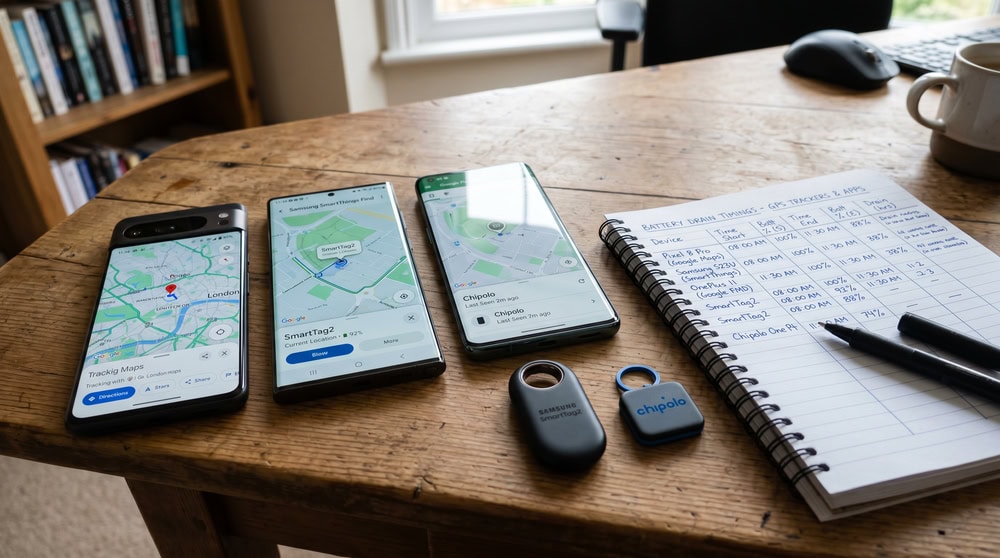
We narrowed a longer shortlist to five by living with each one. For the Bluetooth tags, we attached them to keys and bags, walked them out of range, and timed how long the network took to report a last-seen location. For the app and cellular picks, we shared location across several phones and watched the live map for drift and battery cost.
We weighted four things: real-time accuracy first, because a tracker that reports the wrong corner is useless; then battery life; then app quality; and finally price and subscription cost. Privacy and consent mattered too, which we cover near the end.
What to Look For in an Android GPS Tracker
Some trackers are tiny Bluetooth tags for keys; others are full cellular units that follow a car across the country. Here is how to match the type to your need.
GPS vs Bluetooth (Find Hub) vs Cellular Tracking
Bluetooth tags have no real GPS; they lean on a network of nearby phones to report a last-seen spot, and Google's network spans over 1 billion Android devices (see the Google Find Hub page). Cellular trackers carry their own SIM and stream real-time location over 4G LTE for a monthly fee, while tracking apps for Android like Life360 use the phone's GPS and data. The Android location services docs explain how the phone fuses GPS, Wi-Fi, and cell signals.
Battery Life & Connectivity
A Bluetooth tag runs a year or more on a coin cell, while a cellular unit may last months in battery-save mode but only days when it reports every few seconds. Tags also need other phones nearby, so they shine in cities and struggle in rural areas, whereas cellular trackers go almost anywhere with a tower.
Android Compatibility & App Quality
Compatibility is not a given. The Samsung Galaxy SmartTag2 needs Android 11 or later and works only with Samsung Galaxy phones, while a universal tag taps Google's Find Hub across Android 6 and up (browse the Google Play Store). App quality also matters, so we looked for clean live maps and reliable geofence alerts.
Privacy, Legality & Subscription Costs
Sharing location should be consensual, and we cover the legal side below. Tags are usually a one-time purchase, while cellular trackers and the best family-app features carry recurring fees, so factor in the ongoing cost.
Common Mistakes to Avoid When Choosing a Tracker
The most common mistake is buying a Bluetooth tag when you need live tracking. A tag shows where something was last seen near another phone; it cannot follow a moving car across an empty highway, so a live dot needs a cellular tracker and its subscription.
The second mistake is ignoring network compatibility, since a SmartTag2 is excellent on a Samsung phone and nearly useless on a Pixel. The third is forgetting the recurring cost: a cheap cellular device can cost more over a year than a pricier tag with no fees, so add up twelve months before you buy.
Is It Legal to Track Someone with an Android GPS Tracker?
Tracking your own phone, car, or child is generally fine. Tracking another adult without their knowledge is a different matter, and in many places it is illegal. Family apps like Life360 are built around mutual, visible location sharing for exactly this reason.
Frequently Asked Questions
How do Android GPS trackers work?
App-based trackers use your phone's GPS and data to report a live location. Cellular trackers carry their own SIM and stream real-time location over 4G LTE. Bluetooth tags have no GPS at all; they rely on a network of nearby phones to report a last-seen location.
Can a GPS tracker work without internet?
A cellular tracker works anywhere it has a mobile signal, even with no Wi-Fi. Bluetooth tags can report through Google's offline network when another Android phone passes nearby. App-based tracking needs the tracked phone to have a data connection to update.
How accurate are Android GPS trackers?
Live GPS and cellular trackers are accurate to roughly a few meters in open areas, dropping indoors or among tall buildings. Bluetooth tags show a last-seen point rather than a continuous track, so precision depends on how recently another phone passed the tag.
How much does a GPS tracker app cost?
From free to a few hundred dollars a year. Google Find Hub is free, and Life360 has a free tier with paid plans from $14.99/month or $99.99/year. Cellular trackers add hardware plus a subscription, often from $19.95/month, dropping to around $9.95/month annually.
Can I track an Android phone for free?
Yes. Google Find Hub is built into Android at no cost and can locate, ring, lock, or erase any of your signed-in devices. Life360's free tier also lets family members share live location without paying. Our guide on how to track a phone walks through the setup.
GPS tracker vs Bluetooth tracker
Choose a cellular GPS tracker to follow something live over long distances, such as a vehicle, and accept the subscription. Choose a Bluetooth tag like the SmartTag2 or Chipolo One Point to find everyday items nearby on year-plus battery.
Conclusion: Which Android GPS Tracker Should You Buy?
Our overall pick is the Samsung Galaxy SmartTag2 for Samsung owners, for its UWB precision finding and battery rated up to 700 days. To track loved ones, Life360 is the family choice, with real-time location sharing and a free tier worth using. For any non-Samsung Android phone, the Chipolo One Point is the best universal tag on Google's Find Hub network. To follow a vehicle live, buy the Tracki Pro if you can budget its subscription, and to find your own phone or earbuds for free, Google Find Hub is already on your device. Match the tracker to the job, add up a year of cost, and respect consent.

 Best Android Tracking Apps
 Best Phone Tracker Apps
 Best iPhone Tracker Apps
 How To Track An Android Phone
 Best Android Monitoring Apps
 Life360 Review